
The scholarship on truth and reconciliation in Canada has grown considerably since the Truth and Reconciliation Commission of Canada’s final report was published in 2015. Yet, sustained engagement with visual art as a form of knowledge making has remained peripheral to that conversation. Where Indigenous art has entered these discussions, it has often been read through frameworks inherited from Western art history—those that position artworks as objects of interpretation, evidence, or cultural data rather than as living practices grounded in Indigenous knowledge systems. This book begins from a different place. It asks what becomes visible when Indigenous ways of seeing, making, and truth telling are understood in their own right. That question opens a different relationship to the artworks assembled here: one that is relational rather than extractive and accountable rather than merely interpretive.
When the Archive Names You

Yellow Horse, Blackfoot head chief, and family, Blackfoot (Siksika) reserve, Alberta, c.1913–15, Glenbow Museum Library and Archives, Calgary.
I write this book from the perspective of my lived experience as a nêhiyaw ayisiyiniw (Plains Cree person) shaped by the legacies of day and residential schools, as a curator who has worked within colonial institutions, and as a scholar committed to what I call Indigenous visual knowledge, a concept grounded in Plains Cree kanawâpâtahmowin (seeing with responsibility). Indigenous visual knowledge refers to a way of seeing in which knowledge is carried through land, story, memory, and kinship and activated through visual and material practices that connect generations. It is a living archive—one that continues to take form in the images, ancestral belongings, and actions through which Indigenous people affirm who they are. My training in Western art history has given me another way of looking, and in this book, I work between these perspectives through Two-Eyed Seeing: holding Indigenous and Western frameworks together while refusing to let one subsume the other. In Cree, this is miyô kanawâpâhtowin, seeing together in a good way.
Personal memory is one of the most vital sources of this living archive. This understanding emerged for me in the archives of the Glenbow Museum in Calgary, where images and records revealed long-standing connections to my Siksika and Red Pheasant Cree Nation families. I was guided through the museum’s collections by eminent Alberta historian Hugh Dempsey, who led me to the residential school records. There, we discovered how two boys from Siksika were stripped of their names and assigned new ones: O’Keefe and McMaster. This early encounter with forced erasure was not simply historical but deeply personal, as I had carried the assigned name McMaster for my entire life. A letter in the file described how the two young boys attempted to escape from Old Sun Residential School, their capture by the Royal Canadian Mounted Police, and their forced return.

Saint Joseph school, Cluny, Alberta, c.1920, Glenbow Museum Library and Archives, Calgary.

Letter describing the escape of two boys from Crowfoot (St. Joseph's) Residential School.
The violence of renaming resonated with a broader pattern I began to see in the documents. Before the boys ever arrived at the school, the colonial state had already begun to redraw the world around them. It imposed borders across the Plains, fragmenting Nations and corralling communities onto reserves whose boundaries bore little relationship to Indigenous geographies. Renaming children was simply another layer of this reordering, another mechanism designed to sever people from place, from kin, and from story. These records made visible the intimate costs of that system and echoed the complex layers of my own family’s history.

Gerald McMaster, niya nêhiyaw, 1993, acrylic and graphite on unstretched canvas, Agnes Etherington Art Centre, Queen's University, Kingston.
The materials I studied in the Glenbow’s archives were not passive historical objects; they bore witness to lives shaped by residential schools and cultural suppression. Encountering them required me to acknowledge my own place within these histories. Through the archive, I had access to stories I recognized and silences I had inherited, and these made clear that my work would have to account for Indigenous and institutional ways of seeing simultaneously. This recognition marked a shift in how I approached Indigenous art and its histories. The narratives I sought to write could not be separated from my responsibilities as a nêhiyaw ayisiyiniw nor from the museum and university contexts in which I had long worked. In this way, the archive, beyond being a repository of records, became an active site of encounter—one that reshaped how I understand art, history, and responsibility.
A Personal Prelude
Lena Wuttunee and other children on the steps of the day school near Red Pheasant Cree Nation.
My approach as a scholar and curator is inseparable from the histories, relations, and responsibilities I carry with me, which shape how I understand truth, testimony, and the role of art in reconciliation. Lena Wuttunee, nikâwiy (my mother), was from Red Pheasant Cree Nation in Treaty 6 territory south of North Battleford, in west-central Saskatchewan. In the 1940s, she travelled to Gleichen, Alberta, and met a man named Howard McMaster from Siksika. Although he passed away before I was old enough to know him, I inherited his name through that relationship, which connected me symbolically to both the Red Pheasant and Siksika communities. I grew up on Red Pheasant and, like many of my generation, attended the local Indian day school for Grades 1 and 2. Unlike residential school students, we returned home each evening, but the school still bore the mark of assimilation. As policy, nêhiyawêwêwin (Cree language) was suppressed, Christianity was enforced, and discipline was maintained through rigid and punitive means.
From Grade 3 onward, I was sent to an “integrated” public school in the nearby town of Battleford. The shift was both liberating and disorienting. By Grade 6, I was the only Indigenous student in my classroom; all of my cousins had been placed in another Grade 6 class. One day, our teacher recorded each student reading aloud. When I heard my voice played back, I recognized the rhythm of “the rez” in my speech. A wave of shame washed over me near instantly. I learned to self-edit, to speak differently—what some today might refer to as code-switching. In short, to adapt through acts of self-erasure, I would later spend years unlearning.
Those early years left their mark. In that integrated school environment, I encountered racism from both students and teachers, and the separation from my cousins made the experience even more isolating. Anything connected to Plains Cree language or culture was treated as backward or inferior. That climate made the recording exercise all the more painful, confirming what the school system had quietly taught us to believe. It took many years before I could reclaim my voice and begin to undo the shame woven into those early lessons.

Battleford Industrial School football team, Battleford, c.1897, photograph by Daniel Cadzow.
On another occasion at the Glenbow Museum, I came across images that deepened these reckonings. An 1897 football team photograph from Battleford Industrial School included many names I recognized. Some were relatives—among them, my great-uncles Peter and James. Isabella Schmidt, nohkôm (my grandmother), attended that school for ten years (1904–1914); George Wuttunee, nimôsom (my grandfather), did not. Based on family history, he likely attended Red Pheasant Indian Day School. I encountered this photographic evidence through two ways of seeing: one rooted in relationships with land, language, and kin and the other framed by institutional control and the moral certainty of the church. This dual perspective reflects what I understand as a form of Two-Eyed Seeing: holding Indigenous and Western ways of knowing together while remaining accountable to both.
This prelude is indeed personal; however, it also sets the stakes for the work that follows. If my own family’s story is entangled with the history of residential and day schools, then the artists in these pages expand that story into a collective one. Their practice demonstrates that Indigenous art, far from being merely aesthetic, carries law, story, kinship, ceremony, and forms of knowledge that exceed the written record. Their works stand as acts of sovereignty and truth telling, refusing disappearance. In this way, the personal and the conceptual together form the ground from which this book approaches Indigenous art as a living practice of visual knowledge. I write this book because art has carried truths our families were never meant to keep and because those truths still shape who we are and who we will become.
These encounters—the archive, the integrated school, the football team photograph from Battleford Industrial School—did not produce the framework I bring to this book; they clarified it. What each of them demanded was a particular kind of seeing: accountability rather than detachment—a willingness to remain with what the records held, to acknowledge both what was taken and what endured. That kind of looking requires terms adequate to what it encounters. The three Plains Cree concepts developed in the section that follows—kanawâpâtahmowin, tâpasinahikêwin, and miýikosiwin—are not imposed upon the works in these pages as an analytical system. They are a recognition that Indigenous visual practice has always been shaped by these commitments: to relation, to truthful making, to the life-giving force of creation. The personal and the conceptual are the same ground.

Allen Sapp, Red Pheasant School a Long Time Ago, 1988, acrylic on canvas, 16" x 20", Allen Sapp Gallery, North Battleford.
Seeing, Making, Truth Telling

1952 exhibition of artwork by First Nations children at the Provincial Museum, Victoria.
Guided by Indigenous paradigms that understand seeing, making, and truth telling as inseparable, this book draws on three Plains Cree concepts—kanawâpâtahmowin (seeing with responsibility), tâpasinahikêwin (drawing truthfully), and miýikosiwin (the life-giving force of vision and creativity)—as modes of understanding Indigenous art about truth and reconciliation. These principles account for kinships and continuance while resisting detached modes of analysis. They function as a coherent framework that situates art as a form of knowledge grounded in relation, responsibility, and lived practice. Examining children’s drawings, survivors’ art, and contemporary art practices, the book traces an intergenerational continuum of visual knowledge and truth telling, demonstrating that Indigenous art is central to reconciliation. In this sense, Indigenous art operates through what Tuscarora scholar and artist Jolene Rickard (b.1956) has described as visual sovereignty: the assertion of Indigenous self-representation, authority, and presence through visual and material practices, grounded in relation and responsibility. In relation to the histories of residential and day schools, art cannot be approached solely through aesthetic critique but must be engaged as cultural responsibility: testimony, relational knowledge, and an ongoing practice of accountability and renewal.

Jeff Thomas, Broken Treaties, 1613-, 2020, Pigment print on archival paper mounted to Aluminum Composite Panel.
At the heart of this framework is kanawâpâtahmowin—seeing with responsibility, or the condition of seeing. In nêhiyaw (Plains Cree) thought, seeing is not passive or merely visual; it is how awareness, relationship, and responsibility come into being. Oral teachings tell of the First Human rising, opening his eyes, and encountering the beauty of the world—an act through which consciousness was formed before speech or naming. The first words spoken were an expression of gratitude for life and, in that moment, vision, humility, and relationship were linked. Cree storytellers remind us that this act of seeing is renewed each morning when we wake, making vision a daily, ceremonial practice. To see in this sense is to enter into relationship with people, land, memory, and the unseen and to accept responsibility for what is witnessed—in other words, seeing is relational. kanawâpâtahmowin asks us to look with care rather than detachment, through kinship rather than ownership, and to respond rather than to extract. It establishes seeing as an ethical condition—one in which perception itself carries obligation. Seeing in this way is an ethical act, and it forms the ground from which truthful, accountable art can emerge.
If kanawâpâtahmowin teaches how to see, tâpasinahikêwin teaches how to make truth visible. It names an ethic of accountability in which drawings function as testimony. As I have written elsewhere, in Plains Cree tradition, warriors returning from a hunt or battle were required to recount their actions truthfully, and those stories needed to be witnessed to be believed. Their drawings served as visual testimony; if they were drawn inaccurately, the warriors would lose credibility. This commitment to veracity shaped practices such as ledger art, where images recorded lived experience as acts of integrity rather than display. By this definition, representation is inseparable from responsibility: to depict is to answer for what is shown.

Big Tree: On Way to Battle or Returning from One (Arapaho), ledger drawing.
During the residential and day school era, tâpasinahikêwin took on new urgency. Children often drew what they could not safely speak about—homes, family members, ceremonies, and memories the system sought to erase—using drawing as a way to witness and carry knowledge forward. An undated drawing of Raven created by a student at Alberni Indian Residential School, carefully copied from “The Coast Indians of Southern Alaska and Northern British Columbia,” reflects both skill and resilience. Even within a system meant to suppress Indigenous identity, drawing truthfully became a quiet but powerful means of remembrance and refusal. Here, drawing becomes a form of survivance, not only recording what was lived but sustaining what could not be erased. In this book, I use the term survivance to refer to visual acts—like children’s drawings—that assert truth, memory, and Indigenous knowledge within and beyond colonial structures.

Jeffrey Cook, Raven, n.d., Private collection
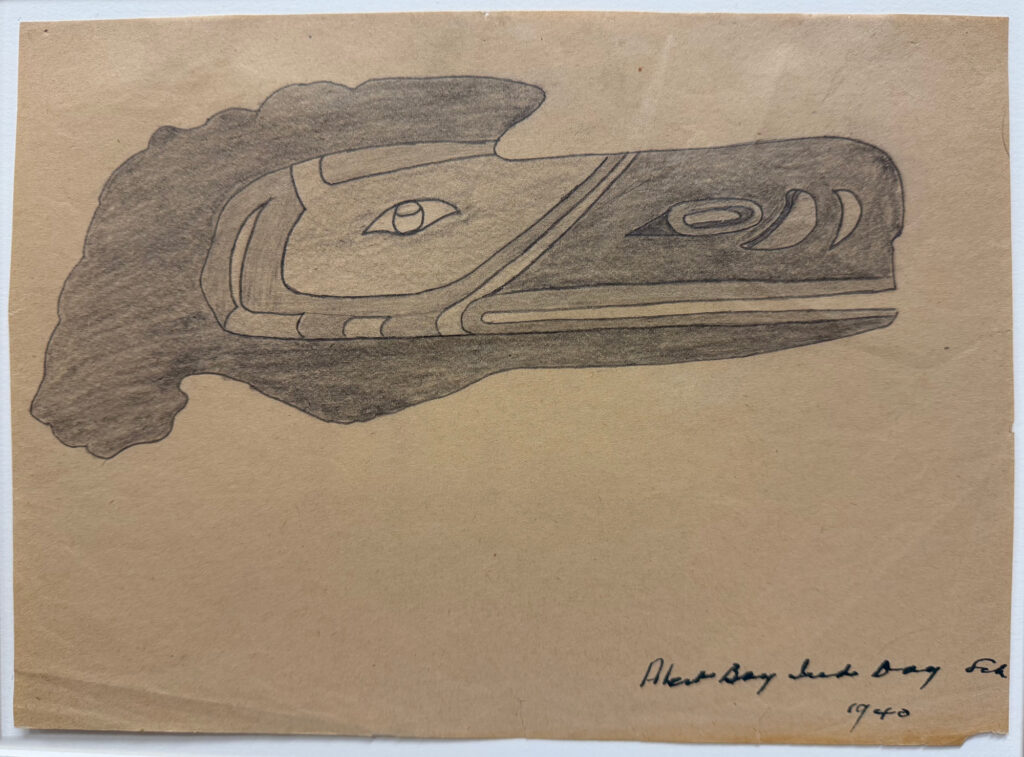
Once-known child artist, untitled drawing, 1940, graphite on paper, on loan from the U’mista Cultural Centre, St. Michael’s Indian Day and Residential School Centre Collection, Alert Bay.
Finally, miýikosiwin is the gift of vision, creativity, and life—a generative force that animates Indigenous making. It is a form of visual knowledge bestowed by the Creator and carried through generations, referring to artistic talent as well as to the creative intelligence found in other disciplines such as medicine, architecture, storytelling, land stewardship, and ceremony. To receive miýikosiwin is to be entrusted with responsibility: creativity must be exercised in a good way, guided by Elders, accountable to community, and grounded in gratitude. Through miýikosiwin, creativity becomes a relational and life-giving act, one that nourishes the world rather than extracting from it. It affirms that creation is not individual expression alone; it is a responsibility carried within networks of relation.
The framework of this book is guided by what Mi’kmaw Elder Albert Marshall called Etuaptmumk, or Two-Eyed Seeing: the practice of holding Indigenous and Western ways of knowing together, in their respective strengths, without allowing either to subsume the other. Elder Marshall developed this concept through his sustained collaboration with researcher Cheryl Bartlett, and it has since been taken up by scholars across disciplines as a way of working responsibly across knowledge systems. For this book, Two-Eyed Seeing, rather than being a metaphor for tolerance or pluralism, names a specific intellectual and ethical commitment. My training in Western art history provides one mode of engagement with the works assembled here, using methods of analysis, contextualization, critical comparison. I turn also to Plains Cree frameworks for the acquisition of insight, which is to inquire through relation, accountability, and living knowledge. These two ways of seeing carry different histories and different responsibilities. What Two-Eyed Seeing makes possible is movement between them without the erasure of either and without the pretense that they are interchangeable. The three Cree concepts discussed here—kanawâpâtahmowin, tâpasinahikêwin, and miýikosiwin—are not offered as Indigenous equivalents of Western art-critical terms. They establish the primary terms of engagement: how to look, how to make truth visible, and how to understand creation as a relational, life-giving act.
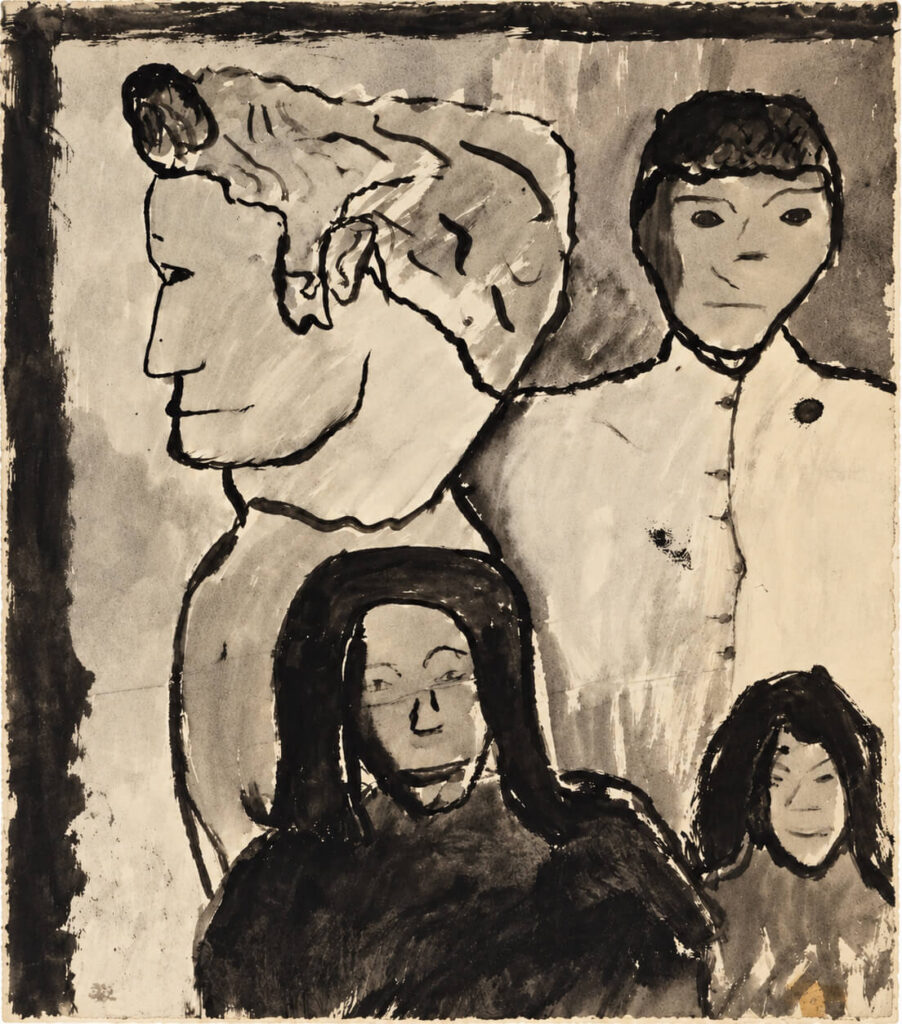
Jim Wastasecoot, Untitled (Family Portrait), n.d.
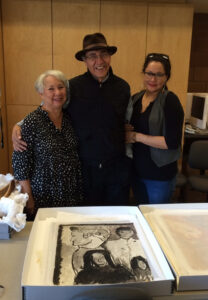
Jim Wastasecoot with a childhood portrait of his family.
Together, these principles function as a paradigm of visual knowledge that shapes how the chapters to come will engage with artworks. They open a way of engaging with Indigenous art as ethical knowledge making, offering one pathway among many. When such frameworks guide our understanding, we move beyond Eurocentric readings that have too often treated Indigenous art as symbolic or illustrative. These teachings invite us to instead recognize Indigenous art as a living archive, a practice of knowing that enacts sovereignty and continuity—what has been called the Indigenous turn. Beyond simply expanding art history, they challenge its foundations, reorienting interpretation toward relation, responsibility, and accountability. This is the heart of the Indigenous turn: art is not representation but relation.
These teachings are not abstract to me; they are lived and practiced. They came into focus most sharply when I encountered my own name in the Glenbow archive, recorded as an administrative trace of violence: the renaming of a child sent to a residential school. That encounter, shaped by my work as an artist, scholar, and curator, demanded careful looking—staying with what the record holds and accepting responsibility for its meanings. Making that history visible required deliberation and accuracy, attending to what was taken as well as what endures. And the moment affirmed my creative life moving forward, propelling the work of research, artmaking, and exhibitions: transforming archival fragments into sites of relation and accountability.
The chapters are organized around an intergenerational continuum of visual knowledge. The book opens with the historical and institutional conditions—the residential and day school systems—under which Indigenous art was both suppressed and persistently made, establishing the stakes of the artworks that follow. From there, it turns to drawings produced by children during the school era: works through which young people used the act of making to carry language, memory, and relation forward under conditions designed to erase them. Subsequent chapters examine the visual practices of Survivors, for whom art became both testimony and a means of working through histories the official record could not hold. The book then moves to contemporary Indigenous artists whose work engages the archives, landscapes, and institutions of the colonial period, transforming them into sites of sovereignty and ongoing truth telling. The final chapter carries this arc to its youngest edge, turning to emerging Indigenous artists for whom the residential and day school era is inherited rather than lived—carried in family, community, silence, and story. Their work demonstrates that the visual knowledge traced throughout this book continues to move forward through new hands, new media, and new forms of relational accountability. The book does not end so much as it opens outward, joining a conversation already unfolding across generations, classrooms, communities, and lands.

Robert Houle, Premises for Self-Rule: Treaty No. 1, 1994, oil on canvas, photo emulsion on canvas, laser cut vinyl, 152.4 x 304.8 cm, Winnipeg Art Gallery
What follows moves from personal encounter and methodological grounding toward a wider field of relations. Indigenous art is an active, living form of knowledge that moves across generations and continues to shape the present. These practices, instead of seeking resolution or closure in the face of residential and day school histories, hold memory in relation, insisting on truth as an ongoing process in holding ourselves accountable. Across painting, drawing, sculpture, installation, and performance, artists carry what has been inherited forward without relinquishing it to the past. In this sense, Indigenous art does not illustrate reconciliation; rather, it creates the conditions for it, asking us to see, remember, and respond differently—responsibilities that extend beyond individual works and resonate throughout the discussions in these pages.