Morrisseau's Travels
From Anishinaabe Aki to Tkoronto

The Names of Norval Morrisseau
by Alan Corbiere

Anishinaabe Giikendosowin Babaamaajimo – Anishinaabe Stories Travel Around
by Patricia D. McGuire
Biography of Morrisseau’s Life
by Carmen Robertson

Morrisseau’s Recruits: Joseph and Esther Weinstein and Selwyn Dewdney
by Ruth B. Phillips

Norval Morrisseau: A Reminiscence
by Richard Baker
Anishinaabe Giikendosowin Babaamaajimo – Anishinaabe Stories Travel Around
by Patricia D. McGuire
Bouzhoo! Bouzhoo! Kiishebakabaykwe dichinikaz. Makwa dodem. Gi’odapininigo gaye Bizhiw chi-odoodemiyan. Anishinaabe shooniyaa ojimau gii onakonige, Chitibetagoziyan ima Bingwi Neyaashi Anishinaabek. Mamaabun Gii-onji Bingwi Neyaashi Anishinaabek. Babaabun gii-onji Ginoozhe Minis. Odingwemaganan Kiashke Zaaging Anishinabek onjiwak.
Greetings. This is my Anishinaabe name, Kiishebakabaykwe. I am from the Bear clan and was adopted into the Lynx clan. The literal translation of this in Anishinaabemowin is the boss of the Indian Act, who had the authority to add me as a status Indian to Sandpoint Indian reservation. My mother was from Sandpoint. My father was from Jackfish Island, and we have family connections at Gull Bay.
Mamaabun, Babaabun ki-wiijigindiwag Norval Morrisseau’s nookomis, mishoomis. Norval Morrisseauabun nookomis, mishoomis giikendsowinan, gitchi-ayaag giwiindamaagewag onoozhisheziwan.
My mother and father were close in age to Norval Morrisseau’s grandmother and grandfather. Norval Morrisseau’s grandmother, grandfather transferred ancestral Anishinaabemowin knowledge(s) to him, their grandson.
Miiwe gii Anishinaabemowin ey-ishiwaabandaman. Mamaabun, Babaabun giikendsowinini gitchii-ayaag giwiindamaagoog aadisookewinan.
This is part of an Anishinaabe worldview. My mother and father transferred ancestral Anishinaabe knowledge(s), stories to their children, including me.
Aadizookaazo abinoojii Animbiigoo Zaaga’igan. Awe gwillwizens mitigooni ogii-mazinibii’ige bingwii-kaang. Gikikenendaagozi enita mazinibii’igwech Gwiiwizens awe Bingwii Nayaashii Anishinaabe. Asini-mazinibiiganan ki ishinagonoon omazinibiiganan. Mamaabun ki-ikido Norval Morrisseau awe gwiiwizens.
I was taught a story of a young child by the shoreline of Lake Nipigon. This boy by himself was drawing with a stick in the sand. This boy was known in the community for drawing in the sandy shore by Bingwii Nayaashii Anishinaabe. His pictures looked like those pictures painted on rocks. Mamaabun says this young boy was Norval Morrisseau.
Gichi-ayaa kikendamowin gaa-gii pimiwitooch Norval Morrisseau. Gii Anishinaabe maskakiiwinini. Ogii pimiwiitoon awe Norval Morrisseau Mino Bimaadizewinini. Gii Anishinaabemo, gi-dibaajimo kaye, minwaajimo, ayadizookeg aadizookewinan. Dadibaajimoowinini awe Norval. Gii nita anishinaabemo kaye aadisookewinon. Chi gikendamang chi badakigaabawiyang, geget gitchi ayaa, Norval.
This man was well known as a carrier of Anishinaabe knowledge(s), as a traditional healer with medicine pictures. Norval Morrisseau said this led to a good life—that is, living with good values and practising being a good human being. He spoke the language and knew good stories. He knew ancient stories and was a storyteller. He had knowledges helping one stand tall while being grounded in culture, who you are as Anishinaabe.
I offer my respect to Norval Morrisseau for his spirit and the work he accomplished despite all the challenges life offered to him. Life for the Anishinaabe in Canada has been and still is difficult. Our social location in our homelands presents significant challenges, yet we continue. Norval Morrisseau was a controversial Anishinaabeinini. He was contradictory. He was the first artist to achieve great exposure and success for his work. This happened at a time when Anishinaabe were wilfully dispossessed of their land and cultural lives.
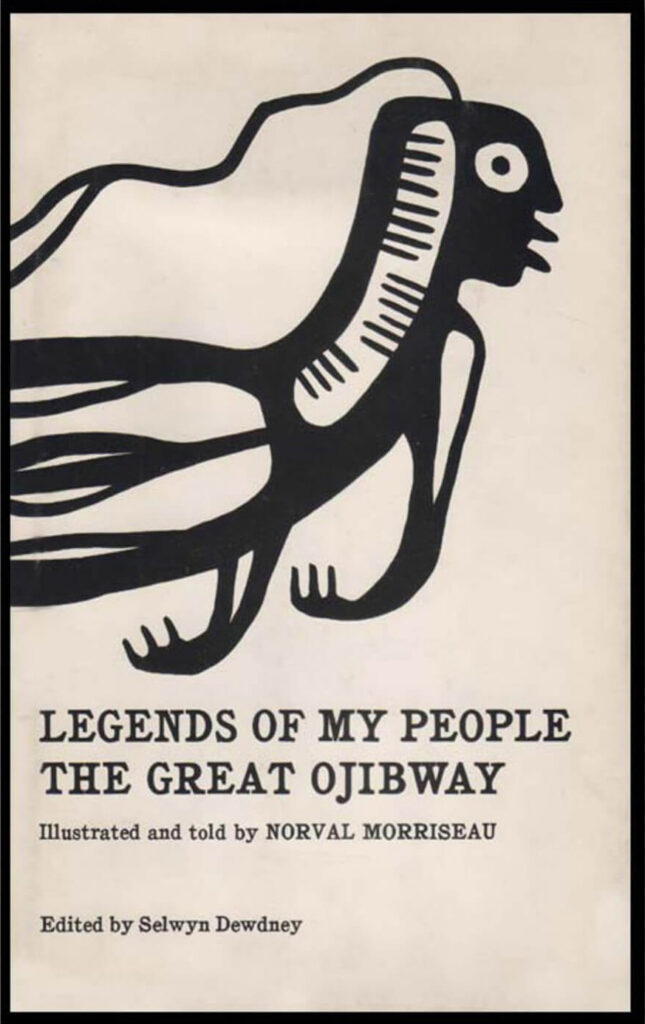
Cover of Legends of My People, the Great Ojibway, by Norval Morrisseau (1965).
I do not have the stories others have of him. To me, he was my parents’ friend, a relative who dropped by once in a while. His book Legends of My People, the Great Ojibway (1965) informs my life to the current day. It continues to offer a lens of continuity for Anishinaabe knowledge(s). I remain committed to learning to speak my ancestral language, Anishinaabemowin. I want to be able discern our stories within our cultural context. I offer this first effort in grounding my language in my written work.
The land stories of Lake Nipigon offer culturally mediated meanings and understandings about place and identity as Anishinaabe. The relationships we maintain, such as the 1850 Robinson-Superior Treaty, are based on these understandings. These stories offer different understandings. Yet these stories offer pride, inspiration, and dignity to our ancestors, who considered, planned, negotiated, and established futures for us, today. Strength, knowledge, and respect interweave and continue in these words. This ensures we are prepared to meet our responsibilities to our future generations.
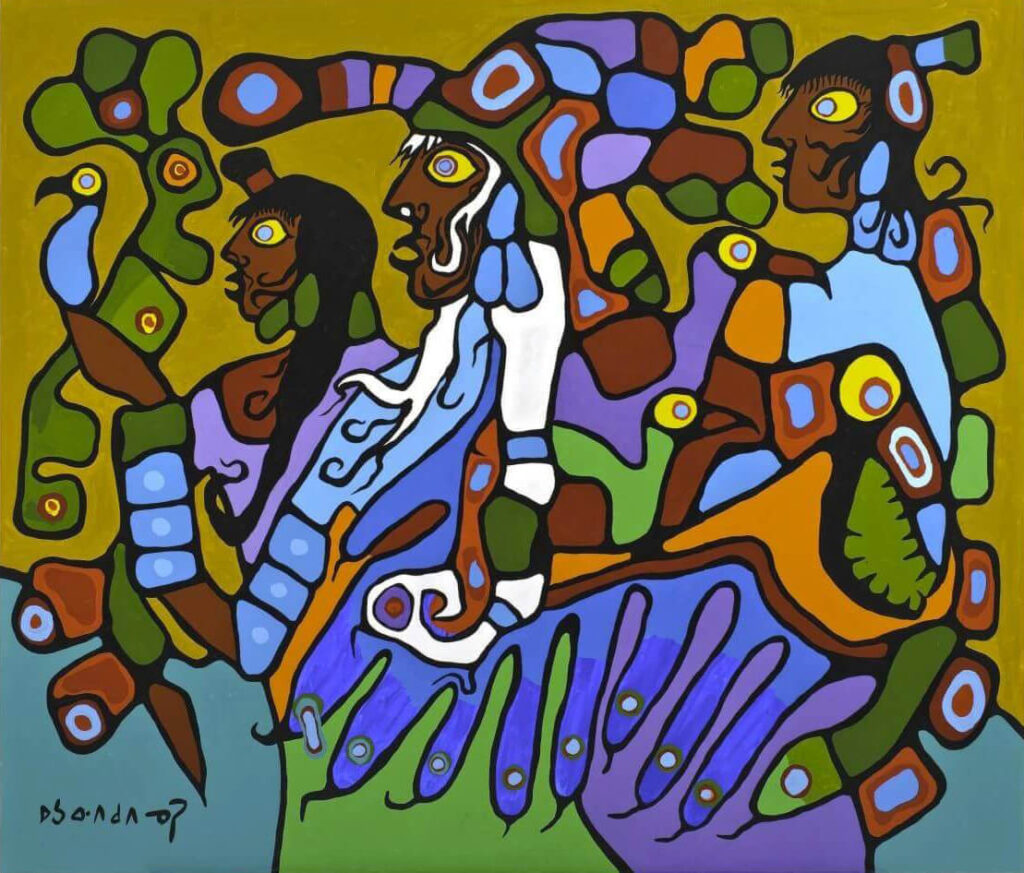
I have a painting by Morrisseau. I purchased it from Norval in the early 2000s. He came to visit his children in Thunder Bay, Ontario. With his sons Christian and Eugene, he hosted an art sale of some of his paintings at Victoriaville mall in Thunder Bay. It was apparent he had advanced Parkinson’s disease. We visited, and I told him who my parents were. I asked about his shaking hands. He replied, haltingly, barely understandable, that his painting days were short, maybe twenty minutes. No longer was he able to paint for days. I purchased an undated painting entitled Young Man Warrior. The painting has a number 5 circled on the back, with a black thumbprint and 12 by 16 inches (which is the size of the painting). It has some of the white canvas showing when you put it in the light, and the border is not smooth like other works I have seen from him. It is not perfect. It reminded me of my mother, Mamaabun, telling me a story of Potan’s grandson Norval as a young boy, practising drawing pictures in the sand on the Sandpoint reserve.
Norval Morrisseau, Young Man Warrior, n.d., acrylic on canvas, 30.5 x 40.6 cm, Collection of Patricia McGuire, Bingwi Neyaashi Anishinaabek.