Morrisseau's Travels
From Anishinaabe Aki to Tkoronto

The Names of Norval Morrisseau
by Alan Corbiere

Anishinaabe Giikendosowin Babaamaajimo – Anishinaabe Stories Travel Around
by Patricia D. McGuire
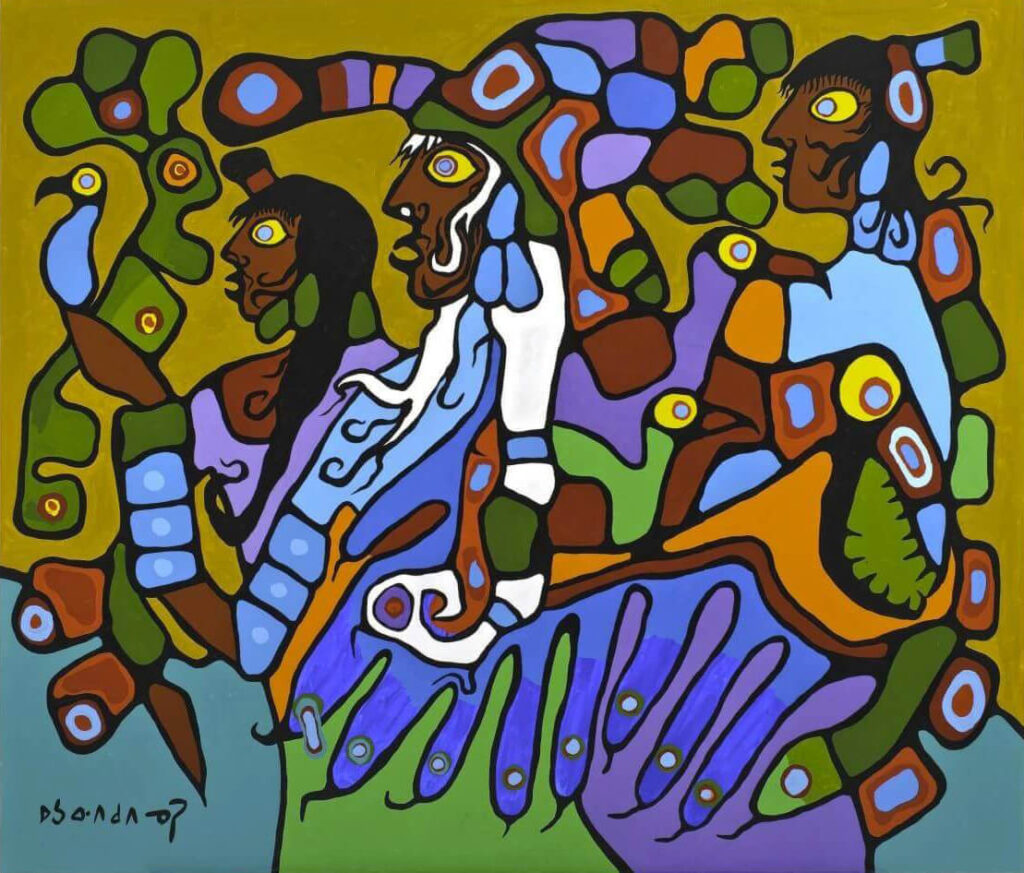
Biography of Morrisseau’s Life
by Carmen Robertson

Morrisseau’s Recruits: Joseph and Esther Weinstein and Selwyn Dewdney
by Ruth B. Phillips

Norval Morrisseau: A Reminiscence
by Richard Baker
Norval Morrisseau: A Reminiscence
by Richard Baker
Very few people encountered in the course of life endure to become permanent fixtures in one’s mind. Such a person, whom I met when I was a young lawyer starting out in 1975, was a man who became my client for the next seven years. He was Norval Morrisseau.
This reflection on his enormous accomplishments and remarkable career comes almost twenty years after his death and fifty years after the beginning of my collaboration with him. It consists of some little-known facts and personal impressions offered as a modest addition to the already extensive accounts of Morrisseau’s life.
There is a vast gap today between the portrait of Morrisseau as a quasi-mystical artistic giant—the unassailable repository of his people’s culture and beliefs—and the kind of recognition he received from the artistic establishment in the early 1970s, a period characterized by widespread ignorance of and indifference to Indigenous art. Though Morrisseau was used to being regarded with the wonderment that his art instilled, the larger-than-life qualities attributed to him were only a small part of his public persona, or of the news coverage he received. Far more attention was paid to his often troubled life.
* * *
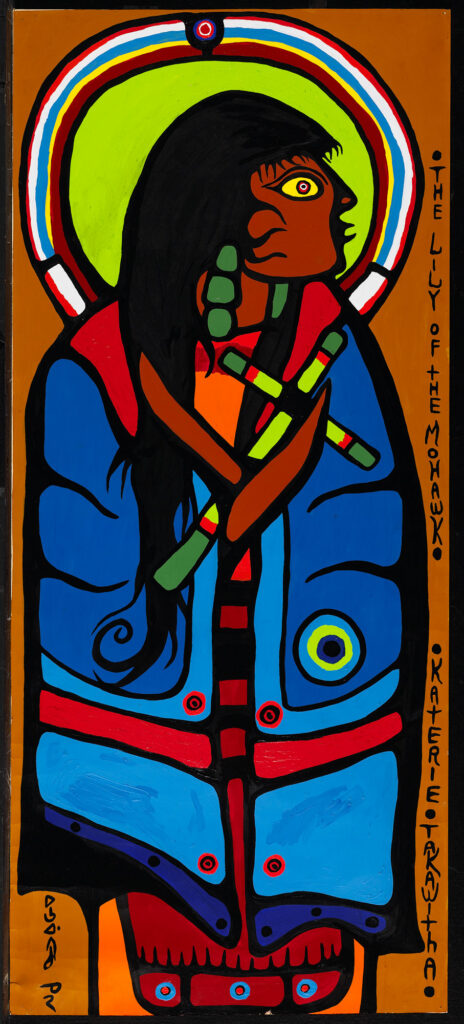
Norval Morrisseau, Lily of the Mohawks, 1974, acrylic on paper, 136 x 59 cm, National Gallery of Canada, Ottawa.

Norval Morrisseau, Indian Jesus Christ, 1974, acrylic on paper, 134.6 x 68.5 cm, Aboriginal Affairs and Northern Development Canada, Gatineau.
I was never formally introduced to Morrisseau. I first laid eyes on him in a witness box, in March 1974, at a trial in the Kenora District courthouse. I was cross-examining him in a case involving Jack Pollock, a client of the Toronto law firm where I was working as an associate. Pollock was by then a well-known and established Toronto gallery owner who had been instrumental in the 1962 exhibition that launched Morrisseau into the spotlight. But a decade later, he was charged with theft after he took some works Morrisseau had painted in the Kenora jailhouse to Toronto. This was during one of Morrisseau’s brief stints of incarceration following an episode of public drunkenness to which he was, at that time of life, frequently prone. Among the works that resulted in the theft charges against Pollock were Lily of the Mohawks and Indian Jesus Christ, both from 1974. These graced the courtroom for the duration of the trial—perhaps the most beautiful exhibits ever tendered in a Canadian court of law.
After a three-day trial, Pollock was acquitted and even lauded by Judge L.A. McLennan, who, in his reasons, touched upon the turmoil in Morrisseau’s life and revealed his own deep awareness of his talent and potential:
[T]he trial may have done some good by focusing public attention on the serious and tragic social problem involving the life and potential of Norval Morrisseau. Anyone who heard this man give evidence and read the letters filed as exhibits would have to feel that this is an extraordinary man capable of deep sincerity and powerful expression. Indeed you [Pollock] while in the witness box eloquently described him as a great Canadian artist bordering on genius and you stated, and with your experience I think it was a professional statement, that he has a potential as a great International artist.
As the trial came to an end, Morrisseau emerged from the back of the court and embraced Pollock, whereupon he and I were invited to the artist’s nearby dwelling, where he gave Pollock a number of paper works to take to his gallery in Toronto to sell. The trial had not impaired their long-established relationship. A year later, in early 1975, Pollock suggested to Morrisseau that he would benefit by having me help structure his business affairs and protect his interests generally. Morrisseau agreed and took me on, both of us perhaps feeling a bit chary about what lay ahead. What lay ahead for me, in fact, was a unique chance to act for an artist of profound sensibility and imaginative vision, entering the most brilliant period of his artistic life.
* * *
For the next seven years, and particularly between 1975 and 1978, Morrisseau’s interests often conflicted with those of the individuals, institutions, and businesses interested in acquiring or benefiting from his art. As I came to know Morrisseau more closely, I was better able to anticipate his attitudes and reactions to these stresses. We communicated primarily by letter and telephone, with some meetings in my office and several visits to cities outside Toronto, depending upon his whereabouts.
I was quickly taken up with the everyday practicalities of the work he generated. I did not pretend to “understand” his art, or its “meaning,” or his inspiration for it, but I always felt an element of genius present in his paintings, and I sensed in them a unique force that was rare in any art I had seen, at any time. I felt this from the beginning, when I was first shown some of his paintings while preparing for the Kenora trial.
Judge McLennan’s prediction about the trajectory of his career proved correct as Morrisseau became recognized and celebrated both in Canada and abroad. Unfortunately, at the peak of his artistic power and physical strength, he was also capable of devastating episodes of alcoholic excess, during which his painting would often stop and his life would devolve into chaos, making things extremely difficult for those close to him. In 1975, he became estranged from his wife, Harriet Kakegamic, and was separated from his many children, and in the years that followed, he generally kept to himself or lived with male companions or helpers. He and Harriet eventually divorced in January 1977.
A tall man, he had a commanding presence that drew all attention to him the moment he entered a room. He was inherently reserved, but also magnetic, brooding, able to extemporize with long lines of folklore or to philosophize as the mood, the audience, or the occasion demanded. Never one to take himself too seriously, he once wryly described indulging in flights of rhetoric for the benefit of the “blue rinse ladies” who lapped it up and bought his art. Socially he could be shy and reticent, and he was disinclined to make small talk. He was polite and had innate good manners, never giving offence in public situations unless drunk. He was articulate, with a gentle, deep voice, distinctly accented by what I assume to have been the intonations of his Ojibwe language. He was conversant with the Bible and biblical characters and much given to invoking and describing the myths and cosmology of his native culture. He accepted his artistic gift and was comfortable with the celebrity it had brought him.
He trusted few people but nonetheless gravitated in the later years of my watch to forming fleeting relationships with a number of young men whose companionship and professed business skills made them, from Morrisseau’s point of view, useful adjuncts in his relentless need for cash flow—often through spontaneous sales of his art in random and short-lived markets. When he was drunk, he was easily taken advantage of, encouraging those eager to acquire his paintings to value them more by their relation to the price of a bottle than their intrinsic worth. Northern Ontario was then, and remains, the repository of untold numbers of his paintings, most of which will likely never come to light.
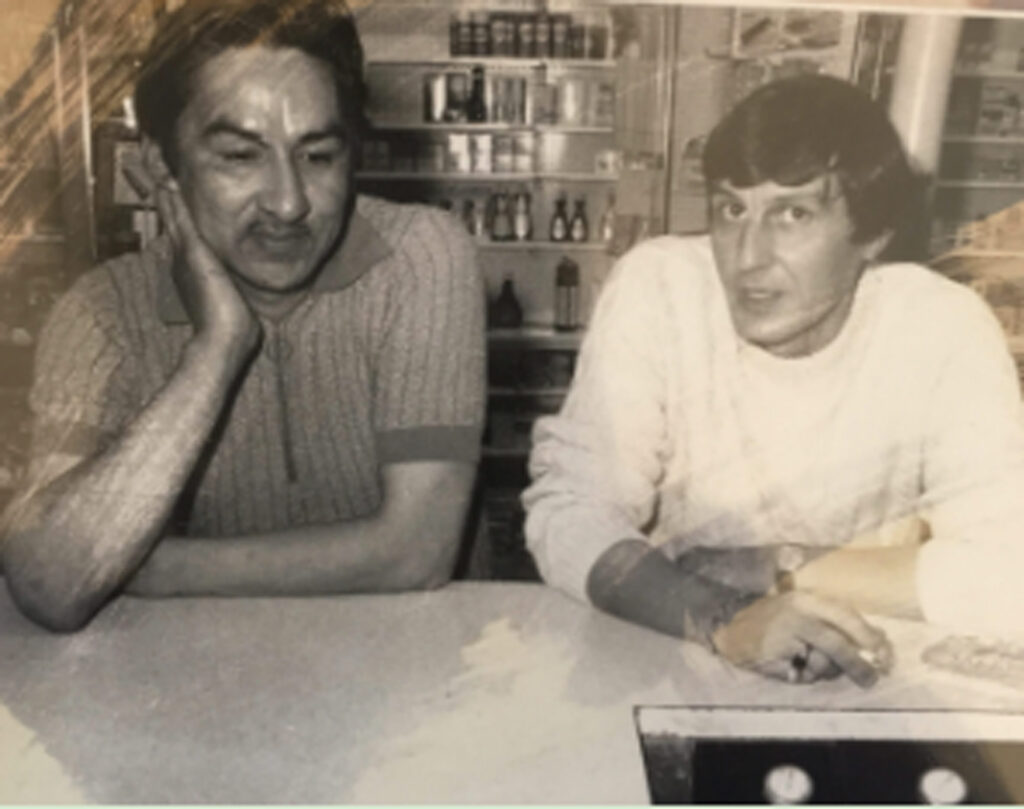
Norval Morrisseau with Jack Pollock, 1978, photographer unknown.
Of the many gallery owners and dealers who dealt with him from 1962 until his move to the West Coast in the 1980s, his biggest champion and most enduring representative was Jack Pollock (1930–1992). Despite his own complexities, he had the deepest understanding of Morrisseau’s art and genius, and of its inherent significance. As far as I was aware, no other person, then or since, came close to Pollock’s intuitive appreciation of Morrisseau’s gifts and uniqueness. Some of his greatest works and inspirations derived from conversations he and Pollock had about the evolution of his artistic style and its thematic content. Man Changing into Thunderbird, 1977, is an example of that symbiosis. But the two men also had a love-hate relationship: a mutual respect for their shared artistic instincts and sensibilities, undermined by the resentment that each felt for the other, usually the result of slow payment by the gallery for art sold, matched by unreliable delivery of finished paintings to the gallery by the artist.
Being Morrisseau’s lawyer in those years gave me deep insight into the modus operandi and pathology of the Canadian art industry. The first three years of my involvement with him coincided with a period of great artistic energy and output, matched by a growing outside curiosity about his work. There was an aura about him that was never quite as strongly felt again. It was fuelled by a series of five very successful exhibitions held consecutively between 1975 and 1978—three in the Pollock Gallery in Toronto, one in the Shayne Gallery in Montreal, and one in Winnipeg’s Gallery 115. Each exhibition built upon the excitement of the previous one, resulting in ever-widening acclaim. Seizing upon Morrisseau’s magnetism and charisma, the press was more than ready to report on his story and his work.

Shayne Gallery Exhibiton Card for Norval Morrisseau Exhibition, 1975.
With this new-found acclaim, it became possible for the first time to maintain a fixed address for him, which in turn made it easier for galleries and publishers to obtain permissions and copyright licences to reproduce his art in books, magazines, cards, posters, and other media. Requests from international art galleries and museums—for solo shows or the inclusion of single works in wider exhibitions—became more frequent.
Negotiating gallery contracts for shows or consignment sales in Toronto, Ottawa, Montreal, and beyond was a major part of my responsibilities. For a while, I set the prices for his paintings, relying upon an acquired familiarity with his market. At the time, his works fetched prices ranging from the hundreds to several thousands of dollars. To eliminate the feast-or-famine nature of his finances, and to encourage him to live within his means, I opened a bank account for him. It became the repository of a large part of his income derived from galleries, royalties, institutions, and collectors.
Given the value of his paintings and their market appeal, there inevitably arose disputes and even some litigation as people tried to acquire his works for inadequate compensation. Like all artists, then and now, he got into more conflicts over prices and payment than any other issue.
In those years, Morrisseau had a propensity to move around from place to place. When not in Toronto for exhibitions, he spent most of his time in Beardmore, Thunder Bay, and Winnipeg. When he was living in Winnipeg for some years, my law office became a small collection and distribution centre for his paintings. This led to a more efficient method of dealing with galleries that wished to hold exhibitions, and it lessened the risk of works being unavailable at the crucial time. Some of his finest paintings passed through the office, to the surprise and great curiosity of those who caught a glimpse of the odd masterpiece leaning against a wall or sticking out of a closet.
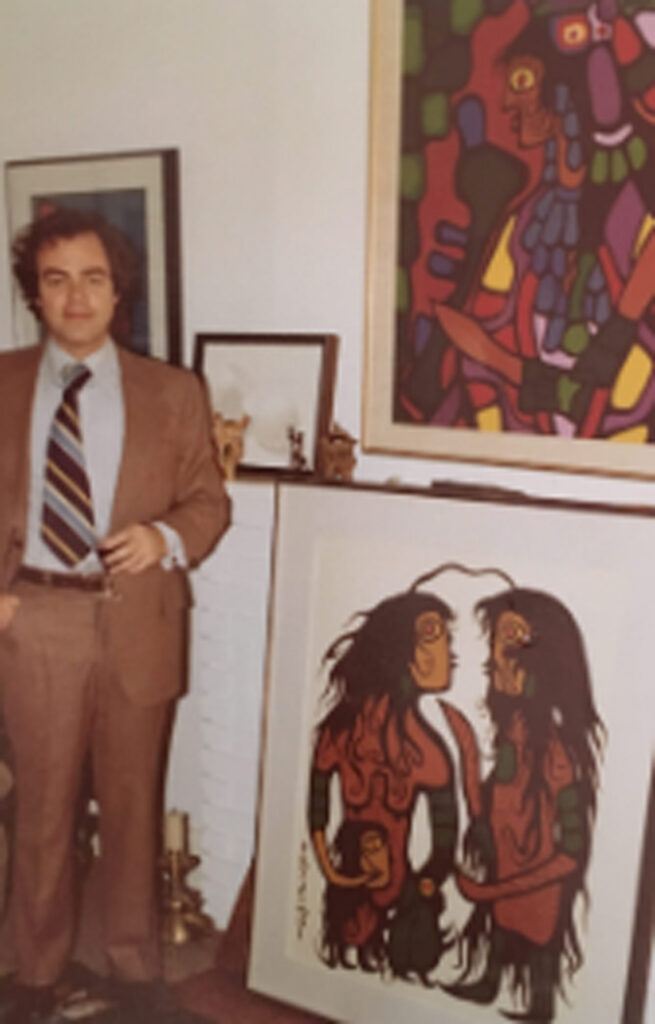
Richard H. Baker at Pollock Gallery, Toronto, standing next to Untitled (Mamagwesiwuk / Hippie Family), c.1975, photographer unknown, Art Gallery of Ontario Archives.
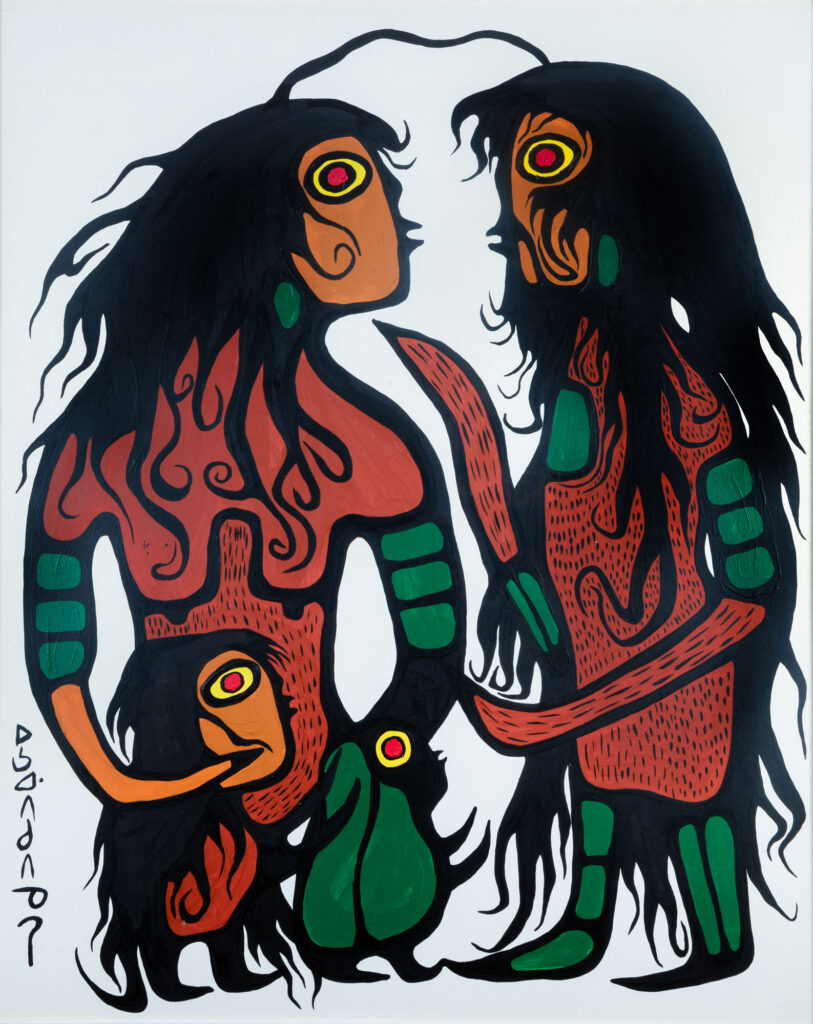
Norval Morrisseau, Untitled (Mamagwesiwuk / Hippie Family), 1974, acrylic on canvas board, 101.6 cm x 81.3 cm, private collection.
We met quite frequently, especially in the first three years, which afforded me opportunities to observe Norval at work. The process was pure, unrehearsed, instinctive creation: from mind and eye to paint and brush, and then directly to paper or canvas, without the slightest hesitation or reworking of form or imagery. In retrospect, it reminds me of the film Amadeus (1984), where the anguished Salieri describes Mozart’s ability to set down his music on paper, without amendment, as if it came straight from God to the page.
On one occasion in 1975, while staying in my apartment, Morrisseau started to draw in the evening, with a pen and black ink on a white board, sitting on the couch. He was still there when I woke up the next morning, but by that time, he had a fully completed drawing, known today as Obsessions. He gave it to me as a gift, and it hangs on the wall beside me to this day. His pen never hesitated, and he never spilled a drop of ink. It was just, simply, done.
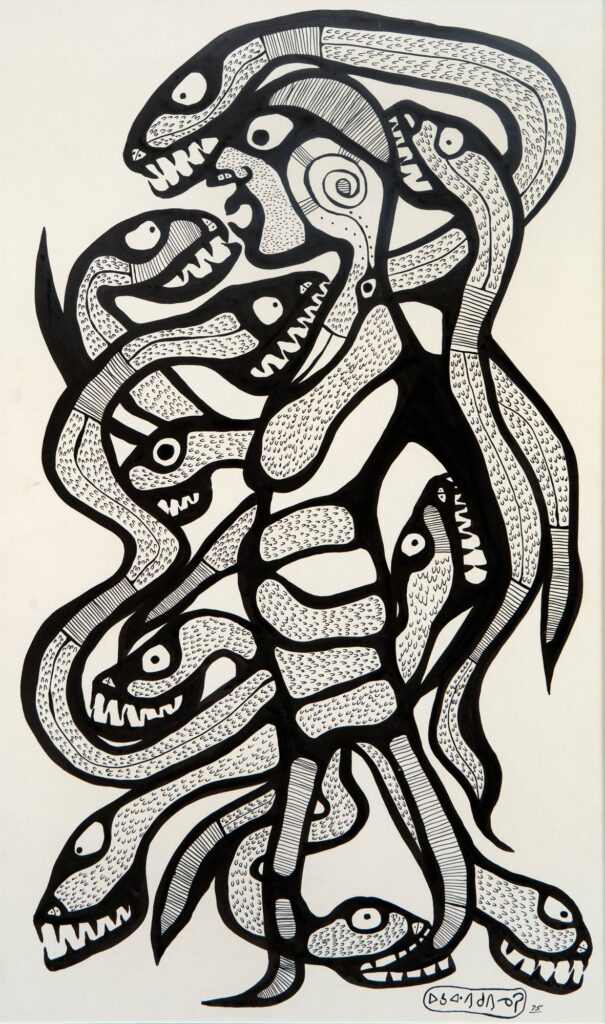
Norval Morrisseau, Obsessions, 1975, ink on card, 101.6 x 81.28 cm, private collection.
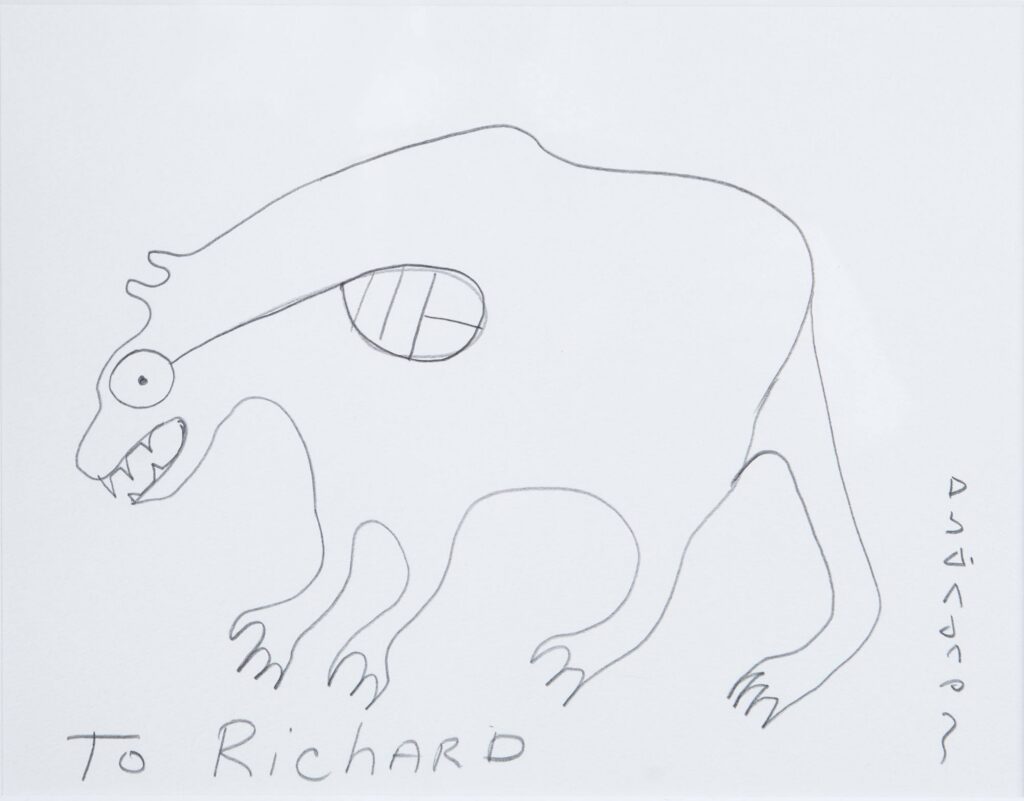
Norval Morrisseau, Untitled (Drawing for Richard Baker from Tea Party), 1978, pencil on paper, private collection.
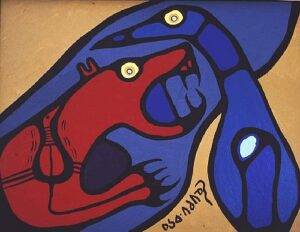
Norval Morrisseau, Sacred Mide Bear and Loon Totem, c.1975, acrylic on canvas, 76.5 x 101.5 cm, McMichael Canadian Art Collection, Kleinburg.
The later 1970s was also the period when his finest serigraphs and limited-edition prints were produced. They seem to have had a short production lifespan, however, as few, if any, prints were made after the 1980s. Morrisseau signed these professional serigraphs in pencil with his longhand signature in English and no Cree syllabics appearing at all. The number of each print was indicated as numerator and the size of the edition as denominator: for example, 3/56 meant it was the third print of fifty-six. In my personal view, the most professional and striking prints of that time came from Winnipeg’s Great Grasslands Graphics, owned and operated by Robert Checkwitch. These usually were impressed with a company seal and sometimes displayed a small green butterfly mark in the margin. There were other high-quality prints as well from the Triple K Cooperative, in Red Lake, Ontario, a venture of the Kakegamic family, to which Morrisseau was related by marriage.
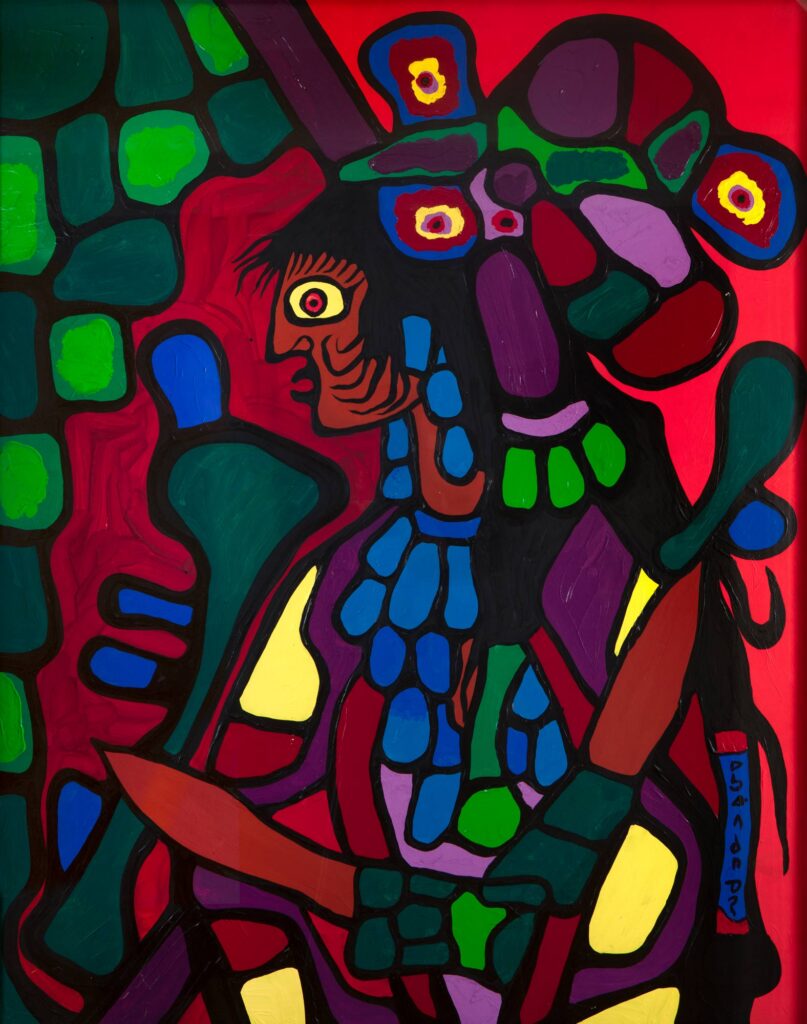
Norval Morrisseau, Great Mother Earth, 1976, acrylic on canvas board, 101.6 x 81.28 cm, private collection.
The growing commercial appeal of his imagery led to widespread reproduction of his art and often to its incongruous appearance in unexpected places, such as a reproduction of Great Mother Earth, 1976, on an office wall in an early scene of Stanley Kubrick’s film The Shining (1980).
Over time, I gained a sense of his artistic output and capacity. He did not paint while under the influence, for periods that could often last weeks. Otherwise, when motivated, he could paint quickly and was able to produce several works each week. The number painted in any given time would depend on their size. A large painting could take several days, a smaller one a few hours. I was not aware of assistants painting background colour on canvases for him, although that may have been the case in later decades. The exhibitions in Toronto, Montreal, and Winnipeg typically showed only about two dozen paintings at a time. Given his rather irregular lifestyle, it was often difficult for galleries to ensure delivery of works in time for openings. This uncertainty only added to Norval’s mystique—and to the grey hairs of the gallerists.
I remember two notable occasions that, in retrospect, were regrettable missed opportunities. Both involved works specifically commissioned from Morrisseau: the first was a painting intended for a 1975 cover of the Canadian edition of Time magazine, to accompany a story about Indian land claims (as they were then described), and the second was a large maquette for an even larger wall mural commissioned by Toronto for the main entrance of New City Hall. In both cases, he fulfilled these commissions by producing pieces that now (and even then) rank among his most significant and enduring works, The Land (Land Rights), 1976, and The Great Flood, 1975. In both cases, his proposed commissions were rejected—by Time because it decided that Henry Kissinger was more newsworthy for the cover, and by the City of Toronto because some jury deemed a sculpture of concentric nails to be more desirable.
Norval Morrisseau, The Land (Land Rights), 1976, acrylic on canvas, 122 x 96.7 cm, McMichael Canadian Art Collection, Kleinburg.
At least Time Canada had the generosity to return the painting to Morrisseau, pay his commission fee, and run, in the very issue in question, a two-page spread on his art and burgeoning fame. The Great Flood was later completed by Norval at full size (9 x 2.4 metres) and acquired by a private collector, and both works later appeared in books and other publications.
* * *
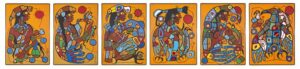
Norval Morrisseau, Man Changing into Thunderbird,1977, acrylic on canvas, six panels: each panel 153.5 x 125.7 cm, private collection, on loan to the Art Gallery of Ontario, Toronto.
In August 1977, the Pollock Gallery held an exhibition that, for the first time, displayed one of Morrisseau’s greatest achievements: six large canvas panels depicting a transformation that gave the work its title, Man Changing into Thunderbird. Four of the panels had been painted in Winnipeg and were shipped directly to the gallery in finished form. The last two were painted by Morrisseau in his room at Toronto’s Sheraton Hotel on Queen Street, a day or two before the opening. I was at the gallery when the paintings arrived and can clearly picture Morrisseau crouched beneath the last two panels, signing off on them with his Cree syllabics signature. What struck me as utterly remarkable was that in executing a work of six large canvases—requiring a subtle, fluid progression of image, theme, and complexity—he was able to complete the last two panels without visual reference to the preceding four. He finished this masterpiece, under severe time constraint, relying entirely on the strength of his imagination and memory.
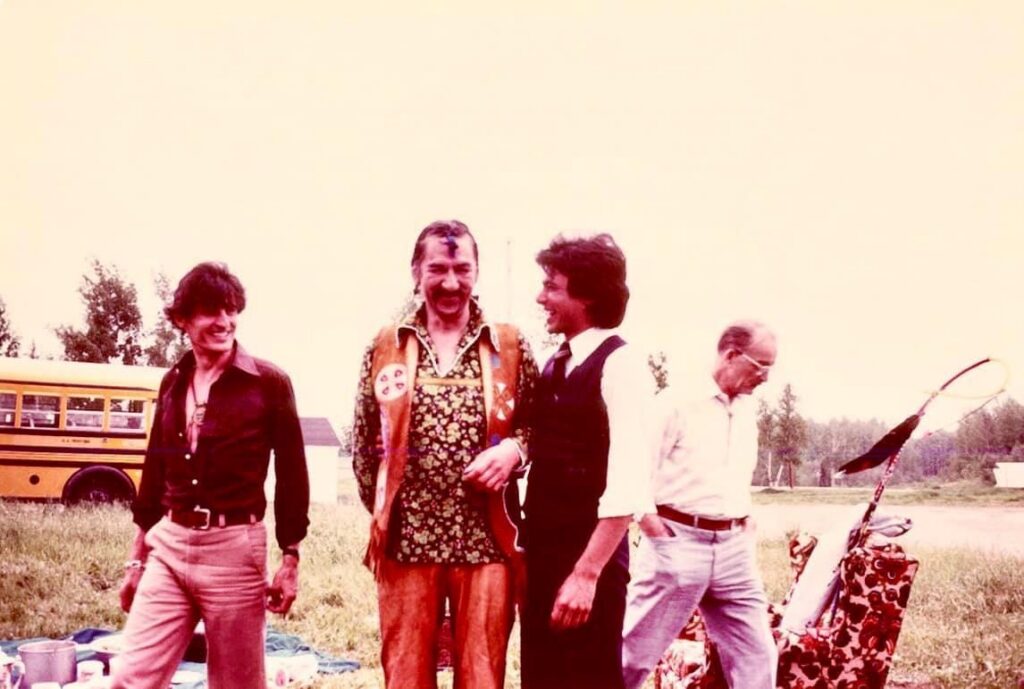
Documentation of Norval Morrisseau’s tea party held in Beardmore, ON, 1978.
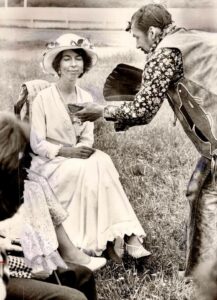
Documentation of Norval Morrisseau’s tea party held in Beardmore, ON, 1978.
The 1970s coincided with a particularly vibrant and energetic period of the Toronto art scene, and there was a quality of flamboyance evident in that world, which was blessed with a wealth of new and highly gifted artists in all genres. Morrisseau, who was by then well established, was capable of attracting print, media, and audience attention as a matter of course. With their shared unerring instinct for theatricality, he and Pollock staged what was probably one of the most unusual events in the history of Canadian art. On June 25, 1978, Morrisseau invited a collection of Toronto aficionados to fly up to his home north of Thunder Bay in a rickety 1930s DC-3 aircraft for what was billed as the Beardmore Royal Garden Party. Once there, they were received by Morrisseau and his assistant, Brian Marion, with bannock and tea, served in a Royal Doulton set acquired for the occasion, followed by a smoke-purification ritual delivered unselfconsciously, despite its trace of irony and send-up, in an unforgettable demonstration of cultural pride and self-assurance. The whole event underscored the remarkable ascendance of Morrisseau as the dean of a uniquely original form of Indigenous artistic expression.
Morrisseau’s cultural and political ascension into the Canadian pantheon culminated in December 1978 with his appointment as a Member of the Order of Canada. Sometime thereafter, he misplaced or lost the medal, becoming possibly the only recipient of the honour ever to have had a replacement minted specially for him.
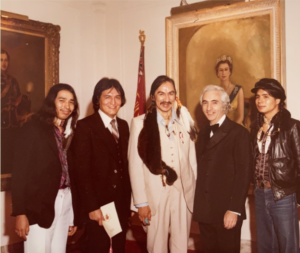
Norval Morrisseau receiving the Order of Canada, 1978, photographer unknown.
* * *
Somewhere, for me, in the entirety of the memories to which this reminiscence has given rise lies Morrisseau’s character and personality. He was unlike any man I have ever known, then or since. He was invariably the focus of attention, always at centre stage; the artistic genius; the prolific and spontaneous creator of wondrous imagery; the acknowledged founder of the Woodland School of Art; the darling of a fawning art world; the easily duped and sometimes indifferent target of covetous gallerists and collectors; the conflicted husband and father; the generous spendthrift; the troubled soul who so often sought release from his demons through drink—but he was always, even in his darkest moments, the towering and enduring inspiration for countless artists and followers among his people. Through it all he persisted and successfully integrated these disparate aspects of his personality into a largely functional whole—one that acknowledged not only his fundamental gifts, nature, and character, but also the roles with which he clearly identified, with pride: a shaman, a spiritual being, a teacher of the Ojibwe.
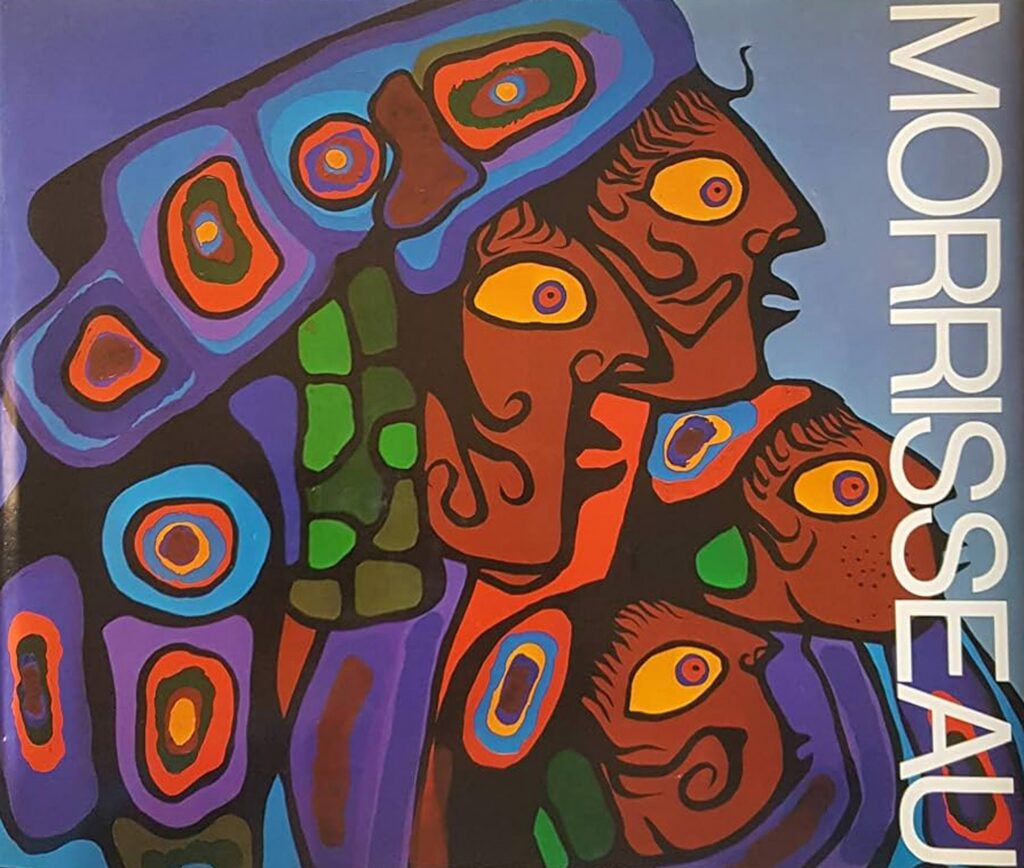
Cover of The Art of Norval Morrisseau, by Jack Pollock and Lister Sinclair (Methuen, 1979).
The recollection of Morrisseau’s distinctive and spellbinding way of speaking has never faded. There are many videos that capture his voice, but it can also be found in the syntax and mode of expression in “My Name Is Norval Morrisseau...” his contribution to the 1979 book The Art of Norval Morrisseau, edited by Jack Pollock and Lister Sinclair. I can still “hear” him in the words of that essay, as if he were talking to me. As immeasurably complex as Morrisseau was—and as possessed of undeniable confidence and self-assurance—I cannot read it and believe him to have been influenced by ideology or political dogma or self-aggrandizement. He was too honest and too modest for that.
* * *
After 1980, Morrisseau had a less frequent impact on my practice, and he started dealing with collaborators and individuals farther afield. My retainer ended in 1982, when he moved away from Toronto. He continued to work for twenty-five years, settling in British Columbia in what was a very different chapter of his life, and even of his art. While my day-to-day contacts with him ended, a friendship and trust remained between us. I continued to hear from him intermittently until his last years, when the irruption of forgeries across Canada and around the world cast a shadow over the integrity of his art. Weakened by illness, he was nonetheless able to take the initiative to protect his legacy by persuading a group of informed Canadians to join together to establish the Norval Morrisseau Heritage Society in 2005. From those persons, and their efforts, eventually came the inspiration to publish this present work.
I leave the last words of this reminiscence to the two men whose distinct but complementary qualities—namely, Morrisseau’s own imagination and genius, and Pollock’s intuitive understanding of their significance and possibilities—were essential to the dazzling trajectory of the artist’s career.
They both kindly agreed to sign my copy of The Art of Norval Morrisseau. Wrote Pollock: “To Richard, who perhaps more than most, realizes the love, pain, and great great joy culminating in this very special book. Love always, Jack.” Wrote Morrisseau, with small accompanying illustrations: “Short Legend, One day, long ago, a frog and a turtle where sitting upon an old floating log. The Turtle said to the frog. I see rain coming. Turtle jumps into the water and said I am not getting wet an[d] the frog jump in into the water—both got wet. Norval.”
Both men were endowed with intensity of feeling and capacity for joy; both were equally capable of dry wit and whimsy. From the range and reach of their imaginations and intellects, which defined their natures, there emerged, in a span of less than two decades, that artistic miracle of unparalleled power and beauty: the art of Norval Morrisseau.
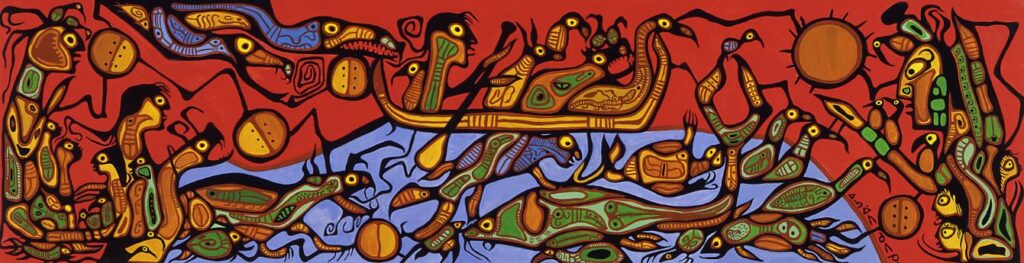
Norval Morrisseau, The Great Flood (Design for City Hall Mural Competition), 1976, acrylic on paper board, 114 cm x 30.6 cm, Market Gallery, Toronto.