Responses and Legacies


“Busting in the Gallery Door”:
Artists’ Homages to Morrisseau
by Ruth B. Phillips
The people before me had kind of busted in the gallery door, and there I was, the “pioneer” walking into the fort.
—Rebecca Belmore
By the early 1960s, when Norval Morrisseau erupted so dramatically into the Toronto art world, Canadians had developed a strong appetite for the new stone sculptures and prints coming out of the Arctic. Their enthusiasm was fuelled by the modernist taste for what was then considered ‘primitive art and a young nation’s desire to establish its distinctive cultural identity. The country was ready for an artist to emerge from the northern woodlands bearing gifts of “truly Canadian” ancient iconography and shamanistic wisdom. In other words, if Morrisseau had not arrived on the scene, he would have had to be invented.
But he did arrive, and the example of his artistic success was compelling both because of the innovative brilliance of his work and its timeliness. His re-creation of Anishinaabe traditions in a modern Western fine art format drew the attention of collectors and also inspired a whole generation of young Indigenous artists searching for a way to resist assimilation, preserve cultural knowledge, affirm sovereignty, and support themselves financially.
The significance of Morrisseau’s breakthrough into modernism must therefore be measured not only in its own aesthetic terms but also as a demonstration that it was possible to be accepted as both modern and Indigenous. A new generation of young Anishinaabe and Cree painters and printmakers who adopted and adapted many of Morrisseau’s graphic and stylistic innovations soon emerged, encouraged by his success and supported by a range of government programs and marketing initiatives. Initially but misleadingly termed Legend Painters or the Woodland School, these artists continued his transpositions of oral traditions into visual imagery.
Morrisseau’s seminal importance to the establishment of modern and contemporary Indigenous art has been acknowledged and honoured not only by these Anishinaabe painters but also by a wide variety of artists whose practices range from abstraction and photography to conceptual art and performance, and whose works do not look anything like Morrisseau’s. They have expressed their debt both verbally and through explicit acts of visual homage. Anishinaabe artist Rebecca Belmore (b.1960) undoubtedly had Morrisseau in mind when she appeared on a popular national radio show in 2014. Referencing her selection as Canada’s representative at the 2005 Venice Biennale, the interviewer characterized her as a “trailblazer.” “The people before me had kind of busted in the gallery door,” Belmore responded. “And there I was, the pioneer walking into the fort.”
Greg Hill (b.1967), curator of the National Gallery of Canada’s 2006 Morrisseau retrospective, was more explicit in recalling how he discovered Morrisseau as a young Mohawk art student in the late 1980s. “A fellow student showed me a catalogue of Morrisseau’s work,” he recalled, “and I was deeply intrigued. They communicated knowledge and pride in an indigenous view of the world. The works appeared to come from an ancient place, but the brightly painted canvases also spoke the language of the modern world in ways that I thought challenged the work of the celebrated western artists that we studied at school.”
Morrisseau’s historical importance is even more compellingly demonstrated in works by the multi-generational group of Indigenous painters, photographers, and installation artists discussed in the remainder of this essay. Though far from comprehensive, these examples speak to the formative power of Morrisseau’s work in the language of art itself.
Roy Thomas, We’re All in the Same Boat (1984)
Roy Thomas (1949–2004) was one of the young Anishinaabe painters most influenced by Morrisseau’s success, and the two men’s lives displayed many parallels. Although almost twenty years younger than Morrisseau, Thomas also came from the Anishinaabe homelands north of Lake Superior. During his early childhood, he travelled with his family and fellow members of the Loon Clan in their seasonal journeys to hunt and trap. In interviews with writer and biographer James Stevens, Thomas described his childhood in idyllic terms—living in harmony with the natural rhythms of the land and the animals and secure in the closeness of his extended family. He began to draw by using his finger or a stick in wet sand to trace the animals and beings his grandmother described in her stories. Radical disruption came when, under pressure from government agents, the Thomas family left the land and settled in a small town. Roy and his siblings were sent to Thunder Bay to the same residential school Morrisseau had earlier attended. Orphaned and left largely to his own devices, the teenage Thomas fell gradually into a roaming life, working sporadically at jobs and punctuated by drinking and partying.
In Winnipeg, Manitoba, in the early 1970s, Thomas came upon the small gallery owned by artist Daphne Odjig (1919–2016), widely acknowledged as the co-founder, with Morrisseau, of Anishinaabe modernism. After moving to Winnipeg in 1970, Odjig began to produce and market her prints and those of other Indigenous artists. When she couldn’t find commercial galleries willing to sell “Indian art,” she opened one of her own. Odjig’s gallery came as a revelation to the young Roy Thomas and allowed him to convert his long-standing pleasure in drawing and painting into a professional career.
In 1973, Odjig brought together six fellow artists, including Morrisseau and the pioneering abstract painter Alex Janvier, to form Professional Native Indian Artists, Inc. The artists termed themselves the Indian Group of Seven, Janvier explained, in intentional parody of Canada’s national school of landscape painters: “This group decided to change the fibre of Canadian culture. We were not included, we were not in their galleries, we were nowhere.” He has also stressed the artists’ strategy of reverse appropriation of Canadian identity: “Morrisseau was one of the members of the group, the real group of seven.... Instead of borrowing from Europe and more from New York, Canada is now challenged to start painting like Canadians.” As curator Morgan Wood has noted, the group had “very high ideals at a time when Aboriginal people had only recently received voting rights and were fighting politically for their human rights.”
By the 1980s, dozens of aspiring young artists were producing paintings and prints that drew on the graphic devices and iconography Morrisseau had introduced. In comparison with the contemporary Inuit art, which was marketed through federal and provincial agencies, the new Anishinaabe paintings and prints were mostly sold through craft shops or directly by the artists and displayed a greater variation in quality. Anishinaabe art was, furthermore, largely ignored by the art establishment and remained unintegrated into the chronology of Canadian modernism until recently. Acquired almost exclusively by ethnology museums, where it fit uneasily within existing collections, it faced even greater barriers in fine art museums, where it failed to meet the criteria that defined authentic primitive art. during those years.

Roy Thomas, We're All in the Same Boat, 1984.
The Art Gallery of Ontario’s landmark 1984 exhibition Norval Morrisseau and the Emergence of the Image Makers, curated by Tom Hill and Elizabeth McLuhan, was an exception to this general rule. Roy Thomas was one of the seven Anishinaabe artists featured, and his painting We’re All in the Same Boat, 1984, is a kind of group portrait of the artists in the show. Morrisseau and Odjig, as the founders of the new movement, stand in the centre, and all the figures gaze intently at seven images derived from their paintings. Morrisseau’s is the active brush, rendering the powerful underwater being Misshipeshu in the rock painting style recorded by Dewdney. We’re All in the Same Boat is at once a homage to Morrisseau, a strong affirmation of group solidarity, and an acknowledgement of the collective tradition on which they all drew. As Thomas said, “When I use my paint brush I understand that I am not the only one doing the painting even though my name goes on the finished work.”
Arthur Shilling, Self-Portrait with Morrisseau (1980)

Arthur Shilling, Self Portait, c. 1980, oil on masonite, 76.2 x 60.96 cm, Roberts Gallery.
Morrisseau’s distinctive imagery also appears in the background of two self-portraits painted around the same time by Arthur Shilling (1941–1986), another young Anishinaabe artist—albeit one who chose to work in a very different style. Shilling was born and raised on the Rama reserve in Southern Ontario, a region where Indigenous Peoples had been surrounded by settler society for more than a century. Although they faced the same evils of racism and enforced residential schooling as Anishinabeg in Northern Ontario, they had been cut off much earlier from access to traditional lifestyles, knowledge, and beliefs.
Drawn to painting in his youth, Shilling won a scholarship to study art in Toronto but developed his representational, loosely Impressionist style largely on his own. His focus on portraiture was out of step with both the late modernist art that dominated the Toronto art world and the new iconographies of Morrisseau and Thomas, both of whom he met in Toronto. Shilling’s artistic choices instead emerged from a driving need to explore issues of memory, history, and identity by depicting the faces of his family and community members. In 1966, speaking to a journalist about his sense of Indigenous identity, he made a direct comparison to Morrisseau: “I still hold to what I am; otherwise I wouldn’t be me.... Every artist must find his own space, his own environment. Take the Indian painter Norval Morrisseau. He’s got something real. He’s got his own space, which I haven’t.”
Shilling found his own space in the 1970s, when he moved back to his reserve from Toronto and reconnected with his community. “I paint,” he said, “because there is no other way to express the beauty of my people.” Heart disease and a near-death experience in 1976 renewed his desire to affirm his identity through painting. In the portraits he made in the following decade, the backgrounds come alive with colour and form and display a new breadth of reference not only to Morrisseau’s iconography but also to Northwest Coast and Plains visual traditions. In his last works, Shilling extrapolates abstract mosaics of colour and form from sacred Anishinaabe imagery, rendering them in a vibrant Expressionistic style that aligns with Morrisseau’s own intensifying colourism.
Morrisseau’s influence was forecast in the two earlier self-portraits; in the late works, the connection between the two artists resides not so much in specific motifs or stylistic approaches as in their shared belief that painting could be a healing practice and a site for the restoration of pride in identity. The juxtapositions of portraits and short poetic texts in The Ojibway Dream, Shilling’s posthumously published book, speak directly to these beliefs, many of which reflect on the damaged identities of Indigenous Peoples. “Most people I paint don’t like themselves,” Shilling wrote. “I try to reveal their spiritual soul, the quietness that makes us different, that no other nation or people have. The echoes of a great past may be a new beginning, a new peace. Our souls and hearts can heal, and a new togetherness make our people proud, and in harmony again with the land.”
For Anishinaabe artists in the 1980s, as Shilling’s writing and work make clear, the restoration of pride through cultural renewal was far more important to the sense of a shared artistic project than the labels that tied them to particular styles or schools. Their works cannot be marshalled into a modernist progression of stylistic movements. That Morrisseau shared this sense is suggested by a photograph taken of his living room in Red Lake in 1965, three years after his rise to fame. The room is filled with the things he loved and could afford to buy as a result of his success—fancy silver, fine china and furniture, and Indigenous art from across Canada. Next to one of his own paintings hangs an Arthur Shilling portrait of a little girl, likely exchanged in one of the Native craft galleries or bars in Toronto where the two men came together.
Robert Houle, Parfleche for Norval Morrisseau (1999)
Unlike Shilling’s Post-Impressionism, which stood in an asynchronic relationship to the mainstream art of the 1980s, Robert Houle’s post-colonial reworking of Abstract Expressionism was much more in keeping with the dominant art of the decade. In Parfleche for Norval Morrisseau, 1999, Houle (b.1947) returns to the Parfleche series he created in 1983. Above a blue colour field animated by cloud-like gestural strokes of white and pink, the black form of a thunderbird rises high. Like representations of these beings in historic Great Lakes art, it hovers between abstraction and representation. Houle’s painting finesses any apparent disparity between his own contemporary visual language and Morrisseau’s success in rendering the beings of Anishinaabe oral and visual traditions in a modern artistic idiom.

Robert Houle, Parfleche for Norval Morrisseau, 1999.

Robert Houle, Parfleches for the Last Supper, 1983.
Houle belongs to the first generation of professionally trained Canadian Indigenous artists. Born into a Manitoba Saulteaux-Ojibwe family, he survived abuse in a Catholic residential school before going to study art at the University of Manitoba and McGill. He became deeply engaged in the work of American artist Barnett Newman (1905–1970) and other Abstract Expressionist painters, and he recognized in Newman’s work especially a powerful model for his own desire to express both Anishinaabe and Judeo-Christian spirituality. Parfleches for the Last Supper, 1983, one of his first major projects, is a series of twelve abstract works painted on folded paper. It is a homage to both Newman’s The Stations of the Cross: Lema Sabachthani, 1958–66, and to the Plains tradition of painting abstract geometric designs on the fronts of folded buffalo hide storage containers known as parfleches.
Houle’s reference to the parfleche also lifts Indigenous aesthetic traditions out of the ethnographic context. Appointed the first curator of Aboriginal art at the National Museum of Man (now the Canadian Museum of History) in 1977, he left the position after just three years to protest the relegation of Indigenous arts to museums of anthropology rather than to fine arts institutions. The essay he wrote for his landmark exhibition New Work by a New Generation, 1982, stands as a manifesto for the authenticity of late-modernist Indigenous artistic approaches. While stressing that the new generation of Indigenous artists needed to engage with “the polemics of modern art,” he also argued that “being modernists, they carry the privilege of appropriating bits of their traditional and contemporary cultures to form an amalgam strictly reflective of their own identity.”
It is thus all the more striking that in 1999, firmly established as a prominent contemporary Canadian artist and curator, Houle chose to pay tribute to Morrisseau—an artist so differently oriented from himself. He made the nature of his debt clear in the moving eulogy he delivered at the National Gallery’s memorial service for Morrisseau in 2007, in which he described him as “a master narrator, [who] had a voice that thundered like the sentinel of a people still listening to the stories told since creation.” Houle positioned himself and Morrisseau as members of the same artistic lineage, but he placed Morrisseau “at the centre of a cultural transformation” and lauded him as an original creator who pointed both forward to “contemporary cultural theory” and backwards to the “ancient shaman artists.”
Rosalie Favell, HollyWoodLand Shaman (2003)

Rosalie Favell, HollyWoodLand Shaman, from the Plain(s) Warrior Artist series, 2003.

Rosalie Favell, Paper Dolls, 1999.
After this moving but sombre tribute, it is a fine thing to come upon HollyWoodLand Shaman, 2003, by Rosalie Favell (b.1958). This self-portrait is a photographic collage, the artist’s preferred medium throughout much of her career. The wordplay of the title immediately introduces Favell’s central concern with how her identity—as a woman and a Métis person descended from Indigenous and white settler forebears—has been defined in a world saturated by stereotyped images produced at the intersection of popular culture and ethnographic discourse. The layering of reference in this piece begins to reveal itself when we look at the sources of this and other works in her Plain(s) Warrior Artist series, 1999–2003.
Favell was captivated by the late 1990s television series Xena: Warrior Princess because of its mingling of female power, agency, sexuality, and hybridized ancient mythic imagery. In one episode, the artist recalled, Xena becomes a shamaness and exercises her power with a shaman’s doll. Favell riffs on this scene, building on the layered references to dolls, female warriors, and Indian maidens, in HollyWoodLand Shaman and other collages of the same series. In Paper Dolls, 1999, for example, she creates a complex interplay of stereotypes in which she, in her adult Indian persona, holds a paper Indian princess doll that, in turn, holds another paper doll. Favell’s face as a child is grafted on to the larger doll, and in the background, we see her again in a family snapshot, wearing her everyday clothes and holding a doll that might or might not represent an Indian. Favell has drawn inspiration from her family and especially from her paternal grandmother, Anne Favell’s affirmation of her Indigenous identity. As she has written: “My Nanny…left my family a powerful legacy through her extensive collection of photographs that depict Indigenous experience from an Indigenous point of view….these photographs stand alone as portraits of a strong independent and free-spirited Aboriginal woman….My work pays tribute to her continued presence in my life, as well as acknowledging her strength and sense of adventure.”
Paper Dolls exposes the processes of repetition through which stereotypes imprint themselves on our consciousness in childhood, but it also references the bonds of family that give the individual the strength to withstand threats to wholeness posed by such cultural attacks. In HollyWoodLand Shaman, Favell includes flowers painted in Morrisseau’s distinctive style as a further level of reference. She has said that the visual act of imagining herself as Xena or a warrior artist was similar to Morrisseau’s practice of painting himself as a shaman. A provocative comment. Is Favell saying, from her postmodernist and post-colonial perspective, that Morrisseau’s re-enactments were both as grounded and as groundless as her own? Is she commenting on the kind of empowerment the artistic exploration of identity can confer?
In either case, she has used Morrisseau as a point of departure for the explorations she is carrying out through a very different artistic practice. And although her pop culture references may seem to lie at a diametrically opposite pole from the shamanistic pictography of Morrisseau and Thomas or the searching portraits of Shilling, there are nevertheless important parallels. “My quest to find my place in the world has taken me many places physically, intellectually and spiritually,” Favell has written. “My work comes from a culmination of searching for a way to comment on the worlds that I live in, investigating issues of personal and cultural identities.”

Norval Morrisseau, The Storyteller: The Artist and His Grandfather, 1978 Acrylic on canvas, diptych: each panel 176.3 x 96.6 cm Aboriginal Affairs and Northern Development Canada Aboriginal Art Collection, Gatineau, QC

Norval Morrisseau, The Storyteller: The Artist and His Grandfather, 1978 Acrylic on canvas, diptych: each panel 176.3 x 96.6 cm Aboriginal Affairs and Northern Development Canada Aboriginal Art Collection, Gatineau, QC
Like Favell, Morrisseau frequently painted his own features into the shamanic figures in his work, while Shilling returned again and again to the self-portrait. All three thus used visual art as a site from which to explore identity—a project made necessary by the prevalence of stereotypes, both negative and romanticized, that informed their environments. The process of psychological strengthening is evident in HollyWoodLand Shaman. Favell has transformed the Indian princess doll into a shaman’s doll—a tool or a weapon. She holds it tight to her body, taking ownership, and makes of it a source of personal empowerment.
Kent Monkman, The Academy (2008)
Another kind of power derives from the place an art tradition or an artist is assigned within the history of art. The large canvas that the Art Gallery of Ontario (AGO) commissioned Kent Monkman (b.1965) to paint for the 2008 reinstallation of its Canadian galleries takes up the work of re-positioning—of repossessing—the art historical narrative. It is part of Monkman’s grand post-colonial project of “painting back” to colonial power by critiquing canonical nineteenth-century representations of North American Indians as pre-modern, exotic, and doomed to extinction. The virtuoso brilliance with which he carries out this project has made him one of the most sought-after contemporary Indigenous artists in North America.

Kent Monkman, The Academy, 2008, acrylic on canvas, 205.7 x 297.2 cm, Art Gallery of Ontario, Toronto.

Benjamin West, Death of General Wolfe, 1770, oil on canvas, 152.6 x 214.5 cm, National Gallery of Canada, Ottawa.
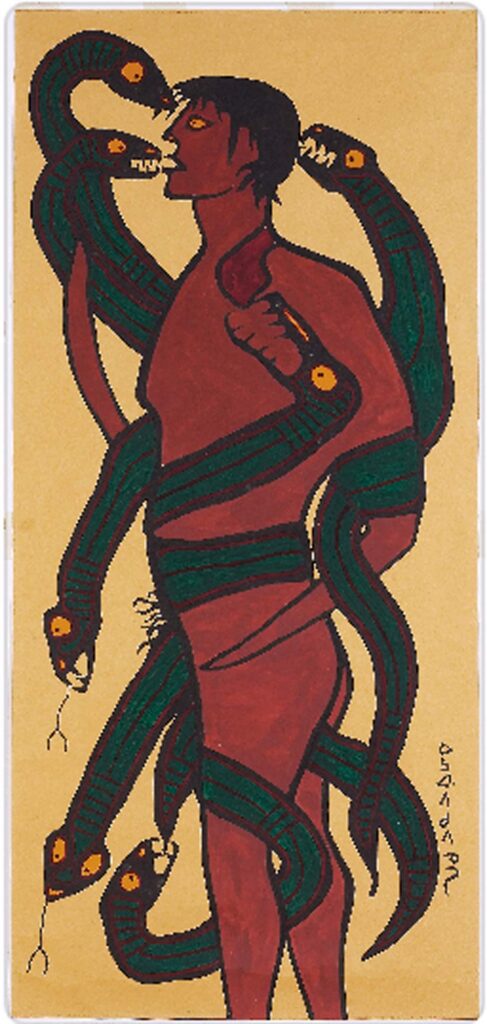
Norval Morrisseau, Self Portrait Devoured by Demons, 1964, acrylic, oil, ink, graphite on kraft paper, 209.2 x 78.7cm, Art Gallery of Ontario, Toronto.
The Academy, 2008, is a tour de force that reimagines the nineteenth-century art school, complete with bystanders, within the rounded space of one of the Plains earth lodges painted by George Catlin (1796–1872). It’s also a roman à clef in which key figures can be identified as eminent founders of Toronto’s art gallery, while others reference well-known paintings. Monkman lifted the Indigenous warrior seated in the centre from Benjamin West’s Death of General Wolfe, 1770—a version of which hangs at the nearby Royal Ontario Museum—while the artifacts scattered about the room evoke the radical decontextualizations wrought by Western collecting practices. Although Monkman usually appoints Miss Chief Eagle Testickle, his Cher-like alter ego, to carry out his acts of subversion, he appears here on the far right in his own guise, clothed in a painted hide outfit and top hat that might have been worn by one of his Cree forebears. One arm points to the group posed as Laocoön and the other to an artist sitting at an easel and painting a self-portrait. The mirror shows us that this is Norval Morrisseau, and we recognize the painting on his easel as Self-Portrait Devoured by Demons, 1964, from the AGO’s collection.
With these inversions, substitutions, and repositionings, Monkman critiques a skewed settler art history that traces the origins of art-making in Canada to the Greco-Roman and classical traditions of Europe and not to the First Peoples of the continent. Monkman also stresses that Canadians must come to terms with their own histories of oppression and struggle before they can create this new art history—a process of re-education that would be initiated seven years later by the final report of the Truth and Reconciliation Commission in 2015. The Academy thus pays homage to Morrisseau by drawing out the decolonial implications of his work for art historical narratives. Like Houle, Monkman points to a genealogy that must be acknowledged if visitors are to understand works by contemporary Anishinaabe artists on view elsewhere in the Canadian galleries.
Duane Linklater, Tautology (2011–13)

Duane Linklater, Tautology, 2011-2013, neon, aluminum, enamel and transformer, 156 x 152 x 13.5 cm, National Gallery of Canada, Ottawa.
Cree artist Duane Linklater (b.1976) gave the title Tautology to his grouping of five thunderbird sculptures constructed of varicoloured neon tubing. The work won him the prestigious Sobey Art Award in 2013, and in the wake of the announcement, digital images of his piece flashed across the internet, creating a national reputation for him just as newspaper coverage of his first Toronto exhibition had done for Morrisseau fifty years earlier.
Linklater produced Tautology by commissioning a maker of neon signs to trace the outline of the great Thunderbird at the centre of Morrisseau’s monumental painting Androgyny, 1983. Morrisseau had presented that huge canvas to the Canadian people as a gift of spiritual healing after he received the Order of Canada and it became one of his best known works. As the Sobey Award website explains: “Tautology depicts a series of bold neon birds—an image that Linklater says he ‘appropriated’ from the Norval Morrisseau painting Androgyny. ‘I first encountered this painting on television, as the result of watching political events in Rideau Hall, where it hung until last summer. I thought it was a very interesting and complicated place for this painter to have his artwork’.” The website further explains that the work explores “ideas of repetition, ritual, signage, and symbols,” that, Linklater noted, get “lost in translation.”
Although he makes his appropriative intent clear, Linklater leaves undefined the relationship between Morrisseau’s work and his own practice as a twenty-first-century Anishinaabe artist. As his remarks on translation make clear, a tautology—a needless repetition of a word or an idea or image —whose meaning may be lost when iterations are too many or too frequent. Is Linklater suggesting that successive appropriations of Morrisseau’s image, from the early renditions of Woodland School painting to his own version of it as a piece of public signage, have reduced its sacred power to something mundane? Possibly. By translating Morrisseau’s supremely painterly thunderbird into a series of glass objects filled with glowing light in a standard range of colours, Linklater is clearly evoking the banality of consumerism and the erosion of meaning through commodification. At the same time, he also builds on a late-modernist legacy, established by artists like Dan Flavin (1933–1996), of reinterpreting the sacred through profane consumer technologies of light.
Linklater has also suggested that through copying and then contracting out Tautology’s fabrication, he is signalling the distance he feels between his generation and Morrisseau’s. Although both artists came from Northern Ontario, Morrisseau’s only formal education consisted of three years in a residential school, while Linklater holds a master’s degree in contemporary art from a prestigious American college. Morrisseau’s work entered the National Gallery only at the very end of his life, while Linklater’s was displayed there when he won the Sobey award in mid-career.

Norval Morrisseau, Androgyny, 1983, acrylic on canvas, 366 x 610 cm, Aboriginal Affairs and Northern Development Canada, Aboriginal Art Collection, Gatineau, QC.
The recognition achieved by modern Anishinaabe artists has engendered its own forms of appropriation. In 2006, when the National Gallery of Canada accorded Morrisseau the first retrospective given to a living First Nations artist, Androgyny, 1983, was arguably positioned as exhibition’s culminating work. A photograph of a frail and ailing Morrisseau, disabled by Parkinson’s disease and seated in a wheelchair in front of his painting, was published widely in leading newspapers. And when Governor General Michaëlle Jean requested the loan of the painting for the grand salon of her official residence, Androgyny’s frequent appearance in the media as the backdrop for numerous official ceremonies was, as noted, a key provocation for Linklater’s work. Although the public display of Indigenous art can be a positive form of recognition, as Robert Houle also noted, this appropriation by the governor general “reveal[ed] fallacies and ironies in the building of a national identity.... Isn’t it ironic to see the harmony of creation depicted on the painting and the divisive trademark of a government who… left more aboriginal people exposed to the vitriolic culture of poverty, homelessness, landlessness, hopelessness and just plain misery.”
The very indeterminacy of Tautology—the unresolved tension between the shared ground of technological reproduction and modernity and the specificity of Indigenous cultural reference—may be its most lasting message. As in his video projects and installations, Linklater’s messages are embedded in his use of industrial and post-industrial media, which both insists on and questions the nature of the difference they make. In Tautology, he opens up a dialogue with past artists without attempting to predict where, when, or how it will end.
Art History and Genealogy
In the 1960s, artists like Norval Morrisseau were, as art historian Charlotte Townsend-Gault put it, “struggling to be modern.” Fifty years later, Duane Linklater was engaged in a struggle to retain a connection to the modernity that the earlier generation had achieved. This brief sampling of Anishinaabe art between 1962 and 2012 has revealed the enormous complexity of the processes referred to as “postcoloniality” and “decolonization,” and it has also suggested that these processes remain unfinished. There should be no surprise here. Losses and harms that took four centuries to inflict on the Indigenous Peoples of the Great Lakes region cannot be recovered in half a century. It would be hard to find a more diverse array of approaches to the process of recovery than those chosen by Thomas, Shilling, Houle, Favell, Monkman, and Linklater. Yet all address an interconnected set of concerns—the loss of historical memory; the survival and revitalization of stories, language, and spiritual practices; the strengthening of Indigenous identities; the rewriting of exclusionary narratives and institutional policies; the recognition of a shared modernity that coexists with tradition—that were arguably first raised in the Canadian art world by Norval Morrisseau.
We now understand the modern in art as multiple, dispersed, and asynchronous in production. Such new understandings lead in the direction of a true paradigm shift, in which local modernisms can retain their integrity within a consciousness of the global. Yet anomalies, puzzles, and unresolved issues still abound, for although students of globalization have persuasively demonstrated that the co-modernity of peoples around the world has a long history, standard narratives of artistic modernism have not yet been able to accommodate the discrepant temporalities of global modern arts. Knowledge of the ancestral beings—animal, human, other—has travelled through space and time in stories relayed from generation to generation. They were told by Morrisseau’s grandfather, Thomas’s grandmother, and members of Houle’s Saulteaux family. But even for artists like Arthur Shilling, who did not have access to such direct modes of transmission, the intergenerational bonds remained strong. “In my culture,” Shilling wrote, “the mother is symbolized in a circle. Outside of the circle is infinity, where my life begins. When the mother dies the circle is shattered, then slowly renourishes itself and becomes your own aura.”
The circle of time constructed by the intergenerational relationships and statements of the Indigenous artists considered here resists the linearity of conventional Western art-historical narratives. It was articulated by Anishinaabe curator and artist Bonnie Devine when she discussed how she thought of her own contemporary installation art in relation to Morrisseau and Daphne Odjig. “Morrisseau,” she said, “is the point of reflection. We bounce up and we find the rock art and the pictographs.” For her, contrasting styles and artistic practices do not negate these connections. “I can still feel the resonance,” she noted. “I don’t feel myself in conflict. We are simply linking hands and moving this through.”
To think of artistic relationships in the Great Lakes in terms of the unity of the circle rather than the rupture of the broken line is to retain the interconnection of the generations that is at the heart of the Anishinaabe understanding of time. In this worldview, modern and contemporary Indigenous arts have neither superseded nor rendered obsolete the stories and visual expressions of the ancestors. Instead, they are reborn and remain alive and present in the work of contemporary artists. Understood as neither rupture nor rootlessness, change in Anishinaabe art remains linked through transgenerational teaching and transmission, achieved against great odds but now growing in strength—precisely the lesson Moses Panakonagos bequeathed to his grandson Norval Morrisseau.