Morrisseau and Anishinaabe Painting: The Cinader Collection at the Royal Ontario Museum
by Trudy Nicks
TK caption info
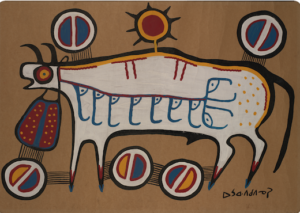
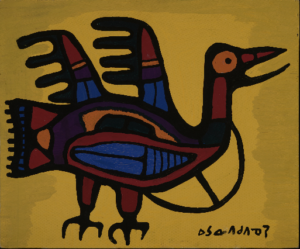
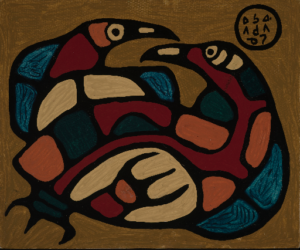
Norval Morrisseau’s painting of a sacred white animal with horns and medicine bag (Figure 1) was one of the first artworks to be acquired for the contemporary First Nations art collection at the Royal Ontario Museum (ROM). The painting came to the museum through Morrisseau’s association with Canadian artist, author, and amateur anthropologist Selwyn Dewdney (1909–1979). They met in 1960 while Dewdney was recording rock art in the Red Lake area of northern Ontario for the Royal Ontario Museum. Dewdney brought Morrisseau and his art to the attention of his friend and research partner, Kenneth Kidd, head of the museum’s department of ethnology. The sacred animal painting was acquired soon after. Since that initial acquisition, additional works by Morrisseau have been added to the ROM collections through donations, purchase and bequest. In 1972 the museum purchased eleven Morrisseau artworks from John Sweeney, a private collector from Wawa, Ontario. Selections from the Sweeney collection were displayed in the Woodlands Gallery during the 1970s, providing a contemporary Indigenous voice to ethnographic style exhibits purported to represent indigenous life in the latter half of the nineteenth century (FIGS. 2,3,4). The largest additions to the ROM’s collection came in 1998 and 2001 when Dr. Bernhard Cinader donated over 350 works by gift and bequest. The Cinader collection added fourteen paintings and some prints by Morrisseau and a much larger number of works by Anishinaabe artists who were influenced by him. This chapter discusses Dr. Cinader as collector of Morrisseau art, as a patron and friend to emerging Anishinaabe artists, and examples from his collection that illustrate the impact Morrisseau’s work had on a generation of younger artists.

TK caption info
TK caption info
TK caption info
TK photo of Dr. Bernard Cinader
Dr. Cinader and Indigenous Art
Bernhard “Hardi” Cinader was born in Vienna on March 30, 1919. His studies there were cut short by the German occupation of Austria in the late 1930s. He fled to London where in 1948 he completed his studies at the University of London’s Lister Institute of Preventive Medicine. He continued to work in London until 1958 when he moved to Toronto to head the immunochemistry subdivision of the of the Ontario Cancer Institute and then, as founding director, the Institute of Immunology in the University of Toronto’s Department of Biochemistry. Cinader had brought an African art collection with him to Toronto, but with few opportunities to add to it in Canada he turned his attention to Indigenous artists and became a passionate collector of Indigenous contemporary arts.
Dr. Cinader’s arrival coincided with a period of growing public interest in Inuit and ‘Indian’ art. By the early 1970s he was spending his summer vacations on Manitoulin Island, where he was inspired by a new generation of artists encouraged by programs run between 1966 and 1977 by the Manitou Arts Foundation and, after 1974, the Ojibwe Cultural Foundation. The latter organization was founded as part of the new cultural and educational centres program begun by the government of Canada in 1971 in response to effective Indigenous lobbying. Both organizations ran programs designed to assist artists’ development, including summer schools taught by established artists and workshops with elders. As he continued to spend summer vacations on Manitoulin Island, Cinader came to know personally many of the young artists who were either resident on the island or attended cultural programs there.
Cinader amassed an extensive contemporary collection and donated it to the Royal Ontario Museum. A first gift, made in 1998, consisted of artworks displayed in his offices at the medical arts building at the University of Toronto. He kept the greater part of his collection at his home, with the intention of sending it to the museum in a series of installments the last of which would be made up of his favourite works that held place of honour on the main floor of his residence. His sudden passing in March 2001 precluded the installment plan, and the artworks from his home arrived at the museum as one group later that year. In a 1978 essay in American Indian Art Magazine John Warner referred to Cinader’s collection as "unquestionably the most important and impressive collection’ of contemporary Algonkian legend painting," and praised him for making his “stupendous collection available to art galleries and museums in Canada and Europe.” Cinader’s interest in promoting First Nations art and artists is evident in a sample of his activities. Between 1974 and 1987 he lectured on Indigenous art, was curator for or contributor to multiple exhibitions shown at venues in Ontario (four originated at the ROM), London (Canada House), and Lahr, Germany. He consulted on the development of the Woodland Indian Gallery at the McMichael Canadian Collection at Kleinburg, dedicated in 1976, and on the acquisition of a contemporary Woodland painting collection for New College at the University of Toronto, realized in 1980. He also lobbied the University of Toronto for improved Aboriginal access to careers in health-related professions.
Dr. Cinader’s Morrisseau Paintings
The Cinader collection at the ROM has two significant components. The first consists of fourteen paintings by Morrisseau which span a period from c1961 to 1979 plus original silk screen prints. The second component results from his engagement with young Anishinaabe artists from Manitoulin Island and other northern Ontario communities as a mentor, patron, and sometime marketing agent. Together with the artworks, the museum received an archive of research notes, catalogues from exhibitions he curated, correspondence with Indigenous artists and others, lecture notes and draft texts, slides, art publications, and ephemera including newspaper reviews and invitations to gallery openings. The archive contains only brief references to Cinader’s association with Morrisseau. One letter, from Morrisseau’s partner and agent, Michael Zebryk, relayed Morrisseau’s response to a short write-up on his life that Cinader had sent for approval. Morrisseau “would appreciate very much if you illuminated [sic] the part on his mother being an alcoholic and his experience in jail. The rest sounds OK.” Other letters indicate his desire to meet Morrisseau that were unsuccessful because of the artist’s ill health or the difficulty of pinning down his movements. These brief references do not account for other occasions on which they may have met. Among the ephemera in Cinader’s files there are notices of gallery events, one for a special preview to meet the artist on August 27, 1977 at Pollock Gallery’s exhibition of new paintings of Man Changing into Thunderbird by Norval Morrisseau. Cinader may have found the invitation irresistible.
TK carousel of works found at end of paragraph beginning with "Dr. Cinader's selection of Morrisseau artworks..."
There is a dearth of information that sheds light on how or when Cinader acquired the Morrisseau artworks. The one exception is Native Imagery Fascination (1979) which Cinader purchased at a silent auction in Toronto held December 10–13, 1992. Cinader’s notes indicate that the painting of flowers had remained in gallery stock for over a decade, suggesting that a painting based on floral beadwork aesthetics failed to meet the expectations of buyers accustomed to Morrisseau’s bold interpretations of Anishinaabe spiritual interrelationships between humans and the natural world and with powerful manitous?
Dr. Cinader’s selection of Morrisseau artworks addresses both Anishinaabe cultural narratives and the personal experience of the artist. Interpreted in Morrisseau’s innovative art style, the paintings are compelling examples of visual storytelling. Two themes dominate the collection. Narratives of the spiritual interrelationships between humans the natural world appear in The Indian and Mother Nature (1970); Indian Keeper of his Natural Resources (1972); Suckling Children, Mother, Loons (1972); Unity of Man and Animals (1974); and Native Imagery Fascination (1979). Narratives of the spiritual interrelationships between humans and manitous appear in Serpent Legend (c1961); The Indian is Given Protection by the Thunderbird (1972); The Great Serpent Mother: Mother of all Serpents in the World (1972); and Shaking Tent (jeesekum) (1974).
TK caption info
TK caption info
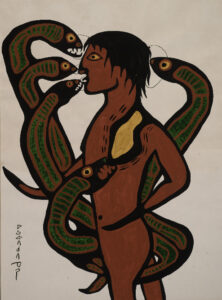
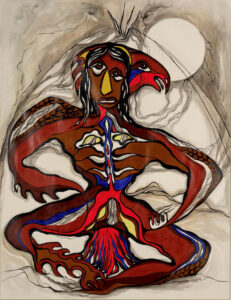
Man and Four Serpents (1972) represents Morrisseau’s personal inner battle with the conflicting dualities of Indigenous beliefs and Catholicism. (FIG 6) He depicts the medicine snake of the Midewiwin as a many-headed serpent of temptation, in contrast to an earlier version of this theme, Man and Snake, discussed by Elizabeth McLuhan. She quotes Morrisseau ‘s comment on the image: “Any man who is attached to sence’s (sic) and desires and richs (sic) of this world is like a man who is being devoured by serpents who represents (sic) his own passions and desires.” Cinader repeats this quote in his description of his 1972 version Man and Four Serpents.
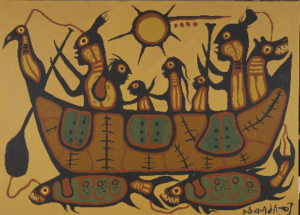
The sacred oral tradition of an Anishinaabe migration is an often-used theme by Morrisseau. A Cinader favourite, Migration was displayed with his other prized artworks on the main floor of his home. (FIG 7) In the oral tradition the migration to the Anishinaabe territory comes from the east. Anishinaabe artist Randy Trudeau refers to the migration tradition and Manitoulin as a place of rebirth in a letter to Cinader in 1978. Cinader’s own notes are a shortened version from the Sinclair and Pollock 1979 book The Art of Norval Morrisseau: “We do not know how the native people reached this Canada. Perhaps they came across the Behring (sic) Straits gradually in single family groups. There are legends about a migration in single and family groups; this is the picture which recalls this legend.” But Cinader’s notes omit a key piece of information in Morrisseau’s explanation of the migration: “Well, my people don’t believe they really came from Asia.”
TK caption info

TK caption info
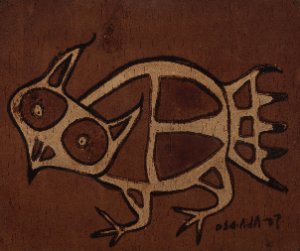
In 1986 Dr. Cinader curated The Birchbark Sings, an exhibition for Ontario North Galleries at Ontario Place in Toronto, that explored the uses of birch bark for utilitarian purposes and for spiritual and aesthetic expressions. An image of an owl painted on birchbark was one of three Morrisseau pieces in the exhibition (FIG 8) along with additional paintings on birchbark by twelve young Anishinaabe artists. A collection of porcupine quilled and sweetgrass boxes represented ‘crafted art pieces,’ to use Tom Hill’s term, that have relevance to Anishinaabe cultural narratives. Two of the best examples, made by Victoria Osawimak and Maime Migwans, incorporate culturally significant images of eagle and shamans created by artists James Simon and Carl Beam, respectively.
Dr. Cinader’s remarks on the use of colour in several paintings in several paintings in his collection suggest a particular interest in then current research on Morrisseau’s artistic development. His notes describe the 1961 painting Serpent Legend (FIG 9) as “a peak achievement of the first period in Morrisseau’s work. Its colours of black, white and brown relate it to the sacred birch bark scrolls of the Mide ceremonies.” Other colour categories illustrate a period of’ ‘muted browns, ochre and white’ which was followed by the adoption of the ‘multicolours of stained glass’. Cinader loaned Serpent Legend to the 1984 Art Gallery of Ontario exhibition Norval Morrisseau and the Emergence of the Image Makers.
He describes Chief (1969) as the "first known work where the multicolours of stained glass replace muted browns, ochres and whites of his early work," and Suckling Children, Mother, Loons (1972) as “a master work of the palette that saw its beginning with the Chief in 1969.” The colours in Woman Suckling Bear (1970), a west coast theme, “represent a return to his earliest paintings in multicolours,” while Indian and Mother Nature (1970) “marks the beginning of a period in which Morrisseau used strong, luminous colours.” The Unity of Man and Animals (1974) “belongs to a series in which new and bold uses of colour are being made and which followed his recovery from serious burns, suffered in Vancouver.” These comments stand in contrast to earlier works like Serpent Legend (1961) that use a limited and subdued range of colours. Cinader describes this early painting as “a peak achievement of the first period in Morrisseau’s work. Its colours of black, white and brown relate it to the sacred birch bark scrolls of the Mide ceremonies.” He lent it to the 1984 Art Gallery of Ontario exhibition Norval Morrisseau and the Emergence of the Image Makers. McLuhan refers to the painting in her catalogue essay as an illustration of Morrisseau’s successful adaptation of pictography to a painterly mode.
TK caption info
Norval Morrisseau’s Influence
Berlo and Phillips capture Norval Morrisseau’s influence on younger artists in a succinct statement: “The originality of his formal and iconographic syntheses of the traditional and the personal and his great commercial success inspired—directly and indirectly—a whole generation of young Anishinaabe painters to take up the brush and the pen." According to Elizabeth McLuhan, by 1984 “a conservative estimate of the number of avid practitioners of a pictographic style in northwestern and central Ontario would indicate that there are well over seventy-five." Dr. Cinader’s files include artworks from over forty Ojibwa-Cree-Odawa artists working in a Woodland/Anishnaabe style in the 1970s and 1980s. (FIG 10) A Woodland style virtually became the definition of a native artist at the time. Curator Tom Hill noted a negative effect of Morrisseau’s 1962 exhibition in Toronto was that he “set such a pattern that everyone said, “This is Native art,” and if you happened to be a Native artist, you faced the dilemma of not painting like Morrisseau.”
When Dr. Cinader visited Manitoulin Island in the 1970s, he encountered the summer art programs run by the Manitou Arts Foundation and the Ojibwe Cultural Center. The founding of the Ojibwe Cultural Center in 1973–74 initiated “a whole process of conscious retrieval and encouragement of Indian culture’ on the island. Of first importance was the Elders’ program, which sought to engage local elderly residents in setting out wisdom and knowledge for the young to carry on.” Letters in the Cinader archive testify to his promotion of these programs. Artist Randy Trudeau wrote to Cinader on June 16, 1978 to thank him for information about the art workshops at Schreiber Island. “I was invited to go there once. But every thing I know about it seems to be in your letter.” Mary Lou Fox Radulovich, Program Co-ordinator of the Ojibwe Cultural Foundation, wrote to Cinader on April 12, 1978 “it was good to hear from someone, who is so enthusiastic about the art work being produced by our people. It’s a great feeling to be surrounded by all this creativity. Our artists continue to develop. It is one of our greatest pleasures to work with them.”
TK caption info
Dr. Cinader, Patron to contemporary Anishinaabe artists
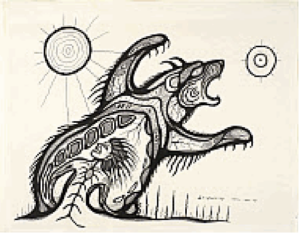
Dr. Cinader’s files from the 1960s through the 1980s provide many further glimpses of his role as a patron of this younger generation of artists. In slides he appears with young artists, both parties obviously enjoying each other’s company. Correspondence to and from Cinader often concerns his role in buying and selling art in the 1970s. For example, a December 1974 letter from Goyce Kakegamic notes: “Enclosing [sic] please find 30 paintings. 22 smalls ones and 8 larger ones. The price for the smaller paintings are the same as before $30.00 each. As for the large paintings they are still $75.00 each. Also I’m enclosing one screen prints, a merry X-mas to you from me.” Cinader also offered practical advice and marketing help. Tuscarora/Mohawk artist Don Lynch wrote in October 1976 that, “One problem I’ve experienced is arriving at a price for my paintings,” and in December 1978 James Simon wrote: “Soon as I finished your little painting I wanted to send it right away,” adding “Thank you very much for the paintings you sold for me. Cinader commissioned some art works, notably Medicine Bear, a large pen and ink drawing by Sandy Lake artist Carl Ray. (FIG. 11) Ray described it as ‘a medicine bear with the spirit of a man and the background is the sun and symbol of the great spirit.” The drawing represents a powerful guardian spirit in the shaking tent and Midewiwin ceremonies. It was one of Dr. Cinader’s favourites because of its reference to his profession—medical science—and the coincidence that his own first name, Bernhard, means “bear” and “hard,” i.e. someone who is strong and brave. It was displayed at his funeral service.
Dr. Cinader’s connections with commercial galleries and through the Department of Immunology provided valuable contacts, sometimes indirectly, for the artists. His files mention Saul Williams who, between 1971 and 1975, “brought his paintings to a group of Toronto paediatricians... They were tacked to the walls of the waiting room with drawing pins and sold to the parents of the patients.” Cinader wrote to Terry Simard at Thunder Bay Indian Crafts on December 4, 1974 that, “some of my colleagues may be interested in getting paintings for Christmas and that it might be worthwhile sending me 7 or 8. As usual I shall undertake to buy one at least and to return any paintings which do not find a buyer. May I say again, it would be greatly useful, to have paintings which have a coloured background.” In the case of Morley Kakepetum, who made his first trip to Toronto in 1979, Cinader directed him to the Kar Gallery, and the Nishnawbe Arts on Dupont Street, where he sold many of his paintings, and “the rest of the smaller paintings were sold in the Medical Sciences building.”
A selection of paintings from Cinader’s collection included in this essay illustrates some of the individual styles developed by second generation artists working in a Woodland art tradition. Beyond the paintings, two other items collected by Cinader represent cultural and business projects in the development of Anishnaabe art in the 1970s and early 1980s. The first is a large lapel button depicting the crest of the Native Sons, a group initiated by indigenous inmates at the Guelph Correctional Centre in 1976. (FIG 12) The second is a wall hanging featuring a silk-screened image of a Morrisseau self-portrait from the Triple K Co-operative (1973-c1980) at Red Lake. (FIG 13)
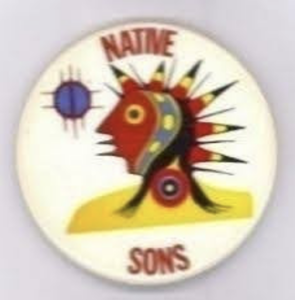
TK caption info
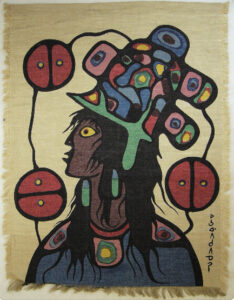
TK caption info
The Native Sons: Reclaiming indigenous culture and identity
In 1977 Anishinaabe artist Richard Bedwash wrote to Cinader from the Correctional Centre at Guelph in southern Ontario: “we have a group here at the centre called the Native Sons and [a] few of the Boys are artists.” The purpose of the Native Sons is described in a booklet illustrated and issued by Guelph inmates. “The group known as the Native Sons began in the Guelph Correctional Centre in July of 1976. It was initiated by a small group of native inmates who came together for one evening a week with the desire of learning more about their cultural and spiritual heritage. As they continued to meet, their group steadily grew until it encompassed nearly all the native inmates of the institution…. The Native Sons have been able to grow and function effectively in Guelph Correctional Centre without becoming the source of any tension, conflict, or division. In fact, they have gained the respect of the other inmates, the staff, and the administration.”
The time and place were auspicious for establishing the Native Sons group and related programs. The Prison Arts Foundation, created in 1969, promoted creativity as a path for rehabilitation. By 1976 the Guelph Centre already had an ‘open studio’ art program that provided incarcerated individuals with opportunities for creative expression. The Native Sons’ concern with Indigenous culture and identity resonated with the concurrent interest in Morrisseau’s new art elsewhere in Ontario. Sanctioned by the Correctional Centre and supported by outside organizations, Native Sons programs ranged from art, crafts, and Indigenous history and traditions to participation in sweat lodges and other religious ceremonies led by spiritual leaders. Buttons featuring the Native Sons Crest and copies of Native Sons, a small book of poems and drawings by inmates, were sold to raise funds for these programs. The Native Sons programs shared aspects of the Manitoulin summer art programs, within the limits imposed by incarceration. Fred Taylor, another member of the group in the 1970s, expressed the group’s ethos of mutual support, stating simply—“We were there to help each other.” Morrisseau, who had himself spent time in a correctional centre, supported Native Sons and designed a cover for one of its publications.
Bedwash (1937–2007) had been an apprentice with Morrisseau, and at the time of his incarceration his work was represented by the Canvas Gallery in Hamilton. His letters to Dr. Cinader and Selwyn Dewdney, in 1976 and 1977 respectively, tell something of the experience of artists in the Native Sons group. He asked Cinader for patterns, books, booklets or catalogues “to give Group members some ideas of what our Native artists are starting to Create.” In a letter to Dewdney Bedwash admitted he had a lot more to learn, including how to pick colours. He asked for "some samples that would give me some ideas" and noted “I would have a lot of time to study out here as I am doing time here at Guelph Correctional Centre.” Dewdney replied to Richard Bedwash:
As an old art teacher myself the best advice I can give you is to follow the example of Norval Morrisseau. That is just paint what comes into your mind when you think of the stories you’ve heard when you were young or memories of how things were when you were a boy. As you keep trying to turn these memories into pictures you will find that your paintings will have more power, and the forms you paint will become clearer. Just keep painting… and… painting. Lots of luck!”
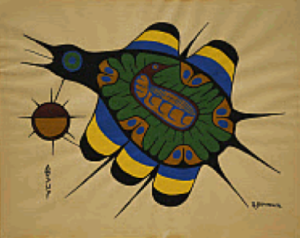
TK credit info
Another inmate, Tona Mason, the president of Native Sons group, also wrote to Dewdney requesting assistance in promoting Bedwash’s art more widely. Dewdney’s reply on January 8, 1977 assessed Bedwash’s art as ‘technically impressive’ and noted that he had obviously chosen to follow the trail blazed by Norval Morrisseau. But, he also cautioned, Bedwash needed to concentrate on finding his own style or “he will face challenges in exhibiting and selling his work, because there is competition from more than a dozen young Cree and Ojibwe artists who also are following in Morrisseau’s footsteps.” A Bedwash painting The Bird and Its Spirit from 1976 illustrates his work at the time of his Guelph incarceration.[FIG 14] Bedwash went on to become a successful artist. Dr. Cinader added eleven Bedwash paintings to his collection, most from the 1980s. Layers of the Past (1983) appeared as the cover image of the catalogue for his 1986 exhibit The Birch Bark Sings.
The Guelph Correctional Centre closed in 2002 leaving behind wall murals painted by Bedwash and other inmates. The Yorklands Green Hub, a nonprofit organization, was established in 2014 with the aim of adaptive reuse to preserve the indigenous and non-indigenous cultural and natural heritage of the conservation district which included the site of the Correctional Centre. One goal has been to save the wall murals painted by inmates and make them available for public viewing. In the spirit of the Yorklands project, the Art Gallery of Guelph mounted a retrospective exhibition of Bedwash art in 2024. Yours in Native Spirit: Richard Bedwash focussed on paintings he created while incarcerated in the 1970s.
The Triple K Cooperative Incorporated
Silk screen prints account for a small part of the Cinader collection. The best documented print in the Cinader collection, thanks to information provided by John Vincett who had known Morrisseau from Red Lake days, is based on a colourful self portrait that Norval Morrisseau painted in 1973. Morrisseau depicted himself wearing an elaborate headdress, an image described by Vincett as a sort of “appropriated chieftainship” or perhaps a shaman totem. The self portrait was screened as a linen wall hanging at the Triple K Cooperative print shop in Red Lake a few months later. (FIG 13) John Vincett recalls that Morrisseau was working daily in the print shop in the early 1970s. Intrigued by the screen cutting process, Morrisseau often interrupted his painting to check on the progress of the work.
The Triple K Cooperative print business was operated at Red Lake by Morrisseau’s brothers-in-law Joshim, Henry, and Goyce Kakegamic from late 1973 to the early 1980s. A history of the Triple K describes it as "an initiative to support and promote the growing artistic talents of Indigenous artists in Northwestern Ontario," the Kakegamics, Morrisseau, Saul Williams, Barry Peters and Paddy Peters. In the first year of operations the print shop produced unlimited edition prints, switching to printing original limited-editions in the second year. "Original" in this context meant that the prints were made from drawings designed specifically for the silk-screen process by the artist, who then was involved at every stage of the process and made all artistic decisions. The artist and printers worked together on technical details. As the Triple K’s brochure stated: "Given the Co-Op’s commitment to this standard, we feel that our prints are artistically, technically, and aesthetically distinct from limited editions reproduced from paintings."
Triple K organized a series of successful exhibitions, locally and in urban centres to introduce the business and Indigenous artists of northwestern Ontario, and to attract buyers for prints. It also hired an agent, Roy Maxwell, who had extensive knowledge of the Canadian art market. With his help Triple K prints were distributed across Canada to approximately fifty galleries. The wide distribution was a particularly important opportunity for newer and younger artists in isolated communities to gain recognition and sell their art. In 1975, faced with copyright issues, Triple K hired a copyright lawyer to develop a standard contract covering copyright, reproduction, artistic control, distribution, and royalties to be signed by artists and the Co-Op President. The Morrisseau self portrait print was the subject of a legal dispute over copyright infringement between Triple K and the Department of Indian Affairs. The government claimed Morrisseau had given permission to use the image on greeting cards, a claim that Morrisseau denied. When the Triple K print shop closed in the early 1980s, 180 editions of prints had been printed in just under a decade.
The self portrait by Norval Morrisseau was reproduced on linen, burlap, Kraft paper, and fine art paper. Because the painting on which it was based was richly coloured, especially the headdress, multiple screens were required to create a print. Wall hangings were technically challenging to print and were not considered products that would generate enough funds to cover materials, labour, and royalty payments as well as return any real profit. Given the difficulty of producing prints, John Vincett suggests that there were never more than 100 copies of Self Portrait produced on burlap or paper. Self Portrait was also printed as a limited edition of seventy-five as a fine art print on white paper, each of which was signed by Morrisseau. According to Vincett, the original painting remained in the print shop for several months, which was unusual given the number of visitors, tourists and locals who came to purchase Morrisseau works. An image of the original painting appears in a letter in the Cinader files from the Iroqrafts Crafts and Arts store at Ohsweken, Six Nations dated August 5, 1976. In the letter the owner of Iroqrafts offered six Morrisseau paintings including the Self Portrait for sale to collectors of Indigenous art. Cinader did not take the opportunity to add it to his collection.
Dr. Cinader’s Canadian Indian Renaissance
The period of Dr. Cinder’ active collecting coincided both with a time of increasing public interest in Indigenous art and Morrisseau’s expanding influence on a younger generation of Anishnaabe artists. The last major exhibition he curated was Manitoulin Island—The Third Layer, at the Thunder Bay Art Gallery in 1987. In the exhibition catalogue Cinader extolled Manitoulin as one of Canada’s significant creative centres, and Manitoulin artists as “acknowledged masters of Canadian art’ whether influenced by Morrisseau or following a different path." Cinader’s understanding of the historical importance of contemporary Indigenous art was summed up in his use of the phrase, ‘The Canadian Indian Renaissance.’ For Cinader, the notion of a Renaissance referred to a transformation of Native art that resulted from artists’ success in balancing integration into mainstream Canadian culture with the preservation and adaptation of ancient values. As he wrote in 1977:
Many alternatives have been explored artistically to solve the dilemma between preservation of a magnificent past and the search for a place in the technological and social reality of modern Canada. Artists have attempted to state and to resolve the conflict between affirmation of traditional values and the apparent irrelevance of tribal Indian culture and language to the young generation of Natives who still strive for success and acceptance in the wider Canadian society.
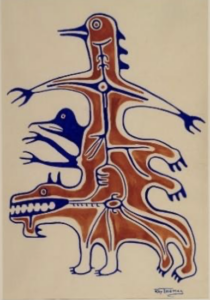
TK image credits
TK image credits
TK image credits
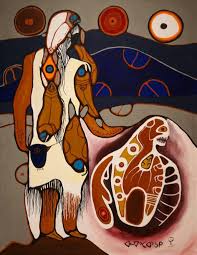
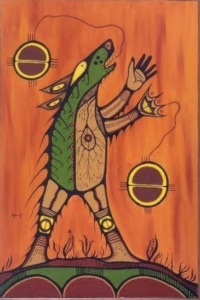
One consequence of adopting this perspective is that it allowed Cinader to bring together different generations and schools of Indigenous art in his exhibitions. For him, any artwork that addressed preservation and rediscovery of traditional practices and teachings or was concerned with Indian identity in the present and future, was a ‘renaissance’ work. For Cinader, Anishinaabe artist Roy Thomas’ painting Water God Misshipishu, (FIG 15) which Thomas intended to represent the God of Water and the interdependence of the creatures of the air, water, and land epitomised the Canadian Indian Renaissance. Two artworks concern contemporary social issues for Anishinaabe. Blake Debassige’s Woman in White Buckskin (FIG 16) represents a woman who appeared in a dream following troubling unnatural deaths (suicides, violence, drowning) in two Manitoulin communities in the mid-1970s. The fish draped on her clothing are symbols of good fortune, a healing message that the senseless deaths will end. Saul William’s Aspiration (FIG 17) is an illustration of hopes and dreams thwarted, a universal theme, in Saul’s case by legs symbolically rooted to the ground.
Cinader’s exhibitions brought together pieces from his diverse art collection including Iroquoian medicine or ‘False Face’ masks, Ojibwa Woodland school or ‘Legend’ paintings, paintings that depict the influence of industrialized mainstream society on Indigenous communities, modern abstract expressionist painting, and Northwest Coast iconography. Several of his exhibitions in the 1970s, particularly Contemporary Indian Art—the trail from the past to the future 1977, are examples of bringing together art from diverse traditions to educate Canadians about indigenous beliefs and culture.
TK credit info
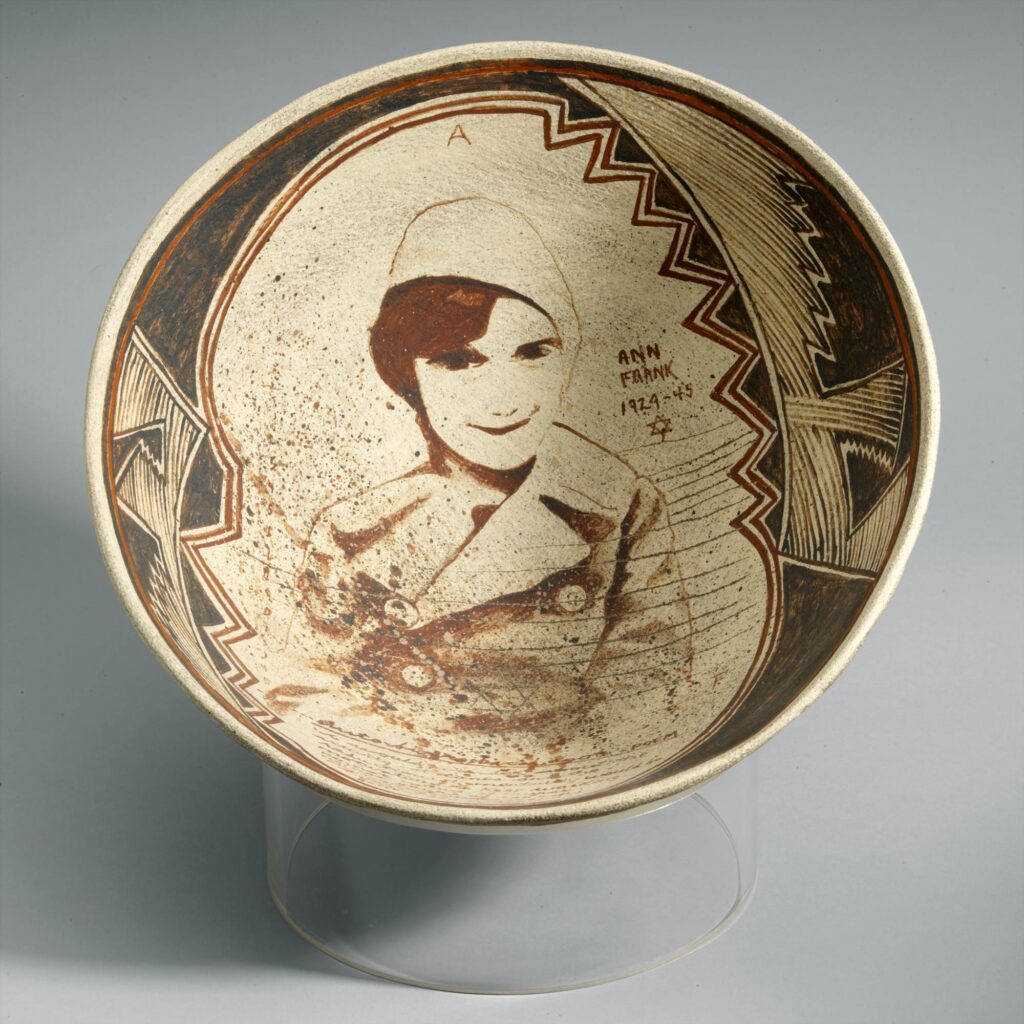
He also appreciated the new forms of Indigenous art that followed on the establishment of the Woodlands style and addressed global concerns. He especially valued Carl Beam’s Anne Frank ceramic bowl (FIG 18) as an expression of concern for international inhumanity. He displayed it together with his other favourite pieces on in the front room of his home, but noted that finding potential buyers for Beam’s art was a slow process since it did not conform to the Morrisseau style widely associated with ‘Indian Art.’
Bernhard Cinader was awarded the Order of Canada in 1985. His citation recognized not only his work in immunology but also the impact of his support for First Nations artists: “From his base at the University of Toronto, he has gained international recognition for his discoveries in the field of immunology, particularly for his work on the mechanisms which regulate the immune response. Equally well-known as an authority on and promoter of contemporary Canadian Indian art, he has, through extensive loans of his important collection, made Canadians more aware of this aspect of their heritage.”
His contribution, preserved in the collection now at the Royal Ontario Museum, has been recognized by artists of diverse artistic formations. Prominent Manitoulin artist Blake Debassige has spoken of Cinader’s encouragement and financial support that made it possible for many artists to pursue a career in art. Mohawk figurative artist Gary Miller, trained at the Ontario College of Art and influenced by Arthur Shilling, recalled that “[Cinader] would buy our artworks when galleries would not look at them.” And Carl Beam commented simply, “Anything for Dr. Cinader.”