Perceptions: the 1966 exhibition at the Musée du Québec
by Marie Paule Robitaille
During the 1960s and 70s art audiences in Winnipeg had the opportunity to see exhibitions featuring Norval Morrisseau, Alex Janvier (1935–2024), and other young Indigenous artists at Odjig Indian Prints of Canada Ltd. and the Winnipeg Art Gallery (now Winnipeg Art Gallery-Qaumajuq). While these artists introduced the wider public to a completely new visual expression, they enabled me to continue to hear the voices of Manitoban Anishinaabek and Cree community members with whom I had worked during several summers “North of 55.” After my move to Quebec City in 1987 to take up the position of curator of ethnology at the newly opened Musée de la civilisation I missed these opportunities. Yet, works by Morrisseau somehow continued to cross my path during the years that followed. In thinking back over these encounters, I am struck by the importance of several exhibitions of the 1960s that were held in Quebec City and Montreal. Key works by Morrisseau that remain in public and private Quebec collections can be traced to those initiatives.
The exhibition held at the Musée du Québec (now the Musée national des beaux-arts du Québec) in 1966 was particularly important. While it is regularly listed in the art historical literature on Morrisseau, however, little has been written about its organizers or the historical context of its presentation. In this essay, I will try to fill this gap by tapping the memories of some of the participants and evoking the enthusiasm they and others manifested at the opening on June 15, 1966.
The Quiet Revolution and Indigenous Activism
The Norval Morrisseau exhibition came about in a time of heightened social activism in Quebec, a moment when cultural projects and political affirmation converged in many different areas. The exhibition was one of a sequence of socio-cultural and political events stimulated by the Quiet Revolution. During these years, artists in Quebec were foregrounding their work as part of the political fight for Quebecois rights, and although less evident to the public at the time, a parallel and transformative fight for rights was in progress within the Indigenous communities of Quebec. Hydro-electric projects were galvanizing the fight for land rights. As the James Bay and Northern Quebec Agreement was being negotiated, the 1960s saw ongoing confrontation with Eeyou, Inuit and Naskapi—conflict that was not resolved until 1975.
In the previous decades, Inuit artists had created art initiatives and cooperatives such as the Coopérative de Purvinituq, which helped to structure production and marketing and to enhance income for remote communities. The Fédération des Coopératives du Nouveau Québec, created in 1967, increased Inuit self-management, enhanced control of the food, travel and industrial sectors, and contributed to the achievement of Inuit self-government.
In southern Quebec, Indigenous activists aspired to a more global political voice. People talked, and people gathered. In 1965 Wendat chief Max Gros-Louis, Innu Chief Aurélien Gill, and a number of other First Nations leaders formed the Association des Indiens du Québec or, Indians Association of Quebec. Their aim was to speak in a common political voice to the Quebec and Canadian governments and to play decisive roles in the land claim process. Locally, community-based institutions actively sought to control cultural development and heritage. The Wabanaki Nation’s Musée des Abénakis in Odanak—the first Indigenous museum recognized in Quebec—opened its doors in 1965. Other museums, cultural centres and archive facilities soon followed in Mashteuiatsh, Kanawake, and Uashat.
Québec Cultural Institutions in the Mid-1960s
On the provincial level, Quebec’s cultural agencies were reorganized in the 1960s and new institutions created. The Ministère des Affaires Culturelles du Québec (now the Ministère de la Culture et des Communications) was formed in 1961 to support museums and other cultural programs, with an emphasis on the transmission of knowledge and language integral to the affirmation of identity. These new organizations promoted not only understanding of the past, but also contemporary expression and creativity.
In 1963 responsibility for natural sciences and ethnology was removed from the Musée du Québec, which had been founded in 1933. The ethnology collections were moved to the Service d’Ethnologie preceded the Musée de la civilisation in 1988, and the Musée du Quebec was mandated to focus on art. A year later, in 1964, the Musée d’art contemporain opened in Montreal. All Quebec museums were mandated to raise their profiles not only locally, but also nationally and internationally.
When Guy Viau (1920–1971) was named director of the Musée du Québec in 1965, he set out to change that venerable institution. He came to the museum having worked as a journalist for Radio-Canada, taught at both McGill University and the Institut des Arts Appliqués de Montréal, and gained respect as an art critic. Viau quickly led the Musée du Quebec into a more dynamic phase in its long history. The Ministère de la Culture, which had recently funded a new wing at the Musée that provided space for expanded activities, supported his initiatives.
To Viau, atmosphere counted as much as content. Hosting permanent, temporary, or ephemeral exhibitions would involve new and more colourful techniques of presentation. He promoted cinema, dance, jazz, and gastronomy, as well as the visual arts, and gave more space to contemporary art and its creators. He was a strong advocate for his museum’s responsibility to the artists of Quebec, who had long lacked visibility and diverse audiences, and he also welcomed more exhibitions originating in the rest of Canada and Europe. In the 1960s, Viau ushered in a new period of artistic production and his institution gladly opened its doors to all.
Organizing the Morrisseau Exhibition at the Musée du Québec
At least two other Morrisseau exhibitions held in Montreal served as stepping stones to muster interest for Morrisseau’s work in the Quebec art world. The first, Images du folklore indien, Norval Morrisseau an Ojibway artist, was on view at the Galerie Agnès Lefort between April 22 and May 4, 1963. The show was an initiative of the gallery in collaboration with Jack Pollock (1930–1992), who supplied pictures. Artist and writer Selwyn Dewdney (1909–1979) also seems to have lent several drawings. The gallery’s invitation introduced Morrisseau with an article written by Dewdney in both French and English that had been published earlier that year in Canadian Art. Advertisements appeared several times during the show’s run in Montreal’s weekly tabloid Le Petit Journal, where on May 12, 1963, the journalist Paul Gladu reported being very taken by the show: “It is a wonderful discovery.... Here is an artist from our own milieu... a new and original vision... I hope he will open the eyes of our artists. Here is a fresh spring from which it is good to drink.” The daily La Presse also reviewed the show favourably.
A second exhibition of Morrisseau’s work soon followed at the Montreal home of Jacques Rousseau, a botanist and ethnohistorian who had directed several major institutions and research projects. Rousseau was aware of the success of the early shows of Morrisseau’s work at Toronto’s Pollock Gallery and may have seen some of the works, which might have given rise in his mind to the idea of a major Morrisseau show in Quebec as early as 1962. The Agnès Lefort show in 1963 must have impressed Rousseau and encouraged him to set up a private showing of twenty-four relatively small drawings in early 1965. In part, Rousseau’s motivation seems to have been a desire to show the museum community the potential for a larger exhibition.
Rousseau shared Morrisseau’s fear of loss of traditional Ojibwe knowledge for which the artist had found visual expression. Rousseau wanted a broader public to see the new work being produced by Indigenous artists in Quebec and Canada and their importance in transmitting traditional knowledge. Also in 1965, he collaborated with the artist Françoise Bujold (1933–1981), writing the introduction to her highly original publication of artwork by children from the Mi’gmag community of Gespegiag. Rousseau certainly visited the 1963 Morrisseau show at the Galerie Agnès Lefort and knew the specific works and themes presented there. Perhaps it was Morrisseau’s pictures that haunted him as he narrated his own expedition on the George River in 1949 together with Innu and Inuit friends and guides to document the riparian vegetation of the Ungava. Or, perhaps, he had connected with Morrisseau’s spirit world when he visualized the dreams his Lake Mistassini Eeyou guide, Andrew Gunner, had vividly described to him.
When Rousseau met Viau in 1965, he discussed the need for Indigenous elders to pass on traditional knowledge to the young and arranged to discuss the Morrisseau drawings he had on display. The newly appointed Musée du Québec director responded immediately. He suggested an exhibition and, early in 1966, arranged for the Ministère de la Culture to have the Morrisseau drawings photographed by Gabor Szilasi (1928–2026) at the Musée d’art contemporain in Montreal. Rousseau would include at least twenty of the twenty-four works documented by Szilasi in the 1966 Musée du Québec show. Soon after Rousseau and Viau’s initial meeting, the project was formally accepted. Rousseau was invited to curate the exhibition, scheduled for the summer of 1966, and his wife Madeleine Aquin Rousseau joined him in writing the catalogue.
On March 12, 1966, The Rousseaus boarded the Canadian Pacific Railway’s Montreal-to-Kenora train with Morrisseau’s Legends of My People, the Great Ojibway (1965) in hand. Jacques documented the trip and the agreements discussed with Morrisseau in two small notebooks that are preserved in the archives of Laval University. He describes in detail the arrangements to meet Morrisseau and his family in Sandy Lake, their travel to reach his log cabin by bus, bush plane, and on foot, and his impressions of and exchanges with Morrisseau. Rousseau notes that Morrisseau had in his home at least sixty paintings on paper executed in India ink and colour, two created on birchbark, and some on animal skins. He comments on the vegetation along the path to the house, the brightness of Morrisseau’s daughter, and the artist’s techniques and materials. Morrisseau, he also recorded, presented the Rousseaus to others in the community as his white grandparents.
The notebooks include many remarks on Morrisseau’s names for himself, his manner of signing pictures, and the symbolic motifs that appear in his paintings. Rousseau recorded Morrisseau’s accounts of the history of his people, past wars and victories, and the too-often-forgotten knowledge of Ojibway traditions. He also transcribed Morrisseau’s comments regarding his Toronto dealer Jack Pollock: “Once Pollock wanted to have an exclusive contract. If [or It] not be said I can disobey you and there will be no Morrisseau exhibition at Kitchener and Waterloo...” Prices for works of different sizes are also recorded.
March 18 brought more snow. Further talk centred on how Morrisseau’s paintings would be handled, packed and shipped to Montreal; much of the packing would be done at the missionary’s home and at the nearby Hudson Bay Company post. The final pages of the first notebook describe Rousseau’s expenses for his travel and the dates and a budget for Morrisseau’s trip east in mid-June.
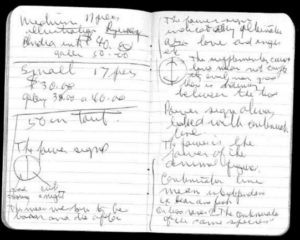
Journaux manuscrits du séjour de Jacques Rousseau chez le peintre amérindien Norval Morrisseau avec sa famille a Sandy Lake, Fonds Jacques Rousseau, Tiré du Carnet I, B 148, Archives de l’Université Laval.
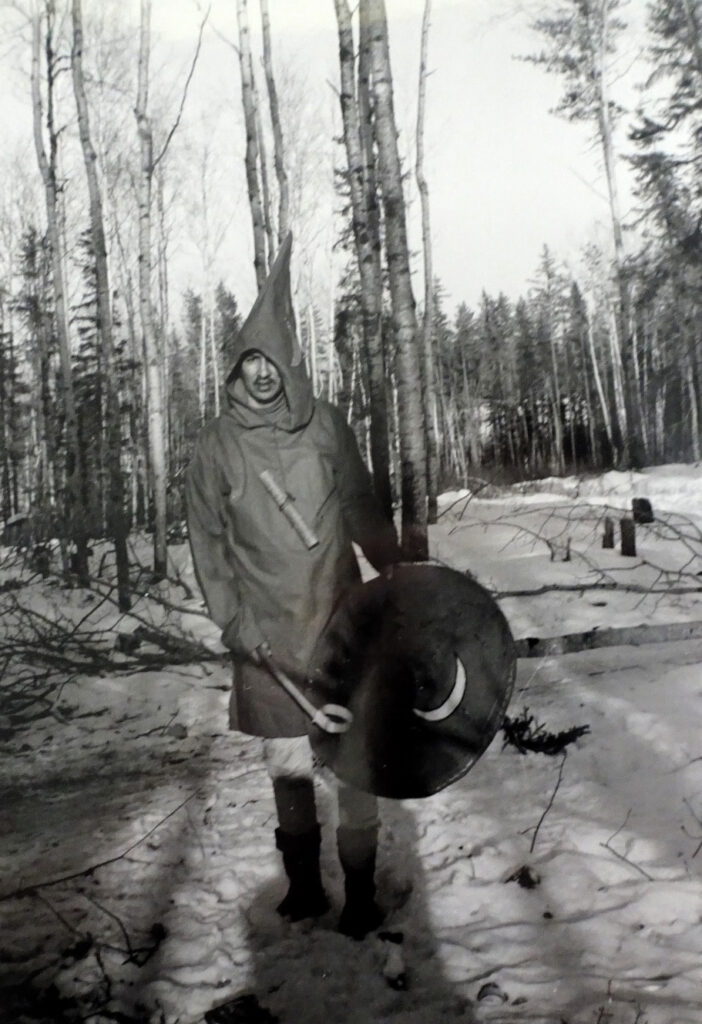
Norval Morrisseau with ceremonial drum and capot, Sandy Lake. Fonds Jacques Rousseau, dossier no. P174/B,149. The negatives are in the Fonds Jacques Rousseau, photo file B,149, Archives de l'Université Laval.
The second notebook continues the Rousseaus’ stay at Sandy Lake and describes a few requests Morrisseau has made: he would like the address of a good bookstore in Montreal and wishes to have two bundles of paper sent to Sandy Lake. A grizzly bear skull is mentioned, as well as a list of books Morrisseau would like, including one on the mound-builders. He would also appreciate copies of all of Rousseau’s Smithsonian books, if at all possible. Notes follow on Rousseau’s reference photographs. Sadly, he reported that some films had been damaged, although several developed properly. Most photographs are exterior scenes, but two show Morrisseau wearing a capot-style long coat with scroll attached and a lunar symbol on the hood. He holds a traditional drum with the same lunar symbol and a traditional bentwood beater. Others show him with his family or alone, walking off on a snowy path near his cabin, a few paintings under his arm.
Following their trip, Jacques and Madeleine Rousseau drew up a rationale for the exhibition and specific recommendations from Morrisseau and forwarded them to the Musée du Québec’s exhibition director, André Marcoux. Rousseau noted that the French texts for the catalogue were based on conversations with the artist in the forest at Sandy Lake, and statements must not be changed as they came directly from the artist. Because the catalogue would be in French only, there would be no English translations. All photos of the works would be taken by the Office du Film du Québec. As well, Rousseau noted that the paintings did not represent a survey of the artist’s work, only the years 1965 and 1966.
Madeleine and Jacques Rousseau wrote the exhibition labels and catalogue essays. Their drafts included detailed instructions for the Quebec government publisher concerning language, the tone of the labels, and the colour scheme for the cover. Jacques specified that the catalogue should be a simple but informative booklet: attractive, yet affordable for students, young people, and the public. He further stipulated that any profits from catalogue sales should go to the artist rather than to the province.
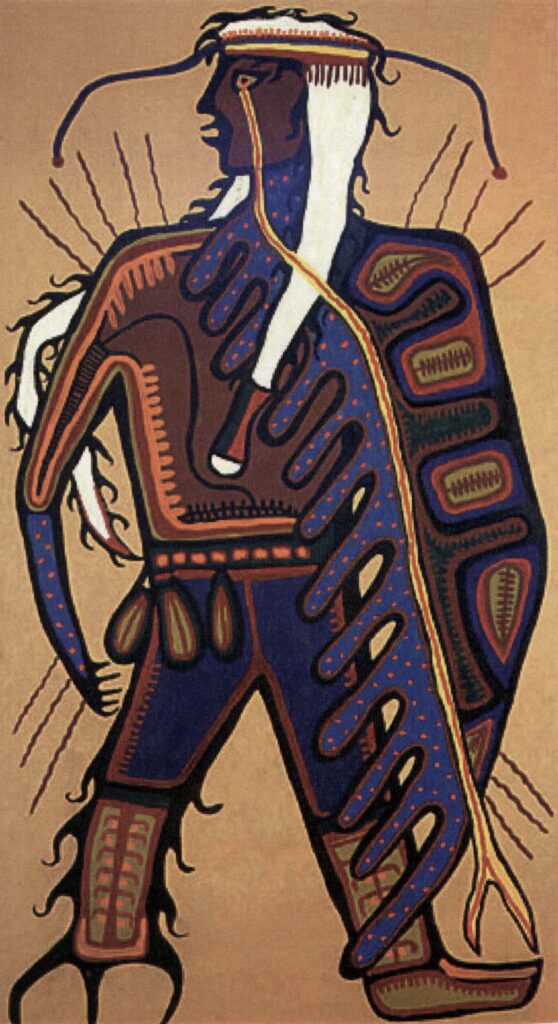
Norval Morrisseau, The Transformation of Man into Thunderbird, 1963, gouache on cardboard, 148 x 81.4 cm, Musée national des beaux-arts du Québec.
Rousseau also presented Viau with a three-page handwritten letter from Morrisseau accepting the invitation to show his work at the Musée du Québec. The artist stated his intentions clearly as well as his pride in the coming event. He hoped “that the art of the Ojibway may inspire other Indians of different tongues to reassemble the fragments or pieces which are scattered and forgotten... not knowing the value these are, but the importance it is to inspire to preserve—instead of the culture to be lost forever...." Morrisseau went on to detail that he would send his artwork to Rousseau in Montreal and how sales would be arranged by Rousseau, himself, and Leon Lippel of Montreal’s Lippel Gallery. All these archival sources attest to the mutual confidence and respect that characterized the relationship between Morrisseau and Rousseau. They demonstrate how fruitful Rousseau’s visit to Sandy Lake had been and reveal the care with which the exhibition was planned in consultation with the artist.
Back in Quebec City, the catalogue, invitation card, and exhibition poster were printed. The catalogue opened with a preface written by Guy Viau, followed by the Rousseaus’ essay, “Le Monde enchanté de Norval Morrisseau,” a brief bibliography, and sixty-nine pages illustrating works produced in 1965 and 1966. The paintings, which were not individually dated, were accompanied by detailed descriptions that, as Rousseau reminded readers, were drawn directly from his conversations with the artist. Although the catalogue was published in French, the original titles of works appeared in English, with Ojibwe titles retained where Morrisseau had provided them. Rousseau noted that, while most of the paintings had been reproduced the previous year in Morrisseau’s Legends of My People: The Great Ojibway, the publisher had suggested using Mikkinak Spirit of the Shaking Tent, which had not previously been reproduced, for the cover. Ten works dating from 1961 to 1964 were added to the exhibition and listed by title and date in the catalogue, but were not illustrated. Two works from this list—most prominently, The Transformation of Man into Thunderbird, 1963—were reproduced to accompany reviews of the show in the newspapers Le Soleil and L’Action.
The Opening: Attendance and Reception
On the evening of the opening, André Readman, the photographer for the Ministère de la Culture, took pictures of dignitaries, the artist and the large, mainly young audience in attendance for the museum’s files. A crew from the National Film Board (NFB) that included producer Marcel Carrière also covered the event. The footage is short but starts with a shot of Morrisseau walking into the exhibit before the opening, looking very serious but with an air of assurance and approval. Short clips of film taken at the opening were later used in two NFB films, The Paradox of Norval Morrisseau (1975) and The Indian Speaks (1967). Morrisseau, accompanied by an interpreter, was introduced by both Guy Viau and Jacques Rousseau. Guy Frégault, the Minister of Culture, was also present. Morrisseau then mingled with the crowd and autographed copies of the catalogues and Legends of My People.
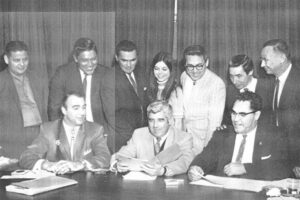
l’exécutif de l’Association des Indiens du Québec, fondée en 1965. Source : W. B. Edwards, 1966, coll. Institut Tshakapesh
In his column for Le Soleil, journalist Claude Daigneault noted the presence of several “Indians” that evening and commented that Indigenous People better supported their members than did other communities. Unfortunately, the columnist did not name any Indigenous attendees, but it is possible that one of them was Wendat chief Max Gros-Louis, known to take advantage of all possible opportunities to speak to government representatives since becoming president of the Association des Indiens du Québec in 1965. Though I have found no direct reference to his presence, the daughter of Henri Dorion, professor of geography at Laval University and president of the Commission d'étude sur l'intégrité du territoire du Québec, says her father recalled that “Max Gros-Louis was very likely there. His elegance, commitment, and diplomatic skill would naturally have led him to attend.” Gros-Louis also was a collector and owned two black and white preparatory drawings for Morrisseau’s proposed Expo 67 mural Human Mother and her Half Bear Children. According to Isa Gros-Louis, Max’s daughter, these were unfinished works that Morrisseau had offered to complete before Gros-Louis acquired them. Max stated that he liked them as they were and refused to wait, and they are thus untitled. Isa Gros-Louis added that Norval Morrisseau had stayed at her father’s house in Wendake when in Quebec and they had developed a strong friendship.
All of Morrisseau’s works sold on the evening of the opening. Allowing emerging artists to sell their work at the museum was an innovation that Guy Viau hoped would support their developing careers. He explained this unusual policy in an article by Jean Paré published in the May 1966 issue of Maclean’s: “And Viau added that if they were worthy of exhibiting at the museum, they were worthy of selling their works there.”
In line with usual practice, Rousseau carefully noted the prices and buyers’ names on the reproductions of the works in a copy of the catalogue preserved in the exhibition files of the Musée national des beaux-arts. We find there the names of art lovers, collectors, employees of the Ministère, and Rousseau’s students, including the young anthropologist Pierrette Désy. Several years ago, Désy proudly showed me the Morrisseau work, Coloured Bear, that Rousseau had prompted her to buy at the 1966 launch and that had hung ever since over the mantel in her Montreal living room. Another purchaser was Dorion, who acquired works that included preparatory drawings for Human Mother and her Half Bear Children. He recently recalled how access to Morrisseau paintings had in fact been greatly facilitated by Rousseau.
The Musée du Québec also purchased five paintings for its permanent collection: Loons and Fish, 1966, Indian as Representative as Ruler of the Earth, 1966, Three Ducks Under the Sun, 1966, Fish with Round Power Signs and Continuation Lines, c.1960, and The Hawk and the Fish, c.1960. The show remained on view for the rest of the summer. Through the pages of the Morrisseau catalogue as annotated by Rousseau, we know the prices paid and date of delivery of each work in the exhibition, as well as names of the purchasers.
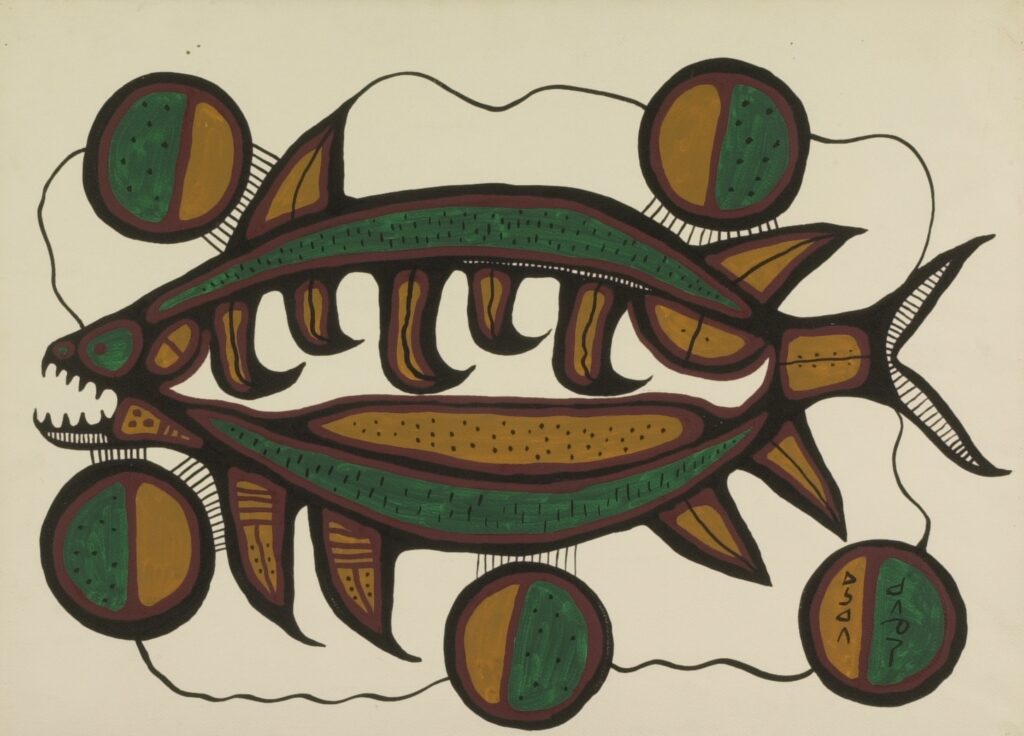
Norval Morrisseau, Fish with Round Power Signs and Continuation Lines, c.1960, gouache on paper, 56.1 x 76.2 cm, Musée national des beaux-arts du Québec.
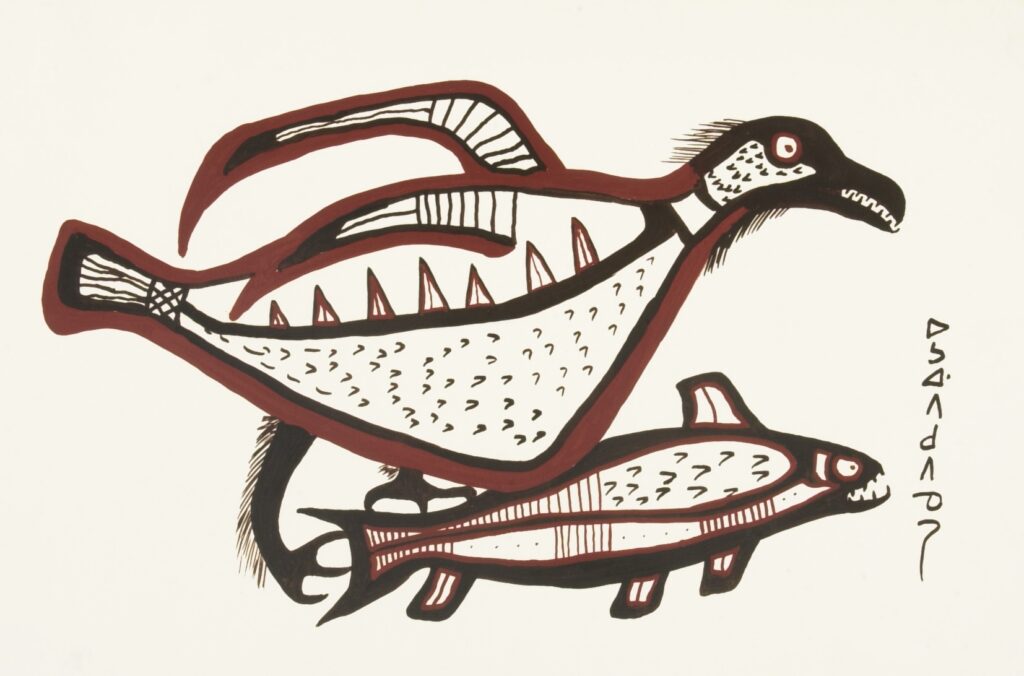
Norval Morrisseau, The Hawk and the Fish, c.1960, gouache on paper, 36.2 x 54.7 cm, Musée national des beaux-arts du Québec.
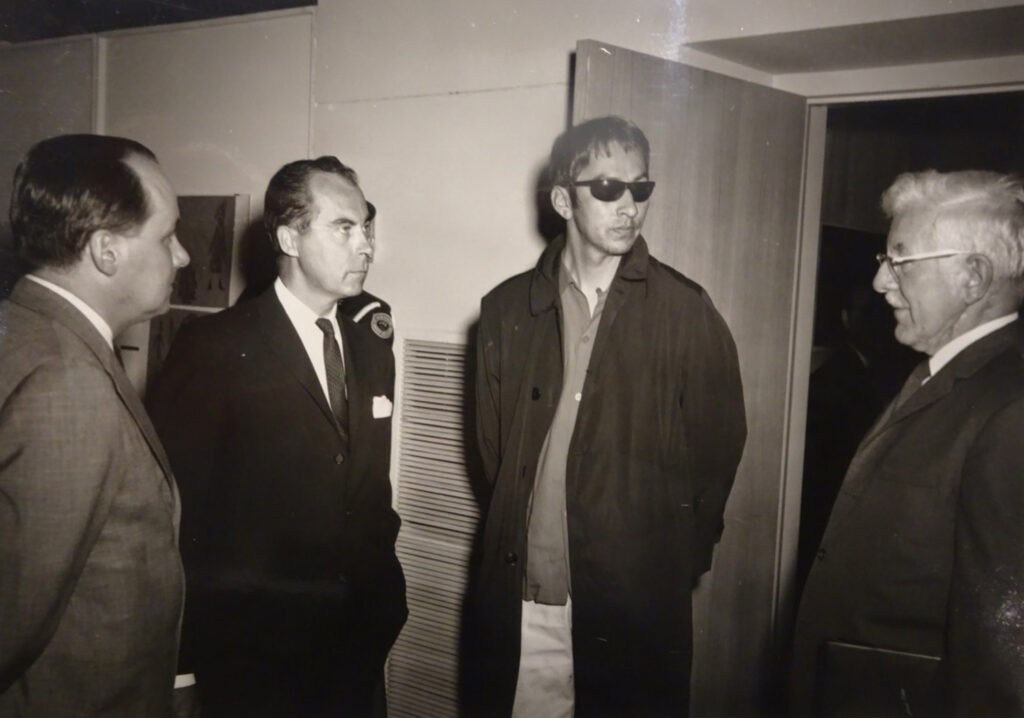
Guy Viau, Director of the Musée du Québec, Guy, Frégault, Ministre de la Culture du Québec, Norval Morrisseau, featured artist, and Jacques Rousseau, ethno-botoniste and coordinator of the exhibition project. June 15th 1966, Musée du Québec
Morrisseau’s Presence in Quebec
Word of Morrisseau and his artistic mission soon travelled beyond the walls of the museum’s exhibition galleries, and from 1966 onward he became increasingly well known within Indigenous communities in Quebec. Wendat graphic artist Mireille Sioui recalls, however, that to her knowledge, few, if any, Indigenous People saw or were aware of the exhibition at the time. Cultural institutions were changing rapidly, yet awareness of these developments did not necessarily extend to students or to communities beyond their walls.
At the time, Sioui was studying at the École des beaux-arts de Québec, where her identity and experience as a member of the Wendat Nation went largely unrecognized. Reflecting on the place of Indigenous art within the broader cultural landscape, she explains that “knowledge continued to be held within families and communities, and artistic practices remained active and very much alive, even if they received little recognition within the fine arts establishment, which was oriented primarily toward collectors. Some artistic activity was beginning to emerge on the margins of established institutions, and connections were gradually being forged between the worlds of artistic training and exhibition.” Sioui recalls the Musée du Québec and the milieu of the art school as two largely separate worlds: “It really was a world apart! We were invisible, unknown....” The distance between their respective knowledge and points of reference made meaningful connections difficult to establish.
However, young artists would learn soon after the 1966 exhibition, whether directly or indirectly, of Morrisseau’s commitment to preserving Indigenous traditions. Sioui, for example, visited Expo 67 with her parents, as her father represented the Wendat Nation. Morrisseau’s name resounded with a certain familiarity and his influence started to become more apparent to her. Nonetheless, she is adamant that the Ondigenous cultural scene was quite politically animated at the time. In fact, it was just as alive as the entire Québécois milieu—the ’60s were the ’60s.
Morrisseau did influence the path the Indigenous cultural world would take. Other artists became aware firsthand of Morrisseau’s impact through media reports of his involvement in the Indians of Canada Pavillion at Expo 67 and the opposition of organizers to the mural design he presented. Beyond the headlines, Morrisseau’s example reinforced ideas already circulating within Indigenous communities in Quebec and being put into practice by a number of individuals.
Today, Wendat sociologist and critic Guy Sioui-Durand, among others, identifies the Morrisseau exhibition as one of several influences that contributed to expanding networks, educational and cultural initiatives, and opportunities for Indigenous youth in the mid-1960s. He emphasizes, in particular, the growing importance of organized training and education. The exhibition formed part of this broader cultural momentum, which would eventually contribute to initiatives such as the influential art program at the pioneering Indigenous-led Collège Manitou in La Macaza, Quebec. In its three years of operation, from 1973 to 1976, it drew on the skill of artists like the Mexican-born artist, educator, and activist Domingo Cisneros (b.1942). Morrisseau’s continuing significance was evident in September 1987, when the Innu community of Mashteuiatsh, on the western shore of Lac Saint-Jean, presented an exhibition of his work at the Musée Amérindien de Pointe-Bleue (now the Musée de Mashteuiatsh). The show was attended by well over 20,000 visitors that fall. Later, Morrisseau’s work would be presented alongside those by Cisneros, Tom Hill (1943–2023), Ron Noganosh (1949–2017), Edward Poitras (b.1953), and Diane Robertson (1960–1993) at the 1991 exhibition L’Oeil Amérindien, Regards sur l’animal at the Musée de la civilisation du Québec.
Over the years, the Musée national des beaux-arts du Québec has continued to bring its collection of Morrisseau’s work to the public through exhibitions and publications. His 1966 exhibition, the first presentation of his work at a major public art museum in Quebec, marked an important moment both in his career and in the development of contemporary art museology in the province. Morrisseau’s confidence in Viau and Rousseau, and his willingness to enter into the partnership they proposed, established a significant precedent for a new generation of artists.