Dealers and Networks: Morrisseau's relationship with the business of art from 1955-1985
by carmen robertson
If I was a famous Artist and Sold Pictures in Sums like Picasso does... I would start this Idea on my own without seeking your Advice—but as a workerman at Kenora... help me.
–Norval Morrisseau, 1962
When Morrisseau made his complicated entry into the Toronto art scene in September 1962, the Canadian art world was largely pumped up on abstraction and unprepared for his arrival on the scene. Planning and plotting his career during the 1950s and early 1960s, he had cultivated relationships to gain support for what was, at the time, his unusual goal of pursuing a successful art practice. As he navigated his pathway as an artist in the settler art world, Morrisseau defied the odds against him by proactively soliciting support. He turned especially to the residents of the Red Lake region after he and his new wife, Harriet Kakegamic, settled in the gold mining town of Cochenour in 1958. Those early relationships are discussed in greater detail in other chapters of this book.
The artist soon discovered that his chosen path required not only artistic talent, but also an ability to navigate the business side of the art world. He found his way through this unfamiliar terrain with help of these new friends, mentors, and patrons, on some occasions launching a charm offensive to battle colonial structures, and at other times resorting to Anishinaabe protocols of reciprocity.
Managing Morrisseau: Business and Government Alignment
It was only in 1955, just as Morrisseau was embarking on his artistic career, that an Indian Act ban on the spiritual ceremonies that were primary sites for traditional artistic creativity was repealed. And only in 1962 that First Nations people in Canada became eligible to vote federally for the first time. Even with these minor advances, the heavy hand of bureaucracy continued to dictate much of the lives of Indigenous Peoples.
At the same time, the contemporary art scene—and the gallerists and curators who controlled access to it—were unaccustomed to the participation of Indigenous artists or their approaches to creativity. All too often their responses were shaped by a racialized society ridden with stereotypical images of “Indians,” which were as deeply entrenched in the art world as elsewhere. Canadian museums and galleries continued to position Indigenous artists as “primitive,” relegating Indigenous-created work, except for Inuit art marketed through a federal government system, to ethnographic or craft-related institutions.
Seneca curator Tom Hill (1943–2023) critiqued these attitudes in an article entitled “The New Age of Indian Art” in Maclean’s magazine in 1979. In the article, which featured Morrisseau’s art, Hill argued that there “seems to be an unwritten policy—painting coming from ‘primitive cultures’ is not considered high art. Their treatment of Indian artists as ethnographical oddities is nothing less than racist.” Hill’s comments confirm the challenges that faced Morrisseau and other Indigenous artists who were gaining attention in the Canadian art scene in the early 1960s. Even as the decade advanced and Morrisseau’s work entered commercial galleries in Toronto and Montreal, it was collected not by fine arts institutions but the ethnology departments at Toronto’s Royal Ontario Museum, Calgary’s Glenbow Museum, and Ottawa’s National Museum of Man (now the Canadian Museum of History). The Indian Art Centre (now the Indigenous Art Centre within Crown-Indigenous Relations and Northern Affairs Canada), which also collected his work, appeared to be something of an exception in that it was created to support, preserve, and promote contemporary Indigenous works as fine art. But it, too, was governed by a paternalistic colonial mandate, that infested Indian Affairs in its early years. This despite hiring Hill to head up the newly created Cultural Development Section of Indian Affairs in 1968, where he pushed for greater autonomy for Indigenous artists.
Yet, Morrisseau steadfastly maintained an unwavering commitment to his artistic vision. As he negotiated an art world reflecting settler values, Morrisseau manipulated established conventions, broke rules, and forged new avenues for Indigenous arts.
Dealing with the Art World: 1955-1962
From his earliest dreams of becoming an artist, Morrisseau aimed to make an impact in the art world beyond his home territory that, he knew, would require both luck and the help and advice of a wide range of people. Morrisseau took every opportunity to sell or gift his work to his circle of supporters to facilitate his future career. His first major patrons and mentors were Joseph and Esther Weinstein, who lived in the Red Lake area, and artist and amateur anthropologist Selwyn Dewdney (1909–1979), who was based in London, Ontario, but travelled widely in the north.
After the Weinsteins recommended that Norval and Harriet take their eldest child, Victoria, to Winnipeg for treatment by their friend Dr. Harry Medovy, Morrisseau also gifted and sold a selection of works to the doctor and his wife. A letter he sent to Medovy describing the range of works in different media he could provide exemplifies the artist’s early method of marketing. In March 1961, with help from Dewdney, Morrisseau received his first contract, from the Hughes Gallery in London. Sadly, the Hughes Gallery went out of business shortly after, and the arrangement fell through.
Undeterred, Morrisseau cast a wider net. He began seeking funding for an arts-related economic project he had envisioned not just for himself, but also on behalf of his community. Two senators, John Alexander “Pete” Robertson and Allister Grosart, responded to his appeal. Senator Robertson was a Kenora-Rainy River political candidate appointed to the Senate in 1962 by Prime Minister John Diefenbaker. While Robertson was not connected to the cosmopolitan art world that Morrisseau had heard about from his friends and supporters, the artist gambled strategically that the senator, with his local ties, could facilitate connections in Ottawa.
Morrisseau invoked the celebrity status of Pablo Picasso (1881–1973) in the first letter he wrote to Robertson in January 1962. In keeping with Ojibwe protocols he also enclosed a work of art as a gift to establish a reciprocal bond with the politician, a practice Morrisseau continued throughout his career. Explaining that his request was not only for himself but on behalf of “Indians” in northern Ontario who needed help beyond the meager welfare provided by the federal government, he pitched an idea for selling “Native Crafts... to Encourage a Preservation of Crafts by Indian Peoples,” in the Sandy Lake region where his wife’s family lived. Laying out a detailed plan to teach crafts to community members and market their artistic output in urban centres, including Winnipeg and Toronto, Morrisseau’s forward-thinking project requested autonomous funding that would be provided directly to his business venture rather than being funnelled through a church or Indian Affairs (at that time a branch of the federal Department of Citizenship and Immigration) as was the usual method. With this letter, Morrisseau joined his own emergent arts practice to an ambitious economic vision for supporting a larger arts movement in the region.
That June, he wrote to the Weinsteins, who had since left Cochenour, and announced, “I have now established myself and I am starting on my project.” While Morrisseau does not describe the project, he was no doubt buoyed by his many business ideas and eager to inform his supporters of his actions. The following year he queried his new Toronto art dealer, Jack Pollock (1930–1992), about how to put his designs on fabric and pottery that he would sell in regional fishing lodges as an additional income stream.
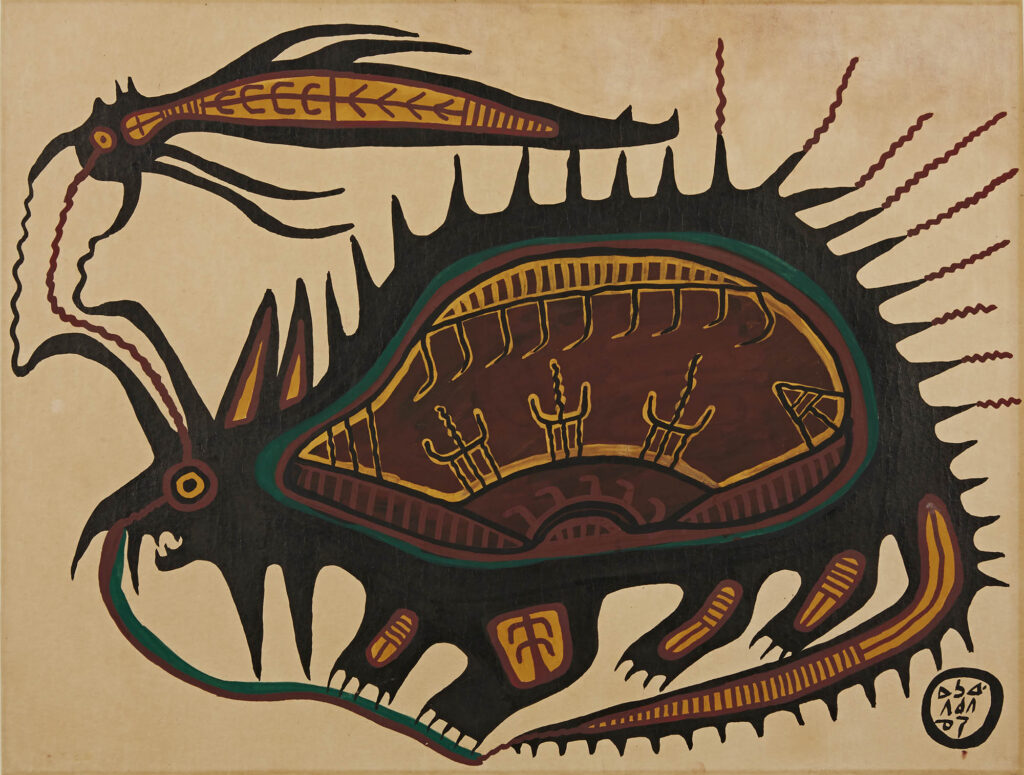
Norval Morrisseau, Mishipeshoo, 1961, gouache on paper, 83.8 x 109.2 cm, Westerkirk Works of Art.

Norval Morrisseau, Spirit Creature, 1959, tempera on paper, 45.7 x 53.3 cm.
To help Senator Robertson fully grasp the significance of the painting Morrisseau had gifted him, the artist described Mishibizhiw, its sacred subject: “the Art form is that of the Ojibwa Demigod of Water and a Demigod to Shakeing tent Rites. Keeper of all Gold—and a Ruler of water of all the world—(Mishipeshoo).” This gift, which remained with the Robertson family for many years, had the desired effect of prompting the senator to introduce Morrisseau to Senator Allister Grosart, who soon became a significant force in Morrisseau’s early career. A former journalist, public relations consultant and political strategist who had also been appointed to the Senate in 1962, Grosart had greater political traction in Ottawa than Robertson, and had been viewed as an architect of Diefenbaker’s 1957 win. He introduced the artist’s work to influential Canadian anthropologist Marius Barbeau (1883–1969) and promoted his art in national political circles. It was not long before Morrisseau gifted Grosart, too, with a painting. Spirit Creature, 1959, an earlier representation of Mishibizhiw, helped forge their alliance. Eager to assume an not entirely selfless role in Morrisseau’s success, Grosart gave formal remarks on behalf of the Canadian government at Morrisseau’s Pollock Gallery exhibition on September 12, 1962. After the financial windfall of that show and Morrisseau’s subsequent struggles with his gallery, the senator would step in to oversee his finances.
Dealing with the Art World: 1962-1965
Jack Pollock, whose Toronto gallery showed major Canadian, European, and American contemporary artists from 1960 until it closed in 1983, has often been referred to as Morrisseau’s “discoverer.” As he himself proclaimed in Dear M: Letters from a Gentleman of Excess, his 1990 compilation of his letters to a Toronto psychiatrist: “If I were to die tomorrow, the single most important thing people would remember me for is, damn it, the discovery of Norval Morrisseau.” The business aspect of Pollock’s relationship with Morrisseau was, however, frequently rocky.
Much has been made of the initial meeting in July 1962 between Morrisseau and Pollock in the town of Beardmore, located about 200 kilometres northeast of Thunder Bay and both had been encouraged to meet. Morrisseau was primed to push forward his dreams of artistic greatness after learning Pollock would teach an art appreciation course for the art club funded by the provincial government.
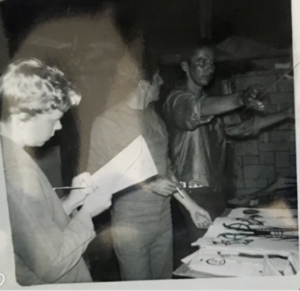
Jack Pollock and Norval Morrisseau, July 1962, photographer unknown.
Norval Morrisseau at the opening of his exhibition at the Pollock Gallery, Toronto, September 13, 1962, photograph by Frank Grant / Toronto Star.
Pollock opened the Pollock Gallery in 1960 in Toronto, after studying art at the Slade School of Fine Art in London, England. The art dealer recalled his first impression of the aspiring artist as “lean,” “a bit savage,” and a “virtual mix-master of emotions and personalities.” A photo taken during their initial meeting shows a young Morrisseau actively engaged in presenting his art to the Toronto art dealer. Nattily dressed for the occasion in a shimmery shirt, Morrisseau surely understood the importance of this opportunity for his career. Pollock’s characterization of him as “a bit savage” would seem to be part of the stereotyped and romanticized narrative he would manufacture to mythologize the artist. Pollock recounted: “He [Morrisseau] wanted me to pay him five bucks each [for the thirty works Pollock chose to take back to Toronto for an exhibition]. I had to explain that wasn’t the way I did business—that I’d take them, get them framed, exhibit them, and keep 25% of what they sold for.”
The September 1962 exhibition of Morrisseau’s work at the Pollock Gallery was remarkable in many respects. A key moment in Morrisseau’s artistic career, it introduced his new and fertile visual language to the Toronto commercial art scene. The show was a huge success, selling out the first night. The media spectacle that surrounded it not only opened a new sphere for Morrisseau’s art but also altered the history of Indigenous arts in Canada.
While the show resulted in a windfall for Morrisseau, subsequent correspondence illustrates the extent to which the artist, while entering what seemed at first to be new territory, would soon become entangled in the same paternalistic struggles that he and other Indigenous people of the time knew all too well. Pollock notes in an essay he wrote for the monograph he and Lister Sinclair published in 1979 that he sent Morrisseau a statement and cheque following the successful exhibition. The total value of all paintings sold was $4,320, of which Morrisseau’s share, after the agent’s fee and other expenses, was about $2,600.
Pollock reported, however, that the artist was soon broke: “He phoned me collect asking for more money, and gradually news filtered down that most of the Indian community of Beardmore had been drunk for a week.... It became clear to me that I was not dealing with just another artist.” Another account says the funds were used for frivolity, alcohol, and gifts. After this initial payment, but prior to the formal establishment of a trust, Pollock changed to paying Morrisseau “outright, one [painting] at a time, with the idea that he would never have a huge amount of money at any one time.” Later, however, “I’d pay quite a bit at once, because I was buying a large number of pictures.” By early 1963, Pollock came to understand that the business side of his relationship with the artist was more complicated than he had first imagined.
Just five months after the sell-out show in mid-February 1963, Morrisseau wrote to Pollock questioning his dealer’s failure to make further payments from what must, from his perspective, have been a continuing financial windfall. After niceties regarding the possibility of an ongoing relationship, he wrote: “But first you must give me my money that is due to me months ago.” Clearly frustrated, Morrisseau ended the letter by noting that if the account was not settled, he would turn the issue over to Indian Affairs to “Look After My Interest without Delay.” A copy of Pollock’s budget reckoning for the 1962 show was supplied to Indian Affairs (perhaps following a call from the artist for help). As well as sales figures, it lists expenditures of $609 advanced for Morrisseau’s trip to Toronto for the opening that included airfare, a new suit, and other costs the artist seemed to have been unaware of were subtracted.
In a nine-page letter to Pollock two weeks later, Morrisseau followed up on a phone conversation the two had had in the intervening time. He again began by politely thanking Pollock—“I will say that I am very pleased with your Constant Efford to work on my behalf and I will ASSURE you I will do my utmost best I repay you for your Effords [sic] in me”—and wrote that he prayed for Pollock to the “Ojibwe Ancestral Gods.” Pollock had learned of his own Indigenous ancestry just prior to meeting Morrisseau, according to his memoir, and conveyed this information to Morrisseau, perhaps in an effort to create a stronger bond, which for Morrisseau was important. In this same letter, Morrisseau draws attention to Pollock’s indigeneity and asks that he forget their past issues, “...if you are part Indian you will forget everything as I have already as nothing can be undone.” He then reiterated his earlier inquiries regarding outstanding payments and his hope that they could move forward together: “So Let the Hatchet be Burried [sic] I have learned a lot of things these past six months and now I am I believe learned a lesson,” and admitted to his own learning experience: “You must have been aware I did not know the art world except I was becoming an artist but not the real business part of what I should do or what is expected of me.” It was the business side of the art world that Morrisseau sought to clarify.
Continuing on a fresh page with “Except” circled in ink for emphasis, he reminded Pollock that they had not yet discussed a future relationship “as an Artist and Agent basis” as he had requested on several occasions. Morrisseau again candidly confessed that “I did not know the Art World.” He added that although people asked to purchase art directly from him, he wanted to sell his art “in a business manner.” The letter ended with a repeat of the threat to involve Indian Affairs. In his 1990 memoir, Pollock wrote little about this aspect of their business and personal relationship, choosing instead to focus on Morrisseau’s artistic impact.
After the persistent efforts to clarify his contract with Pollock in 1963, the artist received an invitation from Pollock and Senator Grosart to meet with them in Toronto that fall. Pollock, it seems clear, had complained of Morrisseau’s behaviour and difficulty in understanding how his profits were being calculated and had asked for Grosart’s help. The dealer and senator instituted a trusteeship. At the Toronto meeting they presented the artist with their plan. Lawyer David Rutherford would set up the trusteeship that would provide financial oversight of Pollock’s sales of Morrisseau’s work, and Pollock would send Morrisseau a monthly stipend drawn from the deposit of Morrisseau’s portion of sales into an account that would provide him with a minimal but steady income over which he had no say.
The agreement purposely gave Morrisseau little control over the funds. It also gave the Pollock Gallery the exclusive right to sell Morrisseau’s work, a common commercial art world practice. But—highly uncommon—it provided for overall surveillance of the artist’s activities and potential unreported sales by a Red Lake regional Social Welfare employee, Madeleine Cooper.
The level of control and scrutiny afforded to Pollock and Grosart, especially with Cooper’s surveillance role, was invasive and paternalistic, and went far beyond the sale of art. For example, a March 1965 letter from the lawyer to Grosart reported: “Mrs. Cooper says that Norval has been despondent and is drinking and she hints that he might try to sell some of his paintings to local residents without our consent.”
Despite the restrictions and surveillance, Morrisseau asserted autonomy by marketing and selling art in areas beyond the reach of the Toronto handlers. He began to rely heavily on his friend Susan Ross, a fellow artist, to facilitate sales in 1964. The niece of documentary filmmaker Robert Flaherty (1884–1951), best known for Nanook of the North (1922), Ross sketched and painted portraits of Indigenous People in northwestern Ontario and Nunavut. Morrisseau benefited from her contacts with collectors and sales outlets in these regions, as well as in the Port Arthur/Fort Williams area where she lived. She also visited the artist and his family in Beardmore and Sandy Lake. The rich collection of correspondence between Morrisseau and Ross, penned between 1963 and 1968 and preserved in the Thunder Bay Art Gallery, offers insights into their friendship and business dealings.
Seeing Ross as “a good saleswoman,” Morrisseau asked her to check places his art was for sale, noting that “even 12 or 15 is plenty” if they were beyond the control of Pollock and the trust. He said in a follow-up note: “I am very pleased with your Service, and Please Pay Mr. Marshall Wells the $150 owed plus $35.00...” and adds that if she wishes to buy the “ark” [migration painting] “I will sell it to you for $50.00.” Later he asked her to check “Nanabojous Curios” to see if they had sold paintings Morrisseau left with them. He also asked her for help shipping work to a gallery in Winnipeg for a show there.
Throughout this period, Morrisseau continued working on his book project, Legends of My People, in collaboration with Selwyn Dewdney. Exhibitions in Montreal and Quebec City established Morrisseau as an artist in Quebec. In 1964, Morrisseau sold a painting to Alfredo Santos in Montreal and included a formal letter of agreement giving Santos the “right to sell my Art which he has and only what I will Ship him-this is a Pravate Dealings between both Partys.”
A widening circle of Morrisseau collectors and supporters in the Red Lake area in the 1960s and 1970s helped the artist in his efforts to distribute his art independently of his Toronto dealer. Supporters included John and Doreen Sweeney, who ran the Sears outlet in Red Lake and sold much of their collection to the Royal Ontario Museum; Paul and Mary Okanski, who sold Morrisseau’s work through their P & M What-Not-Shop (much of their collection and archive of notes, letters, and IOUs are housed at the National Gallery of Canada); local engineers, geologists, school teachers, and other community members; and the family of clothing designer Linda Lundström, who grew up in Cochenour during the 1960s.
Lundström recalled Morrisseau walking around town with artwork on rolls of birchbark or kraft paper under his arm. Morrisseau would visit her mother, who ran a fabric store in the basement of their house, and the two would trade fabrics for art: “Harriet, his wife, was a beautiful seamstress and sewed everything by hand and she did beautiful beadwork and moccasins,” Lundström remembered. In one anecdote that demonstrates his creative and entrepreneurial ideas, she describes how he went to the machine shop at the gold mine to have someone weld two pieces of metal together. When curious onlookers asked what he planned to do with the welded rods, he said he was going to bury them in the ground for five years and, once they were corroded, dig them up and sell them to American tourists as artifacts. Lundström added, “he was a real good salesperson for his art.” Irene Dewdney described a visit to the studio of London, Ontario artist Greg Curnoe (1936–1992) that Selwyn Dewdney arranged, and noted Morrisseau’s strong sense of self-assuredness.
In October 1963, Pollock opened a small show of Morrisseau’s art. The artist did not attend. Although Kay Kritzweiser wrote in the Globe and Mail that the work “shows that his primitive talent had capacity of growth and enlargement without loss of the native genius,” the exhibition was not financially successful: a reminder that Morrisseau was not immune to the boom-and-bust reality of the art market.
When Morrisseau visited Toronto in March 1964, he stopped first to visit Selwyn Dewdney’s family in London, Ontario. He brought his wife and children, Victoria and Albert (Alfred). They went on to Toronto and stayed with Millie Ryerson, who had purchased several of Morrisseau’s works and happily invited the family into her home. The artist had with him eight new paintings. Pollock quickly capitalized on the impromptu visit by organizing a press conference for the following day. Morrisseau wore a beaded buckskin jacket, and the baby boy was nestled into a tikinagan, or cradleboard.
Norval Morrisseau with his wife, Harriet, daughter Victoria and son Eugene, 1963, photographer unknown.
This time, the event created an immediate buzz that translated into sales. Photos of the family snapped by a Globe and Mail photographer were published in the paper on March 21, 1964, and reproduced over the coming months. This photograph of the family also illustrated a story by Joy Carroll in Canadian Art entitled “The Strange Success—and Failure of Norval Morrisseau.” A year later the Globe and Mail reprinted the photo to announce an exhibition at the University of Toronto’s Hart House, the elite venue associated with the Group of Seven, in January 1965.
Despite the rebound in Pollock Gallery sales, Morrisseau remained unhappy. In September 1964 Morrisseau confessed to Susan Ross that he was ready to cut ties with the Pollock Gallery, even as he sent best wishes for her own upcoming show there. After learning through Ross of Morrisseau’s many side dealings, Pollock sent him a letter saying: “The idea of an agent is a two-way benefit,” and added that their arrangement would fail “unless you learn to control both yourself and your art.” In December 1964, Morrisseau sent Pollock a formal letter announcing his decision to cancel the dealer contract. It began: “After carefully considering your request for more art and the show you mention… I wrote to some people who I ask for advice if it would be possible to rebuild something out of the ashes of my past troubles and I must agree with my advisors as well as myself I am sorry Mr. Pollock, I don’t feel it will do you or me any good except financially and I won’t commit myself to your gallery again.” Morrisseau also asked Pollock to cancel future shows and said he would send no more art. He concluded, “then again it does not matter to me what you do for I know what I am.” Shortly afterward an affidavit signed by Pollock was forwarded to the artist. It stated that he was ending his contractual relationship with Morrisseau in all aspects except for the important upcoming exhibition he had curated for Hart House, scheduled to open in January 1965.
The Hart House exhibition was significant for Morrisseau, as it resulted in greater exposure for the artist in Toronto beyond the Pollock Gallery. As with earlier shows, the exhibition situated Morrisseau within a narrow ethnographic frame. It also reflected government involvement: at the opening Senator Grosart read greetings from Barbeau, who, despite his retirement from the Museum of Man, was still closely associated with that institution. (Barbeau purchased one of Morrisseau’s portraits from the show for his home.)
Most of the twenty-seven works in the show appear to have been sold. The Man Who Became Thunderbird, 1964, the largest work in the exhibition, shows Morrisseau’s ongoing exploration of transformational subject matter. Student reporter Gail Dexter [Lord] was laudatory in her review for the university newspaper. She had visited Morrisseau’s 1962 exhibition at the Pollock Gallery with her parents and met the artist, which no doubt informed her understanding of his work.
The Globe and Mail’s Kay Kritzwiser also reviewed the Hart House show. She reported that the art on display “leans heavily to the four colours sacred to the Indian,” and included a description of Morrisseau’s elaborately beaded coat, the same one he had worn to the Pollock Gallery in March 1964. Her review departed from the conventions of art criticism by dealing mostly with the trusteeship. She assured her readers that “Morrisseau, his wife Harriet and their children will benefit by the guidance and advice of the trusteeship,” conveying to the newspaper’s readers the need to maintain oversight of Morrisseau and Indigenous art more generally and reinforcing racialized stereotypes. At the same time, however, the journalist herself —and likely her readers—should have been aware of the ways that Indigenous People were taking matters into their own hands during this decade: Kritzwiser also covered the visit to the exhibition of Kanien'kehá:ka activist Kahn-Tineta Horn (b.1940), photographed in front of one of Morrisseau’s Thunderbird paintings, to promote Indigenous self-governance. Horn said of the exhibition, “Such art flows through the blood of my brothers and sisters—but how little of it reaches the white man’s salons.”
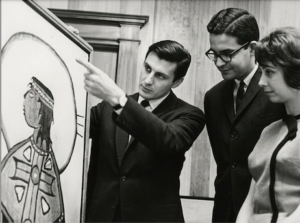
Jack Pollock with clients viewing Morrisseau's Child Jesus, c.1965, photographer unknown.
Despite their apparent rupture in late 1964, Pollock’s hold on Morrisseau’s finances continued. In September 1965 an increasingly frustrated Morrisseau wrote to Grosart proposing a new approach, one that might have been inspired by his disillusionment with the profit motives of commercial galleries. He argued that he should be awarded a special artist grant as the “one and only Ojibwa Indian Artist of all Canada that does art.” Morrisseau also pleaded with Grosart to increase his monthly stipend from $150 to $350 and complained that Pollock was not selling his work for fair prices. Referring to the dealer as his “So Called Agent or Gallery,” Morrisseau explained his reluctance to send art to the Pollock Gallery or to the senator: “I Cannot Part with them, Not until I get Full Value of Established Prices in my Hands.” Grosart replied: “You mention your dissatisfaction with Jack Pollock. I can only tell you that he is as anxious as any of us to see you get your rightful recognition. There is no gallery owner in Toronto whose reputation for integrity is greater than his.”
Morrisseau wrote again, questioning how he could be expected to abide by a legal agreement that did not allow a father to provide food for his children: “if his children Belly’s [sic] are Rumbling. Children Don’t understand if you tell them wE have to wait for our food—again the person involved would do anything to feed his children.” The trust was withdrawn later that month.
Morrisseau’s request for an artist grant was fulfilled in 1966, although it is unclear who initiated this, and he announced the end of his dealer agreement with Pollock: “I do believe Now I am a free Agent.” The grant, however, was contingent on Morrisseau working with Pollock. Although the artist had some say in how the funds were dispersed, he remained bound to the dealer.
The difficulties Norval Morrisseau experienced as an Indigenous artist in navigating the established business practices of the settler art world were not unusual. In an essay written in 1998, Tom Hill explained that during the 1960s, the marketing of Indigenous art was “all over the place with major artists.” Hill concludes: “It was a period in which the Department of Indian Affairs seriously tried to put some stability into the market. It never materialized as it should have, but there was some effort made.”
From Quebec to France, 1966–1969
Morrisseau had first established his presence in Quebec with a show at the Galerie Agnès Lefort in Montreal in 1963. In October 1966, Morrisseau met Herbert Schwarz when the artist was doing preliminary work for his Expo 67 mural commission for the Indians of Canada Pavilion. Schwarz, a Montreal physician and gallery owner, was serving as an art consultant for the fair. Schwarz and Morrisseau quickly became friends. While a large exhibition at Schwarz’s Galerie Cartier in Montreal in December 1966 seemingly resulted from this contact, Schwarz and Pollock had already begun planning the show, and possibly the two additional shows in 1968 and 1969 that included some of the same artworks, without Morrisseau’s knowledge.
The earliest identified correspondence between Pollock and Schwarz dates to June 1966, when Morrisseau’s art was being shown at the Musée du Québec (now the Musée nationale des beaux-art du Québec) in Quebec City, a show curated by Jacques and Madeleine Rousseau with input from Dewdney. Schwarz often wrote quick notes to Pollock on his prescription pad—prescriptions for art sale success. In one, he instructed Pollock to buy “all the paintings you can get your hands on! I may go to Sandy Lake this summer and pick up 100–200 in a truck.” A second note, written the same day on the same prescription pad, declares: “VICTORY” in all caps followed by: “We are in.” The tone of these messages reads less like a curated art exhibition and captures the financial gains that motivated both Pollock and Schwarz.
With these machinations unfolding, Schwarz purchased an initial twenty-two works directly from the artist in September, after a meeting in the summer with Morrisseau and Harriet in Ottawa, where they were being hosted by the Department of Cultural Affairs. Morrisseau subsequently wrote to Schwarz to tell him that he had forwarded eleven recent paintings and was hoping to send the rest in four days. A letter that Morrisseau wrote to Pollock in Toronto on the same day shows that, as far as he knew, the Galerie Cartier show had been set up without Pollock’s input. He warned Pollock that his “gallerist territory” did not extend to Quebec and that the Galerie Agnès Lefort (which was bought by Mira Godard [1928–2010] in the early 1960s and had organized Morrisseau’s 1963 show in Montreal) would handle sales in Quebec.
Morrisseau no doubt believed by this point that he had figured out the business of art and his letter was meant both to let Pollock know about the upcoming show and advise that his services were not required. Yet, it became clear to the artist that Schwarz and Pollock had joined forces to plan an exhibition at Galerie Cartier, and at this point, Morrisseau made no further mention of Galerie Agnès Lefort and agreed to continue to work with Pollock. The letter also detailed the artist’s plan for utilizing the recent $4,500 grant from Indian Affairs, which was to be administered through the Pollock Gallery. Morrisseau would use $500 for art supplies for the upcoming show and instructed Pollock to place the rest in his account. Morrisseau asked to be paid out twice monthly from the account with a more generous stipend than the original trusteeship agreement had provided. Morrisseau signs off with, “My friend, I will Remain the same to you—No matter how HIGH I make the waves Roll.” This letter reveals the artist’s growing understanding of the constraints placed on him when working with gallerists.
Pollock and Schwarz jointly purchased a large number of works at low prices, some from the Pollock Gallery’s holdings and some directly from the artist for the Galerie Cartier show. Correspondence between Schwarz and Pollock continues through the fall of 1966. After the meeting with Morrisseau and his wife in Ottawa, Schwarz reported to Pollock, “This time he [Morrisseau] was sober and very reasonable. He was staying at the plushiest motel in Ottawa all expenses paid by the Government. By the time I got to him he sold three large paintings for over $1,000.” He complained, however, about the twenty-two works Morrisseau had sold him for the upcoming show: they were “not at all good,” “some of them very weak,” and “Harriet had apparently helped him in the production.” Schwarz nonetheless purchased the works, boasting to Pollock, “I got the whole lot for $450.” He crowed to Pollock: “I told him that never again, will I buy another painting from him, unless it is a large one, preferably in oil, preferably a legend or a large figure or two on a brown or canvas background.”
Morrisseau urged Schwarz to purchase thirty more works. Schwarz took the bait, explaining to Pollock, “I told him that I’ll give him $1500 for the lot and he is calling me on Wednesday to let me know if they are on the way.” Schwarz noted to Pollock that “there are people all around him trying to grab his paintings” and resolved that they would be “pretty lucky” to get additional works for the negotiated price.
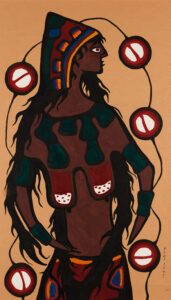
Norval Morrisseau, Mother Earth, c.1966, gouache on cardboard, 140 x 81.5 cm, Canada Council Art Bank, Ottawa.
One large artwork that may have been part of the second shipment from Red Lake was Mother Earth, c.1966, a work that remained in Schwarz’s collection until it was acquired by the Canada Council Art Bank in 1972. The impressive three-quarter image of the central figure surrounded by five white and red split circles connected by black line includes elements of the artist’s visual vocabulary in the late 60s. Stylized hair, a colourful hood, arm bands, and detailed yoke all convey spiritual majesty. The work must have been a favourite of Schwarz’s, since he held onto it even as he sold dozens of other works in the three exhibitions organized with Pollock.
Morrisseau and the two gallery owners signed a formal contractual agreement in early November 1966. Pollock wrote Schwarz that month to let him know “we have been able to round up twenty-four more works by Morrisseau.” In the end, the show at the Galerie Cartier included ninety-five works. A November letter from Pollock Gallery assistant Eva Quan to Schwarz outlines the Pollock Gallery’s planning for the show, beginning with a shipment of works to Montreal in the coming weeks. She reminds him that the two dealers would need to “decide on the official name of each painting—we have merely described them at this point.” (The entries for the list of works written in pencil on La Galerie Cartier letterhead have faded over time, making it difficult to recognize individual works.) In response, Schwarz asked Pollock to arrive early so that they might hang the show together. Pollock and Schwarz set to work manufacturing titles and hanging the artworks in hopes of a financial windfall. Schwarz confided, “I only hope that our exhibition will be a success to make some money for you and me!” Morrisseau had already been paid for his art so there was no need to figure artist’s fees into the sales. Still, the artist, too, was caught up in the excitement and sent a note to Pollock: “Now Jack, make a good show and advance me two hundred dollars right away in order [for me] to come down.”
During the exhibition, Schwarz sent notes to Pollock on a couple of occasions to report sales figures (on day three, for example, sales had reached $5,200). Two weeks later he laments to Pollock: “V. slow! In spite of tremendous publicity, we are at $6,500 now... Can’t understand it.” But he adds: “We only have to sell one out of that lot, one of the bigger ones to be OK.” Schwarz ends his note by getting in a dig at the artist, explaining to Pollock that Morrisseau is “buying himself a house in Beardmore—‘a very large one’ for $350!!” Finding this low-priced real estate deal amusing, he adds, “As he has not got a cent he asked me to lend him money for his ‘art’ which he will deliver in the future.” Such comments reveal the economic interest that underpinned the exhibition. It also sheds light on the exploitative nature and questionable business ethics of the two gallery owners’ enterprise and relationship with Morrisseau.
The 1966 Galerie Cartier exhibition was the first step in an international marketing plan orchestrated by Schwarz and Pollock, with exhibitions to follow in Newport, Rhode Island, often referred to as a playground for America’s elite, and Saint-Paul-de-Vence, a celebrated centre for fine art on the French Riviera.
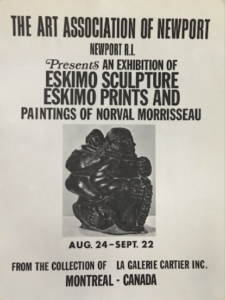
Poster for exhibition in Newport, RI.
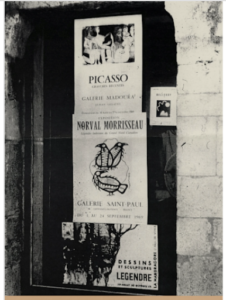
St. Paul de Vence exhibition poster.
The show at the Art Gallery of Newport in August 1968 featured Morrisseau’s work alongside selections from Schwarz’s Inuit art collection. The poster for the show features a soapstone carving but not an image of Morrisseau’s art. Two wealthy Americans, Lawrence Rockefeller and Harvey Firestone III, purchased works by Morrisseau from the show.
The solo Morrisseau exhibition at Galerie Saint-Paul in Saint-Paul-de-Vence in September 1969, with both Pollock and Shwarz attending the opening, advanced a mythology around the artist based largely on their marketing, including a romanticized essay penned by Schwarz. While neither gallery was able to accommodate a large number of Morrisseau’s works, the impact of the shows, especially the one in France, was important for Morrisseau’s career and helped to increase his sale prices in the 1970s.
Correspondence between Schwarz and Pollock began to trickle out after the Montreal show. Schwarz wrote to Pollock shortly before the September 1969 exhibition in France in response to Pollock’s request for $575 owing to the Pollock Gallery from the sale of an unidentified Morrisseau painting at the Newport exhibition. Schwarz included a cheque for $250 with the letter and outlined his plan to collect and repay the remainder of the debt. He added that although he had since closed his Montreal gallery, plans were moving ahead for the pivotal show in France. “... [I]f possible... if I get short of his work. I’ll call on you. I haven’t heard from him for at least two years and I haven’t got a clue what he is doing.”
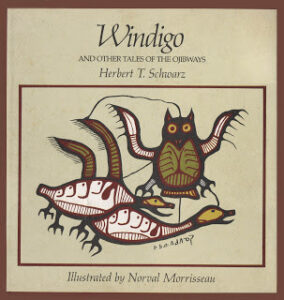
Cover of Windigo and Other Tales of the Ojibway, by Herbert T. Schwarz, illustrated by Norval Morrisseau (McLelland & Stewart, 1969).
Despite what he wrote to Pollock, Schwarz had, however, maintained a relationship with Morrisseau, and not only as a dealer. He had written an essay on his art for the Quebec arts journal Vie des arts, which the journal published instead of one submitted by Rousseau, who had curated the Musée du Québec exhibition. Schwarz’s article did double duty as the essay for the Saint-Paul-de-Vence exhibition catalogue. In 1969, shortly after the French exhibition, he published Windigo and Other Tales of the Ojibway, a book based on Indigenous stories mostly supplied by the artist with commissioned illustrations that Morrisseau produced during 1966. Schwarz recounted on the book’s jacket cover his first encounter with Morrisseau in 1966, and his introduction to the book continued to promote a romanticized and primitivist image of Morrisseau: “Then, among these wordless and defeated people, a man was born who had vivid visions of their past greatness, and the strength and insight to recognize the value of their legends... saving them from passing into total oblivion.” While Schwarz goes on to laud Morrisseau’s paintings in modernist terms as “spontaneous, free and entirely original,” he conflates his art as an admixture of “ancient rock art paintings” with “a primordial Asiatic root."
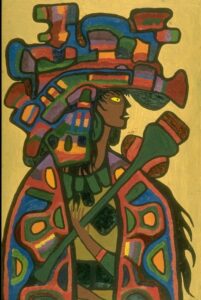
Norval Morrisseau, The Thunderbird Boy, 1966, oil on Masonite, 121 x 80.5 cm, Canada Council Art Bank, Ottawa.
Morrisseau clearly appreciated the efforts Schwarz made to support his art career. He referred to him as Paisk, a powerful figure who appears in “Ishka-Maatuk and the Thunderbird Boy,” one of the stories included in Windigo and Other Tales of the Ojibways. In this story, an Ojibwe woman encounters Thunderbird, who has taken the form of an Indigenous man, and they have a son named Paisk, Thunderbird Boy. The connection between Morrisseau, Copper Thunderbird (a name he sometimes used for himself), and his gifting of the name Thunderbird Boy to Schwarz conveys a close relationship. Morrisseau may have also gifted him The Thunderbird Boy, 1966. When Schwarz sold his art collection to the Canada Council Art Bank in 1972, this work was included.
A letter written by Morrisseau in October 1969, following the successful exhibition in France and the sale of the original drawings made for Schwarz’s book, offers further insight into the close relationship they had formed. Morrisseau did not mention Pollock in the letter but said that he was eager to paint additional artworks for Schwarz and alluded to a discussion they had had about Schwarz becoming his art dealer. As noted earlier, Morrisseau confided to Schwarz about going “tourist trade” for quick sales, but the making of second-rate art “has to Stop—Now that your willing to offer me your Assistance again” and added that “my private [sketch] books are loaded with ideas.” He had work ready to send, but in the opinion of “Harriet and Myself... it needs some more work.” This is the end of known correspondence between Morrisseau and Schwarz and it appears that the two did not work together after this. In an interview with Jim Stevens in 1972 Morrisseau said of Schwarz, “He was a man who had a lot of money, was willing to offer me all kinds of money but then again I didn’t like the idea… I severed myself.”
During this period he did sell a large number of works to James Casey, a collector in Edmonton who had first encountered Morrisseau’s art at the Glenbow Museum in Calgary. Morrisseau wrote to Casey on September 9, 1969, to explain a delay in sending some of the works, as he was waiting for the arrival of a supply of kraft paper that would enable him to paint eight more large works. Morrisseau sent the eight works for potential purchase by COD freight and noted that the prices he offered were well below gallery pricing. He asked in lieu of part of the payment if Casey would arrange to have five Ukrainian Orthodox icons and several bibles, one in Cree syllabics, shipped directly to Morrisseau at McKenzie Island (now part of Red Lake), which the buyer did. In total, Morrisseau sent nineteen works, which he referred to as Art Forms in his correspondence, between May and December 1969. They included Merman–Ruler of the Water, 1969, Misshipeshoo–Earth Monster, 1969, and Mother Earth, 1969.
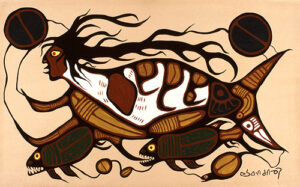
Norval Morrisseau, Merman–Ruler of Water, 1969, acrylic on paper, 101.6 x 162.5 cm, McMichael Canadian Art Collection, Kleinburg.
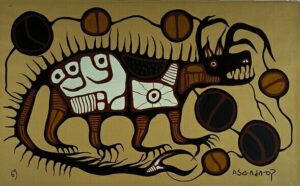
Norval Morrisseau, Missipeshoo–Earth Monster, 1969, tempera on paper, 101.6 x 162.1 cm, McMichael Canadian Art Collection, Kleinburg.
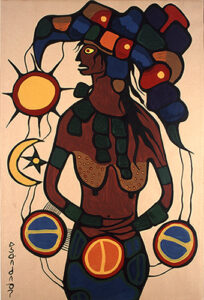
Norval Morrisseau, Mother Earth, 1969, tempera on paper, 151.7 x 101.9 cm, McMichael Canadian Art Collection, Kleinburg.
Conclusion
In just seven short years, Morrisseau went from being unprepared for the business end of an art career to working with curators and gallerists to mount significant exhibitions in Canada and abroad. His success did not come easily. He had to negotiate such practical barriers as distance from urban markets and a lack of availability of art supplies. But more critically, the profit motive driving the mainstream art market and its view of art as another commodity tripped Morrisseau up again and again. Though he was an expert at building relationships, the established rules and practices that surrounded the selling of art were foreign to him and often did not align with his own ideas about marketing and art sales.
Morrisseau instead carved out an unorthodox path. He sold and gifted art to local community members, shipped work by train to large urban centres, used materials outside the traditions of European art, reached out to senators, convinced curators of his artistic vision, and learned how to negotiate with dealers. Despite the questionable arrangements that came to characterize his relationship with Pollock and Schwarz, he would go on in the 1970s not just to work amicably with Pollock for several years but to show an astute understanding of the broader Canadian art world and his place in it.
In making this path for himself, Morrisseau drew on the protocols of his culture as well as his innate charisma and his unwavering commitment to his vision. He frequently confounded and even frustrated those he was dealing with. But the reality may be that few supporters, handlers, or media pundits were prepared to fully understand the complicated person that was Norval Morrisseau.