Travelling with the Shaman-Artist
by Armand Garnet Ruffo
Travelling with the Shaman-Artist began for me with a phone call from the National Gallery of Canada. Greg Hill, at the time a curator of contemporary art, wanted to know if I would write something for their 2006 Norval Morrisseau retrospective catalogue. His proposal intrigued me, and after thinking about it, I told him I would do it if I could write something creative rather than a standard academic essay. What I wanted to do was tell a story—the traditional form of teaching for the Anishinaabek—while at the same time paying homage to the artist and his accomplishments. This culminated in two books: Norval Morrisseau: Man Changing into Thunderbird (2014), a creative biography, and The Thunderbird Poems (2015), a collection of fifty-three ekphrastic poems based on Norval’s paintings, which allowed me to tackle subjects—such as the traumatic effects of colonialization—more succinctly than prose.
When I look back on that period, I see that at some point, I had decided the best way for me to write about Norval was to focus on aesthetics as much as theme. I intended to employ literary devices commonly associated with creative writing, such as image, metaphor, rhythm, sound, voice, point of view. In other words, I wanted to foreground technique as much as content, just as Norval’s paintings do. To do this, I realized that I could not approach his life without coming to an intimate understanding of his artistic practice, because the way I saw it, his life and his art were indelibly related.
We know today that Norval drew upon numerous sources in his work: traditional Anishinaabe-Ojibwe orality, Indigenous artistic expression and material culture, contemporary art, popular culture, religious imagery, new age religion, and so on. Whatever the influence, he had broken away from everyday realism to create his own unique art form. With this in mind, I knew that I would have to learn a great many things. The project seemed daunting, but then again, it could not be otherwise.
The first thing I did was read everything I could about him. And I have to say, there is a plethora of writing about Norval Morrisseau, including critical articles about his work, catalogue entries, PhD and MA theses and other scholarly essays, film and radio documentaries, newspaper and magazine articles, memoirs, websites, songs, and even a dramatic play. And then there are the many interviews he gave throughout his life. It seemed that he was never out of the news. Finally, there is Norval’s own writing in the form of letters, notes, a memoir of sorts, and even a book called Legends of My People, the Great Ojibway, a collection of traditional stories about the pantheon of Anishinaabek manidoog, published in 1965 and dedicated to his grandfather Moses Potan Nanakonagos. Norval himself once said that he could paint a hundred paintings from just one of his grandfather’s stories. The book confirmed that the “Ojibway legends” and their earliest renderings in pictographs were central to Norval’s art. He had grounded his work firmly in Anishinaabe-Ojibwe ontology—and to that end, its mythology and spirituality.
Wading through this material was all preparation for meeting Norval, and the second thing I did was to fly out to Nanaimo, British Columbia, where he was living at the time. By then his health was failing, and I had no idea what to expect. When I finally met him, I have to say that I was intimated by his presence, which still loomed larger than life even though he was using a wheelchair. I have written about our encounter in the preface to Norval Morrisseau: Man Changing into Thunderbird; suffice to say that he still had buckets of charisma. He was not surprised in the slightest by my arrival and in fact acted like he had been expecting me. He was helpful and answered my questions, and later he gave me his shamanic blessing, certainly a great honour. But in typical Norval fashion, he also challenged me. He told me not to leave anything out of my writing.
This of course made me want to know everything about him, and so the third thing I did was interview as many people connected to him as I could. It was a journey that took me from one end of the country to the other, and all the way to Europe. But everything sooner or later comes to an end, and eventually I finished the research. There was only one last thing left to do—and that was to start writing.
A central question remained. I knew generally how I wanted to approach the writing, but it was unclear how I should begin. Norval found a technique (which would continue to evolve) to render his grandfather’s stories into visual art, and now here I was, wanting to reinterpret his art back into story. I had to figure out a way to do this, and I went back to the paintings because I felt they were the key to unlocking the writing.
And so I studied Norval’s paintings as I travelled to institutions across the country, including the Thunder Bay Art Gallery, the Canadian Museum of Civilization (now the Canadian Museum of History), the Indigenous Art Centre in the Department of Aboriginal Affairs (now Crown–Indigenous Relations and Northern Affairs Canada), the National Gallery of Canada, the Royal Ontario Museum, the Art Gallery of Ontario, the Montreal Museum of Fine Arts, the Glenbow Museum in Calgary, and the McMichael Canadian Art Collection in Kleinburg, as well as to private galleries such as Kinsman-Robinson Gallery in Toronto, E.A. Studios in Maligne Canyon (near Jasper), and Bearclaw Gallery in Edmonton. Once I arrived at a museum or gallery, I would sit for hours in the quiet space and stare at Norval’s paintings. My challenge was to find a literary equivalent for his technical achievements, while still holding to the facts of his life. To put it another way, I had to interpret the spirit of his paintings in words.
And so one day I found myself staring at Norval’s magnificent six-panel work Man Changing into Thunderbird, 1977, and I thought of the outrageous story his agent, Jack Pollock (1930–1992), had told about Norval executing the painting. He had arrived in Toronto with two blank canvases and insisted he could paint them before the opening of the show the next day. As I remembered this anecdote, I shook my head and laughed, and I pulled out my dog-eared copy of Legends of My People, the Great Ojibway. Then, sitting there before Norval’s magnificent painting, I flipped the pages and reread the section called “The Thunderbird Beliefs.” My elation nearly lifted me off the bench. If the sacred stories were the metaphoric right hand—because they were the foundation of Norval’s paintings—then the anecdotes about his life were the left hand. To write my book I would have to combine these two forms of storytelling: what the Anishinaabek call dibaajimowin, or everyday stories—for example, Jack Pollock’s anecdote—and aadizookaan, or the mythic / sacred stories. It had been there in front of me all along.
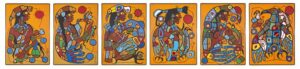
Norval Morrisseau, Man Changing into Thunderbird, 1977, acrylic on canvas, six panels: each panel 153.5 x 125.7 cm. Private collection, on loan to the Art Gallery of Ontario, Toronto.
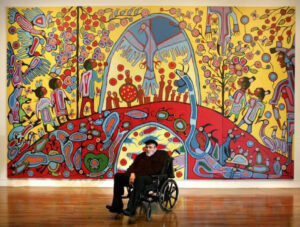
Norval Morrisseau in front of his painting Androgyny, 1983, at the opening of his solo exhibition Norval Morrisseau—Shaman Artist at the National Gallery of Canada, Ottawa, 2006.
I looked back up at the six panels and, with Jack Pollock’s reminiscence in mind, saw that the levels of storytelling about the painting and in the painting fit together like the stained glass found in the churches that had also inspired Norval. From the earliest paintings, in which he placed himself on the back of a thunderbird, to the latest, where he soared into the sky on his wheelchair, he had incorporated the sacred and mythic into his own life. I now knew what I had to do, and it was a strategy that I would continue to use throughout the writing process. I would let him fly.
I will add that my piece about Man Changing into Thunderbird was published in both of my books. That it contains both aadizookaan and dibaajimowin and finds its inspiration in Norval’s great painting signifies its formal characteristics, and accordingly, it is a piece that shape-shifts (transmigrates) and disrupts the boundaries of literary genres. I leave you with this excerpt:
And the people who remained below
in the world of humans
generation upon generation
remember Wahbi Ahmik
as the Man Who Changed
into
a Thunderbird.

Norval Morrisseau, Shaman Rider, 1972, acrylic on kraft paper, 103.7 x 164.5 cm, Indigenous Art Centre, Crown-Indigenous Relations and Northern Affairs Canada, Gatineau.
With the canvases still wet, Pollock carries the paintings back to the gallery in his outstretched arms and brings them to the framer’s the moment they are dry. The show opens on time, with Morrisseau touching up the new panels with dabs of paint on the tip of his right index finger. Within one hour the complete set of six panels is sold. As Pollock predicted, everyone who is witness to Man Changing into Thunderbird cannot look away. As one reviewer describes it, the brilliant stained-glass colours and the visionary fluidity of its tangled shapes give the work a joyous force that overwhelms. Only later will Morrisseau confess to the press, saying, I didn’t think I’d finish it, and then add, displaying his customary confidence, I had a right to see all those visions. I am a shaman. I am part thunderbird. It is me.