Norval Morrisseau at Expo 67, Earth Mother and her Children, 1967
by Linda Grussani
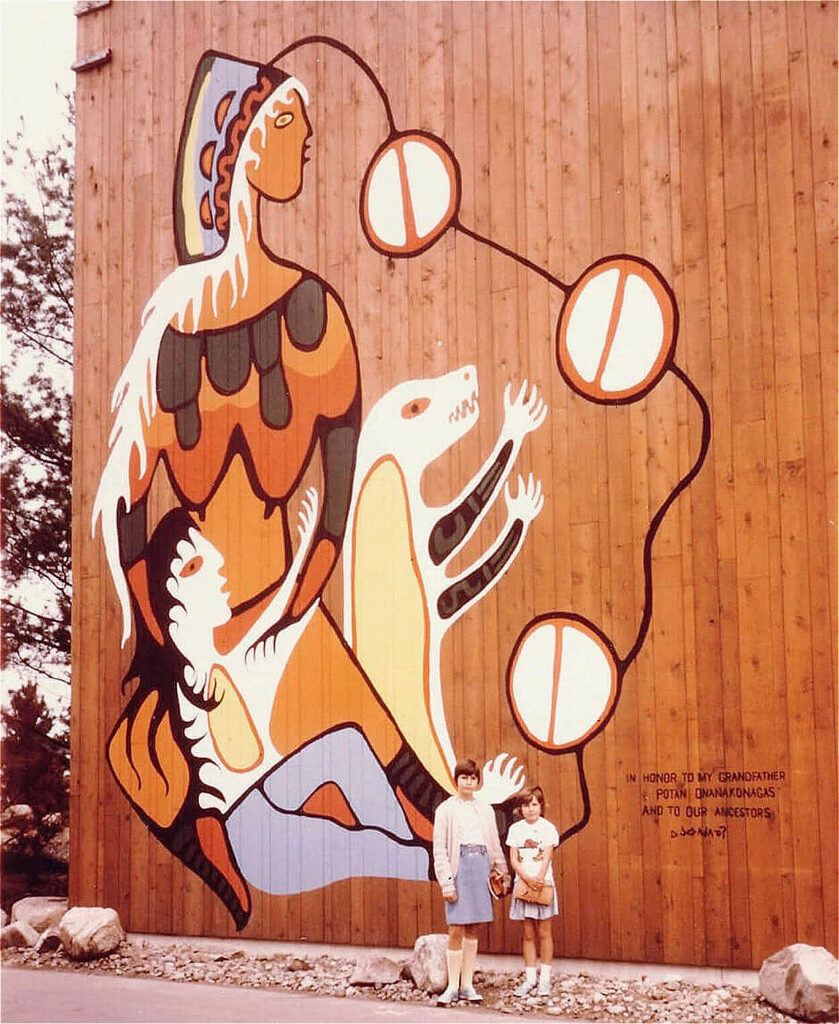
Norval Morrisseau and Carl Ray, Earth Mother and Her Children, 1967. Indians of Canada Pavilion, Expo 67, Montreal. Mural Designed by Norval Morrisseau and painted by Norval Morrisseau and Carl Ray.
Norval Morrisseau’s first major public commission in terms of scale and audience reach was the painted mural Earth Mother and Her Children prominently displayed at the 1967 International and Universal Exposition in Mooniyang/Tiohtià:ke, Montreal, Quebec. Better known as Expo 67, this event was an important part of Canada’s Centennial celebrations, which took place from April to October 1967 and showcased the culture, accomplishments, and future aspirations of many nations under the banner “Man and his World.” Expo 67 is considered one of the most successful world’s fairs of the twentieth century, helping to elevate Canada’s global profile during a time when the country was seeking to establish a strong sense of national identity.
Against this backdrop, the contributions of a standalone Indians of Canada Pavilion on Île Notre Dame triumphantly marked a significant milestone for Indigenous sovereignty and activism. Created at the insistence of Indigenous leaders and creative artists, the pavilion is considered the first major exhibition in Canadian art history where Indigenous Peoples gained control over how their histories and visual cultures were presented before a large global audience. More than fifty million people attended Expo 67, with close to three million visitors visiting the Indians of Canada Pavilion. The bold and striking contemporary Indigenous visual art program, commissioned by the Cultural Affairs Section of the Department of Indian Affairs and Northern Development, for the pavilion's exterior contributed to its success. Painted on wood panels, Earth Mother and Her Children was prominently displayed on the pavilion's exterior facing the adjacent Atlantic Provinces Pavilion. Morrisseau’s mural boldly depicted an Anishinaabe worldview at a time when Indigenous perspectives were largely absent from national narratives. With its vivid imagery and spiritual themes, the artwork challenged dominant colonial viewpoints, becoming a significant example of Indigenous visual sovereignty on the global stage. Created only five years after his first solo show at the Pollock Gallery in 1962, it marked a major recognition of Morrisseau’s place among the nation’s Indigenous artists.
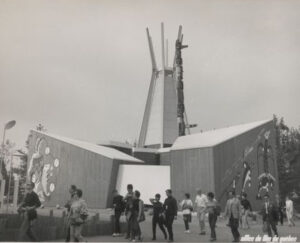
View of the Indians of Canada Pavilion with the Totem Kwakiutl created by Tony and Henry Hunt, Expo 67, Montréal, Québec, Collection Centre Canadien d'Architecture/ Canadian Centre for Architecture, Montréal.
Emergence of the Indians of Canada Pavilion
Initially, the Federal Department of Indian and Northern Development Canada proposed that a program on First Nations art, culture, and history be folded into a single Canadian Pavilion that would align with the standard Canadian settler narrative of the time, relegating Indigenous contributions to the pre-Confederation era. The advisory council of Indigenous leaders and artists, convened by the department to contribute to the storyline, strongly rejected this plan and demanded a separate pavilion developed by an Indigenous team informed by nation-wide consultations. Following from this, the minister in charge of the Indian Affairs portfolio presented a program and budget to Treasury Board, which approved the proposal in August 1965.
Members of the advisory council began crafting a storyline based on meetings with diverse groups of Indigenous leaders, creators, artists, and other community members from across Canada. The goal was to encompass as many Indigenous First Nations and perspectives as possible. Indigenous artists were involved early on in the pavilion planning process and played a key role in shaping both the interior and exterior of the pavilion. In December 1965, a group of nine First Nations artists gathered in Ottawa to help create a design.” The process was far from smooth. In a talk given in 2011, Tom Hill (1943–2023), the youngest of the invited artists, recalled these initial meetings as “chaos, absolutely sheer chaos.” Members of the group voiced disagreements concerning the inclusion of contemporary and traditional artists, status and non-status Indians, and artists with different kinds of practices. “The cultural battles that raged during the creation of the pavilion,” Hill commented, “can best be characterized as growing pains. It was our first time at a national debate over what our social status was to be.”
The Murals
The ambitious exterior art program for the Indians of Canada pavilion afforded contemporary Indigenous artists a significant opportunity to tell their story. By July 1966, the Indian Affairs Cultural Affairs Section, headed by Yves Theriault, assisted the Expo 67 Task Force by organizing a gathering of prominent Indigenous artists from across Canada. At a seminar held in September 1966, which featured a reception given by Governor General Georges Vanier and Madame Pauline Vanier at their official residence, Government House, the artists were introduced to the pavilion models and plans, to help them determine preliminary designs for the artistic program. Artists were invited to submit their design sketches for the pavilion murals by October 15, 1966, for review by a selection committee formed by the National Gallery of Canada. On November 14, 1966, this committee, made up of representatives from the gallery as well as members drawn from a commercial gallery, the pavilion, and the Cultural Affairs Section, assembled to decide which artists would receive commissions.
At the end of the process, nine artists were commissioned to create eight murals: four circular murals, one circular ceramic mural, and three large murals, with work scheduled to take place in rented studio space in Montreal from November 15 to December 15, 1966, and on-site at the pavilion, beginning in January 1967. The list of artists was an intergenerational one: Norval Morrisseau, George Clutesi (1905–1988), Francis Kagige (1929–2014), Noel Wuttunee (1926–2011), Alex Janvier (1935–2024), Gerald Tailfeathers (1925–1975), Ross Woods, and Tom Hill, whose Tree of Peace design would be executed in ceramic by Huron-Wendat artist Jean-Marie Gros-Louis (1933–2013). These artists collectively produced contemporary works that questioned stereotypes and provided a critical, often subversive, perspective on First Nations and government relations.
Morrisseau secured one of the larger walls, reflecting his prominence in the art world at the time. According to Tom Hill, who was also an advisor to the project, “Morrisseau was one of the artists who played a major role in the pavilion; he created the mural. Morrisseau had the south wall of the Land section of the pavilion, and he titled his painting Earth Mother and Her Children.” Morrisseau’s plans for the large-scale exterior mural showed a bear cub and a child being nursed by Earth Mother’s bared breasts, a subject the artist had painted before. The organizers expressed concerns regarding this unconventional image, deeming it excessively explicit or graphic. Anticipating outrage and scandal among Expo 67 visitors, they consequently requested Morrisseau to modify his design. Morrisseau chose to leave the project rather than alter his plan for the mural. The mural was completed by his friend and fellow artist Carl Ray (1943–1978), who had apprenticed with Morrisseau. According to Hill, “I would say that 75–80% of the work on the mural was the work of Carl Ray, although the original drawing was that of Morrisseau. He didn't really change the image to suit the Department's wishes.” In the mural’s final censored version, an “appropriate” distance was maintained between Mother Earth and her children. Perhaps the organizer’s objections were less about breastfeeding and more about a lack of understanding of kinship relationships among human and more-than-human beings. There is a certain irony: while the mural depicts Earth Mother with her children, many Indigenous children were still being separated from their families and sent to residential schools, where they were further separated from their Indigenous identities, language, and culture in traumatic ways.

Norval Morrisseau, Earth Mother, c.1960-64, acrylic on kraft board, 142.2 x 76.2 cm.
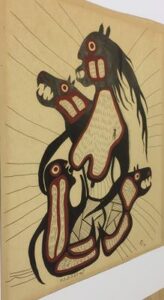
Norval Morrisseau, Bear Mother, c.1963, acrylic on kraft paper, 61 x 50.5 cm, Westerkirk Works of Art
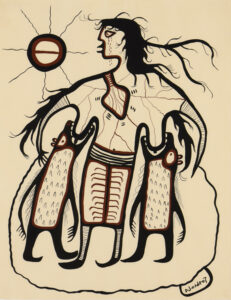
Norval Morrisseau, Legend of the Ojibwa Woman and Her Bear Offspring, 1966-67, ink on paper, 72 x 57 cm, Canada Council Art Bank, Ottawa.
The grand mural Earth Mother and her Children can be seen as a culmination of themes Morrisseau had been developing in earlier works, such as Earth Mother, c.1960–64, Human Mother and Her Half-bear Children, 1966, and Earth Mother Suckling Man and Beast, c.1966–68. In each of these paintings, he explores the figure of the Earth Mother as a life-giving presence and a central force of Anishinaabe cosmology, visually linking human, animal, and spirit beings through interconnected forms and energy lines, emphasizing transformation and kinship across species. In the mural, these ideas grow in scope and intricacy, depicting Earth Mother not just as a maternal figure but as the unifying force of creation, encircled by her children in a web of reliance, though physically separated as requested.
The final mural showcased Morrisseau’s distinctive visual language, deeply rooted in Anishinaabe oral tradition, spirituality, and cosmology, depicted through vibrant colours and bold black outlines. At the centre of the piece is Earth Mother, a nurturing figure embracing human and animal forms, highlighting the interconnectedness of all living things. Morrisseau’s style is not only visually captivating but also rich in spiritual symbolism, where each element radiates energy and significance. Despite refusing to complete the mural, it bears Morrisseau’s signature. Acknowledging the cultural legacy of the past, Morrisseau inscribed the painting: “In honor to my Grandfather Potan Onanakonagas and to our ancestors.” Morrisseau’s name in syllabics, ᐅᓴᐘᐱᑯᐱᓀᐦᓯ (Ozaawaabiko-binesi), which translates as “Copper Thunderbird,” appears along the lower right of the painted image.
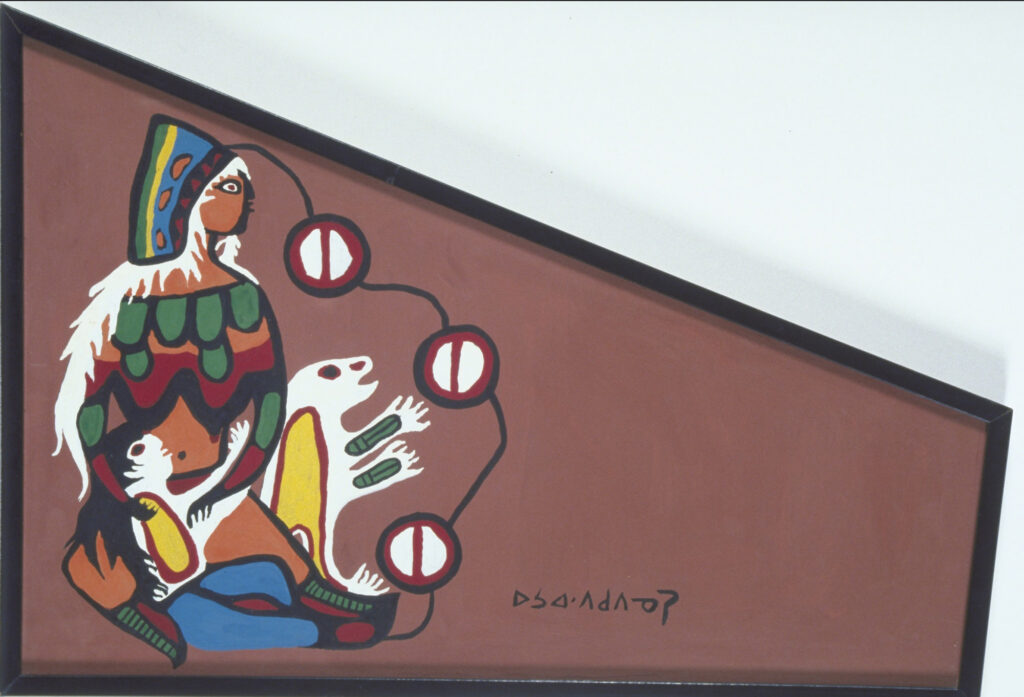
Norval Morrisseau, Mother Earth, 1967, tempera on paper, 38.2 x 56.3 cm, Canadian Museum of History, Gatineau.
Like most pavilions built for Expo 67, the Indians of Canada Pavilion was a temporary structure and not meant to last. It was eventually dismantled, and the painted murals were not preserved. All that remains are photographs, footage from the National Film Board of Canada’s 1967 film Indian Memento, and a small trapezoidal painted maquette of the mural, Mother Earth, 1967, measuring 38.2 by 56.3 cm, which is in the Canadian Museum of History’s collection.
The maquette, bearing Morrisseau’s signature in Cree syllabics, clearly mirrors Morrisseau’s signature style; however, the child’s head seems more tilted upward than level. Earth Mother is part of a collection that includes maquettes for all eight exterior murals by their artists and a painted scene of the Indians of Canada Pavilion by Gerald Tailfeathers. These are not the original maquettes created for presentation, but a second set likely made after the murals were completed. The presence of these maquettes and other traces of the Indians of Canada Pavilion is vital for understanding the original murals and establishing a visual link to the significant work of these artists in expressing visual sovereignty on Indigenous lands for a global audience.
Opportunities following Expo 67
While working on the Indians of Canada Pavilion, Morrisseau met Herbert T. Schwarz, a physician and owner of Le Galerie Cartier in Montreal, who was a consultant for Expo 67 and one of the seven judges convened on November 14, 1966, to select artists for the commissioned Indians of Canada Pavilion mural program. Morrisseau recognized the significance of showing at Expo 67. In a letter to Schwarz who was addressed as “My dear brother ‘Paisk,’” Morrisseau wrote, “I understand I will get a Cultural Affairs grant for four thousand five hundred dollars which I am going to devote much time for art on canvas etc., which I want to make a lot of pictures for Expo and other art shows that will perhaps establish me better (successfully).” The two men formed a friendship and would go on to collaborate on three exhibitions and the production of a collection of illustrations for Schwarz’s book Windigo and Other Tales of the Ojibways (1969). In 1968, Morrisseau received Canada’s Centennial Medal for his “valuable service to the nation.”
Conclusion
The Indians of Canada Pavilion was celebrated as a success. The vivid and striking contemporary Indigenous visual art program created for the pavilion’s exterior played a significant role in this achievement. Morrisseau’s mural showcased an Anishinaabe worldview, challenging colonial stories with bright imagery and spiritual themes, and became a prominent example of Indigenous visual sovereignty worldwide. Against the exposition’s emphasis on progress and technology, Earth Mother and Her Children served as a compelling counterpoint, emphasizing the ongoing importance and wisdom of Indigenous cultures. The mural program commissions encouraged viewers to see Indigenous Peoples not as relics of the past but as vital, living contributors to the nation’s identity and future. They had a profound effect on the development of Indigenous art going forward. Morrisseau’s work on the pavilion was more than just art; it was a political act of reclaiming and resistance. The mural’s memory continues today as a call for respect, unity, and harmony between humans and the natural environment.