Solitary Confinement: The Prison Series of Norval Morrisseau
by Gerald McMaster
When I look at that wall I shall think of you,
and of what you did not Paint there.
Only the truth makes
the Pain of Lifting a hand worthwhile:
the Prison Staggering
under the blows of the Rage.
The Vanishing Point is the
Point where he appears.
Two Parallel tracks Converge;
yet there
Has been no wreck to Mutilate
Privacy with a single foolish syllable
is to throw
Away a Search for the one Nessasary [sic] word,
When you Read these lines,
Think of Me.
And what I have not Written hear [sic].
Norval
–Norval Morrisseau, “When I Look at That Wall”
The untitled drawings by Norval Morrisseau in the Canadian Museum of History collection present a singular opportunity, and challenge, for the scholars and students of Anishinaabe art. Made on fragile, monochromatic paper—smooth, fading green pages with uneven, torn edges—they offer an unmediated window into the working mind of the artist. They show him thinking through the cosmological, spiritual, and relational problems that animate his entire oeuvre. Without titles, without the commercial or institutional framing that surrounds his finished paintings and prints, they strip away every layer of mediation. To engage with them seriously is to recognize that they are not illustrations of legends but vital arguments, in visual form, about the structure of an animate world. All that, and they were made in a prison cell.
In confinement, time stretches out endlessly, each moment pressing against the mind like a weight too heavy to bear. The walls (bare, unyielding) stand as silent witnesses to the prisoner’s thoughts, a canvas for what has not been painted, a sounding board for what remains unspoken. What does one do? Smoke, think, sleep, scream, cry? Or does one, like a painter without a brush, reach for the unseen—what in Plains Cree is called tâpasinahike—the tracing of lines in the air, inscribing meaning onto silence? Like a writer sketching out ideas, Morrisseau worked as if mapping a mind, his drawings not only revealing but withholding, leaving spaces between lines for meaning to emerge. Just as words converge and diverge around a central thought, so too does Morrisseau’s art, where relations shift, form, and dissolve.
At first glance, the Prison series echoes an earlier tradition of ledger drawings, created by Plains Indian warriors incarcerated at Fort Marion, Florida, in the late nineteenth century. They recorded their stories, in their case in the pages of an accountant’s book, documenting what they had fought for, what was taken from them, and what they refused to surrender. Morrisseau’s drawings, however, move beyond the visible world. He does not recount the past; he searches for something else. The imprisoned warriors drew memory; Morrisseau drew vision. Indeed, more than drawing it, he enacted it.
This essay makes three interconnected arguments. The first: that Morrisseau possessed deep, initiated, and historically grounded knowledge of Anishinaabe cultural traditions, derived not from casual exposure but from direct training within the Midewiwin lineage, knowledge that gave the prison drawings an intellectual and spiritual substance that confinement could not diminish. The second: that his visual language (the power lines, the x-ray anatomy, the transformation figures, the profile eye, the handless limb) constitutes a deliberate and original synthesis of pre-contact pictorial traditions with the demands of twentieth-century gallery art, a synthesis made possible only by that initiated knowledge. The third: that the conditions of the prison cell, far from limiting that vision, concentrated and distilled it, producing works of clarity and necessity that stand among the most revealing documents of his practice.
“I Shall Think of You”
When I think of Norval Morrisseau, I think not only of his art, but of the world in which it emerged: the forces that shaped him, the struggles that defined his people, and the individuals who, knowingly or unknowingly, left their mark on his life. As his fame rose, Morrisseau crossed paths with Robert Fox, an economic development officer for the Government of Ontario. Fox arrived in northern Ontario with an eagerness to help, his focus on Indigenous youth. He worked with emerging Anishinaabe artists, including Goyce and Joshim Kakegamic (1952–1993), to establish the Triple-K Print Shop in Red Lake, Ontario, a silkscreen business that would flourish for several years. Morrisseau, married to Harriet, was drawn into these circles.
But at the same time, his life took another turn. Arrested for domestic assault, Morrisseau was imprisoned in Kenora, Ontario, for six months. It was here, in the stark solitude of confinement, that he turned to drawing and writing on paper. He did not make these works for an audience. They are neither performance nor plea, but a necessity. Like a prisoner tracing invisible lines upon a wall, Morrisseau’s hand lifted, inscribing something beyond sight. It was to Robert Fox that Morrisseau entrusted these prison drawings and the poem that opens this essay, not as a transaction but as a gift, a gesture of friendship that endured beyond the walls that held him.
When I think of Morrisseau in this moment, I think of what imprisonment could not take from him. A prisoner meets others in passing (guards, fellow inmates, an occasional visitor), but their presence is fleeting. In forced confinement, even a moment stretches into eternity. And yet Morrisseau, ever independent, survived. His vision was never confined: neither by prison walls nor by the constraints of the market. The knowledge he carried, and the tradition from which it came, sustained him.
Cultural Formation: The Midewiwin Tradition and Initiated Knowledge
To understand that requires understanding the depth of knowledge Morrisseau carried with him into the cell. This was largely, although not exclusively, biographical. His grandfather, Moses Potan Nanakonagos, was a practitioner of the Midewiwin, the Grand Medicine Society of the Anishinaabe peoples and the most significant and enduring institution of their spiritual and intellectual life. Within the Midewiwin, Nanakonagos held initiated knowledge of healing practices, ceremonial rites, and the cosmological narratives encoded in birchbark scrolls called wiigwaasabakoon. It was through him that Morrisseau received his understanding of the animate structure of the Anishinaabe world, not as folklore or inherited story but as a living system of knowledge.
The Midewiwin (which Basil Johnston characterizes as “the way of the heart”) is a society of spiritual advisers and healers, the Mide, who conduct religious ceremonies, study sacred healing methods, and maintain the relationship between humanity and the natural world. What makes the Midewiwin especially significant for understanding Morrisseau’s art is how it transmitted its knowledge: on birchbark scrolls, using a pictographic system of figures, lines, and symbols that encoded both narrative and ritual procedures. These scrolls are the direct visual antecedent of Morrisseau’s own pictographic style. The bold outlines, the schematic rendering of the human form, the visible internal anatomy, the connecting lines: all of these formal devices have their roots in a pre-contact Indigenous tradition of knowledge inscription that the Midewiwin preserved and transmitted across generations.
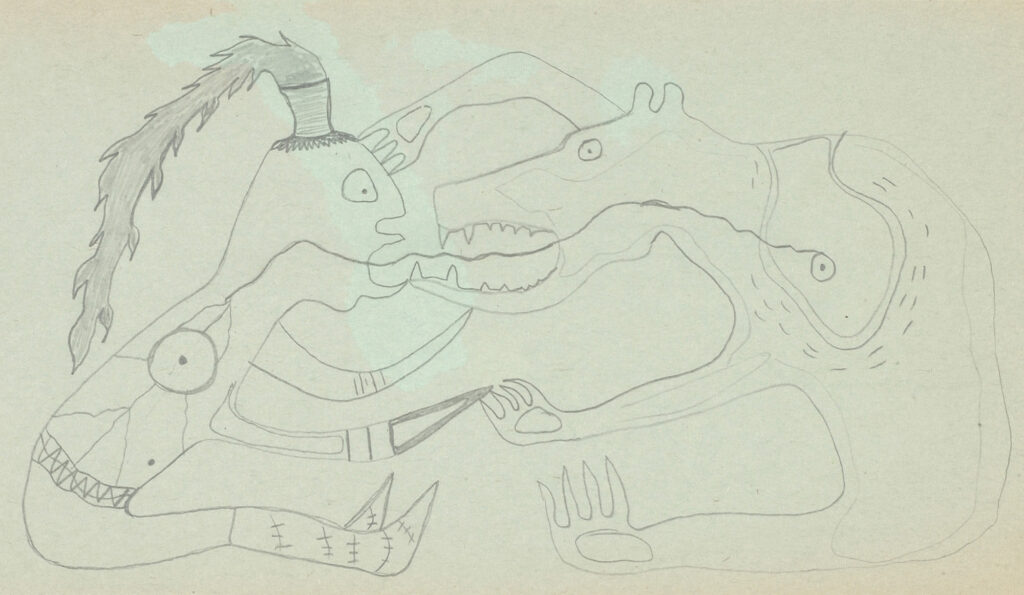
Norval Morrisseau, Bear Gift to Human, 1973, pencil sketch on hand towel paper, 18 x 36.9 cm, Canadian Museum of History, Gatineau.
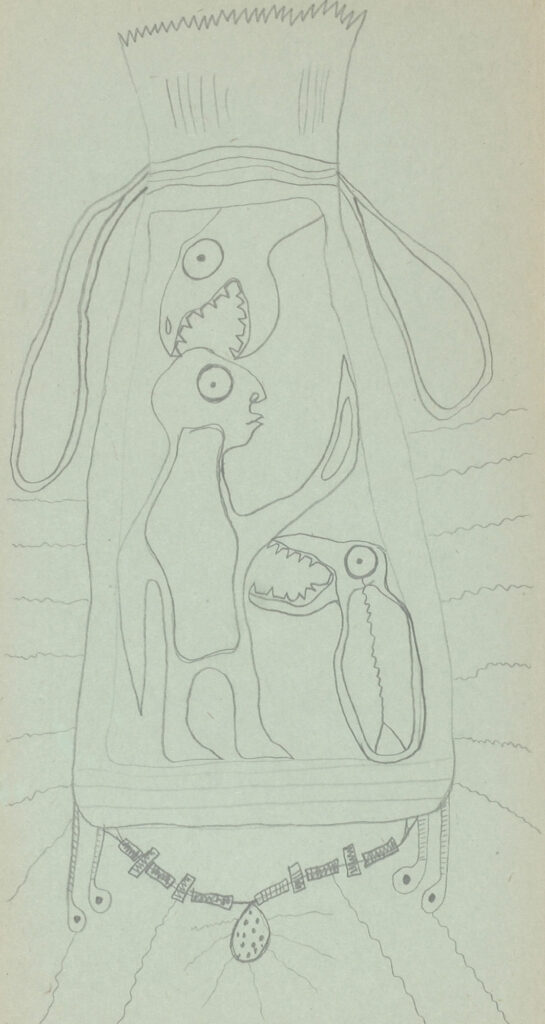
Norval Morrisseau, Man Trapped in Medicine Bag, 1973, pencil sketch on hand towel paper, 36.9 x 18 cm, Canadian Museum of History, Gatineau.
When Morrisseau depicts the connecting lines between a human heart and a bear’s heart in the drawing Bear Gift to Human, 1973, or when he renders a medicine pouch emitting radiating lines in Man Trapped in Medicine Bag, 1973, he is not inventing a visual metaphor from scratch. He is working within and extending an established iconographic tradition whose conventions were transmitted to him through precisely the relationship that the birchbark scrolls themselves were designed to sustain. His formal choices are culturally informed decisions. And in the prison cell, stripped of almost everything else, it is this deep knowledge, carried in the body, in the memory, in the trained eye, that remains.
The naming ceremony that Morrisseau underwent at the age of nineteen, when a medicine woman gave him the name Osaawaabikobinesi (Copper Thunderbird) to restore him from serious illness, is itself evidence of his immersion in this tradition. In Anishinaabe practice, a powerful name given at a moment of crisis carries spiritual charge; the name connects the recipient to the power of the being it invokes. For Morrisseau, receiving the name of the Thunderbird was no mere honorific but an event that positioned him within the cosmological structure he would spend the rest of his life articulating through his paintings. Sitting in a prison cell in Kenora, decades later, he was still working within that structure.
Anthropologist and curator Elizabeth McLuhan argued that Morrisseau was trained as a shaman and that his art functioned as a tool for revitalizing an ailing Anishinaabe culture. His work does not merely illustrate Anishinaabe philosophy; it enacts it. This distinction matters. In the prison drawings, we do not see a man retreating into nostalgia or myth, but an artist actively practising, using the visual tools of his tradition to map the cosmological world that the walls of his cell could not shut out.
“The Vanishing Point is the Point Where He Appears”
In The Prison series, Norval Morrisseau transforms time into space. Not the space of his physical confinement but the boundless expanse of the spiritual world. His drawings are portals, entry points into an unseen reality where he moves freely, where the limits of the material world dissolve. In this space, he is not imprisoned; he is present, wholly, with a vision few can access.
In the Anishinaabe world, Morrisseau’s world, personhood is not confined to the human. Animals, plants, certain stones, bodies of water, the sun, the moon, and the stars are understood as animate persons with whom the human community stands in ongoing relation. This is not metaphor or poetic personification: it is a description of how the world actually is.
For many, escape implies a departure, a release from suffering. In Anishinaabe thought, however, there is no such division; what others might call escape is simply a fuller presence within the same continuous relational world, one in which the living, the ancestral, the physical, and the spiritual are all co-present, all in relation. Among the Anishinaabe, stories speak of a time when humans and animals understood one another, when the relations between species, realms, and identities were openly acknowledged—and when their neglect carried consequences. Some still know that certain individuals (shamans, visionaries, medicine people) move through these relations with a fluency that others have forgotten. Morrisseau understood this profoundly.
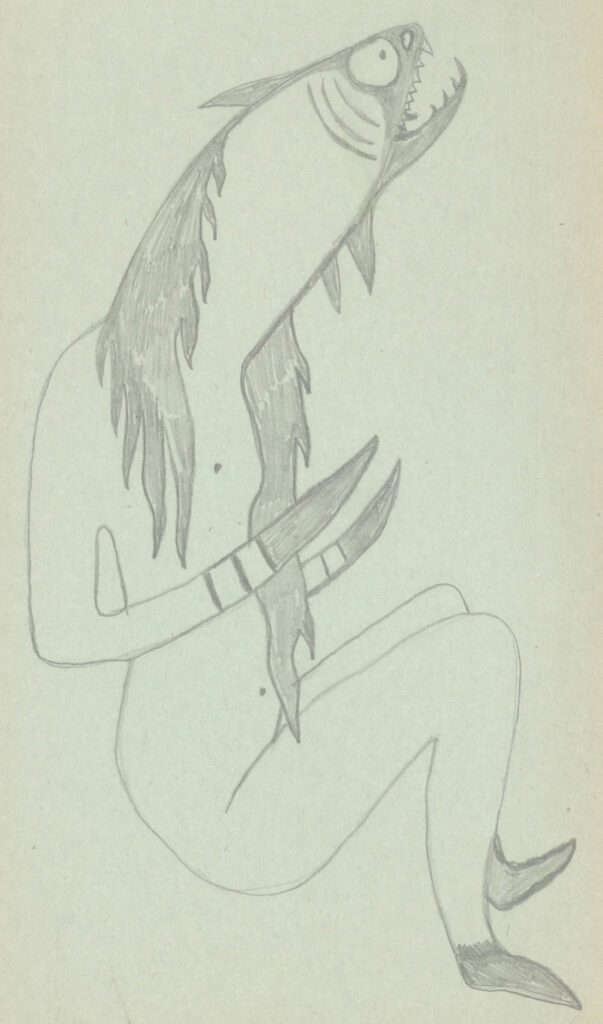
Norval Morrisseau, Untitled, c.1973, pencil sketch on hand towel paper, 40.6 x 18 cm, Canadian Museum of History, Gatineau.
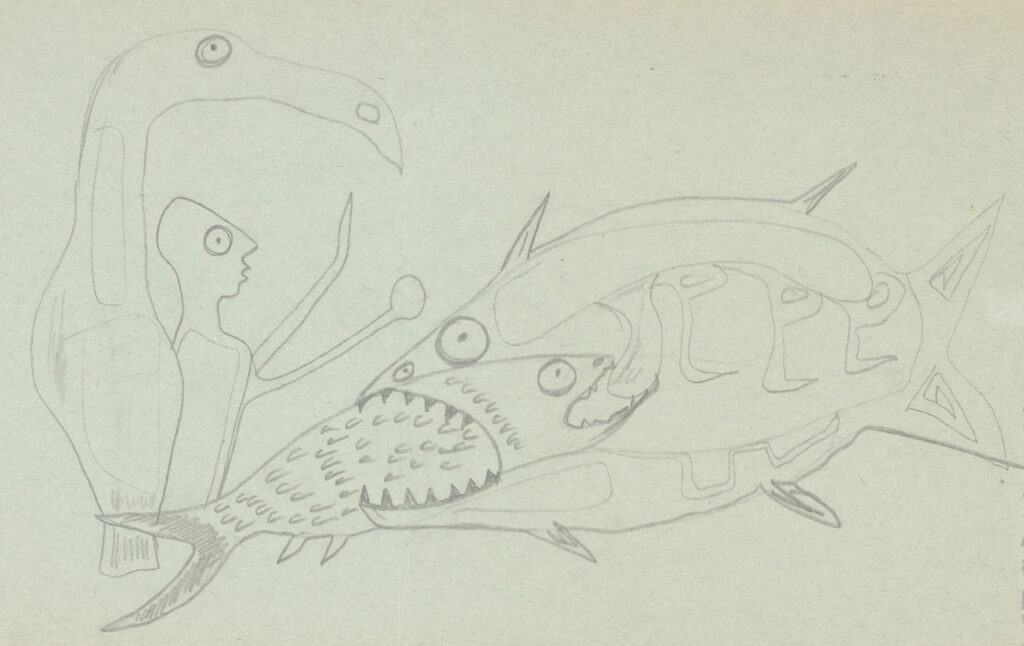
Norval Morrisseau, Untitled, c.1973, pencil on green hand towel paper, 18 x 31.8 cm, Canadian Museum of History, Gatineau.
This has direct consequences for how Morrisseau’s imagery should be read. When a drawing depicts a man, whose body is half fish or another transforming into a bear, this is not fantasy or allegory. It is a visual statement about the fluidity between human and animal personhood. As Basil Johnston explains in The Manitous: The Spiritual World of the Ojibway (1995), bears and humans are understood as nearly identical in the sacred tales: bears are addressed as “Anishinaabe” (as human persons), and the transformation between the two is not a supernatural intrusion into ordinary life but an expression of the structure of life itself.
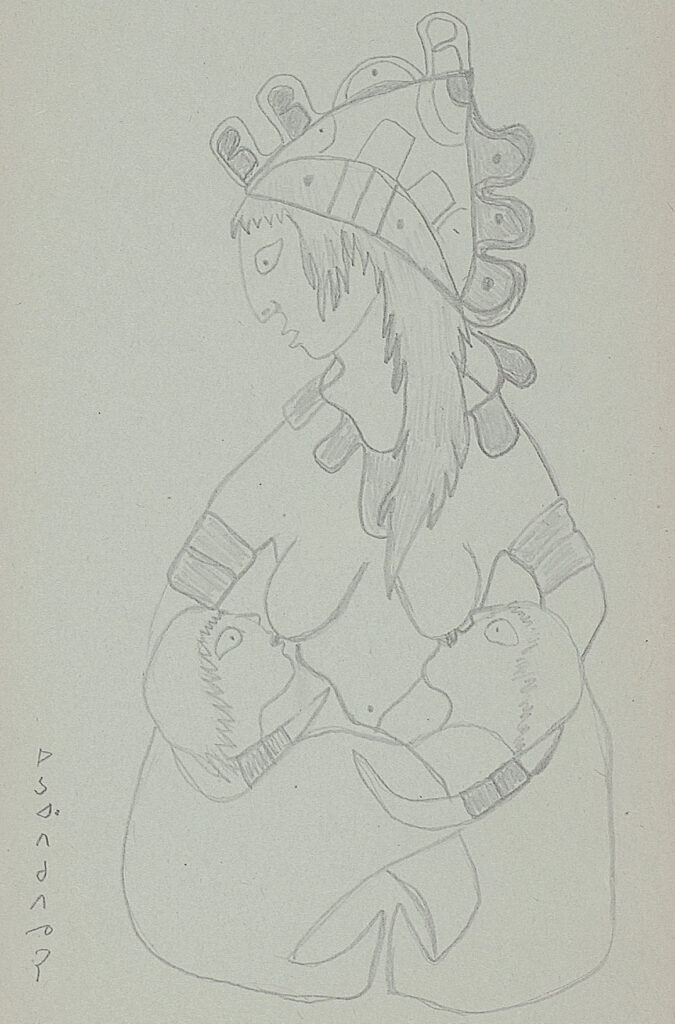
Norval Morrisseau, Untitled, c.1973, pencil sketch on hand towel paper, 36.6 x 18 cm, Canadian Museum of History, Gatineau.
Morrisseau populates his compositions with fish, birds, beavers, bears, serpents, bison, frogs, turtles, otters, and moose alongside men, women, and children engaged in acts of purification, eating, raising children, and performing ceremonies. Some figures wear headdresses, others horns, and some wear nothing at all, because identity, like form, is not fixed. In the CMH collection, the nursing mother drawing is an image of the most elemental relational act: a mother suckling two infants, presumed twins. In Anishinaabe tradition, as Johnston recounts, twins speak to the relational complexity at the heart of creation: the understanding that the full range of being, from the most nurturing to the most formidable, is held within the same cosmological whole. Even in an image of quiet intimacy, Morrisseau is thinking cosmologically. The Anishinaabe prayer Gimiigwechiwiwaanaanig, “We All Thank Them All,” is a prayer of gratitude acknowledging the interconnectedness of all beings and the gifts provided by the Creator and the natural world.
The cosmological structure of the Anishinaabe world, like other Indigenous worldviews, is not organized around opposition but around relation. For example, much of the scholarly literature has framed the Thunderbirds and Mishibizhiw as opposing cosmic forces, a framing that reflects Western binary thinking more than the Anishinaabe view, which understands the world through the web of connections binding all beings to one another. To impose a binary structure upon a relational cosmology is to fundamentally misread it. The Thunderbirds (Animikiig) are among the most powerful spirit beings, described as protectors of the people, controllers of rain and storm, and mediators between earth and sky. Mishibizhiw (the Great Lynx or Underwater Panther) is the being of the deep waters of the Great Lakes, the currents, the whirlpools, and the vast copper deposits beneath them. These are not rival powers cancelling each other out but related presences, each with its own domain, its own responsibilities, and its own kind of power. Morrisseau understood this profoundly.
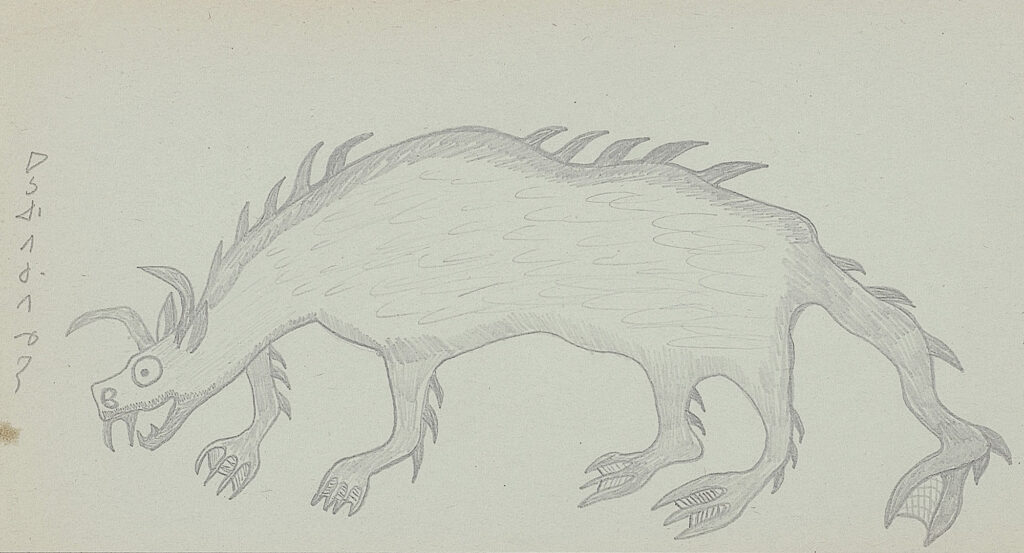
Norval Morrisseau, Untitled, c.1973, pencil sketch on hand towel paper, 18 x 38.9 cm, Canadian Museum of History, Gatineau.
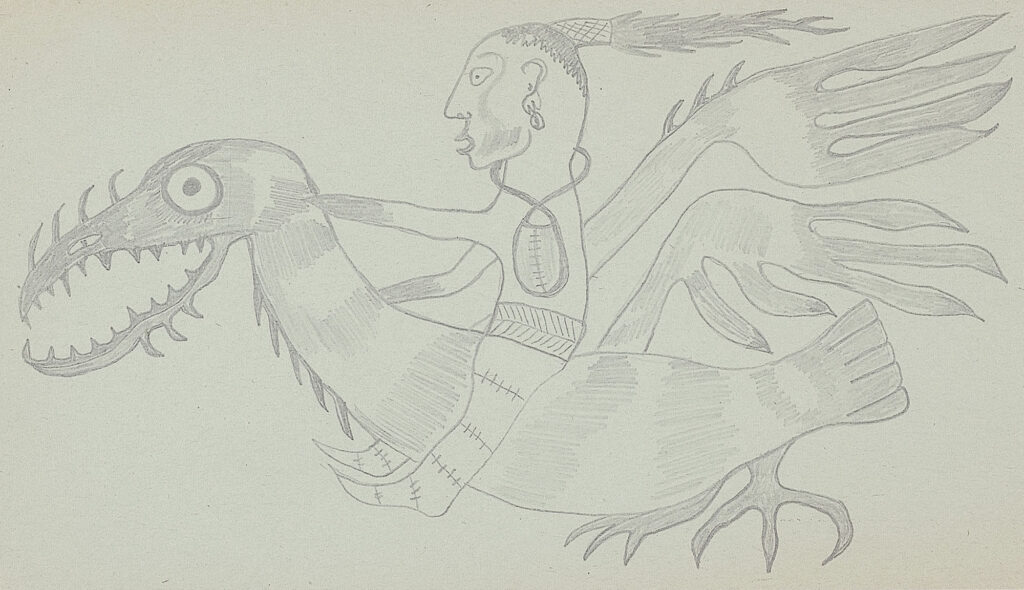
Norval Morrisseau, Untitled (Shaman Riding Thunderbird), 1973, pencil on paper towel, 18 x 34.6 cm, Canadian Museum of History, Gatineau.
The relational dynamic between sky and water, between the being of thunder and the being of the deep, runs through Morrisseau’s iconographic universe and appears in concentrated form in two drawings from the museum’s collection: the Mishibizhiw drawing and the Thunderbird drawing of a shaman rider, works that together map the relational fields within which Anishinaabe spiritual life moves and through which it is sustained. In the first, Mishibizhiw’s horns, scaly body, webbed feet, and mouth full of teeth are precisely those recorded in the pre-contact rock paintings of the Great Lakes region. The sacred being also appears at Agawa Rock on Lake Superior, among the most significant surviving repositories of Anishinaabe rock painting. Morrisseau’s rendering is continuous with those ancient representations, not as nostalgic imitation but as the living continuation of a tradition he understood as culturally authoritative. The tradition also holds that Mishibizhiw came as twins, a pairing that speaks not to a fixed binary of good and evil but to the full relational complexity of being, the understanding that creation encompasses the complete range of existence. This connects back to the nursing mother drawing, in which Johnston’s account of Sky Woman’s twins opens the same question: not which force prevails, but how all things are held in relation. In the second, a shaman rides a Thunderbird (the great sky being whose name Morrisseau himself carried), being transported, as shamans are, between realms.
For Morrisseau, there is no doubt that this is real. His work insists on its own reality. And if countless Anishinaabe artists continue to articulate these visions (through painting, literature, film, and performance), then it is not the singular imagination of one man. It is an inheritance. Morrisseau’s presence remains strongest at the vanishing point: not where one world ends and another begins, but where the unbroken relational whole comes into view. Some saw his revelations as dangerous. Others saw them as necessary. But one thing is certain: where others imposed separations: between past and present, the visible and the known. Morrisseau recognized only the relations that had always sustained everything.
Visual Synthesis: From Rock Art and Birchbark Scroll to Prison Cell
Morrisseau’s genius lay not merely in his cultural knowledge but in his understanding of how that knowledge could be translated into a visual language; it is in the prison drawings that this translation is most raw, most direct, and most revealing. Morrisseau, confined within prison walls, drew on what was available: smooth, fading green pages, their colour lending a patina of age. The edges, roughly torn, suggest urgency, as if the next drawing could not wait. Confined to a cell, even his materials were limited. But limitation did not mean diminishment; rather, it distilled his vision to its purest form.
Norval Morrisseau, Untitled, c.1973, pencil on green hand towel paper, 18 x 31.8 cm, Canadian Museum of History, Gatineau.
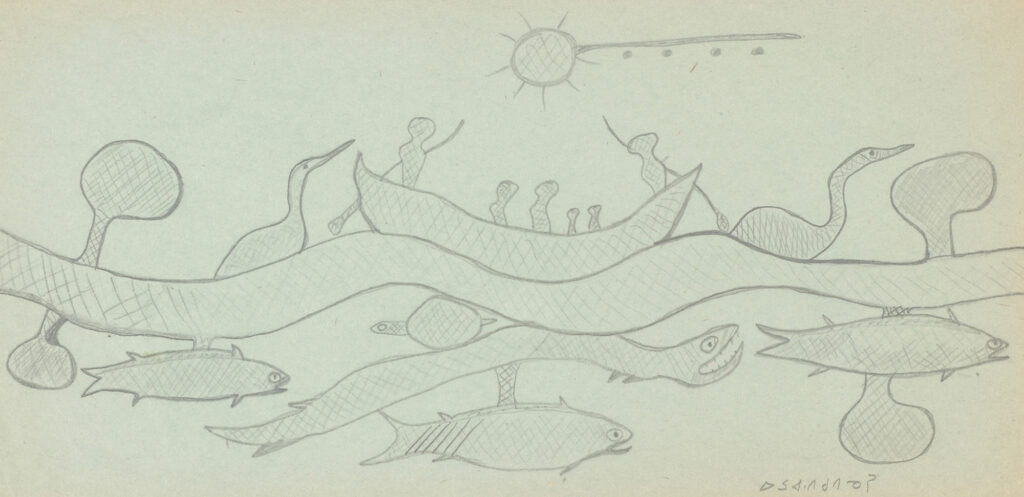
The primary visual sources for Morrisseau’s style are the rock paintings of the Canadian Shield and the birchbark scrolls of the Midewiwin. Selwyn Dewdney (1909–1979) and Kenneth E. Kidd’s systematic documentation of the Great Lakes rock paintings (begun in 1957, published in 1962, and conducted in direct correspondence with Morrisseau) established the visual conventions of this tradition for the scholarly world, but Morrisseau had known them intimately from childhood. The profile figures, the composite human-animal forms, the rendering of Mishibizhiw, the canoe scenes, the celestial motifs: all of these appear in the ancient pictographs, and all reappear, transformed, in Morrisseau’s drawings. What the collection makes visible, however, is the degree to which individual works are in direct dialogue with these pre-contact models. The drawing’s fish-on-fish scene is continuous with the underwater creature imagery at Lake Superior pictograph sites; the Mishibizhiw drawing echoes the creature’s representation at Agawa Rock with a fidelity that is clearly intentional.
From the birchbark scrolls, Morrisseau derived the two formal devices most distinctive of his mature style: the visible internal anatomy (x-ray representation) and the power line. In the Midewiwin scrolls, figures are rendered schematically with their spiritual essence, their life-force, made visible within the body outline. Lines connect figures to indicate relationship, communication, and the flow of sacred power. Morrisseau took these conventions and amplified them: his x-ray figures show not just organs but the spirit presence within. Throughout his practice, as McLuhan and Hill document extensively, Morrisseau understood power lines as the visible connectors between medicine songs, sacred power, and the animate world—formal devices that are at once cosmological statements and pictorial conventions inherited from the scroll tradition.
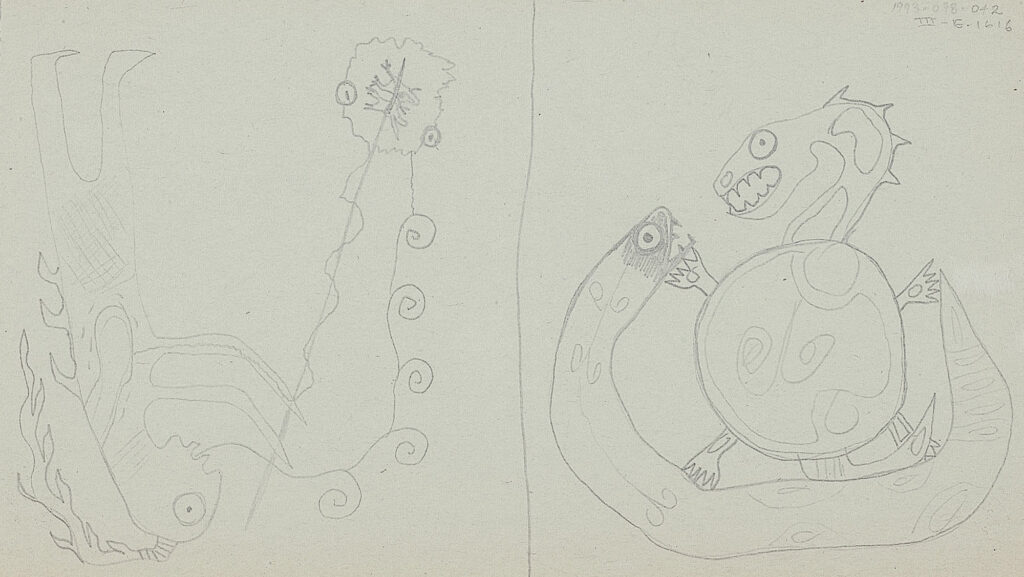
Norval Morrisseau, Untitled, c.1973, pencil sketch on hand towel paper, 18 x 32.4 cm, Canadian Museum of History, Gatineau.
Norval Morrisseau, Untitled, c.1973, pencil sketch on hand towel paper, 31.9 x 18 cm, Canadian Museum of History, Gatineau.
Norval Morrisseau, Untitled, c.1973, pencil sketch on hand towel paper, 18 x 38.3 cm, Canadian Museum of History, Gatineau.
These connections take multiple forms across the drawings. Power lines run from the human’s heart to the bear’s heart, rendering visible a form of interspecies communication that Morrisseau understood as real and as central to the shaman’s work. The human’s heart, depicted as four times larger than the bear’s, is itself a statement: the shaman is the one who initiates and sustains the connection. He carries more of the burden of relation. The figure’s knotted hair (a recurring marker across Morrisseau’s work) identifies him as a shaman or medicine man. The power lines in Untitled, c.1973, take the form of curlicues indicating speech or song between a man and two creatures; in another untitled drawing they radiate from a medicine pouch as lines of concentrated power discharge toward four surrounding bears, suggesting the power that frightens them into retreat. These are not decorative flourishes: they are, as Morrisseau understood, visualized truths that express the Anishinaabe concept of dodem: the ancestral ties that link human and animal kin.
The waterscape drawing extends this argument into the realm of the everyday. Lake Superior, almost certainly the subject given its scale and centrality to Morrisseau’s world, is not merely a landscape. It is the domain of Mishibizhiw, a place of power that demands respect and carries danger. The six figures in the canoe exist in a world animated below by fish, eel, and beaver, and above by the sun, whose long extending line may represent a power connection between the celestial and the earthly. The four dots beneath this line are significant: in Anishinaabe cosmology the number four is pervasive and generative, associated with the four orders of Creation, the cardinal points, the seasons, and the four stages of life. In the Anishinaabe language and worldview, the sun (Giizis) is understood as Grandfather, the moon as Grandmother. The calm, unified flow of this image is not compositional convenience but cosmological statement: everything in an animate world moves together, connected.
Norval Morrisseau, Untitled, c.1973, pencil sketch on hand towel paper, 31.9 x 18 cm, Canadian Museum of History, Gatineau.
One additional formal convention merits attention: the rendering of human hands throughout the drawings, shown without fingers and reduced to a rounded, pointed shape. Far from being a limitation or a stylistic quirk, this is a considered formal decision continuous with the schematic economy of the birchbark scroll tradition. The hand without fingers is not a deficient hand: it is a hand understood as relational appendage rather than tool-using instrument. It reaches, connects, and gestures, but it does not grasp or manipulate in the way a realistically rendered hand would. This is consistent with the Anishinaabe tradition.
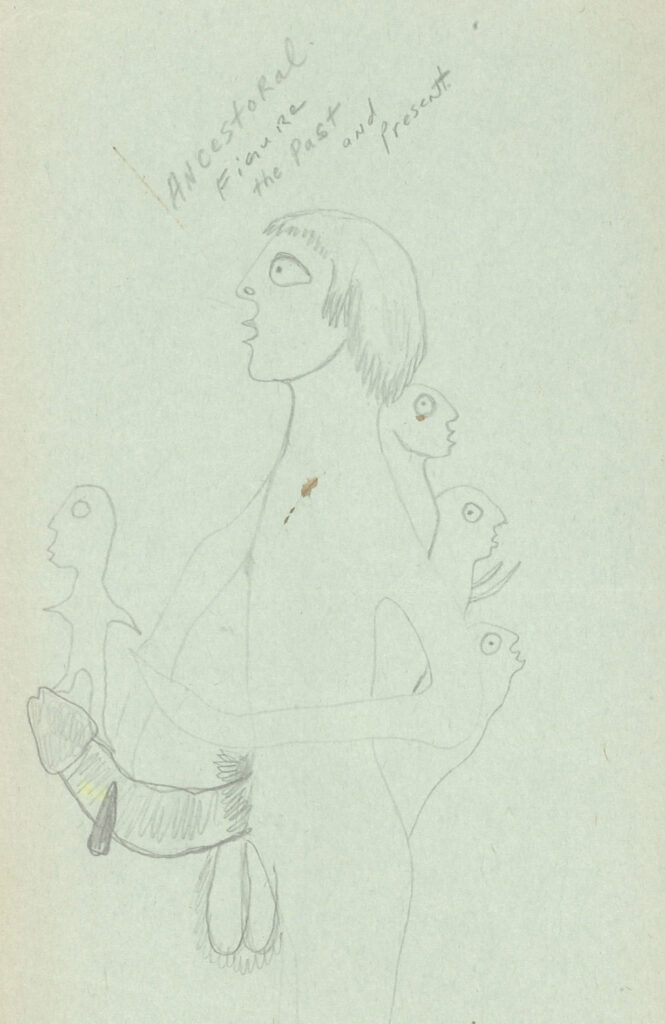
The erotic drawing, with its conspicuously oversized and erect phallus, the small figure standing upon it, and the inscription in Morrisseau’s hand “Ancestral Figure The Past and Present,” must also be read within this cultural framework. As Greg Hill argues, Morrisseau’s treatment of the erotic is spiritually charged rather than transgressive: sexuality in Anishinaabe sacred narrative is inseparable from creation, life-force, and the ancestral transmission of being. Johnston’s account in The Manitous of the sacred dimensions of embodiment in Anishinaabe tradition provides the grounding: the body, including its generative capacity, is understood as spiritually significant rather than profane. The question Morrisseau’s inscription poses (“Ancestral Figure The Past and Present”) is a question about the continuity of life across time, about how the present is carried forward from the past. It is a cosmological question, and the drawing is its visual investigation.
The sweat lodge drawing belongs to this same register of enacted knowledge. In it, two men are seated inside a sweat lodge, their identity as shamans indicated by their topknots, commonly worn for ceremonial purposes. As is customary in a sweat lodge ceremony, water is being poured over heated rocks to produce intense steam. The sweat lodge is understood within Anishinaabe practice as a site of purification, spiritual communication, and healing. In the prison drawings, an image of two shamans performing ceremony is not nostalgia; it is, in a sense, the act itself. The image holds the ceremony.
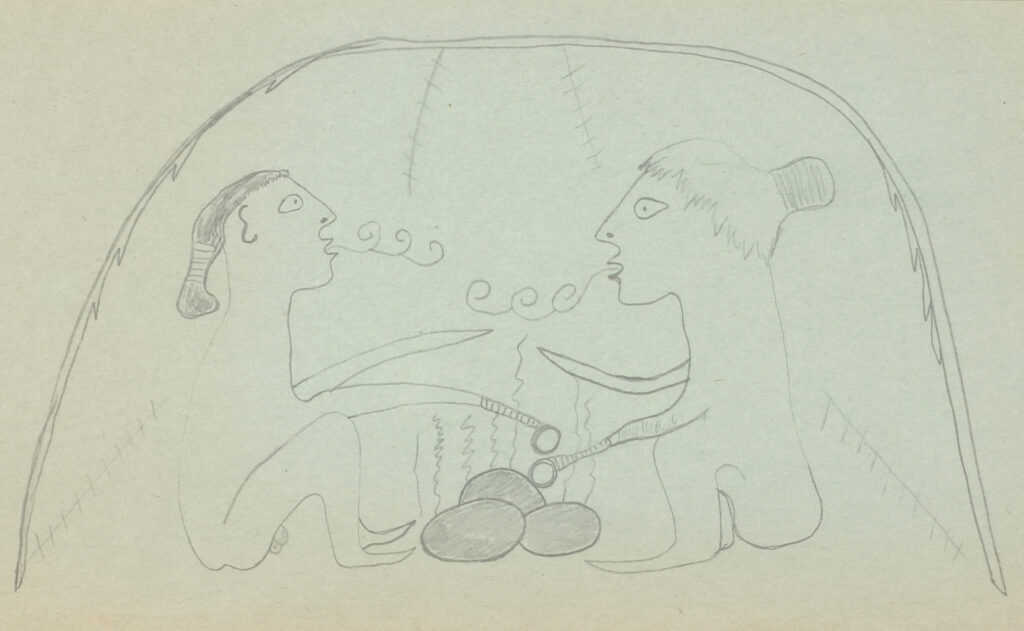
Norval Morrisseau, Steam Bath Ritual, c.1973, pencil sketch on hand towel paper, 18 x 36.9 cm, Canadian Museum of History, Gatineau.
“With a single foolish syllable is to throw away a search for the one necessary word”
In these drawings, Morrisseau reveals a density of images, a complexity of composition absent from many of his paintings. There is a delicacy here, inspired by the very material itself: lines that carry a precision born of restraint. The images, as Anishinaabe Elders might say, are so powerful they cannot be contained within the sheet. And yet, for all their richness, these drawings do not, and cannot, convey the full depth of Anishinaabe philosophy. They offer only traces, fleeting impressions of something far greater.
In the solitude of his confinement, in the long hours with only paper and pencil in hand, expression surged forth, unrestrained. The smallness of his cell could not restrict him. If anything, it forced a clarity that might not have been possible amid distraction. Solitary confinement could not stifle the outpouring; it sharpened it. Each mark became necessary, every stroke deliberate. The fragile paper, the rapid, urgent lines, speak of an artist who had no choice but to create.
For artists like Morrisseau, such torrents do not cease. He seemed propelled by something beyond himself, creating not for the masses but for the few who might understand, above all for himself. He existed on the periphery, an outsider by choice, at peace in a world of his own making. His art was not about abundance but about distillation: the search for the one true image, the essential articulation. His work (his poetry, his drawings) stands as a metaphor for the unknown. That which humanity has always pursued: an articulation of truth. Not excess, not ornamentation, but revelation.
To make a full argument for Morrisseau’s significance is to insist on something that Carmen Robertson’s scholarship has made plain: the colonial narrative that surrounded him in his lifetime systematically undervalued the knowledge that made his art possible. In a formal analysis grounded in that knowledge, one that can say with confidence why the bear appears within the man’s body, what the power lines between two hearts mean, why Mishibizhiw carries horns and scaly skin, what the four dots beneath the sun’s extending line might signify: this is not merely an art-historical exercise. It is an act of restitution. In the solitude of his cell, Morrisseau himself was practising that restitution: inscribing, on the flimsiest of materials, a knowledge that the world around him was doing its best to ignore.
Conclusion
The final lines of the poem, “When you read these lines, think of me. And what I have not written here,” resonate with the essence of Norval Morrisseau’s work, where meaning extends beyond the paper, living within the relational continuity that form and spirit share. His works are not just visual records but invitations: to see, to feel, and to listen to what is not explicitly rendered. Morrisseau’s art speaks of ancestral knowledge, spiritual continuity, and the resilience of Indigenous identity, yet it also leaves room for interpretation, for what cannot be fully captured in lines and colour.
The argument for Morrisseau’s intellectual and cultural significance rests on the convergence of three bodies of evidence: the biographical record of his Midewiwin formation; the cultural literature of Anishinaabe tradition that provides the cosmological framework for his imagery; and the formal analysis of the works themselves, which consistently demonstrate that his visual choices are culturally informed decisions rather than intuitive gestures. The Canadian Museum of History collection drawings, unmediated by title, market, or institutional framing and made under conditions of maximum constraint, are among the most direct evidence available for this argument. In them, Morrisseau can be seen working through the problems of transformation, relation, power, creation, and cosmological structure that his tradition had grappled with for centuries, using a visual language he had synthesized from the most ancient sources available to him.
Like the silences in language and the unseen forces in nature, his work reminds us that stories are never complete; they are carried forward by those who engage with them. To look at his art is to acknowledge what is rendered visible and what continues to resonate beyond the frame: to honour not only what is shown but also what remains, still speaking. Morrisseau, ever independent, remained one of the survivors. His vision was never confined: neither by prison walls nor by the constraints of market demand. His art, like his spirit, endured.
A substantially revised version of an essay of the same title originally commissioned by The Drawing Center, New York, on the occasion of the exhibition Norval Morrisseau/Copper Thunderbird: Draw and Tell: Lines of Transformation. See Catherine de Zegher and Gerald McMaster, eds., Draw and Tell: Lines of Transformation by Norval Morrisseau/Copper Thunderbird, The Drawing Center, 2000.