Materials, Imagery & Technique

Mamaandaawizi, He performs wonders: Anishinabemowin discourses of art, artist, image, and colour
by Alan Corbiere

Renewing Anishinaabe Arts: Norval Morrisseau and the Deep Tradition
by Ruth Phillips

Materialism and Meaning in Morrisseau’s Wiigwaasabak
by Christopher T. Green

The Story of the Conservation of a Birchbark Artwork
by Jill Plitnikas, Marie- Helene Nadeau, Jessie Richard

What Big Teeth You Have Grandfather: Trauma and Rage in Art of Norval Morrisseau
by Richard Hill

A New Visual Language: Experimentation and Creativity (1955-1969)
by Carmen Robertson

Experimentation from the 1970s through 1985
by Carmen Robertson

The Blues: The Spiritual Erotic Fantasies of Norval Morrisseau in Technicolour
by Michelle McGeough
The Blues: The Spiritual Erotic Fantasies of Norval Morrisseau in Technicolor
by Michelle McGeough
Norval Morrisseau’s art was driven by his desire for contemporary society to appreciate the oral traditions and worldview of the Anishinaabe people. While most of this work is very familiar to us, very little attention has been given to his body of works concerned with sexuality. In this art, Morrisseau depicted both male and female nudes not as objects for the male gaze, but rather to bring the Anishinaabe oral tradition and Morrisseau's interpretation of it into the contemporary art world. Among these paintings and drawings on canvas and paper, many can today be identified as homoerotic. To dismiss the work as simply erotic or homoerotic, however, is to not fully appreciate Morrisseau's insights regarding the body, spirituality, and ultimately the Anishinaabe worldview.
Historically, “the erotic” was not seen in Morrisseau’s culture as a separate category as it is within the Euro-Canadian artistic tradition. As Indigenous oral traditions have demonstrated, erotic elements were a very natural and sometimes humorous inclusion in the oral traditions. Taboos surrounding the display of sexuality and sexual acts reflect the beliefs and notions that were brought to North America by settlers and as such reflect Judeo-Christian conceits and concerns. The labeling of someone based on their sexual preference is a recent notion introduced to Indigenous Peoples by the settler nation state. As I have written elsewhere, many Indigenous nations, unlike settler societies, do not construct gender as a binary proposition. Rather, Indigenous languages have terms that indicate multiple genders.
Throughout his lifetime, Morrisseau was a strong advocate for restoring, promoting, and appreciating Anishinabek culture. He felt that he had been chosen for this task, and he recognized the potential of art to assist in his quest. In an unpublished manuscript he wrote: “I have often felt in this earthy human shell I was a choosen [sic] vessel of my ancestors to be an instrument for the restoring of our Ojibway Culture” ––a daunting task considering settler colonial government policies that sought to eradicate Indigenous people.
With the editorial assistance and encouragement of one of his mentors, Selwyn Dewdney (1909–1979), Morrisseau wrote and illustrated the book Legends of My People, the Great Ojibway. Written in 1965, it is perhaps one of the first texts about Ojibwe worldviews written and illustrated by an Ojibwe person. This had previously been the purview of the educated non-Indigenous anthropologist, and early accounts of Ojibwe culture and beliefs often reflected the writer’s sensibilities and prejudices. Stories or elements of the oral traditions that seemed overly sexual or referenced sexual acts that, in the eyes of Canadian society, were illegal and judged as morally repugnant were edited out of the oral traditions that were translated for non-Indigenous audiences. This censorship marks a failure to understand that the depiction of sex and sexual acts is sometimes used as a metaphor to express other things such as fertility, an exchange between two entities, or a connection or a transference of power and knowledge. It can also reflect a very different understanding of sexual intimacy and pleasure.
Morrisseau was a brilliant colourist, and his use of colour is expressive of his erotic imagery as well as being emblematic of his work as a whole. While the palette of his early paintings was marked by his use of earth tones, by the 1970s, his canvases exploded and vibrated with colour. Art historians have suggested that Morrisseau’s colourism was influenced by his conversion to Eckankar. Carmen Robertson, for example, writes that Morrisseau’s use of the colour yellow for the eyes in some of his paintings is reference to the all-seeing eye from Eckankar.
Morrisseau stated in an interview that colours he used in his paintings had the capability to heal: “We can learn how to heal people with colour.… My art reminds a lot of people of what they are.… Many times people tell me that I’ve cured them of something, whatever’s ailing them.… It was the colour of the painting that did that.” Morrisseau wasn’t the first artist to explore the healing properties of colour. His use of colour was not prescriptive. Morrisseau specified that his deployment of colour enables the viewer of his paintings to heal themselves:
I believe that everyone has a colour space. When one looks at a picture, the picture and the colours reflect in the mind or in soul or in whatever part of the body has the colour space inside of you. So now for a brief moment you are more or less in tune with it. When you do that you heal yourself. The colour heals you. I don't heal you, the spirit doesn't heal you. It’s the colour that does something.

Norval Morrisseau, Artist as Child: Self Representation of Morrisseau as a Fetus in Womb (Mother Earth), 1976, acrylic on canvas, 60.9 x 45.7 cm, private collection.
The idea that colour heals may seem esoteric, but there is in fact scientific evidence that colour can influence one’s emotional state. Many cultures view chromotherapy as one of the healing arts; it is regarded as such, albeit with some skepticism, even today.
What is evident in many interviews and essays is that Morrisseau’s choice of colour was intentional. His vibrant palette was infused with meaning. While it is not known if all colours Morrisseau used had specific meaning or significance, two shades of blue, as seen in Artist as Child: Self Representation of Morrisseau as a Fetus in Womb (Mother Earth), 1976, were known to have spiritual significance for him. In Legends of My People, Morrisseau talked about how these two colours were given to him in a vision. The darker blue represents the evening sky geygah naakshek (almost night) and the light shade of blue giizhig’ aande, the colour of a morning sky. These are two of the most important times of day––times when prayers are offered.
What is interesting here is that Morrisseau often uses these two shades of blue in the background of paintings depicting sexual intimacy between same-sex lovers, opposite-sex lovers, and male nudes. It occurs too often for it to be happenstance: there is intention behind the use of these two shades of blue. I argue that their use signifies not only that the painting’s subject matter is spiritual in nature—or, at the very least, sanctioned or protected by the spiritual realm—but also reflects the place of erotic imagery within the Anishinaabe worldview. For example, Morrisseau often painted the sexualized male nude, consistently depicted as having a large, erect phallus and shown in profile. His use of colour––a background of the two shades of blue that held such deep meaning for him––signals what we are seeing is otherworldly and spiritual, not just a reference to sexual prowess. It is an expression of male fertility and the reciprocal relationship between all things that is necessary for life to continue.
Norval Morrisseau, Artist in Union with Mother Earth, 1972, acrylic on canvas, 77.5 x 116.8 cm, National Gallery of Canada, Ottawa.
Norval Morrisseau, Artist Shaman with Apprentice, 1979, acrylic on canvas, 202.2 x 124.8 cm, McMichael Canadian Art Collection, Kleinburg.
Norval Morrisseau, Untitled (Shaman, Phallus), c.1973, acrylic on canvas, 243.8 x 182.9 cm, Royal Ontario Museum, Toronto.
Morrisseau does not confine his use of the two shades of blue to his depictions of pairs of lovers. In an Untitled painting, c.1973, he presents a lone male figure. On his head is an elaborate headdress, a visual cue that Morrisseau often uses to indicate the person depicted is a shaman. The headdress itself appears to be alive, with parts morphing into other beings. While the fish are easily identifiable, the appearance of a serpent or Mishibizhiw is camouflaged by Morrisseau’s use of colour. On the hand of this figure rests a bird. The colour of the bird suggests it is a loon, a figure that transverses the skyworld, middleworld, and underworld and also references his mother’s loon clan. The hand holds a semi-erect penis, suggesting that the figure is pleasuring himself. The presence of water beings in this painting suggests that the male figure is not from the earthly realm but is instead the powerful water spirit Nepii-Naba, also referred to as merman. This idea is strengthened by Morrisseau’s use of the two shades of blue in the background, signifying that this being is imbued with power and presence. Nepii-Naba, who is documented in Legends of My People, is gender neutral. Morrisseau sometimes paints the figure as female and at other times male.
Indian Erotic Fantasy, n.d., makes visible both the sexual and the spiritual connections between two people. This painting and six others were exhibited in Lee-Ann Martin and Morgan Wood’s groundbreaking exhibition Exposed: the Aesthetics of Aboriginal Erotic Art in 1999 at the Mackenzie Art Gallery. Its size, along with the subject matter, is confrontational, especially when you consider that it is dated to around 1982, and sexual acts between same-sex individuals were a criminal offence in Canada until 1969. Attitudes toward same-sex desire have continued to be a flash point between the LGBTQIA+ community and the conservative right.
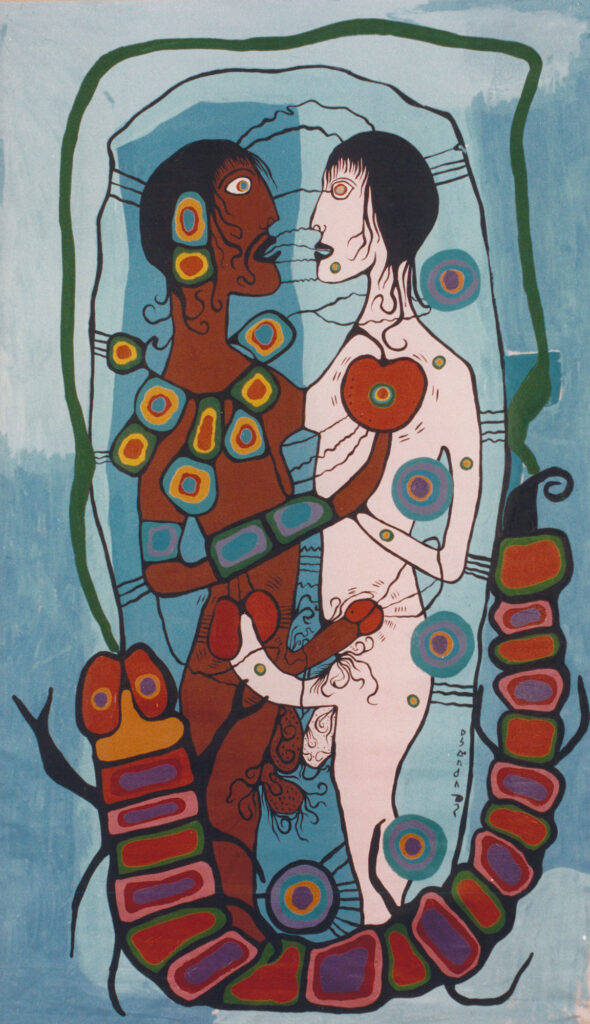
Norval Morrisseau, Indian Erotic Fantasy, n.d., acrylic on canvas, 257.8 x 152.4 cm, private collection.
The narrative Morrisseau has created is rich in symbolism, and the painting exemplifies transformation and metamorphosis in both figurative and literal terms. Set against a background of two shades of blue, two nude male figures are enclosed within a cocoon formed by the curved body of a caterpillar. Their mutual arousal signals sexual desire, while the blue field suggests both protection and the spiritual sanction of their relationship.
The figures are shown in profile, their bodies outlined with heavy black lines. Each is painted in distinct opaque colours that indicate their different racial backgrounds. The figure on the left, an Indigenous man, is set against the darker blue that Morrisseau described as the colour of the almost-night sky. The figure on the right, positioned against the lighter blue of morning, appears to be non-Indigenous. Around the Indigenous figure’s neck hangs a necklace composed of circles and ovals outlined in black and filled with light blue, dark blue, yellow, red and orange. This same graphic treatment appears in the design of his ear lock. He also wears an armband and two wristbands outlined in black; unlike the necklace and ear lock, however, these ornaments consist of elongated ovoid forms rendered in the two shades of blue with the addition of lavender.
Morrisseau employs a number of visual elements to emphasize the profound interconnection between these two individuals—a bond that is physical, emotional, and cognitive. Although they are represented as distinct beings, they appear conjoined at the shoulder. Small undulating black lines are like electric circuits passing between them, tracing an exchange of energy. One figure reaches upward to touch the beating heart of the other, whose own hand seems to support and welcome this intimate act—a gesture that also serves as a reminder that the image portrays more than physical attraction.
Near the bottom of the composition, concentric circles of lavender, turquoise, yellow, and red enclosed within a black form line act as a hub from which lines radiate outward to connect the two figures. Variations of this concentric-circle motif recur along the back of the figure on the right, tracing an ascending path that parallels his calf, buttocks, torso, and neck, further reinforcing the painting’s visual language of connection and shared vitality. The circles, as Martin and Woods inform us, signify the “five stages of life one must pass through in order to free the soul.”
Six much smaller concentric circles of yellow and blue are placed on the body of the fair-skinned male on the shaft of his penis, his buttock, wrist, bicep, shoulder, and chin. A seventh red circle, larger than these six, has been placed in the centre of his heart. Both the placement and the use of a new colour indicate that it is more significant than the others. The interpretation of these visual elements of metamorphosis lends itself to the French definition of orgasm: la petite mort or the little death, implying both a spiritual release and a transcendence in which death is a temporary state that evolves into a different state of being.
Indian Erotic Fantasy stands out as an example of same-sex desire while also alluding to very deep level of emotive exchanges between the two male figures. They seem to merge physically, forming a symbiotic existence. Morrisseau’s use of the word “fantasy” in the title may have been intended to imply that such transcendence is an ideal but unattainable state. The painting was a very profound work for its time and for the generations of Indigenous youth who do not conform to the binary constructions of gender and sexuality.
Jack Pollock (1930–1992), Morrisseau’s art dealer in early years in Toronto, described Morrisseau as dangerously experimental in his sexual exploration. Even though Morrisseau eschewed labels of any kind, he would later allude to being bisexual. In an unpublished interview recorded in 1973 at the Lake of the Woods Museum, Morrisseau related that:
I often feel that I am two people, two people. Two different kinds of people. I don’t mean to say crazy, insane, you know but like I have an Indian name, it represents horse and then I have the skyname, thunderbirds, copper thunderbirds. I could have the female feeling as far as cooking, sewing and so on, keeping house or making things, whatever a woman does, I could have that same feeling. Or I could be male, very physical male. And then even always my pictures––you see that half mark––day and night. I believe in day and night. I like dark blue and light blue. Even the bear––half human, half bear.
This statement illustrates Morrisseau’s understanding of his own gender as being fluid and that gender roles are not conflated with one’s biological sex. Gabe Vadas, Morrisseau’s caregiver and adopted son, stated that Morrisseau “made it very clear to me that he is neither gay, straight, or bisexual. Everybody could be all of that from Norval’s point of view.” Morrisseau gave us this insight into one of the major differences between Euro-Canadian and Anishinaabe constructions of gender and biological sex well before Myra Laramee’s coining of the term “two-spirit” in 1990.
Norval Morrisseau, Life Figures, c.1980, acrylic on paper, 91.4 x 60.9 cm, Art Gallery of Hamilton.
The painting Life Forms, c.1980, while also depicting sexuality, provides insight into Morrisseau’s views on the impermanence of the human form. Here, we see two biological males engaging in the sexual act of anal penetration. However, one of the figures displays physical characteristics that are both human and other-than-human. The ability to shift one’s physical form from one being into another is an indication of one who possesses exceptional abilities. Many of the oral traditions of Nanabush, the central figure in Ojibwe oral traditions, attest to this ability––one that mere mortals do not possess, but rather is the mark of a shaman.
While it may seem evident that the painting Life Forms depicts a sexual encounter between two men, Morrisseau layers it with other possibilities through the transformation of one of the figures. The figure is depicted shifting and transforming into a bird and a fish, while the hands used to embrace the other male figure resemble the paws of a bear. This, along with the hair worn in a topknot and the special treatment Morrisseau employs in rendering the eye of the figure, indicates that he is not a mere mortal, but a shaman.
Is this painting autobiographical? Throughout his career, Morrisseau invited controversy by stating that he was a shaman. Morrisseau wrote: “My parents told me I was blessed ritual by 6 shaman [sic] from Fort William, Nipigon, Sandpoint and Grand Bay, these anchient [sic] supernatural blessing [sic] where carried out so I may have the power to be like them in belief, wisdom, knowledge of the ancestorial way… I am a born artist, a shaman, a mystic and seer…” This could have been one of the factors that led to young Morrisseau being sent to live with his maternal grandparents, Moses and Veronica Potan Nanakonagos. Moses was a shaman, a spiritual leader and member of the Midewiwin Society. Anishinaabe child-rearing practices provided for children who displayed particular inclinations to be sent to live or apprentice with someone in the community who could help them develop their innate abilities. The time Morrisseau spent with his grandfather had a significant impact on his life, as the subject matter of much of his oeuvre suggests.
As for the sexual activity depicted, Curator Lee-Ann Martin noted that many of Morrisseau’s erotic paintings “are based on personal sexual experiences and fantasies involving men.” Morrisseau himself wrote, “to myself I have often knew how to give myself pleasure, and I have found sexual expression and fulfilled them in a variety of ways and means” and that “I enjoy the company of men as well as women. Yet, if we see this painting as just an expression of sexual desire, the other narrative Morrisseau is putting forth is obscured. The key to this painting’s complexity lies in examining how the shaman’s body becomes a pictorial representation of an Anishinaabe worldview. I argue that this painting is both personally autobiographical and an affirmation of Morrisseau’s shamanic identity.
The bear motif is one that frequently appears in Morrisseau’s work, including Sacred Medicine Bear, 1974, that also includes both light and dark blues. The bear carries personal significance for Morrisseau and also figures centrally in the origin of the Midewiwin Society and in its ceremonial practices. The other beings depicted in the painting are also important to Anishinaabe cosmology. In the three worlds of the Anishinaabe universe represented by those other than human beings, shamanic power derives from the bird (the skyworld), the bear (the middleworld), and the fish (the underworld). These worlds are interdependent, based on the notion that all beings have gifts that are meant to be “shared with each other to take care of the earth and all life.” With this comes the idea that while “clearly each kind of person… has unique gifts, which vary considerably in power and in scope,” all are viewed as equal in this co-creation.
Norval Morrisseau, Sacred Medicine Bear, 1974, acrylic on canvas, 133.4 x 172.7 cm, Agnes Etherington Art Centre, Kingston.
The settler nation state is instead founded on establishing and maintaining hierarchies. As Blackfoot scholar Leroy Littlebear points out, “one of the problems with colonialism is that it tries to maintain a singular social order by means of force and law, suppressing the diversity of human worldviews.” An Anishinaabe worldview recognizes that all beings are gifted and a part of creation, therefore all are equal. It is against the fundamental tenets for a human being to decide that one part of creation is less valuable and subject to less recognition of its gifts than the other.
Central to the idea of equality is the concept of non-interference. In Anishinaabe this is understood as Aanjigone: each being has its own path to follow and one does not interfere in that journey. As Mississauga Nishnaabeg writer, musician, and academic Leanne Betasamosake Simpson explains about her child:
... my child has the responsibility of figuring out a meaningful way to live in the world that is consistent with her intimate realities. The job of everyone else is to not direct or control that but to support her. This is the relationship between her and the spirit world. No one else has the right to interfere with that, unless it is causing great harm to someone else and the spirit world.
This worldview is not unique to the Anishinaabe, as these lines from Umeek, a hereditary Nu-chah-nulth chief and scholar from the west coast of Vancouver Island, indicate:
Equality is about having respect for all persons because each is a co-creator, which is a sacred responsibility to carry… in this worldview, each person was to be respected because of his or her association with Qua-ootz, Owner of Reality, Creator of All. This respect was extended to all life forms for the same reason. A translation of this respect into the practice of living is that each life form, each individual person, must be allowed to be whatever Qua-ootz intended.”
In sharp contrast, the settler nation state expresses control and hierarchy in part through the regulation of sexuality. Nineteenth-century European society was obsessed with sex and the control of sexual desire, using restraint as a marker through which the emerging bourgeoisie could separate itself from the working class. As scholars such as Anne McClintock and Ann Laura Stoler have demonstrated, this preoccupation also shaped the colonial relationship between Europeans and Indigenous Peoples. In Race and the Education of Desire: Foucault’s History and the Colonial Order of Things (1995), Stoler argues that policing desire and sexuality was a means by which colonizers distinguished themselves from the colonized. The capacity to control basic drives, including the sexual desire, was taken as evidence of one’s degree of “civilization,” reinforcing colonial claims of moral and cultural superiority over Indigenous Peoples. In Imperial Leather: Race, Gender, and Sexuality in the Colonial Contest (1995), McClintock examines how British imperialism was structured through the intertwined categories of race, gender, class, and sexuality, demonstrating that sexual regulation was fundamental to the exercise of colonial power.
In Canada, the policing of Indigenous desire and the boundaries between the colonized and colonizers were regulated through the Indian Act, the residential school system, and missionization, all of which contributed to the erosion of Indigenous kinship and social structures. Under the Indian Act, when a non-Indigenous women married an Indigenous man, she abandoned her place in settler society. She and the children of the marriage became––like her husband––wards of the state. Conversely, because an Indigenous woman who married a non-Indigenous man might become “civilized” under the guidance and direction of her husband, she ceased to be “Indian,” and her and her children’s Indian status was revoked.
Missionization further internalized settler colonial values around sex, gender, and desire. Much has been written as well about the corrosive impacts of residential schools, often run by the same religious organizations that provided missionaries, on Indigenous people––something Morrisseau experienced firsthand as a residential school Survivor. These forces contributed to the vilification of those who did not conform to settler norms of heterosexuality and binary sexual orientation. More broadly, the state also regulated sexual relations outside and within the confines of the conjugal contract. Interracial marriage was legalized across the United States only in 1967. It was two years later that homosexuality ceased to be a crime in Canada, although the decriminalization was only partial.
Morrisseau lived life very much on his own terms, and those terms did not include obeisance to the norms and hierarchies of the settler society that surrounded him. He invited controversy; he was outrageous and unapologetic for his behavior, boastful and pointed in his words and interactions. Above all, he saw himself as spiritual being. He also saw connections between spirituality, art, and what settler society would regard as unacceptable sexual orientation, once proclaiming that “a homosexual is one of the most gifted person there is. I think all shamans are homosexual or anyway bisexual.”
Morrisseau’s paintings and use of colour give us some insight to this unique vision of the world. To see his paintings for only the erotic content is to miss some very fundamental truths about what it means to be human. While institutions continue to showcase Morrisseau’s artwork, their reluctance to also show artworks like those I have discussed in this chapter reflects how our society continues to marginalize non-binary and transgender desire. His work contains a worldview where all beings contribute equally to the collective. There are no hierarchies. Our only responsibility is to fulfil our pathway and share our gifts. Morrisseau did all that in a way that only he could.