Materials, Imagery & Technique

Mamaandaawizi, He performs wonders: Anishinabemowin discourses of art, artist, image, and colour
by Alan Corbiere

Renewing Anishinaabe Arts: Norval Morrisseau and the Deep Tradition
by Ruth Phillips

Materialism and Meaning in Morrisseau’s Wiigwaasabak
by Christopher T. Green

The Story of the Conservation of a Birchbark Artwork
by Jill Plitnikas, Marie- Helene Nadeau, Jessie Richard

What Big Teeth You Have Grandfather: Trauma and Rage in Art of Norval Morrisseau
by Richard Hill

A New Visual Language: Experimentation and Creativity (1955-1969)
by Carmen Robertson

Experimentation from the 1970s through 1985
by Carmen Robertson

The Blues: The Spiritual Erotic Fantasies of Norval Morrisseau in Technicolour
by Michelle McGeough
A New Visual Language:
Experimentation and Creativity (1955–69)
by Carmen Robertson
An artist owes it to himself to experiment with many effects in order to reach the highest possible quality.1
—Selwyn Dewdney
Norval was experimenting... and this was when Selwyn was encouraging him to experiment with birchbark for his paintings... and at the same time with the leather too, painting on leather, and I remember Norval buying a very expensive deerhide here, to paint on... beautiful big skins, and he did some paintings on them. Experimenting with ink, experimented with material, whether this was feasible.2
—Irene Dewdney
In the mid-1950s, Norval Morrisseau set himself on a path to define an arts practice. He quickly began to develop a visual storytelling aesthetic that was wholly his own—one that drew from all parts of his life and his beginnings. By using black line to capture otherwise unseen aspects of a world charged with spiritual energy, Morrisseau created interconnected artscapes where sacred figures interacted with the natural world and with humans. As he continually adapted and refined this emerging visual language, he offered audiences new ways of seeing. In effect, Morrisseau was practising a form of “earth diplomacy,” to borrow a term from art historian Jessica Horton,3 because he situated Mother Earth at the centre of his practice and expressed deep reciprocal ways of knowing aki and nibi (land and water) in his artmaking from the 1950s on. As he honed this visual language, processes, materials, and subjects shaped by his understanding of an Ojibwe worldview coalesced within his practice. Morrisseau also drew from the colonial world he navigated in mid-twentieth-century Canada, with Christianity and other influences expanding his visual vocabulary.
Always a storyteller, Norval Morrisseau made art with a clear aim to offer viewers insights into the world he inhabited. As he worked out ways to tell stories visually, he pushed the boundaries of how he represented the sky world, our world, and the water world. Embracing his spirit name, Osawa Bego Binesi (or Copper Thunderbird), as part of an embodied identity, Morrisseau gave form to complex narratives that conveyed the spiritual dimensions of the Anishinaabeg universe.
Morrisseau’s book Legends of My People, The Great Ojibway, edited by writer and artist Selwyn Dewdney (1909–1979) and published in 1965, provides context for the subjects of his drawings and paintings. A born teacher, Morrisseau remained committed to revealing the spiritual underpinnings of his interconnected understanding of the world. His continual experimentation expanded his ability to communicate the teachings shared with him. One group of overtly spiritual works from the late 1950s laid the foundations for later artistic explorations. Untitled (Sky People), c.1958, a simple sketch that features nine red spirit beings surrounding a lodge, is one of many early works that demonstrates his burgeoning interest in conveying ceremony. In 1960, OPP officer Bob Sheppard purchased the drawing from Morrisseau and gave it to Dewdney. Morrisseau’s inscription on the verso—“Wugeesh-gukawiinin-wuk the Ojibwa Wabino Heaven People Society”—offers context for the work’s subject and he further expands on this in Legends of My People.4 Dewdney later gave the piece to curator Jacques Rousseau, probably around 1966, the year of the Morrisseau exhibition at the Musée du Québec (now the Musée national des beaux-arts du Québec). The gift also included the drawing Wugeesh—Gukawiininwuk “The Heaven People,” c.1958–61. Both works depict figures wearing the ceremonial red robes and hoods associated with the Midewiwin shamans. Morrisseau continued to depict himself wearing similar robes into the 1970s.
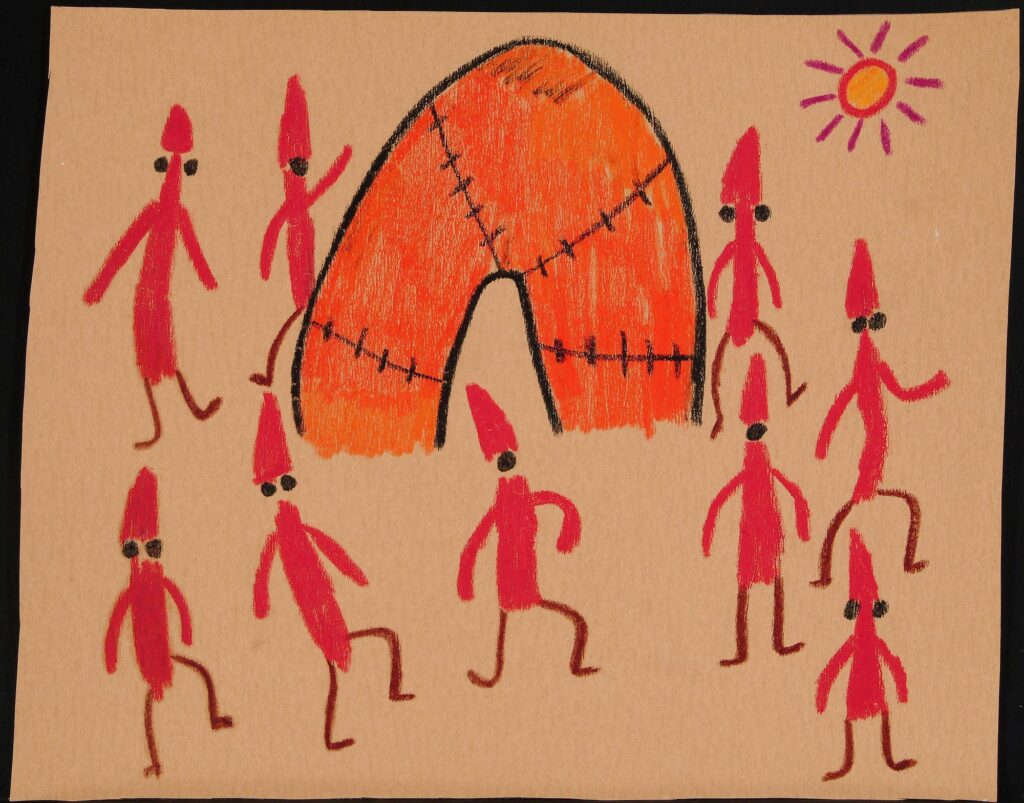
Norval Morrisseau, Untitled (Sky People), c.1959, crayon on paper, 40.1 x 49.7 cm, Montreal Museum of Fine Arts.
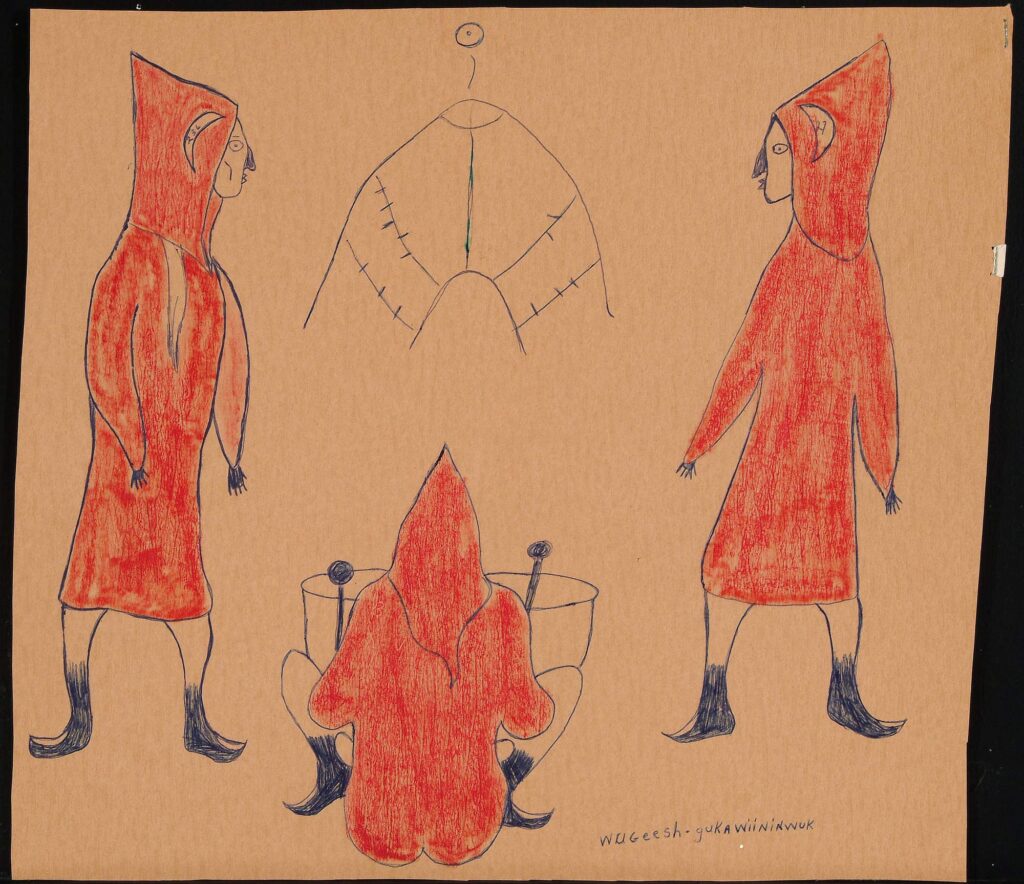
Norval Morrisseau, Wugeesh – Gukawiininwuk “The Heaven People,” c.1958–61, crayon drawing on paper, 39 x 43.7 cm, Montreal Museum of Fine Arts.
Embodiment: Self-Representations
Morrisseau painted countless self-representations. Some of these pieces were titled self-portraits by gallerist Jack Pollock (1930–1992), though this body of work has not been understood as part of the conventional western form of portraiture. He repeatedly located himself in drawings and paintings in ways that revealed aspects of his personality—and most importantly, aspects of his spiritual growth.

Norval Morrisseau, Self-Portrait After Death, 1962, tempera or berry pigment on paper, 54.3 x 69.8 cm, Collection of Nancy Wright.
Self-Portrait After Death, 1962, envisions a future reality for the artist, donning an elaborate headdress and a regal blue robe. The story goes that Morrisseau mixed blue tempera paint with crushed blueberries to achieve the sacred colour he desired.5 A large reproduction of this work was included alongside the story in the November 1962 issue of Weekender Magazine. An insert in a wide variety of newspapers across Canada, Weekender introduced new audiences to Norval Morrisseau’s art following his entry into the art world in September 1962. Writer Bill Brown compared this and other works by Morrisseau to Cubist artist Pablo Picasso (1881–1973), who also created a new artistic language.6
In 1964, Morrisseau depicted himself entwined with snakes—a motif he returned to at least four more times in the following decade—in Self-Portrait Devoured by Demons, a title chosen by Pollock. The enigmatic, autobiographical work, which was part of the dealer’s personal art collection, includes seven serpents whose varied meanings can be understood through Anishinaabe, Christian, and Freudian ways of seeing that reflect the complexities of the world Morrisseau inhabited. Anishinaabe poet and scholar Armand Ruffo explains that “whoever dreams of snakes will have the power to become a great shaman, to move through the four levels of the Midewiwin Grand Medicine Society.”7
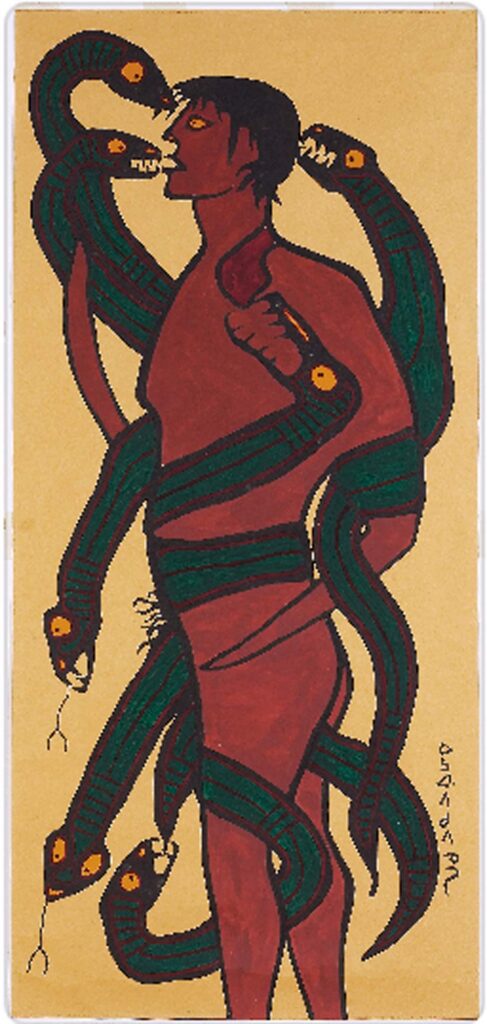
Norval Morrisseau, Self Portrait Devoured by Demons, 1964, acrylic, oil, ink, graphite on kraft paper, 209.2 x 78.7cm, Art Gallery of Ontario, Toronto.
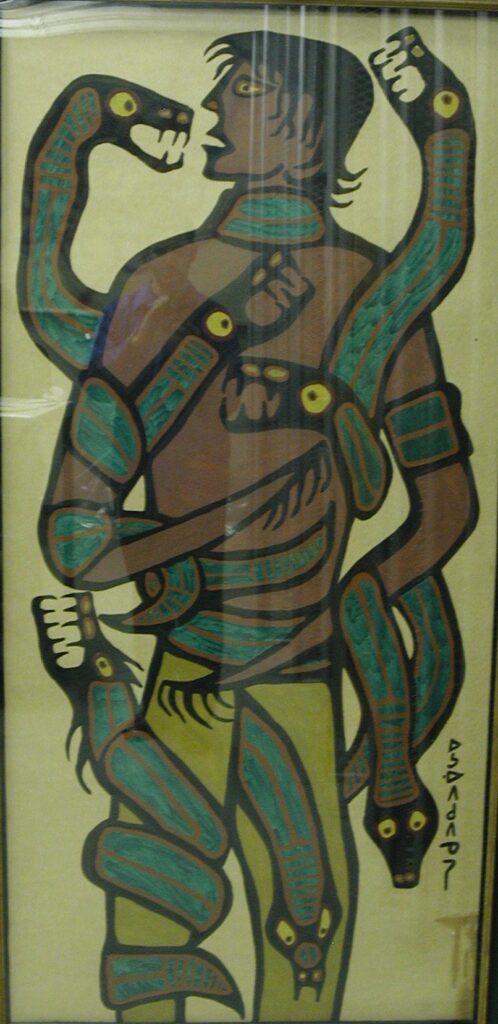
Norval Morrisseau, Man and Snake, 1965, tempera and ink on kraft paper, 175.3 x 81.3 cm, Glenbow Museum, Calgary.
Morrisseau painted another version of this work in 1965, and it was included in the exhibition Norval Morrisseau and the Emergence of the Image Makers at the Art Gallery of Ontario in 1984. Curator Elizabeth McLuhan described the piece as “one of the earliest works dealing with the theme of inner battles and conflicting dualities. The medicine snake has become a many-headed serpent of temptation, a creature of Christianity, not of the Midewiwin.”8 Two self-representations in ink on paper from 1969 also offer insight into Morrisseau’s personal struggles: Old Self and New Self together form a narrative of healing. In Old Self, the artist is bound by a snake whose fanged mouth menaces his face. Though devoid of colour and reliant on line, this piece captures the struggles the artist faced. On its own, Old Self offers only a hint of meaning, but together with its companion work, New Self, it tells a story of struggle, transformation, and resolution.9
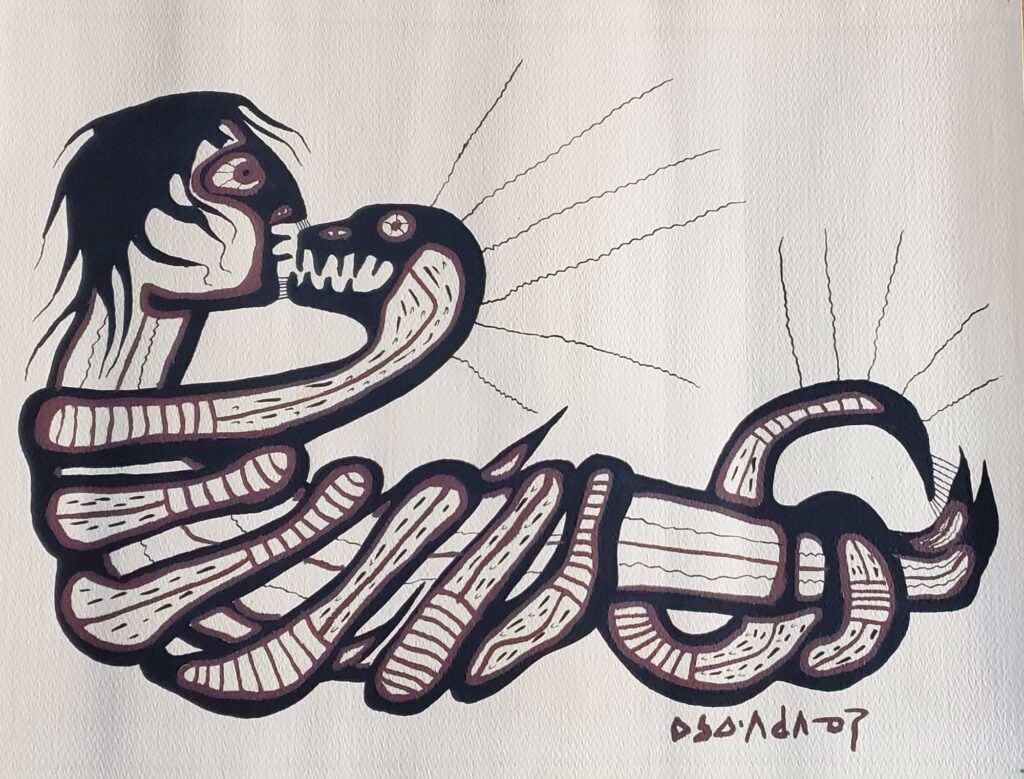
Norval Morrisseau, Old Self, 1969, ink on paper, 38.1 x 54.6 cm, private collection.
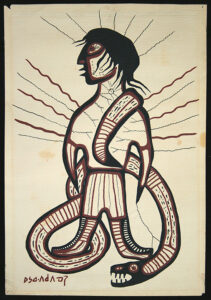
Norval Morrisseau, New Self, 1969, ink on paper, 48.3 x 38.1 cm, private collection.
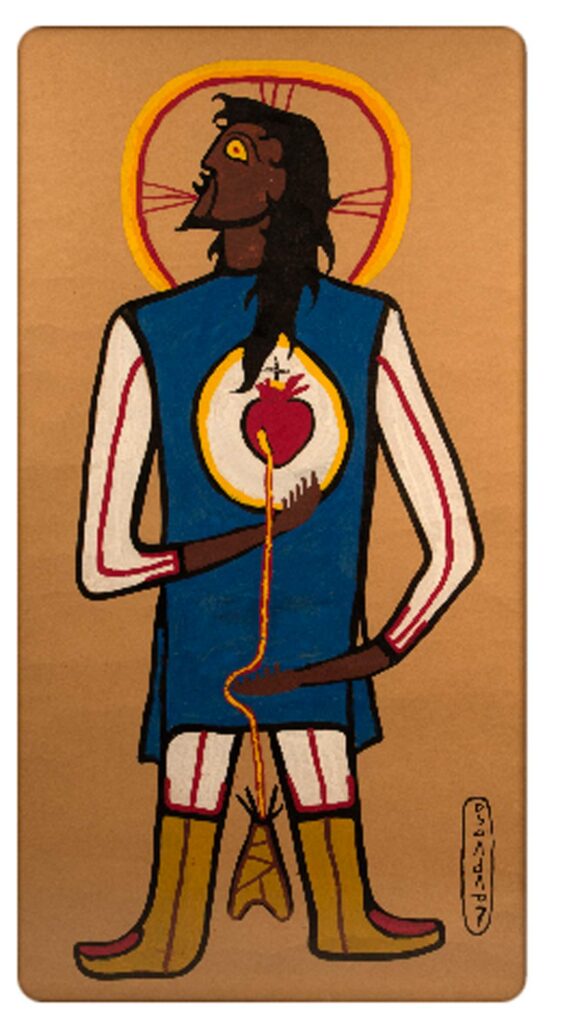
Norval Morrisseau, Mormon Mu Mu, 1960, tempera on kraft paper, 135 x 74 cm, Thunder Bay Art Gallery.
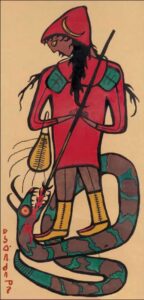
Norval Morrisseau, Shaman Fighting Water Snake, 1964, tempera and acrylic on kraft paper, 163.8 x 80.1 cm, Westerkirk Works of Art.
Portrait of the Artist as Jesus Christ, a self-representation from 1966, brings together motifs from Christianity and Anishinaabeg culture, revealing the ways in which spiritual teachings impacted Morrisseau. The work merges the identities of a shaman called Blue Jay, Jesus Christ, and the artist. A glowing halo or aura encircles his head, and he wears the red robes of a Midewiwin shaman. Two medicine bundles painted in tones of sacred blue and a Christian cross hanging from his neck complete a syncretic image of spiritual power. Like the self-representations entwined by snakes, this work visualizes the complexities of Morrisseau’s identity. Painted on kraft paper at a commanding scale, it reflects the artist’s personal spiritual quest and the influence of his life with his grandparents and his time at a Catholic residential school.
An earlier painting similarly brings together Christian and Indigenous symbolism. Shaman Fighting Water Snake, 1964, again depicts a shaman wearing Midewiwin robes and includes a snake, though some have interpreted it as Morrisseau’s take on the Christian imagery of St. George slaying the dragon. These motifs of snakes differ from his many depictions of horned medicine snakes, commonly done on birchbark. Mormon Mu Mu, c.1960, offers a full-length portrait of the artist wearing a blue tunic, white pants, and calf-high moccasins. A sacred heart, common in religious iconography, is painted in the centre of the figure’s chest in red, with a vertical yellow line extending down to a small tipi between the figure’s legs. A yellow-and-red halo surrounds the Indigenous male form. The Child Jesus Among the Ojibwa, painted in 1965, focuses on a halo and cross with the son of God wearing hide clothing and moccasins. Morrisseau also painted several representations of himself as Christ in the 1970s.
Themes of spiritual transformation can be traced to early birchbark works from the late 1950s that were part of the Weinstein collection; these demonstrate Morrisseau’s interest in the embodiment of spiritual transfiguration. During this period, he frequently painted and drew himself transforming from man to thunderbird, as seen in an elaborate work painted on tarpaper in around 1962. Another example from 1963 was later exhibited in Quebec City and served as a guide for a large-scale mosaic created by Ruby Owens for the Mary J. L. Black Library in 1965 in Thunder Bay.
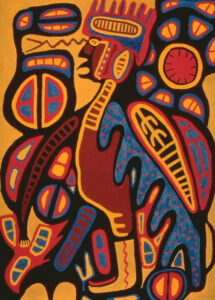
Norval Morrisseau, Untitled, 1962, gouache on tarpaper backing, 94.5 x 73.5 cm, Indigenous Art Centre, Crown-Indigenous Relations and Northern Affairs Canada, Gatineau.
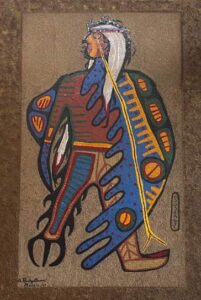
Ruby Owens, Transformation of Man into Thunderbird, 1965, mosaic, public art commission for the Mary J. L. Black Library, Thunder Bay. This mosaic was created as a replicate of Morrisseau's 1963 painting in the collection of the Musée national des beaux-arts du Québec.
In 1969, Morrisseau painted How I Feel About Myself, a self-portrait made for his friend Merv Farrow, a teacher who worked at Confederation College in Thunder Bay. The piece depicts him in an extravagant thunderbird headdress with a wing wrapped around his shoulder—a departure from earlier transformational motifs. The work implies transformation but relies on the headdress to suggest a ceremonial conversion. Set against an intense dark blue background, light blue and yellow draw attention to the wing enfolding the artist. On the verso, Morrisseau added a personal inscription: “picture of Artist Norval Morrisseau—the way he feels he looks to my friend Merv.” Morrisseau’s inscription leaves much to consider regarding identity. This and other self-portraits from the 1960s, however, demonstrate a clear embodiment of his identity as Osaawaabikobinesi (Copper Thunderbird) and expand the intertwined imagery central to his storytelling aesthetic. He not only depicted himself in spiritual communion with the manidoo of the sky realm but also represented the manidoo Thunderbird throughout his career, sometimes as a single being and sometimes in relation to other beings. He also painted Thunderbird, 1969, for Merv Farrow as a companion to How I Feel About Myself.
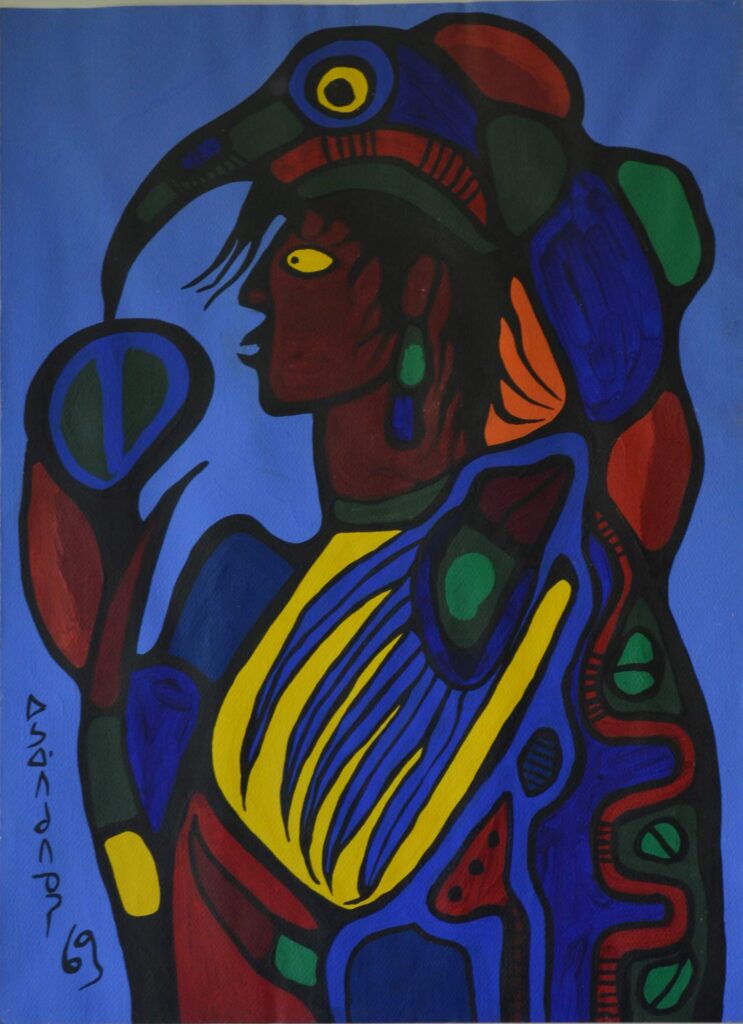
Norval Morrisseau, How I Feel About Myself, 1969, acrylic on paper, 76.2 x 55.8 cm, Collection of Jane and Robert Battye, Oakville, Ontario.
Early works of the manidoo Animikii, or Thunderbird, abound from the 1950s through the 1960s. Thunderbird with Sacred Snake, sold to Alfredo Santos in 1964 and painted on birchbark, is a symmetrical composition of spirit beings with divided circles. The talons of the Thunderbird dramatically squeeze the snake, its body dripping blood rendered in red paint. The sacred snake has horns and has a medicine bundle below its head. Morrisseau signs this work with an encircled syllabic signature but also includes a second pencilled signature that reads “Norval Morrisseau Ojibwa Indian Artist.” The work is also significant because Morrisseau sketched a version of it in pen on lined notepaper to aid Santos’s understanding of the symbolism.10 The annotated sketch clarifies his visual vocabulary by explaining that the divided circles are medicine signs and sources of power associated with both the serpent and the Thunderbird. Morrisseau also identifies the lines between the serpent and the outstretched wings of the Thunderbird as “pulling power.” Using an arrow to draw attention to the lines, he points out that the jagged form coming from the Thunderbird’s eye is power or lightning and identifies the manidoo as “Thunderbird Protector of all Indian Peoples or Race’s of North A Merica a Power Demigod.”11 In 1960, Morrisseau painted a similar work of a Thunderbird with wings outstretched and lightning emanating from its eye, and lines that denote power but this earlier piece did not include a snake.12 In 1962, the artist sketched another version of the Medicine Snake for Dewdney that demonstrates ongoing examination of this subject.
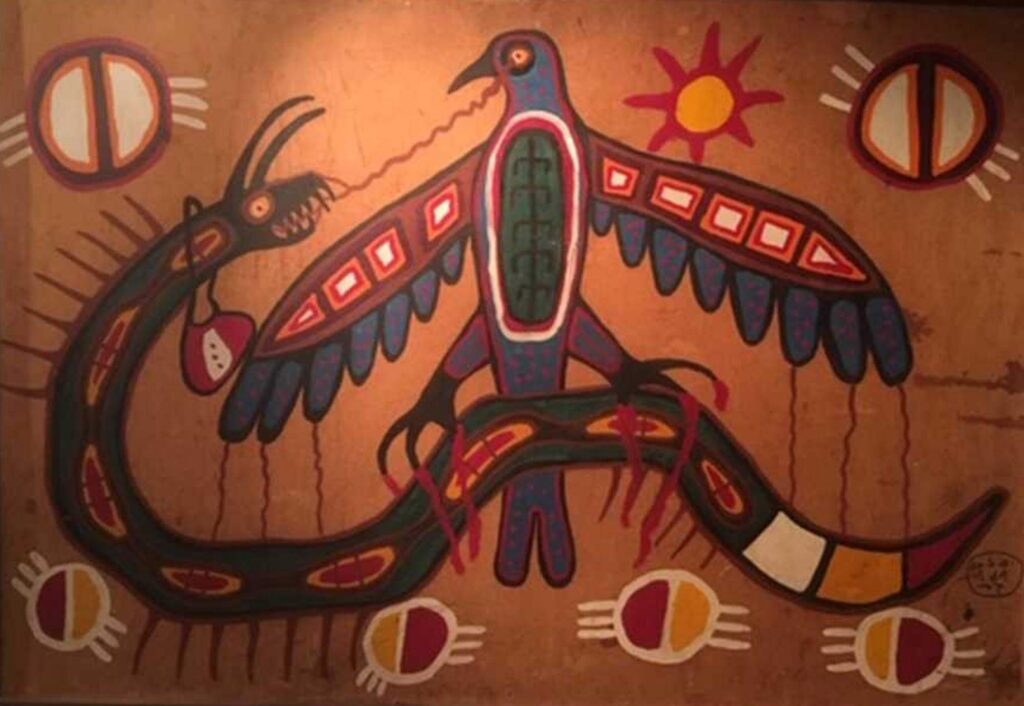
Norval Morrisseau, Thunderbird and Snake, 1964, tempera on kraft paper, private collection.
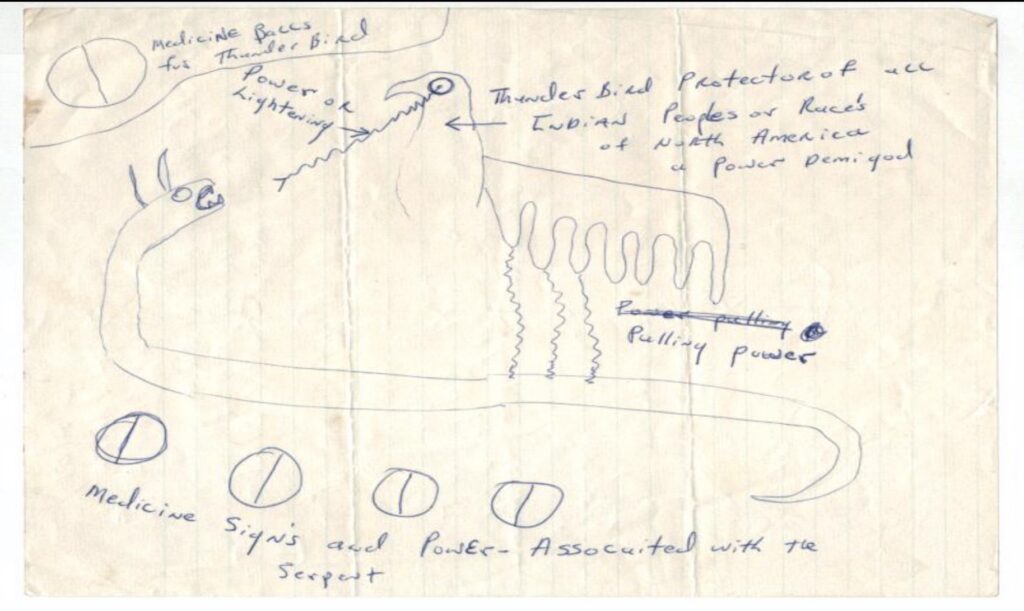
Norval Morrisseau, Untitled (Sketch of Thunderbird and Snake), n.d., ballpoint pen on paper, private collection.
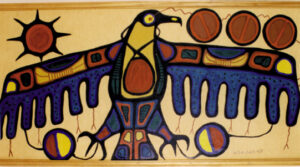
Norval Morrisseau, Thunderbird, c.1960, tempera on kraft paper, 76.8 x 158.1 cm, Red Lake Regional Heritage Centre.
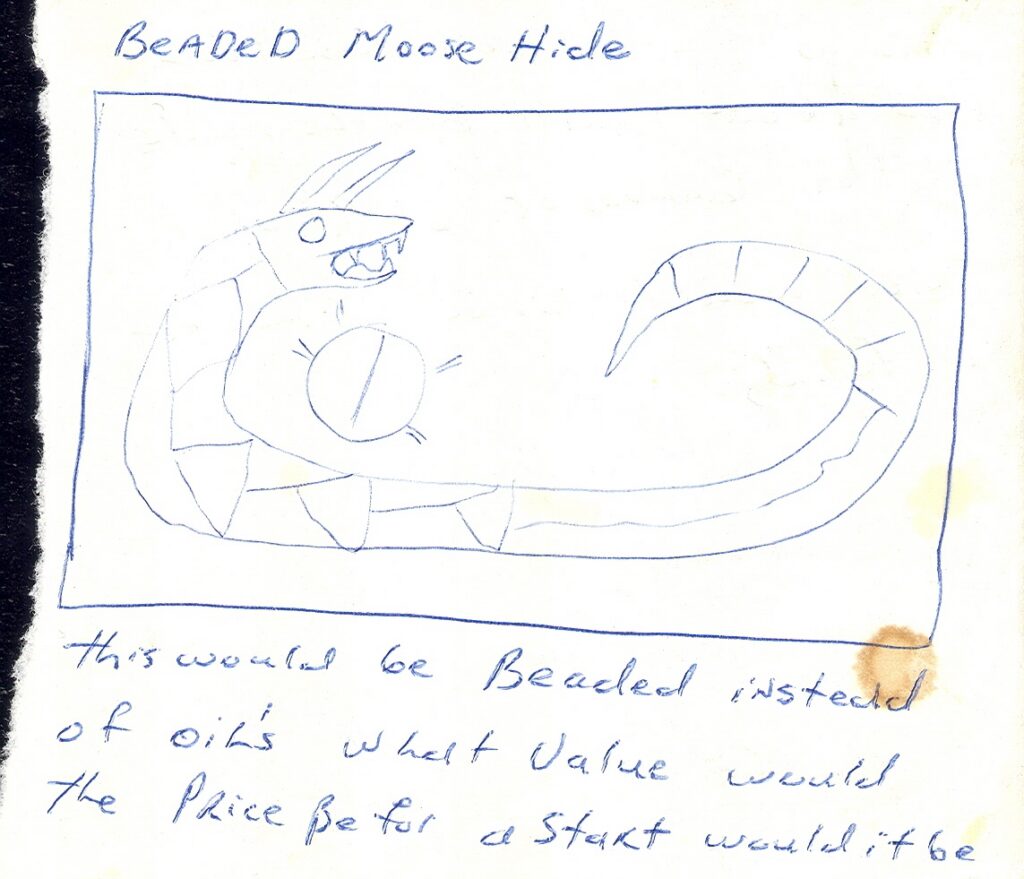
Norval Morrisseau, Medicine Snake, 1962, drawing/sketch, Indigenous Art Centre, Crown-Indigenous Relations and Northern Affairs Canada and Dewdney Archives.
Spirit beings from the water realm were an equally important subject matter for Morrisseau, and from his earliest years, he frequently painted representations of the manidoo, Mishibizhiw, and a wide range of other water beings. This is perhaps unsurprising given that he was born on the shores of Lake Superior, grew up on Lake Nipigon, later lived in the Red Lake area, and spent a great deal of time at Sandy Lake. Morrisseau connected many of the water beings he depicted to stories he shared in Legends of My People, though takes artistic license in his renderings, explaining for example that Mishibizhiw is known to be a horned cat: “The huge cat is believed by the Ojibway to be white in colour, with horns, and very powerful. It is believed to live in the water but why a cat lives in the water, or where it lived is unknown.”13 Several of his earliest portrayals of Mishibizhiw were given to friends and acquaintances. The wide-ranging visual forms he gave this being reflected his ongoing interest in developing imagery suited to this powerful manidoo.
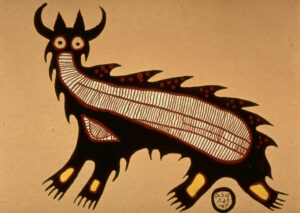
Norval Morrisseau, Untitled, c.1960, gouache on roofing paper, 74.7 x 93 cm, Indigenous Art Centre, Crown-Indigenous Relations and Northern Affairs Canada, Gatineau.
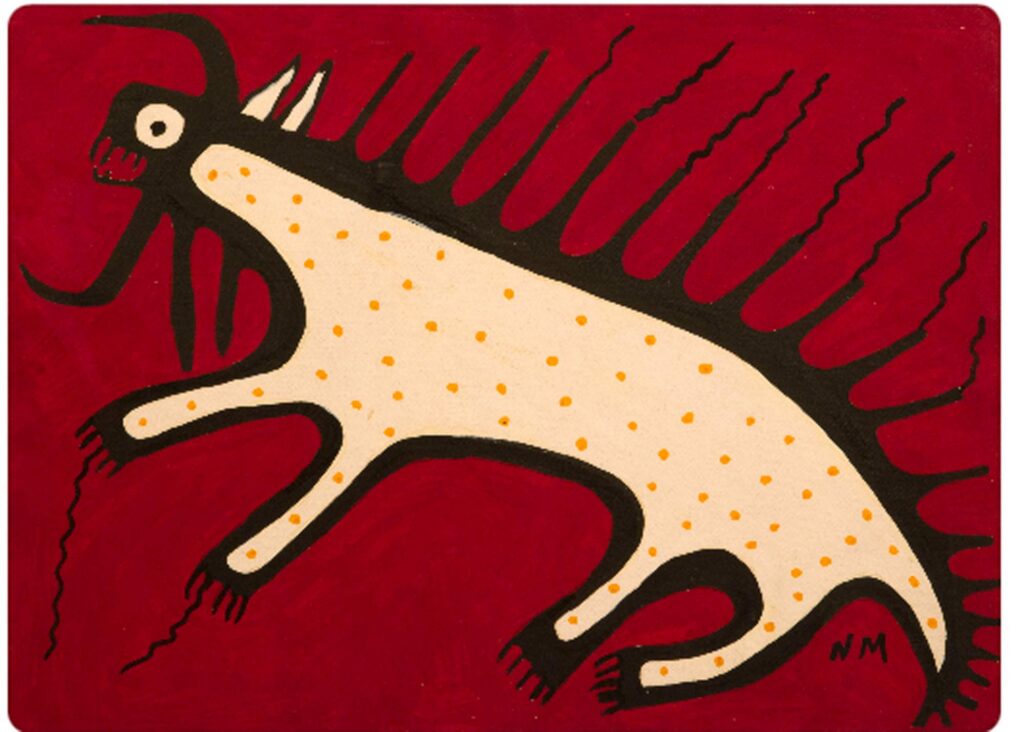
Norval Morrisseau, Miss-Hi-Bishoo, c.1964, oil and tempera on paper, 56 cm x 77 cm, Thunder Bay Art Gallery.
An early example, featuring horns, intense yellow eyes, and elaborate interior segmentation, painted in gouache on roofing paper as a gift for Selwyn Dewdney, demonstrates this early experimentation. Morrisseau also presented a Mishibizhiw painting to Senator Pete Robertson in early 1962 to recognize his support. This work differs from the other noted representations with the addition of an unusual proboscus. Some examples related closely to descriptions of a horned cat or panther found in stories, including in Legends of My People, while others demonstrate him pushing the subject matter in new directions. Another work from this period, purchased by prominent Toronto collector Helen E. Band, was painted in white with yellow dots to convey sacredness on an intense red background. It depicts the entire being emanating pulsating energy lines painted in black.14 At times, Morrisseau also painted Mishibizhiw together with Mikinaak, the turtle to call attention to the interconnected stories between these two sacred beings. One example is Misshipeshu Water God and Miskinuk Turtle, painted between 1966 and 1969 for art dealer Herbert T. Schwarz, an early supporter of Morrisseau’s work. In it, Morrisseau exploited the rich colour possibilities of oil paint and rendered the scene in a rare bird’s-eye view.
His depictions of mermen, mermaids, and medicine fish draw on traditional stories he learned from his family and community, many that are retold in Legends of My People. Through painting and drawing, he gave visual form to the complexities of the water realm. Morrisseau’s interest in publishing written accounts underscores his commitment to sharing the intricacies of the artworks. Merman Legend (Male Fish Spirit Embodying a Male Shaman), 1962, offers an excellent early example of a transformational image, with a shaman shown within the merman’s body.
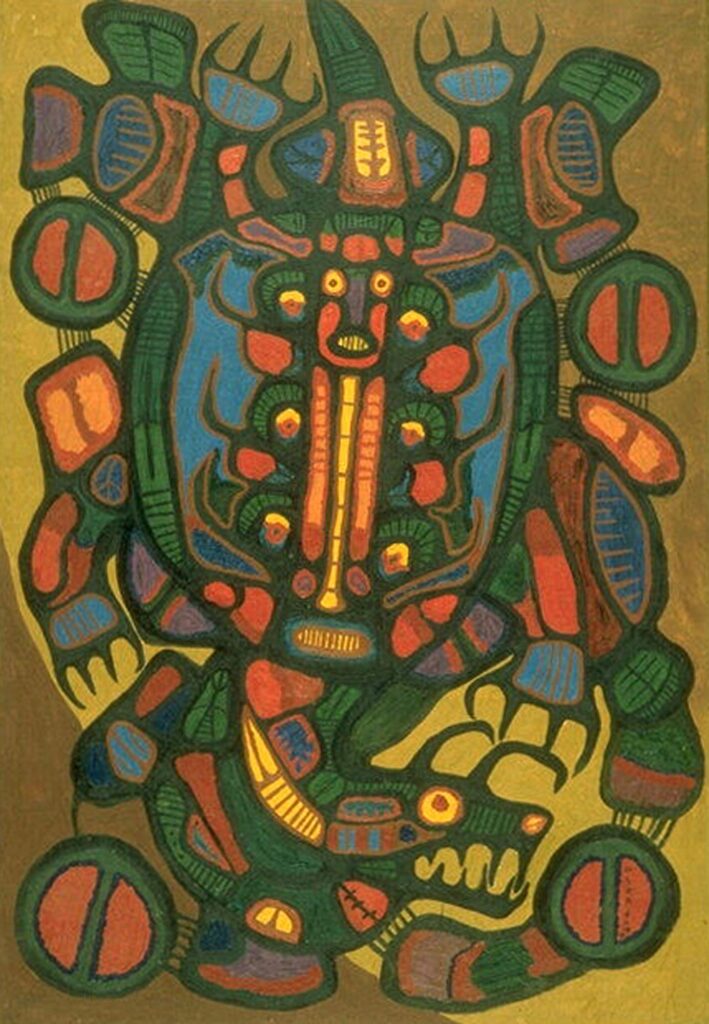
Norval Morrisseau, Misshipeshu Water God and Miskinuk Turtle,1965, oil on canvas, 132 x 91 cm, Canada Council Art Bank, Ottawa.
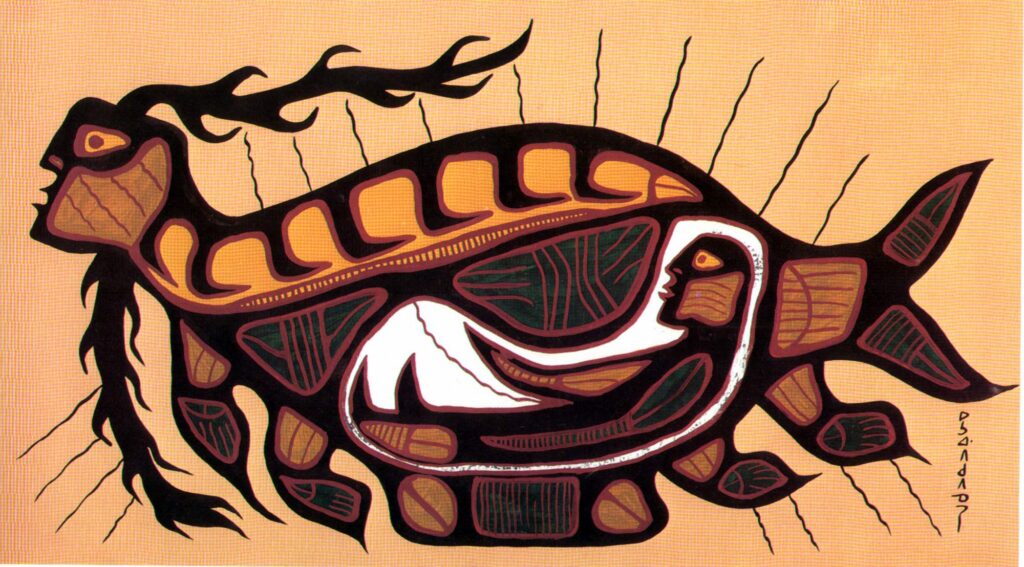
Norval Morrisseau, Merman Legend (Male Fish Spirit Embodying a Male Shaman), 1962, acrylic gouache on paper, 80.2 x 142.3 cm. Art Gallery of Ontario, Toronto.
In 1965, he returned to this subject for a large-scale masterpiece on kraft paper; this work was created for an exhibition that travelled to France and was later acquired by Herbert Schwarz, who organized the show. In Legends of My People, Morrisseau described the merman as “one of the most revered among the water beings and demigods of Ojibway culture. He has exceptional powers and there are many stories to substantiate this.”15 Ancestors of the Waters of the World, 1965, conflates female and fish forms in a composition that communicates a growing interest in experimentation. Breasts hang beneath the figure as a symbol of nourishment and fertility, while the interior cavity of the fish contains a large heart with radiating lines and four directions marked by dots, revealing the spiritual power of the water keepers. The female figure looks directly out at viewers with a stylized, mask-like face, while the fish body is rendered from a side angle. Numerous paintings of medicine fish, such as Sacred Trout, 1965, and Big Fish, a work offered in exchange for fabric at Linda Lundström’s mother’s store in Cochenour in 1965, provided the artist with opportunities to explore a wide range of colour combinations.
Norval Morrisseau, Ancestors of the Waters of the World, 1965, acrylic on paper, private collection.
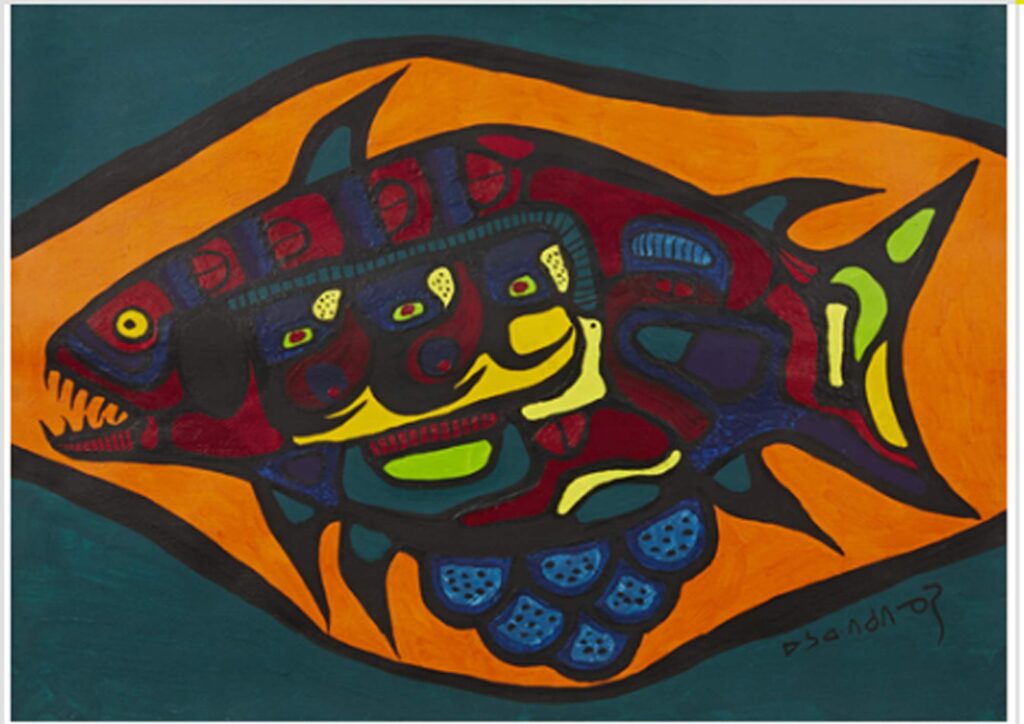
Norval Morrisseau, Sacred Trout, 1965, acrylic on paper 60.9 x 81.3 cm, Westerkirk Works of Art.
Mother Earth was another subject that prompted Morrisseau to explore a variety of ways to capture her essence and offer a relational understanding of Mother Earth’s role as a life giver. One example from the early 1960s is an unusual demonstration of Morrisseau’s ongoing experimentation with form and colour. This unconventional portrait, painted on kraft paper in a muted and limited colour palette, features facial and neck tattoos and an ornate headdress. Flanked by two bird heads on either side and a fish in the foreground, the composition connects land, water, and sky realms. Morrisseau painted several versions of the Earth Mother from the 1960s through 1985 that stress themes of physical and spiritual nourishment, often rendering the breasts as focal points in the compositions. He most frequently painted Mother Earth nursing a young bear and a young boy.
Two strong examples of maternal imagery, Mother Earth, c.1966, and Mother of Serpents, 1968, travelled to France as part of his solo exhibition in 1969. Mother Earth is a three-quarter-length portrait that focuses on her ornately painted breasts to convey spiritual significance, in a format similar to The Merman, 1968. Surrounded by five split circles, she wears a beaded prayer hood, an ornate neckpiece, and matching armbands. Morrisseau painted Mother of Serpents in advance of the exhibitions Pollock and Schwarz mounted in St. Paul de Vence, France in 1969. This version on kraft paper stands out as another impressive example of a large-scale female figure emerging from an ornately decorated, scaled serpent body complete with a rattle. The goddess’s white-painted torso features prominently displayed breasts and trailing tendrils of hair, while a long, thin forked tongue extends from her mouth. Morrisseau’s interconnected forms of visual storytelling bridged visual, oral, and written accounts that, throughout the 1960s, increasingly pushed his visual language in new directions.
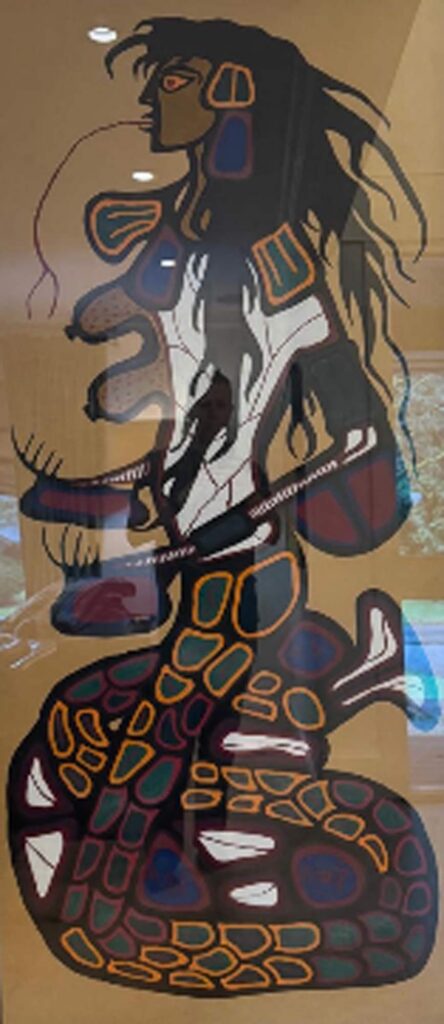
Norval Morrisseau, Mother of Serpents, 1968, acrylic on millboard, 180.3 x 81.3 cm, private collection.
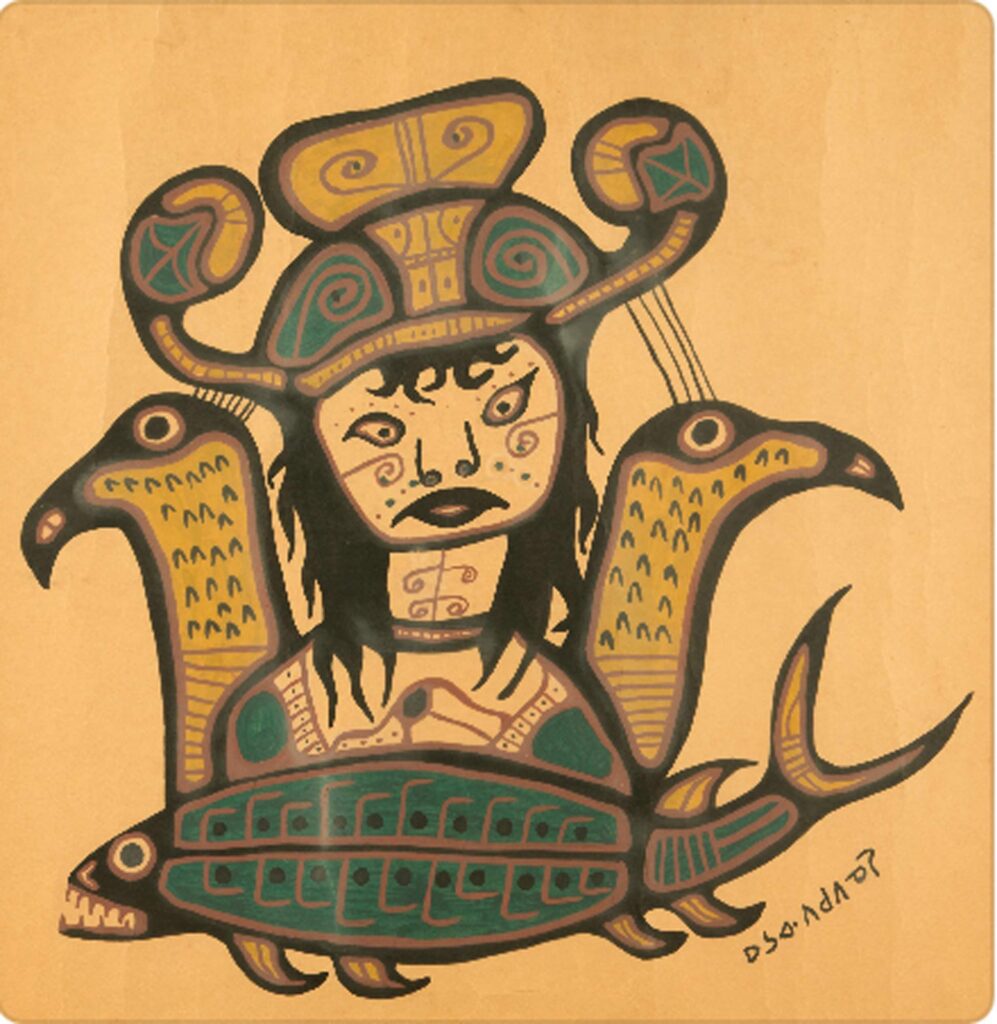
Norval Morrisseau, Earth Mother, c.1960, tempera on paper, 65.5 cm x 92 cm Thunder Bay Art Gallery.
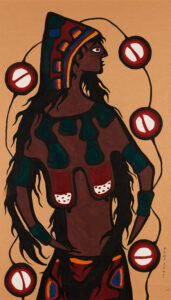
Norval Morrisseau, Mother Earth, c.1966, gouache on cardboard, 140 x 81.5 cm, Canada Council Art Bank, Ottawa.
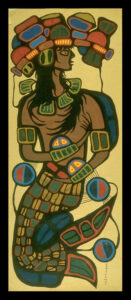
Norval Morrisseau, The Merman, 1968, gouache on kraft paper, 199 x 80.5 cm, Canada Council Art Bank, Ottawa.
Materiality and Experimentation
Morrisseau’s choice of materials shifted constantly in the early years, and those choices in turn informed aspects of his visual aesthetic. At times, they reflected a pragmatism driven by economics and the scarcity of art supplies in northwestern Ontario. These realities led Morrisseau to work with materials that, in some cases, would come to define his practice, even if their use was driven by availability. Birchbark, hide, tarpaper, plywood, kraft paper, and stone inspired him to explore the unique properties of different materials and learn how they could support his storied artistic vision. Both birchbark and hide, however, carry layered meanings beyond. Used for millennia in cultural contexts, these natural materials embody living spiritual presence and connections with other beings, and therefore they can be understood as story keepers that transmit intergenerational knowledge. At the same time, they signal Morrisseau’s role in adapting and innovating such materials. Hide also carried the weight of Western systems of signification, long associated with ethnographic and the primitivist constructions, as Christopher Green carefully explains in relation to Morrisseau’s use of birchbark.
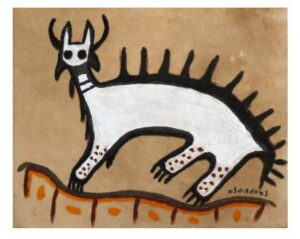
Norval Morrisseau, Untitled (Mishibizhiw), c.1960, paint on hide, 45.72 cm x 63.5 cm, private collection.
The animacy of these materials complicates discussions of why a particular material was chosen for a specific project. Sometimes hand-tanned, other times commercially processed—and mostly derived from local sources—hides were an important medium for Morrisseau throughout the 1960s and 1970s. Selwyn Dewdney wrote to him in early 1961 to encourage him to paint on hide rather than on birchbark, citing its practicality. He also viewed hide as an opportunity to market Morrisseau’s works as authentically “Indian.”16 By contrast, Jack Pollock—as a gallerist and modernist who aimed to situate Morrisseau’s art within a white-cube gallery setting—mostly ignored his works on hide and didn’t include any hide paintings in the book The Art of Norval Morrisseau (1979), although he did show some early examples of the artist’s work on birchbark.
After meeting with writer and artist James Houston in early 1961 and showing him some of Morrisseau’s birchbark pieces, Dewdney relayed Houston’s question: “Why doesn’t Norval do what the Plains Indians did—use hide?”17 Morrisseau replied to Dewdney the following month with news that he had received funds from the Department of Indian Affairs (now Crown–Indigenous Relations and Northern Affairs Canada) and bought hides in Sandy Lake to paint “45 pces.of Art.”18 But this was not his first time using this material—Morrisseau had already created paintings on hide in the late 1950s. Charles Hendrick, who worked at the mine in Cochenour, gave the budding artist a piece of tanned moosehide and asked him to paint something for him. The result was an animated representation of Mishibizhiw, painted in white and outlined in black, with ochre-coloured dots on the legs to signify its sacredness. An undulating line and four dots run along the bottom edge of the painting.19
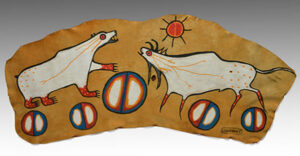
Norval Morrisseau, Untitled (White Bears on Hide), 1962, acrylic on hide, 68.6 x 154.9 cm, Westerkirk Works of Art.
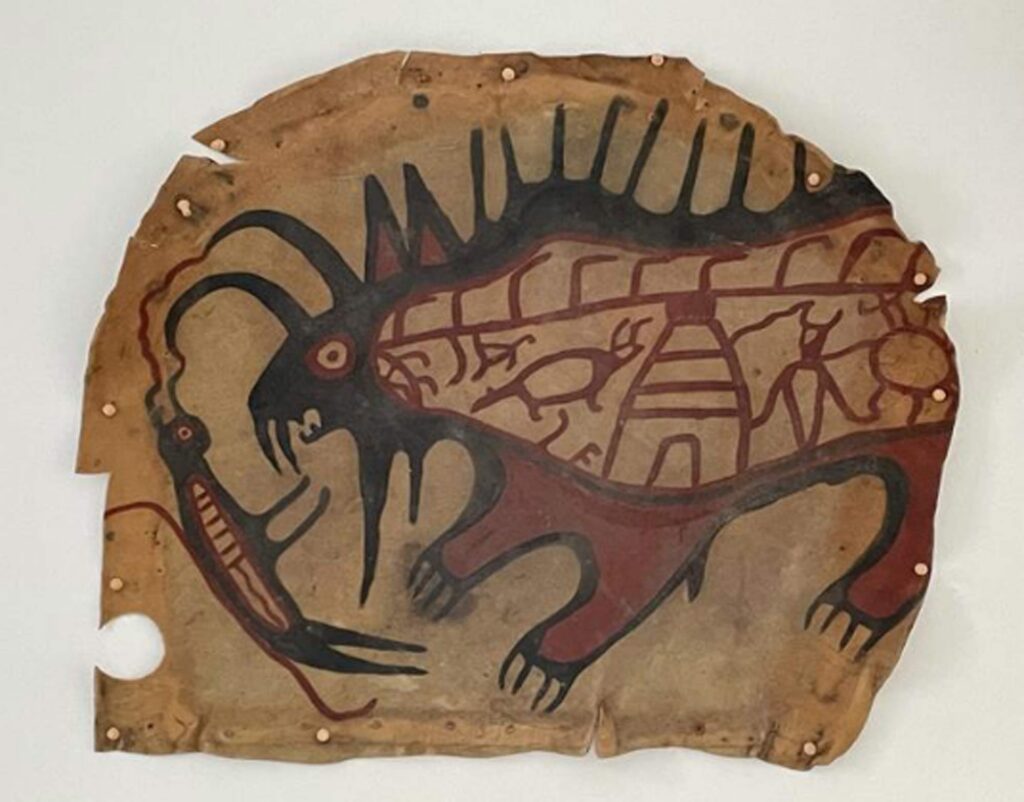
Norval Morrisseau, Mishibizhiw, c.1962, oil on hide, 70 x 76.2 cm, private collection.
In the hide painting Untitled (White Bears on Hide), 1962, Morrisseau includes five split circles below the two figures and a rudimentary rendering of the sun above.20 A small encircled syllabic signature is also included. The next year, Morrisseau gave his neighbours Tom and Evelyn Stanley a hide painting known as Mishibizhiw, c.1962. The Stanleys lived next door to the Morrisseaus in McMarmac, Ontario, in one of several small houses provided by the local mining company. The artist came by one day with his two young children and asked the Stanleys if they could take care of his little ones while he and his wife flew north for an emergency trip to Sandy Lake.21 A few days after the Morrisseaus returned, the Stanleys found the rolled-up hide leaning against their doorstep.22 This version of Mishibizhiw with a conjoined spirit figure fills the entirety of this half-circle-shaped piece of hide and is unusual in depicting only the front portion of the figure.23
In 1969, Allan MacDonald Torrie, a doctor in Kenora,24 acquired a medicine snake painted on hide. The complex composition depicts the snake encircling four spirit figures and several circular forms, including split circles, a circle with the four directions, and another white-painted circle that serves as a point of convergence for all the lines of power in the painting. Morrisseau painted a similar medicine snake on birchbark for Joseph Weinstein in Cochenour in the late 1950s that served as the cover image for The White Ojibway Medicine Man and Other Stories published in 2009 as an homage to his time in the Red Lake area. Dr. Harry Medovy was also gifted two birchbark scrolls with horned serpents in September 1961 after he treated Morrisseau’s young daughter, Victoria in Winnipeg. Morrisseau wrote to Medovy, misspelling his name as Matavi, thanking him for his help and pitching his art offerings. The gifted horned snakes painted on sheets of birchbark were seamed together and began to roll up shortly after they were received. Medovy took the works into a steam room, unfurled them, and clamped them between wood before quickly taking them to a framer.25 The signature on one was smeared during the steaming process.
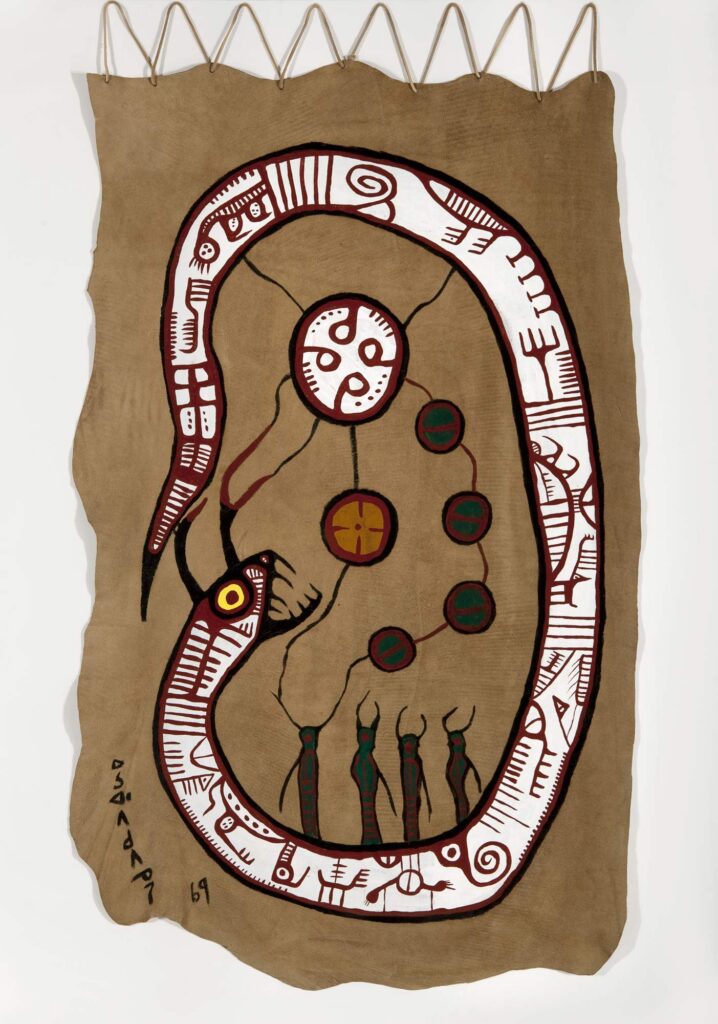
Norval Morrisseau, Untitled (Snake), 1969, acrylic on hide,147 cm x 88.5 cm, Montreal Museum of Fine Arts.
A Passion for Painting
Early on, Morrisseau used whatever was available as a surface to paint on. Authors Christine Penner Polle and Reggie Bacon, in their book Norval Morrisseau and the Woodland Artists: The Red Lake Years, 1959–1980 (2008), interviewed Gunter Seitz, Morrisseau’s partner at the mill at the Cochenour mine, to gain insight into the artist’s inventive use of materials in the early 1960s. “He used any kind of paint that he could find... we had green paint there, red paint.... Only ordinary house paint or whatever, he would use anything,” Seitz recalled. “If he needed brown he would take some shoe polish, too.... He made some [paintbrushes] out of big brushes ’cause we had everything up there. So he’d cut a big brush, he’d cut the hair off there, make a little brush, and he’d be painting away.”26 Seitz also described the artist’s uncontained outpouring of creativity, which often spilled onto the walls and other surfaces in the mill, providing a palpable sense of Morrisseau’s creative energy.
Norval Morrisseau, Hunting Bear and Raven, c.1962, tempera on kraft paper, 79 x 93 cm, private collection.

Norval Morrisseau, Bear and Lake Trout, n.d., private collection.
The lack of access to art supplies was both a challenge and a recurring topic of discussion in much of his correspondence with friends like Dewdney, Pollock, and artist Susan Ross in the early 1960s, and with Herbert Schwarz and writer Jim Stevens later in the decade. Materials he came to rely on, such as roll ends of kraft paper from pulp mills, were not always readily available. Morrisseau painted Hunting Bear and Raven, in tempera on kraft paper in 1962 that includes a fish, bear, and raven that foregrounds kinship relationships for an employee at the mine in Cochenour. The theme also appears in Bear and Lake Trout, n.d., which was painted for his 1962 exhibition and was highlighted in a photograph of the artist with the work, published for a story in the Globe and Mail.
Birchbark, too, had a harvest season and could only be gathered at certain times of the year. And while hides were easier for the artist to source in Sandy Lake, this supply also fluctuated. In September 1969, Morrisseau wrote to Jim Stevens asking him to ship kraft paper from the Red Rock Domtar mill. The following month, he wrote to Herbert Schwarz to report that his usual supplier of kraft paper was out of stock. But, he said, he had a solution: “I’m Hopeing [sic] to use wood plyboard... Natural wood Grains background, closer to Natural Stuff.”27 Morrisseau had had good success with plywood in the past. In the mid-1960s, he traded The Family, c.1960, painted in acrylic on plywood, to high school teacher Gary Rogen, who later sold it to another Red Lake teacher. In this work, Morrisseau takes full advantage of the plywood’s wood grain, using it as a background for a series of interconnected heads painted in black, red, and beige, emphasizing kinship ties. Divided circles united by a black line, along with the visible natural wood grain, further evoke concepts of family connections.
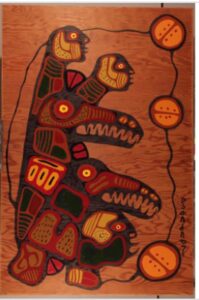
Norval Morrisseau, Untitled (The Family), c.1960, Collection of Romy Rinas, Ottawa.
Morrisseau’s colour palette became more expansive in the 1960s, reflecting his growing access to professional art supplies. Shopping lists preserved in archival sources provide insight into the types of paints he used, the colours he sought, and the quality of paper he required. This correspondence also serves as a reminder of the challenges he faced because he lived in such remote locations. In a 1964 letter to Susan Ross, Morrisseau asked her to send “a roll of Hercules Super extra heavy sheating paper” from Marshall Wells, a hardware chain, along with a selection of seven oil paint colours, including cadmium red, dark yellow, cerulean blue, viridian, and two tubes of yellow ochre.28 Morrisseau relied heavily on Ross for supplies, and he often shipped finished paintings to her in Thunder Bay by train. He also travelled to the Port Arthur area to sell works he did not send to Pollock.
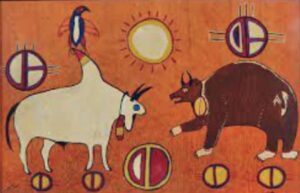
Norval Morrisseau, Untitled, 1963, oil on plywood, private collection.
Norval Morrisseau, Untitled (Three Young Thunderbirds), 1965, oil on Masonite, 81.3 x 121.9 cm, private collection.
Selwyn Dewdney encouraged Morrisseau to paint in oils and he continued to experiment with oil painting intermittently during this decade. An untitled work of oil on plywood was gifted to Dewdney by Morrisseau in 1963 and offers an unusual example of a white buffalo with a Thunderbird perched on his hump. Untitled (Three Young Thunderbirds) from 1965 exudes the richness that comes with ongoing instances of working with oil paints. The layers of colour and techniques that Morrisseau applied to works creates a sense of three dimensionality. The artist traded this painting for clothing to the Emde family who owned a second-hand clothing store in Red Lake.29
Morrisseau is known for his paintings and drawings, but he did sometimes work in three-dimensional forms, and in the 1960s, he made other efforts to expand his art offerings. Locally harvested stone challenged him to imagine new creative directions. His earliest experiments in stone carving were shaped by the hours he spent in the company of the Weinsteins’ library and art collection. During this early period in the late 1950s, Morrisseau created several small sculptures inspired by the Inuit sculptures the Weinsteins had on display. These carvings display a compelling range of experimentation as he explored forms that echoed the scale of Inuit sculptures. He interpreted these forms differently, however, and sometimes included design elements that referenced both Ojibwe and Northwest Coast aesthetics.
Carving clearly appealed to Morrisseau, as evidenced by a 1960 letter to a potential collector about purchasing art. He notes that he has several small stone sculptures available for sale. His efforts to sell his carvings. whether encouraged by the Weinsteins or not, speak to his interest in pursuing sculpture more deeply. In 1964, long after the Weinsteins had left Cochenour, Morrisseau continued working in stone. In a letter to Susan Ross, he proposed a plan for stone sculptures that would reference Indigenous traditions from other parts of Turtle Island. He was, he wrote, “planning to do Sculpters in Stone Incorperating Two Ideas on Idols the Ancient Mound Builders and Mayan Ideas and Putting them in Ojibway Style Ideas by me, and making pipes.”30
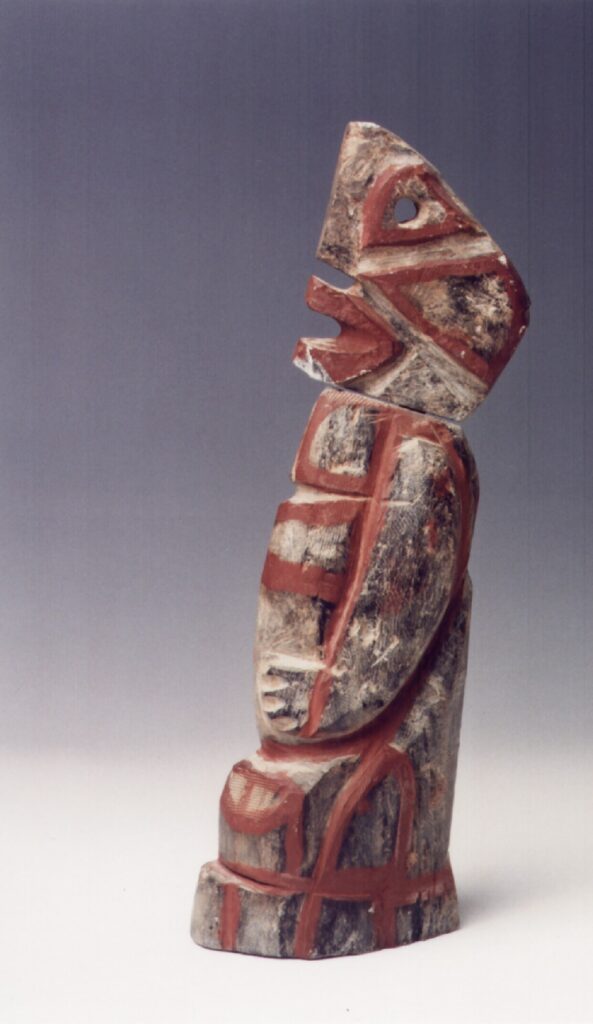
Norval Morrisseau, Untitled, n.d., paint on stone, private collection.
Wood was another medium that Morrisseau explored outside the artistic practices that more closely conformed to Pollock’s expectations for artmaking. Examples from the 1960s are scarce, but it is nonetheless likely that he carved in those years because in a September 1973 letter to Jim Stevens, he provided details of carvings he’d completed during his stay at a lake near Kenora: “12 Wooden Spoon’s, 2 Wooden Dildo’s and 3 Wooden Knife’s Plus frame’s from Ash wood for one Drum and Rattle’s.”31 The Lake of the Woods Museum received a donation of several items carved by Morrisseau, with little sense of when they were done. One piece combines a loon and a duck (or a beaver) and was created for a local lawyer and his family after the man’s wife told Norval she loved to listen to the loons and feed the ducks off their dock on the lake.
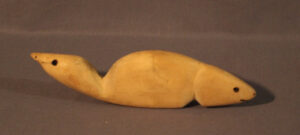
Norval Morrisseau, Untitled (Loon and Duck), wood, 8 cm x 53 cm x 1.5 cm, private collection.
Encouraging Artistic Development
Morrisseau’s September 1962 debut at the Pollock Gallery is well known and received national media attention at the time, charting a new course for both the artist and his dealer, Jack Pollock.32 One of the works included in the white-cube exhibition space was Serpent Legend, 1962, which relates to shared stories told to the artist. Nancy Robinson Villarroel and her mother, Edna Fulford, photographed the artist and his wife holding up this work outside their cabin during a visit to Beardmore in the summer of 1962. Shortly thereafter, Morrisseau met with Pollock, and this work—along with a large number of other pieces—was shipped to Toronto for his debut solo exhibition. The sold-out show was marked by the hierarchical tensions that existed in the art world at the time.
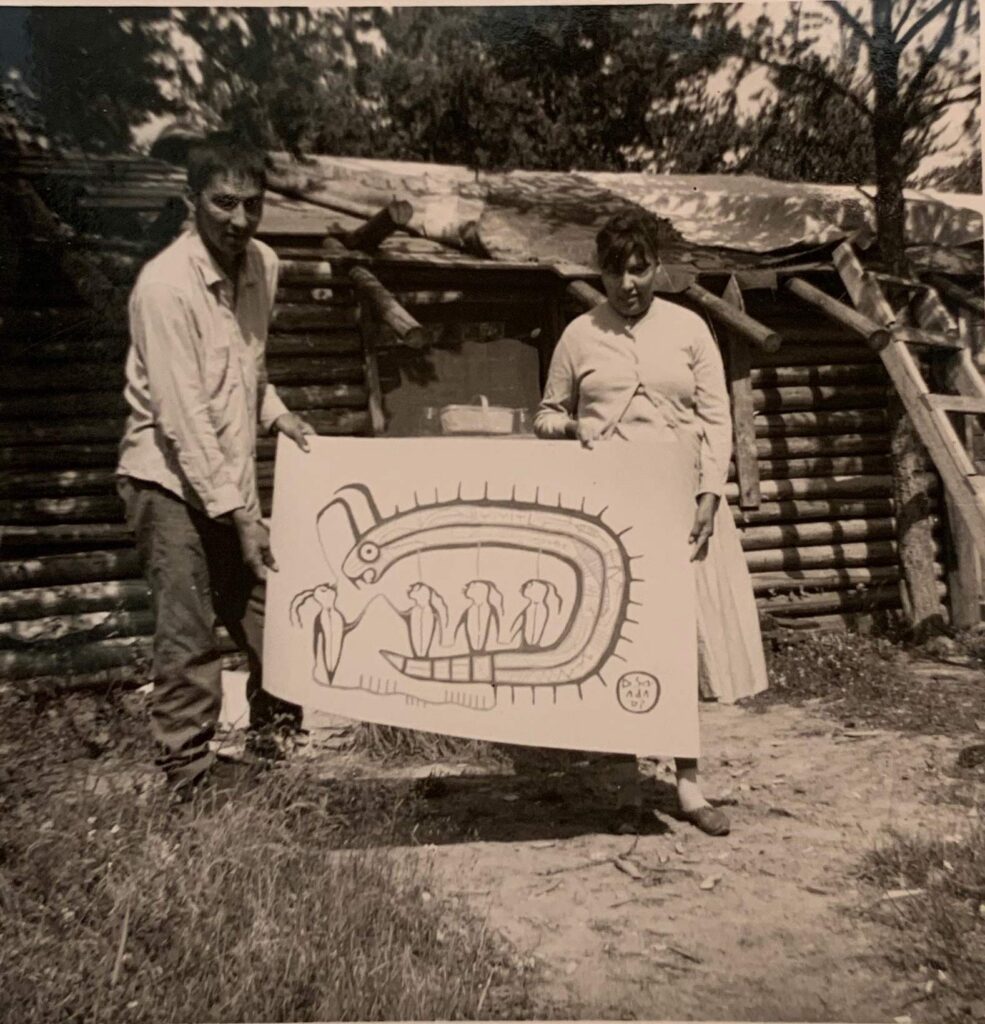
Norval Morrisseau and his wife, Harriet, holding Serpent Legend, Beardmore, Ontario, 1962.
And while much attention has rightly been focused on Morrisseau’s entry into the art world in 1962, his 1963 exhibition at the Pollock Gallery was less of a spectacle. In her review of the later show, Globe and Mail art critic Pearl McCarthy noted his ongoing stylistic development. “The present exhibition at the Pollock Gallery is so much superior to his earlier work as to be thrilling,” she wrote, “because it shows that his primitive talent had capacity for growth and enlargement without loss of the native genius.”33 Although McCarthy uses the term “primitive” to label his art—a common trope in coverage of his 1962 exhibition as well—she more importantly recognizes a growing maturity, signalling a willingness to consider his work as more than a racialized, “frozen in time” monolith. Morrisseau’s sustained engagement with experimentation in the 1960s—and indeed throughout his artistic career—has been underappreciated.
Morrisseau found inspiration not only in Anishinaabe stories and cultural traditions but also in books about a wide range of art movements, from Latin American and pre-Columbian art to Byzantine, Christian, and European art. He also drew from popular culture sources such as comics and cartoons. These books—many shared with him by early supporters such as the Weinsteins, and others borrowed from public libraries—opened new directions in his work. In a 1964 letter to Susan Ross, Morrisseau asked if she could borrow a book on Byzantine art in Constantinople from the Fort William library. He must have seen the book earlier because he referred to it by its title.34 Morrisseau read voraciously and mined books on Indigenous spiritual traditions of the Plains and Pueblo cultures—studies that informed his expansive artistic language throughout the 1960s and 1970s.
Drawings and Illustrations
Although he was known primarily as a painter, Morrisseau was also a master of graphic rendering, using line alone to capture the presence of animals, spirit beings, and elements from visual stories. The absence of colour challenged him to create different forms of visual narration, and he often sketched and sold drawings in the 1960s. The iconic black-and-white line drawings he produced for his book Legends of My People reveal his rich graphic approach to depicting beings and stories. This graphic style was highlighted in the 1966 exhibition at the Musée du Québec, curated by Jacques and Madeleine Rousseau and discussed in greater detail by Marie-Paul Robitaille. The show included original drawings created for Legends of My People and other graphic works. One of the notable paintings in that exhibition, Indian Representation of the Ruler of the Earth, c.1960, rendered in black line, makes the heart a focal point, extending his visual language to convey Anishinaabeg ways of being, in which the heart, rather than the brain, is central to the decision-making process.
Morrisseau took on the role of graphic illustrator a second time when he was commissioned by Herbert Schwarz to illustrate his book Windigo and Other Tales of the Ojibways (1969). The illustrations were a combination of black and sepia ink on paper. In 1973, Schwarz sold a number of Morrisseau’s drawings to the Canada Council Art Bank. One piece from Schwarz’s collection that was not included in the book, Shamans Invoking the Spirit of the Deer, 1968, offers a clear sense of Morrisseau’s capacity for visual storytelling through drawing. More detailed than other drawings included in Windigo, this work features a central deer figure containing a full spirit form. Tipis, birds, and other spirit figures share the crowded space. Schwarz may have felt the drawing was too busy to serve as a book illustration, but it clearly demonstrates the complexity of Morrisseau’s drawing style.
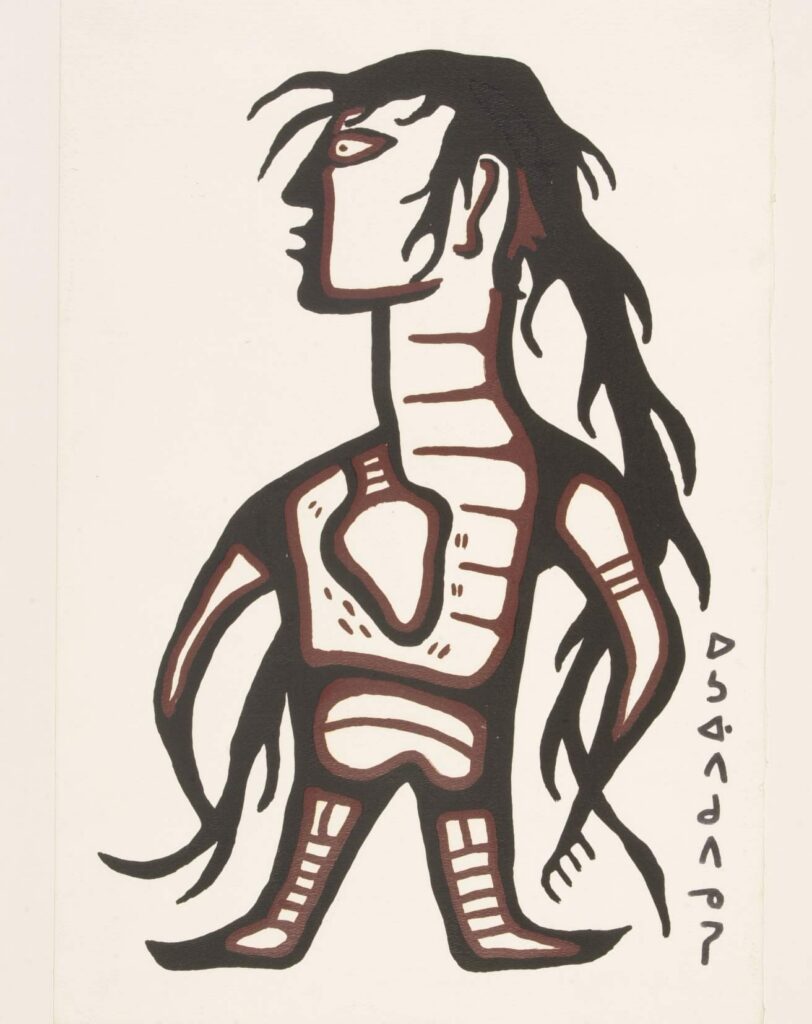
Norval Morrisseau, Indian Representation of the Ruler of the Earth, c.1960, gouache sur papier, 56 x 38,1 cm, Musée national des beaux-arts du Québec.
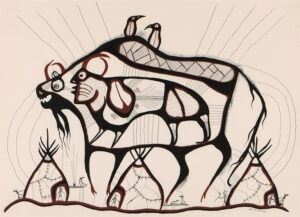
Norval Morrisseau, Shamans Invoking the Spirit of The Deer, 1966, oil and ink on paper, 58.5 x 79 cm, Canada Council Art Bank, Ottawa.
In Windigo, Mikkinnuk the Turtle and the Shaking Tent, c.1966, illustrates the story “Forbidden Mountain.” Morrisseau used sepia ink to mimic the sacred onaman sands and define the spiritual and ceremonial connections between Mikinaak and jiisakan, the shaking tent. This is a subject he often painted, both before and after Schwarz’s commission. One early example of Mikinaak with a shaking tent inscribed on its shell was traded with a local in Red Lake in 1961, providing evidence of Morrisseau’s interest in visual stories shared by his grandfather. Untitled (Mikkinuuk and Jiisakiiwin), 1961, a tempera-on-paper painting, was given to Barbara Hunter, whose husband had taken a position as a teacher at the Red Lake high school. In exchange, she gave Morrisseau a Siamese kitten from a new litter. On the back of the painting, Morrisseau wrote an explanation of the work: “Mikkinuuk the Turtle who is the Interpreter of the Demigods the Innards his body represents the Shakeing tent Ceremony—he is the giver of Vishions and Medicine.” In 1968, Morrisseau painted his daughter Victoria with two Siamese cats in acrylic on millboard.
Another of the many stories that Morrisseau painted from the 1950s onward centres on a teaching about gifting sacred onaman, a red sand used by the Anishinaabe for rock art and other ceremonial purposes. In keeping with his ongoing efforts to experiment with ways of visually conveying stories, that he also recounted in Legends of My People, Morrisseau returned often to the theme of the onaman legend. He first conceived of the story in a work he made for the Weinsteins around 1958. Untitled (Thunderbird with Beaver), c.1958, was painted in watercolour. Another early version of the same story, Onaman Legend—Origin of Sacred Sands, 1962, was painted in gouache on paper in black and browns.35
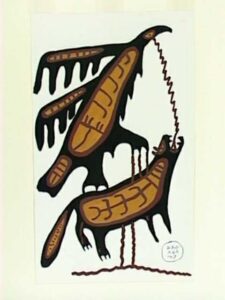
Norval Morrisseau, Onaman Legend––Origin of Sacred Sands, 1962, gouache on paper, 44.8 x 27.6 cm, McMichael Canadian Art Collection, Kleinburg.
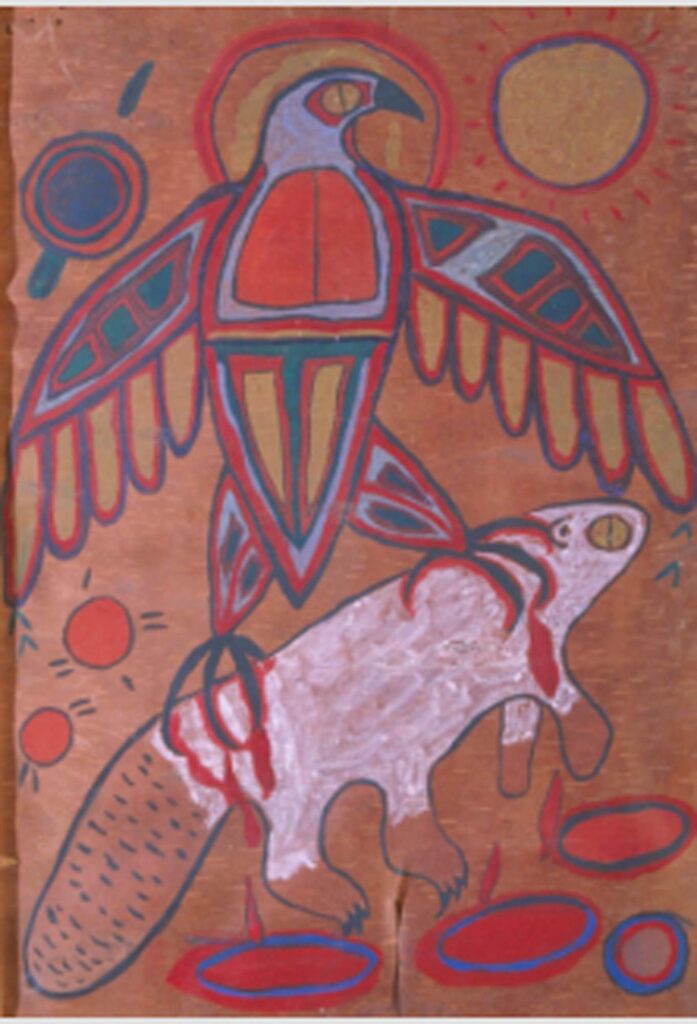
Norval Morrisseau, Untitled (Thunderbird with Beaver), c.1958, watercolour on birchbark, 81.3 x 59.2 cm, Canadian Museum of History, Gatineau.
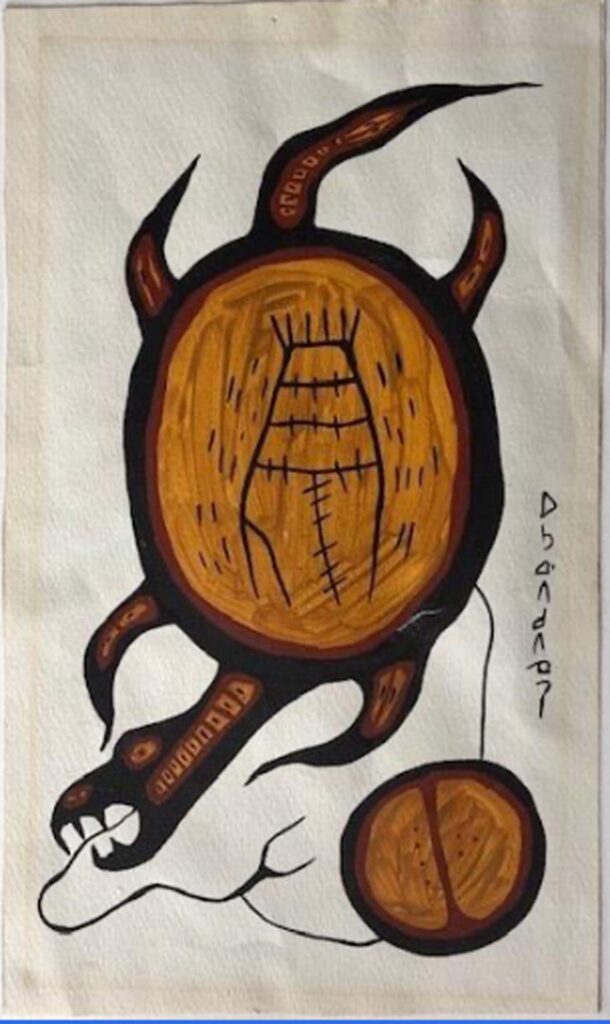
Norval Morrisseau, Untitled (Mikkinuuk and Jiisakiiwin), c.1960, acrylic on paper, 23.1 cm x 39 cm, Collection of Karen Devuono, Thedford, Ontario.
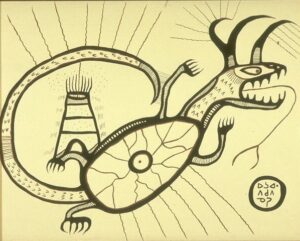
Norval Morrisseau, Mikkinnuk the Turtle and the Shaking Tent, c.1966, ink on paper, 59 x 73 cm Canada Council Art Bank, Ottawa.
Mid-1960s Shifts
As Morrisseau experimented with his visual vocabulary, his work was shown more often. Five key exhibitions helped to launch his career to new heights, and he became better known regionally, nationally, and internationally. By 1966, he was showing his work in a range of venues. Graveyard Scavenger, c.1966, a work that is most likely a large-scale Mishibizhiw in acrylic on kraft paper, was featured in the Winnipeg Free Press in 1966 to announce the artist’s upcoming participation in Expo’67. It was later sold through the Yellow Door Gallery in Winnipeg to collectors in Regina. Morrisseau’s 1965 show at the Hart House Gallery was his first in Toronto outside the Pollock Gallery and, significantly, took place in a non-commercial gallery, signalling an important shift in how his work was received. The 1966 exhibition at the Musée du Québec—mounted by Jacques and Madeleine Rousseau—also shone new light on his art.
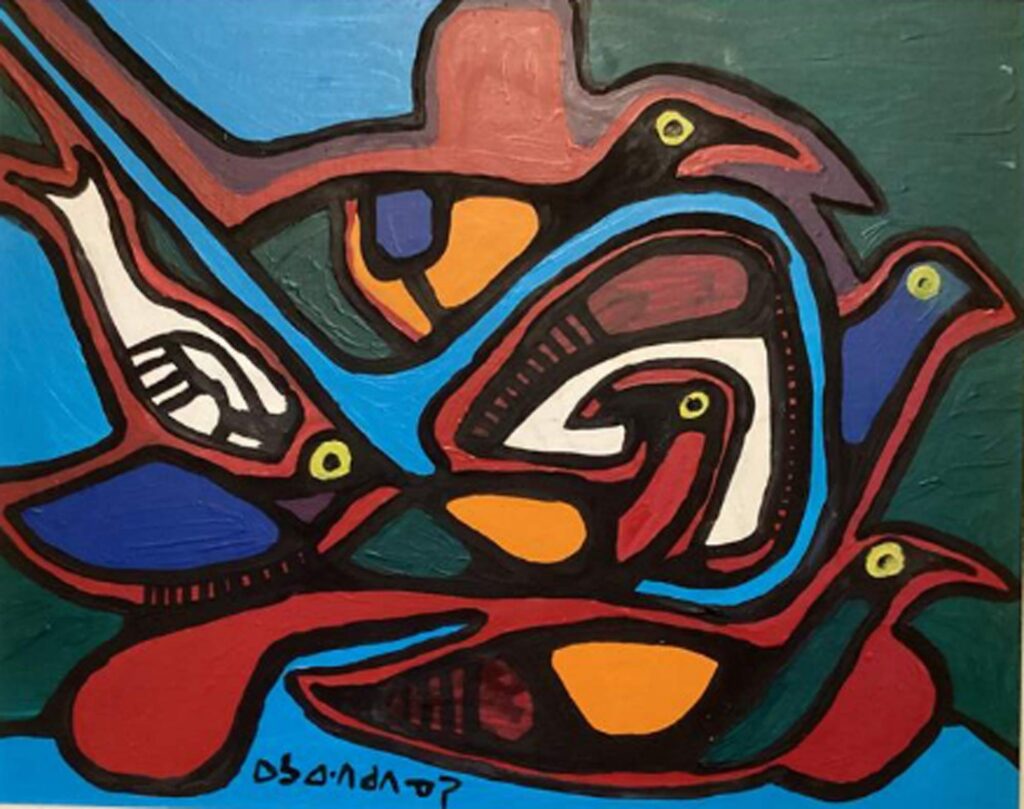
Norval Morrisseau, Untitled (Birds and Fish), c.1965 oil on canvas, 40.6 x 50.8 cm, Collection of Sandra Hogarth (nee Sweeney).
Norval Morrisseau, Owl Human Spirit Helper, c.1969, gouache and tempera on paperboard, 86.4 x 71.1 cm, Westerkirk Art Collection.
Exhibitions and International Stardom
Exhibitions grew in number and significance over the course of the 1960s. Following the success of the exhibition in Quebec City, Herbert Schwarz and Jack Pollock organized a show at Schwarz’s Galerie Cartier in Montreal in late 1966. The dealers amassed more than ninety works to show that December. Schwarz and Pollock purchased a large number of works, which they pooled and displayed at two additional venues for greater impact. This exhibition travelled to Rhode Island in 1968 and, most importantly, to St. Paul de Vence, France, in September 1969. Morrisseau found it difficult to work with Pollock during this period, but his collaboration with Schwarz was exciting for him, and together the dealers and the artist benefited from the increased international exposure. Schwarz, who had a large collection of Inuit art, supplemented Morrisseau’s work with pieces from his collection for the exhibition in Rhode Island. The exhibition in France, however, featured Morrisseau’s work exclusively.
Morrisseau continued to explore new ways to convey visual stories throughout the last few years of the decade, pushing his colour palette and interior segmentation to new levels. As he had in the painting of birds and fish made around 1965 for the Sweeney family, he introduced vivid colour into other painted subjects. The Thunderbird Boy, which was not a self-representation but an homage to Herbert Schwarz, was painted with a new vibrancy in 1966. It depicts an important character, the son of Thunderbird, from a story in the Windigo collection that Schwarz published in 1969. Both the headdress and the figure’s mantle demonstrate his experimentation with shape and form, with less reliance on line and more emphasis on varied decorative forms. The painting travelled to the U.S. and France but remained in Schwarz’s personal collection until he sold it to the Canada Council Art Bank in the 1970s. This work is an excellent example of the lush application of colour that emerged in this period. Ongoing experimentation in colour, materials, and subject matter throughout the 1960s primed the artist for pushing his artistic language in fresh directions in the 1970s.
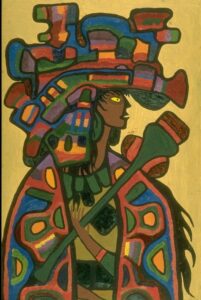
Norval Morrisseau, The Thunderbird Boy, 1966, oil on Masonite, 121 x 80.5 cm, Canada Council Art Bank, Ottawa.