Materials, Imagery & Technique

Mamaandaawizi, He performs wonders: Anishinabemowin discourses of art, artist, image, and colour
by Alan Corbiere

Renewing Anishinaabe Arts: Norval Morrisseau and the Deep Tradition
by Ruth Phillips

Materialism and Meaning in Morrisseau’s Wiigwaasabak
by Christopher T. Green

The Story of the Conservation of a Birchbark Artwork
by Jill Plitnikas, Marie- Helene Nadeau, Jessie Richard

What Big Teeth You Have Grandfather: Trauma and Rage in Art of Norval Morrisseau
by Richard Hill

A New Visual Language: Experimentation and Creativity (1955-1969)
by Carmen Robertson

Experimentation from the 1970s through 1985
by Carmen Robertson

The Blues: The Spiritual Erotic Fantasies of Norval Morrisseau in Technicolour
by Michelle McGeough
Materialism and Meaning in
Morrisseau’s Wiigwaasabak
by Christopher T. Green
When I was young, I always wanted to make a scroll … but they wouldn't let me. They told me first I had to be a Shaman.
–Norval Morrisseau
Much has been written about Morrisseau’s journey from using more “naïve” or “primitive” materials, such as kraft paper and hide, to purportedly fine art ones, such as acrylic on canvas, in his forays into the commercial art world as he tried to find a balance between Anishinaabe traditions and styles and the advice and expectations of mentors and advisers, patrons and critics. But Morrisseau’s use of certain materials over time has never been rigorously mapped or analyzed. Nor, until recently, has the nature of his chosen artistic materials been the subject of significant study. Instead, discussions most often crop up in arguments about the shift in his work from “craft” to “fine art,” his formal relationship to modernity (and modernism), or his physical and mental health or legal and financial problems. These arguments, however, overlook the fact that certain materials and objects, like visual motifs, recur throughout Morrisseau’s career in ways that cannot be explained solely in those terms.
One such object is the wiigwaasabak (plural: wiigwaasabakoon), or birchbark scroll, something which Morrisseau repeatedly made in the first decade of his career and to which he returned in the mature period of the mid-1980s. Morrisseau was inspired by mide-wiigwaas, the sacred scrolls of the Midewiwin Society. These rolled sheets of birchbark are engraved with pictographic designs that function as mnemonic devices for Midewiwin lodge ceremonies, diagramming the oral histories, the migration stories, and visionary dreams of the Anishinaabe. These linear etchings feature pictographic figures, symbols, and diagrams, with the figures connected by linear structures within a horizontal and rectangular format.
As has been well recounted, Morrisseau found inspiration in these pictographic designs. “My grandfather showed me how to do interpretations of the shaman beliefs on birchbark,” he wrote in 1979. “So all my painting and drawing is really a continuation of the shaman’s scrolls.” Yet Morrisseau’s interest extended beyond translating them in his own artwork: “I always wanted to make a scroll.” This desire resulted in his return to the wiigwaasabak format several times in the 1980s.
Morrisseau’s choices about his objects and materials were intentional and rich with meaning. To understand this, we need to take a materialist reading of Morrisseau's early work. By materialist, I refer to a broad approach that emphasizes the importance of the material aspects of art, particularly the physical substances used to create it, and their impact on artistic meaning and expression. This includes analyses of how works of art produce their meanings in relation to the economic conditions of their creation and reception, as well as what has been called “new materialism,” or an attention to the agency and active nature of artistic material. As Janet Berlo and Jessica Horton have argued, Indigenous philosophies and worldviews pay attention to the vibrancy of matter as expressed through their art and visual culture. Material reality determines social and cultural life, and material conditions determine the production of artistic forms, but an expansive materialist view must consider also the nature and character of materials with which Morrisseau worked and the way they intersected with socio-economic, cultural, and personal meanings.
Morrisseau’s birchbark scrolls offer a case study through which to examine these intersecting meanings. This study is necessary to answer the question of why he returned to the wiigwaasabak several decades into his career, after having seemingly abandoned many of the materials that defined his early years in favor of fine art media. To show how material simultaneously functions beyond and gives meaning to visual imagery as more than a ground or medium, this essay looks at the scrolls’ material and cultural elements: support and animate matter (birchbark); pigments and medicine (white paint), and volume and object quality (containers). These elements recur throughout Morrisseau’s work, and past scholars have concluded that this was driven entirely by historical materialist, primitivist, and formalist concerns. I argue, however, that in the wiigwaasabak these elements come together in ways and for reasons that are quite different, instead reflecting consistency with Anishinaabe spirituality. This requires a close look at Morrisseau as a maker both of images and of objects with material specificity.
Historical Materialism, Primitivism, Formalism
Previous scholars have focused on Morrisseau’s use of materials along three lines: historical materialism, primitivism, and formalism. In 1984, Elizabeth McLuhan first identified these arguments as they pertained to Morrisseau’s use of birchbark (interjections mine):
Morrisseau's use of bark for painting has several explanations. As [James] Stevens points out, Morrisseau was a craftsman who worked in the medium. Bark was an “acceptably Indian” medium for public sale [primitivist]. The Midewiwin scrolls were made of bark [formalist]. And, most importantly of all, bark cost nothing but the effort to gather and prepare it [historical materialist]. Ironically this early work on bark, painted in a hodgepodge mixture of watercolours, oils, and inks, is more derivative of Western painting conventions than his later work.
The historical materialist view is materialist in the Marxist sense: art as a cultural form reflects the economic conditions of its production. Approaches to Morrisseau’s art frequently pay close attention to the socio-economic conditions of his life at certain points and how those determined what materials he used to make art.
For example, Gerald McMaster in this volume discusses Morisseau’s 1972–73 Prison Series––drawings made while he was incarcerated for six months in Kenora, Ontario––and notes that Morrisseau used green paper towel as the only material available to an artist who “demanded a surface.” Morrisseau, McMaster writes, “has often worked with materials that are considered poor in quality; he has used anything available, including craft paper, the walls of homes he rented, and traditional birch bark.” McLuhan, as well as suggesting that birch bark cost Morrisseau nothing but effort, noted that he painted “in any medium available, including plywood, hide, and kraft paper, in crayon, oils, and probably anything at hand.” In some accounts, he would use porcupine quills as makeshift pens. Such notions recur throughout scholarly and critical writing about his work.
Birchbark as a medium is, accordingly, understood mainly as a material, one that––like many others he used––did not involve the costs of expensive art paper or canvas. Considering birchbark only as a “free” or cheap material, however, misses the environmental context of the material and the seasonal nature of its availability. In his youth, Morrisseau and his family frequently worked with the material to create baskets, containers, and collectibles to sell, such as birchbark cutouts and painted containers. Indeed, some of his first-ever painted images were done in Cochenour, in the Red Lake Area, in the late 1950s, on the insides of large birchbark baskets made by his mother-in-law Mrs. Patricia Kakegamic, as well as on sheets of birchbark and plywood panels. Jack Pollock describes that birchbark was so readily available to Morrisseau that at their first meeting, the artist’s table was “piled high with paper, bark and paints.” In letters to Selwyn Dewdney (1909–1979), Morrisseau describes gathering birchbark for art-making. In one, from November 1960, Morrisseau explains that the bark will not be ready to harvest until May or June, as opposed to plywood which is available immediately. The next spring he explains that it is “Hard to get the scrap bark as the sap starts to Run Leaving that Part on the tree itself instead of the Bark but will do whatever I can OK.”
The material called for a different approach from the artist. In the foreword to Morrisseau’s Legends of My People, the Great Ojibway (1965), Dewdney recounts the contrast in the care he took when using birchbark as opposed to plywood, whereas Morrisseau put it, “... when I have the plyboard [in front of me] I don’t Draw what I made in Advance. As I Said I Have a feeling I Should Paint what I am Supposed [intended] to do. So I Sit. And there my Hand moves and I made a Picture.” In contrast, Morrisseau preferred to make preparatory sketches on birchbark. His willingness to paint more freely on plywood speaks to the difference in availability and physical responsiveness between the two supports. Clearly, Morrisseau was not thinking solely in terms of financial cost when it came to using birchbark. Seasonal rhythms, time limitations, and processing all figured in, which suggests the limits of strictly historical materialist approaches to such a medium.
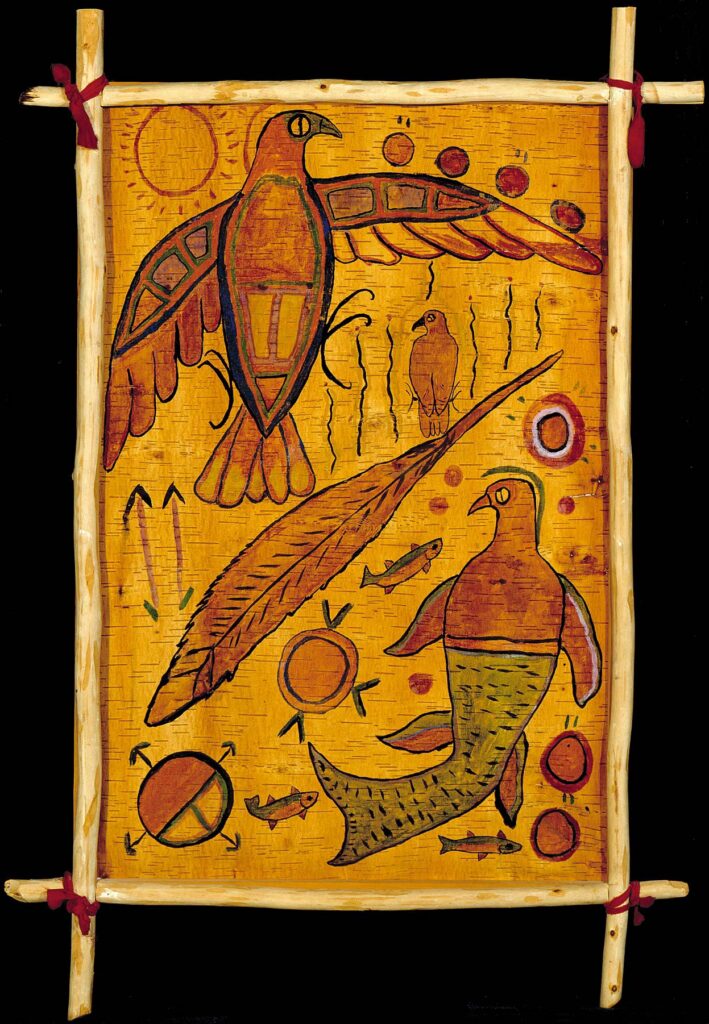
Norval Morrisseau, Untitled (Thunderbird and Nibiinaabe), c.1958, oil on birchbark, 104 x 70 x 3 cm, Montreal Museum of Fine Arts.
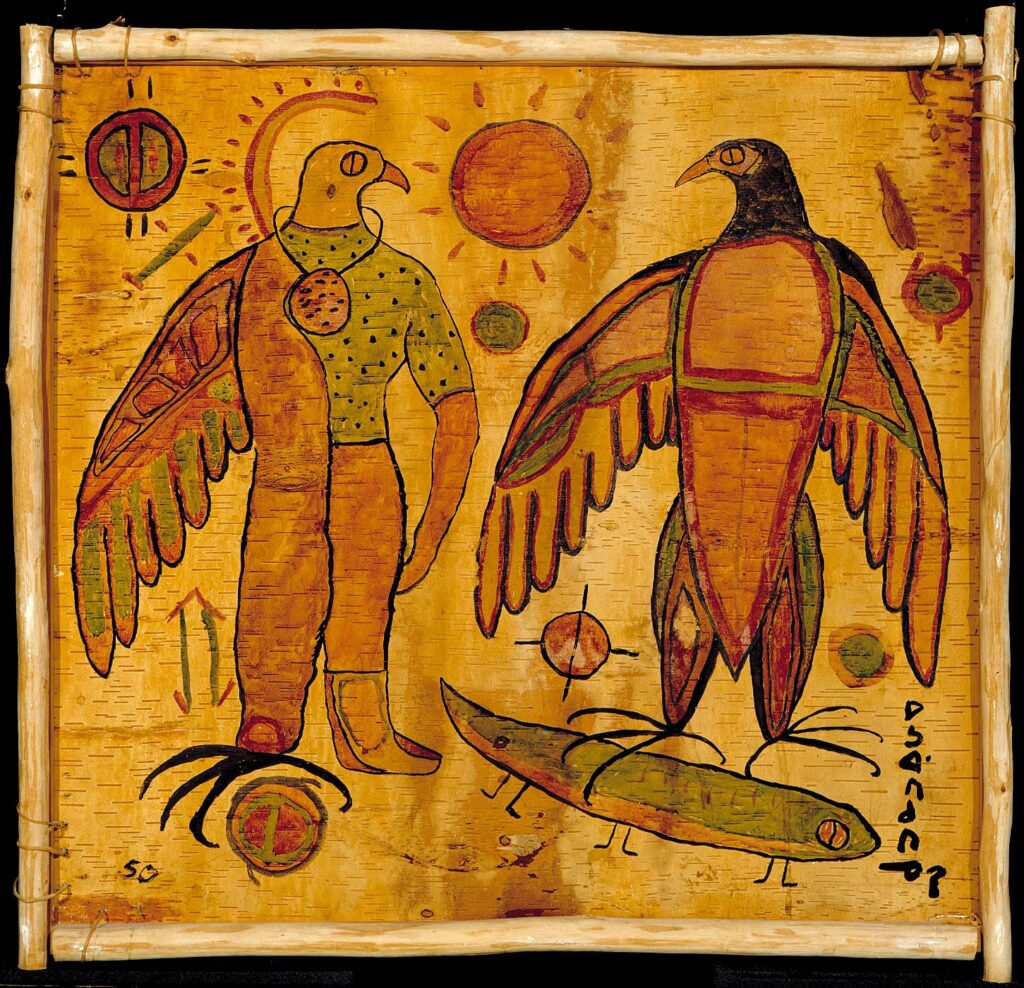
Norval Morrisseau, Untitled (Man Transforming into Thunderbird), c.1958, oil on birchbark, 84 cm x 90.5 cm x 3 cm, Montreal Museum of Fine Arts.
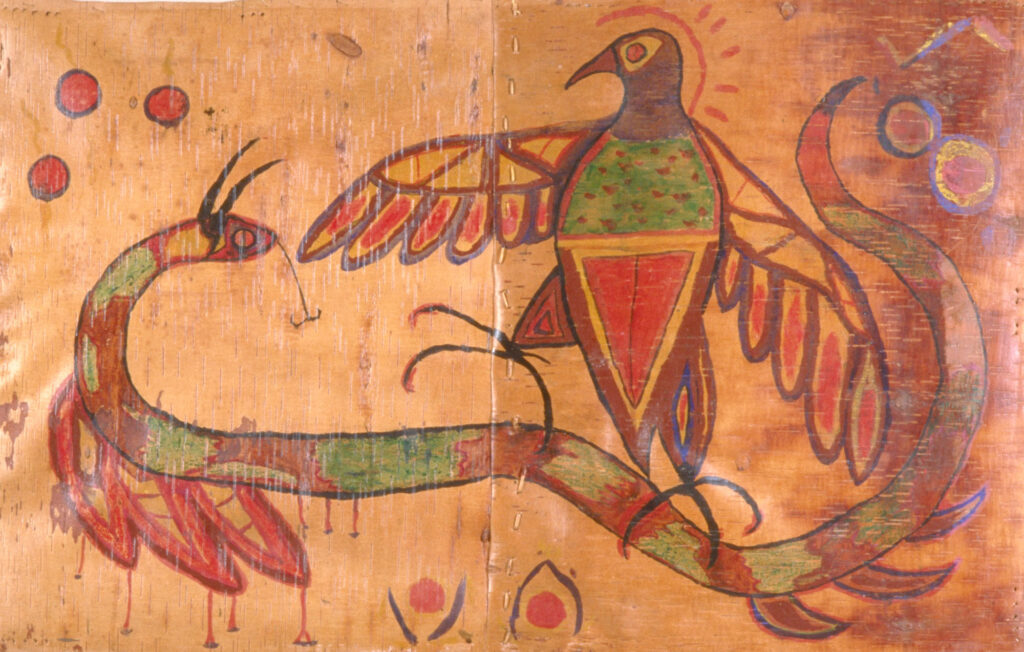
Norval Morrisseau, Untitled (Medicine Snake and Thunderbird), c.1958, tempera on birchbark (2 pieces of bark sewn together and mounted on plywood), 71.3 x 111.3 cm, Canadian Museum of History, Gatineau.
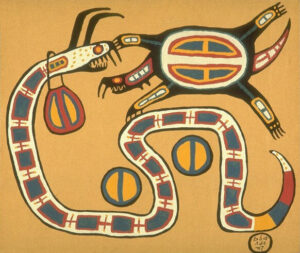
Norval Morrisseau, Great Medicine Snake, Emblem of Medicine, Horns for Power, 1965, gouache on cardboard, 81 x 95.5 cm, Canada Council Art Bank, Ottawa.
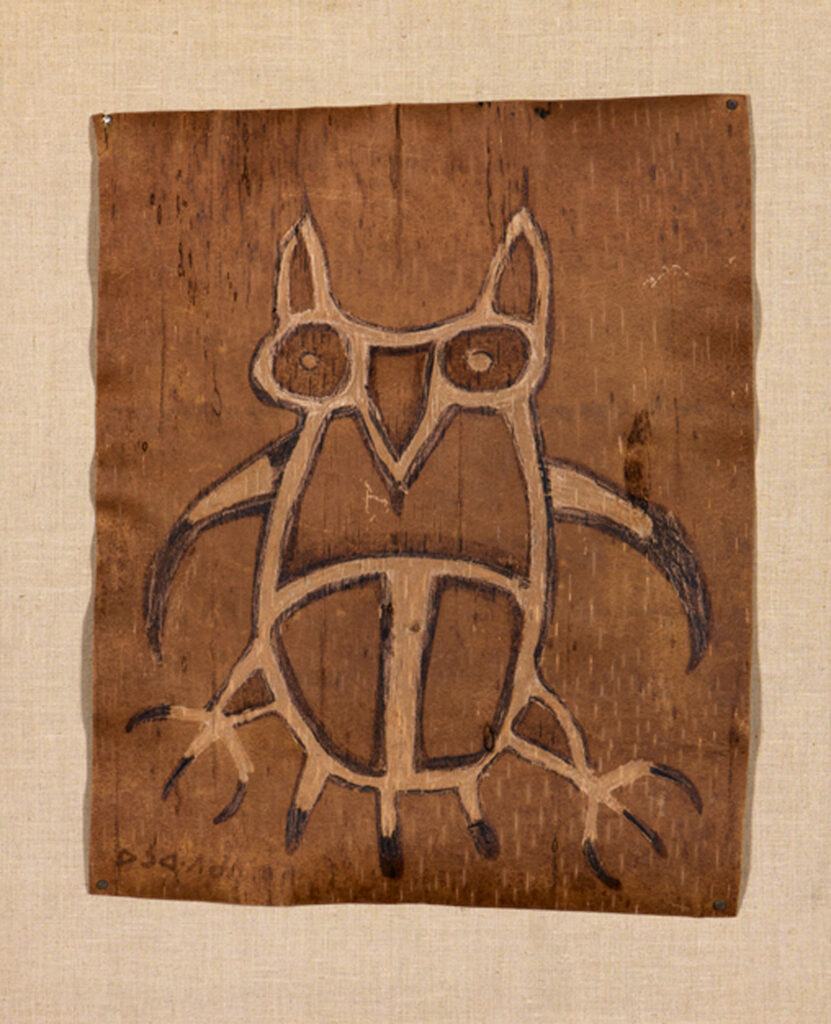
Norval Morrisseau, An Owl, c.1966, ink on birchbark, 45.5 cm x 36 cm, Canada Council Art Bank, Ottawa.
When McLuhan writes that birchbark was seen “as an ‘acceptably Indian’ medium for public sale,” she is invoking a primitivist explanation for Morrisseau’s use of the material. Patrons, audiences, and critics understood birchbark and other organic materials such as hide, as well as earth-tone pigments, to connote a stereotypical “Indianness.” Selwyn Dewdney and gallerist Jack Pollock encouraged Morrisseau to use such materials in his early years. Morrisseau took part consciously and actively in this dynamic. For example, in a November 1960 letter Morrisseau describes to Dewdney his experiments with bark and plywood to achieve a “primitive effect”: “Instead of birch bark these are done on ply board and the grain puts a primitive effect on the pictures. But the bark cannot be beat.” Morrisseau experimented with other types of bark, including spruce and pine bark. In some cases he created closely comparable images on different types of bark that highlight his different approaches to pigmentation, depending on what material he was painting on. In two comparable owl paintings, the image on birchbark is executed predominantly in white gouache and ink, while a similar owl on spruce bark is outlined in black acrylic more typical of this period.
Morrisseau’s paintings from the late 1950s and early 1960s demonstrate that he was exploring consistent motifs across birchbark and plywood. Many of these done on birchbark, such as Untitled (Medicine Snake and Thunderbird), c.1958, and Untitled (Man Transforming into Thunderbird), c.1958, feature his iconic imagery, such as animikii (thunderbirds), horned medicine snakes, and transformation figures, alongside his developing lexicon of geometric motifs such split-circles and miigis (cowrie shells), sun forms, and radiating lines of power. While most are rectilinear and painted across two sheets of birchbark joined with spruce root ties, sometimes mounted on plywood, two birchbark paintings at the Montreal Museum of Fine Arts are unique for their frames of birch sticks strapped together that, as Robertson observes, resemble stretcher frames for hides, or furs.
Examples of the same image created on birchbark and plywood alike include Thunderbird Ojibwa Medicine Society, c.1958, and Thunderbird Medicine Society, c.1960, the latter in tempera and, uniquely, mosaic on plywood. Similarly, Morrisseau executed multiple images of the Great Medicine Snake with medicine pouch around its neck, including two versions of Ojibwa Medicine Society on birchbark, c.1958, and plywood, 1960, and one on cardboard, Great Medicine Snake, Emblem of Medicine, Horns for Power, 1965.
In the early 1960s, Morrisseau and Dewdney continued to correspond about what “authentic” materials—hide, for example, and of course birchbark—the artist should be using. In 1962 Morrisseau sent Dewdney an extensive series of sketches with ideas for the market, including “scrools [sic] of bark-cloth” (birch bark scrolls), “scraped bark art,” model canoes and long houses, log drums, prayer sticks, bark containers with paintings, birch bark cut-outs glued to Masonite board, beaded hides, moose hair and quill work, paintings on slate, cloth art, among others. As Phillips observes, the plethora of bark and other materials in this list shows Morrisseau’s familiarity with Anishinaabe souvenir objects and materials.
But the primitivist approach does not survive closer scrutiny. Notable in these letters is Morrisseau’s conscientiousness about multiple aspects of his media––availability, character, and quality all play a part. He notes that the birchbark in the Red Lake area, where he is writing from at the time, is of lesser quality than what he knew in the Lake Nipigon area: “... also about the Birch Bark I do Believe a person could make a go of it provideing [sic] one could back it up on ply board I will admitt [sic] the bark of this Red Lake area is very poor comparing to the fine quility [sic] we have down east at the Lake Nipigon area.”
That Morrisseau was concerned by the quality of the bark suggests an attention to the material beyond its function as mere background or support. Nor was it the case that a decision to use birchbark was a material one that was foisted on Morrisseau by his mentors or advisers. One of the first Morrisseau paintings Jack Pollock saw was Two Fish, 1962, a painting on multiple sheets of birchbark. It is visible in a photograph of a meeting of the two reproduced in The Art of Norval Morrisseau (1979). While some patrons, like Dewdney, saw birchbark as an anthropologically authentic material, and others, like Pollock, saw it as contradictory to a more prestigious fine art category. Pollock understood that birchbark was an intimate material consistent across Anishinaabe life, architecture, craft, and art, and he repeatedly (and disdainfully) cites that material as counter to his modernist preferences in his autobiographical account of his first meeting with Morrisseau at his house:
[Susan Ross] kept telling me about this Indian who painted on birch bark. I told her the last thing I wanted was an Indian who painted on birch bark. There I was, Jack Pollock, gallery owner, feeling sophisticated, professional, promoting modern art. Birch bark! It made me think of the cutesy birch-bark canoes they sell at Niagara Falls.
With the exception of the photograph mentioned above and one early work, Pollock largely excluded Morrisseau's work on birchbark from The Art of Norval Morrisseau, even though Morrisseau continued to use it as a medium. This reflects Pollock’s attempts to steer Morrisseau to easel paintings and away from birchbark and other “Indian materials,” manufacturing a shift from souvenir and craft to fine art. This, even while playing up romanticized accounts of his artistic persona.
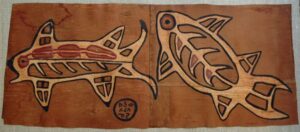
Norval Morrisseau, Two Fish, 1962, acrylic gouache on multiple sheets of birchbark, 49 x 117 cm, McMichael Canadian Art Collection, Kleinburg.
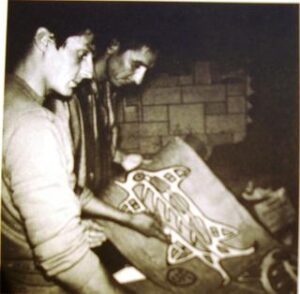
Norval Morrisseau with Jack Pollock and Two Fish painting, 1962.
Morrisseau was conscious of the primitivist dynamic at play, and his deployment of birchbark and similar materials became part of his self-fashioning as an artist. For the statement to his first exhibition with Jack Pollock, which would be used as the introduction to his book Legends of My People, the Great Ojibway, Morrisseau wrote “I have grown up with many stories and legends of my people and I have made paintings of these legends on great sheets of birchbark, done these with tempered water color and some on plyboard.
”Such material choices aligned with the ways that, as Carmen Robertson points out, Morrisseau himself performed a kind of character and “authenticity” as part of his Indigenous
modernity.In the 1974 film Paradox of Norval Morrisseau, for example, the first work by Morrisseau featured on screen is a painting on two sheets of conjoined birchbark featuring a jiisaakan (shaking tent) ceremony and horned Great Turtle. Even a decade after Pollock began encouraging Morrisseau to use more fine art materials, Morrisseau was not only continuing to create work on birchbark and other “Indian materials,” but was also centering them in his own self-fashioning.
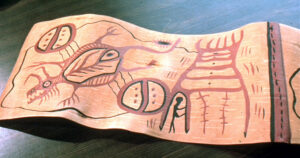
Norval Morrisseau, Birchbark Painting, 1973, birchbark, 41.2 x 180 cm, Indigenous Art Centre, Crown-Indigenous Relations and Northern Affairs Canada, Gatineau.
Formalist arguments contend that if Morrisseau was focused on certain objects or materials, it was primarily because they served as sources of formal inspiration. Much ink has been spilt discussing Morrisseau’s source imagery, from the great pictographs of the Great Lake waterways that Morrisseau called “the Indians’ cathedrals” to imagery from mide-wiigwaas that he says he was shown by his grandfather.
The formalist line argues that Morrisseau used bark because he was emulating the forms of the Midewiwin wiigwaasabakoon but that the birchbark itself is secondary to the style and visual forms depicted on it. The underlying assumption here is that it was a natural step for Morrisseau to translate imagery he was inspired by from birchbark scrolls or rock surfaces into new forms, but it didn’t matter what he created them on, whether something similar or something new.
When it comes to formal influence from mide-wiigwaas, scholars have typically focused on formal motifs and stylistic structures. These birchbark scrolls, called “instruction scrolls” by Dewdney in his comprehensive study on the topic, are typically etched onto the inner sides of birchbark that is tightly coiled. The scrolls, closely guarded within the society and withheld from general view, preserve oral and ceremonial traditions of the Midewiwin. McLuhan notes that the Mide scroll is “an architectural blueprint of the ceremonial longhouse and a procedural outline parallelling the lodge's symbolic and actual construction,” and that the rectangular format is not only similar to the scale of the Midewiwin lodge that such scrolls often depict, but also translates well to rectangular formats of paper, canvas, or, in our case, reconfigured birchbark compositions. McLuhan, Dewdney, and others since them have noted that in addition to the Anishinaabe pantheon of other-than-human beings and ancestral figures, specific motifs in Morrisseau’s work derive from the scrolls. Dewdney, for example, traces the prototype of the split-circle or miigis shell motif to the mide-wiigwaas, noting it was an important part of Midewiwin medicine bag contents, while McLuhan notes the delineation of internal parts in an x-ray style, emanating lines, clusters of dots, and lines extending from and connecting figures through their mouths and hearts all recur in Mide scrolls.
Formalist analyses of Morrisseau’s art quickly seek to separate the birchbark scroll as object from the forms inscribed on it when Morrisseau translated them into a new mode. Morrisseau’s monumental ink drawing Coming Away (Legendary Scroll Motifs, 1977, for example, is often cited as the primary evidence of Morrisseau’s adoption of mide-wiigwaas source imagery. McLuhan calls this work a “missing link” of sorts—“an introduction to the forms and images that would be developed in Morrisseau's work over the next twenty years” and “an artist's reproduction of a scroll,” but in ink on paper. Phillips likewise notes that Coming Away is visual evidence that the Midewiwin scroll tradition provided the foundation for Morrisseau's graphic style with its “representations of oval and rectangular Midé lodges and manidoog in human and animal form [which] are closely related to scroll imagery.”
This line of analyses extends to later drawings, such as Shaman Teaching His Two Halves in a Dream State, 1983, which McLuhan calls a “monumental scroll.” It is, she says, a “breathtaking tribute to his roots in Ojibwa pictography.... The scroll is a spiritual voyage in which the artist is both instructor and student. The scroll cannot be read or decoded for information, although the images are recognizable from the Midewiwin Society scrolls...” She notes that Morrisseau said in a 1983 interview that “When the Midewiwin people wrote simple bird signs––all these signs––they did that for a reason. They began to invoke that dream-state.... This scroll is more or less for the environment of one person... to feel for a while that there is a separate reality.” When McLuhan (and, apparently, Morrisseau) refer to this drawing as a “scroll,” it is not meant in the literal sense as an object, but rather to evoke the mode of viewing a work that unfurls over time before one’s eyes, as well as the linear style of the scroll translated from birchbark to paper.
Birchbark – Support – Animate Matter
These analyses grow out of a modernist, Euro-American focus on surface that relegates Morrisseau’s artistic materials to little more than a support or vehicle for his imagery. They fail to account for the ways in which Morrisseau returned to certain materials, such as birchbark, repeatedly in his career, and how those materials exist in concert with the image. And they fail to consider the nature of wiigwaas as a potentially animate material that exists as part of a network of other-than-human beings, agencies, and forces. How do the Anishinaabe understand the nature of the materials that Morrisseau used, and how do such beliefs allow us to better consider how this material works with the images that populate its surface?
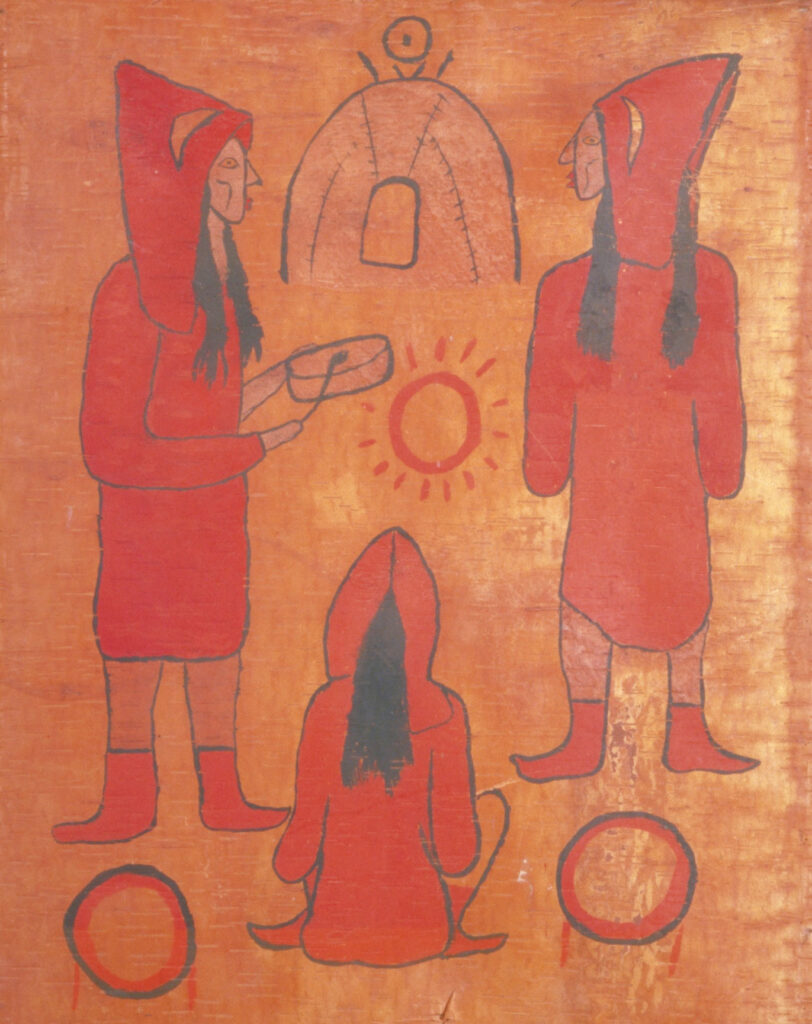
Norval Morrisseau, Ancestors Performing the Ritual of the Shaking Tent, 1958-61, tempera on birchbark, 94.7 x 73 cm, Canadian Museum of History, Gatineau.
Consider, for example, Morrisseau’s well known early work, Ancestors Performing the Ritual of the Shaking Tent, c.1958-61. Created with watercolour and ink on birchbark, it consists of three ancestor figures in red-hooded robes gathered around a domed structure with visible seams. The piece is often discussed in terms of its figurative qualities and relationship to medicine rituals and spirituality that underpins Morrisseau’s life and practice, but as Elizabeth McLuhan has noted, it also includes a visual and material pun between the birchbark it is made on and the depicted structure, a jiisaakan (shaking tent), which is itself covered in
bark.The subject matter––a ritual conducted inside a birchbark structure––is thus appropriately depicted on birchbark, as if to connect the viewer to the shaking tent through the depicted scene and tactile nature of the bark.
As Carmen Robertson’s Norval Morrisseau Storylines project points out, however, this work may not represent a shaking tent but rather a madoodiswan or sweat
lodge.The madoodiswan was historically covered with furs, hide, or layers of bark, though today may be covered with canvas, tarpaulins, or
blankets.The sweat lodge’s form is not unlike a domed wiigwaaam, typically covered in birchbark or woven
mats.Morrisseau describes both the shaking tent and the sweat lodge in Legends of my People. The former he describes as “a jeesekun [jiisaakan], a shaking tent, or wigwam [wiigwaaam], where a medicine man does conjuring” and notes it “would be covered with deer hide, birchbark or canvas.
”The madoodiswan is “steam house that looked like an upside-down bowl, made out of saplings and covered with hide or canvas, with a floor cover of cedar branches... it cleans a man’s body and soul... used by certain medicinemen to talk to the water god, thunderbird or medicine snakes.
”The ancestor figures undertaking this ceremony are engaged in communication with other-than-human beings and manitou, simultaneously inside and on birchbark. The material of the work is one and the same as the depicted ceremonial structure, and conceivably interchangeable.
When birchbark is considered only as a medium, the visual pun referenced by McLuhan concludes at the limit of the support. But when we consider birchbark as wiigwaas, an essential tool and material at the centre of Anishinaabe lifeways, one that holds deep spiritual importance and serves as shelter, container, and vessel, it takes on a very different connotation than merely a pun, a formal reference, an available material, or an indicator of “Indianness.” The ancestral cultural meaning is instead materially layered into the work and calls out to other ways that birchbark serves Anishinaabe life ways and functions in transportive (in both the spiritual and physical sense) and animate ways.
Anishinaabemowin grammar differentiates animate from inanimate nouns. Grammatically, wiigwaas or wiigwaasaatig, birch tree, is an animate noun. Its agency is signified in Anishinaabemowin by the honorific for the white or paper birch, Nimishoomis-wiigwaas, “My Grandfather Birch Tree.” By contrast, wiigwaas as birchbark, as well as most items made from birchbark, including canoes and baskets, are inanimate nouns. One exception is wiigwaasapakwaan, bark roof panels, which are grammatically animate according to one elder because “birch-bark roof wards off Thunderbird attacks,” suggesting that the birchbark dwelling depicted in Morrisseau’s Ancestors Performing the Ritual of the Shaking Tent has an animacy befitting its materiality and ritual status.
Maureen Matthews has further argued that what she calls “socially active artefacts,” or culturally and spiritual significant ceremonial items and materials, including those made with birchbark, are accorded grammatical animacy, although at times this may be obscured in everyday speech by inanimate grammatical constructions. Matthews recounts, for example, a story about birchbark scrolls told by the elder Omishoosh (Charlie George Owen), who notes about “birch bark which they rolled up [scrolls]” that “They would have been inscribed. They had placed them underground. When someone slept there [where they were buried], they would be haunted. They would hear from them [animate], someone speaking about something. That was the scroll that they heard.” That the animacy and status of wiigwaas shifts within the Anishinaabe world depending on its function points to how differently Morrisseau may have understood the material in his artistic practice, particularly given his frequently stated association of art and shamanism.
Alongside the animate nature of (some) birchbark is the understanding that the birch tree is a key representative of the Anishinaabe value of reciprocity. The late Cree and Métis scholar Mary Siisip Geniusz, an Oshkaabewis (ceremonial apprentice) and teaching assistant to the Anishinaabe medicine practitioner Keewaydinoquay Peschel, describes the values of reciprocity and respect in a creation story titled “The Birch Tree, the Maple Tree, and Naanabozho.” In the story, the titular culture hero, Naanabozho, asks the birch tree, wiigwaasi-mitig, about its purpose and creation: “The wiigwaasi-mitig finally said, ‘I was created to help the Anishinaabeg. They can take my bark to fashion makakoon, birch bark boxes, to hold their food or water or possessions. They can store things in my bark for later use.’”
Reciprocity, the act of gifting, is integral to the tree’s nature. Morrisseau himself wrote about the ways that his community acknowledged this generosity of material, writing “All the herbs in the forest are used by the Ojibway, as well as tree roots and barks. Small tobacco offerings were placed where a herb had been removed by some Indians who belonged to the medicine societies.” As previously noted, Morrisseau was keenly aware of the appropriate times of year, namely the spring when sap is flowing so as to minimize harm to the trees, and seasonal rhythms for such harvesting, ensuring that birchbark would be responsibly harvested in a renewable fashion.
Just as the birch tree’s acts of generosity define Anishinaabe understanding of its agency, the Morrisseau Storylines project has astutely identified gifting, or bagidinige, as an essential protocol and theme in Morrisseau’s work: “From his earliest days as an artist he gifted works on wiigwaas as a form of gratitude.” He frequently executed such works on birchbark as an appropriate medium. Two paintings of the Horned Medicine Snake on birchbark, for example, were gifted to the Winnipeg doctor Harry Medovy in gratitude for his treatment of Morrisseau’s daughter, Victoria, when she was ill. In a letter to Dr. Medovy dated September 2, 1961, Morrisseau thanks the doctor for helping his daughter and calls him “a great Medicine man among mine and your people.” Morrisseau explains the dual nature of the “medicine snake who appears in medicine dreams among the Ojibwa as good and at times Evil.” The Medicine Snake is an appropriate subject for this gift to a “great [Western] Medicine man,” but notably Morrisseau refers to the works as “schrolls [sic] of Ojibwa art” in the letter. The works, each consisting of two sheets of joined birchbark painted in black and red tempera, depict the Medicine Snake filled and surrounded by pictographic forms that retain much of the rectilinearity of mide-wiigwaas designs, and one appears to be signed, now illegibly, with a title similar to “The Ojibwa Medicine Society” that appears other early works featuring the Medicine Snake.

Norval Morrisseau, Bagijige, n.d., acrylic on birchbark, 43.2 x 101.6 cm, private collection.
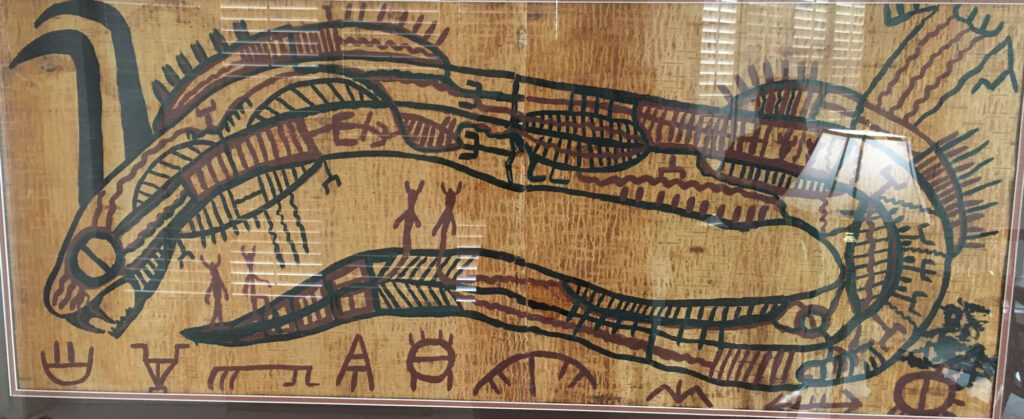
Norval Morrisseau, Horned Snake, 1961, tempera on birchbark, 43.2 x 107.9 cm, Collection of Nancy Wright.
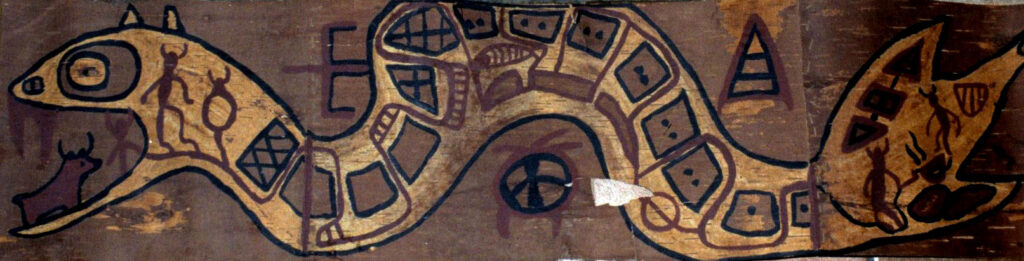
Norval Morrisseau, Untitled (Snake), c.1958, tempera on birchbark, private collection.
One of the works has puncture holes on its outer edges, suggesting it may have originally been tied to stick handles, as is the case in another birchbark scroll, c.1958, of the same period depicting the Medicine Snake from the collection of Joseph Weinstein, another doctor, who served the Cochenour-area community. The handles, which suggest the piece could be rolled up horizontally, emphasize the object quality of this work, and highlight why Morrisseau referred to the Matavi paintings as scrolls. While the overall compositions of the three Medicine Snakes do not match the standard formats of the mide-wiigwaas, the internal details and overall structures, including blocks of rectangular forms, pictographic ancestor figures, and interconnecting lines that function like guides or paths through the meandering snake figures, strongly resonate with the Mide scroll designs. But more importantly, these scrolls are animate with the reciprocal relations that define the very nature of their medium—gifts made from the gift of the birch tree—and as bagidinige operate in a material confluence of birchbark as reciprocal medicine.
White - Pigment – Medicine
The white colouration of the Medicine Snake on the Weinstein scroll is significant for its spiritual connotations within Morrisseau’s aesthetic vocabulary. It is well documented that Morrisseau deployed colour symbolically, though not always consistently across his oeuvre. Colour was a point of contention in his early practice when he first moved into a diverse palette of acrylic paint and away from more the earthen and “natural” tones that some non-Indigenous mentors had at first encouraged. His push into bright electric acrylics in the latter half of his career––reacting against the greys of European modernist masters like Georges Braque (1882–1963) and Pablo Picasso (1881–1973), and channeling inspiration from his Eckankar spiritual beliefs––further expanded his chromatic vocabulary. Indeed, by the late 1970s, Morrisseau’s color symbolism and visual language was heavily inflected by these explorations into Eckankar, and he increasingly referenced the astral plane and what he called the House of Invention as his sources of inspiration. He said “We can learn how to heal people with colour. The House of Invention gave me colour.”
Earlier in his career, Morrisseau thought about colour in an Anishinaabe framework, including the medicinal qualities of certain coloured substances and their cosmological connotations. Morrisseau writes in Legends of My People that “The Ojibway also had a bluish-coloured onaman sand that was used as a sacred charm against conjuring. There was, too, a white-coloured sand that cured headaches when a small amount was placed on a heated stone, also a white liquid to cure pains. All these can still be obtained in the Lake Nipigon area, although none are used at this time.” In various of his accounts, whiteness in particular defines powerful spirits and other-than-human beings like Mishibizhiw: “This huge cat is believed by the Ojibway to be white in colour [emphasis mine], with horns, and very powerful. It is believed to live in the water but why a cat lives in the water, or where it lived, is not known... the true water god, the white one in colour, always brought good luck to all who respected him.” Throughout Morrisseau’s work, significant and dangerous beings, from sacred animals to wiindigo to shamans in transformation, are depicted with white to connote their spiritual power.
In terms of its meaning and use, white is the most consistent colour across Morrisseau’s career. As Sinclair and Pollock describe in The Art of Norval Morrisseau, white, and waabishkaa or whiteness (“it is white”), including “albino animals or persons, white faces, white hair – always denote spirituality.” This consistency, I argue, is linked to Anishinaabe worldviews.
George Hamell has discussed how, in a Northeastern Woodlands worldview, the physical qualities of material such as shell, crystal, and copper, namely their reflectivity, brightness, shininess, and whiteness, are associated with metaphysical, lifegiving powers and properties (medicines). These include health, knowledge, foresight, and insight (reflectivity), which are likewise associated with warmth- and light-emitting entities such as fire, the sun, the stars, and other celestial bodies. Whiteness, he writes, “connotes the cognitive aspect of Life.” Hamell relates this worldview to the metaphorical significance of glass trade beads, onto which such Indigenous values were mapped, and we might likewise relate it the how such values in an Anishinaabe understanding are mapped onto two-dimensional works.
White is used throughout Morrisseau’s oeuvre to connote medicines, legendary figures, and sacred and spiritual beings in a way that is grounded in such Anishinaabe metaphysical associations with the colour’s physical or material properties. It is particularly prevalent in early images executed on birchbark and plywood—including Medicine Snake forms, as in the Weinstein scroll. Morrisseau’s use of white on birchbark is particularly meaningful because the metaphysical or medicinal aspects of whiteness are not unrelated to similar properties in the birch tree and are reflected in the physical properties of white pigments, including its shininess and reflectivity.
As in the works previously discussed, early images of powerful beings like the Great Horned Medicine Snake typically depict them in white. The frequency with which such images are created on birchbark suggests that wiigwaas is an appropriate and essential material on which to depict figures at the centre of Anishinaabe lifeways, and he makes this connection directly in certain paintings on birchbark, which he inscribes with the phrase “Ojibwa Medicine Society.” These works typically depict the Great Horned Medicine Snake with a white body and horns, often with a medicine bundle worn around its lower head and circles of power filling the background. This sacred snake is said by Morrisseau to have given his people “the sacred knowledge of several hundred kinds of medicine” and serves as the “emblem for medicine in the Ojibway tribe.” Another early work on birchbark, inscribed with the similar title Thunderbird Ojibwa Medicine Society, c.1958, extends the use of white to a Thunderbird.
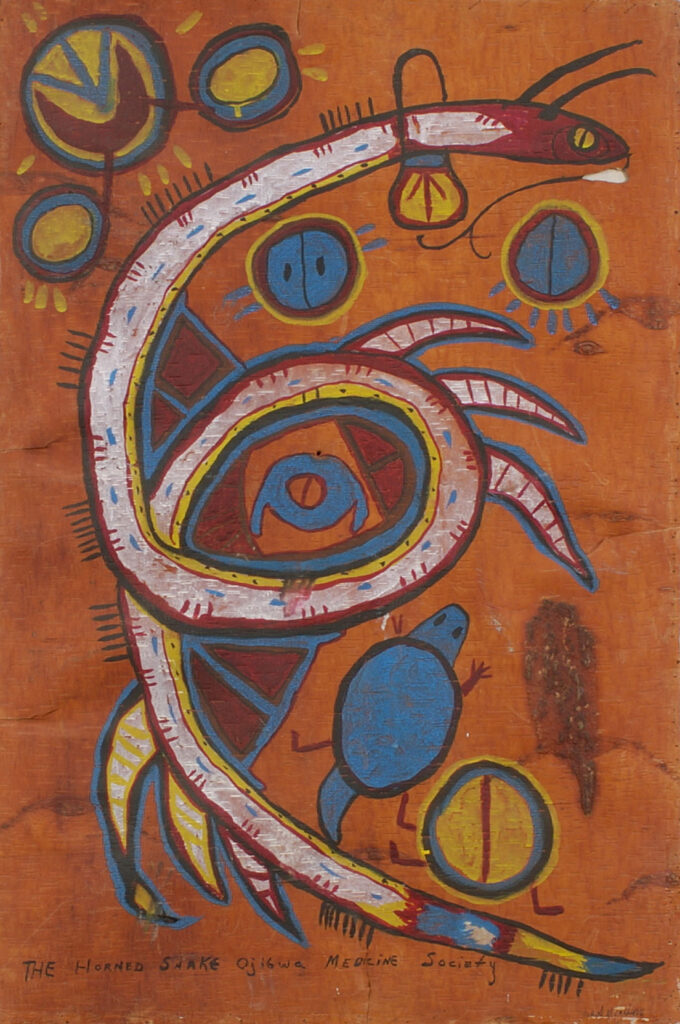
Norval Morrisseau, Untitled (The Horned Snake), c.1958, watercolor on birchbark, 96.6 x 66 cm, Canadian Museum of History, Gatineau.
And if whiteness or shininess functions as power or medicine, it is appropriate that Nimishoomis-wiigwaas itself provides medicinal value to the Anishinaabe as one of its many gifts. The whiteness of the paper birch is not insignificant in the Anishinaabe worldview, and birchbark is deployed in numerous medicinal ways: bark cones are components of medicine kits and used for inhalation; birch twig tips are used to treat stomach cramps and indigestion; birch oil salves are used to treat rheumatism, and birch tea is used to treat diarrhea, kidney stones, and worms. Birchbark is thus a doubly appropriate medium for depictions of medicine figures, themes, and stories.
On the Weinstein birchbark scroll, the white coloration of the Medicine Snake emerges from the darker brown background as if swimming through water. The contrast renders the depth of surface treatment ambiguous––even with some wear showing the lighter brown of the bark through the brown wash, the white coloration of the snake both advances forward and gives the impression that it is a lighter etched surface exposing yet another layer of the bark. Indeed, birchbark can greatly differ in colour, depending on the time of year and how deeply it is cut when harvested. The white outer layer, or periderm, of the paper birch has a yellower and smoother interior surface which served as Morrisseau’s typical working surface. After preparing and drying, this softer interior periderm can be incised with designs or scraped to reveal a lighter surface, like an etching. The next layer of the tree is a darker brown cork skin which protects its vascular system. To maintain the health of the tree this is typically not used but can be inadvertently peeled off in harvesting. The coloration of birchbark reflects a physical depth, which in the Weinstein birchbark scroll, Morrisseau manipulated to simultaneously suggest the Medicine Snake is a scraped design revealing a lighter layer of bark while also being a painted upper surface.
Morrisseau often emulated the aesthetic of scraped birchbark with gouache or tempera, evoking the whiteness and shininess of scraped bark that also appears in mide-wiigwaas. In some cases, he made scrolls and other works on birchbark that are scraped or hammered in close imitation of the incised bark designs of the Midewiwin. Etched or painted in single tones, these works also often feature handles, presumably for rolling. Morrisseau achieved the whiteness of the images with paint but also by incising and hammering, revealing brighter bark beneath.
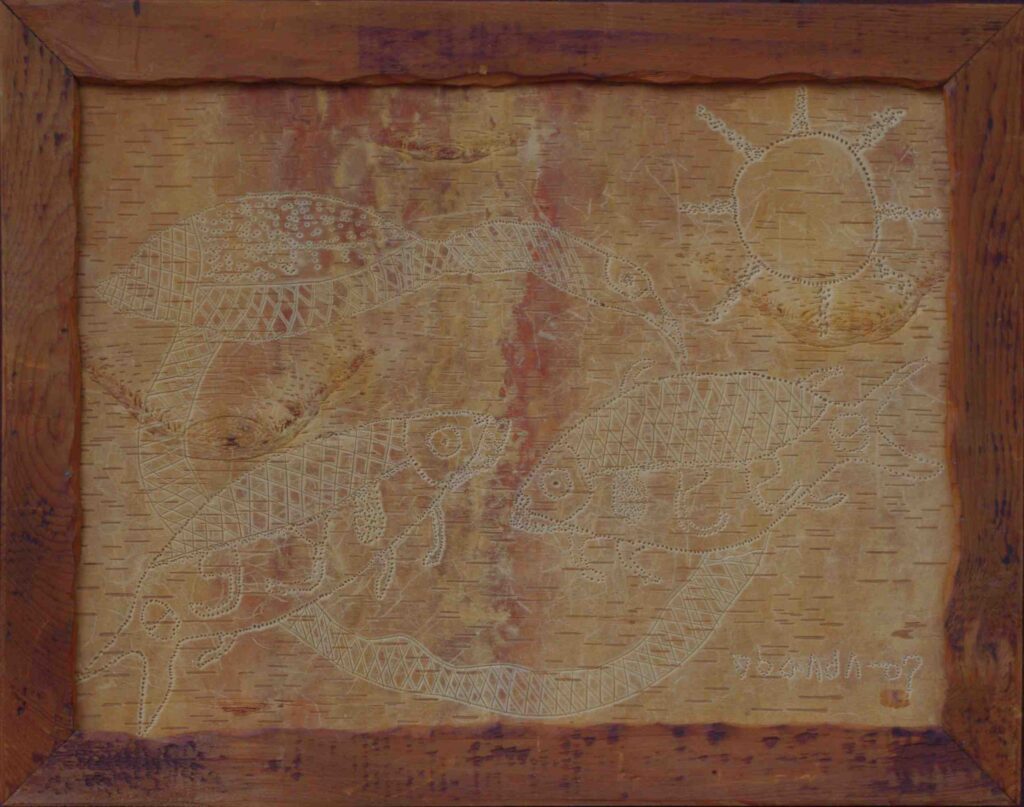
Norval Morrisseau, Untitled (Birchbark Hammered), 1974.
An early untitled and undated birchbark scroll work currently in the Manitoba Museum collection, for example, consists of a design of fish, mammals, fish, and ancestral figures that has been etched across three birchbark panels, bound with dowel handles. The composition has no applied pigment and relies on the whiteness of the etched under-bark to define its figures, which are conjoined across the horizontal surface by a floral-like biomorphic organizational schema. The linear nature of the incising evokes Morrisseau’s drawing practice and his works on paper, connecting such incised birchbark works to scroll drawings such as Coming Away (Legendary Scroll Motifs), themselves based on the linear nature of incised Midewiwin scrolls. Similarly, a later untitled birchbark work from 1974 consists of a bird, two fish, and sun that have been incised and hammered into the birchbark, with holes punched through the bark and cross-hatching that relies on the natural whiter underlayer to define the composition.
Morrisseau undoubtedly took inspiration from historic examples of birchbark decoration and design, including medicine scrolls. Additionally, Selwyn Dewdney suggested to Morrisseau in a 1960 letter that he try scraping bark, and then staining some of the areas. In a scroll from the following year, Thunderbird with Ancestral Motifs, c.1961, Morrisseau applies this advice when he depicts a toothed and horned thunderbird and other animals in white gouache on two sheets of birchbark stitched together with spruce root and with attached dowel handles.
Norval Morrisseau, Thunderbird with Ancestral Motifs, 1961, gouache birchbark scroll incised, 60.9 x 86.4 cm, Westerkirk Works of Art.
Some, but not all, of the designs are etched into the bark before being painted over with the gouache. This suggests that Morrisseau uses the paint to enhance the whiteness of incised and scraped bark designs. The two sheets of birchbark, with a thunderbird on one side and fish and diving water bird on the other, show between the sky and water worlds. Hamell notes that white and shiny medicines or “other world” substances are associated with underwater grandfathers or spirits and are thought to be gifted by such beings at the meeting points of water and land, such as the shoreline. The two sides of the scroll thus conform to the duality of Anishinaabe cosmological opposition seen throughout historic Anishinaabe material culture while giving image in white pigment on birchbark to the meeting place, the spruce root seam, of oppositional worlds.
Whiteness, then, is suggestive of metaphysical as well as material content in Morrisseau’s oeuvre. Whiteness deployed on, or derived from, his birchbark works evokes Anishinaabe values of power and medicine that are likewise associated with birchbark itself. In later works, when Morrisseau shifted primarily to acrylic paints, often applied straight from the tube using both brush and finger, the glossier nature of acrylic polymers was a natural extension of such values.
Object – Volume – Cultural Container
In Morrisseau’s early life, birchbark was first and foremost a pliable, multi-purpose material, useful for creating baskets and bowls, canoes, and even homes and lodges. Among Morrisseau’s earliest uses of birchbark as an artistic material were paintings done on birchbark baskets, made by family members. One such basket was made by his mother-in-law, Patricia Kakegamic, in 1963 at Sandy Lake First Nation. Morrisseau’s design features a simple but evocative split circle in red, yellow, and black, rays extending outward and up the sloped sides of the basket like the sun.
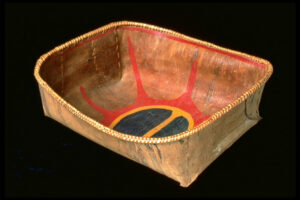
Norval Morrisseau, Birchbark Container, 1963, paint on birchbark and spruce root, 17 x 42.5 x 48.5 cm, Indigenous Art Centre, Crown-Indigenous Relations and Northern Affairs Canada, Gatineau.
Morrisseau painted on and created numerous functional objects, most of them birchbark. Yet there is a lack of attention to the nature of the object within Morrisseau’s oeuvre—that is, the way in which such works take up volume and space in the world. When considered for its physical nature, the container, with its physical capacity to hold, was central to Morrisseau’s work. From baskets and bowls to scrolls, these objects hold space and lifegiving attributes an––not least in the case of scrolls––could also hold the intangibles of knowledge and tradition.
Norval Morrisseau, Birchbark Dish of Painting with Two Fish, c.1958, paint, thread and wood on birchbark,16 cm x 35 cm, Canadian Museum of History, Gatineau.
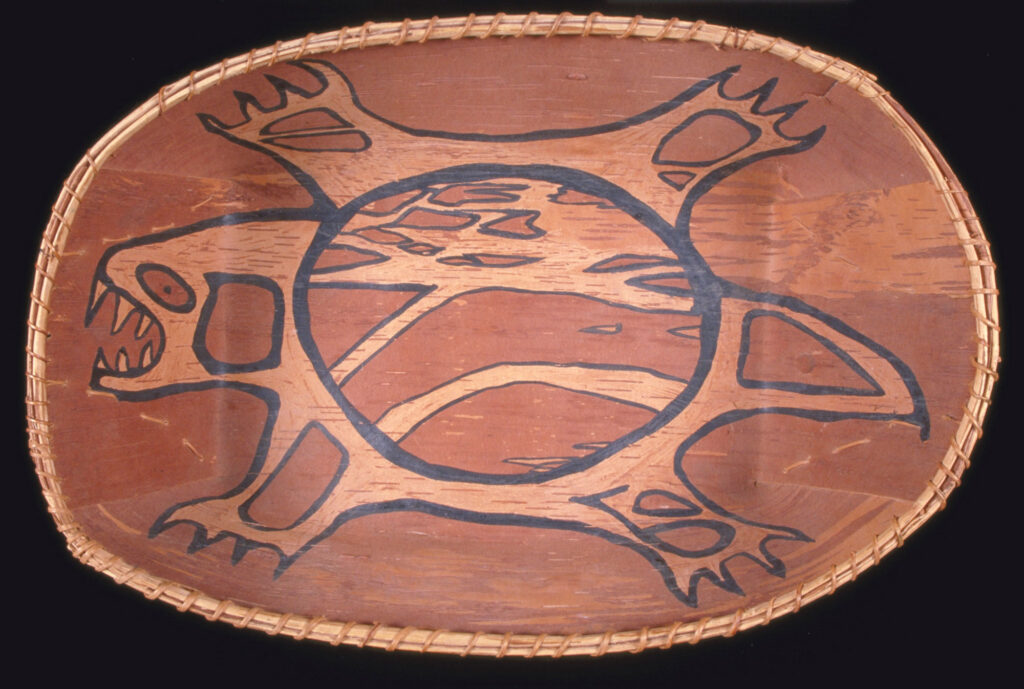
Norval Morrisseau, Untitled, c.1958, paint, thread, spruce root wood and birchbark, 18 x 44 x 67.4 cm, Canadian Museum of History, Gatineau.
In addition to the Kakegamic basket, Morrisseau painted figurative designs in the interior of numerous birchbark containers in the late 1950s. One such dish has a colourful fish design in brown, blue, black, and green paint, with a subdivided interior that features white and is typical of Morrisseau’s early style. Another shows a turtle in black and red. The figure is predominantly white. Morrisseau achieved this by scraping away the darker interior bark to reveal the lighter bark beneath. All the designs dynamically engage with the shape and volume of the vessels, the figures moving with the sloping walls, their tails curving along their sides as if taking up real volume.
Images of fish within the containers suggest their capacity to hold foodstuffs, a catch or a harvest. Morrisseau describes a gathering in which birchbark baskets serve this function in Legends of My People: “At the lake called Mesinama Sahegun, the Ojibway Indians used to go to feast on the sturgeons. Everyone was happy. The old women and the young prepared smoked sturgeon and put it away in birchbark containers for the long winter months ahead.”
Scenes of gatherings are a recurring motif in Morrisseau’s work. The 1983 painting Untitled (Human with Two Bears), for example, depicts a child putting berries into a full basket opposite two bears likewise engaged in their own berry-picking. Morrisseau took the making of such gathering vessels as his subject in the painting The Basket Maker Making the Basket, 1970, in which a woman, identified as Annie Kakegamic, works on three differently shaped birchbark baskets, tendrils of creative power emerging from her mouth and connecting to the basket in her hand. This image, one of the few by Morrisseau to depict Anishinaabe craftmaking, is notable for using the same power line for an artisanal maker as appears with storytellers, Midewiwin figures, and other bearers of culture in Morrisseau’s oeuvre, putting the act of making baskets on the same level of culture significance. The painting acts as a conveyer of cultural knowledge as much as a portrait of Annie Kakegamic or a snapshot of a moment of creation.
Norval Morrisseau, The Basketmaker Making the Basket, 1970, acrylic on paper, 71.2 x 95.5 cm, Royal Ontario Museum, Toronto.
The list of possible sale items that Morrisseau sent to Selwyn Dewdney in 1962, including “bark baskets,” “cedar drums,” “scraped bark art,” and “very thinned bark cut out's [sic] and color paper to show through cutouts,” in addition to aforementioned “scrools [sic] of bark-cloth” and “2 feet bark scroll,” show the range of objects Morrisseau considered making and in many cases executed. But what is noteworthy is how birchbark is used as a material not only economic sustenance, in the case of craft items, but also to create vessels for subsistence and cultural continuity. Morrisseau dynamically engaged with birchbark in his practice. For example, a selection of birchbark cutouts in the Glenbow Museum collection, symmetrical geometric designs similar to paper snowflakes, are flat but would have been folded to cut. Another remarkable birchbark container, painted with a fish design, is unique in its vertical format, perhaps modeled on waste basket designs common among Anishinaabe souvenir makers but also intriguingly beginning to resemble the rolled vertical structure of the scroll.
Norval Morrisseau, Untitled (Birchbark Design), 1964, birchbark, 13.7 cm x 20 cm, Glenbow Museum, Calgary.
Scrolls
The wiigwaasabak is an exemplary container of culture, medicine, lifeways, and knowledge. The format of the scroll brings the characteristics of birchbark, pigment, and object quality together with their associations of animacy, medicine, and cultural conveyance. And as these materialist elements extend across the first three decades of Morrisseau’s oeuvre, so too does the scroll as a format that followed Morrisseau from his earliest works to his maturation in the mid-1980s. The full quote of Morrisseau’s own account of his exposure to wiigwaasabakoon makes clear how central the scrolls were to his formation as an artist:
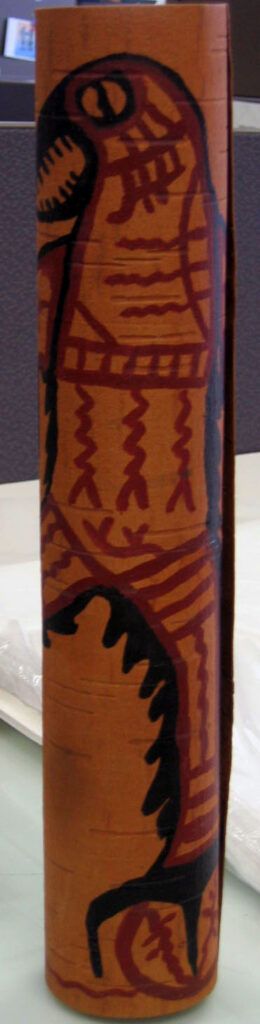
Norval Morrisseau, Untitled (Thunderbird), 1961, tempera on birchbark, 38 x 39.5 cm, Indigenous Art Centre, Crown-Indigenous Relations and Northern Affairs Canada, Gatineau.
My grandfather showed me how to do interpretations of the shaman beliefs on birchbark […] I was being taught. Everyone realizes now, of course, that I was already drawing and this is what I wanted to do. But I was not allowed to make a scroll, even though I wanted to make one. I had to wait until my full initiation to make a scroll. In the meantime, I am strong enough and I don’t want to wait until I am fifteen or sixteen years old. I want to make a scroll now. Anyway, I am being taught what to put down on the bark, for only the shaman made the scrolls. You could say that through history, the shamans were the artists; they were the only members in the tribe allowed to do this. So all my painting and drawing is really a continuation of the shamans' scrolls.65
Morrisseau had a reverence for the wiigwaasabak that went beyond economic concerns, beyond a desire to respond to outsider’s expectations, beyond even visual and formal excitement and emulation. Instead, Morrisseau’s encounter with the idea of creating culturally relevant images on birchbark stems from his desire to create a scroll, something he cannot do until he is initiated.
Whether such a formal initiation into the Midewiwin society ever occurred is a grey area in Morrisseau’s story. But Morrisseau openly claimed the status of a shaman, with aspirations to be the “most powerful shaman in the universe.” And he made scrolls, or what he called and took the material format of scrolls, starting early in his career. Are these early scrolls an ambition to that status, or an acknowledgement and celebration of it?
Morrisseau describes some of his earliest scrolls, those gifted to Dr. Matavi and from the Weinstein collection, in a 1960 letter to Selwyn Dewdney as among “nine birchbark paintings” done for the Weinsteins and several “Medicine Snake paintings” done for Dr. Matavi. Ruth Phillips notes that exposure to the art objects and books he saw at the Weinstein residence would have boosted his interest in scroll formats beyond those of the mide-wiigwaas. Morrisseau took particular interest in the Weinsteins’ megillah scroll, a telling of the Jewish story of Esther for Purim, which was mounted on the their home wall. Perhaps the recognition of the megillah as a similar format for recording oral traditions of sacred stories combined with his ambition and exposure to Midewiwin scrolls to encourage Morrisseau to pursue the scroll format outside of Midewiwin sanction.
Other early birchbark scroll works have an undeniable objectness to them, functioning as containers for the imagery, and relatedly the cultural knowledge presumably kept inside – except in Morrisseau’s case, these early scroll forms tend to be painted on what would otherwise be the outside. One scroll from Selwyn Dewdney’s collection dated to 1961, for example, a painting in tempera on birchbark is rolled up so tightly that it can no longer be opened. Only a toothy avian form is visible, zigzagging lines of power running throughout its body and from its talons to suggest a Thunderbird. There is a message inscribed on the back, or rather the interior, of the scroll in ballpoint pen: “Warmest regards to my very best friend - Selwyn and family, yours respectfully, Norval and family,” entering his work into the category of bagidinige or gift.
Other scrolls from the same collection and likely of a similar vintage are unrolled but the curving nature of the bark seems to threaten to roll the compositions back up tightly, the conjoined sheets of birchbark asserting their material force. These scrolls contain black and red designs of ancestral figures, animals, and sacred beings like a niibinaabe (mermaid or water spirit) and Mishibizhiw, freely arranged across the bark like petroglyphs rather than in the strict frame of the mide-wiigwaas. One of these scrolls features a jiisaakan ceremony, lines of power connecting sacred beings to the reverberating birchbark ritual structure. (A similar one can be seen in the film The Paradox of Norval Morrisseau.) As Phillips describes, the “flowing, calligraphic quality” of these scrolls from the early sixties enlarge Midewiwin-derived motifs and “freed [them] from the rigid geometries of ritual notation.” They are neither completely schematic in how the figures are defined within the bark space, nor do they depict single examples of legendary beings; these arrays of figures interact across the birchbark sheets, which are themselves untreated, fragmenting, and reveal the truth of their material. While these scrolls lack the dowel handles of others from the same period, they are poised to coil back up on themselves, as if the physical nature of the birchbark continues to assert a form of refusal, fighting to hide the entirety of Morrisseau’s imagery from view just as mide-wiigwaas were kept secluded from public consumption. These scrolls exist as simultaneously object and surface, painting and narrative record, animate and poised to enter the fine art world’s system of aesthetic values.
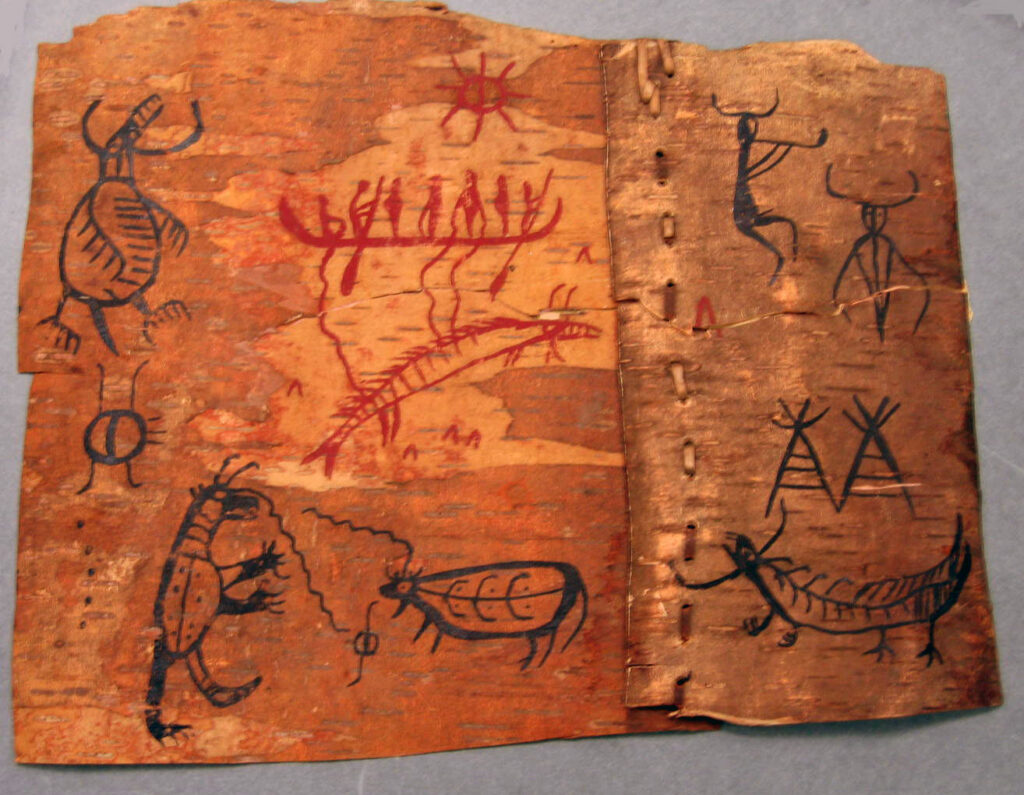
Norval Morrisseau, Untitled, n.d., tempera and India ink on birch bark with split root, 35 x 41 cm, Indigenous Art Centre, Crown-Indigenous Relations and Northern Affairs Canada, Gatineau.
Norval Morrisseau, Untitled - Shaking Tent, Ojibway Pictograph, n.d., tempera and India ink on birch bark with split root, 35 x 39 cm, Indigenous Art Centre, Crown-Indigenous Relations and Northern Affairs Canada, Gatineau.
Conclusion – “I always wanted to make a scroll”
Morrisseau generally reduced his use of birchbark as an artistic material by the end of the 1960s, and we have few examples of works made on birchbark after the scroll he is filmed making in 1973 in The Paradox of Norval Morrisseau. This was not only because of his own interests in other media but also an acknowledgment of the values of the fine art world and its categories of proper materials, a move encouraged by Jack Pollock and others.
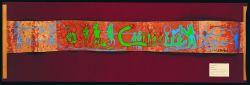
Norval Morrisseau, Life Scroll, c.1985, acrylic on birchbark, 30.7 x 233 cm, Glenbow Museum, Calgary.
In the 1980s, however, Morrisseau returns to the wiigwaasabaak after seemingly more than a decade. In 1985–86, he made two large-scale scrolls, both executed with acrylic on birchbark. Both feature similar imagery entirely in a pictographic style drawn from his Midewiwin scroll-derived lexicon––unusual for Morrisseau at this time. Ancestral figures, sacred beings, and animals, many in states of transformation such as fish walking upright on legs or half-animal half-human figures shifting from one state to another, march across the lengths of each scroll. The first, Life Scroll, c.1985-86, is among the largest works ever executed by Morrisseau on birchbark, consisting of five wide sheets of bark stitched together. Its figures are outlined in brilliant acrylic sky blue and brown with emerald interiors. The bright blue, a recurring colour to denote the ancestral realm and, under the influence of Eckankar, the astral plane in Morrisseau’s later works, recalls Hamell’s observation that “whiteness” and “sky-blueness” are interchangeable in Northeastern ritual contexts. The presence of blue star and sun forms at left and a long, horizontal line of blue across the bottom of the scroll likewise support a reading of skyline and celestial world.
In the other scroll, Ancestral Figures/Scroll Motif, 1986, the bark is split vertically into upper and lower registers, utilizing an organizing principle that Morrisseau often deployed to indicate a split between earthly and astral planes. The figures here, executed in brown and green acrylic, similarly transform between states, the upper and lower zones bifurcated by a thick two-toned boundary. Morrisseau signed this scroll on its verso directly beneath a symmetrical square arrangement of four bright red circles, points of colour hovering on the back like otherwise hidden motifs of power. The ends of the scroll curve under and back in on themselves, threatening to coil up on these mysterious red targets. Unlike the meandering, freely arranged figures seen in his early scrolls from the 1960s, the scenes of the two later works are confidently organized across the bark, filling it and evenly distributed. While they lack the geometric framework of the mide-wiigwaas, they clearly adhere to an internal framework suggestive of Morrisseau’s cosmological narrative pantheon.
Norval Morrisseau, Ancestral Figures/ Scroll Motif, 1986, acrylic on birchbark, 87.5 cm x 35.75 cm x 3.5 cm, National Museum of the American Indian, Smithsonian Institution, Washington, D.C.
Thus, Morrisseau returns to the material and format of the scroll. But why does he do so at this point in his career when he has not only expanded his spiritual and aesthetic vocabulary, but has also found great success with his turn to modernist materials? Through the scroll, Morrisseau could resolve the seeming dilemma that Phillips once observed between “orthodox modernism” and “traditional Anishnaabek genres and media”—what she more recently identifies as the synthesis of “old and new,” “innovation and allegiance to tradition.” He returned to the scroll as a format not created solely for artistic expression, but rather as a materially and culturally significant artform situated in the web of relations and metaphysical properties that encompass wiigwaasabaak.
Scrolls made of birchbark, with pigments evoking shininess and whiteness, or exchangeable with them, function as animate containers of culture. When Morrisseau says “I always wanted to make a scroll... but... [they] told me first I had to be a Shaman,” he implies that in the eyes of his community, the “they” here, the status of shaman is first required. And in roughly the same year that he completed these two late scrolls, 1986, he was appointed Grand Shaman of the Ojibwa.
Morrisseau, then, returns to making scrolls as an object category at the most appropriate time. At this transitional moment in the mid-1980s, even as he began to reach new heights in modernist painting, he felt the need to make scrolls, objects with material potency and agency.
The wiigwaasabaak subcategory of Morrisseau’s oeuvre offers us an opportunity to take seriously a materialist approach to Morrisseau’s work, one which demonstrates that the incorporation of a deep understanding of Anishinaabe worldviews openis new lines of research and makes exciting connections across Morrisseau’s oeuvre. The breadth of Morrisseau’s artistic production includes objects and materials that exceed the categories of modern or fine art and instead must be understood as complex matrices of objecthood, agency, and animate materials, artifacts embedded with cultural knowledge alongside the images they bear. His work is most productively understood as the site of social interactions, cultural systems, and material characteristics. It is not just his birchbark scrolls that function in such ways. His two-dimensional works function as containers in kind, despite their flatness––containers of culture, power, and manifold material natures.