Dealers and Networks: Art Business 1970–1985
by Carmen Robertson
To accomplish what I have started and to die in it feeling I have fulfilled what I have started—to reach a level where I and Manito and the Indian will always keep the Indian Faith alive—to be a great Artist and Preserver of Indian Culture.
–Norval Morrisseau
If the dealer/artist relationship between Pollock and Morrisseau was defined by its rockiness during the 1960s, then for much of the 1970s it could be described as smooth sailing. In 1972, in an interview with James Stevens, Morrisseau explained that he had made up his mind to take more control when he next visited Toronto: “I don’t sit around like I did before, like a dog being cared for on a leash.” His determination to change the relationship he had with Pollock in the 1960s seems to have born results: in a 1975 article, Toronto Star art critic Gary Dault described Morrisseau as a “hard-hitting businessman.” Whatever the change in their financial relationship, Pollock continued to assume a role as a Morrisseau art expert, overshadowing the artist’s own voice in two documentaries produced by the National Film Board, Colours of Pride (1973) and Paradox of Norval Morrisseau (1974), where he confidently explains Morrisseau’s practice to Canadian viewers. Pollock continued to pitch himself as a saviour by noting that he routinely bailed Morrisseau out of jail during the early seventies. Still, the two collaborated on exhibitions and marketing campaigns during this decade that benefited them both. Later, the dealer pushed the marketing of Morrisseau’s art in new directions, with a famous tea party held in Beardmore, Ontario, followed up by the acclaimed coffee table-style art book of Morrisseau’s career, The Art of Norval Morrisseau (1979).

Mother and Child, 1971
TK large abstract canvas by Josef Albers
At this time, Pollock was capitalizing less on the spectacle of the “Indian in buckskins” than on inserting Morrisseau’s work into the larger frame of modern art. In February 1972 Pollock placed a Morrisseau painting, Mother and Child, 1971, (fig. 1) in conversation with a large abstract canvas by Josef Albers (1888–1976) at his gallery, a marketing move that signaled the change. Albers, who had relocated from Germany to the United States during the Second World War, was known as a colour field painter whose art Pollock handled in Toronto. Kay Kritzwiser of the Globe and Mail praised Pollock’s curatorial vision, calling the unique artistic pairing a “sometimes startling but satisfying juxtaposition of ideas, sometimes totally unrelated but usually with an uncanny affinity.” Pollock connected the work of the two artists again that October, this time displaying several of Morrisseau’s so-called master works from the past ten years next to a group of abstract works by Albers.
Even as Pollock pushed audiences to consider Morrisseau’s art in relation to abstraction, older perceptions of Morrisseau’s work persisted. When the Royal Ontario Museum acquired eleven Morrisseau paintings from John Sweeney of Red Lake, Ontario, for its collection in 1972, Kritzwiser described that group of art as “decisive interpretations of the folklore the Ojibway artist knows so well.” In 1972 Pollock mounted a retrospective of Morrisseau’s art at his gallery that marked their ten-year anniversary of working together. The exhibition included his recently painting Self-Portrait of the Artist as Christ, 1972, and while the show received mixed reviews, it demonstrates an enduring relationship between the two
For Morrisseau, the period from 1970 to 1975 was punctuated by a number of ups and downs that impacted both the artist and his dealer. Morrisseau struggled with alcoholism and spent several nights in jails in different towns and cities in Ontario. Morrisseau was, however, admitted to the Royal Canadian Academy of Arts (RCA) in 1972, a sign that the Canadian art establishment recognized him as one of their own. His admission to the RCA no doubt reflected the effort Pollock had expended to reposition the artist’s work.
In early 1973, Morrisseau was sentenced to six months in jail in Kenora, Ontario, after an incident of public drunkenness. On the face of it, this might have been detrimental to his career. However, this extended stay resulted in the creation of a body of work that reflected a growing maturity in his visual storytelling aesthetic. Assigned two cells at the Kenora jail, one that served as his studio, Morrisseau’s stay provided him with the time and space to be creative.
During this time in jail, Morrisseau accused Pollock of stealing some of his paintings. Pollock was acquitted in 1974. It is possible, however, that during his jail stay others may have taken advantage of him. One of Morrisseau’s supporters, Joyce Kennedy, the director of the Lake of the Woods Museum, met with Morrisseau routinely and was concerned about exploitation concerning his art sales. On March 7, 1973, she arranged for Morrisseau to come to the museum on a day pass to view a Midewiwin scroll and other artifacts. She then orchestrated an interview with American anthropologist Lynn Kaufman. During their conversation, Morrisseau admitted, “Jeez, I give away lots of paintings in order to eat and to the guards sometimes. They want to buy them. Sometimes I say, here. If they appreciate it....” Kennedy, concerned about exploitation, suggested he charge for the works. Many of the art works Morrisseau created during his prolific period in jail ended up in private and public collections, sold by Pollock, but also Bob Fox, and a number of prison guards.
TK carousel of works by Jackson Beardy, Alex Janvier, Daphne Odjig, Carl Ray, Joseph Sanchez
During the 1970s, the Cultural Affairs Section of the federal Department of Indian and Northern Affairs Canada (as it was called then) assumed a greater role in the promotion of Indigenous arts across Canada, and Morrisseau was a key part of this shift. Seneca artist and curator Tom Hill (1943–2023) worked for the department and pushed several important initiatives, including Tawow magazine, which was launched in 1970 as a quarterly publication and forum for Indigenous writers and poets. The inaugural issue included a piece by Hill about Morrisseau’s art. In 1974, Jack Pollock also wrote a story for Tawow where he described Morrisseau as a “master.” The department also supplied funding to the National Film Board to produce documentaries showcasing Indigenous arts and Morrisseau, including Colours of Pride and Paradox of Norval Morrisseau, that focused, as noted, on assimilationist messages rather than on his art practice.
The Cultural Affairs Section also organized a large group show of Indigenous art to reflect the dynamic group of artists now creating art and showing their work in galleries throughout Canada. Indian Art ’74, curated by Tom Hill and Elizabeth McLuhan at the Royal Ontario Museum in Toronto, included more than two hundred works by a burgeoning group of Indigenous artists, among them Jackson Beardy (1944–1984), Eddy Cobiness (1933–1996), Alex Janvier (1935–2024), Daphne Odjig (1919–2016), Carl Ray (1943–1978), Joseph Sanchez (b.1948), and of course Norval Morrisseau. Hill recalls the contradiction of developing an exhibition of new art for a museum that otherwise displayed artifacts, but noted that “None of the major galleries [fine art institutions] were even looking seriously at [First Nations] art.” Morrisseau was commissioned for the show to create Water Spirit, 1972, the large-scale work of acrylic on kraft paper that remains one of his masterworks. It was purchased by the Museum of Man (now the Canadian Museum of History) after the show.
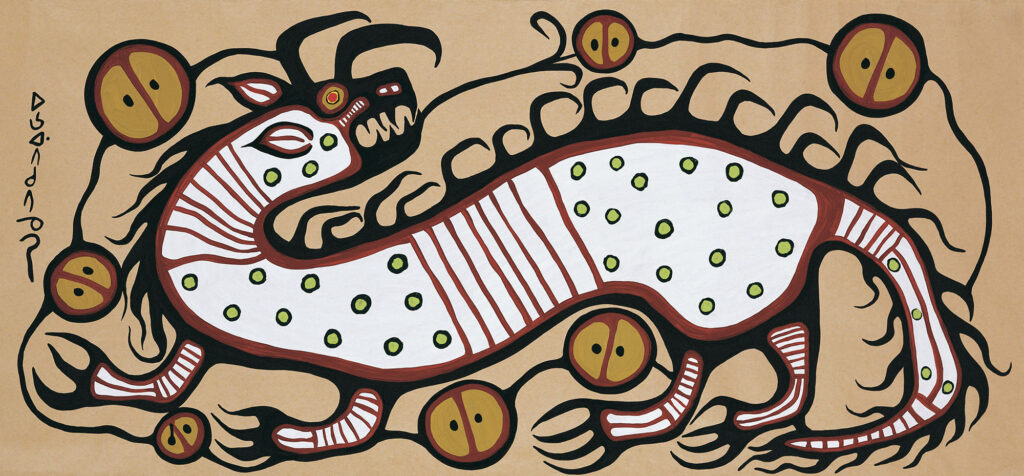
Norval Morrisseau, Water Spirit, 1972, acrylic on brown mill paper, 93 x 184.5 cm, Canadian Museum of History, Gatineau.
Exhibitions and the Professional Native Indian Artists Incorporated
The year 1975 was a blockbuster one for Morrisseau, featuring numerous exhibitions in Canada and France, the completion of several works considered to be among his best, and the formation of an alliance of Indigenous artists. In April 1975, Morrisseau and six other artists answered an open call sent out by Potawatomi artist and entrepreneur Daphne Odjig to bring together Indigenous artists into what would be known as the Professional Native Indian Artists Inc.
Morrisseau first met Odjig in Winnipeg in 1969 and visited her New Warehouse Gallery, the first Indigenous-run gallery and print shop in Canada, often after it opened in 1971 on Donald Street in Winnipeg. Morrisseau also produced some prints at her print shop, Odjig Indian Prints Ltd. He gave her the nickname “Picasso’s Grandmother,” according to Anishinaabe artist Barry Ace (b.1958). (Though Odjig was ironically forty years younger than the Spanish artist.)
The goal of the group, which included Janvier, Beardy, Cobiness, and Sanchez, in addition to Morrisseau and Odjig, was to push back against exclusionary practices that treated the work of “Indian” artists as handicraft. The Department of Indian and Northern Affairs Canada (and its Cultural Affairs Section) worked with the group to further their cause. Joseph Sanchez, a Pueblo community member who arrived in Winnipeg as a draft dodger during the Vietnam war and the youngest artist in the group, says Morrisseau joined the group despite the opposition of Pollock and Baker in Toronto: “No one could tell Morrisseau what to do. And so he joined the Group despite his handlers.” Called the “Indian Group of Seven” by the media, the artists often showed together in Winnipeg in 1975, often in venues, including Eaton’s and the Hudson Bay department stores, that were outside the bounds acceptable to the art world. Pollock approved of Morrisseau’s involvement in gallery shows, but he did not view all the group’s activities as beneficial to Morrisseau’s artistic career and vetoed ad hoc showings.
The group mounted a pivotal exhibition at Montreal’s Dominion Gallery in April 1975 that brought them significant positive attention and was one exhibition that Pollock approved of. The gallery’s owner, international art dealer Max Stern (1904–1987), did not otherwise show Indigenous art but agreed after prodding by Janvier and the assistance of the artists’ adviser, John Dennehy, who worked for Indian and Northern Affairs. Janvier pushed for a show at Stern’s gallery because, in his words, “Whatever Max shows, goes.” Morrisseau was also keen to be back in Montreal and wrote to Richard Baker that he had painted three strong paintings and assured him Stern was committed to the show.
TK figure 3
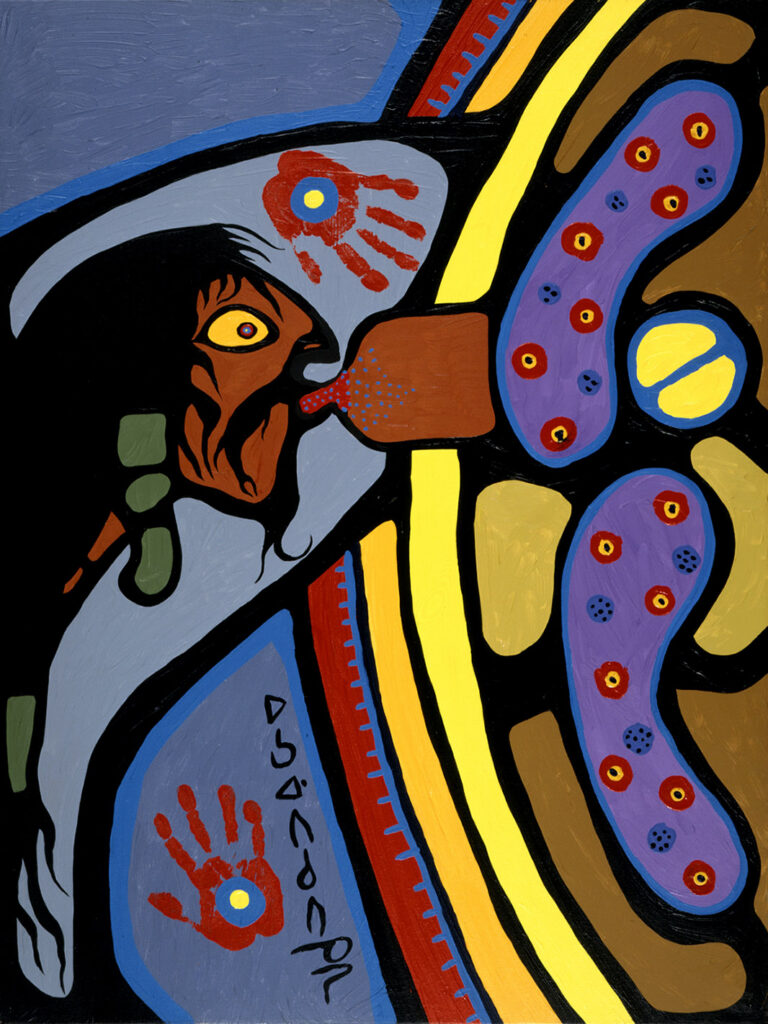
Norval Morrisseau, Christ Subservant to Mother Earth, c.1975, acrylic on canvas, 91 x 121.6 cm, Art Gallery of Alberta, Edmonton.
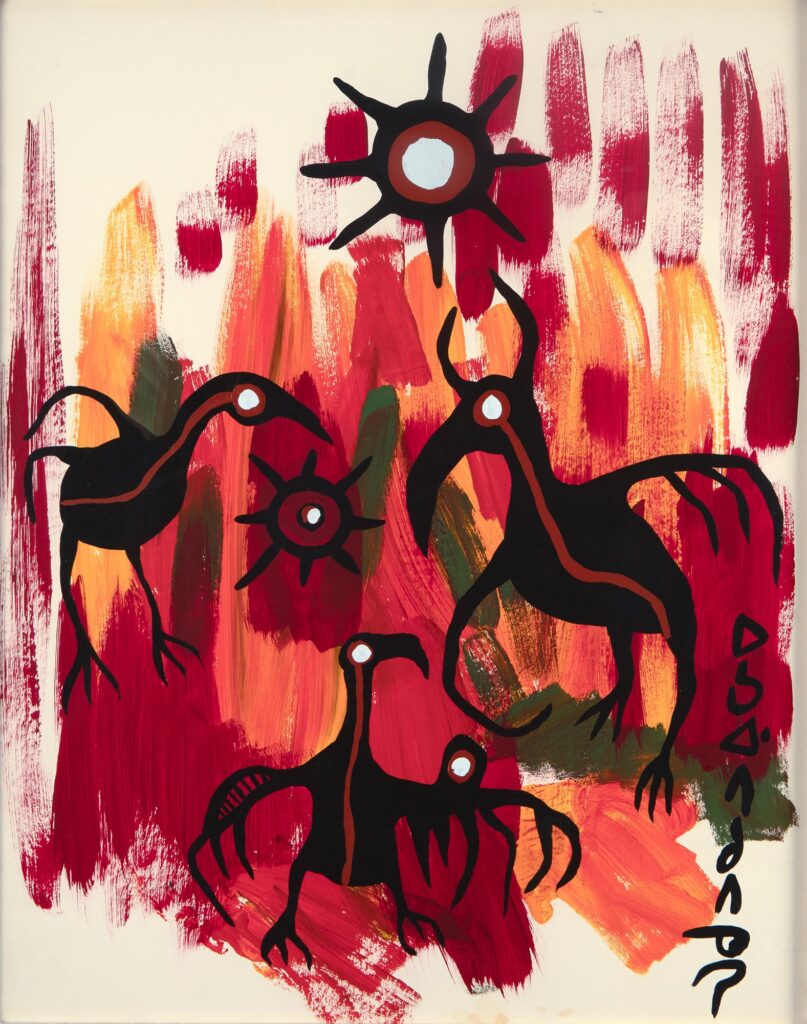
Norval Morrisseau, Impressionist Thunderbirds, 1975, acrylic on card, 51 x 39.5 cm, private collection.
Morrisseau arrived in Montreal a week before the vernissage. Stern supplied him with art supplies and he stayed with local musicians Kenneth and Russell, friends of Bob Fox’s from Kenora, who had a music studio down the street from the gallery and in the week leading up to the exhibition Morrisseau became a fixture in the studio as he prepared for the exhibition. They already owned a work by Morrisseau that they’d been gifted from Fox, a friend from university (fig. 3). Morrisseau painted this sacred bear while in jail in Kenora and it remained unsigned when Fox brought it to Montreal. Morrisseau happily signed their work, ahead of the show. Ken and Russell recall that Morrisseau quickly became a fixture among their musical community, joining jam sessions and painting prodigiously before the opening of the Stern show. The artist also painted the musicians a small personal work that included his handprint to thank them for their hospitality. Morrisseau gave Stern a provocative self-representation that conflated Anishinaabe and Christian motifs, including Christ Subservant to Mother Earth, c.1975.
After his stay in Montreal, Morrisseau suffered a serious breakdown in Thunder Bay in late May 1975. Pollock’s gallery assistant, Eva Quan, and Bob Checkwitch of Winnipeg extricated the artist from a local motel and checked him into Alcare, a detox centre in Ste. Rose du Lac, Manitoba, for all of June. The artist used his time there to produce several successful paintings, including his experimental and now well-known Impressionist Thunderbirds, 1973, that Baker picked up when he visited Morrisseau during his convalescence and provided to Pollock, who displayed it in Cannes, France, later that summer. A June show of the group’s works at the Wallack Gallery in Ottawa that Baker provided work for and attended the opening on behalf of Morrisseau, was followed by Indian Art ’75, a juried exhibition at the Woodland Indian Cultural Education Centre (now the Woodland Cultural Centre) in Brantford, Ontario.
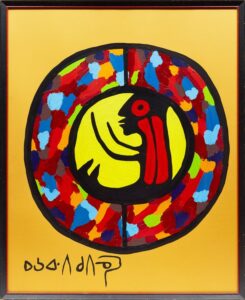
Norval Morrisseau, The Artist and His Environment, 1973, acrylic on thick board, 101.6 x 81.3 cm, private collection.
Pollock organized the exhibition in Cannes in 1975, which he and Eva Quan attended. The exhibition featured twenty-three of Morrisseau’s paintings. While details remain sketchy, Pollock collaborated with Milton Cantor of Montreal who ran a gallery in Cannes and they mounted a show of Morrisseau’s art from July 15 until August 15, 1975. Pollock planned for this to be a travelling exhibition to two or three other European galleries. In the end, it took place only in Cannes.
In August 1975, the Pollock Gallery also mounted an exhibition of Morrisseau’s art in Toronto. Three significant works, Artist with His Four Wives, n.d., Self-Portrait Devoured by His Own Passions, 1974, and Nature’s Balance, 1975, were part of the exhibition. Time magazine reviewed the Toronto show and noted that Pollock was expecting to sell the twenty-nine paintings on display for $46,000—ten times the revenue from his 1962 exhibition. Gary Dault, art critic for the Toronto Star, also reviewed the show and mused that Morrisseau was turning into a living legend and now demanded that his art be discussed like the work of other Canadian artists.
After his busy summer, Morrisseau had two additional exhibitions that fall. Twenty-one of Morrisseau’s works were displayed at Montreal’s Shayne Gallery in October. Jack Pollock provided two large works held by his gallery, Angry Thunderbird, 1975, and Michupichu Legend. The Artist and his Environment, 1973, was sold during this exhibition. Gallery owner Lois Shayne was thrilled to finally mount the exhibition at her gallery and worked with Richard Baker to orchestrate the delivery of works. Shayne added several works to her personal art collection following the successful show. She had wanted to mount the show earlier, but when she corresponded with Mike Zebryk, Morrisseau’s then manager, about a 1972 exhibition, he wrote back to say that Morrisseau had suffered severe burns in a hotel fire and would be in a Vancouver hospital for three months.
Norval Morrisseau, Untitled (Mother of Serpents), n.d., acrylic on paper, 161.3 x 99.1 cm, private collection, Montreal.
Norval Morrisseau, Shaman Speaks, c.1975, acrylic on paper, 100.3 x 78.7 cm, private collection, Montreal.
In 1976 Morrisseau painted Some of My Friends. Featuring dealers, lawyers, and others key to his career, the work signals his growing understanding of the importance of the individuals and networks that helped launch him in the art world. Pablo Picasso’s Cubist rendering of Ambrose Vollard and Pierre-Auguste Renoir’s painting of Paul Durand-Ruel similarly paid homage to their art dealers. Morrisseau, who seldom created portraits beyond representations of himself or his family members and kin relations, rendered his group of supporters integral to his success in his trademark visual style. The horizontal composition is three metres in length and features Pollock, Richard Baker, Eva Quan, Bob Checkwitch, and Tom Muir. Pollock commands the far-right quadrant, presented as a “young Indian brave,” a reinforcement of both the dealer’s Indigenous ancestry and his role as a “brother” to the artist. Eva Quan appears as a female water spirit to convey her importance as a friend to Morrisseau but also significantly as the person responsible for introducing him to the spiritual movement Eckankar. Encapsulated within Quan’s mermaid form, Morrisseau painted lawyer Baker, Winnipeg gallery and Great Grassland Graphics dealer Checkwitch, and his printer assistant Muir. The original painting was also reproduced as a serigraph print through Checkwitch’s Great Grasslands Graphics.
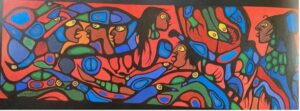
Norval Morrisseau, Some of My Friends, c.1976, ink on paper, 81.3 x 248.9 cm, private collection.
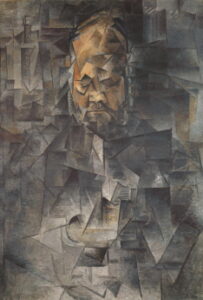
Pablo Picasso, Portrait of Ambroise Vollard, 1910, oil on canvas, 92 x 65 cm, Pushkin Museum, Moscow.
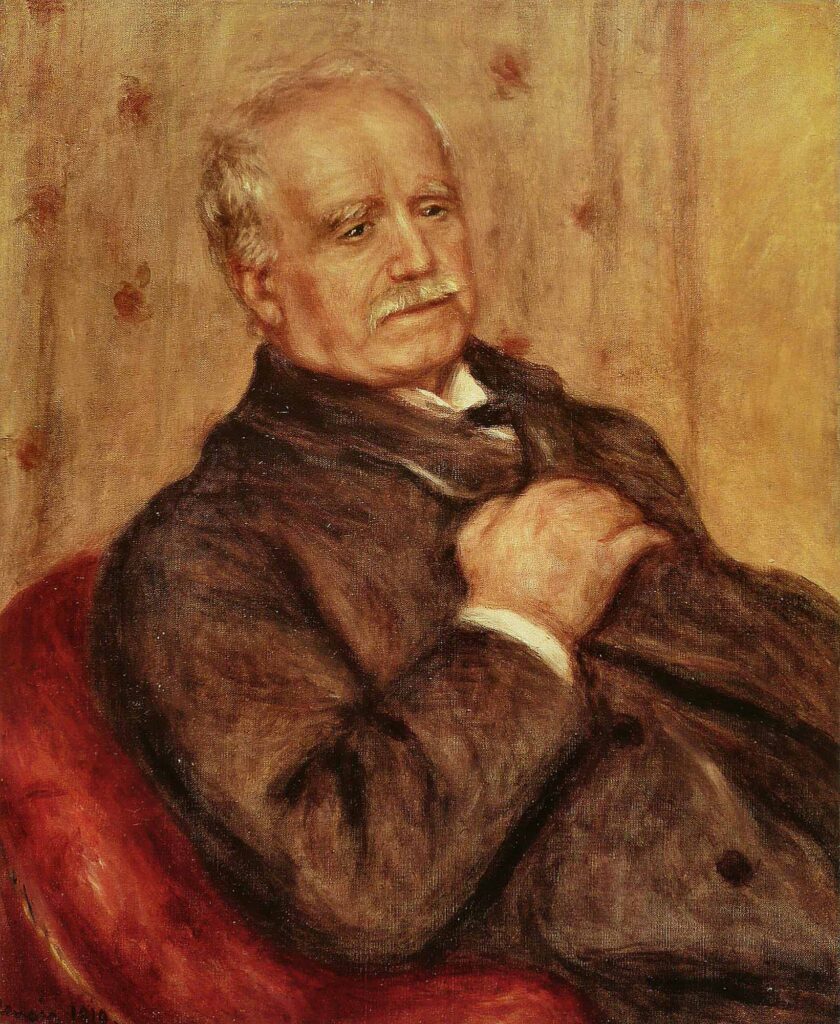
Pierre-Auguste Renoir, Portrait of Paul Durand-Ruel, c.1910, oil on canvas, 65 x 55 cm, Durand-Ruel Collection, New York.
Art Star Marketing
In the late 1970s, Jack Pollock developed further creative means to market Morrisseau’s art, ones that matched his growing fame as a Canadian artist. A coffee table book, The Art of Norval Morrisseau, that included a survey of the artist’s art from the 1950s on was in the works. Pollock’s goal was to create a nudge that would encourage major art institutions to add Morrisseau’s work to their collections.
A more immediate ploy, one that was more performance art happening than marketing event, took the form of a tea party. During the summer of 1978, Pollock and Morrisseau created a national buzz in the press and among collectors that both satisfied stereotypical tropes of the Indigenous artist/shaman and yet challenged those very perceptions. Since the early 1960s, the artist had been collecting china and silver tea services as part of a fascination with all things British. The idea of hosting a tea party in Beardmore provided an opportunity to fuse his dream of a Buckingham Palace-style party attended by guests dressed in fancy dress clothes sipping tea from Morrisseau’s china with Anishinaabe ceremonial protocols. Morrisseau’s eagerness to performatively express a curated shaman-cum-artist identity (one Pollock had exploited to market the artist to collectors and media), led to a party held in late July in Beardmore, some 920 kilometres from Toronto.
Saulteaux artist and curator Robert Houle (b.1947) recounted his experiences related to the tea party as “a throwback to that 1962 exhibition” as he describes the excitement and energy that began the evening prior to the trip to remote Beardmore, when Pollock hosted a cocktail party in Toronto for participants where the conversation “was focused on the new indigenous painting style inspired by the image bank carved, etched, and drawn on the Laurentian Shield.” Pollock invited professional contacts, collectors, art critics, and other potential art buyers to board a DC-3, a Second World War-era plane, for a flight from Toronto to Jellicoe airstrip, followed by a ride on a school bus to Beardmore where Morrisseau, his brother Wolf Morrisseau, and his apprentice and partner Brian Marion awaited their arrival. According to Houle, who at the time was the curator of contemporary Indian art at the then Museum of Man, Morrisseau “looked every inch the shaman, Norval Morrisseau becoming Copper Thunderbird.”
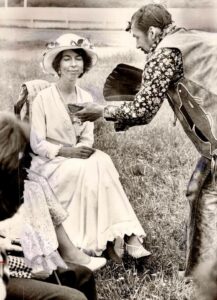
JUNE 28: 'Well; if the Queen can hold garden parties; why can't I?' Oiibwa artist Norval Morrisseau asked his guests. [Incomplete] (Photo by John Mahler/Toronto Star via Getty Images)
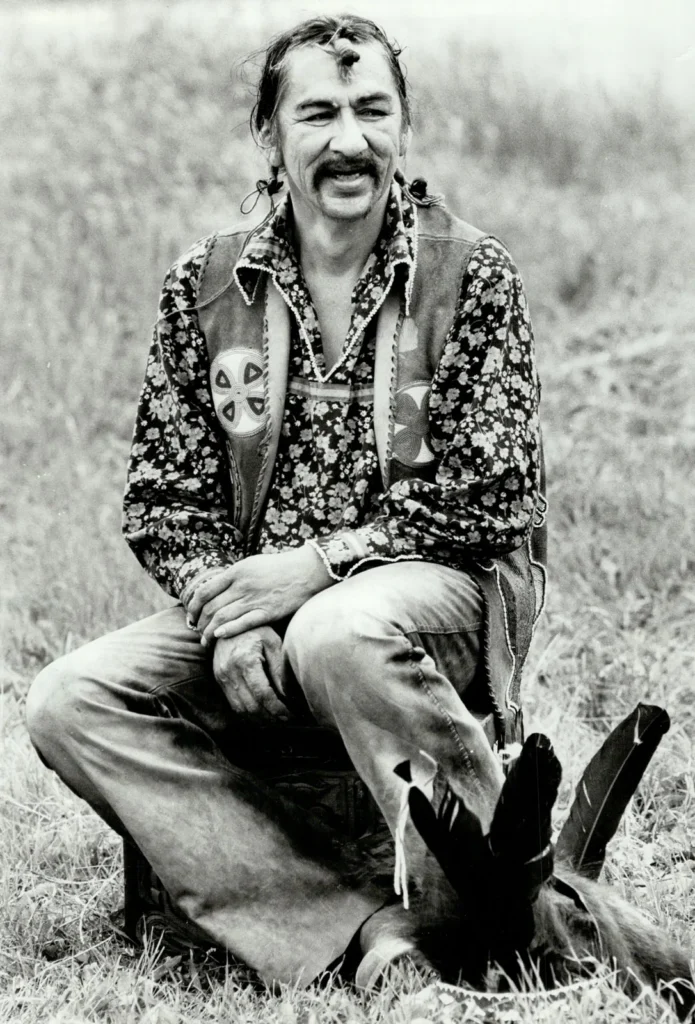
CANADA - JUNE 28: Norval Morrisseau (Photo by John Mahler/Toronto Star via Getty Images)
Morrisseau’s back yard served as the site for the tea party and several locals drove by over the course of the afternoon to catch a glimpse of the odd festivities. While some press reports wrongly assumed that Morrisseau had staged a boozy affair, he had quit drinking two years earlier and served only raspberry tea to the guests. Morrisseau delivered a greeting in Anishinaabemowin while his helpers passed around a plate of Buffalo Nickels as a welcome gift. A smudging ceremony followed. According to a CBC reporter who had been invited to attend the party and reported on it the next day for Morningside, this was viewed by participants who had never encountered such a ceremony before as an odd mix of twentieth century and old traditions. Houle, who helped with the smudge, characterizes the scene as a “cultural parody without the polemical rhetorical language of postmodernity.”
Morrisseau served traditional medicinal tea, raisin bannock, and wild rice flavoured with soy sauce. One unidentified female participant was quoted as saying the event offered her an “instinctive awareness of the past,” while others felt Morrisseau was “looking through you.” After songs and eating, Houle describes what he saw as the most significant portion of the performance, when Morrisseau invited each guest into his house and created personalized drawings. He created these in pencil on sketch paper, “in his newly minted indigenous allegorical style, each one personal and appropriate pulled from his pantheon of legend characters.” Globe and Mail art critic Kay Kritzwiser received a drawing of Mishibizhiw. Houle describes his private moment with the artist: “I entered the house speaking both Saulteaux [a language Morrisseau understood] and English, he Ojibwa and English. Our conversation began with a question about a portrait of Jack Pollock that I had seen the night before at his apartment.” As they talked, Houle said that Morrisseau began to draw for him an “underwater lynx, starting with its horns, without ever lifting his graphite pencil.” Morrisseau handed Houle his version of Mishibizhiw, and the next participant was ushered into the room. Eva Quan received a mother loon and babies, Richard Baker received a medicine bear, Barbara Stimson was offered a rabbit holding a small bird, Brian Marion received a water serpent with a mamequeesik spirit figure riding on its back, and Jack was gifted a medicine turtle. Pollock documented the afternoon event through photos subsequently included as a two-page spread in The Art of Norval Morrisseau, published the following year to connect the marketing of the tea party to Morrisseau’s arts practice.
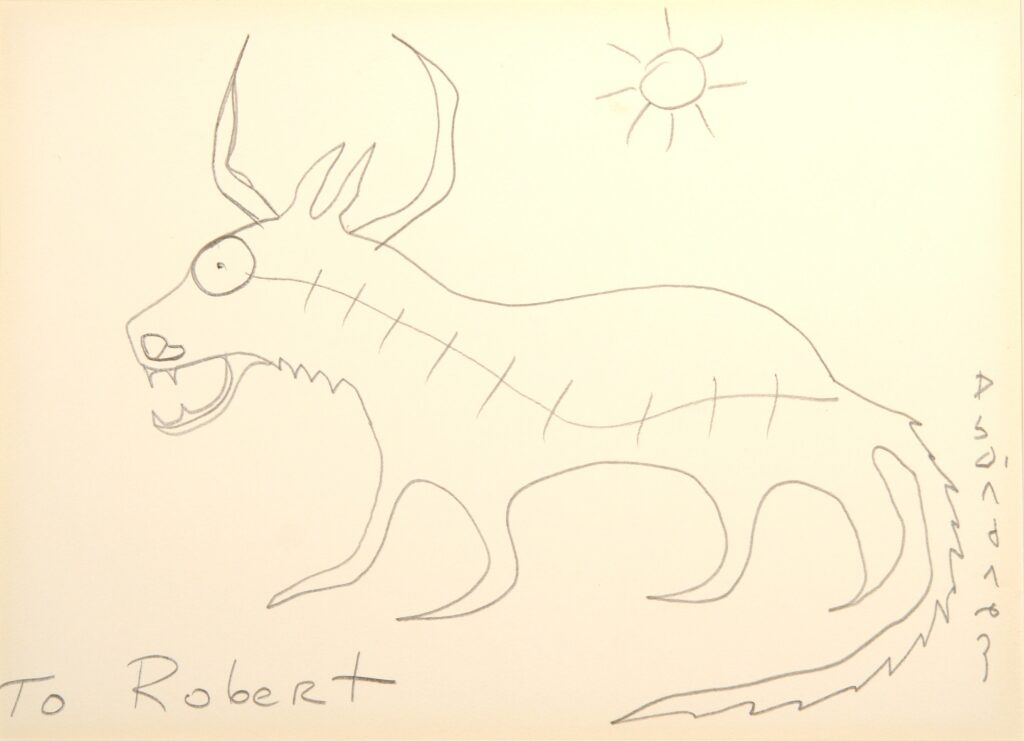
Norval Morrisseau, The Mihshipashoo, 1978, pencil on paper, 28 x 30.1 cm, Carleton University Art Gallery, Ottawa.
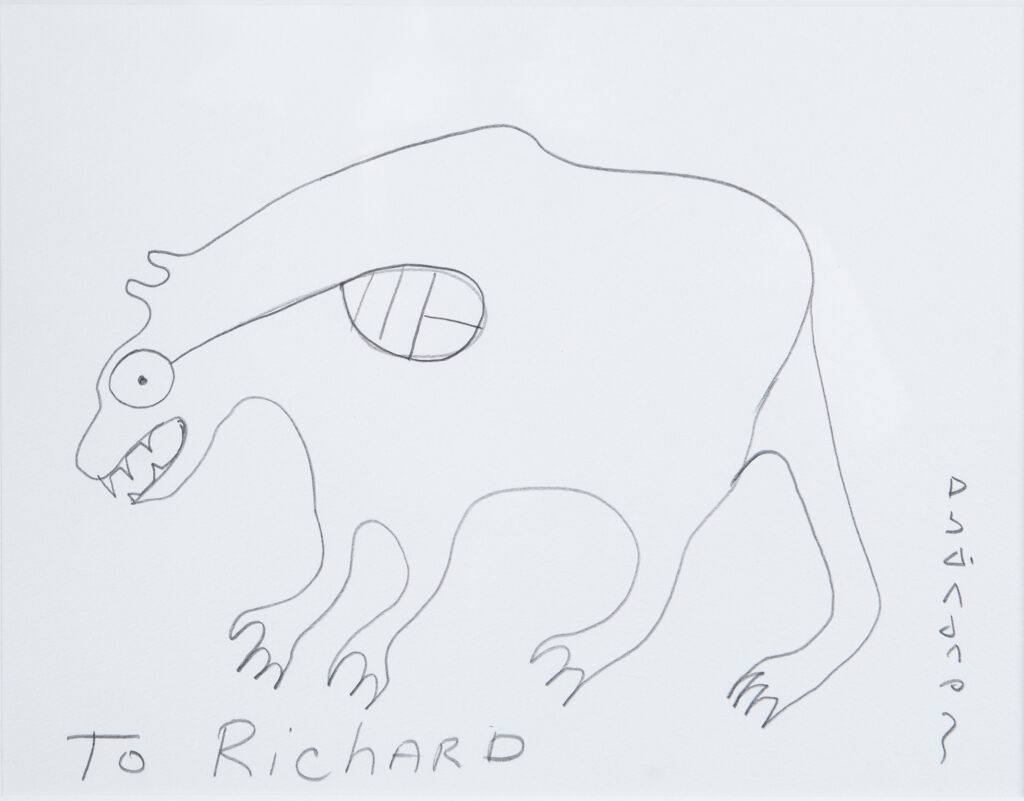
Norval Morrisseau, Untitled (Drawing for Richard Baker from Tea Party), 1978, pencil on paper, private collection.
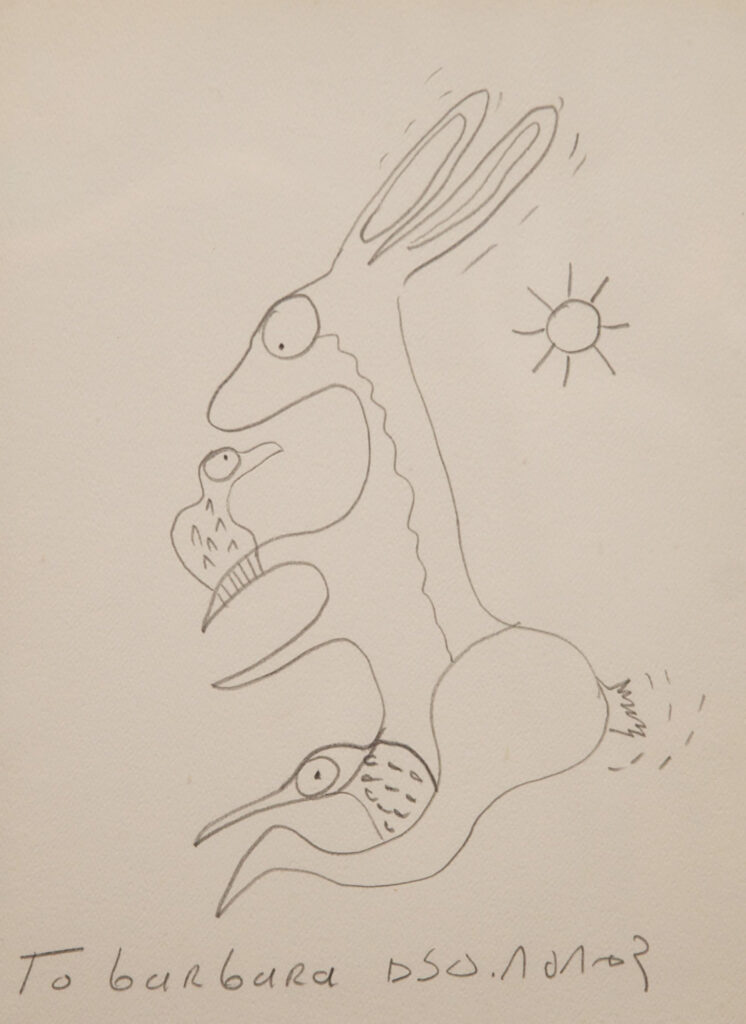
Norval Morrisseau, Untitled (Rabbit), 1978, pencil on paper, 36.2 x 27.9 cm, Westerkirk Art Collection.
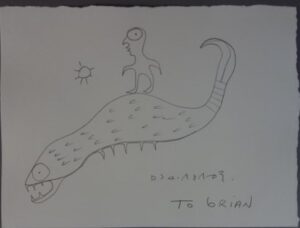
Norval Morrisseau, Untitled (Mishipeshu and Mamequeesik),1978, pencil on paper, 28.1 x 35.9 cm, Westerkirk Art Collection.
The culmination of Morrisseau’s relationship with Pollock as his dealer was the publication of the seminal The Art of Norval Morrisseau in 1979, co-edited by Pollock and Canadian playwright Lister Sinclair. The impressive coffee-table book offered readers a survey of Morrisseau’s career from 1955 until 1979. The book’s format was one reserved for renowned artists and the publication invited such a comparison. Sinclair purposefully curated works by the artist to help collectors and gallerists better understand Morrisseau’s unique visual language and a series of essays by Sinclair, Pollock, and Morrisseau offered further insights into his art. This genius marketing feat ensured Morrisseau’s entry into art institutions, even if only in the form of the collector’s edition. By creating a high-end portfolio that included a signed book and a selection of prints, packaged in an exclusive leather case with a $1,000 price tag, Pollock signalled that Morrisseau had “made it.” In so doing, he created an object that art institutions across Canada had to have. For many years, the portfolio was the only artwork by Morrisseau listed in the collections of many art museums nationally and internationally. Still, this was a coup for Morrisseau and served as an indicator of a shift that, while slow to come in some institutions, was happening.
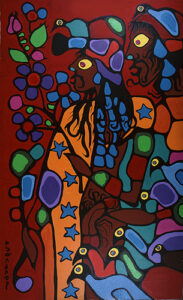
Norval Morrisseau, Artist Shaman with Apprentice, 1979, acrylic on canvas, 202.2 x 124.8 cm, McMichael Canadian Art Collection, Kleinburg.
The book stands today as a significant archival record of the artist’s career up to 1979. No other Indigenous artist in the 1970s was so honoured, and it demonstrates the heights to which Morrisseau and Pollock climbed together. Pollock took part in a promotional tour organized by the book’s publishers that sent him to ten cities from coast to coast in twelve days where he gave over sixty interviews and attended book signings though it seems Morrisseau was not part of the
tour. He also mounted an exhibition at the Stratford Gallery in 1979, where several works showcased in the book were put on display to further promote Morrisseau as an artist at the top of his game.
Yet, whatever successes they were realizing together by this point, Morrisseau was beginning to pull away from Pollock. In 1979, Pollock sold the large-scale Shaman Artist with Apprentice to the prominent collectors Robert and Signe McMichael. That same year, Morrisseau was taking part in an artist residency at the McMichael Collection of Canadian Art in Kleinburg, Ontario. He sold the sixteen works produced at the gallery’s Tom Thomson Shack to Robert McMichael through a company called The Song of Norval Morrisseau Ltd., represented by Shingoose (Curtis Jonnie), who was also involved in selling Morrisseau’s work in Winnipeg.
Morrisseau also landed a contract to paint an album cover during this time, likely through his connects with Shingoose. He created the album cover for the Canadian musician Bruce Cockburn’s forthcoming album, Dancing in the Dragon’s Jaw released in 1979. Cockburn had earlier reproduced a work by Atlantic Realist painter Alex Colville (1920–2013) on his 1973 album, Night Vision. Bernie Finkelstein, Cockburn’s manager, describes delivering a cassette of song recordings for Morrisseau to listen to. He returned to Morrisseau’s Toronto apartment a few days later to pick up the painting.
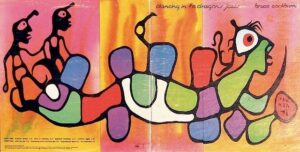
Cover of Bruce Cockburn's album, Dancing in the Dragon's Jaw, 1979, featuring a work by Norval Morrisseau.
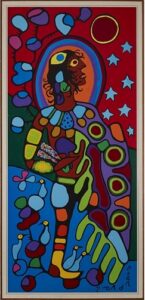
Norval Morrisseau, Shaman Astral Guide I, 1978, acrylic on canvas, 302.6 x 137.2 cm, Westerkirk Art Collection.
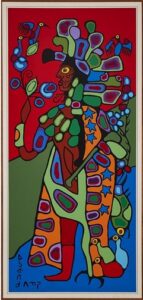
Norval Morrisseau, Shaman Astral Guide II, 1978, acrylic on canvas, 302.6 x 137.2 cm, Westerkirk Art Collection.
Pollock continued to sell Morrisseau’s art, but the painter also became involved with Albert Volpe’s Nexus Gallery in Toronto. In 1979 Volpe sold Shaman Astral Guide I, 1978, and Shaman Astral Guide II, 1978, while the Pollock Gallery sold a similar painting. Many original paintings by Morrisseau from 1978 until 1983 were made into prints through ALVO Canadian Art Ltd. and printed by Superb Graphics, enterprises that were also connected with Volpe. In Pollock’s book Dear M: Letters from a Gentleman of Excess (1990), he noted that Morrisseau soon became frustrated with the Nexus Gallery, however, and refused to sign the many print editions being produced. The artist eventually broke ties with both Volpe and Pollock and left Toronto.
Morrisseau spent much of the first few years of the 1980s without strong gallery representation. In 1983 the Pollock Gallery “collapsed,” and Pollock sold off his stock and his personal collection of Morrisseau paintings before moving to France. Morrisseau continued to work with Bob Checkwitch at Winnipeg’s Great Grasslands Gallery, producing quality prints and selling art through a number of smaller venues.
Galal Helmy first heard of Morrisseau in the late 1960s after arriving in Canada to attend university and was instantly drawn to his art. When Helming later opened a gallery in Jasper, Alberta, called EA Studios, he visited Great Grasslands Gallery and arranged to buy Spiritual Feast, n.d., in 1977. Spiritual Feast was part of a large edition, and Helmy paid Morrisseau to sign the prints that he purchased. Helmy soon began to buy and sell Morrisseau’s prints produced at Great Grasslands in the tourist town. Yet, while Helmy successfully sold prints by the artists, he had yet to meet him.
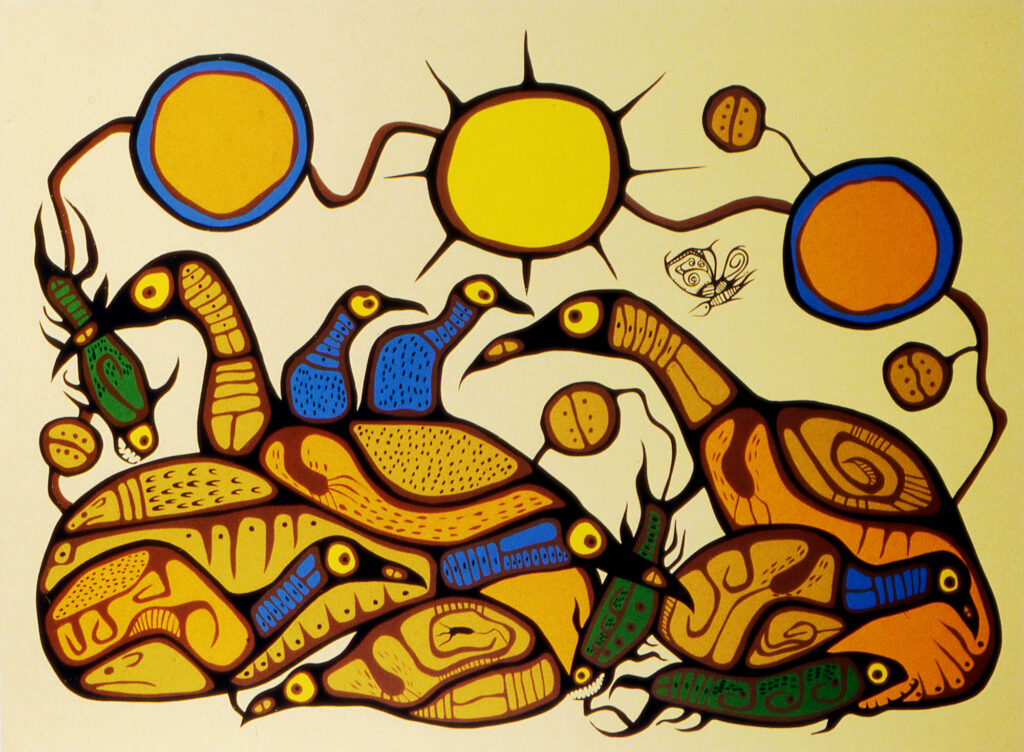
Norval Morrisseau, Spiritual Feast, n.d., serigraph on paper, 51.1 x 63.6 cm, Kenderdine Art Gallery, University of Saskatchewan, Saskatoon.
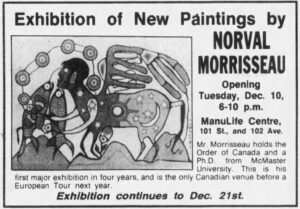
Advertisement for an exhibition of new paintings by Norval Morrisseau at the Manulife Centre, Edmonton, 1985.
In 1985, Morrisseau spoke on the phone to Helmy, who invited him to come and paint in Jasper. When the artist agreed, Helmy arranged his travel from Thunder Bay to Edmonton, and they met in person for the first time. The following day, they went to an art supply store on Jasper Avenue in Edmonton, where Morrisseau had Helmy buy enough supplies to fill the back of a truck. They set off for the cabin reserved for Morrisseau to use as living quarters and a studio. Morrisseau made clear from the beginning, according to Helmy, that his money was his business and Helmy agreed to his terms. While in the process of organizing an exhibition of Morrisseau’s work to take place at the ManuLife Centre in downtown Edmonton in December 1985, Helmy visited Morrisseau at his cabin in October to let him know about the upcoming show. The artist soon had forty works ready. Helmy arranged to have the Alberta Deputy Minister of Culture open the successful show. Later Helmy helped facilitate an international exhibition in Vienna, Austria, and accompanied Morrisseau to two shows in southern California organized with Canadian actor John Vernon.
Conclusion
Throughout the 1970s and into the 1980s, Morrisseau’s art practice grew and shifted and so did his relationship with dealers and supporters who helped him throughout this period. During the almost twenty years that Morrisseau and Pollock worked together, Morrisseau continually sold paintings independently of Pollock, a practice typically frowned upon in the art world. The role of gallerist was one that Morrisseau understood differently from Pollock and quite frankly from other artists and dealers in Canada’s art market. Despite this, Pollock played a significant role in Morrisseau’s career.
To be sure, Pollock was not alone in shaping the business side of Morrisseau’s art career. Other allies, including Richard Baker, Bob Checkwitch, Tom Hill, Curtis Jonnie (Shingoose), Elizabeth McLuhan, Daphne Odjig, Pollock, Eva Quan, James Stevens, and Mike Zebryk, played a role in the 1970s. In the 1980s, Galal Helmy took on a similar role. All supported Morrisseau’s efforts to bend the cultural landscape of the Canadian artworld to make space for Morrisseau’s vision.