Materials, Imagery & Technique

Mamaandaawizi, “He Performs Wonders”: Anishinabemowin Discourses of Art, Artist, Image and Colour
by Alan Corbiere

Renewing Anishinaabe Arts:
Morrisseau and the Deep Tradition
by Ruth Phillips

Materialism and Meaning in Morrisseau’s Wiigwaasabak
by Christopher T. Green

The Story of the Conservation of a Birchbark Artwork
by Jill Plitnikas, Marie- Helene Nadeau, Jessie Richard

What Big Teeth You Have Grandfather: Trauma and Rage in Art of Norval Morrisseau
by Richard Hill

A New Visual Language: Experimentation and Creativity (1955-1969)
by Carmen Robertson

Experimentation from the 1970s through 1985
by Carmen Robertson
The Blues: The Spiritual Erotic Fantasies of Norval Morrisseau in Technicolour
by Michelle McGeough
Mamaandaawizi, “He Performs Wonders”:
Anishinabemowin Discourses of Art, Artist,
Image and Colour
by Alan Corbiere
Anishinaabe people are rightfully perceived as inherently artistic people. There is an assumption that we have an extensive corresponding Anishinaabe vocabulary and discourse about art. Yet discourse in Anishinaabemowin articulates unique concepts about visual expression that are difficult to translate into English. Ozaawaabiko-binesi, Copper Thunderbird, has left us not only a rich corpus of work to build upon, but also the potential to access language that embodies our “legends, art, songs and beliefs, not for ourselves alone but for all future Ojibway.”
As an exploratory search for Anishinaabe words and concepts that elucidate Norval Morrisseau’s legacy, this chapter aims is to reverse the discursive shift that occurred under colonialism when English terms embodying Western concepts of art, artist, image, and colour were imposed on Anishinaabe visual and material expression, distorting their meanings. Morrisseau’s mother tongue was Anishinabemowin and he thought and worked with the Anishinaabe concepts he absorbed through his language and the specific teachings of his grandfather. Utilizing specific examples, I will show that western educated curators and art historians have thus far dictated the discourse about Anishinaabe art. Anishinaabe people have a different discourse about art that is neither well known nor utilized in public fora such as universities, galleries, museums, and publications. I will highlight differences in art discourses that facilitate this discursive shift back from English into Anishinaabemowin with the goal to make this vocabulary, and the discourse in which it is embedded, available to the current generation of young Anishinaabeg who do not know it due to interruptions in intergenerational Anishinaabemowin transmission.
Mamaandaawiziwin: Speaking of “Art”
Approaching Anishinaabe art as a subject presents a paradox because there is no overarching word in Anishinaabemowin for art—many just use mzinbii’gewin/mazinibii’igewin. Back in 2016, I was on the curatorial committee for the Royal Ontario Museum (ROM) exhibit called “Anishinaabeg: Art & Power.” This committee included ROM curator Arni Brownstone and Anishinaabe artist Saul Williams, a contemporary of Norval. We wanted to translate the exhibit name into Anishinaabemowin and Saul wanted it in syllabics as well. I took a stab at it and went literal with two suggestions: “Anishinaabeg: Mzinbii’gewin miinwaa Gshki’ewziwin” or “Anishinaabeg: Mzinbii’gewin miinwaa Mshkawziiwin.” Saul said “Mzinbii’gewin (mazinibii’igewin in his dialect) is just drawing, what about painting? What about basket making? What about weaving? Carving? Beadwork?” Each of these art forms has its own words: gokbinaagnikewin “basket making”; bmaagnigewin “weaving”; mzinkoj’gewin “carving” and mzinaabdoo’gewin “Beading.” There is no overarching word that encapsulates all of these. Saul was right, it would be awkward to call a beadworker artist or a mat weaver, mzinibiigewinini. These words are all, furthermore, neutered verbs. This is done by adding the suffix /-win/ to the end of a verb, so, for example, mzinibiige “s/he draws” becomes mzinbiigewin “drawing.” Similarly, the word “artist” is a verb combined with a noun, mzinbiigewinini, literally ‘drawing man.’ This shows the primacy of the verb in Anishinaabemowin, so much so that nouns are derived from verbs.
The word for power presented further problems. Then one day Saul excitedly reported in a conference call that he had found the word—Mamaandaawiziwin, which he translated as “a one of a kind gift from Creator.” Saul elaborated, stating that artists are gifted by the spirits to create art. The verb Mamaandaawizi means “perform wonders; s/he performs wonders; s/he does magic.” This is not a word for word translation for “Anishinaabeg: Art and Power” but from an Anishinaabe speaker’s point of view it encapsulated the exhibit’s theme.
A couple of years later, I purchased a used copy of the bilingual catalogue of Roy Thomas’s retrospective exhibit. Reading it, I saw that Ojibwe language teacher and renowned translator Patricia Ningewance had also used the word mamaandaawizi. Ningewance translated the title of Norval’s retrospective exhibit, Norval Morrisseau: Shaman Artist as Norval Morrisseau: Mamaandaawizid Mazinibii’igewinini. In this context, mamaandaawizi fits aptly even though it does not mean ‘shaman’—in fact, there is no direct Anishinaabe word for shaman. Checking four Ojibwe dictionaries, two modern and two older, there was no entry for shaman. The word is not Anishinaabe. The Oxford English Dictionary (OED) defines “shaman” as used by peoples of northeastern Europe, Siberia, East Asia, and North America, as a person who is “regarded as having access to, and influence in, the world of good and evil spirits, and who practises magic or sorcery for the purpose of healing, divination, etc., typically by entering a trance state.” The second definition, “figurative. A person regarded as comparable to a shaman; an important or extremely knowledgeable person in a particular sphere, esp. one regarded as arcane or esoteric.” The OED provides an example from 1698, which originated from the German word Schaman, “which signifies as much as a Sorcerer or Priest.” By 1868 the word meant “conjurer-priest, ‘medicine man.’” This does not mean that the word ‘shaman’ is incomprehensible to Anishinaabeg, in fact Morrisseau self-identified with it and curator Greg Hill emphatically stated, “His work must be viewed as the production of a shaman artist.”
Mazininii: Speaking of Images
Problems of conceptualization and translation also arise in discussing the images artists create. We can illustrate the history of language shift when past generations of missionaries and ethnologists have offered English terms for Anishinaabe practices of image making. Meskwaki ethnologist William Jones spent several years collecting stories, both sacred and mundane, from Anishinabeg living in communities west of Lake Superior. One of his chief collaborators was Gaagige-Binesi (John Binesi), likely the father or grandfather of Norval’s namesake namer. A passage from one story is of particular relevance to modern artists. In it, Gaagige-Binesi recounts:
Mazininii gaye odoozhi’aawaan. Niimiwag igiw mazininiinsag. Bezhig waabanong inakake oniibawi’aawaan, mii iniw ‘meskwaawigiizhig’ ezhinikaanaawaad… Niibiwa gaye mazininii’ isa miziwe biindig wiigiwaaming odasaawaan, gakina igiw mazininiig niimiwag.
And some images did they make. The images danced. One over towards the east they placed in standing position, and the name of that one they called Red-Sky… And they put many images everywhere about inside the lodge, and all the images danced.
The specific word used in this passage about Waabanoowiwin practices is mazininii. Bishop Baraga, missionary to the Ojibwe and the author of an early dictionary, wrote this term as “Masinini. Carved image, idol; pl.-g.” However when one looks up the English to Ojibwe part of Baraga’s dictionary they will see, “Idol, masinini. I adore or worship idols, nin manitoke. I adore him (her, it, an idol), nin manitokenan; nin manitoken, Idolatry, manitokewin, matchi-manitokewin. I practice idolatry, nin manitoke.” Today, manidooke refers to conducting a ceremony, or literally, “make manitous.” Thus the waabano practice of making images and idols with iconographic imagery is expressly tied to ceremony and spiritual power.
Jones translated mazininii as ‘images’ as opposed to ‘idols’ or ‘carved images’ and English thus proves insufficient again. Consulting Baraga’s dictionary, English to Ojibwe, we find “Image, masinitchigan. I make images, nin masinitchiganike. Maker of images, masinitchiganikewinini. The making of images, masinitchiganikewin.” Baraga also listed “Masinitchige, (nin). I make an image or images; p. mes...ged.” Nothing in this gloss indicates any association with “idolatry” or what would now be called ceremony. A matter of discourse arises, and the question of whether Ozaawaabiko-binesi made mazinichigan (images)? Mazinibii’igan (drawing, painting, engraving)? Or mazininii (carved image or idol)? I believe he would have preferred the latter, as he emphatically stated: “I am a Shaman-artist. My paintings are also icons; that is to say, they are images which help focus on spiritual powers [emph added] generated by traditional belief and wisdom.” Morrisseau did not believe he was merely painting or drawing images, he believed he was creating and deploying icons, therefore, I suspect he would say he made mazininii—idols, which I equate with icons, images used ceremonially.
The way in which dream experiences were generative of imagery is explained through the traditional narratives of John Baptiste Binesi. He had an intimate knowledge of the Midewiwin and the Waabanoowin. In explaining what we today would call natural order, or world view he stated that manidoog were placed in the four directions, and then a second set were placed in between those four directions, and even more placed in the Great Lakes, on the land and in the sky. He then succinctly articulated a fundamental Anishinaabe concept of the oneness and spiritual nature of the universe:
Behold, this earth in all its length and breadth, such is what is meant as the mystic manitou. So likewise this sea throughout its whole extent, it is the mystic manitou, so I was told. Furthermore, this sky, that too does the mystic manitou overspread, such was what he told me; and this is the extent (of the mystic rite), (as wide as the limits of) this sky.
Nashke mii owe aki gakina enigokwaag, mii iw mide-manidoo gaa-idang. Gaye dash owe miziwe enigokwaag gichi-gami mii a’aw mide-manidoo ningii-ig. Miinawaa owe giizhig mii go o debishing mide-manidoo, mii iw gaa-izhid; o’omaa dash enigokwaag, ow giizhig.
In affirming that the Mide-Manidoo—possibly, but not necessarily the Creator—was everywhere and in everything, his words seem at first to contrast with Norval’s statement that: “I go to the inner planes. I go to the source. I even dare to say I go to the source where all the inventors of mankind go… to the house of invention.” Norval’s “inner planes” and “house of invention,” evoke an external existential place, in contrast, Gaagige-binesi would likely have called the ‘house of invention’ the ‘Mide-Manidoo’—the force and mystery that permeates all.
When Gaagige-Binesi explained the natural order to Jones he used a birchbark scroll as a mnemonic and didactic device. The scroll is a two dimensional profile of the world, perhaps the universe, drawn as a circle with indications of the four directions and numerous animals, birds, and fish represented and identified in their abodes aligned with the eight winds. Jones did not record whether Gaagie-Binesi had made the scroll or if it was passed on to him. In either case this scroll was part of Gaagige-Binesi’s pedagogy. Although Norval is unlikely to have seen it, he was similarly compelled to represent the Anishinaabe cosmos, “I want to paint the Indian version of what the physical universe looks like, and the astral heaven on top.” It can be argued that this scroll depicts from the “astral heaven” on top because the universe is flatly represented from an aerial perspective in two-dimensions. If the animals and humans were not etched in, the scroll would look like an enclosed circular area with a median and an oblong structure in the centre, with north at the top, much like a modern day map or blueprint. Adding the humans and animals in profile provide another dimensionality to the scroll and thus reveal and animate the four cardinal directions, the road of life that runs east to west, and the midewigaan (medicine lodge) in the center of the scroll.
A number of people who knew Norval asserted that he was never initiated into the Midewiwin, and his own statements are ambiguous; Norval, Ozaawaabiko-binesi, insisted that “My grandfather showed me how to do interpretations of the shaman beliefs on birchbark… I was being taught… But I was not allowed to make a scroll, even though I wanted to make one. I had to wait until my full initiation to make a scroll.” Among those who denied that this ‘full initiation’ took place was the wife of his friend and mentor, Selwyn Dewdney, who knew and hosted Norval and his family in the Dewdney home in London, Ontario, during the early 1960s. Irene Dewdney stated in an interview that, “[Norval] certainly did not go through the rituals and the learning process that Jim Redsky did, he certainly did not, but he indicated on more than one occasion that he had special knowledge and special insights that were given to him, and I think that that's suspect. I think that Norval did absorb a great deal from his grandfather. I think he did absorb a great deal from the older people in his community… maybe some Midé teachings but he did not go through the Midé initiation.” Other scholars and critics posit that Morrisseau purposely blurred lines and suggestively used words such as ‘initiation’ to imply an association with the Midewiwin. Even though it is unlikely that Norval received pictography training as a Mide member, his grandfather did pass on aspects of the tradition, and the lack of these opportunities did not impede his grandson’s desire to renew Anishinaabe graphic expression. Notably, Norval’s practice of drawing an animal with its heart and internal organs shown—a convention that has become known as the “x-ray” style—renewed an ancient tradition evidenced by pictographs on rock faces, processional birchbark scrolls and medicine song boards, that distinguishes spiritually active animal beings. This was one of the ways in which he affirmed the intimate and necessary connection between stories, discourse and language with visual imagery. As he stated in his groundbreaking book, Legends of My People, the Great Ojibwe, which he illustrated with his bold black and white drawings: “There's lots of stories that are told in Ojibwa but that wasn't enough for me. I wanted to draw them—that's from my own self—my own idea what they look like.”
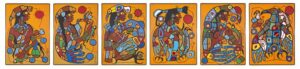
Norval Morrisseau, Man Changing into Thunderbird,1977, acrylic on canvas, six panels: each panel 153.5 x 125.7 cm, private collection, on loan to the Art Gallery of Ontario, Toronto.
Naming Colours in Anishinabemowin
Norval Morrisseau, Spiritual Self Looks Beyond.
Morrisseau loved brilliant colours and he wanted people to appreciate the colours over the images, “People tell me all the different meanings in my paintings. I don't like to tell them that this is not so. If they think it's a loon, if they think it's a hawk, well, fine. What kind of fish is that? Oh, it could be a salmon, but that's not the important thing. It's the colour [emph added]. I'm still going to emphasize the colour.” Nowhere is Morrisseau’s sense of the importance of colour more evident than in his great masterpiece Man Changing into Thunderbird, 1977, where he used copper coloured paint as the background to all six panels to visually articulate his growing sense of himself as Copper Thunderbird.
A reinforcing expression of that unique sense of self as Copper Thunderbird was his signature. Norval signed his name in syllabics and many accept that the syllabics spell the Ojibwe words Copper Thunderbird, but many would be hard pressed to read each symbol and pronounce the corresponding sound. Copper Thunderbird is a compound noun in English and Anishinaabemowin but many are unable to separate Norval’s syllabic spelling into two words. Recently, I was asked if Norval’s name was Miskwaabiko-animikii or Ozaawaabiko-binesi. In southern and central Ojibwe dialect, copper is Miskwaabik and thunderbird is Animikii, so I assumed the former. However, in western Ontario, thunderbird is Binesi and in northern Ontario, copper is Ozaawaabik. The Ojibwe People’s dictionary, based in Minnesota, lists “ozaawaabik, ni, (a piece of) brass, (a piece of) copper.” It also lists “miskwaabik, ni, (a piece of) copper.”
In essence, due to dialect differences, there are four possible ways to say Copper Thunderbird in Anishinaabemowin: Miskwaabiko-Animikii, Miskwaabiko-Binesi, Ozaawaabiko-Animikii, Ozaawaabiko-Binesi. I then decided to decode the syllabics to see how he spelled his name. I checked a syllabic chart and spelled both renditions out to see which one matched Norval’s signature. He signed his name in syllabics as Ozaawaabiko-binesi. In the south, where I live, that would mean ‘brass thunder bird.’ Working through this basic question highlights two relevant issues: colour and dialect. In terms of language revitalization, dialect is an issue because some words are different, as demonstrated with copper and thunderbird. Dialect issues are also tied to orthography (syllabics versus roman orthography versus French influenced conventions versus Methodist conventions). Not to minimize these differences, but ultimately, the language is the same and the similarities far outnumber the differences. For language revitalization purposes, and for Anishinaabe nationalistic goals, dialect familiarity should be the goal. In fact, all four renditions of his name are understandable to Ojibwe speakers, preference is accorded to their respective dialect.

Norval Morrisseau, Fish, 1973.
Anishinaabe discourse concerning colour is thus significant and it is important to understand its unique capacities. Anishinaabemowin has names for the primary colours: red (miskwaa/miskozi), yellow (ozaawaa/ozaawizi), and blue (ozhaawashkawaa/ozhaawashkozi). The shade black is makadewaa/makadewizi and the shade white is waabishkaa/waabishkozi. Yet other colour distinctions are differently made. Like Indigenous people the world over, the Anishinaabeg have been noted to not distinguish between blue and green. If one enters the Ojibwe word Ozhaawashkwaa into the Ojibwe People’s Dictionary, the definition provided will be “it is blue, is green.” Similarly, if we search Ozaawaa in that dictionary we get “it is yellow, is brown.” In southeastern Ontario, perusing the Nishnaabemwin Online Dictionary, the word zaawaa/zaawzi means “be brown, be orange, be yellow.” Recall that in the Minnesota dialect copper is both ozaawaabik or miskwaabik. Is copper red? Or is it more brown? The naming of copper in Anishinaabemowin is analogous to the aforementioned blurring between blue and green in many Indigenous cultures.
This ambiguity about colour may present challenges and problems when talking about art and art history in European languages. Norval Morrisseau masterfully utilized a brilliant colour palette and left us works with spectacular colour contrasts. I have not come across any evidence that he talked about his oeuvre with specific Anishinaabe colour terms. However, Anishinaabemowin is a polysynthetic, agglutinative language and words for colours can be crafted with precision. An artist can make something giizhgwaande/giizhigwaanzo “sky blue”; miinaande/miinaanzo “blueberry coloured”; zhoominaande/zhoominaanzo “grape coloured”; Akiiyaande/akiiyaanzo “earth brown”, and so on. Even if we have no information about Morrisseau’s descriptive vocabulary for colours, teachers of Anishinaabe art today can use that more nuanced vocabulary; in fact, it would be regrettable if they did not.
Conclusion
Overarching, categorical words in English, such as art, artist, image, and Woodland School, subtly subsume and supplant specific Anishinaabe terminology for cultural activities, actions, products and occupations. Much of this essay has focused on the discursive shift that has occurred, and especially the tendency of English speakers to generalize processes, activities and occupations with a single word such as art, artist, image, woodland. I have suggested specific alternatives based upon Anishinaabe narratives, concepts, and words.
In addition to Norval Morrisseau’s profound contribution to the revitalization of Anishinaabe life, culture, art, narrative and pride, he also made more indirect contributions to language revitalization. Despite attending St. Joseph’s Residential School in Fort William, Ontario, Norval could speak Ojibwe, largely thanks to his grandfather Moses Potan Nanakonagos. He titled many of his paintings with Ojibwe words. These words are mostly nouns, such as Misshipeshu (Mishibizhiw—Underwater Lynx), Nepii-Naba (Nibaanaabe—Merman), Maymaygwaysi (Memegwesi—a cliff dwelling spirit), Mikkinnuk (Mikinaak—snapping turtle), etc. Because Anishinaabemowin is ninety percent verbs, his use of nouns might be considered a concession to Western artworld practices and therefore an aspect of the discursive shift. It is perhaps more significant that Norval’s titles introduced important Anishinaabe beings into that Western artworld. His insistence on signing his paintings with syllabics also sent a visual message about Anishinaabemowin—a message of difference, otherness and perhaps mystique, in the sense that the public and many southern Anishinaabe people do not read syllabic script. We might think of his titles and his famous signature as pointers toward the renewal of Anishinaabe discourse about art through reconnection with Anishinabemowin that is now in progress.