Materials, Imagery & Technique

Mamaandaawizi, “He Performs Wonders”: Anishinabemowin Discourses of Art, Artist, Image and Colour
by Alan Corbiere

Renewing Anishinaabe Arts:
Morrisseau and the Deep Tradition
by Ruth Phillips

Materialism and Meaning in Morrisseau’s Wiigwaasabak
by Christopher T. Green

The Story of the Conservation of a Birchbark Artwork
by Jill Plitnikas, Marie- Helene Nadeau, Jessie Richard

What Big Teeth You Have Grandfather: Trauma and Rage in Art of Norval Morrisseau
by Richard Hill

A New Visual Language: Experimentation and Creativity (1955-1969)
by Carmen Robertson

Experimentation from the 1970s through 1985
by Carmen Robertson
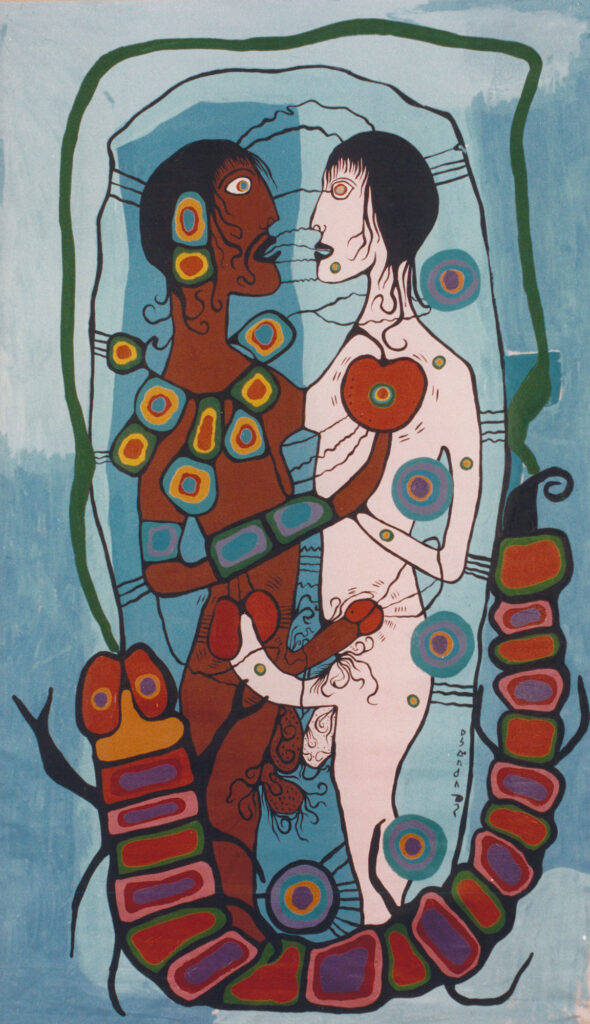
The Blues: The Spiritual Erotic Fantasies of Norval Morrisseau in Technicolour
by Michelle McGeough
Renewing Anishinaabe Arts:
Morrisseau and the Deep Tradition
by Ruth Phillips
All my work is actually the continuation of the shamanic scrolls.
–Norval Morrisseau, 1979
By the second quarter of the twentieth century, few examples remained in Northern Ontario of the visual arts through which Anishinabek had for centuries represented the manidoog. This deep imagistic tradition centred on depictions of the other-than-human beings who bless people with power through visions and dreams. Such images honoured the empowering beings and maintained the potential for ongoing connection. Although only the dreamer knew the full meaning of these vision-derived images, their controlled public display was an important means of expressing and validating the visionary’s powers.

Agawa Canyon rock art site, North shore lake Superior, photo: Ruth Phillips.

Anishinaabe artist, Finger woven bag with six mishibiziw, collected by Jasper and Isabella Grant, 1805-1809 near Windsor ON. nettlestalk fibre, wool (textile), hair (material), 42 x 60 cm, National Museum of Ireland.

Rattle representing a Thunderbird, Mississauga Anishinaabe artist, Collection of Kakekwonaby, Rev. Peter Jones, before 1844, Museum of Natural History.

Cradleboard Ornament, with animkiig (thunderbirds), and lightning lines, Anishinaabe artist, late 18th century, nettled porcupine quillwork, Canadian Museum of History, Gatineau.
By the 1940s and 1950s—Norval Morrisseau’s formative years—the embroidered and woven bags and mats, painted drums, and carved war clubs and rattles on which the sacred beings appeared had long since been removed to museum storerooms and the shelves and drawers of private collectors. And although Anishinabek visionaries had for centuries painted images of the manidoog in red ochre on rock faces rising up from the shorelines of rivers and lakes, the forced removals and suppressions imposed by colonization had disrupted memory of their histories, meanings, and locations. By all logic, the missionaries who condemned Indigenous arts as “pagan,” the residential schools that traumatized children and families and silenced Indigenous languages, and the numerous other governmental policies and laws that sought to engineer assimilation should have succeeded in disappearing the art forms that embodied Anishnaabe intellectual, spiritual, and aesthetic traditions.
Against this history, my encounter with a rare and beautiful eighteenth-century Anishinaabe drum in a German museum in the winter of 1990 was an unforgettable moment. The shock of recognition I experienced was visceral, for it seemed to me that the red ochre outlines of birds, fish, and animal manidoog that circled its two sides could have been painted by Norval Morrisseau. They displayed the same sure and elegant simplicity of line and the “X-ray” conventions for marking ribs and heart lines that characterized Morrisseau’s drawings and paintings in the early 1960s. The resemblance was at once uncanny and affirmative of the strength of Anishinaabe survivance.

Anishinaabe artist, Drum (Side A), Stadisches Museum Braunschweig.

Anishinaabe artist, Drum (Side B), Detail of a Moose, Stadisches Museum Braunschweig.
The historical circumstances of the drum’s own survival merely added to the mystery. It was collected by Lieutenant Johann von Unger, a soldier in one of the regiments supplied by the Duke of Braunschweig to his cousin King George III of England to fight in North America during the American Revolution, and was donated to Braunschweig’s city museum by his descendants in 1871. The drum is the earliest extant example of a genre of central importance to Anishinaabe shamans—no others are known to have been acquired by the many European curiosity collectors active in North America during the long eighteenth century. Drawings of both sides were published in a Braunschweig ethnographic journal in German in 1899, but the drum largely disappeared from sight during the Second World War, when the museum’s ethnographic collections were sent for safety into what would become East Germany. It did not return to Braunschweig until 1989, when the Cold War ended.
Lines of Transmission
How could the young Morrisseau have so precisely reimagined stylistic conventions and iconographies no longer in use in his community, reproduced in publications to which he had no access, and displayed in museums in faraway cities? Such puzzles are meat and drink to art historians, for whom a fundamental task is to identify the sources, genealogies, and historical forces that account for the continuities and discontinuities of artistic traditions. Although the channels of knowledge transmission I outline here offer some answers, the mystery of Norval Morrisseau’s creative accomplishment can only be fully explained by his unique qualities of intelligence, creativity, and talent, as is the case for all great artists. Beyond this, Morrisseau’s unwavering belief in the world-class stature of his heritage—unusual in his generation—informed his will to succeed.

Norval Morrisseau, Caribou, 1969, gouache and tempera on kraft paper, 71.1 x 90.2 cm, Westerkirk Works of Art.
During Morrisseau’s youth, the fragile survival of the Anishinaabe graphic tradition rested primarily with the Midewiwin society, or Mide, although its activities had been driven underground by missionaries and government agents. Its members are shamans who acquire knowledge and healing powers through successive levels of initiation that they can activate on behalf of their communities. Their traditions are materially embodied in the song boards and birchbark scrolls on which are etched pictographic images that serve as memory aids for sacred narratives of creation and migration and for complex initiation rituals. Although Moses Nanakonagos, Norval’s grandfather and teacher, was an initiated Mide shaman, he did not possess scrolls of his own, nor was the Midewiwin society active in the Lake Nipigon region in the middle decades of the twentieth century.

Anishinaabe artist, Songboard (recto and verso), second half of the nineteenth century, The Vatican Museums, Vatican City.
A century ago, anthropologist Frances Densmore conducted extensive interviews with knowledgeable Anishinaabe elders in Minnesota and reported the understanding she had gained of the relationship between visionary experience and graphic image. “The essence of an individual or of a spirit,” she wrote, “dwells in its picture or other representation.” The oral tradition that was primary among the “other representations” has served as a critical channel of transmission in colonized societies because it is less susceptible to physical destruction and removal than material belongings. In sharing the aadizookaanag—the sacred stories—Potan transmitted to his grandson Norval knowledge of the Anishinaabe cosmos, the manidoog who animate and energize it, and the spiritual practices that ensure ongoing connection with these other-than-human beings. Morrisseau may also have seen birchbark scrolls in use when his grandfather took him, as a teenager, to a Mide ceremony at Rainy River, Ontario, although we don’t know how closely he was able to study them.
Potan may also have illustrated his stories by encouraging his grandson to trace images in wet sand with a stick—a traditional teaching practice reported by other Anishinaabe artists, such as Roy Thomas. The artist recounted to James Stevens that his grandmother “encouraged him to express himself through art. She would give him a long stick to hold in his hand while she would tell him short stories. He began to draw what he visualized. Gradually she told him longer stories and gave him shorter sticks to draw in the sand, earth or snow.”
Morrisseau’s own accounts of his relationship to the Midewiwin society and its graphic art tradition are contradictory. When he was introduced to Selwyn Dewdney in the summer of 1960, the older artist, teacher, and amateur ethnographer was in the process of interviewing people all over Northern Ontario, under the aegis of the Royal Ontario Museum, for his groundbreaking studies of Great Lakes Indigenous rock art and Midewiwin scrolls. Indian Rock Paintings of the Great Lakes, co-written with ethnologist Kenneth Kidd and published in 1962, mapped and identified the imagery of Indigenous rock art of the Canadian Shield. It was followed by The Sacred Scrolls of the Southern Ojibway, published in 1975. In a subsequent interview with Morrisseau, Dewdney asked him directly if his grandfather drew pictures for him. He recorded Morrisseau’s answer as “No.” Yet journalist Lister Sinclair, in the autobiographical account that he ghostwrote for Morrisseau a decade later and published in the major monograph he co-authored with Jack Pollock, provided a somewhat different version of the artist’s youthful training in Beardmore:
That was where I started to paint. My grandfather showed me how to do interpretations of the shaman beliefs on birchbark.... I was a loner. The other kids thought I was like a woman, always staying home, and talking to the old people. I was being taught. Everyone realizes now, of course, that I was already drawing and this is what I wanted to do. But I was not allowed to make a scroll, even though I wanted to make one. I had to wait until my full initiation to make a scroll.
Patricia Maguire’s contribution to this book—in which she recounts community members’ memories of young Morrisseau in the place where they were both raised—supports the substance of Sinclair’s account. Her mention of the resemblance to rock painting puts a critical piece of the puzzle in place. As I have argued elsewhere, Dewdney’s willingness to share his research on the deep tradition of rock paintings catalyzed Morrisseau’s recovery of ancient graphic traditions. The correspondence between Morrisseau and Dewdney documents their exchanges of drawings between 1960 and 1962. In a letter written in November 1960, Morrisseau asked: “Can you send me some Indian designs as well as rock painting pictures the ones that could be put on art?” Dewdney promised to provide access to the tracings of rock paintings he had assembled the previous summers through his wide-ranging travels by canoe to sites across the Great Lakes. In one of his first letters, dated November 15, 1960, he wrote: “I hope to send you samples of the rock paintings I have collected. In the meantime I am mailing reprints of two articles that I have published.” He also sent Morrisseau a copy of his book upon publication. Morrisseau acknowledged receipt in a letter dated February 10, 1961, writing, “I got the book of the Great Lakes’ Rock paintings, and I find it very interesting and I think this will give me new ideas.”
The importance of this exposure is confirmed when we examine the drawings and paintings Morrisseau had been making up to this point. They demonstrate his initial lack of knowledge of the Midewiwin graphic tradition and illustrate the idiosyncratic nature of the manidoog images—the animkiig (thunderbirds), the mishibizhiw (underwater being), and the animals and fish of the lands and waters—he had made prior to these crucial exchanges.

Norval Morrisseau, Ojibwa Medicine Society, 1960, tempera on plywood, 81.3 x 121.9 cm, Westerkirk Works of Art.
Norval Morrisseau, Thunderbird and Michupichu, c.1958, crayon on paper, 81.3 x 66.1 cm, Canadian Museum of History, Gatineau.
The graphic conventions he devised were derived from the illusionistic strategies of Western pictorialism. More specifically, as Richard Hill shows in this volume, they incorporate motifs from comic books and other genres of popular visual culture to which the young artist would have had access. The beings are rendered naturalistically, as solid three-dimensional forms descriptively detailed with coats and footwear, feathers and fur, rather than as flat outlines or silhouettes. The sun appears as a rayed circle typical of children’s art, movement is expressed by staccato lines radiating out from the animal and human figures, and internal organs are drawn decoratively, as densely patterned geometric infills. The Western pictorial tradition is present in the ground lines that anchor human figures and animal beings, and in attempts at perspectival representations of deep space. This spatial illusion is seen in the two paintings of the shaking tent ritual acquired by Morrisseau’s early patrons, Joseph and Esther Weinstein and Jacques Rousseau. In this ritual, the shaman enters a bark structure and, aided by mikinaak (the turtle), induces divinatory visions. Morrisseau shows us the human participants from behind and in profile. The reduced scale of the ritual structure in the centre creates spatial recession. As further evidence that Morrisseau’s sources were oral rather than visual or experiential, he drew the shaking tent not as the cylindrical structure built for that ceremony, but as the dome-shaped enclosure used for the cleansing ritual of the sweat lodge.
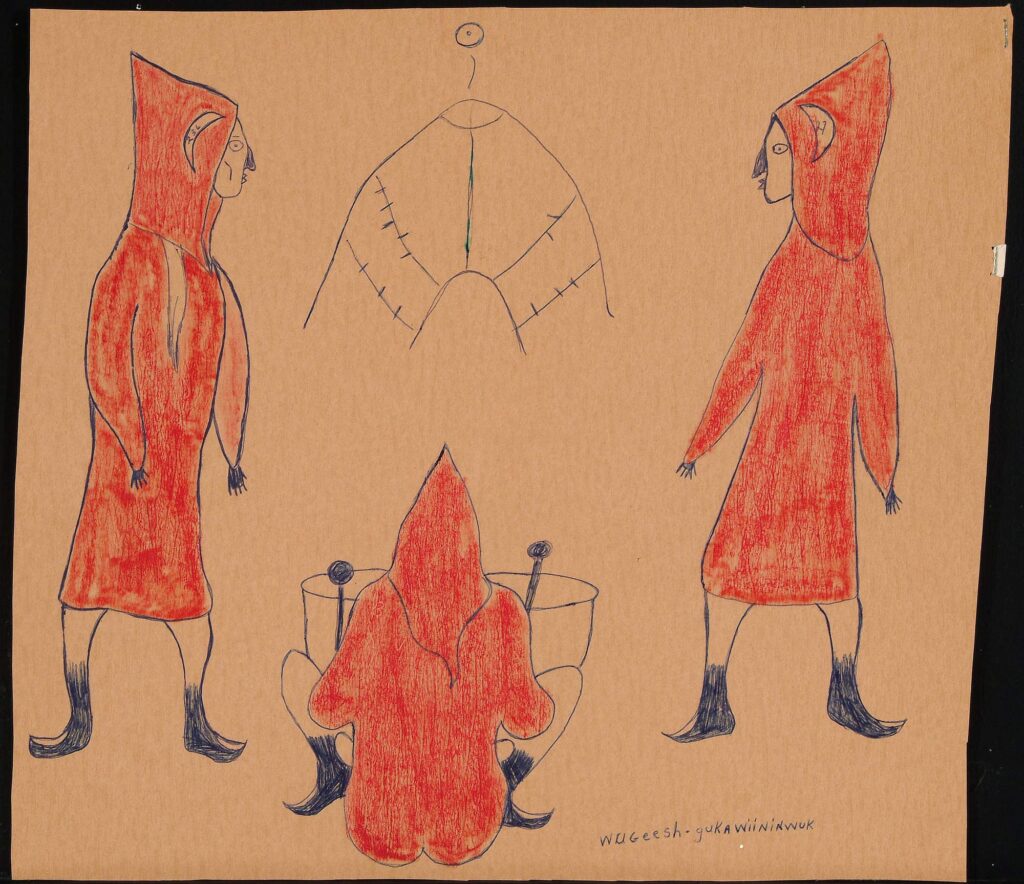
Norval Morrisseau, Wugeesh – Gukawiininwuk “The Heaven People,” c.1958–61, crayon drawing on paper, 39 x 43.7 cm, Montreal Museum of Fine Arts.

Illustration for “The Shaking Tent” from Norval Morrisseau, Legends of My People.
By the time Morrisseau submitted the drawings that illustrate his book Legends of My People, The Great Ojibway (1965), he had replaced the more descriptive and elaborate compositions of his earliest paintings and drawings with bold, simplified, and iconic images of individual manidoog. In his depiction of the shaking tent, the ritual structure is correctly shown as a cylindrical bark enclosure that closely resembles the simplified version found in rock art and Mide scroll pictography, and the image is energized by power lines that radiate out from the shaman’s helper, mikinaak. The emphasis, in other words, has shifted from the stage setting to the mechanism of power transfer. Like the other black-and-white drawings that illustrate the book, this image is endowed with a new dramatic force through the isolation of the heavy, simplified contours against the pictorial field, while its planar composition and economical depiction of bones and organs suggest an otherworldly transparency.
These new pictorial qualities carried over to the paintings Morrisseau showed in early exhibits at the Pollock Gallery in Toronto. Seemingly following Dewdney’s recommendation to use “earth colours,” he also moved from his polychrome palette to a smaller colour range. Morrisseau’s new style was the product of a fusion, accomplished through his artist’s alchemy, of his grandfather’s aadisokaanan and sand tracings, the clarity he had absorbed from Dewdney’s copies of rock art, and the elusive knowledge of Mide pictography he had been able to intuit. As the newspaper reviewers commented, this amalgam appealed strongly to the modernist tastes and primitivist desires of his urban Canadian audiences.

Norval Morrisseau, Water Spirit, 1973, acrylic on deer hide, 95.25 x 127 cm, Westerkirk Works of Art.
The confident graphic language that would inform Morrisseau’s art for the rest of his life was at once old and new. Far from literally copying rock paintings or Mide iconography, he recovered the sureness and forcefulness of ancestral representations while also building out from them. He quickly moved past Dewdney’s urging that he adopt the palette of “earth colours,” which his friend imagined had been used by earlier generations of Anishinaabeg, to embrace the vibrant colourism that would remain one of the glories of his art. As Carmen Robertson has detailed elsewhere in this book, he also introduced a host of new figures and scenes into Anishinaabe visual iconography, depicting not only the beings who populated the aadisokaanan but also others who appear in a second group of orally transmitted stories—täbâtcamowin—that had not been visually represented in the past. A favourite character, for example, was the merman nibiinaabe, whom he drew in an early letter to Dewdney and later rendered in his newly simplified style. Soon, however, Morrisseau enriched these images with colour and descriptive detail, creating a new kind of pictorialism that allowed the artist to portray his ancestors and members of his family, as well as himself, his psychic torment, and his shamanistic out-of-body travel.
Picturing Transformation
Both innovation and allegiance to tradition can be seen in Morrisseau’s progressive interpretations of thunderbird transformation—a quintessential manifestation of manidoog power that carried personal significance for Morrisseau, who, as Copper Thunderbird, claimed their power and blessing. In visions and oral accounts, the animkiig can assume human form; it was probably an early representation of such an event, painted on birchbark, that first attracted the attention of the Weinsteins, Morrisseau’s early mentors and friends.

Anishinaabe artist, Ball headed club, collected by Jasper and Isabella Grant c 1805-1809, probably at Fort Malden. National Museum of Ireland 1902.352.
Thunderbird–human transformations are found in the deep tradition of Anishinaabe art and often appear as highly stylized images incised on war clubs and other belongings. For example, the shaft of a ball-headed war club acquired by Colonel Jasper Grant and his wife, Isabella—probably between 1805 and 1809, when they lived in Fort Malden, near present-day Windsor, Ontario—displays a sequence of five figures, linked by the W-shaped wingspan of the animkiig. An anthropomorphic stick figure on the far right sequences through a series of increasingly abstracted linear images to resolve on the far left into the pure abstraction of a geometricized wing form. At once highly stylized and clearly legible, this sequence, which reads from either left to right or right to left, allows us to decode other W-shaped motifs and zigzag lines as representations of the animkiig when they appear independently of clearly identifiable figurative images, displayed on finger-woven containers for medicine bundles, hide shoulder bags embroidered with porcupine quills, and related belongings.
Morrisseau’s early depictions of transformation were, as we have seen, far more literal, pictorial, and naturalistic. The early thunderbird being in the Weinstein collection, for example, is rendered with feathered wings and flashing eyes and wears a chief’s medal or amulet around its neck. By juxtaposing this figure with a half-human, half-avian form, the painting illustrates the process of transformation unambiguously.

Norval Morrisseau, The God of Lightning, 1970s, acrylic on paper, 149.9 x 78.7 cm, private collection.
As his art developed, Morrisseau also began to represent transformation through a single figure. In one 1970s painting, avian and human features are integrated by a flashing yellow lightning line that runs from the eye down through the figure. In other works, he conveyed the shifting, optically unstable experience of transformation sequentially. In Man Changing into Thunderbird, 1977, the stages of transformation are shown separately on six successive panels. Rightly regarded as one of the artist’s masterpieces, this work exhibits an uncanny conceptual parallelism to the deep tradition represented by the ball-headed war club. This conceptual continuity is all the more striking because of the stylistic contrasts between the two renderings. Where the early nineteenth-century work is linear, minimalist, small, personal, and intimate, the painted panels are monumental, public, explosive in their colouristic intensity, and descriptively detailed. Each is of its time, deploying artistic strategies adapted to the needs of audiences in particular periods.
As Morrisseau understood, the historical moment of the mid-twentieth century demanded reinvention and adaptation. Where the eighteenth-century Indigenous viewers of the Braunschweig drum would have understood the cosmological principles, visionary experiences, and intentional ambiguities that informed the imagery of the ball-headed club, Anishinaabe viewers of Morrisseau’s day had been cut off from key channels of transgenerational knowledge transmission by colonial policies of suppression. At the same time, the ignorance and primitivist fantasies of the settler viewers Morrisseau also wanted to address had made much more literal modes of representation necessary.
Drums and Visions

Norval Morrisseau, Untitled, c.1970, paint on rawhide drum with wooden frame, 6.8 x 28.5 cm. Canadian Museum of History, Gatineau
From the early years of his career, Morrisseau’s desire to revive and continue Anishinaabe arts encompassed an interest in traditional genres such as scrolls, drums, prayer sticks, beadwork, birchbark baskets, and rock paintings. As late as 1962, a few months before his Pollock Gallery exhibition, he enclosed drawings of these kinds of items in a letter to Dewdney and asked him what interest they might evoke. Despite the discouragement of his dealers and patrons, who saw his paintings as more marketable than such “crafts,” Morrisseau returned to these genres—and to the traditional two-headed drum—at regular intervals over the next two decades.
In many ways, these works parallel the pattern of development seen in his two-dimensional paintings. A drum in Joseph and Esther Weinstein’s collection displays the same graphic style and colour palette he was using in 1962 in his illustrations for Legends of My People and in the paintings he showed at the Pollock Gallery. A bear, Morrisseau’s power animal, travels across the top third of the drum head while a horned serpent snakes around the narrow rim—a composition that is as breathtaking in its originality as it is traditional in spirit.
He gave a drum that he may have begun even earlier to Red Lake neighbours when he was cleaning out his house in 1968. He described it to them as “very old” but “unfinished.” Both sides of this drum display the combination of cosmic bodies and manidoog recorded as personal records of dream experiences by Frances Densmore and other ethnographers. The contrasting styles, however, suggest that Morrisseau began to work on the drum around 1959 or 1960 and then overpainted one side with new imagery some years later. On the earlier side, fanciful creatures painted in green circle around a five-pointed star, a crescent moon, and a rayed sun. The other—presumably “finished”—side is painted in bright acrylics. The composition, dynamic and full of movement, is dominated by a large swirling motif painted in red and a blue colour field featuring a glowing red sun, a five-pointed star, and a crescent moon. Although the two sides contrast in style and colourism, both centre around a sun image and depict the beings and cosmic bodies envisioned by shamans in their out-of-body travels. In contrast, a drum that probably dates to the early 1960s is more fully pictorial. Its three hooded anthropomorphic figures and shaking tent are reminiscent of the drawings acquired by Jacques Rousseau in 1961, with the notable addition of an equal-armed cross—painted in green and positioned at the centre—that appears in traditional shamanistic imagery.

Norval Morrisseau, Drum, c.1969, stretched hide on wood, 7.62 x 50.8 cm. Westerkirk Works of Art

Norval Morrisseau, Drum Magic, 1981 Acrylic on drum, 91.44 cm, Private Collection
Each of these drums works in a different way to reference the role of drumming to communicate with manidoog in shamanic ritual. As a group, they demonstrate Morrisseau’s desire to perpetuate the traditional circular formats and ritual contexts of Anishinaabe visual expression, while selectively adopting conventions of Western media and pictorialism. The artist’s larger project, of course, involved transposing shamanistic practices and the visionary experience they enabled to easel painting—the Western art world’s most prestigious and compelling genre. Yet despite the pull of the mainstream, he never completely abandoned the surfaces of hide and birchbark that had supported the works of earlier Anishinaabe artists. Another later work may be entered as evidence: it is a painting on an irregularly shaped slate slab—similar to the image on the lower left in one of the drawings Morrisseau sent to Dewdney in 1962. On its surface, in bright acrylics, the artist has painted an animikii, inside of which lurks a human form—a thunderbird transformation, painted on rock, that his ancestors would surely have recognized.

Norval Morrisseau, Man Changing into Thunderbird (Two Birds) | Untitled (Man Transforming into Thunderbird), 1958 Watercolour and coloured pencil on birchbark, 63 x 101.3 cm Canadian Museum of History, Gatineau