
Across generations, from children sketching under surveillance to contemporary artists wielding beadwork, film, and installation, Indigenous creators transform the trauma
of residential and day schools into acts of truth telling. Their works, rooted in kanawâpâtahmowin, the Plains Cree principle of seeing with responsibility, reassert presence, reclaim language, and honour kinship. This book traces a visual lineage
from the silenced drawings of schoolchildren to the living testimonies of today, revealing how art carries Indigenous knowledge forward. Through miýikosiwin, the gift of vision and creativity, these works offer a call to accountability rather than closure, urging
all who encounter them to witness, unlearn, and engage in the ongoing labour of reconciliation.
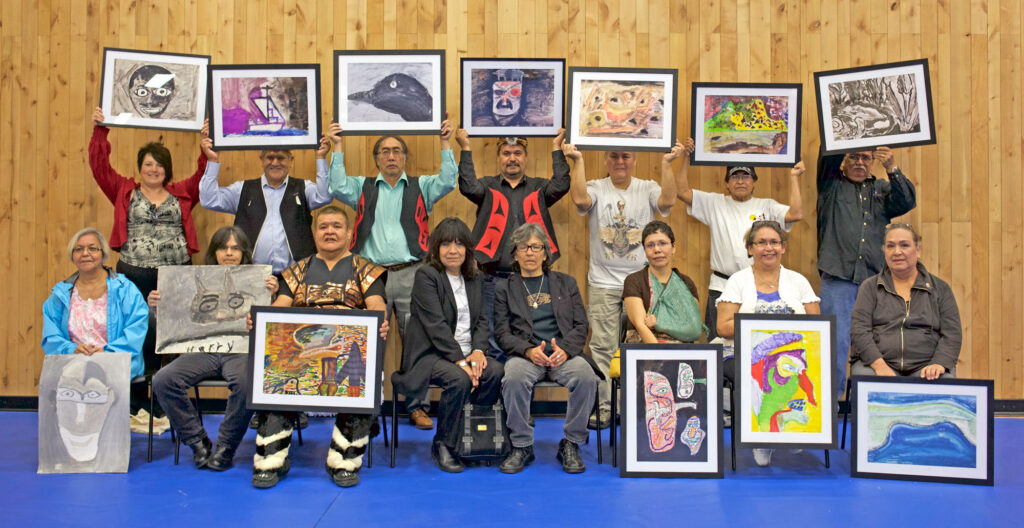
Survivors and family members at a repatriation ceremony holding student artwork produced at Alberni Indian Residential School, 2013, photographer unknown.
The residential and day school system sought to erase Indigenous identities, severing ties to land, language, and community. Yet, within those institutions, children drew salmon, spirits, and landscapes. These early acts of tâpasinahikêwin, drawing as truth telling, resisted assimilation and preserved cultural memory despite suppression. Later generations built upon this foundation, painting homes, carving masks, and stitching photographs to reclaim what was taken. Whether in watercolour or sculptural form, these works confront Canada’s colonial history with unflinching honesty. By centring Indigenous ways of knowing, they transform galleries and public spaces into sites of ethical witnessing, revealing resilience through unbroken threads of ceremony, story, and relation.
This visual sovereignty is dynamic and intergenerational. The artworks mourn the children taken, the languages silenced, and the families fractured, but they also celebrate the strength of those who survived and
those who carry their stories. Creation, whether through Woodland-style colour or stark monochrome, becomes a ceremony of presence, asserting that Indigenous Peoples are not relics of a colonial archive but living narrators of their own histories.
kanawâpâtahmowin teaches that seeing is the first act of consciousness, a responsibility to perceive the world with gratitude and care. Within the legacy of residential schools, this means confronting the truths art reveals: the rupture of a child caught between belief systems, the absence evoked by empty shoes, the defiance of a flag woven from shredded policy. These images demand engagement beyond sympathy and toward relational responsibility. miýikosiwin extends this vision into creation, where art becomes a gift to the community and future generations. Each act of making—stitching torn maps, carving ancestral symbols, or dancing in a classroom—is a refusal to let colonial silence prevail.
My own journey, rooted in the Glenbow Museum’s archives and the stories of my Siksika and Red Pheasant Cree family, mirrors this arc. The photographs I found of boys escaping Old Sun Residential School and of my great-uncles on Battleford Industrial School’s football team revealed both erasure and defiance. These images, like the artworks in this book, are active witnesses. They bear the weight of colonial transformation yet hold the defiance of clenched fists and the tenderness of remembered home. In Red Pheasant School a Long Time Ago, 1988, painter Allen Sapp (1928–2015) captures children in motion beneath an open sky, a scene whose warmth makes the discipline beneath it all the more quietly present—a reminder that kinship endured even within the boundaries the school imposed. These encounters remind me how visual knowledge binds personal memory to collective truth.

Allen Sapp, Red Pheasant School a Long Time Ago, 1988, acrylic on canvas, 41 x 51 cm, Allen Sapp Gallery, North Battleford.
The artists who close this book belong to a generation shaped by the stories, silences, and responsibilities inherited from residential and day school Survivors and their descendants. They came of age carrying layered histories—held in families, communities, ceremonies, and archives—and influenced by the enduring cultural knowledge and relations that colonial systems failed to erase. Their work does not signal an ending, nor does it offer resolution. Instead, it demonstrates how truth continues to move forward through young hands and eyes, translating memory into new visual languages. These artists inherit trauma but also strength, obligation, and vision. In doing so, they remind us that reconciliation is an ongoing practice sustained across generations, not a closed chapter.
At this threshold, it is useful to pause and consider what sustains the capacity to carry truth forward. Reflecting on love, theorist bell hooks writes, “Truth telling lays the groundwork for the openness and honesty that is the heartbeat of love.” hooks reminds us that
love is learned rather than instinctive and
that it depends on the presence of a nurturing environment. Read alongside Indigenous understandings of relational care, these words resonate deeply. In many Indigenous worldviews, love is not abstract or private; it is learned through responsibility, attentiveness, and sustained relations within families, communities, and land-based worlds.
Seen in this light, the legacy of residential and day schools can also be understood as an assault on the conditions that make love possible. Children were removed from their kin and territories and placed in institutions where
care was denied, affection was punished, and relational knowledge was systematically disrupted. The Truth and Reconciliation Commission of Canada (TRC) has shown that, far from ending with Survivors, these ruptures extended across generations, shaping descendants who grew up amid absences of safety, trust, and affirmation. Truth telling is inseparable from care: to speak truth is to restore balance, to renew responsibility, and to make space for future life. Truth, in this sense, is about naming harm and also about rebuilding the relational ground upon which love can once again be learned, practised, and sustained. It is within this ethical terrain, where truth telling, care, and responsibility converge, that the work of Indigenous youth artists must be understood.
Amelia Picard, Ammaakulutché and Ihkulusshíia (diptych), 2024, acrylic on canvas, 152.4 x 101.6 cm.

Kent Monkman, The Scream, 2017, acrylic on canvas, 213.4 x 335.3 cm, Denver Art Museum.
Among the newest generation, Métis artist Amelia Picard carries this vision forward. Her diptych Ammaakulutché and Ihkulusshíia, 2024, titled in the Apsáalooke language of Montana, contrasts an Indigenous woman in full regalia, alive with ancestral strength, with a residential schoolgirl turned away in darkness. Inspired by The Scream, 2017, by Kent Monkman (b.1965), Picard transforms collective trauma into quiet reflection, turning empathy into vision. Her paintings speak to a future where youth take up the work of truth telling, translating remembrance into renewal.
Selected by the City of Prince Albert, Saskatchewan, to design its official Orange Shirt Day shirt, Cree artist Ailah Carpenter brings a youth-centred vision and sense of responsibility to public remembrance on September 30. Flying Back Home, 2021, reminds us that reconciliation is a practice of walking together across generations rather than a destination. The image gathers children, ancestors, and descendants into a single field of movement, carried by the eagle as messenger between worlds. The work does not ask viewers to look away from loss, nor does it offer resolution. Instead, it insists on responsibility: to remember, to carry, and to move forward in relation. In its quiet strength, the image affirms that Indigenous youth are already shaping the visual languages of truth, continuity, and care that reconciliation demands.

Ailah Carpenter, Flying Back Home, 2021, digital illustration.
Among this emerging generation, Tsuu T’ina youth artist Abby Crowchild carries forward a vision grounded in care and belonging. What Family Means to Me, n.d., reflects a lived understanding of kinship shaped by both inherited memory and the supportive environments that sustain Indigenous young women today. Connected to the Stardale Women’s Group, Crowchild’s work emerges
from a space dedicated to nurturing resilience, confidence, and cultural affirmation. Her image centres what endures—family, community, and relational strength—reminding us that the future of Indigenous art is being shaped through care as much as remembrance.

Abby Crowchild, What Family Means to Me, n.d.
As Justice Murray Sinclair reminds us, “Education got us into this mess, and education will get us out.” For generations, Indigenous Peoples—First Nations, Inuit, and Métis—have endured an education system designed to erase language and identity. Today, while Canada is celebrated as one of the most educated nations in the world, these achievements remain unevenly shared. True progress is not measured by diplomas but by the kind of education we build: one that is culturally grounded, language-rich, and under Indigenous control, as envisioned in Indian Control of Indian Education (1972) and reaffirmed by the TRC in 2015. Across the country, Indigenous-led initiatives, including land-based and language-centred education, are transforming education into a source of cultural strength and self-determination. With sustained commitment and respect, education can become a shared pathway toward reconciliation.
The artworks gathered in these pages are acts of remembrance or resistance as well as visual teachings. They show how to witness, how to mourn, and how to walk forward with ethical purpose. Indigenous art transforms silence into story, absence into presence, and trauma into testimony. Each work is a gift of miýikosiwin, offered with responsibility to community and land. Rather than concluding a conversation, in the spirit of kanawâpâtahmowin, this book contributes to one already unfolding across classrooms, communities, and lands, calling us to see clearly, to honour the stories held in each brushstroke and bead, and to walk together in the ongoing work of healing and justice.