Allen Sapp, Recess at Onion Lake School, 1988

Allen Sapp, Recess at Onion Lake School, 1988, acrylic on canvas, 61 x 76.2 cm, MacKenzie Art Gallery, Regina.
In Recess at Onion Lake School, nêhiyaw (Plains Cree) artist Allen Sapp (1928–2015) from Red Pheasant Cree Nation, Saskatchewan, presents a windswept yard bounded by a four-storey institutional block and clipped hedges. Scattered children cluster in mute knots; others stand apart, backs turned, their distance stretched by long prairie shadows. No adults appear. A wind-shredded Union Jack tilts above the grounds—Sapp’s reminder of Crown authority delegated to church administrators intent on assimilation. Scale does the emotional work: sky and school dwarf the figures, and emptiness becomes loneliness. Though the school building burned in 1943, its psychic architecture endured; the painting retrieves what fire and record-keeping obscured. Here, Sapp paints memory as testimony, communicating what could never be said in words.

Allen Sapp, The Pow-wow, 1987, acrylic on canvas, 101.6 x 152.4 cm, MacKenzie Art Gallery, Regina.
Sapp recalled that while he did not suffer physical or sexual abuse at the school, discipline there bore little resemblance to what he knew at home. Cree was forbidden, English compulsory, and punishment could mean isolation. Caught once speaking Cree, he was confined to his room and missed a longed-for cowboy film. He sat alone and wept—language policed, belonging suspended. That register of loneliness, vigilance, and cultural dislocation pervades Recess at Onion Lake School without any literal scene of punishment. His representation of thin arms and block facades reads less as topographic fact than as sensation: how a child’s body felt inside an overlarge, ordered space.
The painting’s restrained handling resists the picturesque. Rather than dramatize trauma, it holds the silence of everyday dislocation, a subtler but no less devastating truth. Sapp’s childhood held poverty, tuberculosis, the death of his mother (news of which was withheld from him for months), and time at the Onion Lake school. All these ruptures of kinship and language seeded a lifetime of painting the world that his colonial education had tried to erase. Because he almost never pictured the school directly, choosing instead the warmth of Cree home life, this canvas reads as a deliberate return to a site of estrangement.
Most of Sapp’s paintings brim with kinship—grandparents hauling wood, sleighs on winter roads, and the colour in pow wow ceremonies. Knowing those domestic scenes, we feel what this schoolyard lacks: language, touch, story. The austerity here underscores how assimilation aimed not only to control the child’s body but to strip away the networks in which meaning is made. In the contrast between presence elsewhere and absence here, Sapp stages a visual argument about what residential schooling set out to sever. Long before the Truth and Reconciliation Commission of Canada called the nation to listen to Survivors, he had already painted a space that asks us to look, feel, and remember—and to stand with the communities still reckoning with their loss.
Collection of Survivors’ Art
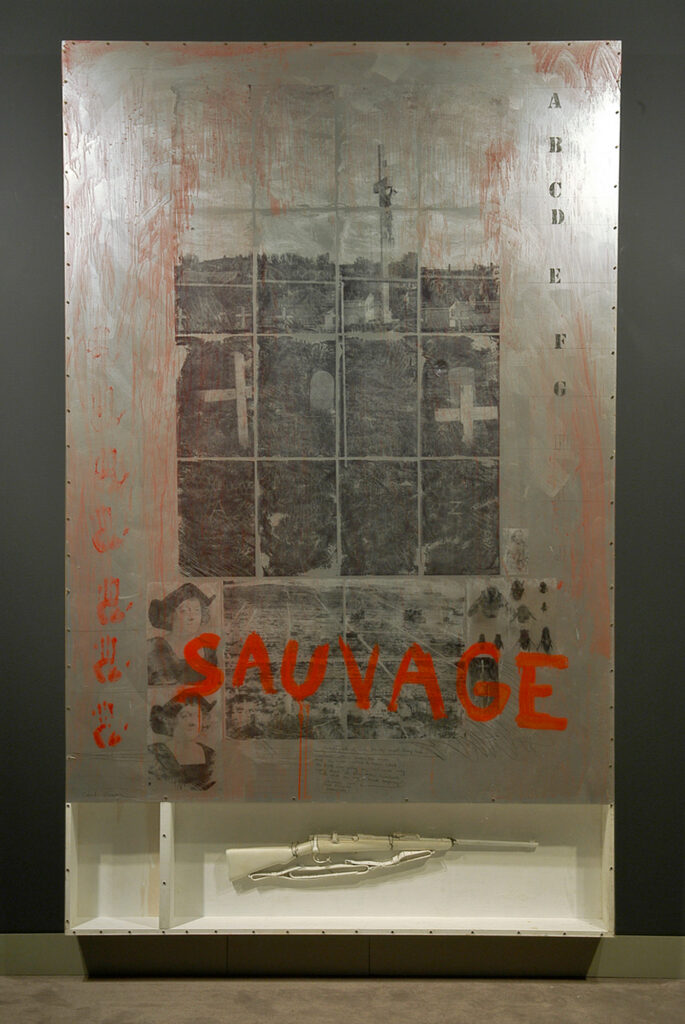
Carl Beam, Sauvage, 1988
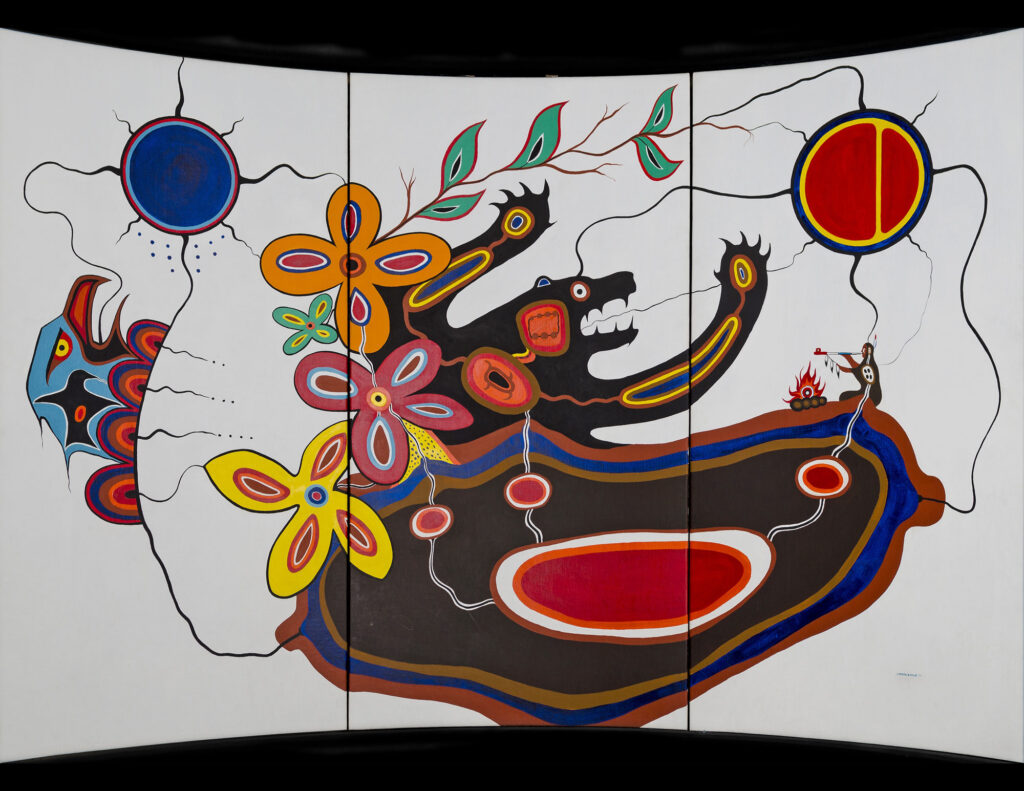
Jackson Beardy, Native World View, 1978

Henry Beaudry, Treaty No. 6, Battleford Area, n.d.

Mary Ceasar, Hair Being Cut by Nuns, 2017

Freda Diesing, Old Woman with Labret, 1973

Faye HeavyShield, Sisters, 1993

Robert Houle, Parfleches for the Last Supper, 1983

Alex Janvier, Blood Tears, 2001

Norval Morrisseau, The Gift, 1975

Ellen Neel, Kakaso'las, 1955–56

David Ruben Piqtoukun, Airplane, 1995

Jamasee Padluq Pitseolak, The Day After, 2010

Abraham Anghik Ruben, The Last Goodbye, 2001

Pitaloosie Saila, Strange Ladies, 2006
Allen Sapp, Recess at Onion Lake School, 1988

Henry Speck, Father Forgive Them, 1958

Adrian Stimson, Sick and Tired, 2005

Gerald Tailfeathers, Blood Camp, 1956

Lawrence Paul Yuxweluptun, Indian Residential School, Leaving the Shallow Graves and Going Home, 2022