Robert Houle, Parfleches for the Last Supper, 1983

Robert Houle, Parfleches for the Last Supper (from top, left to right: Matthew, James the Less, Jude, Simon, Philip, Andrew, Bartholomew, Thomas, Peter, James, John, Judas, Jesus), 1983, acrylic and porcupine quills on paper, various dimensions, Winnipeg Art Gallery.
In 1983, shortly after leaving a curatorial post to devote himself to art, Saulteaux artist Robert Houle (b.1947), a Survivor of Sandy Bay Residential School, created Parfleches for the Last Supper, thirteen mixed-media panels shaped like traditional rawhide pouches. Each panel represents Jesus or an apostle, painted in acrylic and stitched with porcupine quills. By folding and stitching his canvases to echo parfleches—sacred containers of knowledge—Houle marries Christian iconography to an Indigenous form.

Robert Houle, Parfleches for the Last Supper (Jesus), 1983, acrylic and porcupine quills on paper, 56 x 56 cm, Winnipeg Art Gallery.
As Houle explained, he created the work
“out of a desire to combine a single continuum
of the effect of Catholicism and Saulteaux spirituality.” In doing so, he collapses the Last Supper and Saulteaux spiritual practice into a single ceremony of communion. In his reimagining, the gospels become decorative flaps on the parfleche bodies, while quillwork motifs reference shamanistic powers. Even Jesus’s panel is placed off-centre, subtly subverting classical hierarchies. Parfleches for
the Last Supper thus critiques the religious “civilizing” mission of residential schools while asserting Indigenous spiritual sovereignty—and marks Houle’s bold turn toward addressing Indigenous representation and colonial history in his art.
Decades later, spurred by a nightmare and the 2008 apology to former residential school students from the Government of Canada, Houle embarked on his Sandy Bay Residential School Series, 2009, Over twenty-four consecutive days, he made twenty-four oilstick drawings on paper, each a fragment of memory: rows of dormitory beds, bleak playgrounds, looming faceless priests and nuns. Rendered in loose, urgent strokes, the images resemble film stills of trauma, each overlaid with handwritten captions in Saulteaux—the language he was forbidden to speak as a child. Captions such as “Night Predator” or “outhouse abuse” sit alongside Saulteaux words for “pain” or “fear,” turning the drawings into an emotional archive. As Houle has explained, writing these words in his mother tongue was integral to his healing—a process of pahgedenaun (letting it go from your mind), a term associated with a 2019 exhibition of these works at the Carleton University Art Gallery.
The combination of image and Indigenous text confronts viewers with the raw, personal dimensions of the school experience while modelling a form of visual sovereignty, reclaiming not only the story but the language
in which it is told.

Robert Houle, Sandy Bay Residential School Series, 2009, oilstick on paper, twenty-four drawings, each 58.4 x 76.2 cm or 76.2 x 58.4 cm, School of Art Gallery, University of Manitoba, Winnipeg.
Together, Parfleches for the Last Supper and Sandy Bay Residential School Series demonstrate how Houle transformed personal trauma into acts of testimony and reconciliation. In the first, he indigenizes Christian narrative through the parfleche form; in the second, he documents and releases repressed memories through Saulteaux inscriptions. Both bodies of work exemplify Indigenous visual knowledge at work: blending ceremony and critique, memory and prophecy. Houle’s art challenges us to hold two worlds in tension—to recognize the disruptive power of colonial religion and the healing resilience of Indigenous spirituality. His trailblazing practice paved the way for subsequent artists to use their own truths as weapons of witness, ensuring that the legacy of residential schools is neither forgotten nor closed but continually honoured and re-imagined through Indigenous eyes.
Collection of Survivors’ Art
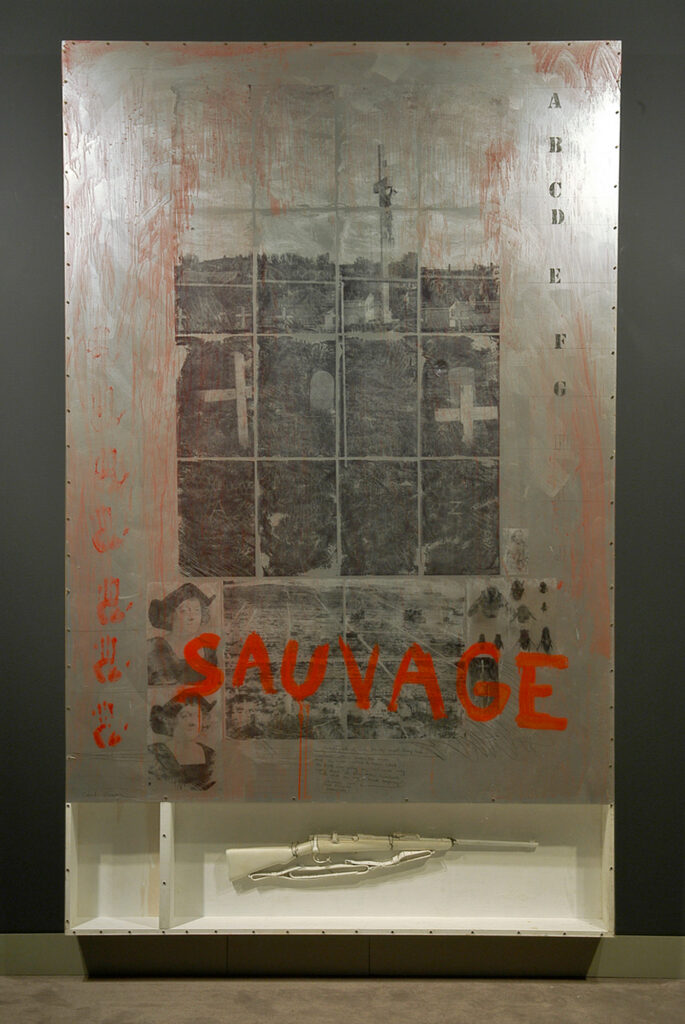
Carl Beam, Sauvage, 1988
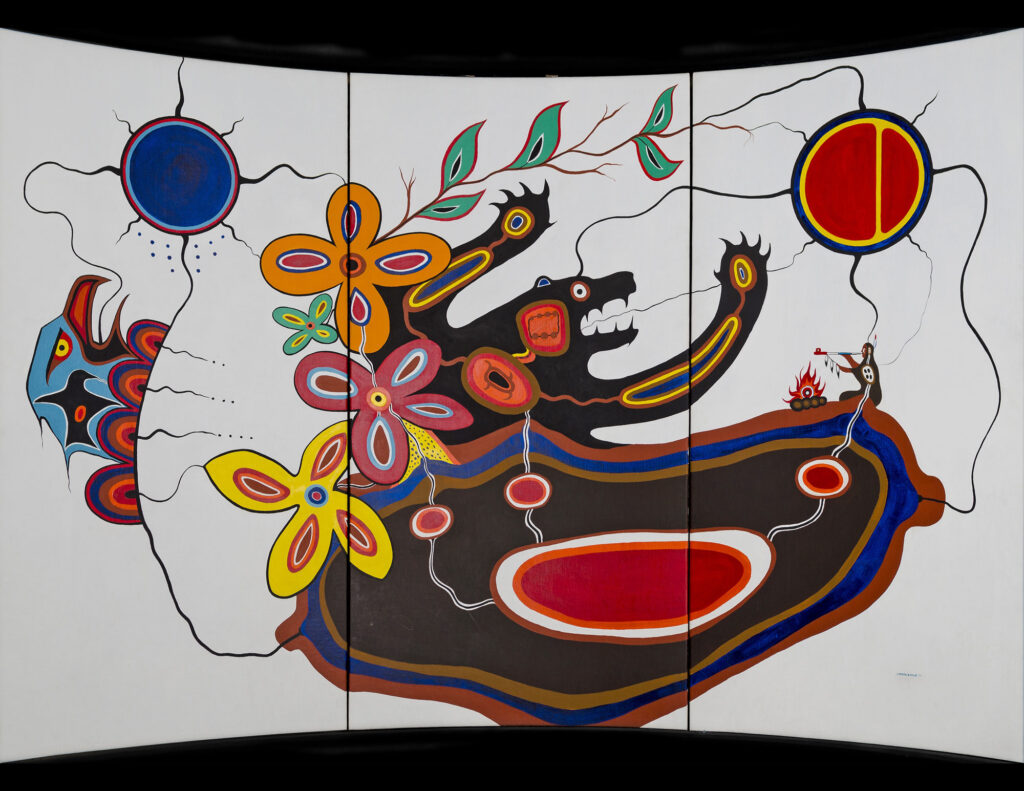
Jackson Beardy, Native World View, 1978

Henry Beaudry, Treaty No. 6, Battleford Area, n.d.

Mary Ceasar, Hair Being Cut by Nuns, 2017

Freda Diesing, Old Woman with Labret, 1973

Faye HeavyShield, Sisters, 1993
Robert Houle, Parfleches for the Last Supper, 1983

Alex Janvier, Blood Tears, 2001

Norval Morrisseau, The Gift, 1975

Ellen Neel, Kakaso'las, 1955–56

David Ruben Piqtoukun, Airplane, 1995

Jamasee Padluq Pitseolak, The Day After, 2010

Abraham Anghik Ruben, The Last Goodbye, 2001

Pitaloosie Saila, Strange Ladies, 2006

Allen Sapp, Recess at Onion Lake School, 1988

Henry Speck, Father Forgive Them, 1958

Adrian Stimson, Sick and Tired, 2005

Gerald Tailfeathers, Blood Camp, 1956

Lawrence Paul Yuxweluptun, Indian Residential School, Leaving the Shallow Graves and Going Home, 2022