Jackson Beardy, Native World View, 1978
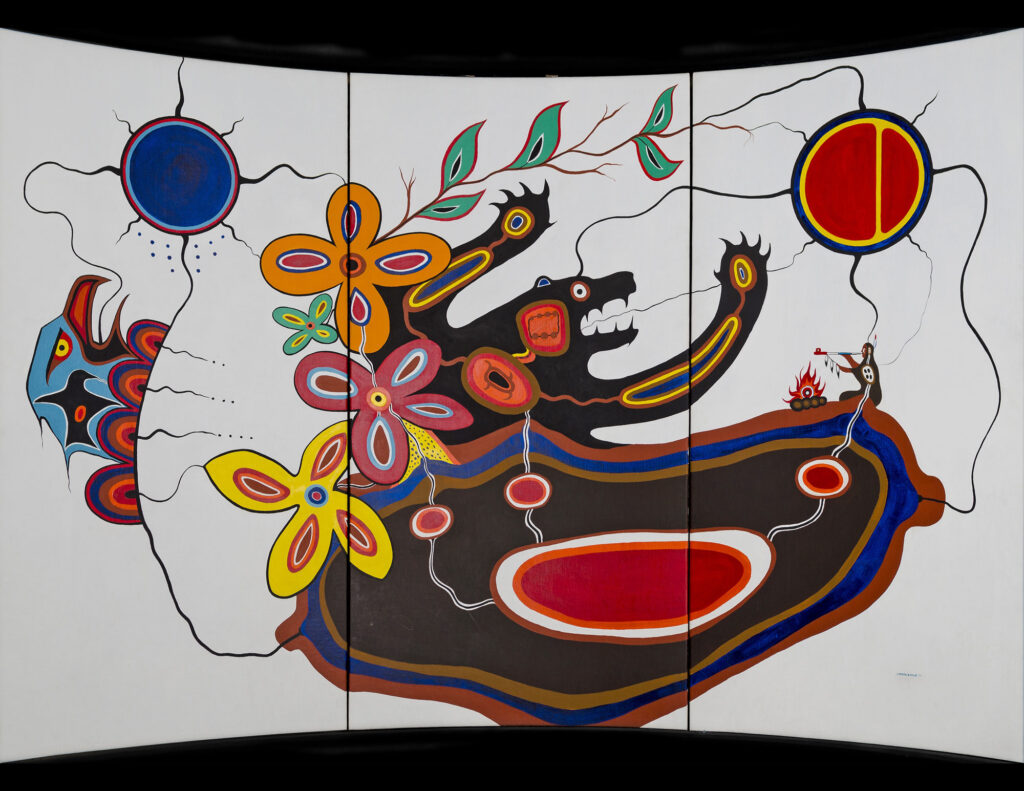
Jackson Beardy, Native World View, 1978, mural, Manitoba Museum, Winnipeg.
The title of the mural Native World View by Ojibwe Cree artist Jackson Beardy (1944–1984) underscores its central premise: that the world itself is alive and interconnected, with beings, elements, and forces existing in dynamic relationship with one another. At the heart of the composition is Earth, rendered as a living body with a visible beating heart. This powerful motif resonates with Anishinaabe teachings that the drumbeat represents the heartbeat of Earth, a pulse connecting humans, animals, plants, water, and sky. From this heart radiate lines of power that extend outward to connect with the hearts of the human figure, the bear, and the plants. These luminous strands weave between beings, suggesting that all of Creation is bound together. In Woodland painting, such “power lines” or “lines of communication” symbolize spiritual energy, kinship, and the unseen currents of life. Beardy’s use of this device makes relationships visible—nothing exists in isolation; everything is interdependent.
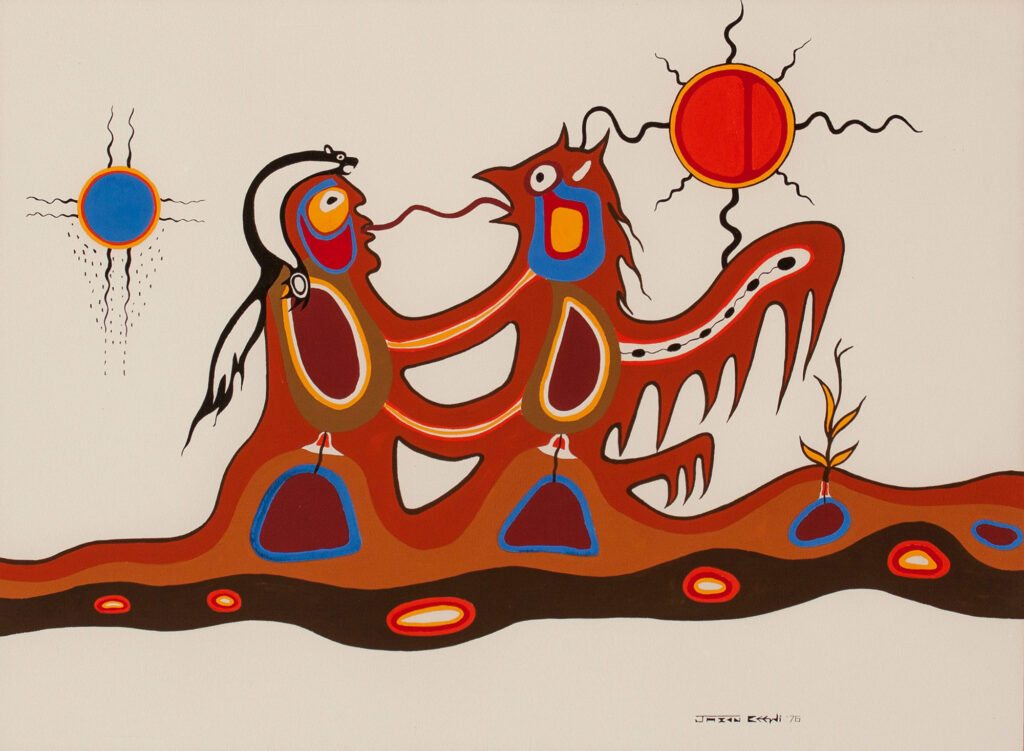
Jackson Beardy, Untitled, 1976, acrylic on paper, 44.5 x 59.7 cm, private collection.
Surrounding this living Earth are figures that together represent the totality of Creation. The Bear (Makwa) is a symbol of strength, protection, and medicine. Among the Anishinaabe, the Bear Clan traditionally carries responsibilities of healing; here, its presence signals both endurance and the capacity for renewal. Above, the Thunderbird (Animikii) spreads its wings, embodying spiritual power and cosmic order. As a bringer of rain, thunder, and storms, the Thunderbird governs cycles of renewal and ensures balance against destructive forces.
The mural also features flowers and plants, recalling the beadwork traditions that inspired much Woodland painting. These floral motifs speak to the medicines of the Earth, the regenerative power of nature, and the reciprocal relationship humans must maintain with the land. They are both decorative and didactic, reminding viewers of the teachings embedded in plant life.
A man smoking a pipe anchors the human
role in this circle of life. The pipe ceremony (opwaagan) carries prayers in smoke to the spirits, affirming truth, reciprocity, and respect for Creation. Beardy situates the pipe-carrier as
a mediator: humanity is not outside of the natural order but participates in its sacred rhythm through prayerful engagement. Celestial symbols, read as the sun and moon, frame the composition in cosmic time. They evoke
cycles of guidance, renewal, and continuity, reinforcing the balance between earthly and spiritual realms.
By uniting Bear, Thunderbird, flowers, pipe, Earth-heart, stars, and the lines of power that bind them, Beardy constructs a visual theology: the world itself prays when its beings live in balance. Painted in 1978, Native World View exemplifies the Woodland School style that he helped pioneer, a visual language rooted in Anishinaabe and Cree cosmology. For Beardy, a residential school Survivor and member of the Indian Group of Seven, this mural was more than an artwork. It was an act of reclamation—an affirmation that Indigenous ways of seeing and knowing endure and can be expressed through paint, symbol, and story.
Installed in the Boreal Forest Gallery of the Manitoba Museum, Native World View stands as one of Beardy’s most significant public works. Displayed in a museum context that long privileged natural history over Indigenous cosmology, the mural asserts the primacy of the Anishinaabe world view. It transforms a gallery wall into ceremony, asking viewers to see the forest not simply as a resource but as a sacred community.
Collection of Survivors’ Art
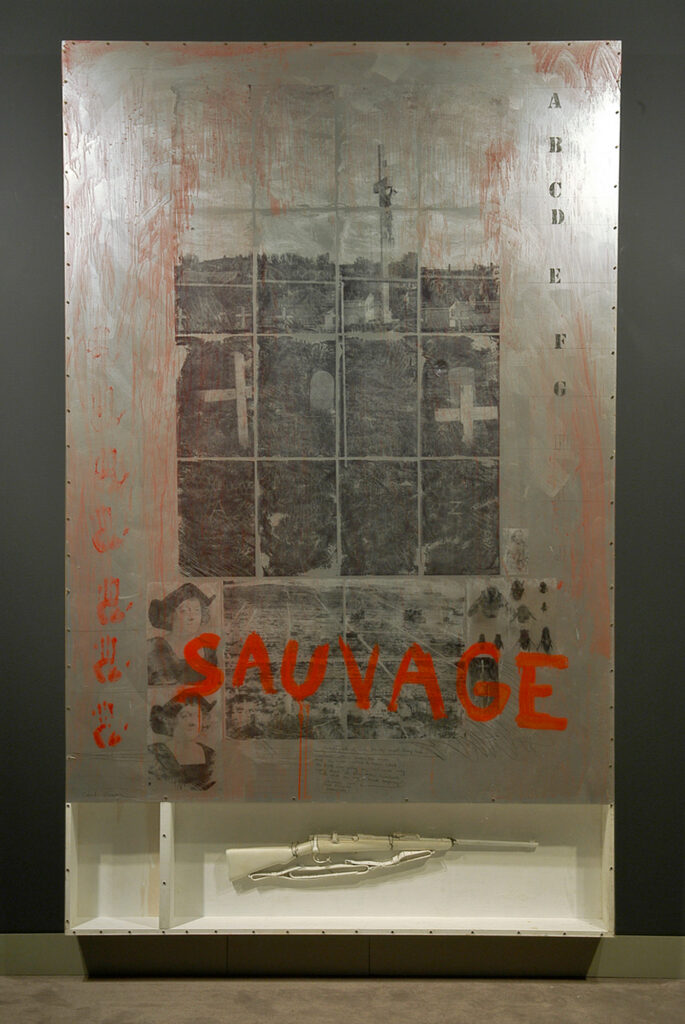
Carl Beam, Sauvage, 1988
Jackson Beardy, Native World View, 1978

Henry Beaudry, Treaty No. 6, Battleford Area, n.d.

Mary Ceasar, Hair Being Cut by Nuns, 2017

Freda Diesing, Old Woman with Labret, 1973

Faye HeavyShield, Sisters, 1993

Robert Houle, Parfleches for the Last Supper, 1983

Alex Janvier, Blood Tears, 2001

Norval Morrisseau, The Gift, 1975

Ellen Neel, Kakaso'las, 1955–56

David Ruben Piqtoukun, Airplane, 1995

Jamasee Padluq Pitseolak, The Day After, 2010

Abraham Anghik Ruben, The Last Goodbye, 2001

Pitaloosie Saila, Strange Ladies, 2006

Allen Sapp, Recess at Onion Lake School, 1988

Henry Speck, Father Forgive Them, 1958

Adrian Stimson, Sick and Tired, 2005

Gerald Tailfeathers, Blood Camp, 1956

Lawrence Paul Yuxweluptun, Indian Residential School, Leaving the Shallow Graves and Going Home, 2022