Abraham Anghik Ruben, The Last Goodbye, 2001

Abraham Anghik Ruben, The Last Goodbye, 2001, Brazilian soapstone, 42.5 x 25.5 x 42 cm, Collection of Christian Steckler.
Inuvialuk carver Abraham Anghik Ruben (b.1951) grew up immersed in a nomadic hunting life until, like thousands of other Inuit children, he and his siblings were taken into the residential school system. He comes from a large family of fourteen children, several of whom were taken in stages to mission schools. His older brother, artist David Ruben Piqtoukun (1950–2026), and his sister Martha were among the first to be removed to the mission school in Aklavik, Northwest Territories, in 1955. The Last Goodbye embodies one of his earliest and most searing memories: the moment his mother sat with them before their departure.

Abraham Anghik Ruben, Things We Share, 2001, Brazilian soapstone, 58 x 53.7 x 31.5 cm, Winnipeg Art Gallery.
Anghik later recalled that his brother was only five years old, his sister a little older, and that the family did not see them again for three years. This intimate domestic moment—his mother’s embrace of her children—became the subject of The Last Goodbye, a monumental carving in Brazilian soapstone, transforming a personal family memory into a shared visual testimony
of the residential school experience.
Formally, the sculpture emphasizes mass and containment. The mother’s large, rounded figure envelops the children, her arms encircling them in a protective embrace. The softness of the curves and the stone’s mottled green surface evoke endurance and shelter, but the mother’s downcast face, carved with understated sorrow, reveals the pain of separation. The children lean into her, the boy pressing his face against her body, the girl turning outward, suggesting both dependence and the inevitability of departure. The title The Last Goodbye underscores the permanence of the break: though the children would return, their lives and their fluency in their language would be irreversibly altered.
After more than a decade in boarding school, Anghik left formal education following Grade 10 and later studied at the Native Art Center at the University of Alaska Fairbanks, where he began to gather and interpret the ancestral stories that shaped his early sculptural practice.
The Last Goodbye carries layered meaning. At
one level, it honours maternal love as a site of cultural and emotional continuity. At another,
it records the violence of colonial policy, which targeted precisely that maternal bond by removing children from families and communities. Anghik’s mother becomes an archetypal figure, a representative of all Inuit mothers who endured the trauma of watching their children taken away. In this sense, the work functions both as memorial and as testimony, speaking to the Truth and Reconciliation Commission of Canada’s call to honour Survivors and their families.
The sculpture holds a distinct place within Anghik’s body of work. While much of his later sculpture explores Norse, Inuit, and shamanic cosmologies, blending ancestral narratives across cultures, this work is grounded in lived experience. It captures what Anghik called
“the dark night of the soul”—the spiritual
and cultural dislocation of being stripped of language, family, and identity at residential school. This experience of separation would
also shape the life and work of his brother Piqtoukun, whose own artistic practice reflected the enduring impact of residential schooling. In contrast to Anghik’s mythological works, such as Things We Share, 2001, this sculpture distills the pain of a single moment into universal form.
The Last Goodbye is an act of remembrance.
It holds in stone what words often fail to
convey: the silence of mothers left behind, the bewilderment of children sent away, and the enduring legacy of loss that continues to shape Indigenous communities today.
Collection of Survivors’ Art
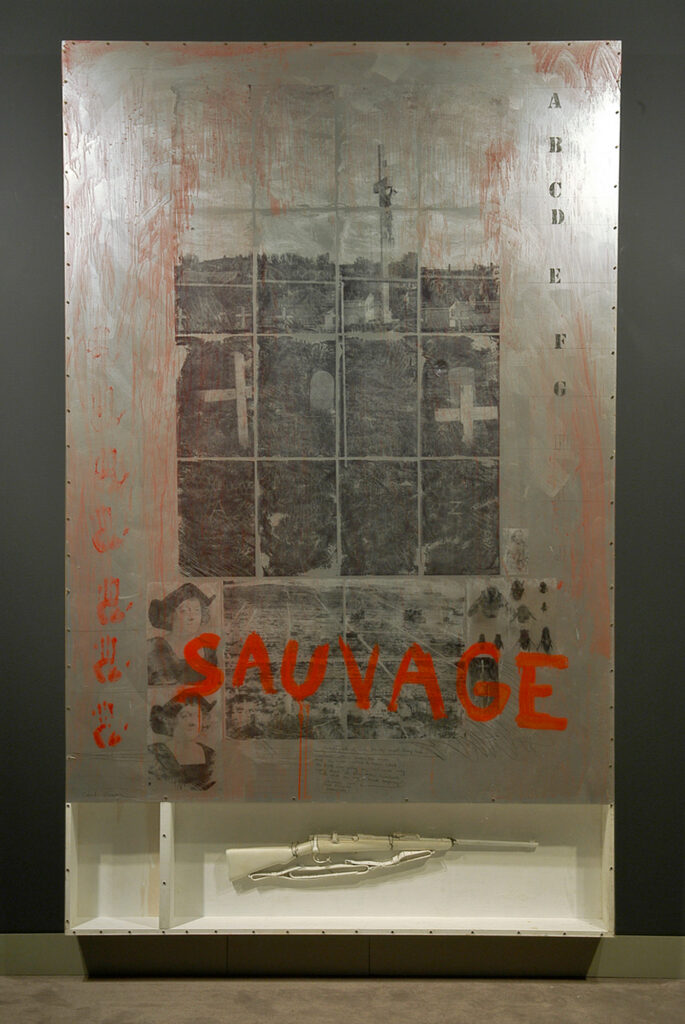
Carl Beam, Sauvage, 1988
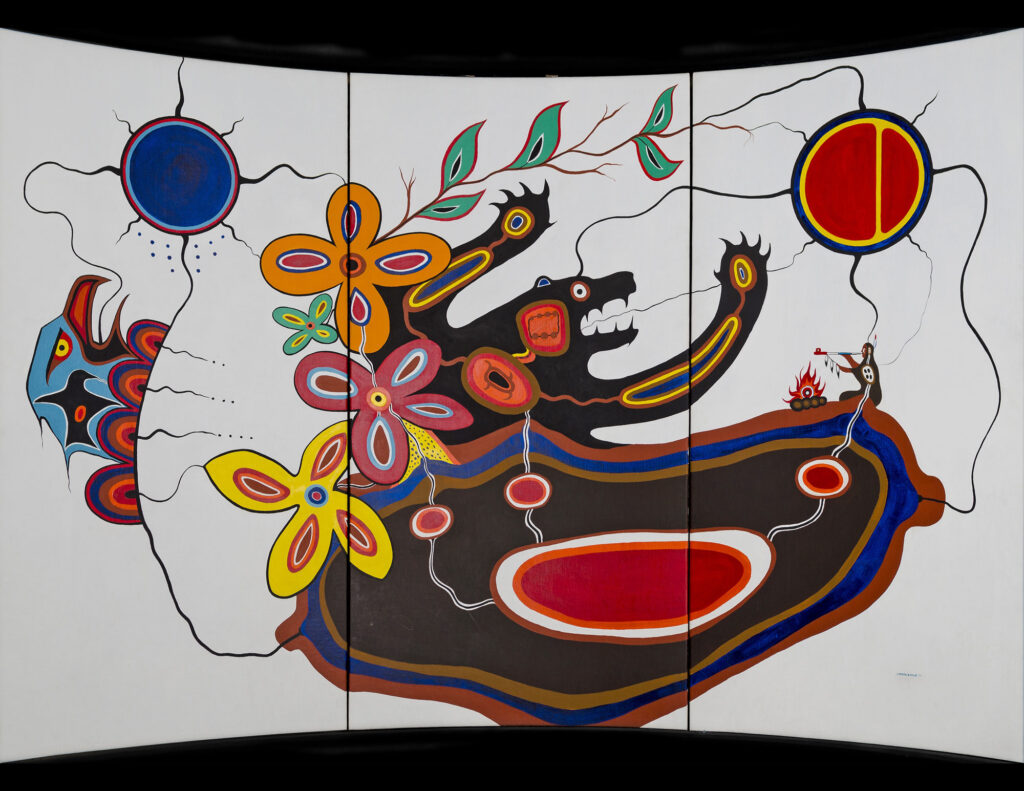
Jackson Beardy, Native World View, 1978

Henry Beaudry, Treaty No. 6, Battleford Area, n.d.

Mary Ceasar, Hair Being Cut by Nuns, 2017

Freda Diesing, Old Woman with Labret, 1973

Faye HeavyShield, Sisters, 1993

Robert Houle, Parfleches for the Last Supper, 1983

Alex Janvier, Blood Tears, 2001

Norval Morrisseau, The Gift, 1975

Ellen Neel, Kakaso'las, 1955–56

David Ruben Piqtoukun, Airplane, 1995

Jamasee Padluq Pitseolak, The Day After, 2010
Abraham Anghik Ruben, The Last Goodbye, 2001

Pitaloosie Saila, Strange Ladies, 2006

Allen Sapp, Recess at Onion Lake School, 1988

Henry Speck, Father Forgive Them, 1958

Adrian Stimson, Sick and Tired, 2005

Gerald Tailfeathers, Blood Camp, 1956

Lawrence Paul Yuxweluptun, Indian Residential School, Leaving the Shallow Graves and Going Home, 2022