Henry Speck, Father Forgive Them, 1958

Henry Speck, Father Forgive Them, 1958, watercolour on paper, 35.6 x 42.6 cm, Vancouver Art Gallery.
In Father Forgive Them, Kwakwaka’wakw painter Henry Speck (Udzi’stalis) (1908–1971), born in Kalugwis, British Columbia, applies vibrant watercolour and ink to depict a powerful reimagining of the biblical crucifixion, with the word “Crucifixion” inscribed beneath the tableau. At the centre, a Christ figure hangs on a cross, clothed in traditional regalia that visually aligns him with Indigenous ceremonial persons. Surrounding him are men and women also dressed in ancestral regalia. This scene, invoking the Christian plea “Father, forgive them” (Luke 23:34), presses deeper when viewed through the lens of Speck’s era—
a time when Christianity and colonial schools were tools of cultural assimilation. The Indigenous visual context reframes the crucifixion as a symbol of Indigenous suffering under colonialism rather than a distant myth.
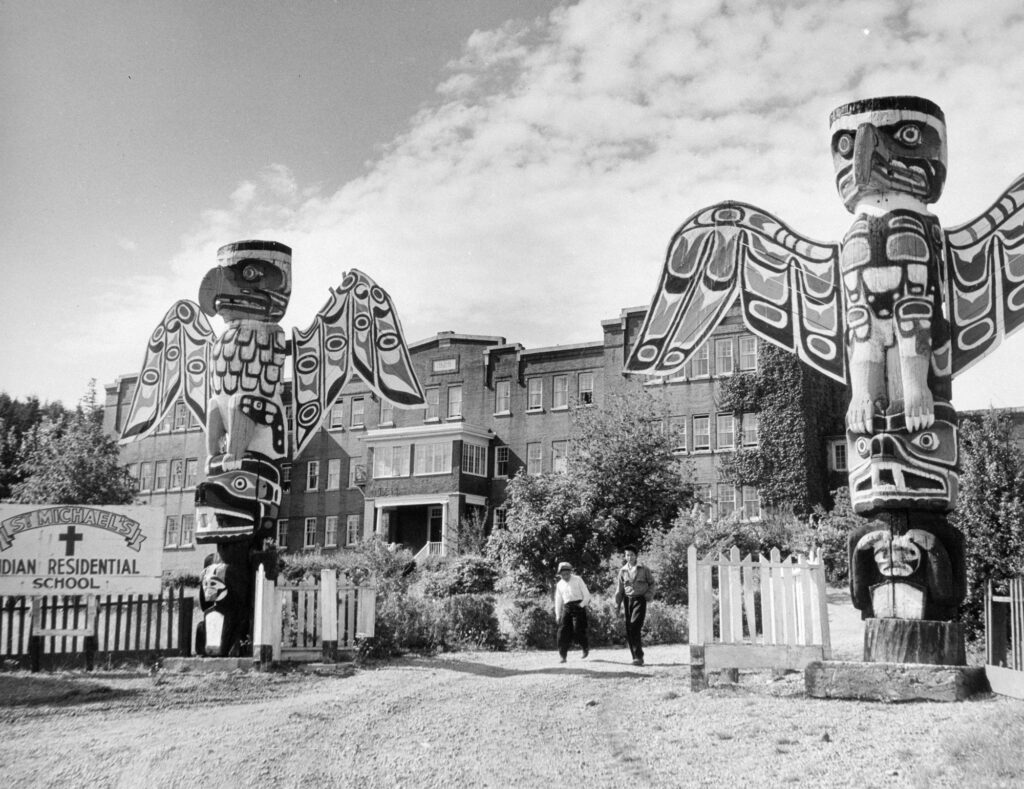
St. Michael’s Residential School, Alert Bay, c.1945–49, photographer unknown.
Notably, the women in the composition face inward toward the crucified figure, engaging with compassion, mourning, and spiritual presence. In contrast, the men appear more detached, distant, or even indifferent. This gendered juxtaposition may signal a commentary on social roles: women as emotional bearers of spiritual continuity and men shaped by models that have been co-opted or suppressed under colonial structures. Direct, attentive, and emotional, the women’s presence suggests intergenerational continuity: the survival of ancestral knowledge through those most often marginalized by colonial patriarchy. The men’s detachment makes subtle reference to how Christian missions and colonial policies fractured male ceremonial roles and authority.
Speck’s approach avoids preachiness. His
forms are stylized, ceremonial, and anchored
in Indigenous visual tradition. The artwork maintains aesthetic and political tension: it is both an invocation of Christian imagery and a reclamation of Indigenous spiritual sovereignty. He places Christ in ceremonial regalia, positioning him as kin rather than as an outsider, challenging the missionary narrative by blending theological imagery with Kwakwaka’wakw visual identity.
Speck was a hereditary chief and ceremonial singer. Active as an artist from the 1930s through the 1960s, he developed a distinct visual language in gouache and ink-on-paper rooted in Kwakwaka’wakw ceremonial imagery and modern abstraction. For two years, he attended Alert Bay Industrial School (St. Michael’s Residential School). His work often portrayed mythological beings, Potlatch scenes, and ancestral narratives in bold, flat forms and rhythmic patterns, creating a modern visual identity that resisted colonial erasure.
Father Forgive Them stands as a prayerful indictment, asking for forgiveness from a tradition that has both inflicted and endured suffering. It is a call for reckoning, resilience, and recognition, inviting viewers into a space where Indigenous spirituality and Christian symbolism intersect but where Indigenous presence remains sovereign.
Collection of Survivors’ Art
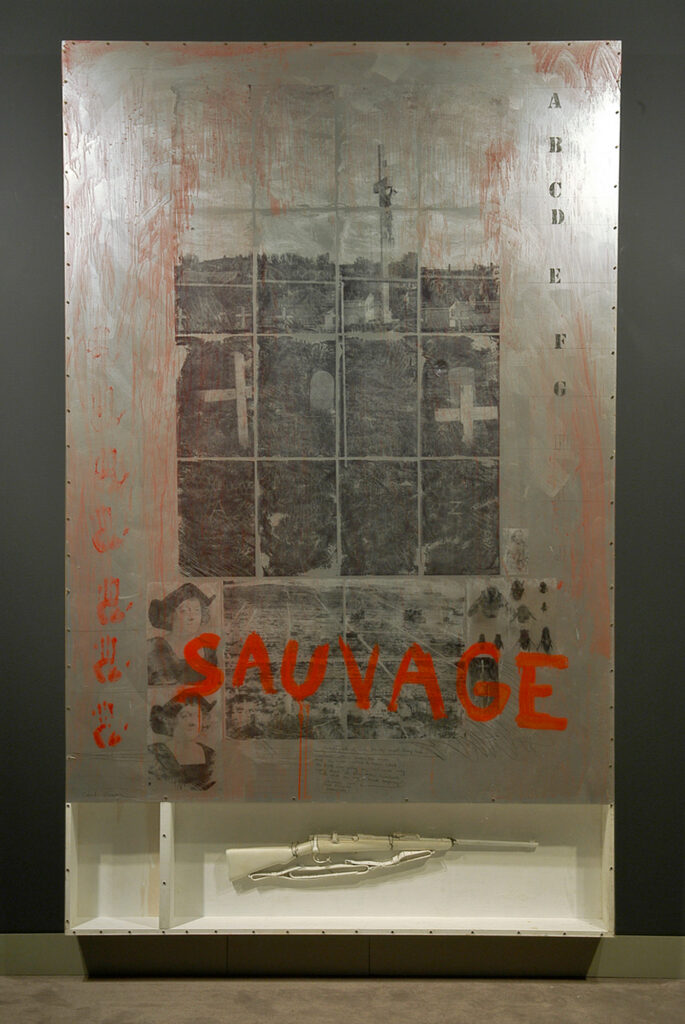
Carl Beam, Sauvage, 1988
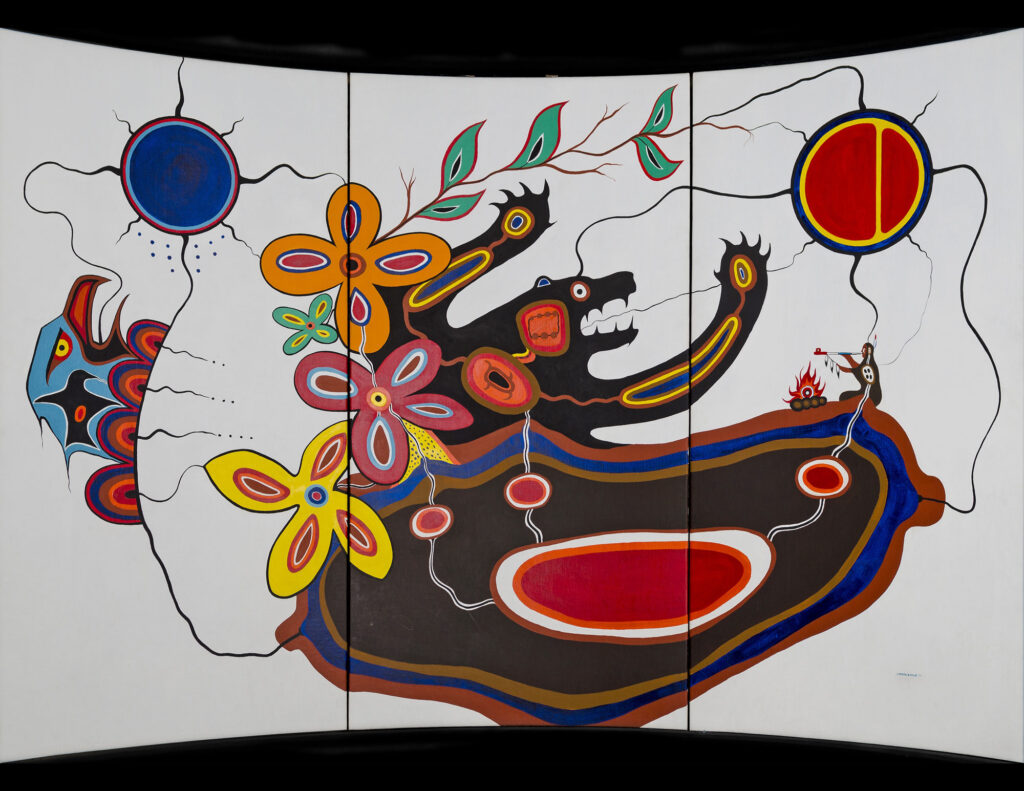
Jackson Beardy, Native World View, 1978

Henry Beaudry, Treaty No. 6, Battleford Area, n.d.

Mary Ceasar, Hair Being Cut by Nuns, 2017

Freda Diesing, Old Woman with Labret, 1973

Faye HeavyShield, Sisters, 1993

Robert Houle, Parfleches for the Last Supper, 1983

Alex Janvier, Blood Tears, 2001

Norval Morrisseau, The Gift, 1975

Ellen Neel, Kakaso'las, 1955–56

David Ruben Piqtoukun, Airplane, 1995

Jamasee Padluq Pitseolak, The Day After, 2010

Abraham Anghik Ruben, The Last Goodbye, 2001

Pitaloosie Saila, Strange Ladies, 2006

Allen Sapp, Recess at Onion Lake School, 1988
Henry Speck, Father Forgive Them, 1958

Adrian Stimson, Sick and Tired, 2005

Gerald Tailfeathers, Blood Camp, 1956

Lawrence Paul Yuxweluptun, Indian Residential School, Leaving the Shallow Graves and Going Home, 2022