
In the aftermath of the residential and day school systems, the descendants of Survivors have inherited not only stories but silences, gaps where memory has been wounded, languages fractured, and embodied gestures stilled. For many of this generation, art is the
first language through which absence can
be spoken and futures reanimated. The
Plains Cree principle of kanawâpâtahmowin,
seeing
with responsibility, offers one path of response. To see is a relational act:
a willingness to face what has been concealed, in intimate and public forms alike, and to remain answerable to it.
Collection of A New Generation of Witness
Sonny Assu, Leila’s Desk, 2013

Michael Barber, A Silent Sky, 2022

Christi Belcourt, Giniigaaniimenaaning (Looking Ahead), 2012

Rebecca Belmore, Apparition, 2013

Rain Cabana-Boucher, Laying Flowers, 2021–24

Quill Christie-Peters, Portrait of Ste. Margaret’s Residential School and All It Could Not Contain, 2018

Dana Claxton, Headdress – Shadae and her Girlz, 2023

Beau Dick, The Ghost Confined to the Chair, 2012
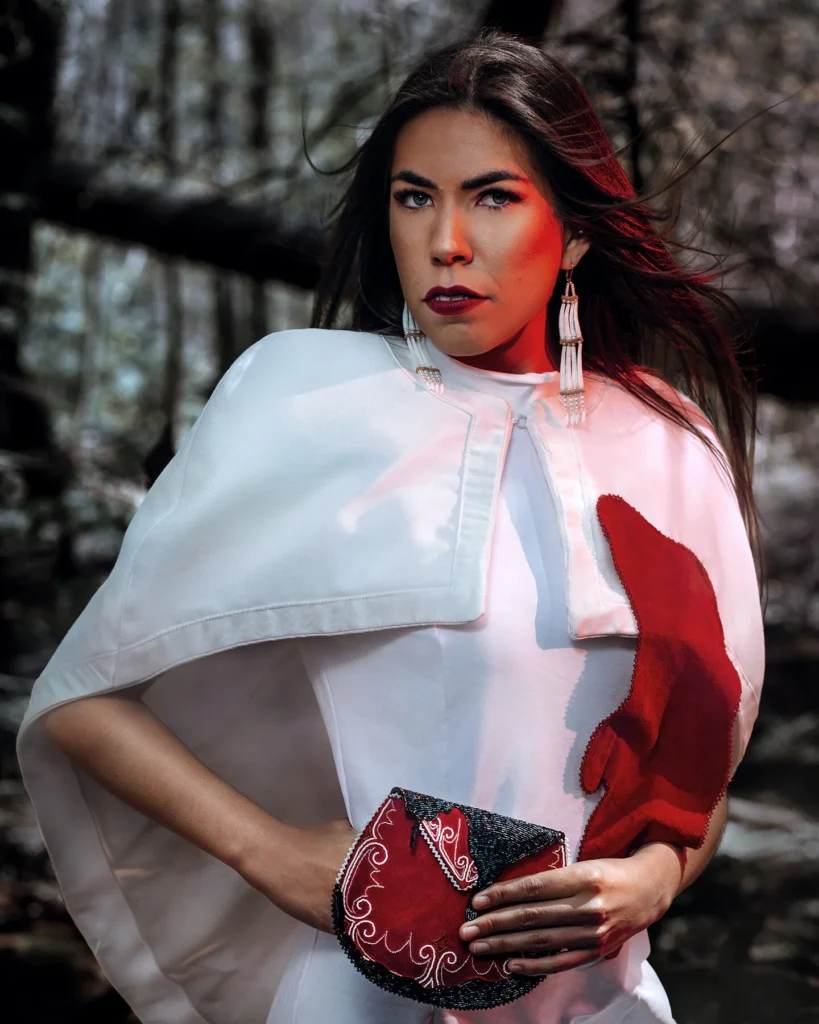
Oakley Rain Wysote Gray, Bleeding Heart Cape – M’st No’gmaq (All My Relations), 2021

7IDANsuu James Hart, Reconciliation Pole: Honouring a Time Before, During and After Canada’s Indian Residential Schools, 2015–17

Emma Hassencahl-Perley, White Flag, 2015

Brent Henry, English Only!, 2021

Shawn Hunt, Flipping the Bird, 2014

Lisa Jackson, Savage, 2009
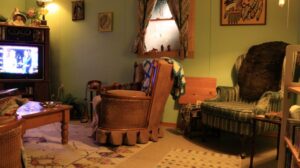
Ursula Johnson, ITHA: The Livingroom, 2021

Siassie Kenneally, All the Things That I Have Seen, 2016

Jake Kimble, It’s All So Incredibly Loud, 2025

Duane Linklater, i want to forget the english language, ulterior, 2020/23

Jim Logan, National Pastimes, 1991

Luke Marston, Bentwood Box, 2009

Kevin McKenzie, Being Indigenous, 2024

Meryl McMaster, Truth to Power, 2017

Kent Monkman, The Scream, 2017

Caroline Monnet, The Black Case, 2014

Tim Moore, Erasure Is Futile, 2021

Peter Morin, This is what happens when you perform the memory of the land (parts 1 and 2), 2013
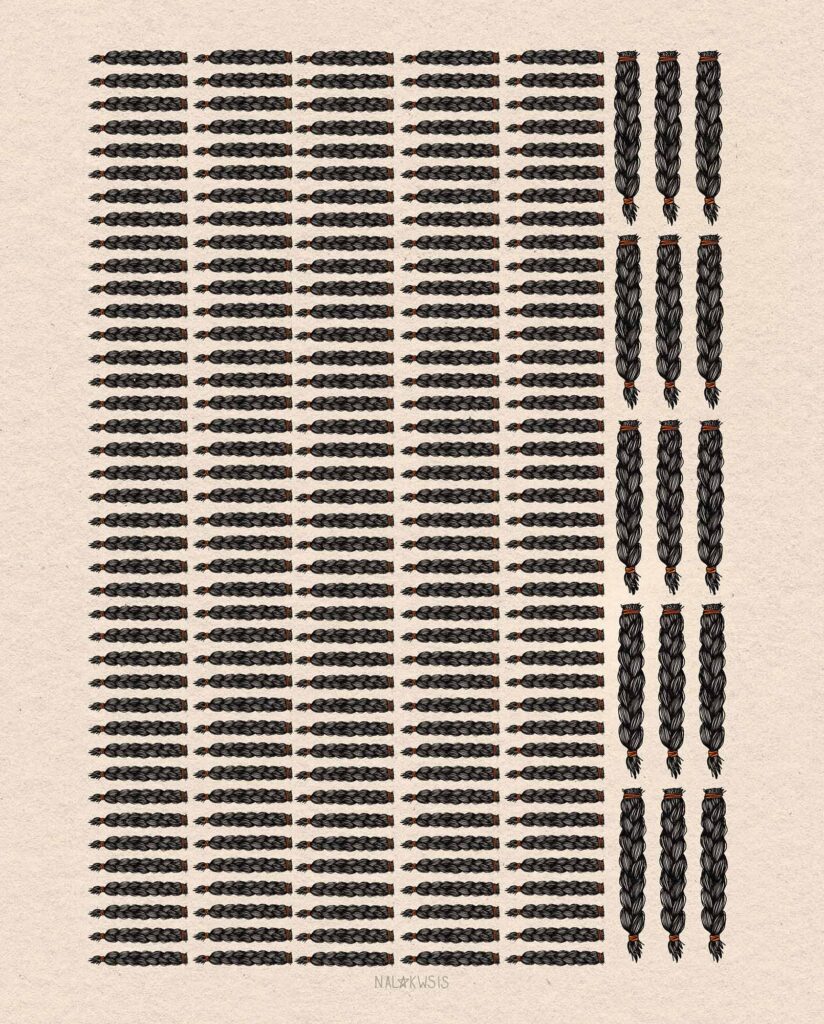
Saige “Nalakwsis” Mukash, 215 Braids, 2021

Nadia Myre, Indian Act, 2000–2002

Carey Newman, Witness Blanket, 2013–14

Davidee Ningeok, Sr., Residential School Nightmare, 2015

Shelley Niro, The Shirt, 2003

Luke Parnell, Neon Reconciliation Explosion, 2020

Dionne Paul, Her First Day of School, 2013
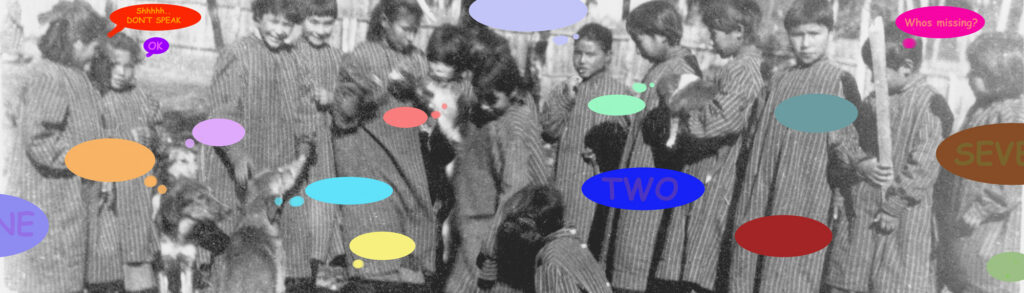
Edward Poitras, Don’t Speak, 2015

Barry Pottle, Yale Dormitory (Residential School), North West River, Labrador, 2015

Teharihulen Michel Savard, Reciprocity (Réciprocité), 2009

Jason Sikoak, Sacrilege, 2015

Greg Staats, Do’-gah – I don’t know [shrugging shoulders], 2020, archival pigment print on canvas on pine stretcher, oil, earth, Indian tobacco ash (edition 2 of 3), 142 x 175.3 x 2.5 cm, Agnes Etherington Art Centre, Kingston.

Alan Syliboy, Grandmother 1, 1997

Jeff Thomas, Broken Treaties, 1613–, 2020
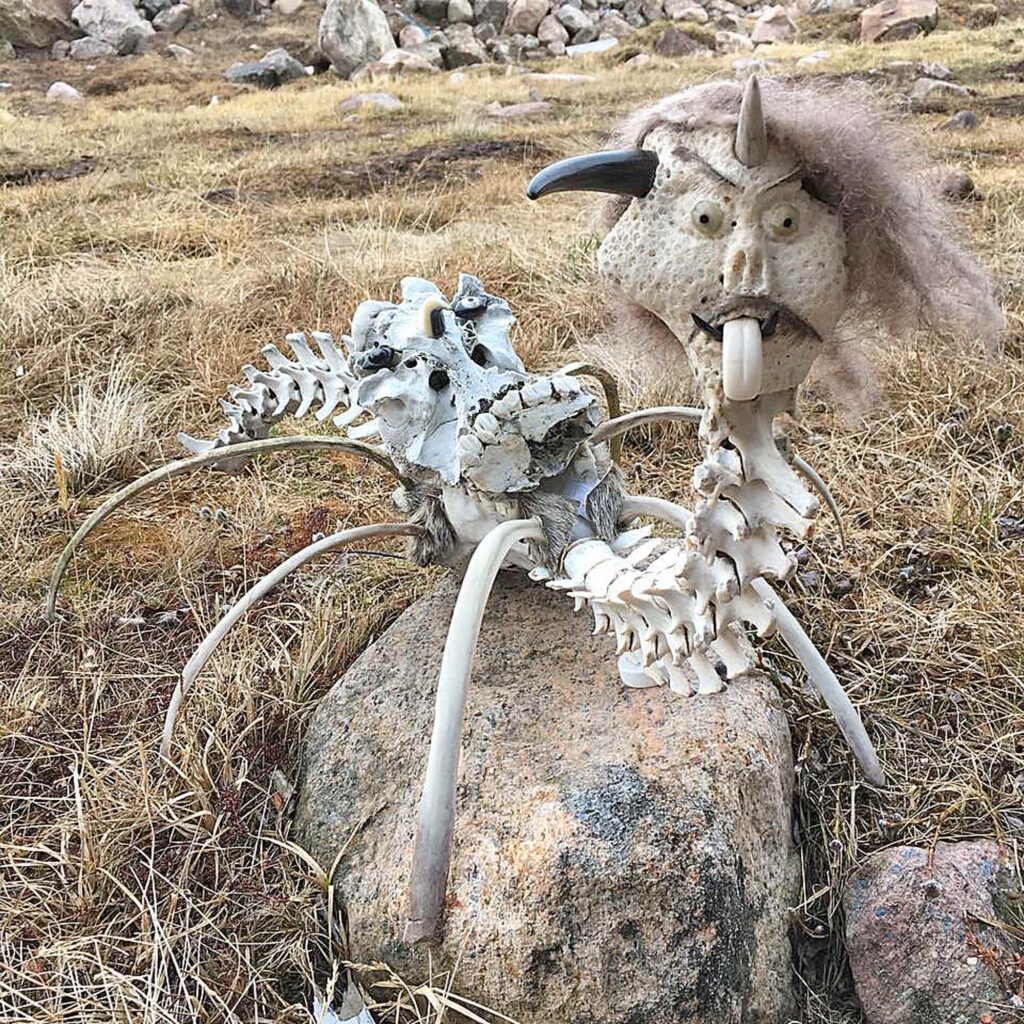
Jesse Tungilik, The Spirit of Intergenerational Trauma, 2019

Tania Willard, Be a Good Girl, 2017
Inherited Silence and Intimate Testimony

People take part in a march on National Day for Truth and Reconciliation, Montreal, September 30, 2023, photograph by Graham Hughes / The Canadian Press.
As the Truth and Reconciliation Commission of Canada (TRC) emphasized, testimony does not end with spoken statements or archival documentation. It continues in the creative practices through which Survivors and their descendants carry memory forward. The TRC called for renewed attention to Indigenous knowledge systems, languages, and arts as living modes of truth telling. The artists gathered here answer that call as illustration rather than extension, turning visual knowledge into a way of reclaiming relation, mending silence, and imagining futures grounded in responsibility.
Within this context, kanawâpâtahmowin names what these artists practice: a form of seeing that transforms inherited weight into ongoing relation. In addition to stories, new artists inherit a way of understanding the world that Survivors have carried forward through their work. They respond to that earlier generation by extending its visual knowledge: where Survivors transformed silence into testimony, their descendants emphasize continuity and future making. kanawâpâtahmowin is today not merely preserved but activated anew, shaped by contemporary experiences, evolving relationships, and changing responsibilities. Their art becomes a continuing conversation across time, in which past, present, and future witness one another through image, form,
and material.
These artists are the inheritors of silence; yet, their works are not quiet. They transform grief into visual testimony and memory into kinship. Their art moves beyond witnessing the past—it reanimates the relations residential schooling tried to sever. Through paint, charcoal, beadwork, photography, performance, and ceremony, they continue the unfinished work of their forebears in truth telling, understood as continuity instead of confession.
The tender domestic scenes that Jim Logan (b.1955) painted decades before the public reckoning with residential schools set the tone for this generational turn. His lonely children beneath the wide northern skies of Yukon gesture toward the quiet persistence of love in landscapes scarred by absence. Logan paints the spaces where language fails, homes are left half-lit, and power lines sag like a tired memory stretched too thin. Through his brush, he gives form to silence.

Jim Logan, Shaman, 2008, acrylic on canvas, 29.1 x 40.6 cm, Gallery Gevik, Toronto.
Michael Barber, A Silent Sky, 2022, reclaimed wooden doors, plywood birds and figure, dimensions variable (installed 365.8 x 243.8 x 274.3 cm), private collection.
In paintings, murals, and sculptural works, Michael Barber (b.1967) carries endurance into a collective ritual. His A Silent Sky, 2022, carved from weathered doors and featuring suspended birds, gathers the memory of his grandmother’s survival of the Mohawk Institute. Each element bears the texture of time: chipped paint, resin dripping, the touch of many hands. Through community carving workshops, Barber transforms remembrance into shared ceremony, extending kanawâpâtahmowin beyond individual vision to collective participation. Here, witnessing becomes a collective act, a repair through relation.
Saige "Nalakwis" Mukash, 215 Braids, 2021, digital print, 23 x 20.5 cm.
Out of these gestures of care, younger artists like Saige “Nalakwsis” Mukash emerge, expanding remembrance into collective space. Nalakwsis’s 215 Braids, 2021, made in response to the discovery of children’s graves at the site of Kamloops Indian Residential School, continues this act of collective witnessing. Each braid stands for a child, those found and those still missing, transformed through the discipline of repetition. In many Indigenous cultures, hair embodies spirit; its cutting marked a profound violence. Nalakwsis reclaims this act by turning severance into connection, grief into continuity. Shared widely online, the work became a digital memorial and a gathering point for mourning that crossed boundaries of community and place. In its quiet insistence, 215 Braids affirms that truth telling must be
both personal and collective, grounded in remembrance and renewal.
This generational shift becomes especially clear in artists whose practices extend testimony through embodied, relational action. Most notably, this occurs in the performance work of Peter Morin (b.1977). Morin’s interconnected performances honour the children who did not survive residential schools by activating relationships between human and more-than-human collaborators. Through mask, button blanket, drum, rattle, fire, and song, he brings these living tools into being, treating them as co-performers with agency and intention. Rather than re-enact trauma, Morin creates regalia meant for the spirits of the children, offering them something to dance in. In this way, his practice echoes the children’s drawings discussed earlier, which do more than simply record suffering; they assert presence, relation, and continuance. Like those drawings, Morin’s performances refuse containment within trauma alone. They make space for movement, ceremony, and ongoing life. His actions transform museums and gallery spaces into sites of ceremony, kinship, and care. Morin positions performance as a relational system of Indigenous law and survivance—an active presence beyond mere survival—where art is medicine, witness, and continuation.
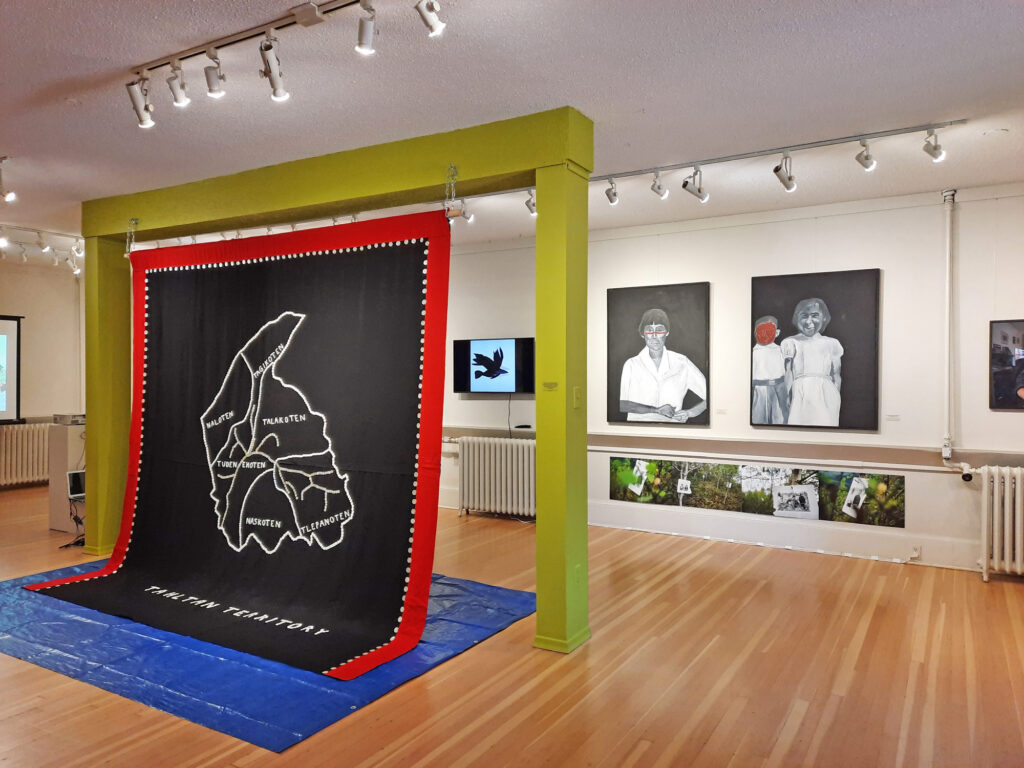
Installation view of the exhibition her name is Edzūdzah: Peter Morin and Janell Morin at Smithers Art Gallery showing Tahltan Territory Button Blanket (a territorial map based on a drawing by James Teit after a conversation with skilled Tahltan leaders in 1910) in the foreground, Smithers, British Columbia, 2022, photograph by Michelle Gazely.
Each of these artists works within an ethic of kanawâpâtahmowin, seeing with and for others. Their art is less about depicting pain than about reanimating relation across generations, between viewers and the seen, and between
the living and those whose voices were taken.
In this, they extend the TRC’s calls beyond documentation and into renewal. Rather than close wounds, their works keep them open to light. They remind us that truth is not a fixed narrative but a living relation, an ongoing conversation between past and present, image and viewer, grief and grace. Through them, the descendants of silence reclaim voice by drawing the past forward, one line, one gesture, one braid at a time.
Metaphor as Mourning and Resistance
Whereas silence and intimate testimony
enacted Indigenous ways of seeing, another group of artists use metaphor to practise kanawâpâtahmowin with care and remind us that there are certain spaces where Canada prefers not to look. If the previous generation of artists inherited silence, this one reshapes it, turning grief into matter and memory into form. In their works, kanawâpâtahmowin extends beyond the act of witnessing into reciprocity. Each artist enacts a return to relation: with ancestors, with land, with community. What begins in sorrow becomes, through miýikosiwin—vision and creativity as life-giving force—a practice of making that sustains life. In this sense, metaphor itself becomes ceremony, transforming trauma’s residue into visual sovereignty.
Dana Claxton, Headdress – Shadae and her Girlz, 2023, LED Firebox with transmounted chromogenic transparency, 152.4 x 101.6 cm.
Across this generation, the impulse to
restore relation is expressed through material abundance, restraint, and gesture. Dana Claxton (b.1959) veils her subjects beneath beadwork and cedar; Rebecca Belmore (b.1960) seals her own mouth with tape; Greg Staats (b.1963) repeats the words “do’-gah”—“I don’t know”—in quiet rhythm; Duane Linklater (b.1976) reorders visual and linguistic syntax to unsettle colonial ways of seeing; Alan Syliboy (b.1952) paints ancestral energy through Mi’kmaw glyphs; Edward Poitras (b.1953) overlays colonial archives with the flicker of Coyote’s laughter. Each transforms metaphor into a form of ceremony, where beauty, silence, and endurance cohere as acts of resistance.
Claxton opens this movement in her Headdress series, where women are wrapped in their own regalia, faces hidden, bodies radiant. What colonial cameras once sought to expose, she conceals in splendour. The gesture is protective yet exuberant: an abundance as defiance. Each bead, cedar strand, or glinting medallion becomes a language of belonging, an archive of kinship. The viewer’s gaze, accustomed to revelation, encounters instead relation. This is kanawâpâtahmowin enacted through a lens—seeing not to claim but to honour. Claxton’s portraits remind us that to cover can be to reveal and that beauty itself can carry the weight of testimony.
Where Claxton’s veils speak in splendour, Belmore answers with silence. In Apparition, 2013, she kneels before a white backdrop, her mouth sealed with duct tape, a brutal echo of the language suppression imposed on residential school children, including her own siblings. When she tears the tape away but remains wordless, she exposes the chasm between removal and recovery. Silence here is not absence. It is the sound of endurance. Belmore’s stillness resists translation, reminding us that reconciliation demands a listening deeper than speech. Her body becomes both wound and offering, her silence a hymn for those who lost their languages but not their voices.
Rebecca Belmore, Apparition, 2013, video installation on painted wall, Morris and Helen Belkin Art Gallery, University of British Columbia, Vancouver.
Greg Staats, Do’-gah – I don’t know [shrugging shoulders], 2020, archival pigment print on canvas on pine stretcher, oil, earth, Indian tobacco ash (edition 2 of 3), 142 x 175.3 x 2.5 cm, Agnes Etherington Art Centre, Kingston.
Duane Linklater, i want to forget the english language, ulterior, 2020/23, five tipi poles, paint, spray paint, rope, tarpaulin, brass chandelier, stone, wooden box, cart, 196 x 706 x 140 cm.
Rebecca Belmore, Apparition, 2013, video installation on painted wall, Morris and Helen Belkin Art Gallery, University of British Columbia, Vancouver.
Greg Staats, Do’-gah – I don’t know [shrugging shoulders], 2020, archival pigment print on canvas on pine stretcher, oil, earth, Indian tobacco ash (edition 2 of 3), 142 x 175.3 x 2.5 cm, Agnes Etherington Art Centre, Kingston.
Duane Linklater, i want to forget the english language, ulterior, 2020/23, five tipi poles, paint, spray paint, rope, tarpaulin, brass chandelier, stone, wooden box, cart, 196 x 706 x 140 cm.
While Belmore holds silence as an absolute, Staats finds ceremony in the smallest of gestures: a shrug. In his performance Do’-gah – I don’t know [shrugging shoulders], 2020, he invites others to repeat the phrase and motion again and again until uncertainty becomes a rhythm of refusal. What might appear as doubt becomes instead a discipline grounded in an Indigenous epistemology of restraint. In repetition, Staats asserts the sovereignty of not telling everything, of holding sacred what must remain within the circle. His work reminds us that truth telling includes the right to protect. For Staats, care and resistance are one: to guard silence is itself an act of love.
For Syliboy, mourning flows into radiance. His paintings, drawn from Mi’kmaw petroglyph traditions taught by his mentor Shirley Bear (1936–2022), pulse with colour and motion. In Grandmother 1, 1997, a luminous matriarchal figure breathes red and gold across the canvas, her form surrounded by symbols of spiritual continuity. Syliboy calls this “painting prayer,”
a visual song of family and survival. Each stroke reawakens ancestral teachings that once had to hide beneath school desks and whispered language. His art transforms suppression into rhythm, replacing the rigidity of colonial lessons with the fluid syntax of kinship.

Petroglyphs in Kejimkujik National Park and National Historic Site, Nova Scotia, date unknown, photograph by Alan Syliboy.

Shirley Bear, Basket Weaver, 1988, woodcut on paper, 64 x 47 cm, Carleton University Art Gallery, Ottawa.
Linklater sharpens this turn toward metaphor
by staging language itself as a site of colonial constraint. In i want to forget the english language, ulterior, 2020/23, tipi poles set on a dolly support a displaced crystal chandelier, forming a spatial syntax that unsettles Western habits of seeing. The work does not reject English so much as reposition it, asking viewers to recognize how perception is governed by linguistic frameworks and to re-enter Indigenous grammars of
relation. Seeing here becomes an act of ethical realignment rather than mastery—the chandelier displaced, the poles repurposed, the grammar of belonging reasserted.
Poitras brings this current to a point of intellectual precision. In Don’t Speak, 2015, a billboard installation that overlays an archival photograph of residential schoolgirls with brightly coloured speech and thought bubbles. His installations, including Rez Girls, 1998, rework the bureaucratic logic of archives, reframing documents and photographs of Indigenous children so that the viewer must lean close, reading through transparency and light. In doing so, he transforms instruments of control into sites of care. The act of looking becomes ceremonial—a slow unlearning of colonial sight.

Edward Poitras, Rez Girls (detail), 1998, transparency photo print and book pages in frames on shelf, each 15 x 10 cm, University of Saskatchewan Art Collection, Saskatoon.
Threaded through these artists is a shared conviction that beauty, restraint, and metaphor can speak truth more deeply than declaration, whether through adornment, silence, touch, or, as in Linklater’s work, the reordering of visual and linguistic syntax itself. Claxton’s adornments, Belmore’s silence, Staats’s shrug, Syliboy’s light, and Poitras’s layered pages all are languages of relation. Each transforms loss into a form of endurance, insisting that art is a way of knowing and relating. Their gestures of covering, shrugging, painting, and reframing form a choreography of care. What binds them is spirit rather than style: a refusal to let grief stagnate, an insistence that mourning can move.
If the first generation of truth tellers bears witness to devastation, this new generation bears witness to continuance. They show how reconciliation cannot be found in spectacle or closure but in sustained attention; in looking, listening, and touching with respect. Instead of symbolizing difference, their metaphors are invitations to enter the circle. To practise kanawâpâtahmowin is to join them: to see with responsibility, to feel without possession,
to remember through beauty.
Public Memory and Material Witness
Public monuments are sites where kanawâpâtahmowin reshapes national seeing.
If earlier generations drew truth into being through intimacy and metaphor, the artists gathered here carry those truths into the public space, where remembrance becomes shared, visible, and enduring. Their works transform the physical landscape of Canada—its galleries, institutions, and streets—into a terrain of active reckoning. Cedar, copper, glass, neon, stone: each material becomes a conduit for memory, binding what is seen to what has long been kept out of sight. kanawâpâtahmowin teaches us to look beyond the monument as object and toward the monument as relation: a living exchange among story, land, and viewer. These works make history touchable—not to fix it in place but to hold it in motion.

Carey Newman, Witness Blanket (detail), 2013–14, mixed media installation, 3.2 x 12.2 m, Canadian Museum for Human Rights, Winnipeg.
At the heart of this movement, a cedar field gathers fragments of a nation’s hidden architecture of harm: doors, hymnals, children’s shoes, braids of hair, bits of brick, and photographs. In Witness Blanket, 2013–14, by Carey Newman (b.1975), more than eight hundred such offerings are arranged in what may seem to be wall but actually is a vessel, an embrace that smells of cedar and the labour of care. The object is inseparable from its making: community visits, permissions sought, stories received, hands carrying the weight of things. Even in digital form, its ceremony and relationality persist. “It’s not about closure,” Newman reminds us, “but responsibility.” The blanket redefines monumentality as reciprocity; it asks the viewer to enter the work as a relation and to leave with a task.
Where the blanket enfolds, a painted facade confronts. Neon Reconciliation Explosion, 2020, by Luke Parnell (b.1971) recomposes a Northwest Coast housefront in acrylic on birch plywood—fifty-five contributors transforming it into a neon butterfly where each panel embodies a personal interpretation of reconciliation. Yet, interruption is painted into its core, with an unfinished doorway bearing the initials of Colten Boushie and Tina Fontaine. The unpainted panel refuses the soothing lie of completion. Between illumination and gap, formline precision meets neon urgency; the piece holds a public conversation in which resolution remains unresolved. The housefront shelters and exposes at once, insisting that justice, far from an afterthought, is an ongoing entrance.
The stained-glass window Giniigaaniimenaaning (Looking Ahead), 2012, by Christi Belcourt (b.1961) is a suspended cycle of ceremony above the threshold to Parliament. Built from an immense accumulation of individually cut glass pieces, the work arcs from pre-contact balance through the devastations of schooling and into futurity, where a drum dancer breaks silence. Métis beadwork motifs shimmer in light, turning the corridors policy into a passage through beauty. The title in Anishinaabemowin invites viewers to stand within the circle, not outside it. Here, law is made to pass beneath ceremony; governance is asked to walk through the light of relation. miýikosiwin, knowledge through making, glows in every tessera.

Christi Belcourt, Giniigaaniimenaaning (Looking Ahead) (detail of Mother Earth panel), 2012, glass, metal, lead, iron, 125 x 339.8 cm, Centre Block, Parliament Hill, Ottawa.

Once-known Anishinaabe or Tsuut’ina artist, bandolier bag (detail), 1900–1919, cotton cloth, velvet, glass beads, wool braid, wool yarn, cotton thread, 39.5 x 116 cm, McCord Stewart Museum, Montreal.
From Belcourt’s glass, 7IDANsuu James Hart (b.1952) turns to cedar. His Reconciliation Pole: Honouring a Time Before, During and After Canada’s Indian Residential Schools, 2015–17, raised on Musqueam land, extends this ethic of making-as-relation: children climbing toward light. Reconciliation is not a noun but a verb; it is threaded, hammered, carved, shared. To see these works is to be asked to help make them, if not in wood and metal, then in policy, teaching, and care.
7IDANsuu James Hart, Reconciliation Pole: Honouring a Time Before, During and After Canada’s Indian Residential Schools, 2015–17, red and yellow cedar, paint, copper, abalone, 1516 x 147 x 147 cm; (base) Kayám ̓ Richard Campbell and 7IDANsuu James Hart, θəʔit (Truth), 2023, bronze, 485 x 485 cm, Morris and Helen Belkin Art Gallery, University of British Columbia, Vancouver.
Public memory, here, is more than monumental; it is also incisive, critical, and contemporary. Tim Moore (b.1974) stacks five hundred stamped erasers into a precarious tower atop a torn map of Saskatchewan in Erasure is Futile, 2021: the instrument of deletion becomes a vertical refusal. Numbers once used to quantify dispossession reappear as a column of endurance. In White Flag, 2015, Emma Hassencahl-Perley (b.1995) pastes shredded fragments of the Indian Act over the Canadian flag’s red, though the red “still shines through.” Both artists repurpose legal debris into counter-symbols, making critique material and visible.
In the domestic sphere that schooling sought to discipline, Tania Willard (b.1977) prints Be a Good Girl, 2007, in gold-ink woodblock. Women appear in prayer and servitude, the repetition of carved lines echoing the cyclic labour of caregiving and basketry around which the work is shown. The piece reframes “women’s work” as a form of sovereignty: the very skills colonial institutions tried to devalue carry culture forward. Public memory, Willard asserts, must also be feminist and decolonial, grounded in the daily forms of endurance that keep communities alive.
Tania Willard, Be a Good Girl, 2007, ink on paper, 66.4 x 101.9 cm, Museum of Anthropology, University of British Columbia, Vancouver.
These artists remind us that truth telling is not the end of reconciliation; it is its beginning. Their monuments breathe, they weather, they wait for new hands to touch, witness, and remember. The public space is not a closed archive but an open field of relation. The works within it teach us that healing is not found in forgetting, nor even in forgiving, but in the continued act of making visible: to bear witness with humility, beauty, and care in the open air.
Diaspora of Memory:
Return and Relational Seeing
Across distance and return, kanawâpâtahmowin becomes a means of reconnection. Indigenous artists have carried stories through separations that are geographic, psychic,
and ancestral. The legacy of residential and day schools scattered families, fractured languages, and displaced communities from their lands. Yet, from this dispersal, a counterforce endures: the will to return. Return is physical, but it is also spiritual and creative. It is kanawâpâtahmowin enacted across distance: seeing with a responsibility that reconnects what was divided; miýikosiwin, the gift of vision, creativity, and life that reanimates what was scattered. Through these intertwined principles, memory becomes motion, and loss transforms into relation.
Meryl McMaster, Truth to Power, 2017, giclée print on cold press paper, 121.9 x 159.8 cm.
Meryl McMaster (b.1988) stands at this threshold between past and emergence. In
Truth to Power, 2017, she confronts the colonial voice of Duncan Campbell Scott, architect of the residential school system, by placing her body against the rigid geometry of plantation pines. The forest, disciplined and symmetrical, echoes the architecture of control; yet, snow unsettles its order. In a companion text piece, Scott’s poem “The Onondaga Madonna” is recopied in a child’s hand. As the lines descend, the words blur and fade, transforming mastery into unlearning. Through this inversion, McMaster reclaims authorship: the child’s handwriting becomes a rewriting from within. Her work enacts miýikosiwin—creativity as life-giving force—where seeing itself becomes an act of re-creation.
If McMaster inhabits the threshold, Quill Christie-Peters expands it into the cosmos.
In Portrait of Ste. Margaret’s Residential School and All It Could Not Contain, 2018, she translates her father’s memory of St. Margaret’s into a celestial field where the school dissolves into constellations and unsettled red skies. Painted in the vivid palette of the Woodland School (like that of Daphne Odjig [1919–2016]), the work turns containment into expansion. Christie-Peters aligns with kanawâpâtahmowin in its broadest sense—the vision that perceives relation among all beings. Her painting transforms trauma into light, remembrance
into cosmic kinship.
Quill Christie-Peters, Portrait of Ste. Margaret’s Residential School and All It Could Not Contain, 2018, acrylic on canvas, 60.9 x 91.4 cm.
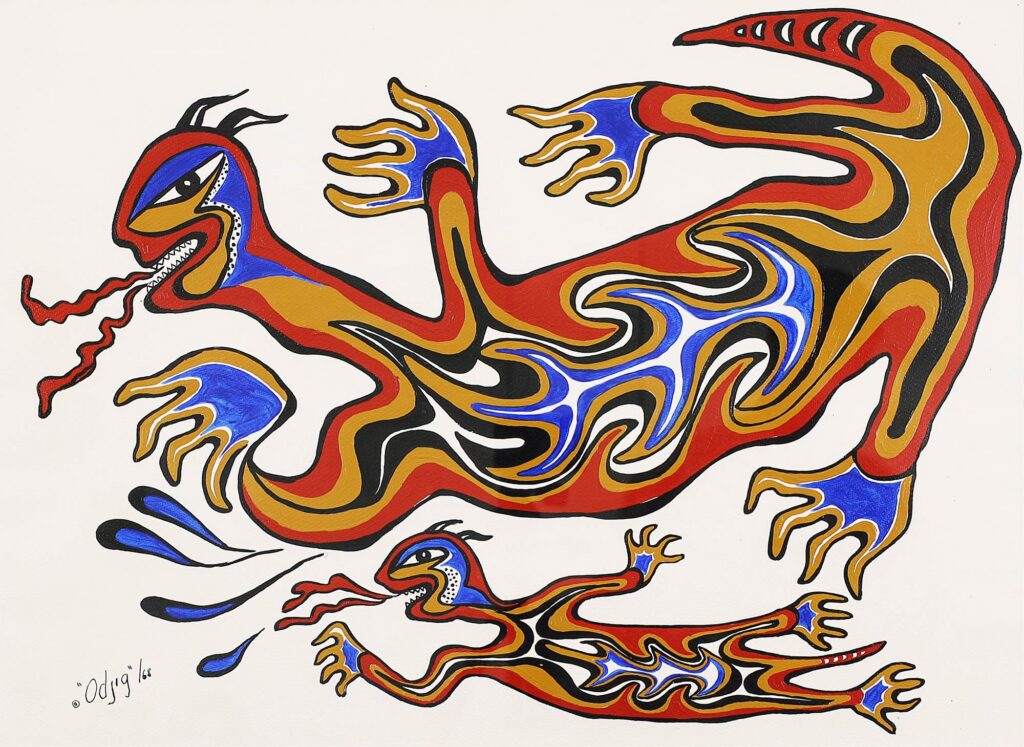
Daphne Odjig, Water Spirits, 1968, acrylic on paper, 52.1 x 71.1 cm, private collection.
Dionne Paul brings that vision home to the intimacy of family. In Her First Day of School, 2013, and His First Day of School, 2013, she overlays archival images of residential school uniforms on photographs of her four-year-old children, ready for their first day in today’s classrooms. Their gestures with hands over eyes, ears, and mouth embody the legacy of imposed silencing. Through digital layering, Paul collapses time; her children inhabit past and present at once. The result is not nostalgia but vigilance. Reconciliation, she reminds us, lives in daily acts of care that protect new generations from inherited harm. This is kanawâpâtahmowin made intimate: seeing one’s children with responsibility, sustaining life through attention and love.

Oakley Rain Wysote Gray, Nmis (Sister), from Mei Eimotieg (We Are Still Here), 2021, cotton, dupioni silk, beads, suede, fur, metal.
From care to ceremony, Oakley Rain Wysote Gray transforms mourning into motion. Gray’s Bleeding Heart Cape – M’st No’gmaq (All My Relations), 2021, is both garment and testimony: deep crimson cloth adorned with double-curve beadwork and a heart split open. “The blood,” Gray explains, “is to honour the ancestors that have suffered bloodshed t hrough colonization.” And the cape does not let that blood rest still. Worn in performance, it moves like blood itself, fluid and life-bearing, because, as Gray insists, “each outfit has its own story to tell, some more traumatic than others, but they need to be heard and seen.” The act of sewing and beading becomes prayer, an embodiment of miýikosiwin as the creative life force that restores connection.
Rain Cabana-Boucher, Laying Flowers, 2021–24, vintage beads, fishing line, deer hide tanned by hunter Garry Blake, collection of Mel Granley.

Flower, shoes, and beaded moccasins placed on the steps of Mohawk Institute, a former residential school for Indigenous children, to honour the 215 children whose remains were discovered on the site, Brantford, Ontario, date unknown, photograph by Cole Burston / Getty Images.
Rain Cabana-Boucher gathers these gestures into a quiet ritual. Her ongoing project Laying Flowers, 2021–24, responds to the discovery of unmarked graves at former school sites. Beading and photographing each floral offering, she turns remembrance into tâpasinahikêwin as a way of drawing truth through gesture rather than line. Each bead becomes a seed of relation; each image a prayer extended outward. By slowing the process, working bead by bead, image by image, Cabana-Boucher resists the speed of consumption, insisting that mourning must be tended, not displayed. Her art enacts kanawâpâtahmowin through witnessing and miýikosiwin through care, which gives life back to memory.
Together, these artists embody movement as testimony. None is bound by a single medium or geography. Their practices travel like stories carried on wind and memory. McMaster crosses photography and performance, Christie-Peters moves between painting and digital space, Paul transforms family photography into political memory, Gray fuses fashion with ceremony, and Cabana-Boucher turns beadwork into collective prayer. Through them, kanawâpâtahmowin evolves from an ethic of seeing to an ethic of moving, while miýikosiwin affirms the generative power of creativity itself.
In this motion, diaspora is redefined. Rising above a condition of loss, it is a field of relation, a gathering of what was scattered. These artists, many living in urban or mixed contexts, reimagine belonging beyond geography, revealing that the aftermath of the schools is not merely a wound to be healed but a horizon for renewal. The land remembers when families scatter; stories persist when languages falter. Through miýikosiwin, they make that persistence visible as a movement toward the future rather than a return to the past.

Michelle Sound, Sipikiskisiw (Remembers Far Back), 2023, archival photo and map on paper, embroidery thread, rick rack, vintage beads, bugle beads, glass seed beads, caribou tufting, porcupine quills, Telus Transit Shelter, Edmonton. Sipikiskisiw (Remembers Far Back) stitches a 1899 survey map of the Papaschase reserve to a photograph of tipis at Fort Edmonton, then tears both and sews them back together with embroidery, caribou tufting, and beadwork. Sound's great-great-grandmother relinquished treaty rights for Métis scrip after Papaschase members were forcibly removed from this land in 1886. Sound calls the tears a way to "show the colonial violence Indigenous people have experienced, including residential school intergenerational trauma, loss of language, and displacement from our territories." The mending stays visible and incomplete because, as she says, that loss cannot be fully mended. Installed at a transit shelter in Amiskwaciwâskahikan, the work returns that history to the very ground where it happened.
Instead of a linear path from past to present, reconciliation forms a generative circle that spirals through vision, creation, and life. Understood through kanawâpâtahmowin,
art binds artists, viewers, ancestors, and descendants within ongoing responsibility.
Each generation meets the next in practices shaped by kanawâpâtahmowin and miýikosiwin, where seeing
with responsibility, creating with life, and carrying knowledge forward operate as ongoing practices. Within this circle, art links generations and sustains the living relationships among ancestors, descendants, land, and language—evidence of suffering but also a renewal of
being through relation. Each work returns to memory to activate in the present. In every brushstroke, bead, and breath, the artists gathered here affirm that Indigenous vision
endures: alive, adaptive, and grounded in relation.