7IDANsuu James Hart, Reconciliation Pole: Honouring a Time Before, During and After Canada’s Indian Residential Schools, 2015–17

7IDANsuu James Hart, Reconciliation Pole: Honouring a Time Before, During and After Canada’s Indian Residential Schools, 2015–17, red and yellow cedar, paint, copper, abalone, 1516 x 147 x 147 cm; (base) Kayám ̓ Richard Campbell and 7IDANsuu James Hart, θəʔit (Truth), 2023, bronze, 485 x 485 cm, Morris and Helen Belkin Art Gallery, University of British Columbia, Vancouver.
Read from ground to sky, the almost seventeen-metre Reconciliation Pole: Honouring a Time Before, During and After Canada’s Indian Residential Schools by Haida carver 7IDANsuu James Hart (b.1952) unfolds a historical arc. At the base, crest beings and sustenance creatures—Salmon, Bear Mother, Raven—evoke the vitality of Indigenous worlds before colonization. Above them rises a meticulously carved residential schoolhouse modelled on the one Hart’s grandfather attended. Encircling this building are ranks of uniformed children holding hands but carved without feet; their truncated bodies signal the deliberate severing
of children from land, language, and family. Driving the lesson home, more than 68,000 copper nails puncture the pole’s surface. Hammered in by Survivors, descendants, local schoolchildren, and allies, the nails stand as witness marks to the children who died in Canada’s Indian residential schools. Together, they glint like tears, scars, stars—an embodied ledger of loss.

7IDANsuu James Hart's Reconciliation Pole: Honouring a Time Before, During and After Canada's Residential Schools during installation at the Morris and Helen Belkin Art Gallery, University of British Columbia, Vancouver, April 1, 2017, photograph by Owen Sopotiuk.

7IDANsuu James Hart, Reconciliation Pole: Honouring a Time Before, During and After Canada’s Indian Residential Schools (detail), 2015–17, red and yellow cedar, paint, copper, abalone, 1516 x 147 x 147 cm, Morris and Helen Belkin Art Gallery, University of British Columbia, Vancouver.

7IDANsuu James Hart, Reconciliation Pole: Honouring a Time Before, During and After Canada’s Indian Residential Schools (detail), 2015–17, red and yellow cedar, paint, copper, abalone, 1516 x 147 x 147 cm, Morris and Helen Belkin Art Gallery, University of British Columbia, Vancouver.
Yet, the narrative does not end in grief. As the eye ascends, the cultural beings Whale, Bear, Eagle, and Thunderbird return, restoring a spiritual ecology that the schools sought to extinguish. A canoe and a European-style vessel travel side by side, proposing that Indigenous Nations and Canada must navigate the future together rather than under conditions of domination. Crowning the pole, an Eagle gathers itself to lift, carrying law, vision, and responsibility outward into the world. Copper sheathing and insets—materials signifying wealth, authority, and accountability in many Northwest Coast traditions—flash at key junctures, reminding viewers that reconciliation entails tangible commitments, not symbolic gestures alone.
Hart’s pole operates simultaneously as memorial, history lesson, and act of visual sovereignty rooted in Indigenous visual knowledge. It lodges the truths of the residential school era in cedar, metal, and public space, where hundreds of people encounter them daily. Because the nails were placed by many hands, the artwork materializes shared obligation. Grief and remembrance are not borne solely by Survivors; settlers, institutions, and future generations, too, are literally fastened to the story. The vertical structure encourages physical witnessing—circling the base, tracing the nails, looking up until the pole disappears into the sky—so that history is felt in the neck, the breath, the time it takes to see.
Reconciliation Pole refuses closure. Hart carved it from an eight-hundred-year-old red cedar and raised it on the traditional territory of the Musqueam People at the University of British Columbia, transforming a campus commons into a site of public memory. It stands in continuity with ceremony, Survivors’ testimony, and ongoing language and culture revitalization across Indigenous territories. By carving the past into the present, Hart asks every viewer, Having seen, what work will you do? The pole honours those taken, those who survived, and those carrying memory forward, insisting that any path to reconciliation must begin with, and continually return to, truth.
Collection of A New Generation of Witness

Sonny Assu, Leila’s Desk, 2013

Michael Barber, A Silent Sky, 2022

Christi Belcourt, Giniigaaniimenaaning (Looking Ahead), 2012

Rebecca Belmore, Apparition, 2013

Rain Cabana-Boucher, Laying Flowers, 2021–24

Quill Christie-Peters, Portrait of Ste. Margaret’s Residential School and All It Could Not Contain, 2018

Dana Claxton, Headdress – Shadae and her Girlz, 2023

Beau Dick, The Ghost Confined to the Chair, 2012
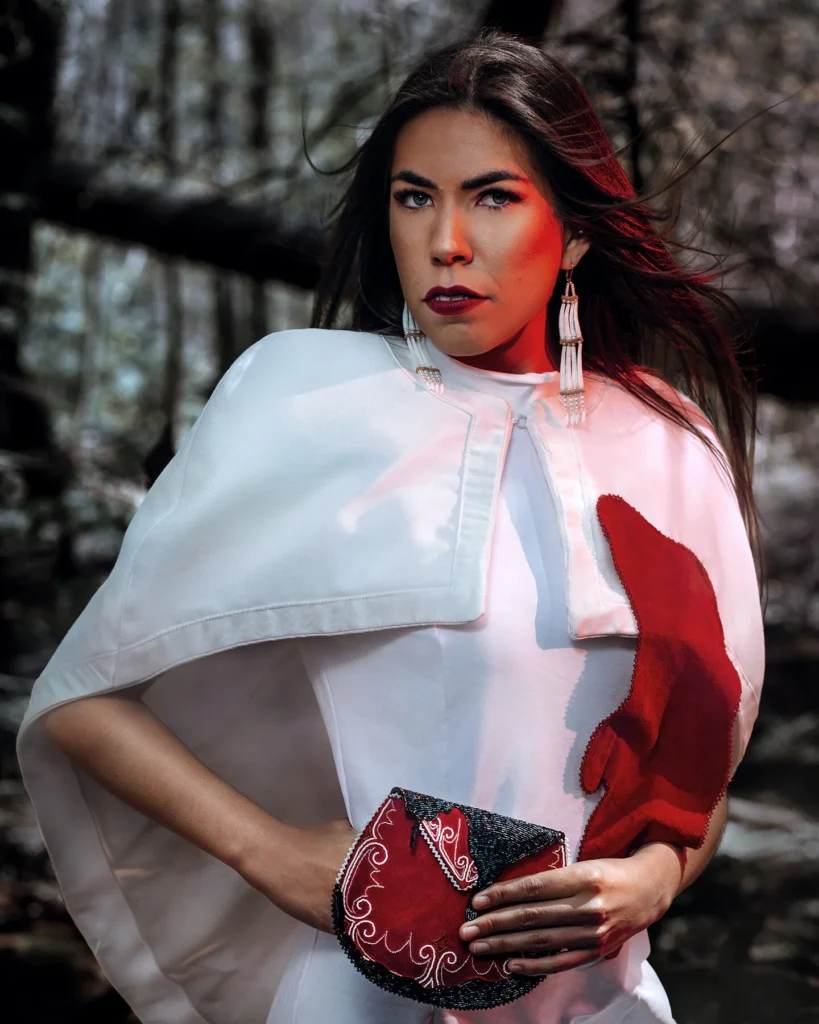
Oakley Rain Wysote Gray, Bleeding Heart Cape – M’st No’gmaq (All My Relations), 2021
7IDANsuu James Hart, Reconciliation Pole: Honouring a Time Before, During and After Canada’s Indian Residential Schools, 2015–17

Emma Hassencahl-Perley, White Flag, 2015

Brent Henry, English Only!, 2021

Shawn Hunt, Flipping the Bird, 2014

Lisa Jackson, Savage, 2009
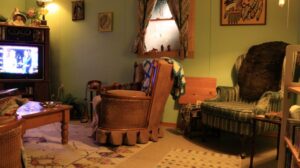
Ursula Johnson, ITHA: The Livingroom, 2021

Siassie Kenneally, All the Things That I Have Seen, 2016

Jake Kimble, It’s All So Incredibly Loud, 2025

Duane Linklater, i want to forget the english language, ulterior, 2020/23

Jim Logan, National Pastimes, 1991

Luke Marston, Bentwood Box, 2009

Kevin McKenzie, Being Indigenous, 2024

Meryl McMaster, Truth to Power, 2017

Kent Monkman, The Scream, 2017

Caroline Monnet, The Black Case, 2014

Tim Moore, Erasure Is Futile, 2021

Peter Morin, This is what happens when you perform the memory of the land (parts 1 and 2), 2013
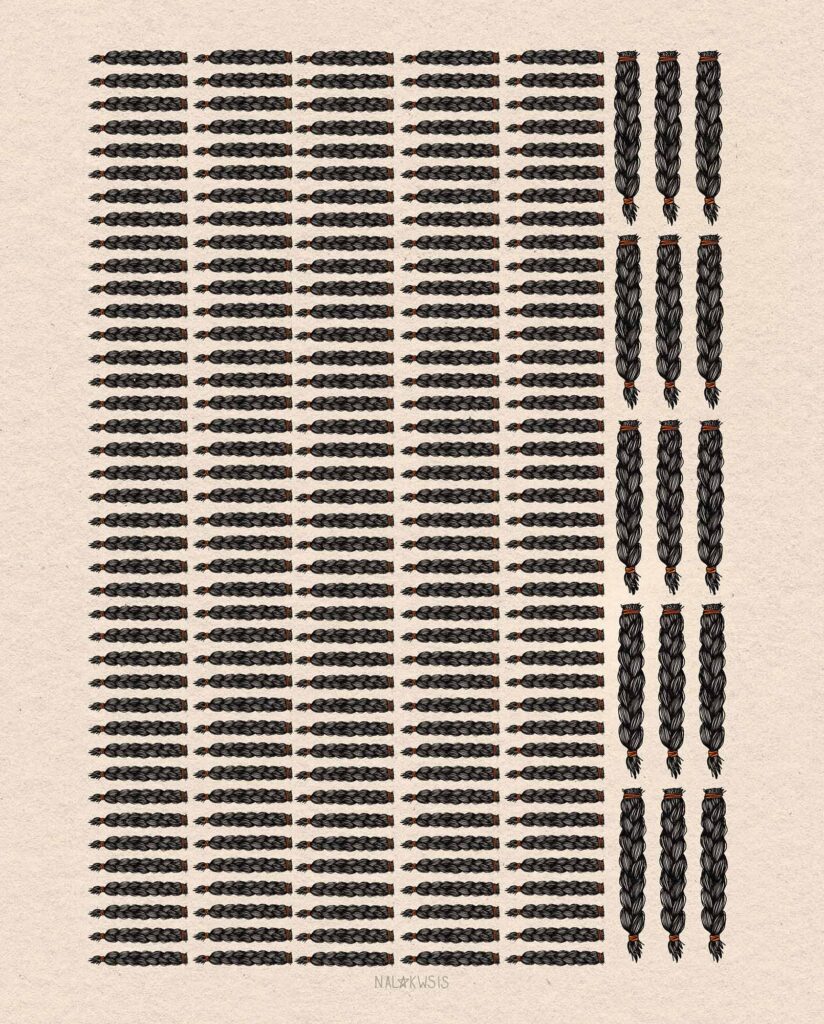
Saige “Nalakwsis” Mukash, 215 Braids, 2021

Nadia Myre, Indian Act, 2000–2002

Carey Newman, Witness Blanket, 2013–14

Davidee Ningeok, Sr., Residential School Nightmare, 2015

Shelley Niro, The Shirt, 2003

Luke Parnell, Neon Reconciliation Explosion, 2020

Dionne Paul, Her First Day of School, 2013
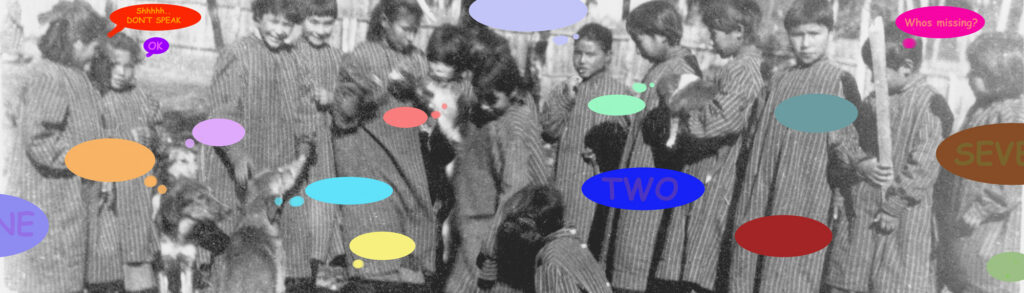
Edward Poitras, Don’t Speak, 2015

Barry Pottle, Yale Dormitory (Residential School), North West River, Labrador, 2015

Teharihulen Michel Savard, Reciprocity (Réciprocité), 2009

Jason Sikoak, Sacrilege, 2015

Greg Staats, Do’-gah – I don’t know [shrugging shoulders], 2020, archival pigment print on canvas on pine stretcher, oil, earth, Indian tobacco ash (edition 2 of 3), 142 x 175.3 x 2.5 cm, Agnes Etherington Art Centre, Kingston.

Alan Syliboy, Grandmother 1, 1997

Jeff Thomas, Broken Treaties, 1613–, 2020
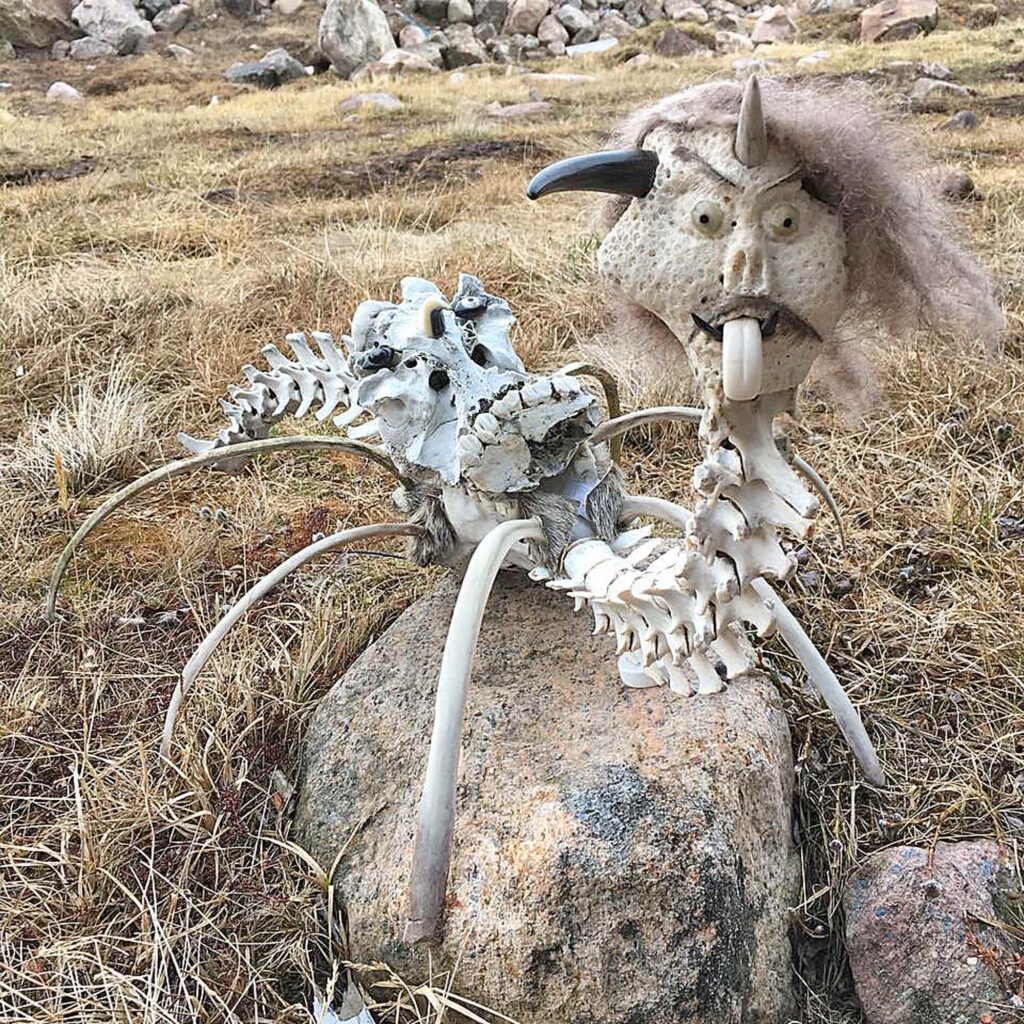
Jesse Tungilik, The Spirit of Intergenerational Trauma, 2019

Tania Willard, Be a Good Girl, 2017