Shelley Niro, The Shirt, 2003

Shelley Niro, The Shirt, 2003, nine duratrans transparencies in lightboxes, 12 x 110 x 138 cm each, Art Gallery of Ontario, Toronto.
The Shirt by Mohawk visual artist Shelley Niro (b.1954) compresses five centuries of colonial violence into a deceptively simple conceit: a tourist tee, that most banal emblem of place, becomes a moving text that refuses to let the viewer look away. In a sequence of fixed, frontal photographic images, an Indigenous woman returns the camera’s gaze as the words on her shirt change, each iteration naming another facet of dispossession. The stillness of her body, the minimal shift in framing, and the incremental alteration of text form a cumulative rhetoric. Repetition functions as drumbeat and dossier, turning a commodity’s surface into a ledger of harms. By choosing the T-shirt—cheap, ubiquitous, extractive—Niro situates colonial history not in distant archives but in everyday consumer culture, implicating tourism, spectacle, and the viewer’s own comfort.

Shelley Niro, The Shirt (detail), 2003, nine duratrans transparencies in lightboxes, 12 x 110 x 138 cm each, Art Gallery of Ontario, Toronto.
Niro’s method is pointedly anti-spectacular. Rather than reconstructing scenes of conquest, she pares cinema back to the essentials of face, ground, and caption so that language bears the force of testimony. The sequence unfolds across the grid from left to right and top to bottom, guiding the viewer through a cumulative progression. The camera’s unblinking directness mirrors the protagonist’s stare, collapsing the distance between witness and reader. As the sequence advances, the shirt’s slogans accumulate like charges in a courtroom until, in a decisive turn, the shirt is removed from her body before the final frame. This removal, as
critics note, converts metaphor into action: the historical “taking” becomes present-tense dispossession, an act felt viscerally through the vulnerability of a bared torso and the viewer’s complicity in watching.
Context matters. Niro has described the work as arising from an aerial view of land divided into fences and parcels—the cartographic logic of extraction made legible from above. Filmed across two locations, the suburban Irvine and Haudenosaunee homelands of the Grand River / Niagara corridor, the piece binds two geographies of settler modernity: the cul-de-sac and the commodified sublime. The location choices puncture the romance of landscape photography; rather than views to be admired, these are territories where ownership overwrote relationships to land grounded in responsibility and care.
Formally, the work sits at the hinge of moving image and photographic series (a related suite of stills circulates in exhibitions), underscoring how Indigenous artists retool both media to insist on sovereignty and memory. The casting
of Hulleah Tsinhnahjinnie (b.1954)—herself a Taskigi (Muscogee/Creek), Diné (Navajo), and Seminole photographer and filmmaker—thickens the piece’s inter-artist dialogue, while ElizaBeth Hill’s score roots the sound-world in the Six Nations. These collaborations enact the very kinship networks that colonial law sought to sever.
For a project on residential and day schools,
The Shirt contributes a crucial structural argument: the schools were not aberrations
but instruments within a larger system of dispossession. By converting a souvenir into an evidentiary surface and then stripping it away, Niro visualizes how policy, representation, and everyday consumption worked together to produce loss—and how testimony can invert that economy, making looking itself accountable. In its quiet rigour and devastating final gesture, The Shirt models an ethics of seeing that is central to truth telling and to Indigenous visual sovereignty.
Collection of A New Generation of Witness

Sonny Assu, Leila’s Desk, 2013

Michael Barber, A Silent Sky, 2022

Christi Belcourt, Giniigaaniimenaaning (Looking Ahead), 2012

Rebecca Belmore, Apparition, 2013

Rain Cabana-Boucher, Laying Flowers, 2021–24

Quill Christie-Peters, Portrait of Ste. Margaret’s Residential School and All It Could Not Contain, 2018

Dana Claxton, Headdress – Shadae and her Girlz, 2023

Beau Dick, The Ghost Confined to the Chair, 2012
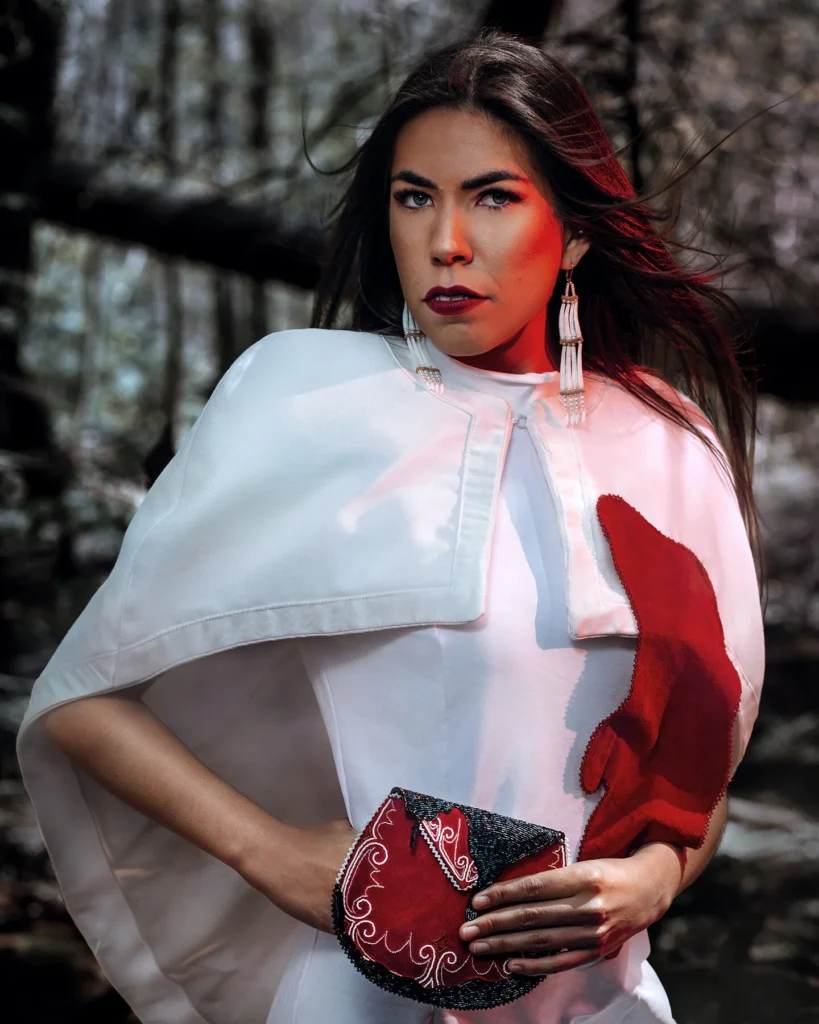
Oakley Rain Wysote Gray, Bleeding Heart Cape – M’st No’gmaq (All My Relations), 2021

7IDANsuu James Hart, Reconciliation Pole: Honouring a Time Before, During and After Canada’s Indian Residential Schools, 2015–17

Emma Hassencahl-Perley, White Flag, 2015

Brent Henry, English Only!, 2021

Shawn Hunt, Flipping the Bird, 2014

Lisa Jackson, Savage, 2009

Ursula Johnson, ITHA: The Livingroom, 2021

Siassie Kenneally, All the Things That I Have Seen, 2016

Jake Kimble, It’s All So Incredibly Loud, 2025

Duane Linklater, i want to forget the english language, ulterior, 2020/23

Jim Logan, National Pastimes, 1991

Luke Marston, Bentwood Box, 2009

Kevin McKenzie, Being Indigenous, 2024

Meryl McMaster, Truth to Power, 2017

Kent Monkman, The Scream, 2017

Caroline Monnet, The Black Case, 2014

Tim Moore, Erasure Is Futile, 2021

Peter Morin, This is what happens when you perform the memory of the land (parts 1 and 2), 2013
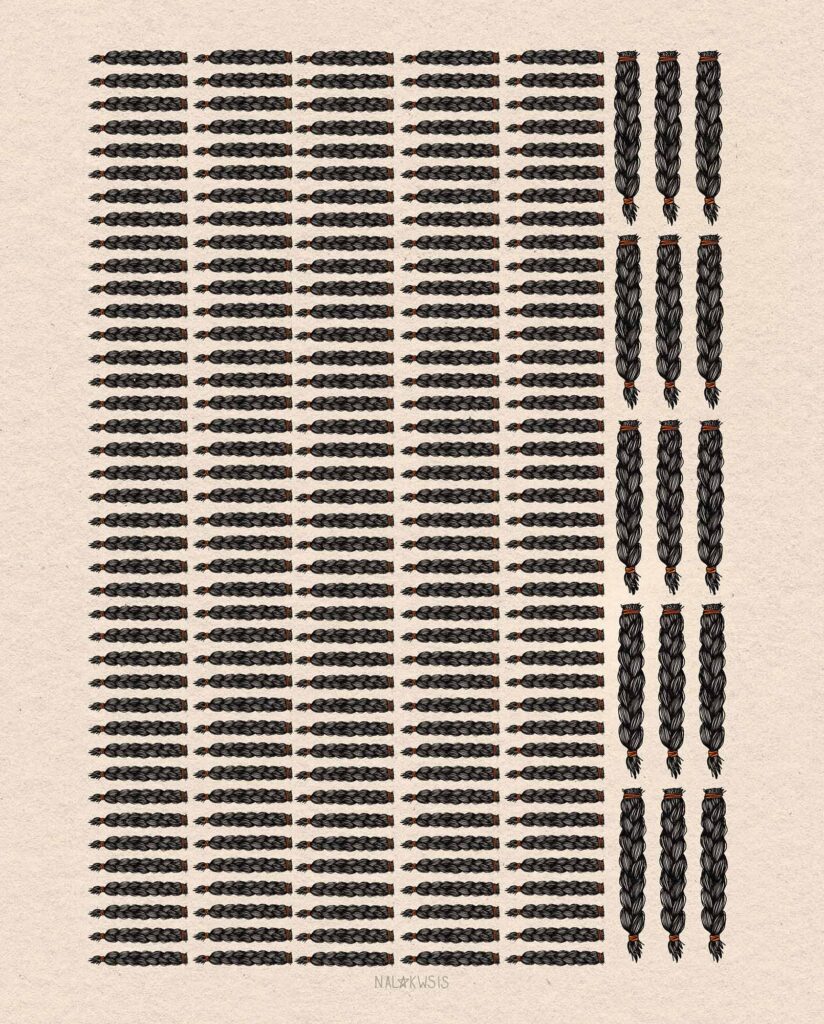
Saige “Nalakwsis” Mukash, 215 Braids, 2021

Nadia Myre, Indian Act, 2000–2002

Carey Newman, Witness Blanket, 2013–14

Davidee Ningeok, Sr., Residential School Nightmare, 2015
Shelley Niro, The Shirt, 2003

Luke Parnell, Neon Reconciliation Explosion, 2020

Dionne Paul, Her First Day of School, 2013
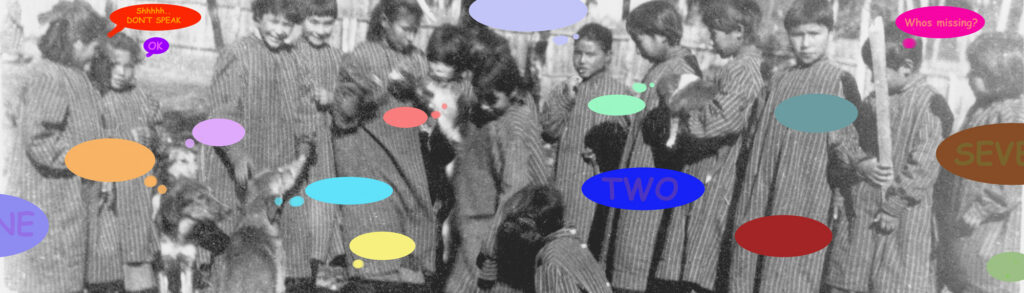
Edward Poitras, Don’t Speak, 2015

Barry Pottle, Yale Dormitory (Residential School), North West River, Labrador, 2015

Teharihulen Michel Savard, Reciprocity (Réciprocité), 2009

Jason Sikoak, Sacrilege, 2015

Greg Staats, Do’-gah – I don’t know [shrugging shoulders], 2020, archival pigment print on canvas on pine stretcher, oil, earth, Indian tobacco ash (edition 2 of 3), 142 x 175.3 x 2.5 cm, Agnes Etherington Art Centre, Kingston.

Alan Syliboy, Grandmother 1, 1997

Jeff Thomas, Broken Treaties, 1613–, 2020
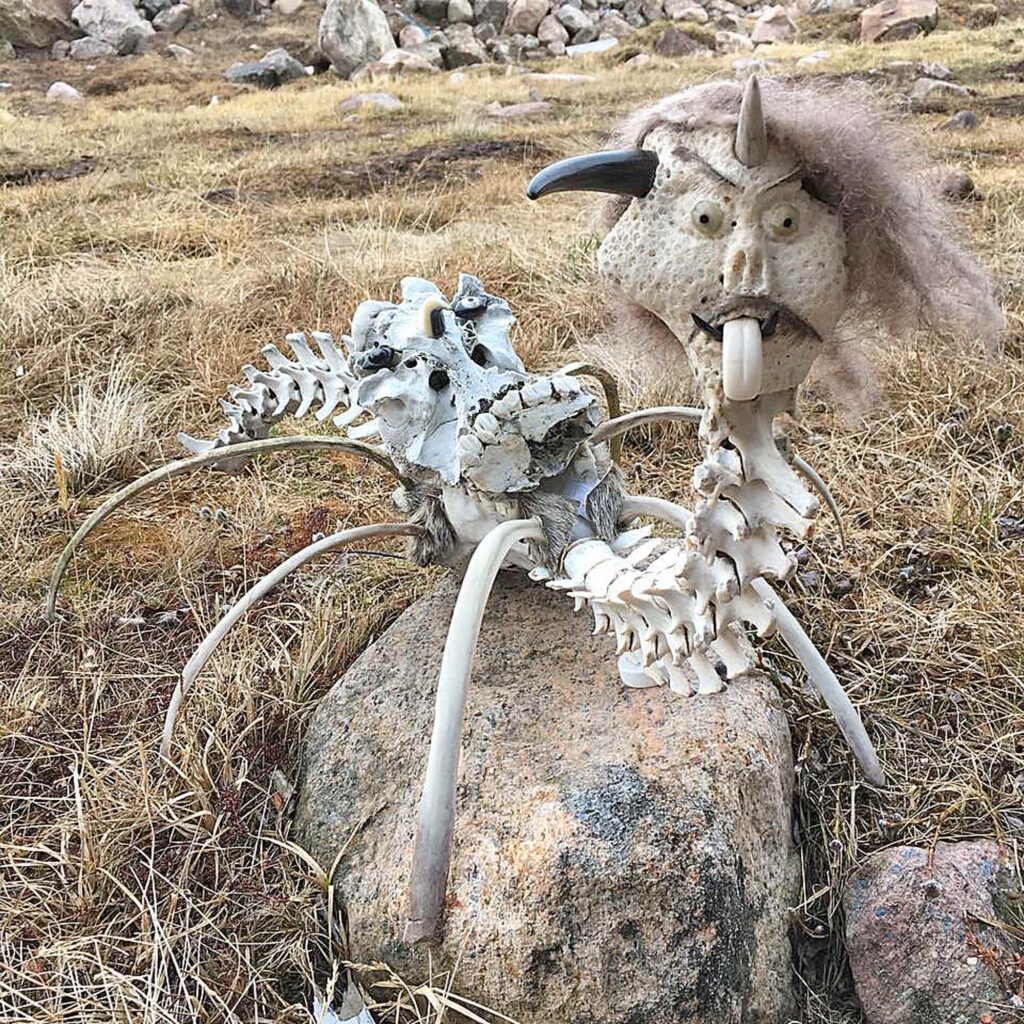
Jesse Tungilik, The Spirit of Intergenerational Trauma, 2019

Tania Willard, Be a Good Girl, 2017