
Children’s drawings from residential and day schools are among the earliest visual declarations of truth during the colonial encounter. These tender works, made in pencil, crayon, and paint during the mid-twentieth century, speak across time with a clarity unclouded by academic critique or adult mediation. They carry presence, relation, and resistance in their simplest forms: gestures on paper that insist on being remembered. To see them through the Plains Cree concept of tâpasinahikêwin, a mark done in a truthful way, is to recognize that these are far from innocent images or quaint school exercises: they are visual acts of survivance. These drawings are not merely responses shaped within colonial systems of control. From the moment of their making, they enacted an Indigenous epistemology grounded in relation, memory, and responsibility.
The works gathered in this chapter represent only a fraction of the children's drawings that survive from residential and day schools across Canada. Many more remain held in private collections, church archives, museum storage, and family homes—some known, many still undiscovered. Others have been lost entirely: destroyed, discarded, or simply uncatalogued in the decades since the schools closed. The selection presented here has been guided by what could be responsibly accessed, reproduced with permission, and situated within the communities from which these works came.
Collection of Children’s Drawings

Mark Atleo, Sockeye Salmon, 1960s

Rhoda K. Awa (Rhoda Katsak), Untitled (Community Scene with Airplane), late 1960s

Jeffrey Cook, Raven, n.d.
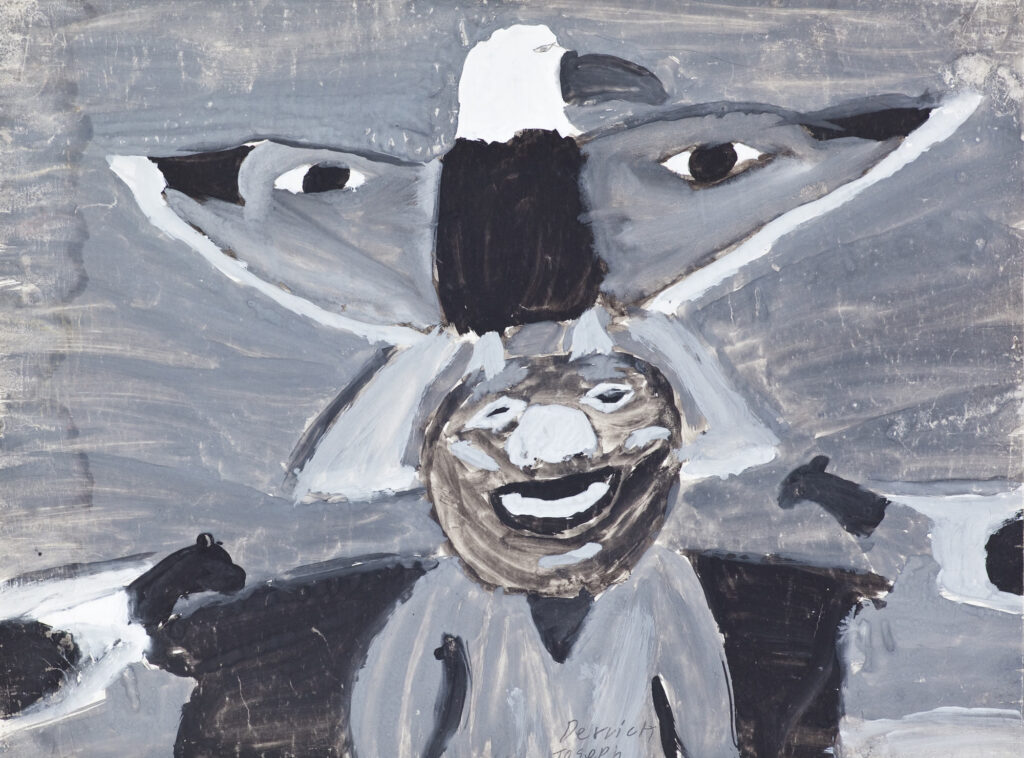
Joseph Derrick, Untitled (Eagle and Figure), 1958–60
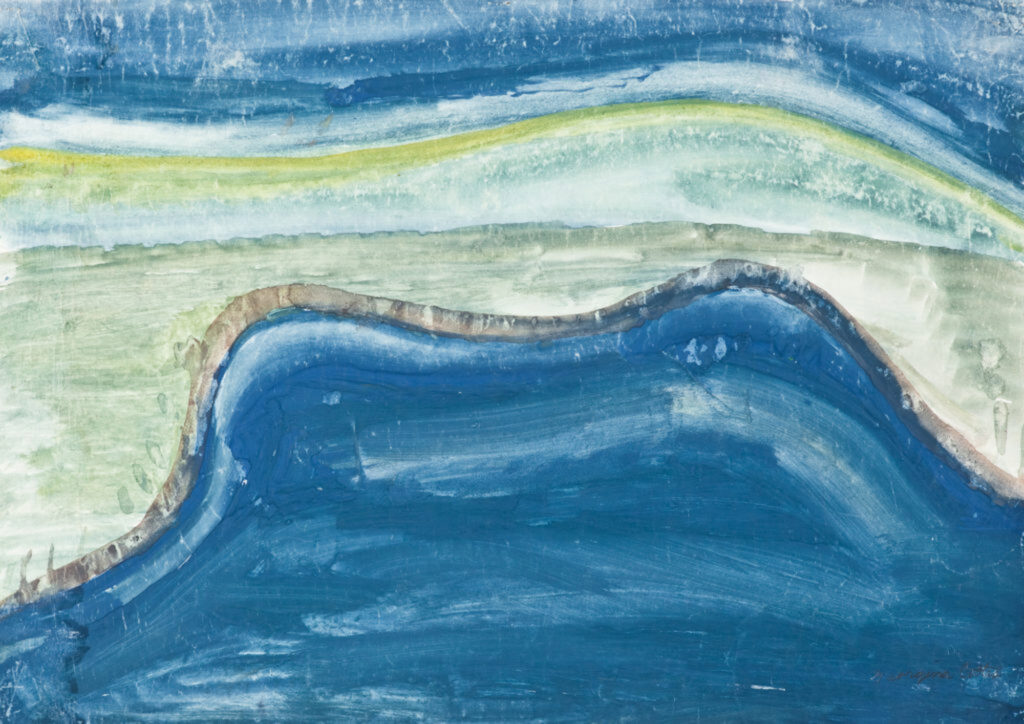
Gina (Daisy) Laing, The Beach, 1954–64
Once-known Stoney Nakoda child at Morley Residential School, untitled drawing, n.d.
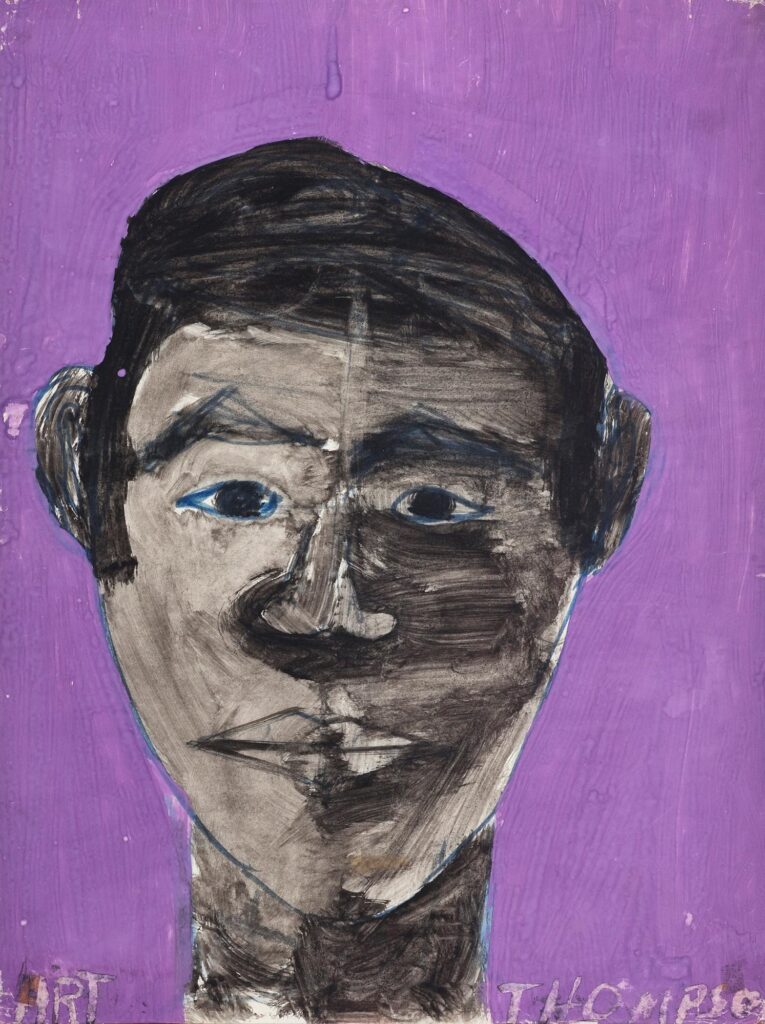
Art Thompson, Untitled (Portrait), late 1950s
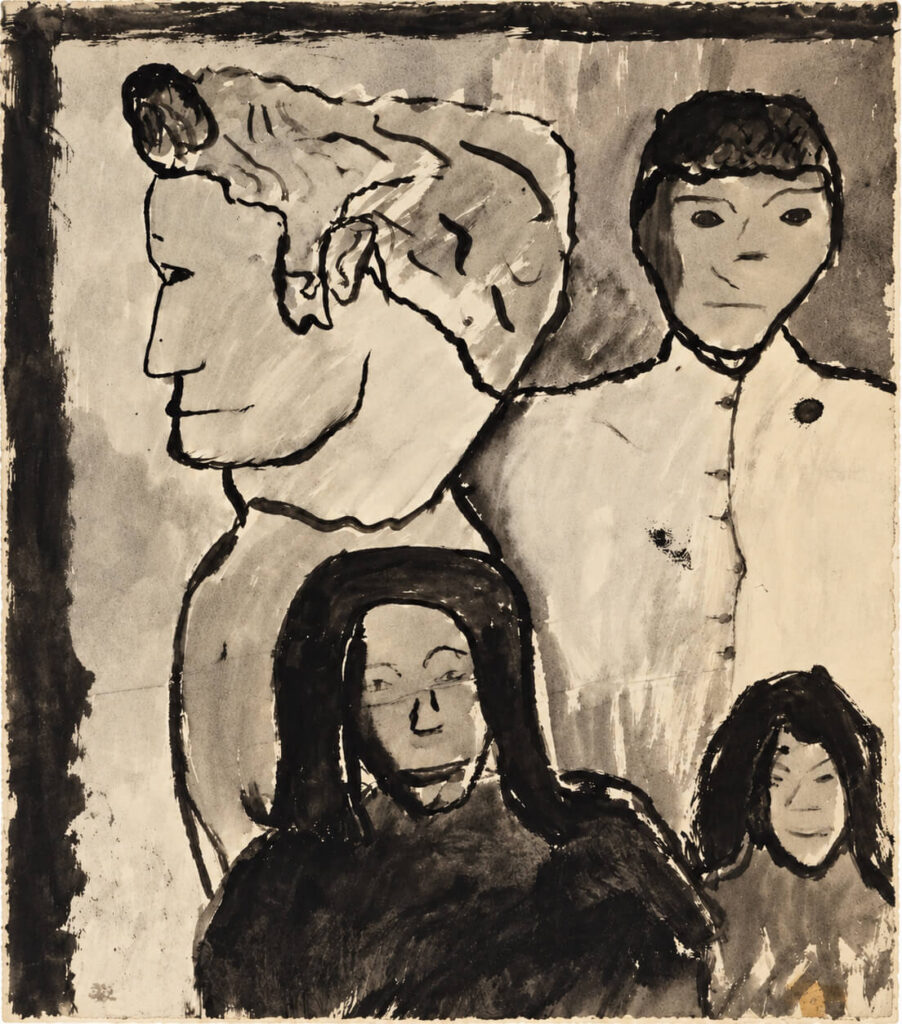
Jim Wastasecoot, Untitled (Family Portrait), 1960
schools and suppression
Although the Historical Overview outlined the broader history of the residential school system, it is necessary to return to its structure here, for it shaped the very conditions in which children created their drawings. By the 1930s, the residential school system was firmly entrenched across Canada. Its guiding principle, articulated with chilling frankness by Duncan Campbell Scott in 1920—“I want to get rid of the Indian problem”—was to assimilate Indigenous children into the colonial body politic.
The schools, run largely by churches, sought to suppress language, ceremony, and kinship structures, replacing them with English, Christianity, and colonial discipline. Day schools allowed children to return home in the evenings; regardless, the pedagogy remained rooted in assimilationist logic. These institutional conditions formed the environment in which children picked up pencils and brushes: a space of coercion where, even within that coercion, acts of drawing could speak truth.

Thomas Moore, a Cree boy, as he appeared when admitted to the Regina Indian Industrial School in Saskatchewan, 1891, photograph by Department of Indian Affairs.

Thomas Moore after admission at the Regina Indian Industrial School, photograph by Department of Indian Affairs.
One of the clearest demonstrations of how imagery itself became a weapon of this project is the case of Thomas Moore Keesick, a Saulteaux boy from Muscowpetung First Nation, Saskatchewan. In 1891, at just eight years old, Moore was admitted to the Regina Indian Industrial School, registered as “No. 22.” His likeness was captured in the notorious before-and-after photographs staged by the Department of Indian Affairs: the first shows him in traditional dress, with long braids framing his face, moccasins on his feet, and a rifle and furs beside him; the second, taken after several years, depicts him in a military-style uniform, with hair cut short, one hand on his hip, and polished shoes on his feet, posed beside a potted plant and ornate furniture.
These paired images were widely circulated as proof of the schools’ “civilizing” mission. They reduced Moore’s life to a visual equation: the so-called savage transformed into the supposedly prosperous young man. For politicians and the public, the photographs functioned as propaganda— fundraising tools that made assimilation appear inevitable and desirable. Yet, what they conceal is the violence of that transformation: the severing of language, kinship, and spirituality. The very symbols stripped from Moore—his braids, beads, and hunting implements—were the same ties residential schools sought to erase across generations.

Junior girls’ class at Alberni Indian Residential School, Port Alberni, British Columbia, c.1930, photographer unknown, BC Archives, Royal BC Museum, Victoria.
Moore’s story ends tragically. In 1895, only four years after entering the school, he died of tuberculosis, one of thousands of children whose lives were cut short within these institutions. His life, like so many others, is not the outlier but the norm. Today, the photographs that once served as propaganda read as blueprints of cultural genocide, stark reminders of how the state sought to transmute Indigenous children into settler ideals. They stand as visual records of erasure, a colonial alchemy enacted on the body of a child.
It is important to recognize that these institutions were not monolithic. The experiences of children at day schools, industrial schools, and residential schools varied by region, governance, and teacher. At northern mission schools, artistic expression was largely marginal. Where it appeared at all, it was folded into manual training alongside utilitarian tasks, while broader arts programming, such as music, painting, sculpture, and crafts, was consistently under-resourced and overshadowed by athletics. In the West Coast residential schools, the arts were introduced to students as a source of revenue. Schools emphasized market-ready craft production. Instruction in fine art disciplines was exceptional and largely carried out on a volunteer basis. These differences shaped the visual archive that survives: a patchwork of children’s marks that together form a map of resistance across the country. Regardless of variation, the underlying purpose of each institution remained the same: to sever Indigenous worlds. The children’s drawings that emerge from these spaces, therefore, carry artistic value as well as a geographical imprint of survivance: each mark embedded in its particular place, each school producing its own contours of truth.
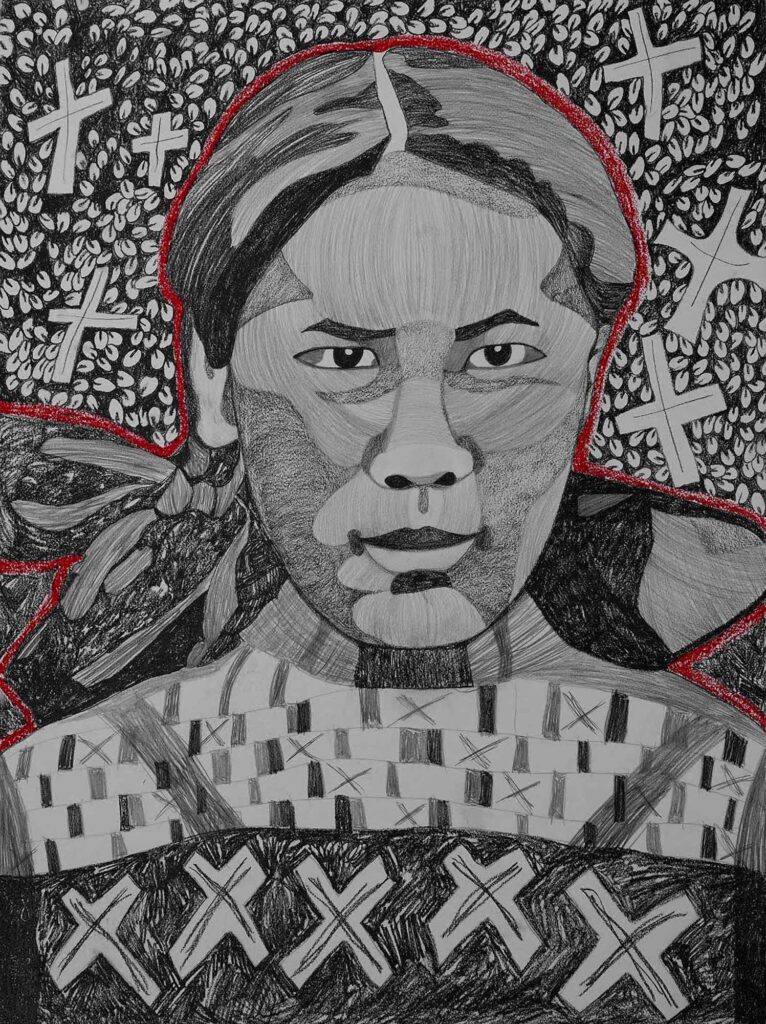
George Littlechild, Unidentified Child from the Ermineskin Indian Residential School #7, 2019, mixed media on paper, 76.2 x 55.9 cm.

George Littlechild, Unidentified Child from the Ermineskin Indian Residential School #4, 2019, mixed media on paper, 76.2 x 55.9 cm.

Installation view of Here I am – can you see me?, by Dr. George Littlechild, 2025, photographer unknown, Comox Valley Art Gallery.
Colonial photography functioned as a technology of control, producing images that translated Indigenous lives into evidence for assimilation and erasure. The infamous before-and-after photographs of children such as Moore were staged to narrate progress, disciplining the Indigenous body into a visual grammar of colonial success while concealing the violence of loss, illness, and death that followed. Indigenous modernism repeatedly returns to this photographic legacy to expose its falsity. Carl Beam (1943–2005), for example, incorporated archival photographs into his paintings and installations to fracture their authority, reworking colonial imagery into sites of memory, rupture, and resistance. More recently, the exhibition Here I am – can you see me? by George Littlechild (b.1958) confronted the same visual archive, reclaiming family photographs and institutional records to restore names, faces, and relations erased by bureaucratic anonymity.
Where official images once sought to fix Indigenous children into narratives of disappearance, contemporary artists mobilize those same images to insist on presence, accountability, and truth, extending the quiet through-line from children’s drawings to Indigenous modernism as a sustained practice of visual survivance. These later artistic interventions clarify what is already present in the children’s drawings themselves: that Indigenous visual knowledge, even in its earliest recorded forms, was never passive but actively engaged in truth telling, memory, and resistance.
Teachers, Tensions, and
the Civilizing Ritual

A kindergarten student painting at Alberni Student Residence, Alberni Indian Residential School, Port Alberni, British Columbia, 1960s, photographer unknown, United Church of Canada Archives, Toronto, Ontario.
Why was art taught in the schools? At first glance, drawing appears benign when compared with the harsher tools of assimilation: hair cutting, uniforms, prayer, labour, surveillance, and punishment. Yet, within the logic of these institutions, art was never innocent. It formed part of the civilizing project—a means of reshaping Indigenous perception itself. Administrators and teachers believed that European-style drawing would discipline the hand and, by extension, the mind. To draw from still life, to copy biblical scenes, to reproduce straight lines and geometric order was to practise obedience and absorb the visual habits of Euro-Christian culture.
Thus, art instruction became a minor but deliberate component of colonial pedagogy. It trained children to see through a settler lens, privileging proportion, symmetry, naturalism, perspective, and the authority of the individual eye over Indigenous relational ways of seeing. Pencils and brushes were offered not primarily as instruments of self-expression but as tools of bodily and mental regulation. Art was meant to redirect Indigenous imagination.
Underlying this was a deeper assumption: that the Indigenous perspective had to be replaced. School officials frequently described Indigenous art as primitive, decorative, or superstitious. European drawing, by contrast, was framed as rational, observational, and morally elevating. In this context, even the seemingly simple act of holding a pencil became part of the assimilationist project, an attempt to overwrite knowledge carried through land, kinship, story, and ceremony.
Nevertheless, children did not simply submit to this visual discipline. In their hands, pencils, crayons, and brushes became instruments of memory. They drew animals, dances, family scenes, home territories, journeys, and ceremonies. Even within institutional constraints, they used drawing to hold on to worlds that colonial education sought to suppress. For this reason, children’s art from residential and day schools is rarely neutral. It is often a form of witness.
That is why, when Survivors encountered their childhood drawings decades later, in addition to recognizing the images themselves, many spoke of the truth the images once held. They saw in the images something they had known and preserved. Through drawing, they carried forward relationships to land, ancestors, and cultural memory, often without knowing the future significance of what they were making.
The Child’s Truth
Against this backdrop of art as discipline within colonial schooling, there were instances in which individual teachers opened spaces for Indigenous creativity to surface. At Inkameep Day School on the Nk’Mip reserve in British Columbia, Irish-born teacher Anthony Walsh (1908–1994) encouraged his Syilx students to paint from their own stories and ceremonies. At Alberni Indian Residential School, after-hours sessions run by Robert Aller (1922–2008) allowed children to draw from memory rather than from prescribed models. These moments did not undo the colonial structure, but they created openings within it.
The situation with teachers such as Walsh reveals the paradox at the heart of children’s art in these institutions: even when educators opened small windows of cultural expression, the broader system remained dedicated to erasure. Some teachers permitted, or even celebrated, Indigenous subject matter, but others banned it outright, insisting that children reproduce European still lifes or biblical scenes. In both contexts, children navigated this terrain with remarkable skill, inserting the symbols of their own worlds where they could. In this sense, the drawings demonstrate a sophisticated social fluency: the ability to move between imposed expectations and cultural responsibility, often within a single page. Through these openings, drawing could become something more than exercise: it could become testimony.
Gina (Daisy) Laing, The Beach, 1954–64, private collection.
The Plains Cree concept of tâpasinahikêwin, a mark done in a truthful way, offers a way to understand this shift. To draw is to affirm what has been seen, lived, and known. The image becomes a record of experience rather than simply a representation of it. In this light, children’s drawings from residential and day schools emerge as acts of visual truth telling.
Themes in Children’s Drawings
The works considered here span several regions and decades. Despite these differences, they share a common orientation. They turn outward from the institution toward land, animals, and memory. They do not reproduce the school. They reassert the world beyond it.
One of the most persistent themes across these works is land as a structuring force of memory. The Beach, c.1954–64, by Gina (Daisy) Laing (b.1947) offers a clear example. Painted while she attended Alberni Indian Residential School, the work turns away from the institution entirely. Bands of blue water, shoreline, and distant land organize the image. It is not simply a landscape; it is a remembered place, grounded in her Uchucklesaht homeland, where relationships to water, family, and seasonal life shaped experience. A similar orientation appears in panoramic drawing of Igloolik, Nunavut, by Rhoda K. Katsak (née Awa). Her composition includes houses, igluit (igloos), dog teams, hunters, and inuksuit (inukshuks), while an airplane enters the scene from above. The image captures a moment of transition in Inuit life, where Qallunaat (non-Inuit) infrastructure and Inuit knowledge systems coexist. Yet, the emphasis remains on community and land. The drawing maps a lived world rather than an institutional one. In both cases, the child does not depict the school. Instead, she draws the world that sustains her. Through tâpasinahikêwin, land becomes memory made visible.
Rhoda K. Katsak, Untitled (Community Scene with Airplane), c.late 1960s, National Centre for Truth and Reconciliation, Winnipeg.
Mark Atleo, Sockeye Salmon, 1960s, private collection.
Jeffrey Cook, Raven, n.d., private collection.
Rhoda K. Katsak, Untitled (Community Scene with Airplane), c.late 1960s, National Centre for Truth and Reconciliation, Winnipeg.
Mark Atleo, Sockeye Salmon, 1960s, private collection.
Jeffrey Cook, Raven, n.d., private collection.
A second thematic current is the persistence of animal knowledge. These images transcend simple representations of animals—they are expressions of relationships and teachings carried through family and community. Mark Atleo’s sockeye salmon, painted when he was seven years old at Alberni, recalls teachings he received from his grandfather before he was taken to school. The salmon is caught within a net, its form rendered in bright colour. The image carries knowledge of fishing practices, kinship responsibilities, and cycles of life central to Nuu-chah-nulth culture. Decades later, the return of this painting reactivated those memories, linking childhood experience to adult understanding. Jeffrey Cook’s Raven, n.d., similarly reflects cultural knowledge rooted in Huu-ay-aht and broader Northwest Coast traditions. The large black bird, with its watchful eye, dominates the page. Raven is known as a being associated with transformation, knowledge, and creation. Through this image, Cook affirms a relationship to story and land that the school sought to interrupt.
Joseph Derrick’s image of an eagle hovering above a human figure introduces another dimension. The vertical relationship between bird and human suggests connection, transformation, or guidance. The composition echoes Northwest Coast visual structures in which the human and animal realms are interconnected. Through these works, children draw what they have been taught to know. They enact tâpasinahikêwin by affirming relationships between humans, animals, and the more-than-human world.

Attributed to Kadyisdu.axch’ (Tlingit, Kiks.adi clan, active late-eighteenth to early-nineteenth century), Yéil X̱ʼéenh (Raven Screen) (detail), c.1810, spruce, paint, 268.6 x 327.7 cm, Seattle Art Museum. A historical example of Northwest Coast formline art.
Joseph Derrick, Untitled (Eagle and Figure), 1958–60, private collection.
A third thematic strand emerges through images of gatherings and movement. The Inkameep Day School drawings are central here, though they are not reproduced in this volume. Created by Syilx children with the guidance of Anthony Walsh in the 1930s and 1940s, they are known to depict riders traversing the Okanagan landscape, dancers assembling in ceremonial formations, and scenes unfolding sequentially across the page, reflecting Syilx knowledge systems grounded in story, land, and collective life. The Osoyoos Indian Band community’s ongoing work of stewardship and return is itself a continuation of this tradition. Similarly, drawings by Stoney Nakoda children at Morley Residential School depict tipis, rodeo riders, and scenes of community activity. Horses move across open ground, linking the children to traditions of horsemanship and mobility central to Plains cultures. These images are not incidental. They record collective practices that the residential school system sought to regulate or suppress. Through drawing, children preserved these forms of life, carrying them forward in visual form.

Children on the steps of Morley Residential School, before November 1930, photographer unknown, United Church of Canada Archives, Toronto.
But not all drawings turn outward. Some register the interior experience. For instance, a portrait by Art Thompson (1948–2003) created at Alberni presents a face divided between light and shadow. One side is visible, the other obscured. The composition conveys tension, suggesting a consciousness shaped by the pressures of the residential school environment. Even as a child, Thompson’s work registers an awareness of division, concealment, and presence. These images remind us that tâpasinahikêwin also includes the drawing of internal states. Truth is not only external and relational—it can also be psychological and embodied.
Repatriation as Ceremony
In the late 1950s, art instructor Robert Aller introduced painting to Indigenous students at Alberni Indian Residential School. His classroom offered moments of respite within the residential school environment, and he recognized and valued the children's artistic expression. Aller preserved many of their paintings for decades after the children left the school. His efforts ensured the survival of works that might otherwise have been lost.
I came to know Aller briefly in the late 1970s, when we were both teaching at James Smith Cree Nation in Saskatchewan. I recall him showing me drawings he had kept, speaking of them with admiration. Looking back, that encounter underscores the complicated history of these works: their preservation made their survival possible, while their subsequent return has prompted important questions about who should care for, interpret, and hold children's works created within the residential school system. Repatriation restores these drawings to the communities from which they emerged, allowing them to participate in Indigenous systems of knowledge, memory, and cultural continuity.
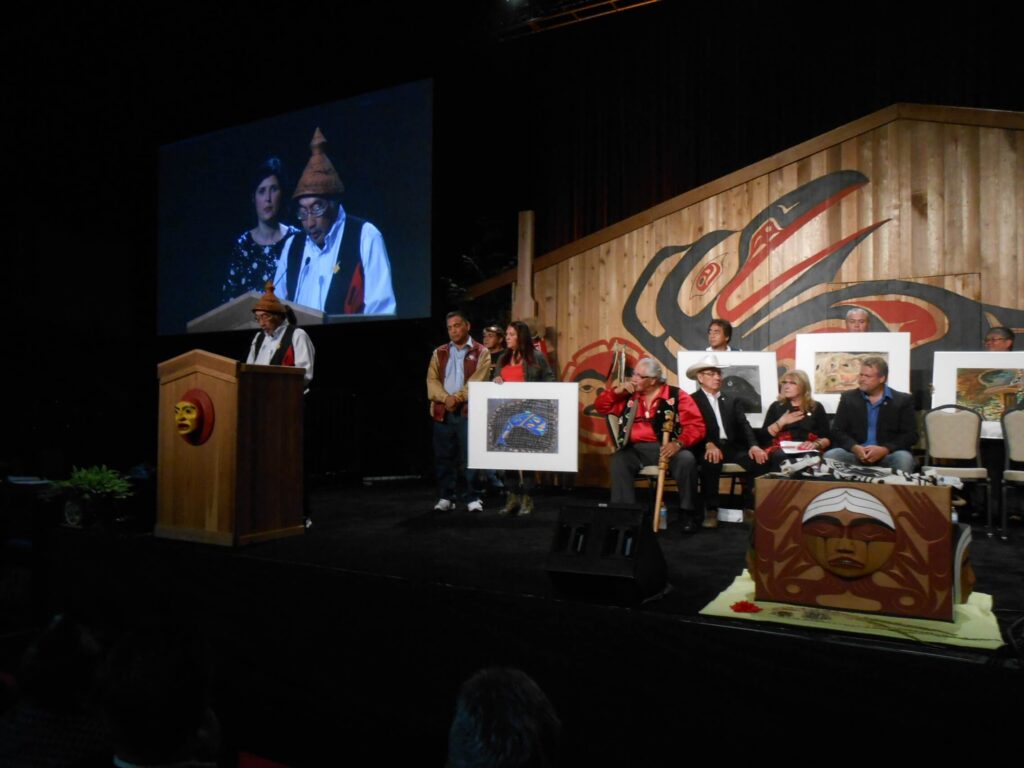
Repatriation of childhood painting created by Mark Atleo (Ahousaht First Nation) at the TRC National Event in Vancouver, B.C. September 21, 2013, photograph by Andrea Walsh.
Repatriation, beyond being the movement of objects from one place to another, is the restoration of relations that were severed through colonial collection practices. For many Indigenous Nations, images created by children are not inert documents but beings with presence, memory, and responsibility. They hold the imprint of the child’s hand, the conditions of their making, and the worlds they recall. Their return creates opportunities to reconnect them to the networks of relations that gave them meaning, to acknowledge the children who created them, and to recognize the communities to which they belong. Repatriation, then, involves more than giving something back; it acknowledges the rupture and invites witnesses to participate in its repair.

Andrea Walsh with Mark Atleo, Ahousaht First Nation and Survivor of Alberni Indian Residential School, date unknown, photograph by Gregory Miller, UVic Photo Services.
In recent decades, Survivors have led efforts to restore the connections between residential school artworks and the children who created them. Anthropologist Andrea Walsh, based at the University of Victoria, has supported and documented this work, taking her lead from Survivors and their families in treating the pieces as animate beings with agency and memory. Her scholarship on the repatriation of paintings created by children at Alberni Indian Residential School describes a Survivor-led process involving participants from several Indigenous Nations, guided through consultation with Salish Elders. Working with materials held by families, churches, museums, and private estates, Walsh helps facilitate connections between institutions and communities, and between archives and living relations. Her curatorial method, grounded in listening and accountability, acknowledges this responsibility. Rather than speak for the children, she works to create the conditions through which their drawings can speak again. Through this careful and collaborative approach, what once lay in drawers and storage boxes becomes a communal archive of truth returned to the relations that give these works their meaning.
Anthony Walsh, Robert Aller, and Andrea Walsh occupy different positions across time, yet their roles point to the ways non-Indigenous teachers, collectors, scholars, and institutions have mediated how these works were preserved, understood, and encountered. This history of mediation brings larger questions of perspective into view: how truth is framed, who is authorized to speak, and what forms of knowledge are recognized. The changing nature of these relationships, including evolving approaches to the preservation, stewardship, and care of works, reflects a broader shift toward Indigenous authority and Survivor-led practice. In the post-Truth and Reconciliation Commission (TRC) era, bringing these drawings home is therefore also about restoring the conditions through which Indigenous communities can interpret their meaning and tell their own truths on their own terms.
Through song, processional movement, language, and the presence of Elders, the return of children’s drawings becomes an event in which truth is spoken, grief is held, and relations are re-established. This ceremonial framing prepares us to understand why the work of individuals like Andrea Walsh carries such weight: in addition to recovering artworks, it restores the conditions through which Survivors, families, and communities can once again be in relation with them.

Paintings by children who attended Alberni Indian Residential School, Alberni Athletic Hall, March 30, 2013, photograph by Debora Steel.
The repatriation of children’s paintings from Alberni Indian Residential School in 2012 and 2013 illustrates how art can become testimony in motion. An important step in the process took place at the regional TRC event held in Victoria in April 2012, when forty-seven paintings created by children at the school between the late 1950s and mid 1960s were brought into the gathering. Nuu-chah-nulth women, accompanied by singers and drummers, carried each painting into the hall, while Survivors and their families participated and bore witness. From this collective act, the process became deeply personal as individual paintings were reunited with Survivors. When a painting by Mark Atleo was returned to him decades after he created it as a child, he was overcome. The painting unlocked memories long suppressed. He spoke of his grandfather, of fishing, of teachings that colonial schooling tried to silence. The painting now hangs in his home, a constant reminder of resilience.
Through such acts of return, a work shifts from artifact to animate witness. Survivors see their childhood marks, long forgotten, and memories surface: of grandparents, fishing trips, village dances. What might have been dismissed as school art is a living archive—vessels of truth requiring care and dignity. Through repatriation, tâpasinahikêwin is enacted again; the drawings tell the truth not only of their making but of their return. They are reanimated as witnesses.
Drawings as Living Testimony
Where official photography sought to erase, children’s pencil marks tell truths. Where colonial imagery displays the absence or taking away of culture, acts of tâpasinahikêwin preserve presence. The wary gaze found in Moore’s “before” photograph, with its quiet hints of defiance, finds its echo in the confident lines of children’s drawings in which animals, ceremonies, and memories endure on paper despite the pressures of assimilation. This truth telling through children’s drawings extends beyond Canada, forming part of a broader transnational archive of Indigenous survivance that links residential and removal histories across settler states.
Alongside Thompson, Awa, and Atleo, many other children created works of profound resonance. Encouraged in rare cases by teachers like Anthony Walsh, these drawings and paintings became extensions of story and ceremony. Even when framed as simple school assignments, they carried knowledges that colonial education could not erase. Such works remind us that children were not merely pupils but knowledge holders. Their marks preserved law, memory, and relationship in forms that outlasted the schools themselves. When returned to families and communities, they become animate again. From static images in an archive, they re-emerge as living presences that carry responsibility and teaching into the present.

Ernest peeking through craft work done by boys of St. Cyprian's Indian Residential School, c.1950, photograph by Bernice Logan, General Synod Archives, Anglican Church of Canada.

Junior students at Old Sun Residential School, Gleichen, Alberta, 1952, photographer unknown, General Synod Archives, Anglican Church of Canada.
To view children’s drawings from residential and day schools is to stand at the intersection of suppression and resilience. These works were created in contexts designed to silence Indigenous voices; however, they speak with clarity across generations. In reclaiming these drawings as acts of testimony, we shift them from artifacts to archives, from collections to relationships. They remind us that truth telling is not only adult work, nor only retrospective. Children told truths in their time, in their way, through pencil and paint. Those truths continue to speak.
This imposed way of seeing had consequences far beyond the schoolroom. Many Indigenous artists of subsequent generations, even those celebrated for their innovative, decolonial, or community-rooted practices, were first trained through Eurocentric visual regimes. Their earliest lessons in proportion, perspective, shading, and naturalism came from the very institutions designed to dismantle Indigenous visual knowledge systems. The imprint of this training is visible across the twentieth century in the work of painters, printmakers, carvers, beadworkers, performers, and photographers who learned to navigate, subvert, or reject the colonial grammar of seeing they inherited. In this way, the legacy of school-based art instruction becomes a quiet through-line in Indigenous modernism, a visual inheritance shaped by coercion yet continually reworked into acts of reclamation, sovereignty, and truth.
The continuity between childhood drawing and later artistic practice forms an essential bridge to the stories of the many Survivors who became artists, including Beam, Alex Janvier (1935–2024), Jim Logan (b.1955), Robert Houle (b.1947), and others, who carry forward the early impulses visible in these schoolroom works. The animals, ceremonies, and landforms of childhood reappear in adult work, transformed by experience but rooted in the same visual sovereignty first expressed in pencil and crayon. Children’s drawings are foundations rather than preludes: they establish the aesthetic and ethical commitments that later generations of artists would deepen, expand, and carry into public consciousness.

Jim Logan, Hiding From the Boogeyman, 2018, acrylic on canvas, 65.1 x 80.3 cm, Indigenous Art Centre, Crown-Indigenous Relations and Northern Affairs Canada, Gatineau.