Jim Logan, National Pastimes, 1991

Jim Logan, National Pastimes, 1991, acrylic on canvas, 122 x 183.2 cm, Indigenous Art Centre, Crown-Indigenous Relations and Northern Affairs Canada, Gatineau.
National Pastimes by Métis painter Jim Logan (b.1955), part of his series A Requiem for Our Children, is among the earliest sustained visual engagements with the residential school system in Canadian art. Bands of pink sky and mauve mountains float above snow-covered paths and brightly painted houses, the heightened palette creating a dissonant sense of warmth that sharpens the underlying gravity. A flattened perspective and comic-strip outlines recall Woodland art practices; yet, they remain distinctly Logan’s own. The graphic clarity invites viewers in, while accumulations of detail—broken windows, laundry strung in the wind, a small chapel steeple—slowly disclose the structural conditions that enabled forced schooling. Scale and spacing matter: children shrink against vast environmental fields, and institutions, though sometimes distant, anchor the horizon like inescapable facts.

Jim Logan, Father Image I, 1991, acrylic on canvas, 53 x 63 cm, Indigenous Art Centre, Crown-Indigenous Relations and Northern Affairs Canada, Gatineau.

Jim Logan, The One the Elders Kept from the School, 2018, acrylic on canvas, 76.2 x 101.2 cm, Canada Council Art Bank, Ottawa.
One of a series of paintings in which Logan renders absence as communal trauma, National Pastimes stages a jubilant winter hockey game in a makeshift rink ringed by leaning fence posts. At the town’s edge, a red, cross-capped school block looms, its institutional geometry chilling the convivial scene. Father Image I, 1991, pushes closer: a pale cleric grips three uniformed boys before the school facade, hockey play continuing in the background—amusement and menace collapse into one frame. Works such as The One the Elders Kept from the School, 2018, isolate a lone child amid tilted power poles, derelict vehicles, and candy-coloured houses, visual shorthand for communities stretched thin by poverty and loss.
The series functions as counter-memory. Where national narratives long framed these sites as places of benevolent education, Logan rereads the built environment’s dormitories, playground fences, and mission churches as instruments of assimilation whose effects echo through domestic spaces in the form of overfull yards, improvised repairs, and caregivers bent to endless labour. His quietly caustic humour—a priest refereeing hockey, a broken boat repurposed as a laundry rack—exposes the absurdities of colonial paternalism without forfeiting compassion for those who endured it.
Logan’s painterly language, often described as a folksy post-Impressionism edging toward Fauvism, deploys saturated colour blocks, assertive black contour lines, and panoramic perspectives to stage complex social narratives from northern and Métis communities. Logan studied European masters as a young man, trained in graphic design, and later served as a lay minister in the village of Kwanlin Dün near Whitehorse, Yukon. His ministry placed him face to face with the intergenerational wounds carried by families scarred by Indian residential schools. Painting became his chosen form of social statement, an arena where beauty and indictment could occupy the same surface.
Shown in northern community centres and southern galleries decades before the establishment of the Truth and Reconciliation Commission of Canada, National Pastimes helped seed public conversation about residential school harms. Educators use the paintings in the series to prompt dialogue; their accessible figuration and vivid palette open doors for viewers who might resist more confrontational imagery. For Indigenous audiences, the works validate memory; for settler viewers, they unsettle complacency. Logan demonstrates how narrative painting can bear witness, archive lived knowledge, and insist that reconciliation begin with seeing what was taken—and who survived to paint it.
Gallery of A New Generation of Witness

Sonny Assu, Leila’s Desk, 2013

Michael Barber, A Silent Sky, 2022

Christi Belcourt, Giniigaaniimenaaning (Looking Ahead), 2012

Rebecca Belmore, Apparition, 2013

Rain Cabana-Boucher, Laying Flowers, 2021–24

Quill Christie-Peters, Portrait of Ste. Margaret’s Residential School and All It Could Not Contain, 2018

Dana Claxton, Headdress – Shadae and her Girlz, 2023

Beau Dick, The Ghost Confined to the Chair, 2012
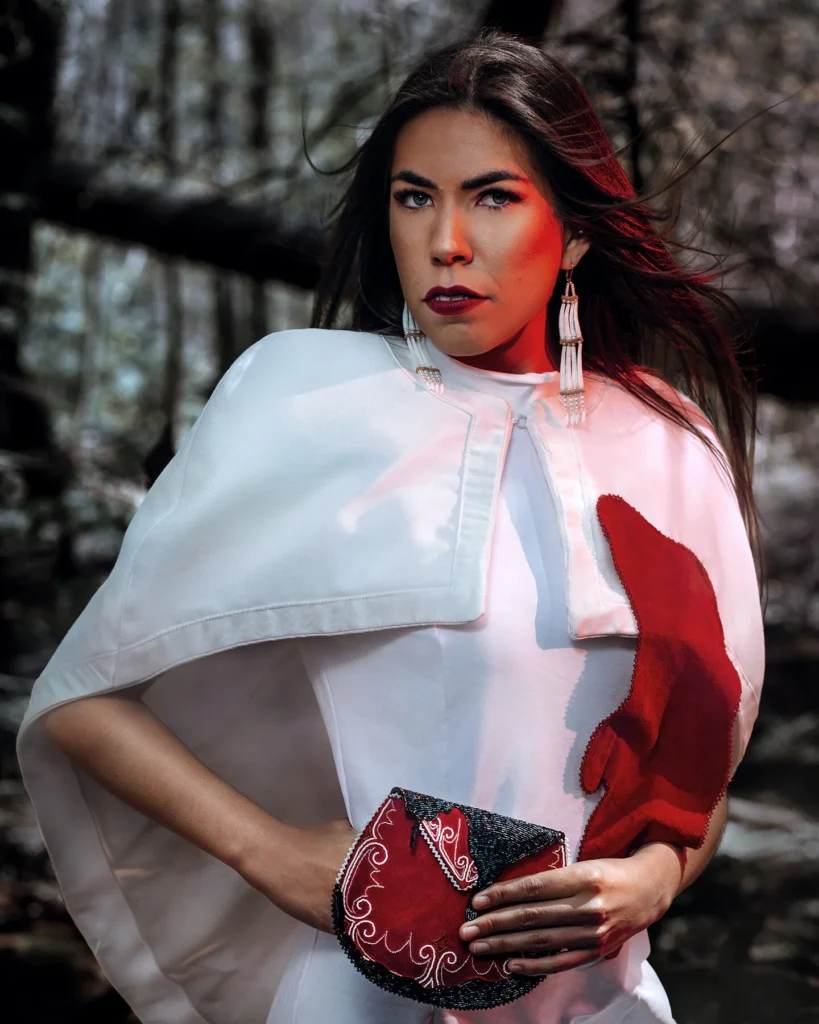
Oakley Rain Wysote Gray, Bleeding Heart Cape – M’st No’gmaq (All My Relations), 2021

7IDANsuu James Hart, Reconciliation Pole: Honouring a Time Before, During and After Canada’s Indian Residential Schools, 2015–17

Emma Hassencahl-Perley, White Flag, 2015

Brent Henry, English Only!, 2021

Shawn Hunt, Flipping the Bird, 2014

Lisa Jackson, Savage, 2009
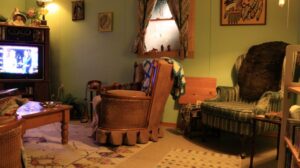
Ursula Johnson, ITHA: The Livingroom, 2021

Siassie Kenneally, All the Things That I Have Seen, 2016

Jake Kimble, It’s All So Incredibly Loud, 2025

Duane Linklater, i want to forget the english language, ulterior, 2020/23
Jim Logan, National Pastimes, 1991

Luke Marston, Bentwood Box, 2009

Kevin McKenzie, Being Indigenous, 2024

Meryl McMaster, Truth to Power, 2017

Kent Monkman, The Scream, 2017

Caroline Monnet, The Black Case, 2014

Tim Moore, Erasure Is Futile, 2021

Peter Morin, This is what happens when you perform the memory of the land (parts 1 and 2), 2013
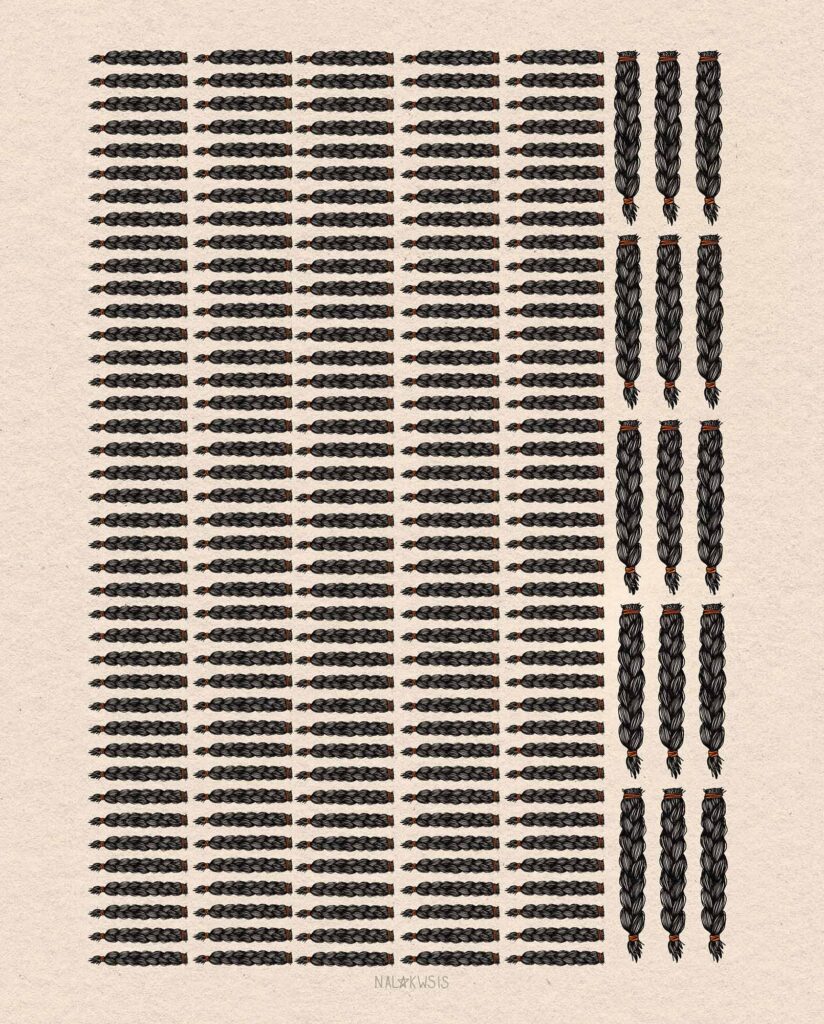
Saige “Nalakwsis” Mukash, 215 Braids, 2021

Nadia Myre, Indian Act, 2000–2002

Carey Newman, Witness Blanket, 2013–14

Davidee Ningeok, Sr., Residential School Nightmare, 2015

Shelley Niro, The Shirt, 2003

Luke Parnell, Neon Reconciliation Explosion, 2020

Dionne Paul, Her First Day of School, 2013
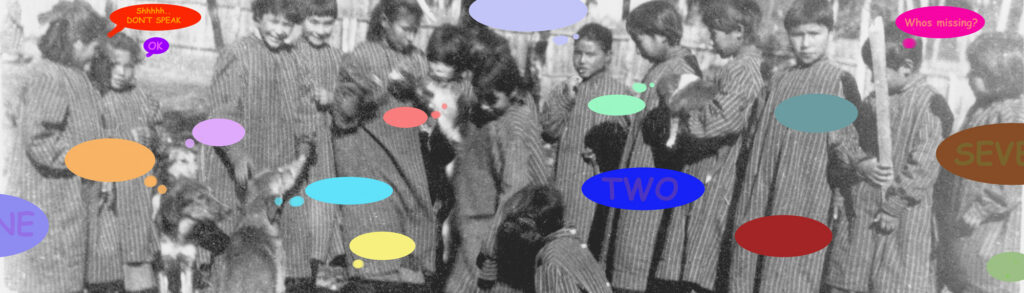
Edward Poitras, Don’t Speak, 2015

Barry Pottle, Yale Dormitory (Residential School), North West River, Labrador, 2015

Teharihulen Michel Savard, Reciprocity (Réciprocité), 2009

Jason Sikoak, Sacrilege, 2015

Greg Staats, Do’-gah – I don’t know [shrugging shoulders], 2020, archival pigment print on canvas on pine stretcher, oil, earth, Indian tobacco ash (edition 2 of 3), 142 x 175.3 x 2.5 cm, Agnes Etherington Art Centre, Kingston.

Alan Syliboy, Grandmother 1, 1997

Jeff Thomas, Broken Treaties, 1613–, 2020
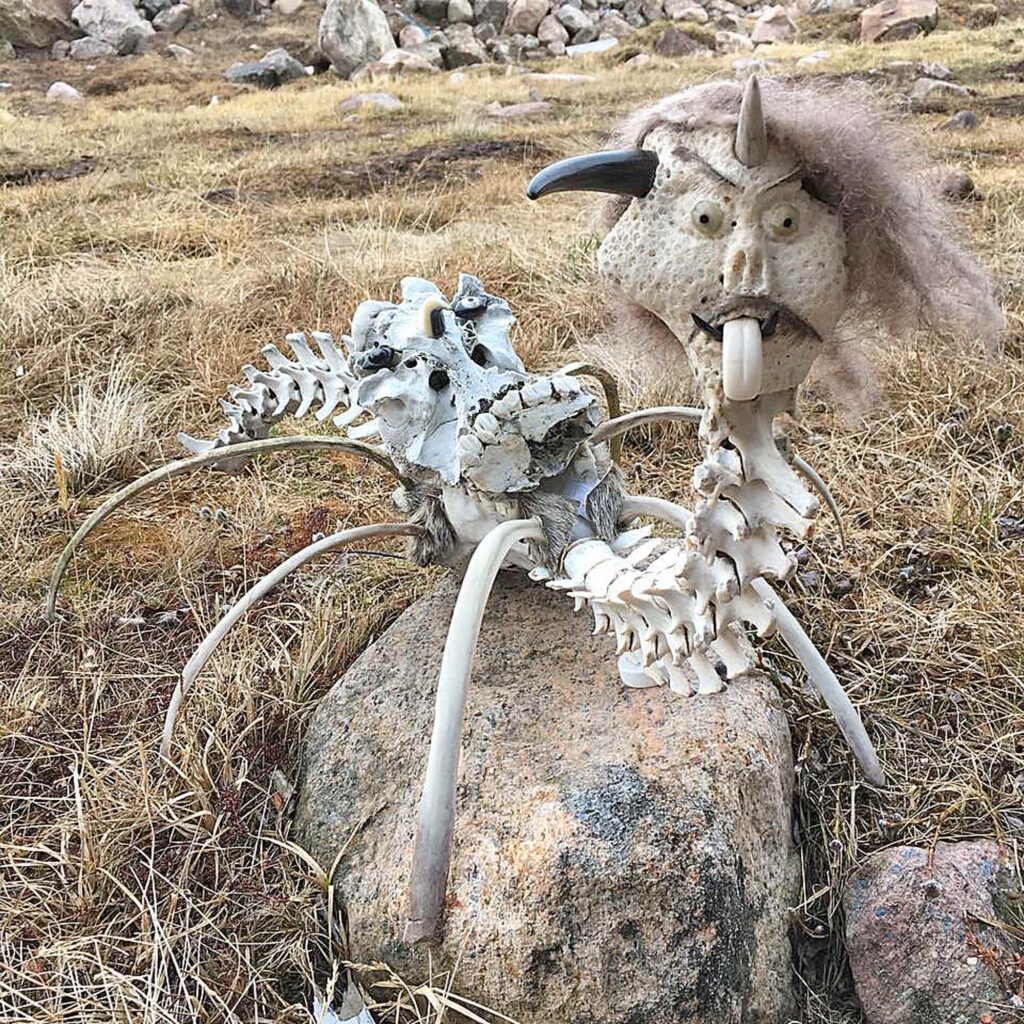
Jesse Tungilik, The Spirit of Intergenerational Trauma, 2019

Tania Willard, Be a Good Girl, 2017