Dionne Paul, Her First Day of School, 2013

Dionne Paul, Her First Day of School, 2013, photograph on paper, 91.7 x 61 cm, Museum of Anthropology, University of British Columbia, Vancouver.
In Her First Day of School and His First Day of School, 2013, multidisciplinary artist Dionne
Paul of Nuxalk and shíshálh Nations, British Columbia, uses photography to stage a powerful act of visual testimony. The works feature her own children captured in colour photographs on their first day of school, smiling, neatly dressed, and ready to step into classrooms filled with possibility. Overlaid across their bodies, however, are archival black-and-white images of residential school uniforms, stark reminders of an earlier generation’s forced assimilation. This layering collapses temporal distance, positioning the present-day innocence of her children against the historical violence of residential schooling.

Dionne Paul, His First Day of School, 2013, photograph on paper, 91.7 x 61 cm, Museum of Anthropology, University of British Columbia, Vancouver.
The effect is disquieting. The children appear doubled, their bodies partially overwritten by colonial memory. In Her First Day of School, the little girl’s cheerful stance is shadowed by the stiff posture of a residential school child, her hands clasped in a gesture of enforced piety.
In His First Day of School, a boy’s confident presence is cut across by the rigid suit of an earlier era, echoing the systemic disciplining of Indigenous boys who were punished for speaking their languages or practising cultural traditions. The juxtaposition forces viewers to see how the past remains inscribed on the present, living on in memory, family history, and the intergenerational transmission of trauma.
Paul’s decision to use her own children is particularly significant. It embodies both vulnerability and reclamation: these works expose the personal stakes of history, and they also reframe Indigenous children not as passive victims but as visible, loved, and protected. The smiling faces of her children resist the erasure intended by residential schools, standing as living proof of Indigenous survival.
The textual frame of the project further emphasizes this tension. By titling the
works around the milestone of the first day of school, Paul aligns her children’s experience with those of the generations before them; yet, she highlights how radically different these experiences are. Where residential schools provided poor food, inadequate health care, and curricula designed to “kill the Indian in the child,” today’s schools, though still marked by systemic inequities, offer opportunities for learning that can be navigated with family support. The contrast underscores both progress and the persistence of structural legacies.
Born to a Nuxalk mother and raised in Sechelt within a shíshálh family, Paul brings together personal experience, ancestral memory, and contemporary forms to assert Indigenous sovereignty and presence. Her work spans painting, weaving, stained glass, and performance, but it consistently returns to themes of reclamation and survival in the face
of colonial erasure. With Her First Day of School and His First Day of School, she confronts the intergenerational traumas of the residential school system while grounding her practice in Indigenous land-based knowledge and cultural continuity. Using photography, a medium historically used to document and objectify Indigenous Peoples, she reclaims its authority, repurposing it to honour Indigenous voice and memory. In doing so, she aligns herself with what Robert Houle (b.1947) has called the
role
of the “artist-warrior,” an artist who uses contemporary forms to insist on truth
telling, sovereignty, and survival.
Ultimately, Her First Day of School and His First Day of School operate as both memorial and affirmation. They remind viewers that residential schooling is a lived presence rather than distant history, its effects reverberating into the present. Yet, they also celebrate resilience, positioning Indigenous children as central to cultural resurgence. Paul’s works invite us into an act of witnessing—one that insists on remembering the past while imagining a future where Indigenous children can step into schools free of fear, confident in both their heritage and their learning.
Collection of A New Generation of Witness

Sonny Assu, Leila’s Desk, 2013

Michael Barber, A Silent Sky, 2022

Christi Belcourt, Giniigaaniimenaaning (Looking Ahead), 2012

Rebecca Belmore, Apparition, 2013

Rain Cabana-Boucher, Laying Flowers, 2021–24

Quill Christie-Peters, Portrait of Ste. Margaret’s Residential School and All It Could Not Contain, 2018

Dana Claxton, Headdress – Shadae and her Girlz, 2023

Beau Dick, The Ghost Confined to the Chair, 2012
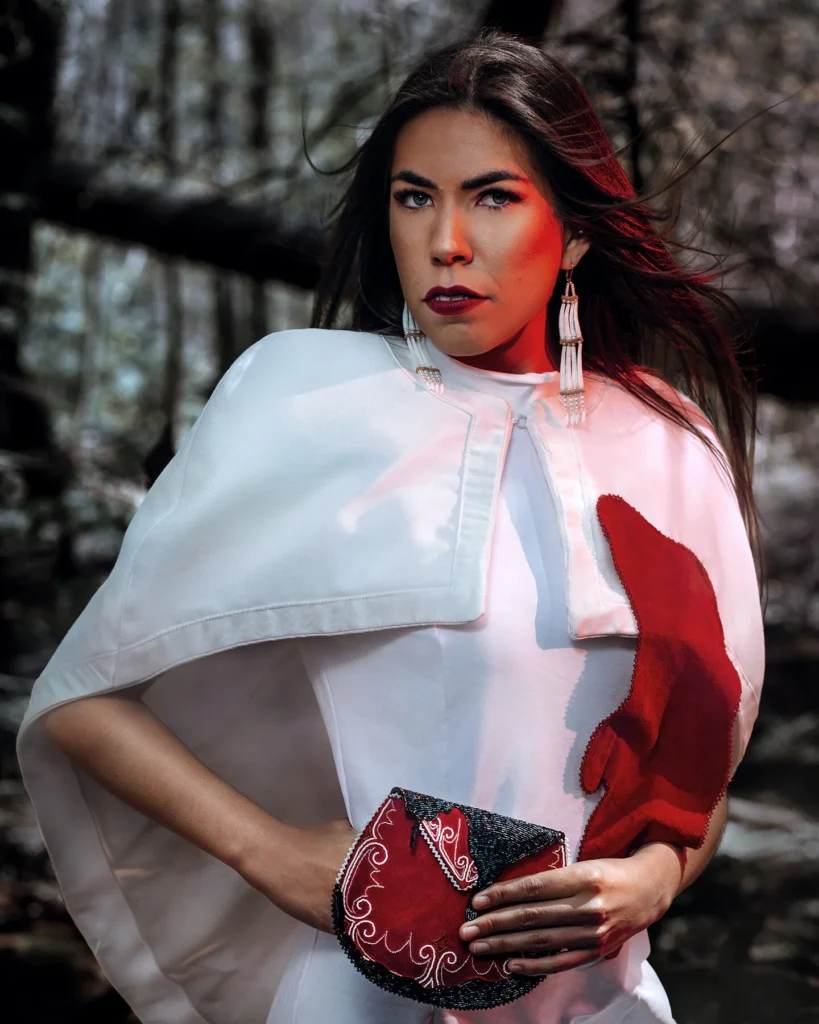
Oakley Rain Wysote Gray, Bleeding Heart Cape – M’st No’gmaq (All My Relations), 2021

7IDANsuu James Hart, Reconciliation Pole: Honouring a Time Before, During and After Canada’s Indian Residential Schools, 2015–17

Emma Hassencahl-Perley, White Flag, 2015

Brent Henry, English Only!, 2021

Shawn Hunt, Flipping the Bird, 2014

Lisa Jackson, Savage, 2009
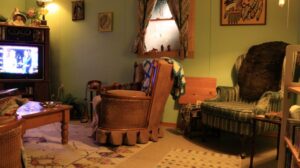
Ursula Johnson, ITHA: The Livingroom, 2021

Siassie Kenneally, All the Things That I Have Seen, 2016

Jake Kimble, It’s All So Incredibly Loud, 2025

Duane Linklater, i want to forget the english language, ulterior, 2020/23

Jim Logan, National Pastimes, 1991

Luke Marston, Bentwood Box, 2009

Kevin McKenzie, Being Indigenous, 2024

Meryl McMaster, Truth to Power, 2017

Kent Monkman, The Scream, 2017

Caroline Monnet, The Black Case, 2014

Tim Moore, Erasure Is Futile, 2021

Peter Morin, This is what happens when you perform the memory of the land (parts 1 and 2), 2013
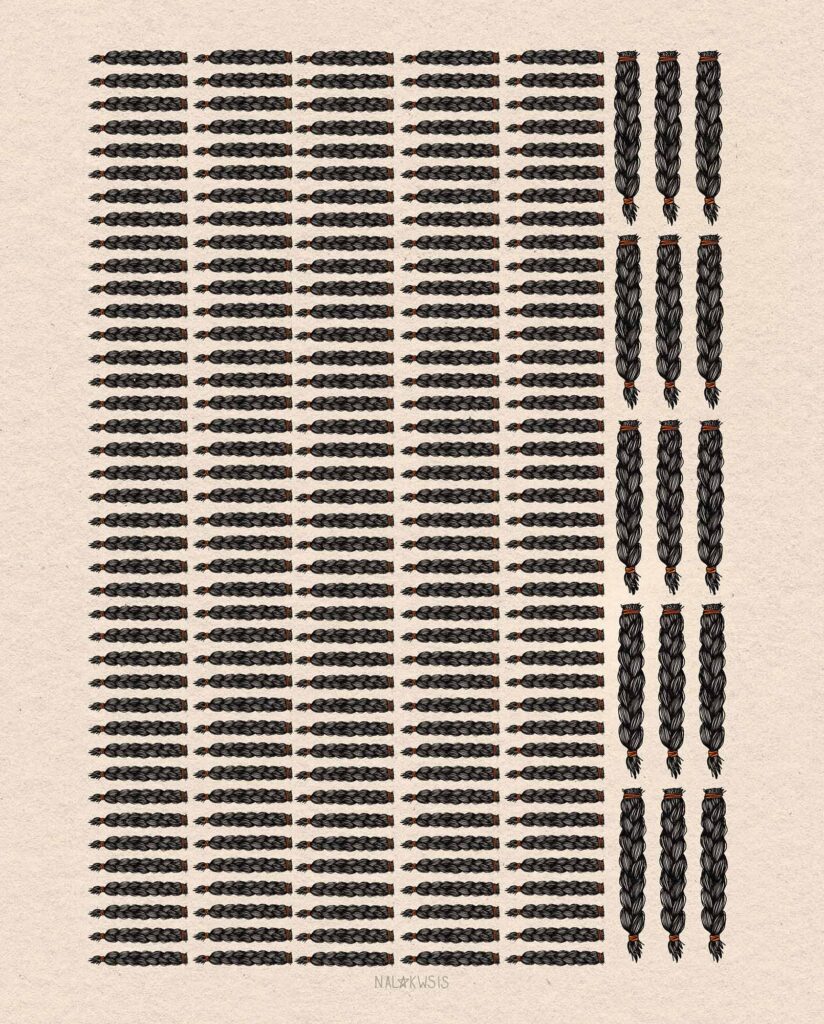
Saige “Nalakwsis” Mukash, 215 Braids, 2021

Nadia Myre, Indian Act, 2000–2002

Carey Newman, Witness Blanket, 2013–14

Davidee Ningeok, Sr., Residential School Nightmare, 2015

Shelley Niro, The Shirt, 2003

Luke Parnell, Neon Reconciliation Explosion, 2020
Dionne Paul, Her First Day of School, 2013
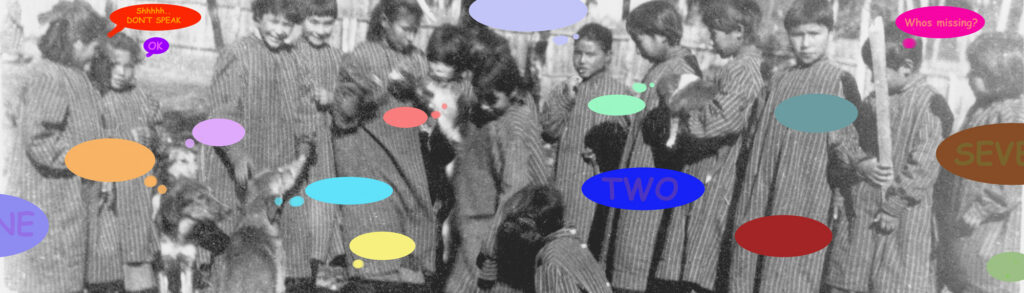
Edward Poitras, Don’t Speak, 2015

Barry Pottle, Yale Dormitory (Residential School), North West River, Labrador, 2015

Teharihulen Michel Savard, Reciprocity (Réciprocité), 2009

Jason Sikoak, Sacrilege, 2015

Greg Staats, Do’-gah – I don’t know [shrugging shoulders], 2020, archival pigment print on canvas on pine stretcher, oil, earth, Indian tobacco ash (edition 2 of 3), 142 x 175.3 x 2.5 cm, Agnes Etherington Art Centre, Kingston.

Alan Syliboy, Grandmother 1, 1997

Jeff Thomas, Broken Treaties, 1613–, 2020
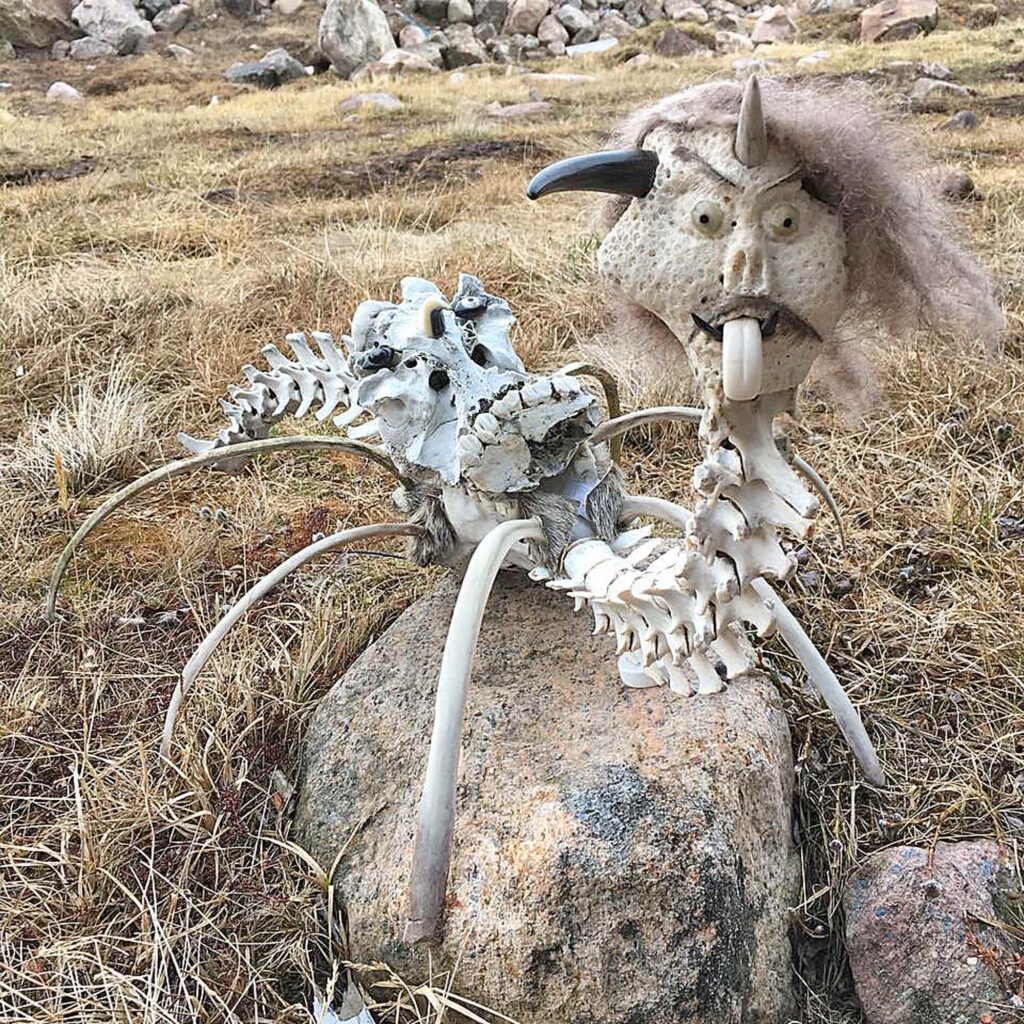
Jesse Tungilik, The Spirit of Intergenerational Trauma, 2019

Tania Willard, Be a Good Girl, 2017