Meryl McMaster, Truth to Power, 2017

Meryl McMaster, Truth to Power, 2017, giclée print on cold press paper, 121.9 x 159.8 cm.
In this quietly searing diptych, Meryl McMaster, Canadian and Plains Cree and a member of Siksika Nation in Alberta, transcends time to stage a confrontation with Duncan Campbell Scott, an acclaimed Confederation poet and, more consequentially, the long-serving deputy superintendent of the Department of Indian Affairs who helped entrench the residential school system as the state’s preferred instrument of assimilation. Scott believed that Indigenous Peoples would, and should, disappear through gradual absorption and that the removal of their children—by force if necessary—to residential and day schools was central to that objective. Truth to Power answers him from across a century.
The work pairs a colour photograph of the artist standing in a winter grid of plantation pines with a translucent text panel bearing Scott’s 1898 poem The Onondaga Madonna, recopied in the hand of a ten-year-old Kahnawà:ke girl. Scott’s terminology—“savage,” “pagan,” “doomed”—racializes an Indigenous mother and her infant while foreshadowing national “progress” through their erasure. In McMaster’s presentation, the poem is legible at the top and fades as it descends, a visual attrition of colonial prophecy: still present, still legible, but losing authority.
McMaster’s stance is deliberate and embodied. She meets the camera head-on, long hair loose, wearing a breastplate that nods to Plains regalia and occupying the forest Scott presumed would not hold Indigenous futures. The surrounding trees, planted in militaristic rows, echo the regimentation of residential schools—uniform beds, drills, surveillance, discipline—yet, the plantation is imperfect. Snow heaves, trunks list, and organic life pushes back through imposed order. The site becomes allegory: colonial systems sought conformity, but land and people persist in their own natural rhythms.
Inviting a child to hand-write Scott’s poem reactivates the pedagogical violence of residential schools—the rote copying of English texts, the suppression of Indigenous languages—while reversing its charge. The young scribe engraves the colonial archive so that we see its harm; intergenerational witnessing converts lesson into critique. McMaster’s title, Truth to Power, names that reversal. The image refuses Scott’s real goal of disappearance and insists on accountability: You imagined our end; here I stand, and our children write back.
Formally, the diptych functions like a before-and-after palimpsest, a sheet of paper bearing traces of its original script but overwritten with a new message. The left panel, the personified present, and the right panel, the archival ideology, sit flush, forcing viewers to read across. Snow-bright negative space behind the poem recalls a chalkboard, with the fading graphite collapsing into the white, suggesting how national memory might finally release Scott’s vision without denying its lasting damage. McMaster does not erase; she overexposes.
Created in an era when Canada is publicly reckoning with residential schools, Truth to Power models how archival texts can be recontextualized through Indigenous presence. It asks us to recognize the persistence of assimilationist thinking, to honour cultures targeted for elimination, and to transform knowledge of that past into protective power for future generations. The grid may remain, but the forest—and the people within it—outlive the plan.
Gallery of A New Generation of Witness

Sonny Assu, Leila’s Desk, 2013

Michael Barber, A Silent Sky, 2022

Christi Belcourt, Giniigaaniimenaaning (Looking Ahead), 2012

Rebecca Belmore, Apparition, 2013

Rain Cabana-Boucher, Laying Flowers, 2021–24

Quill Christie-Peters, Portrait of Ste. Margaret’s Residential School and All It Could Not Contain, 2018

Dana Claxton, Headdress – Shadae and her Girlz, 2023

Beau Dick, The Ghost Confined to the Chair, 2012
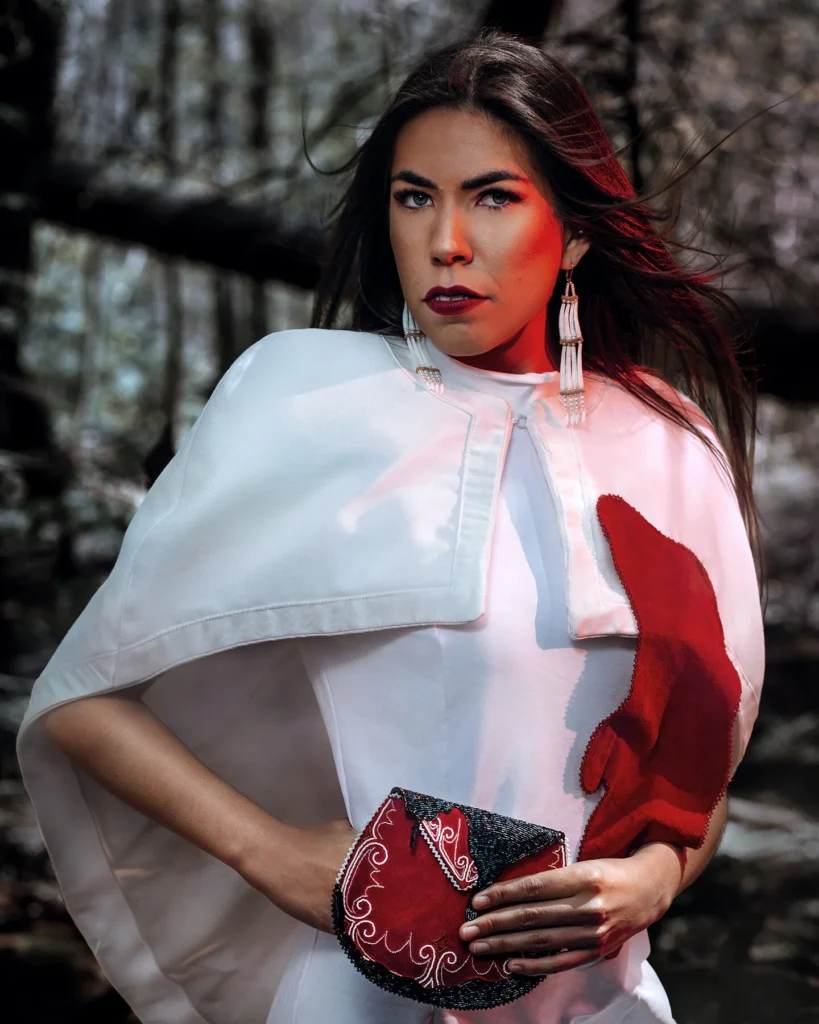
Oakley Rain Wysote Gray, Bleeding Heart Cape – M’st No’gmaq (All My Relations), 2021

7IDANsuu James Hart, Reconciliation Pole: Honouring a Time Before, During and After Canada’s Indian Residential Schools, 2015–17

Emma Hassencahl-Perley, White Flag, 2015

Brent Henry, English Only!, 2021

Shawn Hunt, Flipping the Bird, 2014

Lisa Jackson, Savage, 2009
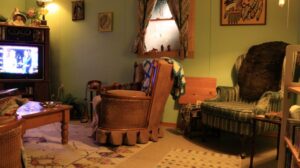
Ursula Johnson, ITHA: The Livingroom, 2021

Siassie Kenneally, All the Things That I Have Seen, 2016

Jake Kimble, It’s All So Incredibly Loud, 2025

Duane Linklater, i want to forget the english language, ulterior, 2020/23

Jim Logan, National Pastimes, 1991

Luke Marston, Bentwood Box, 2009

Kevin McKenzie, Being Indigenous, 2024
Meryl McMaster, Truth to Power, 2017

Kent Monkman, The Scream, 2017

Caroline Monnet, The Black Case, 2014

Tim Moore, Erasure Is Futile, 2021

Peter Morin, This is what happens when you perform the memory of the land (parts 1 and 2), 2013
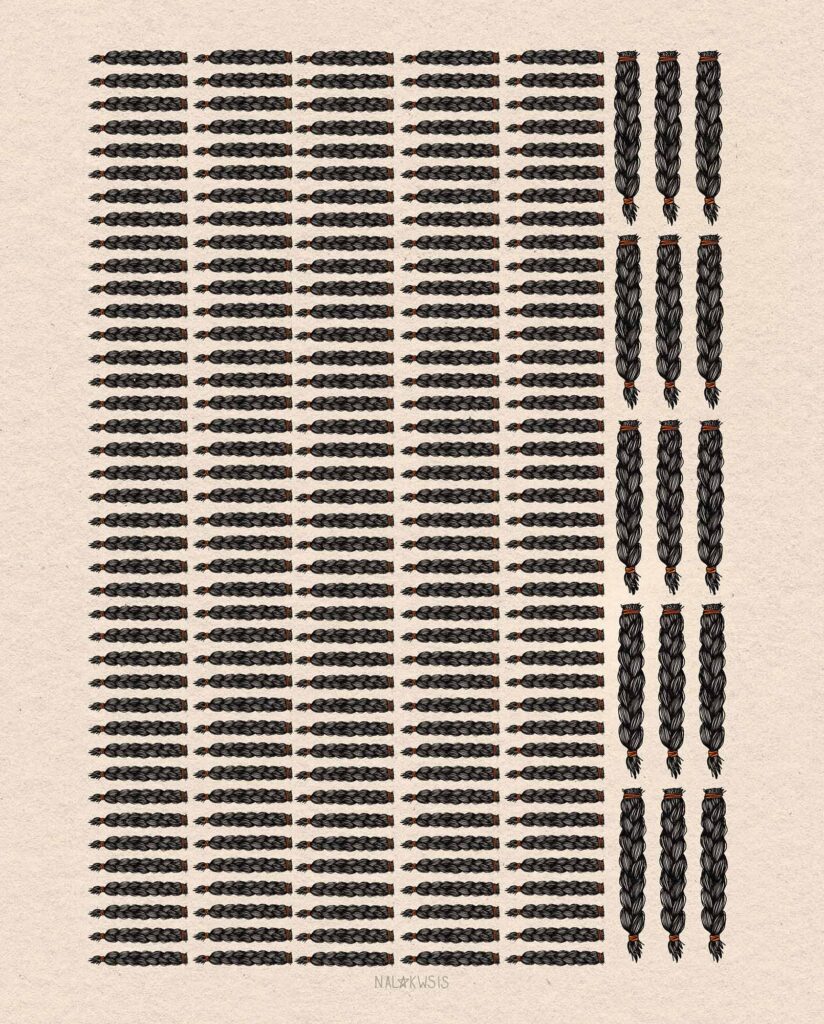
Saige “Nalakwsis” Mukash, 215 Braids, 2021

Nadia Myre, Indian Act, 2000–2002

Carey Newman, Witness Blanket, 2013–14

Davidee Ningeok, Sr., Residential School Nightmare, 2015

Shelley Niro, The Shirt, 2003

Luke Parnell, Neon Reconciliation Explosion, 2020

Dionne Paul, Her First Day of School, 2013
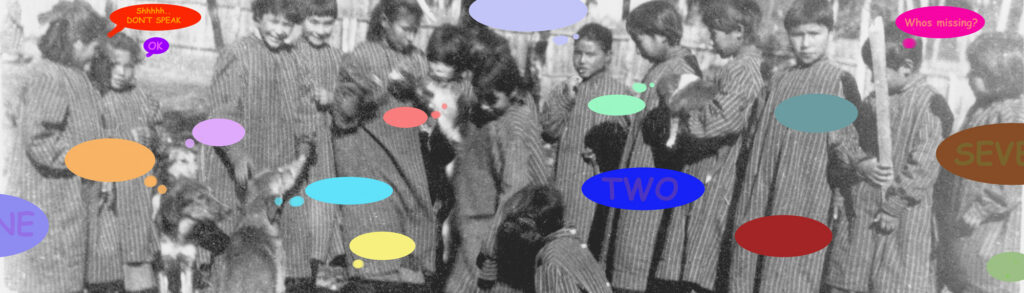
Edward Poitras, Don’t Speak, 2015

Barry Pottle, Yale Dormitory (Residential School), North West River, Labrador, 2015

Teharihulen Michel Savard, Reciprocity (Réciprocité), 2009

Jason Sikoak, Sacrilege, 2015

Greg Staats, Do’-gah – I don’t know [shrugging shoulders], 2020, archival pigment print on canvas on pine stretcher, oil, earth, Indian tobacco ash (edition 2 of 3), 142 x 175.3 x 2.5 cm, Agnes Etherington Art Centre, Kingston.

Alan Syliboy, Grandmother 1, 1997

Jeff Thomas, Broken Treaties, 1613–, 2020
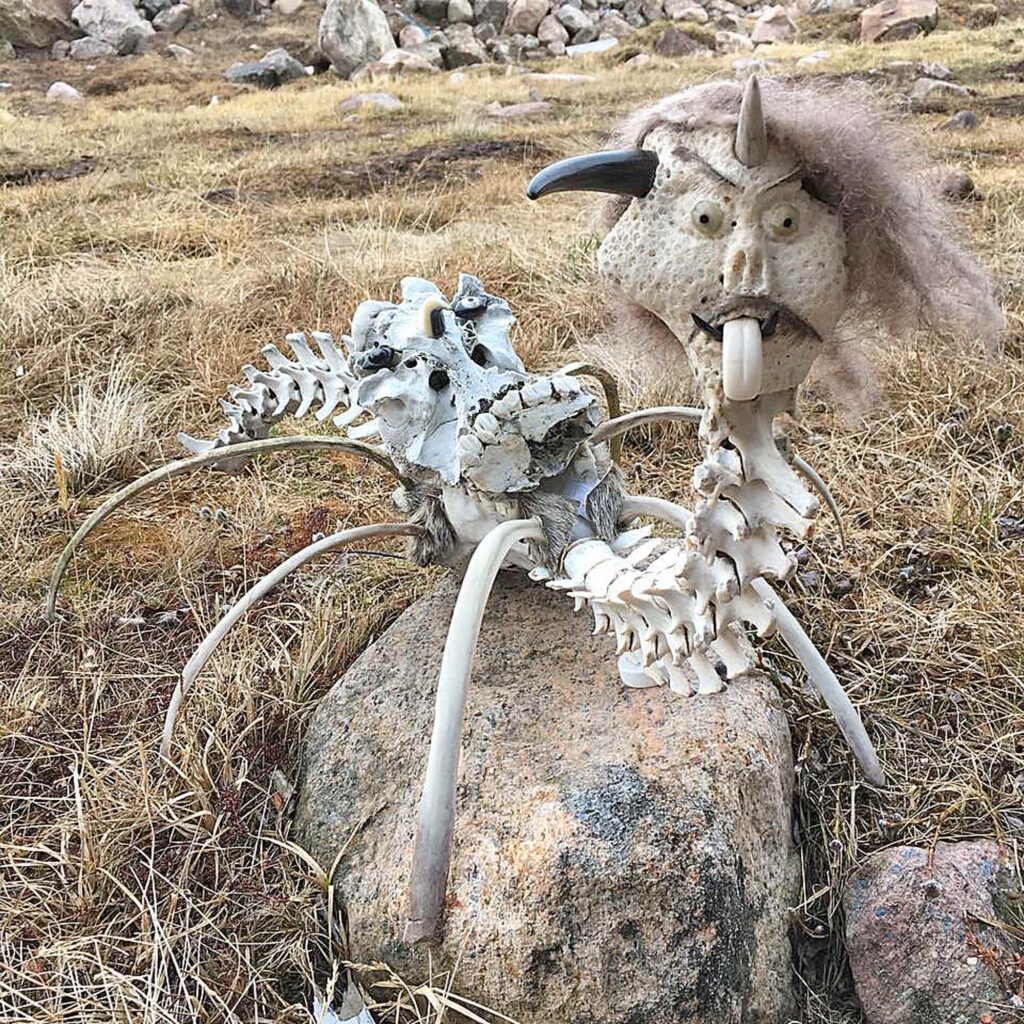
Jesse Tungilik, The Spirit of Intergenerational Trauma, 2019

Tania Willard, Be a Good Girl, 2017