Jason Sikoak, Sacrilege, 2015

Jason Sikoak, Sacrilege, 2015, pen and ink on paper, 124.5 x 132.1 cm, The Rooms, St. John's.
Inuit artist Jason Sikoak (b.1973) from Nunatsiavut, Newfoundland and Labrador, confronts cultural erasure and spiritual rupture in Sacrilege, a finely rendered ink drawing that stages a confrontation between Inuit spirituality and Christian authority. At the centre of the composition stands an Inuk man, rigid with paralysis as he clutches the rope of a qamutik while caught between two overpowering forces. On one side is Tulugak, a Raven spirit, an embodiment of Inuit cosmology and ancestral guidance. On the other side is a Black Robe, a Catholic missionary, cloaked in heavy garments and holding a book of biblical doctrine, his prayer beads entwined around the man’s neck as though to capture or strangle him. The figure’s frozen posture externalizes the psychic and cultural tension imposed by colonial religion.
The work’s drama lies in its symbolism. Tulugak, rendered with flowing plumage and tendrils of energy, personifies both the vitality and the otherworldly presence of Inuit spirituality. Its outstretched wings and fierce posture suggest both defence and desperation, as though fighting for survival against the encroaching power of the missionary. The missionary, by contrast, is grounded, static, and weighty, his figure shaped by rigid lines and squared-off formality. The cross behind the composition radiates with heavy linear force, cutting through the image like an emblem of dominance. Between them, the Inuk man’s wide eyes convey fear, confusion, and a loss of bearings.

Jason Sikoak, The Crosses We Bear, 2016, pen and ink on paper, 76.2 x 121.9 cm.
Sikoak’s choice of medium intensifies this confrontation. Executed entirely in black ink, the drawing strips the scene to its essentials: light and darkness, movement and immobility. Tulugak is fluid and dynamic, with ink splatters and curling lines that suggest breath and transformation. The missionary, on the other hand, is rigid and block-like, his presence almost suffocating. The starkness of black and white denies
any resolution or blending, instead heightening the sense of oppositional forces.
The title Sacrilege signals both desecration and betrayal. For Inuit communities, the arrival of missionaries and the enforced adoption of Christianity often meant the suppression of spiritual traditions, shamanic practices, and ancestral cosmologies. Sikoak depicts this destruction as cultural suppression and also as an act of violence against the sacred. The
Raven recoils as if scorched, while the man’s petrification suggests the internalized trauma of generations forced to abandon their spiritual inheritances.
The personal dimension adds another layer. Sikoak has spoken about how his family name was erroneously recorded as “Shiwak” by a colonial administrator—a doctor or Hudson’s Bay Company (HBC) prefect who could neither pronounce nor spell the original—a distortion that persisted through official census and HBC records for generations. It was only through his great-uncle’s First World War service records that Sikoak found written confirmation of the original name: photographs of the celebrated Inuit sniper John Shiwak bear the notation “Sikoak” in parentheses, as though the true name survived just beneath the colonial record. In Sacrilege, this theme of misnaming and misrecognition becomes visual allegory: the man’s debilitation speaks to a larger historical process in which Inuit people were forced to live between worlds, their cosmologies undermined and their sense of belonging fractured.
What is most haunting is the drawing’s temporality, its sense of an instant in time. Sikoak does not portray resolution, victory, or collapse. Instead, he captures the unbearable stillness of a moment before something breaks. The Inuk man cannot move forward, backward, or sideways—his body locked in a psychic freeze. This threshold is where the horror lies: not in the presence of the supernatural but in the enforced rupture of spiritual continuity.
Sacrilege becomes a visual scream unmasking the silent trauma of colonial spiritual violence. In confronting both missionary authority and ancestral presence, Sikoak stages the cost of cultural erasure as an intimate, embodied paralysis. His drawing demands that silence be broken and trauma named, challenging viewers to reckon with a history still alive in the present.
Collection of A New Generation of Witness

Sonny Assu, Leila’s Desk, 2013

Michael Barber, A Silent Sky, 2022

Christi Belcourt, Giniigaaniimenaaning (Looking Ahead), 2012

Rebecca Belmore, Apparition, 2013

Rain Cabana-Boucher, Laying Flowers, 2021–24

Quill Christie-Peters, Portrait of Ste. Margaret’s Residential School and All It Could Not Contain, 2018

Dana Claxton, Headdress – Shadae and her Girlz, 2023

Beau Dick, The Ghost Confined to the Chair, 2012
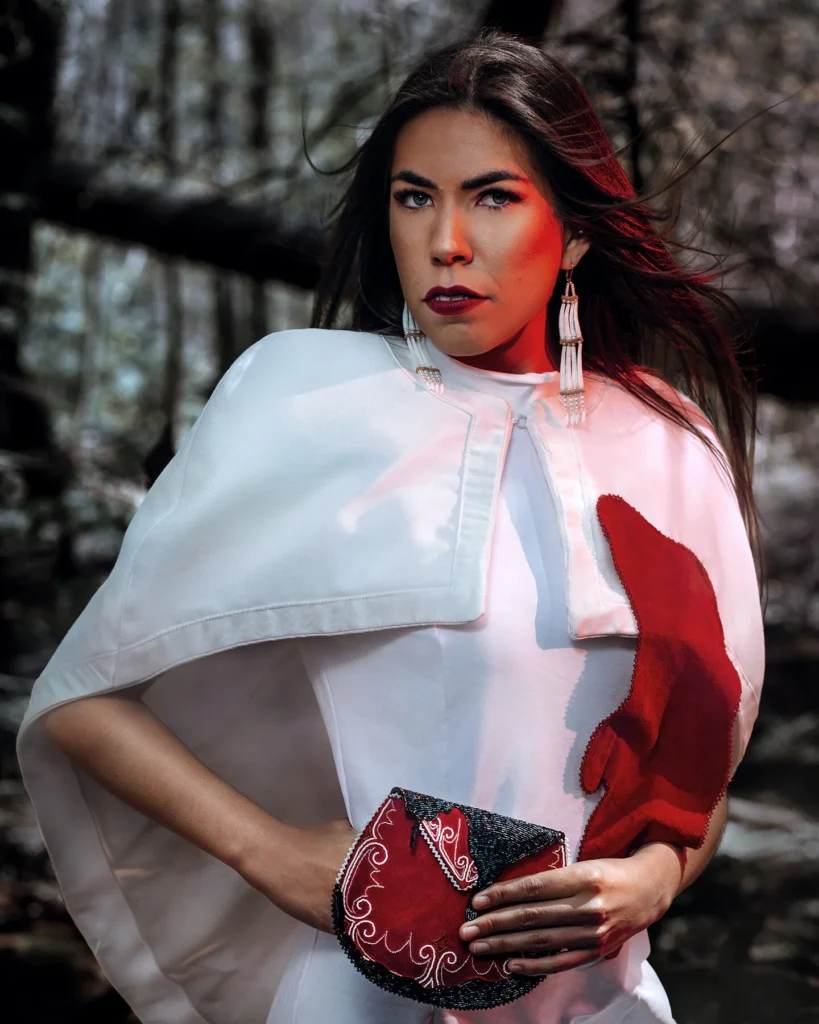
Oakley Rain Wysote Gray, Bleeding Heart Cape – M’st No’gmaq (All My Relations), 2021

7IDANsuu James Hart, Reconciliation Pole: Honouring a Time Before, During and After Canada’s Indian Residential Schools, 2015–17

Emma Hassencahl-Perley, White Flag, 2015

Brent Henry, English Only!, 2021

Shawn Hunt, Flipping the Bird, 2014

Lisa Jackson, Savage, 2009
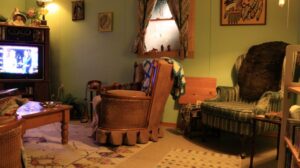
Ursula Johnson, ITHA: The Livingroom, 2021

Siassie Kenneally, All the Things That I Have Seen, 2016

Jake Kimble, It’s All So Incredibly Loud, 2025

Duane Linklater, i want to forget the english language, ulterior, 2020/23

Jim Logan, National Pastimes, 1991

Luke Marston, Bentwood Box, 2009

Kevin McKenzie, Being Indigenous, 2024

Meryl McMaster, Truth to Power, 2017

Kent Monkman, The Scream, 2017

Caroline Monnet, The Black Case, 2014

Tim Moore, Erasure Is Futile, 2021

Peter Morin, This is what happens when you perform the memory of the land (parts 1 and 2), 2013
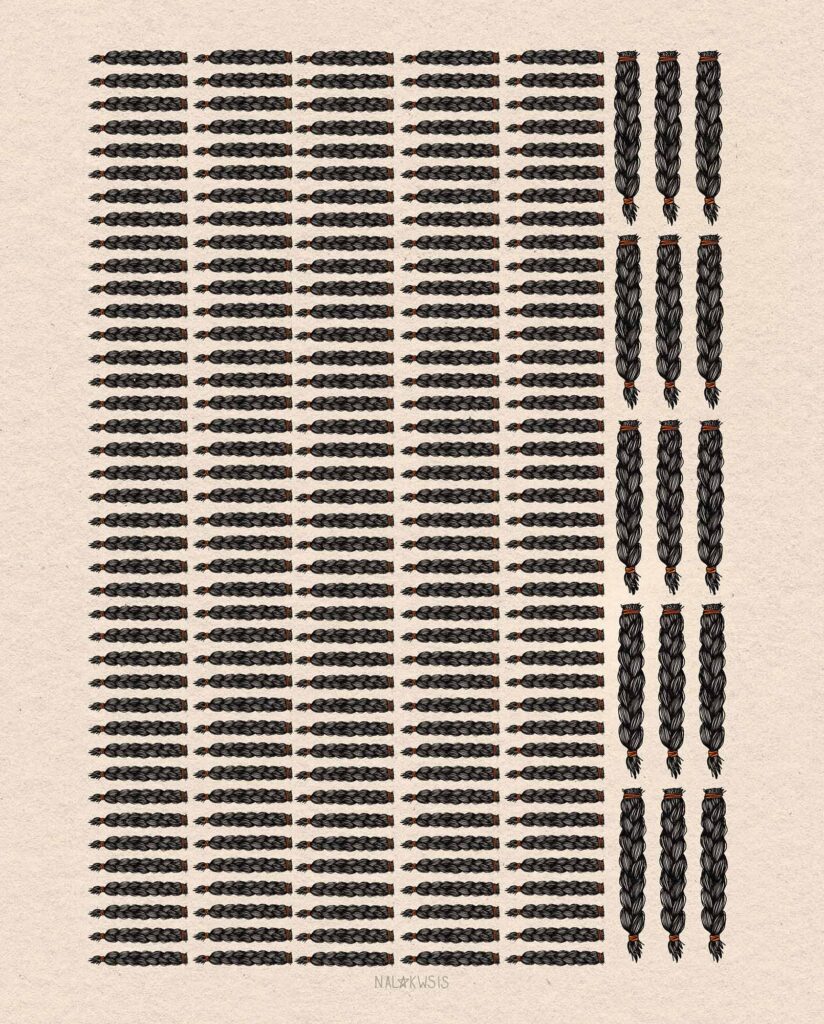
Saige “Nalakwsis” Mukash, 215 Braids, 2021

Nadia Myre, Indian Act, 2000–2002

Carey Newman, Witness Blanket, 2013–14

Davidee Ningeok, Sr., Residential School Nightmare, 2015

Shelley Niro, The Shirt, 2003

Luke Parnell, Neon Reconciliation Explosion, 2020

Dionne Paul, Her First Day of School, 2013
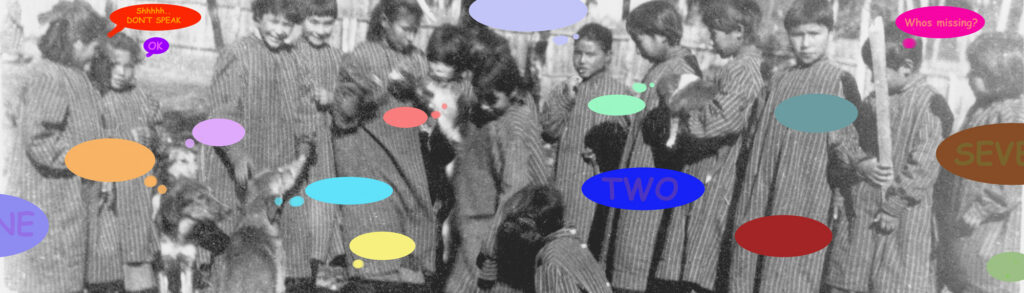
Edward Poitras, Don’t Speak, 2015

Barry Pottle, Yale Dormitory (Residential School), North West River, Labrador, 2015

Teharihulen Michel Savard, Reciprocity (Réciprocité), 2009
Jason Sikoak, Sacrilege, 2015

Greg Staats, Do’-gah – I don’t know [shrugging shoulders], 2020, archival pigment print on canvas on pine stretcher, oil, earth, Indian tobacco ash (edition 2 of 3), 142 x 175.3 x 2.5 cm, Agnes Etherington Art Centre, Kingston.

Alan Syliboy, Grandmother 1, 1997

Jeff Thomas, Broken Treaties, 1613–, 2020
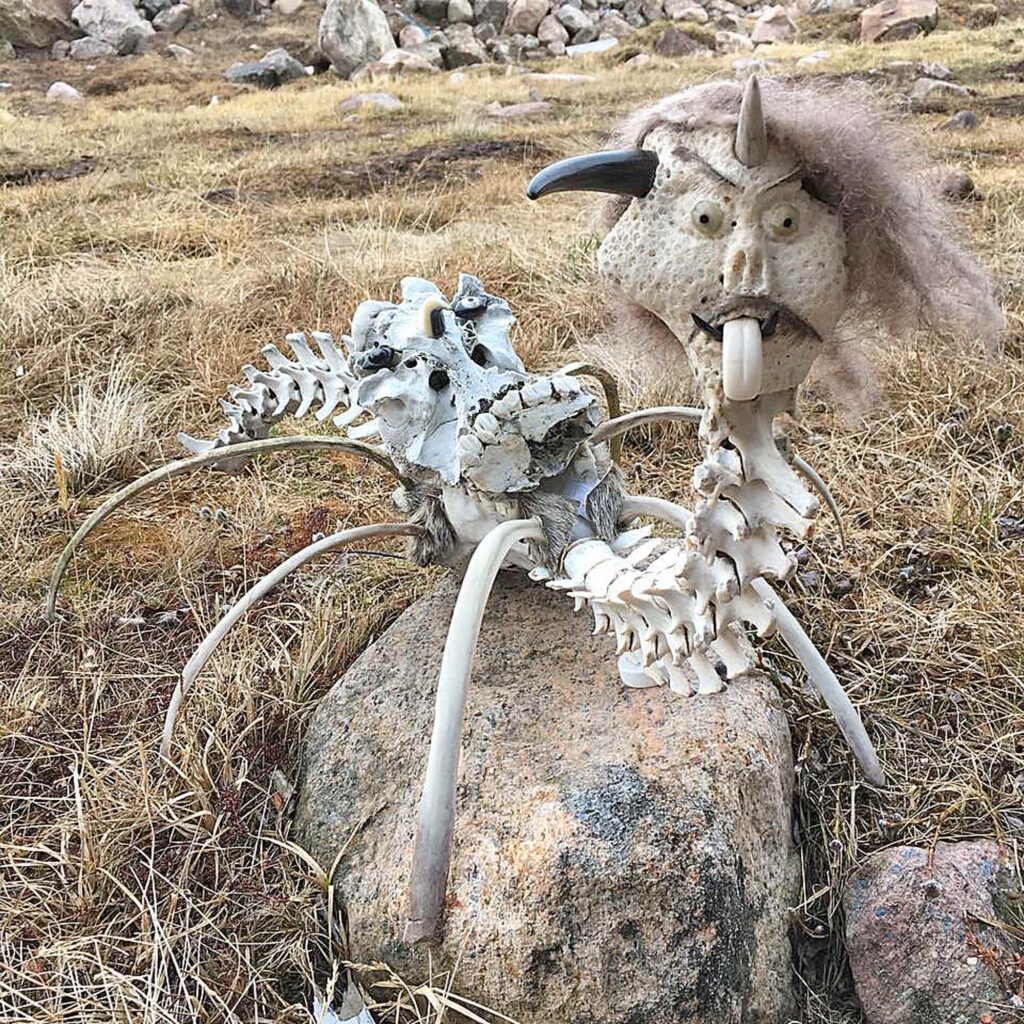
Jesse Tungilik, The Spirit of Intergenerational Trauma, 2019

Tania Willard, Be a Good Girl, 2017