Jake Kimble, It’s All So Incredibly Loud, 2025

Jake Kimble, It’s All So Incredibly Loud, 2025, archival ink-jet prints, Czech seed beads, 35.6 x 27.9 cm.
In It’s All So Incredibly Loud, Denesuliné multidisciplinary artist Jake Kimble (b.1994) blends beadwork with four archival ink-jet photographs. This pairing is significant: photography can record surface and capture likeness or environment, but it does not always convey the tactile, time-consuming labour encoded in beadwork, which is often loaded with cultural and symbolic weight—technique, time, ritual, identity. By embedding Czech seed beads into or onto photographic prints, Kimble makes visible the labour, the craft, and the artistic history that lies beneath or alongside
his images. Here, beadwork “inhabits” the photograph, forcing the viewer to consider what is present and what is missing. The artist’s statement that he “can barely” bead in comparison to earlier generations adds a poignant distance, an almost elegiac register.
It is a recognition that skills, histories, and ways of seeing are fragile, subject to interruption.
Visually, the format of these 35.6 x 27.9 cm prints gives intimacy to this work. These pieces are not monumental but modestly sized, requiring the viewer to come near. The scale suggests personal reflection; internal dialogue rather than grand public assertion. The tension between intimate scale in the form and loudness in the title further complicates notions of voice: the loudness is perhaps emotional, historical, or internal, not simply visual or auditory. The viewer is forced into proximity with that internal “loud,” to sense the dissonance between what one inherits and what one can actively practise or manifest.
Conceptually, there is a dialogue between presence and absence, mastery and partial loss.
The work acknowledges that knowledge is passed on, but not always in whole; that heritage is not static; and that artistic expression is also about remembering what is no longer fully possessed. In doing so, Kimble’s piece resists the romanticization of tradition; it does not claim seamless continuity. Instead, it grapples with tension, friction, and rupture. This approach is more honest, and often more resonant, especially for those navigating mixed or interrupted cultural histories.
With It’s All So Incredibly Loud, Kimble stages a material metaphor for what it means to carry, but only partially access, a lineage of craft and expression. He confronts questions of ancestral memory, cultural transmission, the fragmentation of identity, and the tension between visibility and loss. The work operates in the crevices of “knowing” and “not knowing,”
a territory familiar in many Indigenous and diasporic practices but here deeply personal and generational.
It’s All So Incredibly Loud reminds us that silence is not the absence of sound, and invisibility is not the absence of presence. The knowledge inside is a kind of sound—perhaps muffled, perhaps veiled, but alive. The beadwork is not just decorative but a pulse. The photography frames what is there; the beadwork indicates what lingers, what yearns, what might still be practised. In its convergence of media, its generational honesty, and its modest yet potent scale, Kimble’s work offers a meditation on what it means to live with inherited histories—and to live with the loud insistence of what we have inherited but cannot fully realize.
Gallery of A New Generation of Witness

Sonny Assu, Leila’s Desk, 2013

Michael Barber, A Silent Sky, 2022

Christi Belcourt, Giniigaaniimenaaning (Looking Ahead), 2012

Rebecca Belmore, Apparition, 2013

Rain Cabana-Boucher, Laying Flowers, 2021–24

Quill Christie-Peters, Portrait of Ste. Margaret’s Residential School and All It Could Not Contain, 2018

Dana Claxton, Headdress – Shadae and her Girlz, 2023

Beau Dick, The Ghost Confined to the Chair, 2012
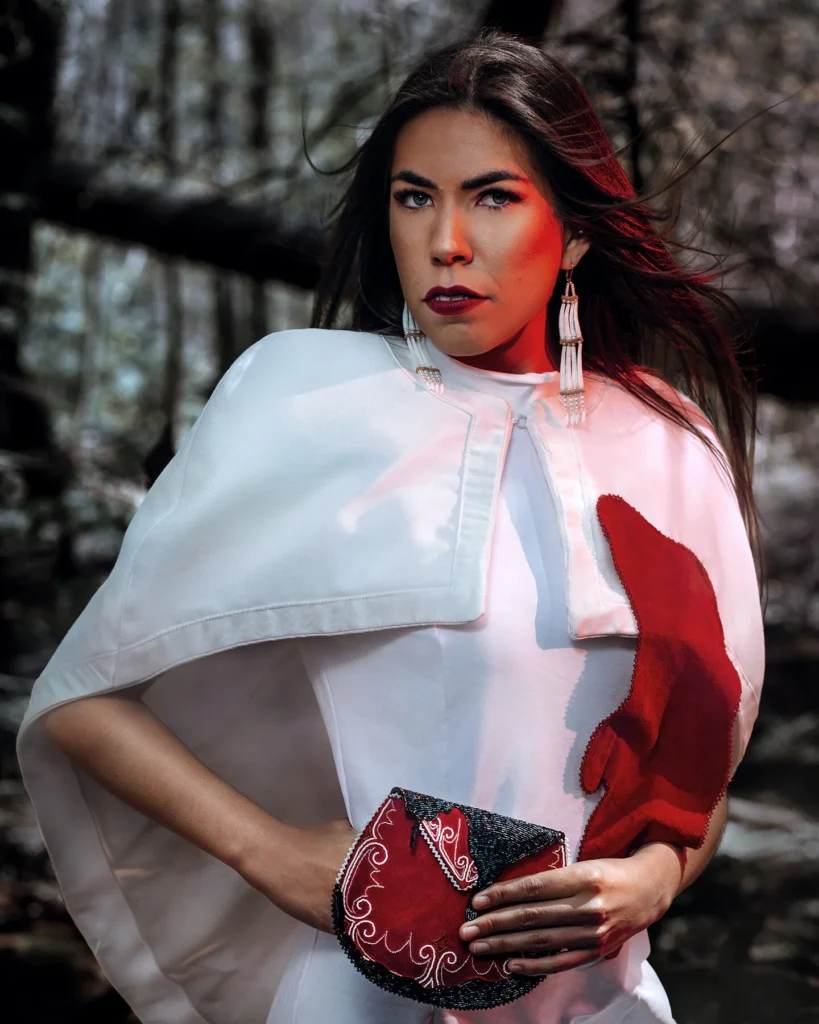
Oakley Rain Wysote Gray, Bleeding Heart Cape – M’st No’gmaq (All My Relations), 2021

7IDANsuu James Hart, Reconciliation Pole: Honouring a Time Before, During and After Canada’s Indian Residential Schools, 2015–17

Emma Hassencahl-Perley, White Flag, 2015

Brent Henry, English Only!, 2021

Shawn Hunt, Flipping the Bird, 2014

Lisa Jackson, Savage, 2009
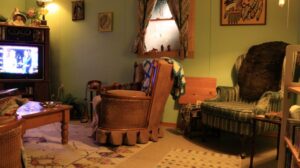
Ursula Johnson, ITHA: The Livingroom, 2021

Siassie Kenneally, All the Things That I Have Seen, 2016

Jake Kimble, It’s All So Incredibly Loud, 2025

Duane Linklater, i want to forget the english language, ulterior, 2020/23

Jim Logan, National Pastimes, 1991

Luke Marston, Bentwood Box, 2009

Kevin McKenzie, Being Indigenous, 2024

Meryl McMaster, Truth to Power, 2017

Kent Monkman, The Scream, 2017

Caroline Monnet, The Black Case, 2014

Tim Moore, Erasure Is Futile, 2021

Peter Morin, This is what happens when you perform the memory of the land (parts 1 and 2), 2013
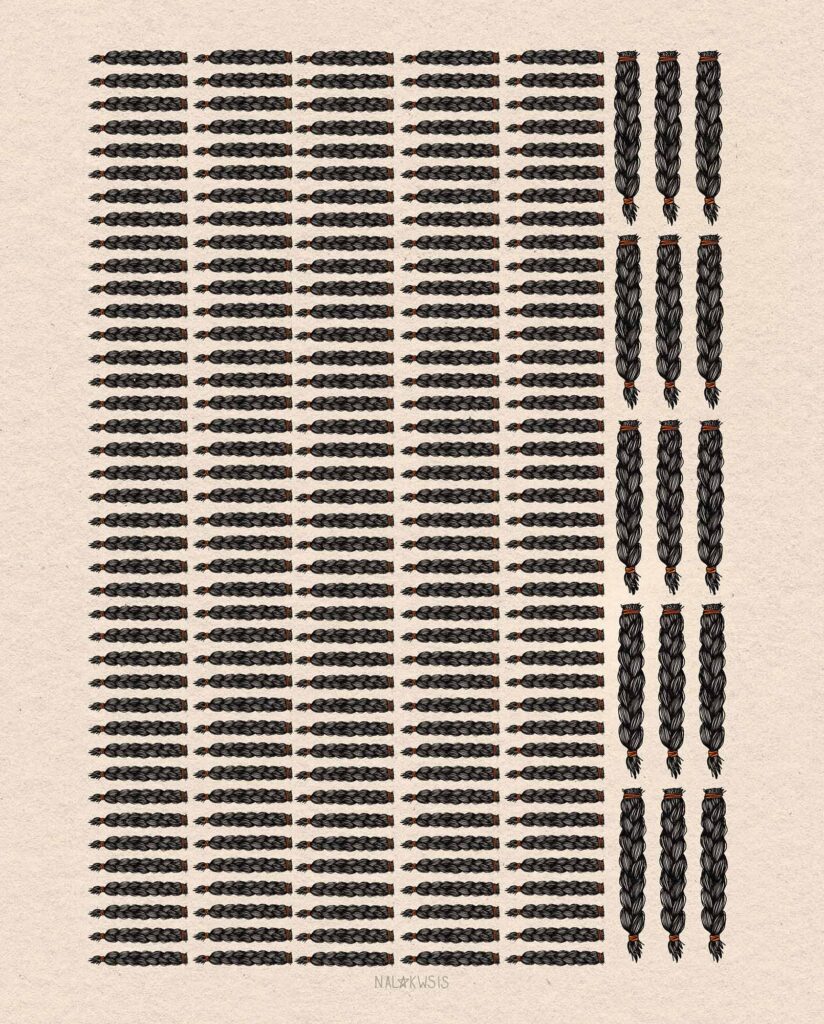
Saige “Nalakwsis” Mukash, 215 Braids, 2021

Nadia Myre, Indian Act, 2000–2002

Carey Newman, Witness Blanket, 2013–14

Davidee Ningeok, Sr., Residential School Nightmare, 2015

Shelley Niro, The Shirt, 2003

Luke Parnell, Neon Reconciliation Explosion, 2020

Dionne Paul, Her First Day of School, 2013
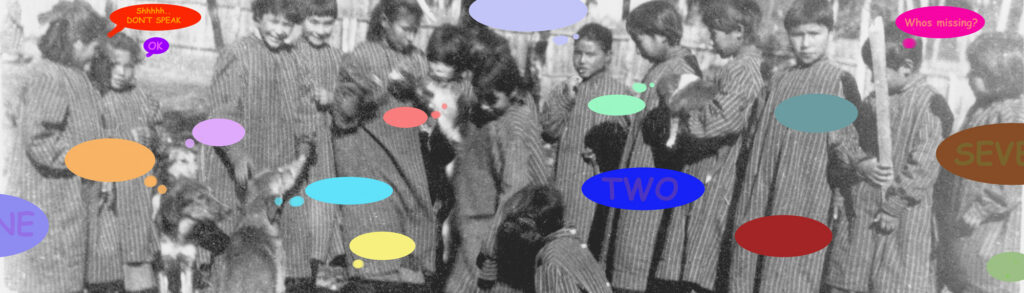
Edward Poitras, Don’t Speak, 2015

Barry Pottle, Yale Dormitory (Residential School), North West River, Labrador, 2015

Teharihulen Michel Savard, Reciprocity (Réciprocité), 2009

Jason Sikoak, Sacrilege, 2015

Greg Staats, Do’-gah – I don’t know [shrugging shoulders], 2020, archival pigment print on canvas on pine stretcher, oil, earth, Indian tobacco ash (edition 2 of 3), 142 x 175.3 x 2.5 cm, Agnes Etherington Art Centre, Kingston.

Alan Syliboy, Grandmother 1, 1997

Jeff Thomas, Broken Treaties, 1613–, 2020
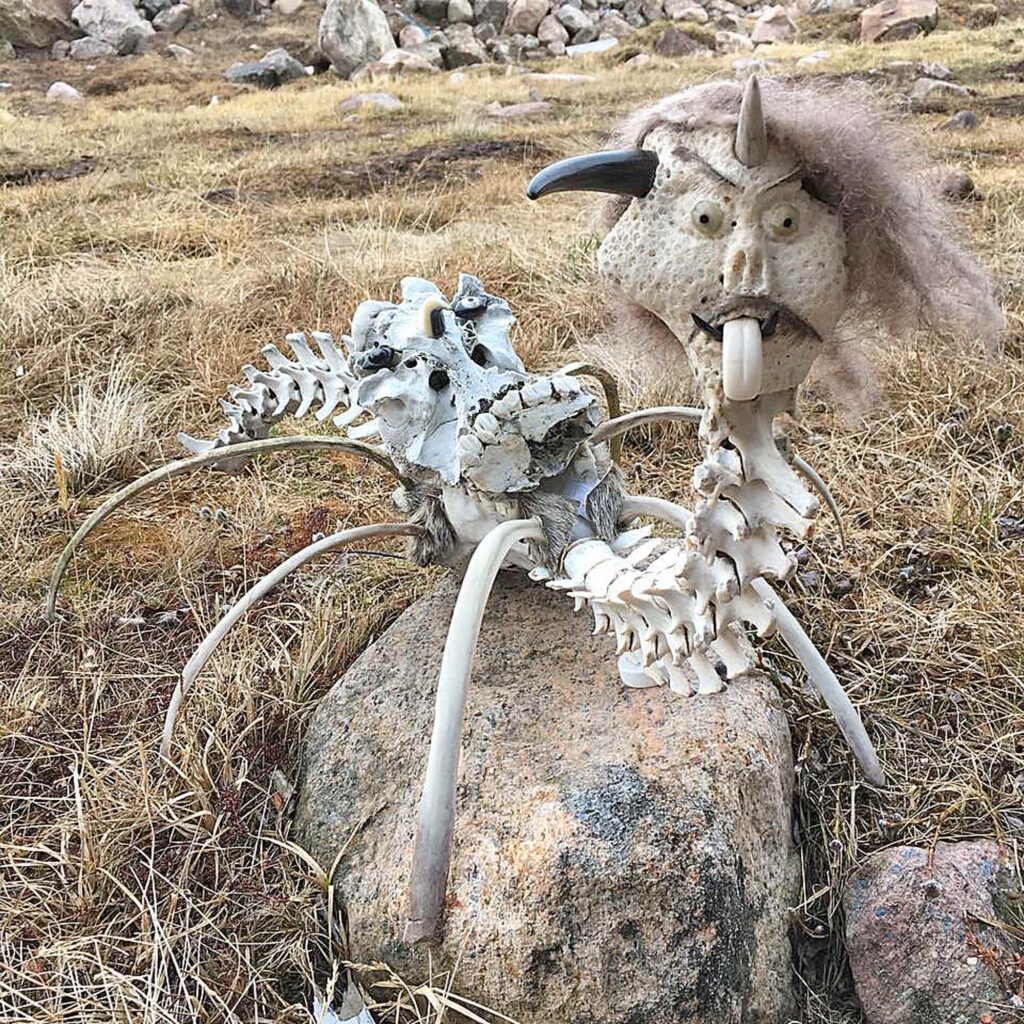
Jesse Tungilik, The Spirit of Intergenerational Trauma, 2019

Tania Willard, Be a Good Girl, 2017