
Truth telling is not only spoken or written; it is also seen. In Canada, the work of truth and reconciliation has relied heavily on testimony, archives, and official records. Yet, these alone cannot bear the full weight of what was experienced and remembered. Indigenous art has long served as a parallel and enduring mode of truth telling, one grounded in visual knowledge, relational responsibility, and cultural sovereignty. This section offers an overview of the systems and policies that sought to control, assimilate, and erase Indigenous life—not to reinscribe violence but to clarify the conditions that made such truth telling necessary. It situates Indigenous artistic practice as a vital site where history is witnessed, denial is resisted, and memory is made present.
The Colonial Ambition

Students at St. Philip's Indian Residential School in Fort George, Quebec, c.1940, photographer unknown, General Synod Archives, Anglican Church of Canada.

Intermediate and Junior Girls dressed in their Sunday clothes on the last day of school at St. Phillip's Indian Residential School, Fort George, Quebec, June 1947, photographer unknown, General Synod Archives, Anglican Church of Canada.

Murray Sinclair listens during the Truth and Reconciliation Commission of Canada's event in Vancouver on September 18, 2013, photograph by Darryl Dyck/The Canadian Press. The TRC heard testimonies from residential school Survivors from 2008 to 2015.
In 1920, Duncan Campbell Scott, deputy superintendent of the Department of Indian Affairs, declared: “I want to get rid of the Indian problem.… Our objective is to continue until there is not a single Indian in Canada that has not been absorbed into the body politic.” His words capture the colonial ambition to erase Indigenous identity through forced education, most notably through the residential and day school systems. Nearly a century later, in 2015, Justice Murray Sinclair, chair of the Truth and Reconciliation Commission of Canada (TRC), turned this logic upside down: “Education got us into this mess, and education will get us out of it.” The TRC named the residential school system for what it was, identifying it as an instrument of cultural genocide, and called on the country to confront truths it had long denied.
These two statements bookend a long arc of violence and possibility. Between them lies the systemic removal of Indigenous children from their families, the suppression of language and culture, and the severing of relationships to land. The arc extends well into the late twentieth century; the last federally operated residential school, Gordon Indian Residential School, did not close until 1996. As documented in timelines developed by the National Centre for Truth and Reconciliation, the residential school system spanned more than a century, its impacts unfolding across generations and continuing to shape Indigenous communities in the present. This ultimately shows that the residential and day school systems were not peripheral policies. They were central to a nation-building project premised on dispossession and assimilation. And yet, the TRC’s reframing of education as a site of repair signals a different horizon. If schooling once functioned as a tool of erasure, it could also become a space for truth telling grounded in Indigenous knowledge systems and languages. The work of reconciliation, then, is not abstract. It unfolds in classrooms, archives, artworks, and everyday acts of remembrance. It requires attention to the structures that produced harm and a sustained commitment to transforming them.
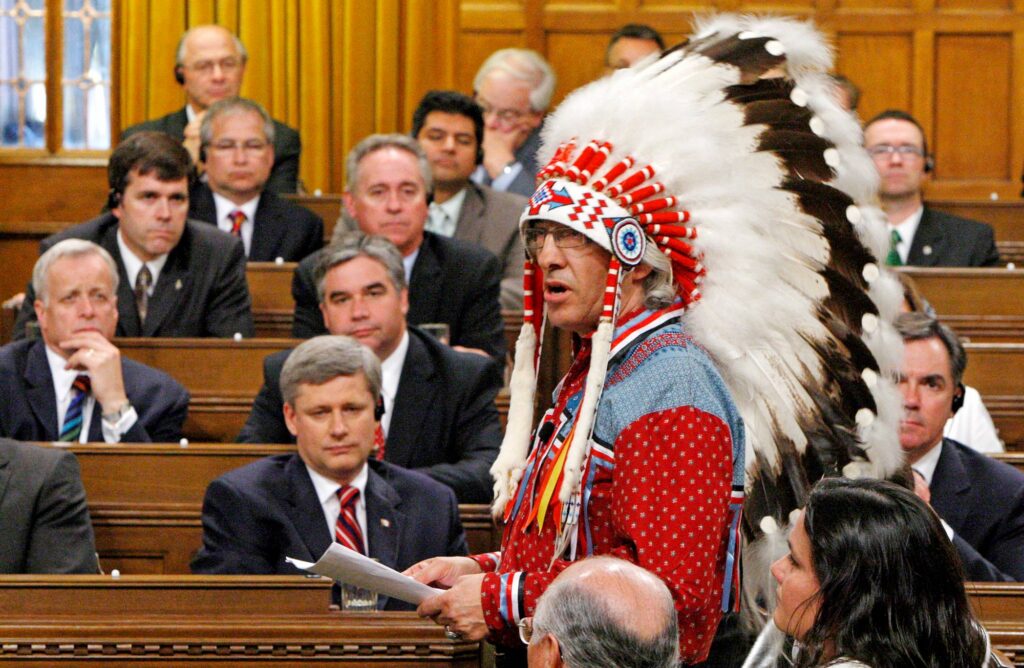
Prime Minister Stephen Harper (bottom left) and other members of Parliament listen as National Chief of the Assembly of First Nations Phil Fontaine speaks in the House of Commons, Ottawa, June 11, 2008, photograph by Chris Wattie.
The TRC was established in 2008 to address the abuses of the residential and day school systems. Through Survivor testimony, the TRC revealed the depth of this violence and issued ninety-four Calls to Action aimed at redress, education, and structural change. Yet, even as reconciliation has entered the public discourse, it is increasingly misunderstood, diluted, or used rhetorically without accountability. For many Survivors and their families, reconciliation is an ongoing demand for material change: equitable funding for Indigenous education, the protection and revitalization of languages and cultures, access to records, child welfare reform, and the implementation of Indigenous self-governance. The Calls to Action were designed as measurable commitments directed not only at governments but also at religious and cultural institutions, school boards and universities, and the broader public. Their force lies in their specificity. The TRC’s work, therefore, makes it clear that reconciliation is not the end point. It is a process—one that requires the ongoing reconfiguration of relationships between Indigenous and non-Indigenous Peoples.
This historical overview is written with the aim of providing the essential context required to understand and enact the work of reconciliation through learning and truth telling. The policies outlined here establish the conditions in which Indigenous art emerged as a critical site of knowledge production. Within this framework, art exceeded representation; it became a method for carrying memory, law, kinship, and responsibility forward at a time when state systems sought to suppress or erase them. It also became a form of truth telling, revealing how, even under colonial regimes, Indigenous children quietly and persistently resisted. They whispered their languages in secret, created drawings and beadwork when staff turned away, passed on stories, and, in many cases, attempted to run home. These acts of cultural continuance were early forms of testimony that quietly but enduringly refused erasure.
The artwork discussions that follow this overview build from this context, shifting from a historical account to the practices through which Indigenous artists sustain and transmit visual knowledge across generations—insisting that reconciliation is inseparable from education and accountability.

Teharihulen Michel Savard, Reciprocity (Réciprocité), 2009, mixed media, 35.5 x 29 cm, Huron-Wendat Museum, Wendake.
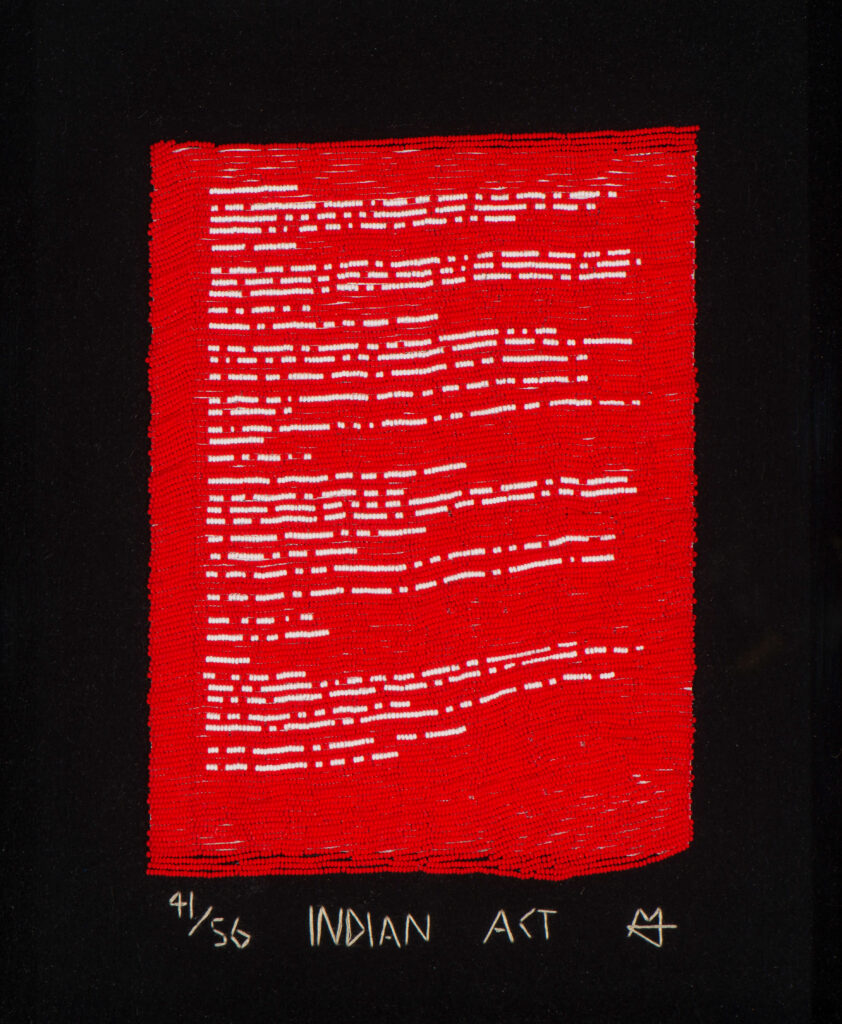
Nadia Myre, Indian Act, 2000–2002, glass beads, copy of page 30 of the Indian Act, adhesive tape, thread, felt, 42.5 x 34.6 x 1.7 cm, Montreal Museum of Fine Arts.
The Establishment of
Residential and Day Schools
From the late nineteenth century into the 1990s, Canada operated a network of more than 130 Indian residential schools, alongside over seven hundred church-run Indian day schools, as part of a national project of forced assimilation. The first institution to open, in 1828, was the Mohawk Institute residential school (in present-day Brantford, Ontario), which was initially run as a day school for boys on the Six Nations of the Grand River reserve. In 1831, operations were transferred to the New England Company (also known as the Society for the Propagation of the Gospel in New England), which converted it into a boarding school. Girls were admitted beginning in 1834, and many were sent from reserves across Upper Canada, including from New Credit, Sarnia, Walpole Island, Muncey, Scugog, Stoney Point, and the Bay of Quinte. The federal government took administrative control of Mohawk Institute in 1922 and continued to operate it until its closure in 1970, making it one of the longest-running residential schools in Canada and underscoring the enduring reach of the system it helped inaugurate.
After the establishment of the first residential and day schools, federal policy increasingly formalized and expanded the removal of Indigenous children from their communities. Under amendments to the Indian Act in 1920, attendance became compulsory. Children were physically severed from the influence of family, language, and culture. Hair was cut, names were replaced by numbers, languages were forbidden, and daily life was governed by strict surveillance and discipline. These institutions were not schools in any educational sense; they were designed to break kinship ties and impose a Euro-Christian worldview.

Children at Kamloops Indian Residential School, 1937, photographer unknown, Archives Deschâtelets-NDC, Fonds Deschâtelets.
Conditions in residential schools were often lethal. Chronic underfunding, overcrowding, and inadequate health care produced catastrophic mortality rates. In 1907, a report by Dr. Peter Bryce, then the chief medical officer for the Department of Indian Affairs, described the system as a “national crime,” noting that nearly one-quarter of Indigenous children died while in attendance, with some schools reaching death rates of 50 to 75 per cent. This report, among many others by Bryce, was suppressed, and the chief medical officer was forced into retirement in 1921. In 1922, Bryce made his findings public, ultimately resulting in the publication of the book The Story of a National Crime: Being an Appeal for Justice to the Indians of Canada. Day school students, though they returned home each evening, endured similar abuses and the same mandate of cultural erasure, an experience now formally recognized through the 2019–2023 McLean Day Schools Settlement.
The Sixties Scoop
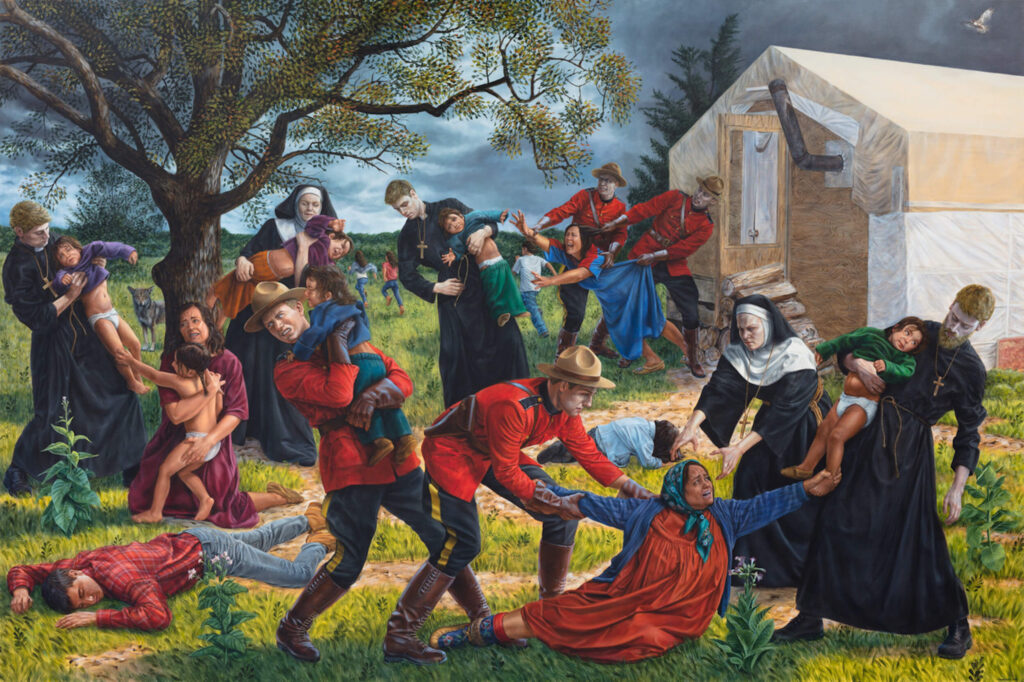
Kent Monkman, The Scoop, 2018, acrylic on canvas, 213.4 x 320 cm, private collection.
The impacts of these systems were not confined to the school walls. Decades of federally mandated child welfare apprehensions applied the same logic: remove the child to eliminate the culture. Beginning in the 1960s and continuing into the 1980s, thousands of First Nations, Inuit, and Métis children were seized by authorities and placed in foster or adoptive homes, most often with non-Indigenous families. The term Sixties Scoop, coined by social worker Patrick Johnston in his 1983 report Native Children and the Child Welfare System, refers to this mass relocation of children from their communities.
Although framed as child protection, the practice operated within the same ideological framework as residential and day schools—namely, that Indigenous family structures were deficient and that assimilation into Euro-Canadian society was in the child’s best interest. Children lost access to language, kinship networks, and community belonging, and many Survivors have described the pain of identity fragmentation, which has created lasting barriers to reconnecting with family and community later in life.
The enduring effects of the Sixties Scoop are powerfully articulated in Every time I think of you I cry, 2021, by Judy Anderson, a beaded work created in honour of her brother, Eugene, who was taken from the family during that period. Drawing on Indigenous teachings and practices of making, Anderson worked collectively with members of her family to complete the piece, transforming the act of creation into one of shared remembrance. Rather than simply representing loss, the work enacts it, holding grief within its material and process while also reaffirming the bonds that colonial systems sought to sever. The work serves as a reminder that grief is not carried alone but is shared within the family and community, reflecting nêhiyaw wâhkôhtowin, understandings of kinship grounded in mutual care and support. In this way, the work illuminates the fragmentation experienced by those who were taken while also insisting on the resolve of relational knowledge and responsibility. It stands as a form of visual testimony, grounded in truth telling and accountability, that carries both rupture and continuity forward.

Judy Anderson, Every time I think of you I cry, 2021, size 8 Miyuki seed beads, porcupine quills, white deer hide, 195.6 x 279.4 cm, MacKenzie Art Gallery, Regina.
In 2017, the federal government reached a landmark settlement with Survivors of the Sixties Scoop, acknowledging the lasting harms caused by the policy. The overrepresentation of Indigenous children in the child welfare system today—with Indigenous children accounting for 53.8 per cent of all children in foster care while representing only 7.7 per cent of the population under the age of fifteen—has been widely identified by the TRC as a continuation of this colonial structure.
Truth Telling and Art
In December of 2015, at the end of a seven-year-long investigation, the TRC concluded that these intertwined policies constituted a form of cultural genocide. The commission laid out, in public and permanent form, what Survivors had carried for generations: the violence of residential and day schools, the ruptures to family and language, and the endurance of Indigenous Nations despite every attempt to erase them. The TRC called this process truth telling, understood as the disclosure of harm as well as the affirmation of Indigenous presence and knowledge.

Red dresses hung on crosses along a roadside to commemorate children who died at Kamloops Indian Residential School, Kamloops, 2021, photograph by Amber Bracken.
Since 2021, the recovery and identification of unmarked graves at former residential school sites across Canada have further confirmed truths long spoken by Survivors. In May 2021, the community of Tk’emlúps te Secwépemc announced the detection through ground-penetrating radar of around two hundred burial sites at the former Kamloops Indian Residential School in British Columbia. In the months that followed, Cowessess First Nation identified 751 unmarked graves at the former Marieval Indian Residential School in Saskatchewan, and Lower Kootenay Band reported 182 potential burial sites near the former St. Eugene Mission school in British Columbia. Other Nations, including Williams Lake First Nation, Penelakut Tribe, and Muskowekwan First Nation, have since reported additional findings. These ongoing investigations, led by Indigenous communities and supported by archaeological technologies, have provided material evidence of the children who never returned home. They underscore the scale and geographic reach of Canada’s residential school system.
These findings have both deepened public awareness and intensified the responsibility to safeguard the historical record from distortion or erasure. Today, this commitment feels even more urgent. The opposite of truth telling is denialism, and we are witnessing a resurgence of it: the questioning of findings at former residential school sites, the minimizing or dismissal of Survivor testimony, and the erosion of historical memory in public discourse and political rhetoric. In such a climate, truth requires repetition and insistence.
This is where art enters. Indigenous artists bear witness in ways that official reports cannot: through images that carry memory; through forms that hold law, kinship, and land-based knowledge; and through visual languages that refuse disappearance. To bear witness through art is to make truth perceptible, to give it presence, and to enact a form of seeing that challenges denial and asserts sovereignty.
Adrian Stimson, Sick and Tired, 2006, windows and infirmary bed from Old Sun Residential School, feathers, fluorescent lights, bison robe, dimensions variable, MacKenzie Art Gallery, Regina.

Girls praying on their beds at Old Sun Residential School, 1952, photographer unknown, General Synod Archives, Anglican Church of Canada.
Art has long been a mode of knowing rather than a supplement to history. It is both testimony and a method that counters erasure and anchors us to what must not be forgotten. This idea is powerfully embodied in works such as Recess at Onion Lake School, 1988, by Allen Sapp (1928–2015) and Sick and Tired, 2006, by Adrian Stimson (b.1964). Both artists are Survivors, and their practices move beyond documentation toward ethical reclamation and accountability. Sapp’s quiet, observational scene renders the everyday life of children in a residential school, hinting at the silent pain of being torn from one’s kin. Stimson’s installation was created from salvaged fragments of Old Sun Residential School, including three original windows packed with feathers and a rusted infirmary bed bearing a folded bison robe. It confronts the material architecture of confinement itself. Light, shadow, fur, and iron do not illustrate testimony so much as make it present. Viewers are placed in the position of witness, required to reckon with how bodies, spirits, and languages were held, exhausted, and broken within these institutions—while Indigenous presence endures. Both works show precisely how art bears truth where official language reaches its limits.
Language could be disciplined, ceremony could be outlawed, names could be replaced, and bodies could be confined to classrooms and dormitories, but visual and material practices continued to carry memory and law in ways that exceeded institutional control. Through acts of making in image, object, and performance, Indigenous artists transferred knowledge that could not be safely spoken or written, sustaining kinships and connections to land and ancestral ways of seeing. In this sense, art is not simply representational, it is kiskêyitamowin, an active process of knowing enacted through visual form.
The art tied to the legacy of residential and day schools can be understood as working on three interconnected levels of responsibility. First, it is testimony: drawings, paintings, installations, and performances serve as records of lived experience and intergenerational memory. Second, it is cultural sovereignty: affirming Indigenous knowledge systems in the face of colonial erasure. Third, it is responsibility: a practice of giving back, of creating in a good way, of holding relations with care.
The Truth About Reconciliation

Everett Soop, Rest In Peace Indian Residential Schools, 1975, pen and ink on wove paper, Library and Archives Canada, Ottawa. Everett Soop (1943–2001), Kainai, Blood Reserve, attended St. Paul's Indian Residential School through grade five, finishing his schooling in Cardston. Diagnosed with muscular dystrophy as a teenager, he channeled that experience into satire, joining Kainai News in 1968 as one of Canada's first Aboriginal editorial cartoonists. In fourteen years he drew more than two thousand cartoons and wrote the column "Gitskenip" ("You Know"), turning the Indian Act and band politics into targets of biting wit. His work was collected in three books, including I See My Tribe Is Still Behind Me, edited with historian Hugh Dempsey.
Reconciliation has become one of the most frequently invoked terms in Canada’s public discourse; yet, its meaning is often unstable. Secwépemc leader Arthur Manuel reflects on a broader unease shared across Indigenous Nations when he observes that “reconciliation” is increasingly deployed as a rhetorical shield—an easy declaration of goodwill that does not demand the real change that is required. It can function as a way for the settler state to absolve itself without confronting land restitution, Indigenous rights, or the structural inequities that persist as a result of the ongoing structures of colonialism.
Dene scholar Glen Coulthard, in Red Skin, White Masks (2014), reminds us that reconciliation framed solely through the history of residential schools allows Canada to treat colonialism as a “sad chapter” that can be closed. This risks turning apology into absolution, permitting the state to say colonialism is over or that it never existed at all. Moreover, Anishinaabe scholar Leanne Betasamosake Simpson insists that reconciliation must be grounded in resurgence: regenerating languages, governance, and cultural practices that were systematically attacked by residential and day schools. She writes, “For reconciliation to be meaningful to Indigenous Peoples and for it to be a decolonizing force, it must be grounded in cultural generation and political resurgence.”
True reconciliation is not a return to a harmonious past that never existed. Instead, it is a forward-looking commitment to justice, honest memory, and to building futures in which Indigenous sovereignty is lived rather than symbolic. This is why truth telling must be more than performance: it acts as the precondition for any shared future. Understanding this also requires dispelling the myth that reconciliation restores a once-peaceful settler–Indigenous relationship. Truth telling must be understood as both a political and a visual practice.
At the same time, the language of reconciliation itself has been critically examined by Indigenous artists and scholars, including Métis artist and writer David Garneau (b.1962). Garneau argues that reconciliation can become a “settler move to innocence,” in which gestures of recognition stand in for structural change. In this context, some artists and cultural practitioners have turned instead to the idea of conciliation, emphasizing processes grounded in Indigenous law, protocol, and relational accountability rather than state-led frameworks. As explored in Arts of Engagement: Taking Aesthetic Action In and Beyond the Truth and Reconciliation Commission of Canada (2016), artistic responses to the TRC often operate not as endorsements of reconciliation but as sites of refusal, critique, and redefinition. Works by artists such as Peter Morin (b.1977) and the ceremonial presence of Bentwood Box, 2009, carved by Luke Marston (b.1976) for the TRC, underscore that what is at stake goes beyond recognition—it is the terms under which relationships are imagined, enacted, and transformed.

Peter Morin during a performance at the Museum of Anthropology, Vancouver, 2013, photographer unknown.

Luke Marston, Bentwood Box, 2009, wood (red cedar) shell, 67.3 x 96.5 x 50.8 cm, National Centre for Truth and Reconciliation, University of Manitoba, Winnipeg.
It is within this ethical and political terrain that Indigenous art assumes its force. Long before the TRC, Indigenous children and artists bore witness through drawing, carving, beadwork, and other visual practices. These works carried truths that could not be safely spoken, holding memory and knowledge in forms that resisted disappearance. Contemporary Indigenous artists continue this lineage as means of knowing, remembering, and asserting responsibility. Art becomes a place where truth is made visible, where denial is confronted, and where knowledge is carried forward. This understanding prepares the ground for the next section, which considers Indigenous art as a form of knowledge in its own right.
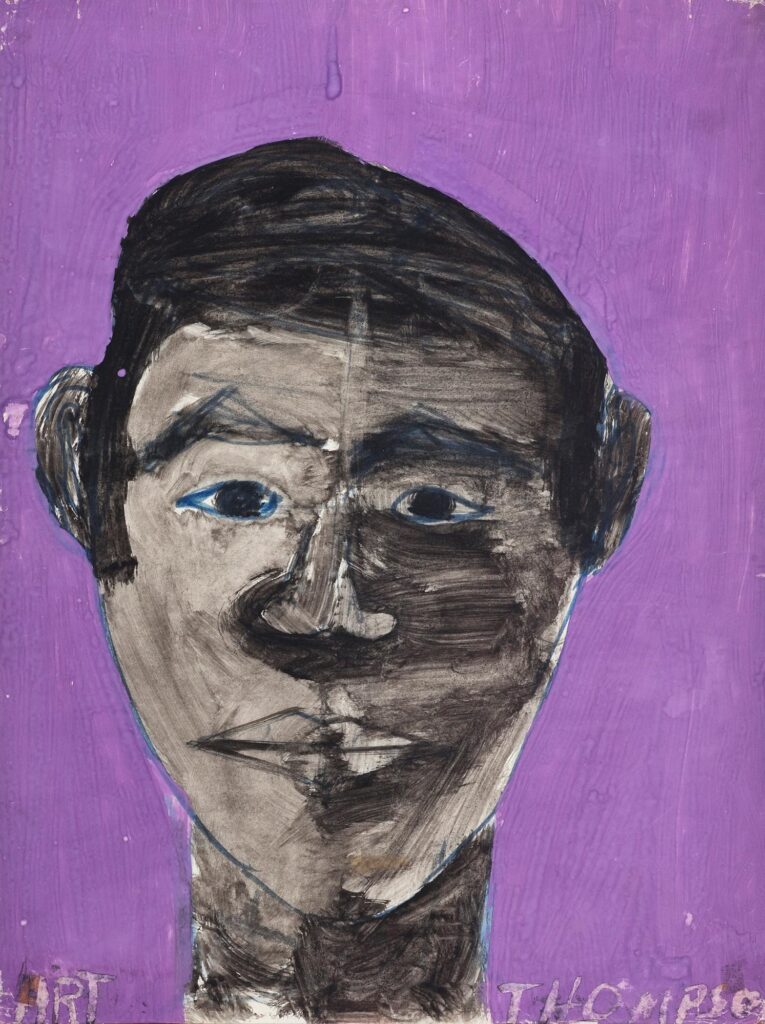
Art Thompson, Untitled (Portrait), c.late 1950s, private collection.
One such work is an early painting by Nuu-chah-nulth artist Art Thompson (1948–2003), created while he was a student at Alberni Indian Residential School in British Columbia, where he was confined from age five to age thirteen. Preserved by his instructor, the painting presents a young face divided by light and shadow, one side rendered with clarity, the other submerged in darkness. The composition is direct and frontal—yet, the gaze appears suspended between exposure and concealment. Within the context of the residential school system, this division evokes the fracturing of identity experienced by many Indigenous children separated from family, language, and culture. The image does not narrate harm explicitly, but it registers interiority under pressure, suggesting the split between the self that endured internally and the self required to perform compliance. Created within an institutional setting designed to suppress Indigenous expression, the work exceeds its pedagogical frame. It becomes an early act of visual testimony, asserting presence and consciousness at a time when other forms of expression were constrained or denied. Seen in this light, the painting stands as much more than a childhood exercise; it is a record of survival before language was available to fully articulate trauma.
This work does not stand alone. It signals a broader practice through which Indigenous children and artists transformed visual making into a means of holding truth when speech was unsafe, constrained, or systematically silenced. Whether produced quietly by children within residential or day schools or later by artists working in public and institutional spaces, such works activate visual knowledge as a form of responsibility. They do not merely illustrate history; they carry it, protect it, and transmit it across generations. Taken together, these works clarify why Indigenous art must be understood as one of the primary carriers of truth rather than an illustration of it. They ask viewers see—and also to remember, to reckon, and to carry forward what has been made visible.
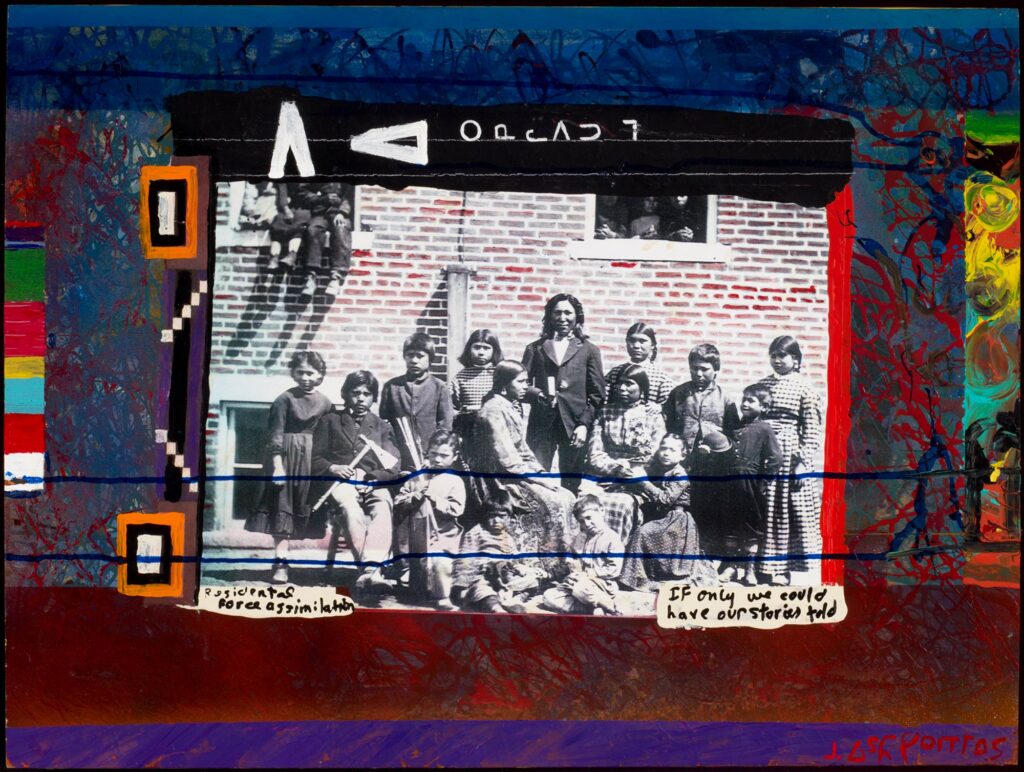
Jane Ash Poitras, If Only We Could Have Our Stories Told, 2004, composite of photograph and paint on wood panel, 50.8 x 66 cm, Library and Archives Canada, Ottawa.