
The artists gathered in this chapter are Survivors of residential and day schools who, in adulthood, turned to art to reckon with and give form to their childhood experiences. Born before, during, or after the Second World War, they lived through these institutions and the long repercussions of colonial violence, drawing on personal and collective memory to create works that confront what happened there and carry their experiences forward. Their art reveals not only what they endured, but also the creative practices through which they asserted presence, reclaimed knowledge, and told stories that colonial institutions sought to suppress. Through paint, print, sculpture, and ceremony, they transformed personal and collective memory into visual knowledge, enacting kanawâpâtahmowin as a practice that preceded, survived, and
continues beyond what was taken.
Collection of Survivors’ Art
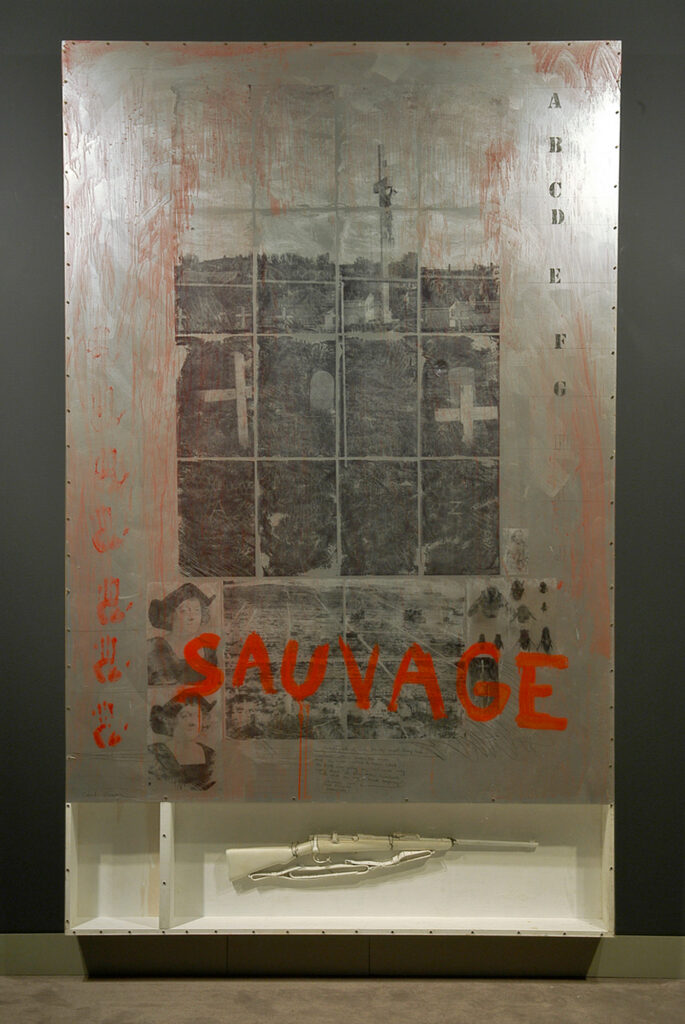
Carl Beam, Sauvage, 1988
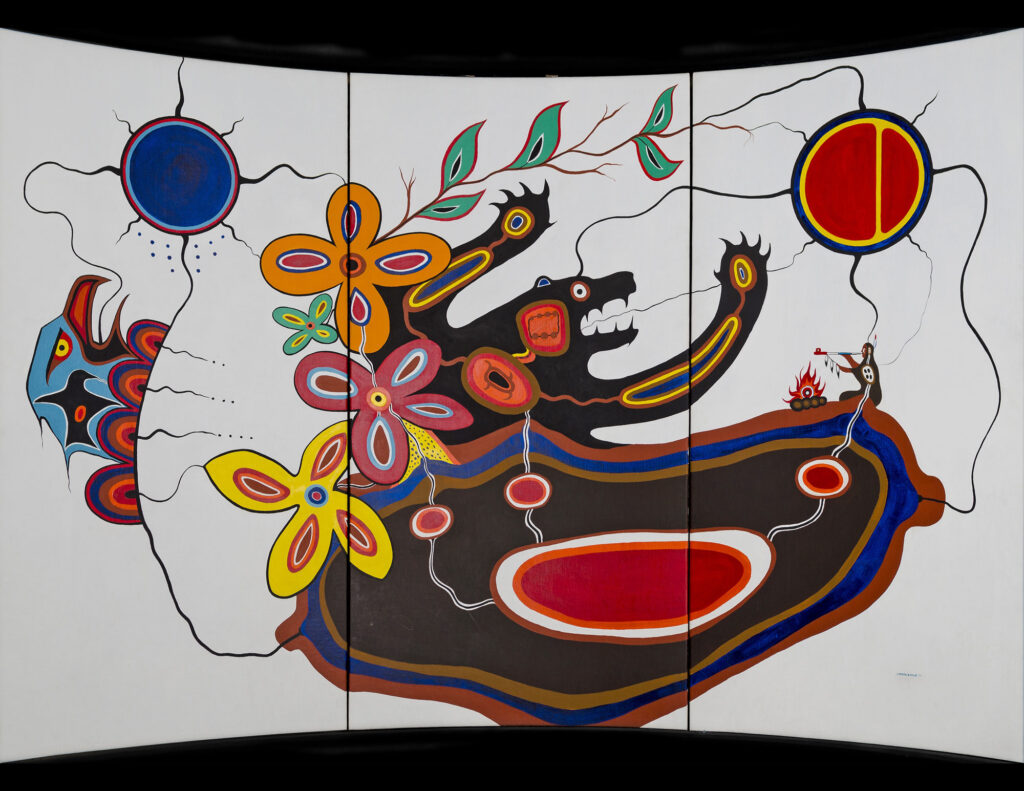
Jackson Beardy, Native World View, 1978

Henry Beaudry, Treaty No. 6, Battleford Area, n.d.

Mary Ceasar, Hair Being Cut by Nuns, 2017

Freda Diesing, Old Woman with Labret, 1973

Faye HeavyShield, Sisters, 1993

Robert Houle, Parfleches for the Last Supper, 1983

Alex Janvier, Blood Tears, 2001

Norval Morrisseau, The Gift, 1975

Ellen Neel, Kakaso'las, 1955–56

David Ruben Piqtoukun, Airplane, 1995

Jamasee Padluq Pitseolak, The Day After, 2010

Abraham Anghik Ruben, The Last Goodbye, 2001

Pitaloosie Saila, Strange Ladies, 2006

Allen Sapp, Recess at Onion Lake School, 1988

Henry Speck, Father Forgive Them, 1958

Adrian Stimson, Sick and Tired, 2005

Gerald Tailfeathers, Blood Camp, 1956
Lawrence Paul Yuxweluptun, Indian Residential School, Leaving the Shallow Graves and Going Home, 2022
Silence as Discipline

Boys in the pottery class at Shubenacadie Residential School, Nova Scotia, 1938, photographer unknown, Library and Archives Canada, Ottawa.
From the late nineteenth century into the 1990s, church- and government-run systems operated more than 130 Indian residential schools as instruments of forced assimilation. Under the 1920 Indian Act amendment, attendance became compulsory, with the explicit goal of separating children from their families and cultures. Upon arrival, children were stripped of their names, hair, clothing, and language, left only with silence and the discipline of erasure. Day schools, which allowed children to return home each evening, often shared this assimilationist logic and inflicted similar forms of erasure. While day schools like those at Red Pheasant or Inkameep did not always reproduce the full brutality of residential institutions, their pedagogies nonetheless displaced Indigenous languages, enforced Christianity, and diminished ceremony.
In this climate of control, silence became both a condition and an imposed pedagogy. Survivors describe how speaking Indigenous languages was punished, how voices were silenced in prayer, and how shame was instilled into children’s speech and identity. This suppression extended into the arts: drawing, carving, and music were framed as tools of European education rather than Indigenous creativity. Yet, even in this atmosphere, children and young adults found ways to create, sketching animals from memory, carving quietly in secret, or drawing from the fragments of oral stories carried into classrooms.
By the mid-twentieth century, as Survivors of these schools began to reach maturity, many artists began to work through what had been constrained or silenced earlier in their lives. They often carried deep scars, but their works rarely staged trauma as spectacle. Instead, they articulated memory and identity in indirect yet profound ways, painting homescapes, documenting community life, or embedding ceremony in modern forms. These practices enacted a form of survival—speaking visually where words had once been suppressed.
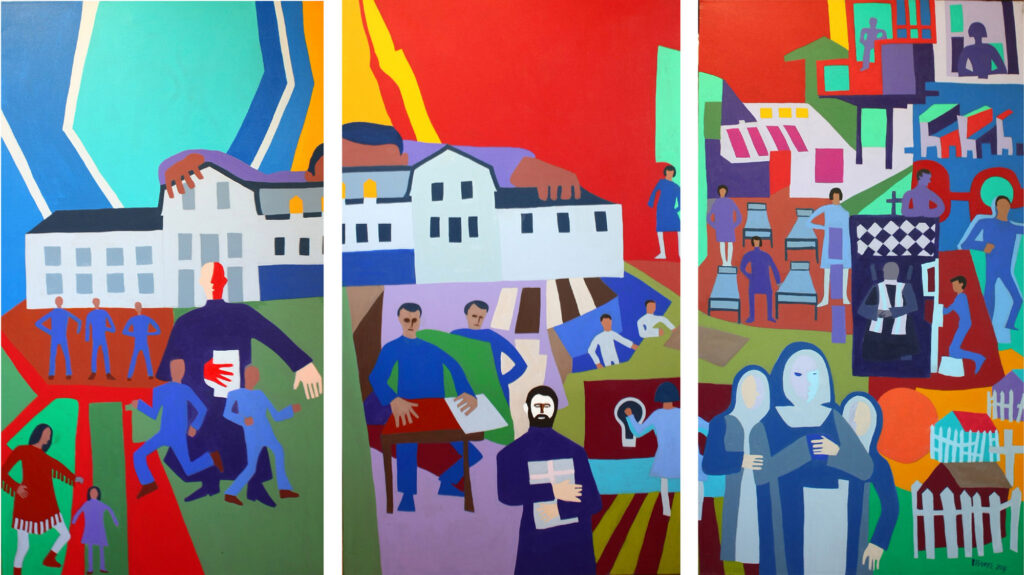
Robert Burke, Looking through the Institution, 2014, acrylic on canvas, 228.6 x 142.2 cm.
New Work by a New Generation
A generation of artists was reclaiming kinship, language, land, and ceremony by the mid-twentieth century. Often, rather than depict abuse directly, their works instead reanimate what the schools attempted to erase. Their quiet radicality prioritizes memory over spectacle, creating a counter-archive of survivance.
As art historian Geoffrey Carr has observed in his essay “Educating Memory,” even the architecture of residential schools enforced assimilationist erasure. Floor plans, corridors, and spatial divisions were designed to contain, monitor, and discipline, turning buildings into instruments of control alongside the curricula they housed. This spatial environment imprinted control into the daily lives of children, making the recovery of home, tradition, and selfhood all the more urgent. The Survivors of these spaces carry forward knowledge, language, and ceremony that persisted within and despite the walls erected to silence them.

Norval Morrisseau, Indian Jesus Christ, 1974, acrylic on paper, 134.6 x 68.5 cm, Aboriginal Affairs and Northern Development Canada, Gatineau.
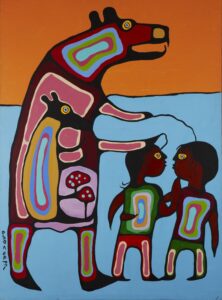
Norval Morrisseau, Spirit Bear with Children, c.1985, acrylic on canvas, 177.8 x 127 cm, Westerkirk Works of Art, Toronto.
It is against this backdrop that the works in this chapter, organized through themes of resilience, continuity, and spiritual sovereignty, preserve what was targeted for destruction. Artists such as Josephina Kalleo (1920–1993), whose drawings record Inuit life and knowledge for future generations; Allen Sapp (1928–2015), whose paintings return insistently to Plains Cree kinship, home, and seasonal life; and Norval Morrisseau (1932–2007), whose visionary imagery reasserted Anishinaabe cosmology within modern art, all exemplify how creative practice carries forward knowledge, language, and ceremony. Their persistence, far from accidental, arises from the deep well of Indigenous visual knowledge—what the Plains Cree call miýikosiwin: the creative force and spiritual gift that enables memory, relation, and meaning to endure.

Still from the National Film Board of Canada documentary Circle of the Sun showing a Kainai First Nation (Blood Tribe) man wearing a headdress and beaded clothing for the Sundance ceremony, Alberta, 1960.

Children handling traditional masks at the University of British Columbia museum, Vancouver, 1973, photograph by George Mully.
The artists who emerged during this period did so at a time when Indigenous communities were already working quietly but determinedly to sustain kinship systems, seasonal practices, and ceremonial life. Although the schools attempted to rupture these bonds, they could not extinguish the gifts that children carried from birth. Many of these artists grew into adulthood during a time of renewed cultural reawakening: the return of ceremonies, the resurgence of Indigenous political movements, and the reassertion of languages long suppressed.
Their creative practices reflect these layered experiences. They are shaped not only by the architecture of discipline imposed by the schools but also by the enduring teachings of their families and Nations, which continued to pass on stories, songs, and ways of seeing. This was a generation learning to see again—on their own terms and with their own inherited gifts.
It is here that the Plains Cree concept of miýikosiwin becomes essential. miýikosiwin
refers to a spiritual gift and an innate form of visual knowledge. It is a creative intelligence that orders how the world is seen and experienced, grounded in memory, land, and the responsibilities of relation—to kin, land, and the spirit world. Encompassing both inspiration and ethical guidance, it reminds us that creation must serve community—human and non-human alike.
Within this framework, resilience, continuity, and spiritual sovereignty guide this chapter and can be understood as direct expressions of miýikosiwin. Resilience emerges through the endurance of knowledge carried as gift—knowledge the schools could not extinguish. Continuity is carried by the generational transmission of those gifts, sustained through story, image, and relation. Spiritual sovereignty arises from the recognition that creativity itself is a sacred inheritance, a power given by the spirit world that remains beyond colonial reach.
For artists, miýikosiwin shapes the quiet power of their work. Their drawings, paintings, and carvings do more than recall what the schools attempted to erase; they reactivate the creative force that binds art to story, land to spirit, and memory to future generations. Through miýikosiwin, their art becomes not only testimony but also a renewal of cultural life and a continuation of gifts that could never be taken.
Reclaiming Story, Home, and Tradition
For many Indigenous artists who came of age between the 1940s and 1970s, art became a vessel for restoring what colonial systems sought to erase. Rather than dwell on overt scenes of abuse, artists turned toward memory, family, and land. Everyday acts such as hunting, gathering, storytelling, child rearing, and ceremony became subjects of survival, asserting continuity where the schools imposed rupture and severance.

Josephina Kalleo, Life Long Ago, c.1984, felt-tipped pen on paper, 17.7 x 22 cm, The Rooms, St. John's.
In Labrador, Josephina Kalleo embodied this ethic of remembering. A former student of the Moravian Mission school in Nain, she returned in her sixties to drawing, motivated by the desire that younger generations might remember “those days.” With felt-tip markers, she produced forty-five detailed scenes, seal hunts, berry picking, marriages, Christmas gatherings, and classrooms, later published as Taipsumane: A Collection of Labrador Stories (1984). Many drawings merge indoor lessons with outdoor work, showing how education flowed seamlessly between classroom and land. Captioned in Inuktitut syllabics, Inuktitut using the English alphabet, and English, her drawings braid languages and lifeways together. Circulated across Newfoundland and Labrador schools, they became portable archives of Inuit knowledge, sustaining community memory against colonial silencing.

Allen Sapp, Kids are Enjoying, 1981, acrylic on canvas, 45.7 x 61 cm, private collection.
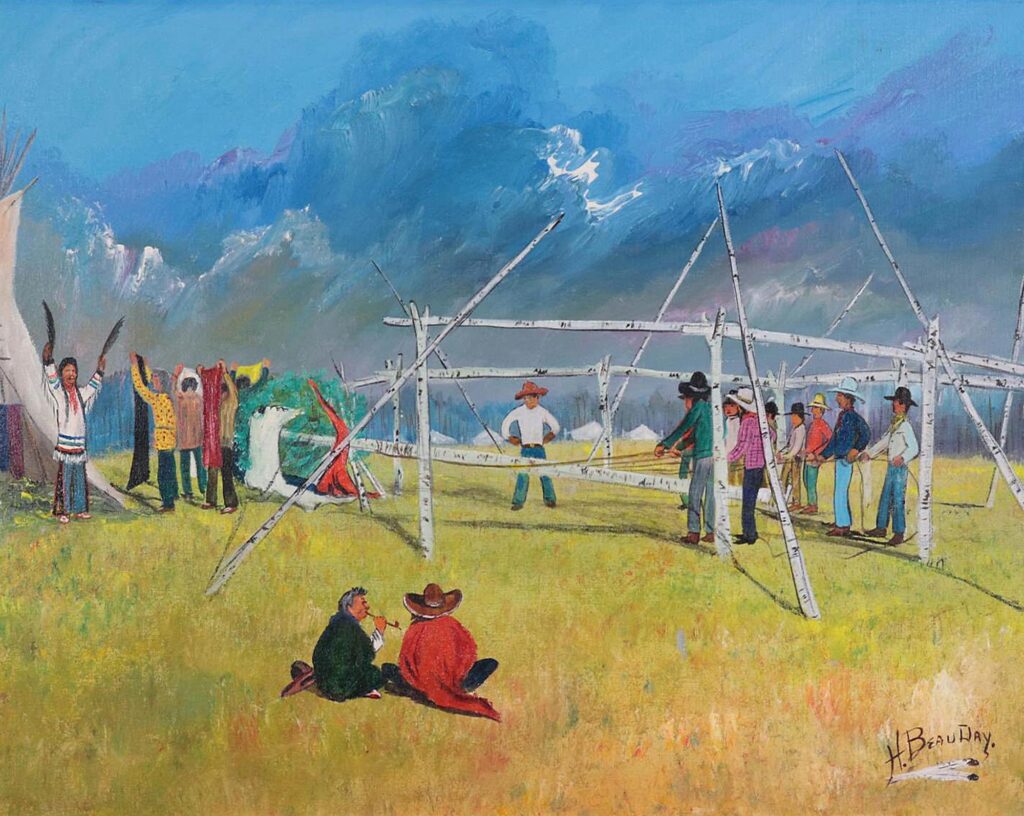
Henry Beaudry, Preparing for the Sundance, n.d., acrylic on canvas, 67.9 x 83.2 cm, private collection.
On the northern Plains, Allen Sapp, a member of Red Pheasant First Nation, used painting to preserve Plains Cree kinship. Though he briefly attended Onion Lake Residential School, his canvases rarely depicted it directly. Instead, he depicted home: hauling wood, children skating on frozen ponds, families travelling by horse-drawn sleigh, ceremonies, rodeos, even a few works about the Red Pheasant day school. These intimate scenes resist the school’s erasure of relational life. One exception, Recess at Onion Lake School, 1988, shows children scattered across a bleak yard beneath a flagpole’s shadow. Adults are absent, colour drained by winter light. Without overt violence, the painting conveys the loneliness of dislocation. Placed alongside his larger body of work steeped in familial warmth, its silence is even more piercing.
Henry Beaudry (1921–2016), a Plains Cree artist and Survivor of Thunderchild Residential School, carried memory into his paintings through a distinct visual language of endurance. A Second World War veteran and former prisoner of war, Beaudry’s canvases move between Cree life—encampments, horses, and ceremonies—and scenes of wartime captivity, bridging local and global histories of survival. His painting of treaty signing, for instance, situates Cree diplomacy within the long continuum of colonial negotiation and resistance. Each canvas, often signed with an eagle feather, reclaims historical memory through colour and compositional clarity, functioning as both testimony and teaching. Rooted in Saskatchewan communities, Beaudry’s work stands as a visual archive of persistence across the intertwined legacies of colonialism and conflict.
Together, Kalleo, Sapp, and Beaudry demonstrate how the act of remembering—through drawing, painting, and the patient recovery of daily life—becomes reclamation. By painting home, family, and tradition, they preserved cultural knowledge and ensured its passage into the future.
Allen Sapp, Recess at Onion Lake School, 1988, acrylic on canvas, 61 x 76.2 cm, MacKenzie Art Gallery, Regina.
Henry Beaudry, Treaty No. 6, Battleford Area, n.d., acrylic and felt pen on canvas, 61.0 x 76.4 cm, SK Arts Permanent Collection, Regina.
Gerald Tail Feathers, Blood Camp, 1956, watercolour on paper, Glenbow Museum, Calgary.
Spiritual Sovereignty
and Visual Testimony
By the middle of the twentieth century, Indigenous artists increasingly turned to the spiritual dimensions of survivance. Their art became a means of reclaiming sovereignty in a terrain fractured by the collision of imposed Christianity and ancestral cosmologies. Each negotiated the path differently, but all arrived at the same insistence: that Indigenous spiritual life had not been extinguished. The confrontation was made unmistakable at Expo 67 in Montreal, when Gerald Tail Feathers (1925–1975) of Kainai Nation painted a Thunderbird across the wall of the Indians of Canada Pavilion. His mural interrupted the centennial celebration with a vision of Niitsitapi (Blackfoot) power, its ceremonial figures refusing assimilationist narratives.

Indians of Canada Pavilion at Expo 67, Montreal, 1967, photographer unknown, Library and Archives Canada, Ottawa.
This insistence on cultural memory was echoed far from Montreal, in Kwakwaka’wakw villages, where Henry Speck (1908–1971) painted ceremonial beings alongside Christian imagery. In Father Forgive Them, 1958, a lone figure kneels before a glowing red cross, stripped of regalia. Speck’s image of faith without adornment registers both accommodation and critique, capturing the spiritual negotiations demanded by colonial life.
Kwakwaka’wakw artist Ellen Neel (1916–1966), a Survivor of St. Michael’s Residential School, played a pivotal role in the reestablishment of Northwest Coast carving in the mid-twentieth century. Born in Alert Bay, British Columbia, in 1916 and named Kakaso’las, she was trained within one of the most important carving lineages on the coast, learning under her grandfather Charlie James (1867–1937) and her uncle Mungo Martin (1881–1962). By adolescence, she was already carving and selling small poles, demonstrating both early mastery and the conviction that carving could sustain family and community. Her influence expanded decisively in 1948, when she addressed the Conference on Native Indian Affairs at the University of British Columbia with a plea that positioned Indigenous art as a living practice rather than an artifact: “If the art of my people is to take its rightful place beside other Canadian art, it must be a living medium of expression. We, the Indian artists, must be allowed to create!”

Ellen Neel carving a totem pole, 1953, photographer unknown, City of Vancouver Archives.

Ellen Neel, Thunderbird and Bear, cedar pole, 43.2 x 27.9 x 10.2 cm, private collection.
Soon after, Neel established Totem Art Studios in Vancouver’s Stanley Park, producing works that reinserted Indigenous presence into civic space, revived public carving traditions, and created a training ground that inspired artists such as Freda Diesing (1925–2002). Diesing, of Haida and Tlingit descent, returned to ancestral forms for their truth and clarity. Her Old Woman with Labret, 1973, restores dignity to matrilineal power once suppressed by colonialism. Together, Diesing and Neel transformed survival into continuity, linking carving, teaching, and mentoring into a single practice of cultural renewal.
For Anishinaabe artists, the confrontation with Christianity produced bold new vocabularies. Morrisseau, a Survivor of St. Joseph’s Residential School in Fort William, Ontario, transformed his trauma into the Woodland School style, a revolutionary visual language rooted in Anishinaabe cosmology. In The Gift, 1975, he inserted Christ among Ojibwe spirits, reframing Christianity inside Indigenous cosmology rather than outside it. Jackson Beardy (1944–1984), Ojibwe Cree from Manitoba, carried this vision forward, painting animal–human transformations in flowing curvilinear lines. Though rarely depicting his own school experience, Beardy’s canvases insist that Anishinaabe Peoples represent themselves through their cosmological knowledge, not through colonial categories. Morrisseau and Beardy expanded Indigenous visual sovereignty: to picture one’s own world was itself a spiritual act.
Testimony, Fragmentation,
and Ceremonial Release
Carl Beam (1943–2005), Ojibwe and a Survivor of Garnier Residential School in Spanish, Ontario, restructured history through collage. Forced Ideas in School Days, 1991, indicted the indoctrination of youth in residential schools, while works in his Columbus Project, 1988–92, including The Unexplained, 1989, extended this reckoning onto a broader historical canvas, layering maps, portraits, churches, and Indigenous iconography in photo transfers and brushwork, refusing a linear narrative. By fracturing images, Beam mirrored the psychological violence of assimilation, compelling viewers to reconstruct meaning themselves. His refusal to segregate Indigenous experience from modernity was itself sovereign: Indigenous truth was world truth.

Carl Beam, Forced Ideas in School Days, 1991, photo emulsion and ink on paper, 94 x 74 cm, Canada Council Art Bank, Ottawa.
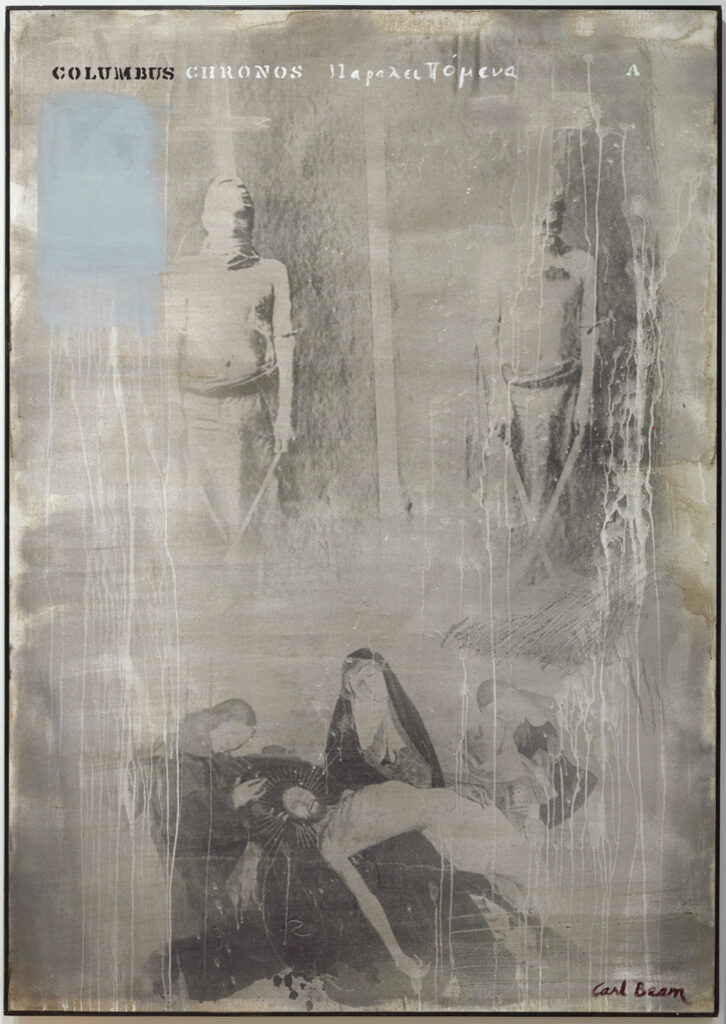
Carl Beam, The Unexplained, 1989, photo emulsion and mixed media on canvas, 213.4 x 152.4 cm, National Gallery of Canada, Ottawa.
For Alex Janvier (1935–2004), Denesuliné and a Survivor of Blue Quills Residential School, abstraction became testimony. Blood Tears, 2001, painted on his sixty-sixth birthday, erupts in turbulent reds and blacks around a cross, with handwritten words on the back listing what was lost in school: “childhood, language, culture, customs, parents, grandparents.” The painting is both artwork and document, abstraction and ledger. Janvier transformed grief into public record, showing how even nonfigurative form could carry the force of testimony.

Robert Houle, Sandy Bay Residential School Series (The Morning), 2009, oilstick on paper, one of twenty-four drawings, each 58.4 x 76.2 cm or 76.2 x 58.4 cm, School of Art Gallery, University of Manitoba, Winnipeg.
The work of Robert Houle (b.1947), Saulteaux from Sandy Bay, Saskatchewan, demonstrates how testimony can be ceremonial. His Sandy Bay Residential School Series, 2009, produced in response to the federal government’s formal apology for residential schools in 2008, comprises twenty-four pastels created in twenty-four days. Jagged strokes and Saulteaux phrases like “Saulteaux forbidden” evoke fragmentation and haunting. Houle calls the process pahgedenaun, to let go from the mind. Drawing becomes release, externalizing trauma into image, inviting communal mourning.
Where Houle’s process enacts release, the work of Mary Caesar (b.1947) demands retention—that memory be carried rather than let go. In Hair Being Cut by Nuns, 2017, a girl’s braids are severed mid-stroke, the saturated colours intensifying the violence of erasure. Caesar’s watercolour turns private trauma into collective responsibility, insisting that what happened must not be forgotten.

Mary Caesar, My School Number, 2017, acrylic on canvas, 24 x 20 cm, private collection.
Lawrence Paul Yuxweluptun Lets’lo:steltun, Indian Residential School, Leaving the Shallow Graves and Going Home, 2022, acrylic on canvas, 182.9 x 243.8 cm, private collection.
This thread of responsibility is carried into the present by artists like Lawrence Paul Yuxweluptun (b.1957), who is of Cowichan and Syilx descent and a Survivor of Kamloops Indian Residential School. His 2022 painting Indian Residential School, Leaving the Shallow Graves and Going Home depicts spectral children rising from earthen mounds beneath cedar-fringed skies. Rendered in electric oranges and reds with Coast Salish formline, the work mourns the children found in unmarked graves while asserting their presence. It is both requiem and resurgence, collapsing the boundary between living and dead, reminding us that reconciliation begins with truth.
Faye HeavyShield, Sisters, 1993, shoes altered with plaster, gesso, and acrylic paint, outside diameter installed: 105 cm, McMichael Canadian Art Collection, Kleinburg.
Kainai (Blood) artist Faye HeavyShield (b.1953) distills memory into spare, resonant forms grounded in land, kinship, and women’s stories. Her installation Sisters, 1993, arranges six pairs of white shoes in a circle, pointed outward, and transforms absence into presence. Each pair stands for women whose lives were altered by residential schools; yet, the circle gathers them together, holding grief, endurance, and relation in a single gesture. HeavyShield’s minimalism is exacting—every element is chosen; every absence is deliberate. Her work honours the quiet, ongoing ways communities carry memory forward despite the ruptures imposed by colonial institutions.
Siksika artist Adrian Stimson (b.1964) draws on the history of Old Sun Residential School to transform installation into a site of visual testimony. In Old Sun, 2005, he reassembles broken windows, light fixtures, bricks, and bison hides into an environment where memory confronts material history. A steel frame draped in bison hide, evoking both sweat lodge and cage, embodies the tension between spiritual renewal and colonial confinement. The bison and Indigenous Peoples share a history of near-annihilation at the hands of colonial expansion. By drawing this parallel, Stimson positions the bison as mourner and survivor, a figure of endurance shaped by miýikosiwin, the creative force that carries truth across generations.
Braided together, these works show that testimony takes many forms: mural and carving, abstraction and print, installation and performance. Some artists negotiate between faiths, others hybridize cosmologies, fracture narratives, or render silence visible. Yet, all refuse erasure. They weave a visual archive of survivance where the sacred continues to speak. In their hands, art is not simply expression but ceremony, reclamation, and sovereignty—a reminder that the struggle for spiritual freedom is also a struggle to see, know, and live otherwise.

Adrian Stimson, Old Sun, 2005, wood, bison hides cut up, steel, Old Sun light glass (original), 122 x 152.4 cm, Art Gallery of Ontario, Toronto.
Inuit Survivors and the Arctic Experience
Although less frequently centred in national narratives of residential schooling, Inuit experiences formed a parallel system of colonial intervention that profoundly reshaped northern communities. Residential schools in the Arctic expanded rapidly from the 1940s through the 1960s, a network of church-run hostels, federal day schools, and boarding facilities that removed children from seasonal hunting cycles and kinship networks. The Truth and Reconciliation Commission of Canada documented how many Inuit children were flown or shipped thousands of kilometres from home, often with no clear explanation to parents about where they had been taken, for how long, or whether they would return at all.
These removals were compounded by the medical evacuations for tuberculosis, in which Inuit patients—children, youth, and adults—were transported south for months or years at a time. Though not formally part of the residential school system, tuberculosis hospitals operated through the same colonial logic: dislocation, language loss, cultural severance, and silence. Survivors repeatedly described the trauma of distance, the absence of family, and the loneliness of southern institutions as defining features of their childhoods.

Three Inuit children outside the mission in Chesterfield Inlet, Nunavut, 1933, photographer unknown, Library and Archives Canada, Ottawa.
Politician and activist Sheila Watt-Cloutier recalls in The Right to Be Cold (2015) how being sent south as a young girl fractured her sense of belonging. Her experiences of isolation, southern discipline, and the suppression of Inuit language echoed stories shared across the Arctic. These forms of removal, whether for schooling or medical treatment, generated a generation raised between worlds, shaped as much by the distance from home as by the institutions meant to assimilate them.
It is against this backdrop that Inuit artists reassert memory and sovereignty through printmaking and sculpture. Their visual languages often encode the symbols of rupture—airplanes, ships, nurses’ uniforms, hybrid landscapes—bearing witness to the mobilities imposed upon northern communities. Through their work, Inuit artists demonstrate that just as testimony emerges from residential schools themselves, it also emerges from the wider system of state interventions that disrupted Inuit life on the land.

Pitaloosie Saila drawing, date unknown, photograph by William Richie.

Abraham Anghik Ruben, Migration: Umiak with Spirit Figures, 2008, Brazilian soapstone, cedar, iron, 63.5 x 93 x 25 cm, Winnipeg Art Gallery.
Inuit artists extend this reclamation into print and sculpture. The lithograph Strange Ladies, 2006, by Pitaloosie Saila (1942–2021) depicts three faceless women—a bureaucrat, a nun, a nurse—embodying the authorities who oversaw Inuit patients during the tuberculosis evacuations of the 1950s. Though outside of the formal residential school system, the rationale was the same: removal, severance, assimilation. Saila’s faceless figures render authority anonymous and interchangeable, insisting that what was done to Inuit patients was systemic, not incidental.
Brothers Abraham Anghik Ruben (b.1951) and David Ruben Piqtoukun (1950–2026), Inuvialuk carvers from Paulatuk, Northwest Territories, translated their own childhood separations into stone and bronze. Ruben’s Death of the Shaman, 2001, mourns a silenced leader, while Migration: Umiak with Spirit Figures, 2008, carries families and animals across a ribbon bridge toward reclamation. Piqtoukun’s Airplane, 1995, recalls the moment of removal, layering igloo, aircraft, and child figure in tiers of loss and resilience. Their sculptures hold what institutions tried to dissolve. By fixing in materiality what was meant to be forgotten, they assert an Indigenous visual sovereignty over memory. The works, enduring and weighty, refuse erasure. Interweaving personal and mythic memory, they transform sculpture into an archive of Inuvialuit sovereignty and the living power of northern knowledge.
Pitaloosie Saila, Strange Ladies, 2006, lithograph, 38.1 x 57.2 cm, Dorset Fine Arts, Toronto.
Abraham Anghik Ruben, The Last Goodbye, 2001, Brazilian soapstone, 42.5 x 25.5 x 42 cm, Collection of Christian Steckler.
David Ruben Piqtoukun, Airplane, 1995, Brazilian soapstone and African wonderstone, 26 x 36.5 x 27.5 cm, Winnipeg Art Gallery.
Relational Knowledge, Carried Forward
The artists of this generation form a visual genealogy of survivance. Their works complete the arc that frames this chapter: from silence to expression, from rupture to continuity, from erasure to sovereignty. Each artist transforms the conditions of schooling, displacement, and erasure into forms of truth telling shaped by miýikosiwin, understood as the creative force and spiritual gift that enables memory, relation, and meaning to endure. Whether through community memory, resurgent ceremony, cosmological vision, or the renewal of ancestral forms, their art is anchored in relational ethics: grandmothers, traplines, Inuktitut lessons, Thunderbirds, bison, button blankets, and the land itself. Without staging trauma as spectacle, they restore presence, making visible the continuities colonial institutions sought to sever. Their work does not simply remember; it teaches.
At its core, miýikosiwin sustains creation even under the pressure of erasure. For these Survivors, remembering is an ethic: an obligation to see with care, to create with responsibility, and to carry forward what was meant to be destroyed. Their testimonies, expressed through drawing, carving, print, canvas, installation, and performance, become a living archive for future generations. In their hands, art surpasses memory—it is a promise kept across generations.