Norval Morrisseau, The Gift, 1975

Norval Morrisseau, The Gift, 1975, acrylic on paper, 196 x 122 cm, Thunder Bay Art Gallery.
In The Gift, a painting by Anishinaabe artist Norval Morrisseau (1932–2007), who was raised in Bingwi Neyaashi Anishinaabek (Sand Point First Nation), Ontario, three stylized figures cluster against an ochre ground. On the left stands a youthful Anishinaabe person—hair bristling, body alive with inner forms—holding a medicine pouch whose radiating lines signal power carried forward from the ancestors. Opposite, a tall clerical figure, with a crest of black hair recalling cassock fringe and a chest banded like vestments, extends an elongated arm toward the pouch. Between and below them crouches a child-being, head tilted toward the offering. Energy passages (the interior lines that are a hallmark of Morrisseau’s X-ray vision) connect all three bodies, showing precisely what is at stake: transmission. Is Christianity being offered as a benevolent gift, or is the child being pulled away from Indigenous teachings toward the cross? The exchange vibrates with ambivalence.

Norval Morrisseau painting outdoors, Red Lake, Ontario, August 1966, photographer unknown.
Colour intensifies the debate. Warm ochres and reds flow through the Anishinaabe bodies, punctuated by life-green cells. The clerical figure is cooler, more segmented, its interior shapes isolated. Dotted fields, Morrisseau’s sign for permeable spirit, travel across boundaries, implying that no encounter leaves either side unchanged. The small cross stamped on the pouch reverses missionary logic; here, Christianity is contained within an Anishinaabe carrier, not the other way around. This inversion tracks with Morrisseau’s lifelong project of spiritual synthesis. Having survived a system that tried to silence Anishinaabe cosmology, he painted worlds in which Midewiwin beings from the Grand Medicine Society, Christ figures, animal guides, and energy circuits inhabit the same pictorial space.
Read through the lens of residential school history, The Gift becomes testimony. The looming adult exchange over the head of a child recalls the coercive bargains churches and the Canadian government struck supposedly for the benefit of Indigenous children. Yet, the visual circuitry insists that cultural power still circulates in Indigenous hands. Morrisseau’s generation opened the door for artists who would later name residential schools explicitly—Adrian Stimson (b.1964), Jim Logan (b.1955), Kent Monkman (b.1965)—but the contribution Morrisseau made himself was foundational. He pictured the psychic negotiations those institutions enforced and, in doing so, modelled survival through his images.
Morrisseau was taken from his home when he was about six years old and placed at St. Joseph’s Residential School in Fort William for several years. Accounts by family, friends, and biographers describe the emotional, physical, and sexual abuses he endured there, as well as the strict prohibition on Indigenous language and ceremony that prevailed. Morrisseau carried the imprint of residential school throughout his life, and The Gift stages that history as a spiritual confrontation.
Collection of Survivors’ Art
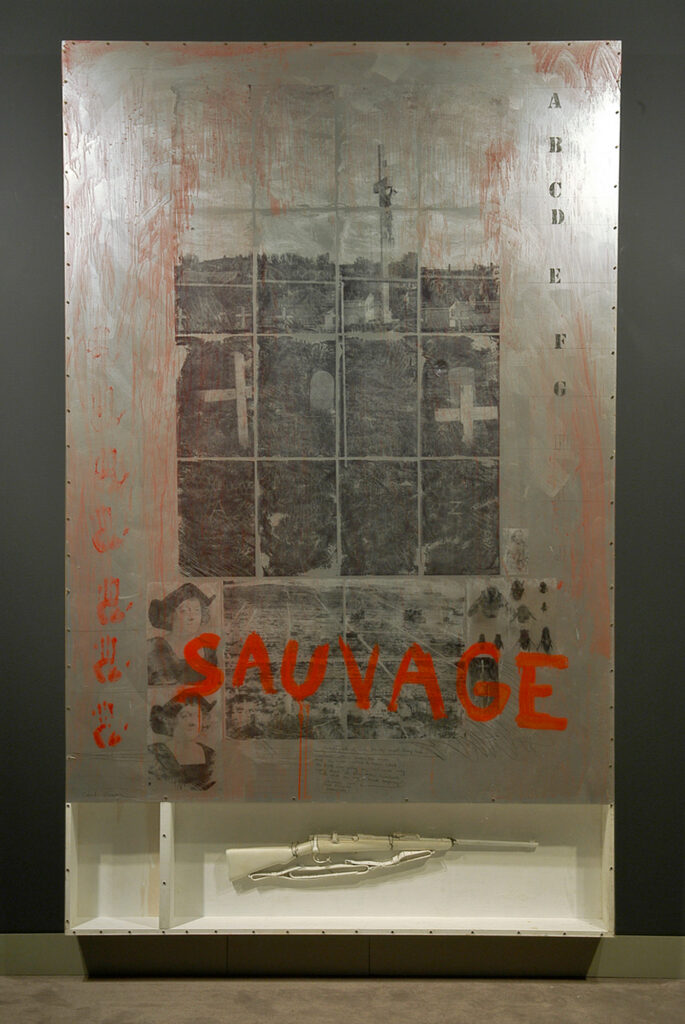
Carl Beam, Sauvage, 1988
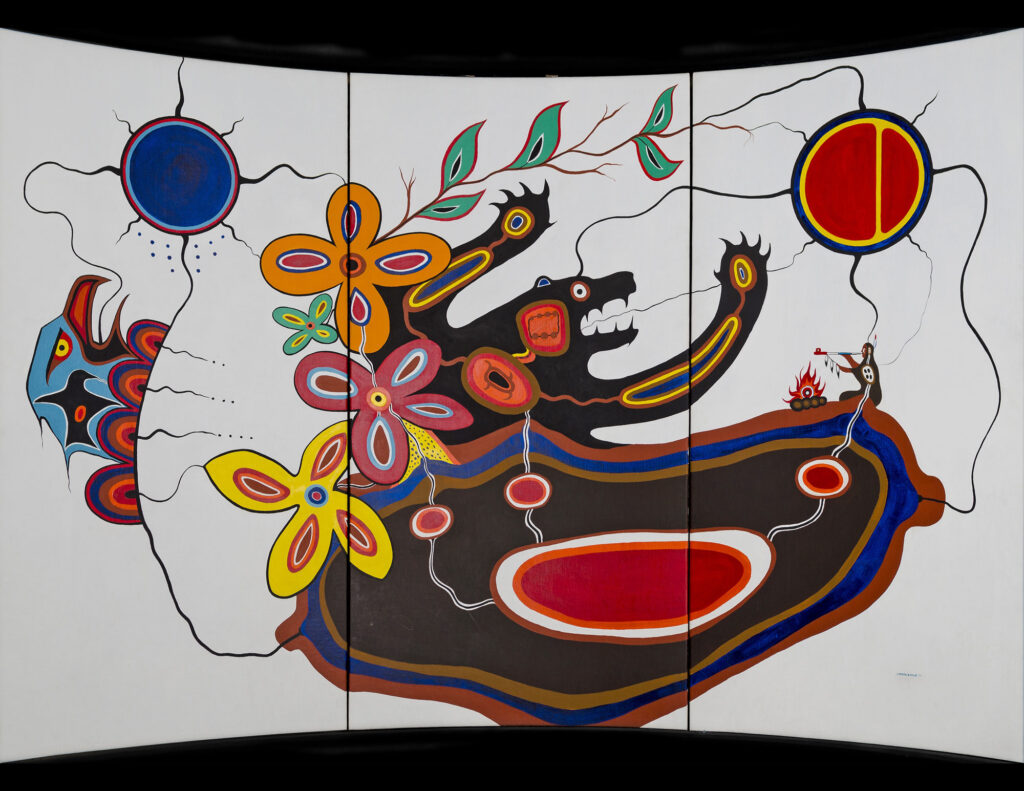
Jackson Beardy, Native World View, 1978

Henry Beaudry, Treaty No. 6, Battleford Area, n.d.

Mary Ceasar, Hair Being Cut by Nuns, 2017

Freda Diesing, Old Woman with Labret, 1973

Faye HeavyShield, Sisters, 1993

Robert Houle, Parfleches for the Last Supper, 1983

Alex Janvier, Blood Tears, 2001
Norval Morrisseau, The Gift, 1975

Ellen Neel, Kakaso'las, 1955–56

David Ruben Piqtoukun, Airplane, 1995

Jamasee Padluq Pitseolak, The Day After, 2010

Abraham Anghik Ruben, The Last Goodbye, 2001

Pitaloosie Saila, Strange Ladies, 2006

Allen Sapp, Recess at Onion Lake School, 1988

Henry Speck, Father Forgive Them, 1958

Adrian Stimson, Sick and Tired, 2005

Gerald Tailfeathers, Blood Camp, 1956

Lawrence Paul Yuxweluptun, Indian Residential School, Leaving the Shallow Graves and Going Home, 2022