Gerald Tail Feathers, Blood Camp, 1956

Gerald Tail Feathers, Blood Camp, 1956, watercolour on paper, Glenbow Museum, Calgary.
The painting Blood Camp by Kainai (Blood) artist Gerald Tail Feathers (1925–1975), signed under his early name Gerald T. Feathers, offers a vivid portrait of the Niitsitapi (Blackfoot) world in transition. It is set at Belly Buttes (Moko’waansistsi), not far from Standoff, Alberta, a site long associated with Sundance gatherings. The scene juxtaposes three forms
of dwelling and mobility: a painted tipi, a utilitarian canvas tent with smoke rising from its stove, and a parked automobile. Nearby, a horse stands harnessed, evoking both the deep relationship between Niitsitapi and horses and the new demands of agricultural labour. Within this tight arrangement, Tailfeathers compresses centuries of cultural transformation into a single frame, showing how swiftly Indigenous life was forced to shift under colonial pressures.
The tipi anchors the image as a marker of continuity, its painted surface signalling cosmological ties and ceremonial practice. Yet, its prominence is unsettled by the encroachment of the wall tent and automobile. The tent, plain and functional, reflects the economic necessity of the mid-twentieth century, when many Kainai and other Niitsitapi adults had to engage in wage labour, farming, and ranching in order to survive within the settler economy.

Gerald Tail Feathers, Process of the Holy Woman, Blood Sundance, 1960, tempera on paper, Glenbow Museum, Calgary.
The automobile, likely a 1920s Ford Model T, embodies the speed with which settler technologies transformed the Prairies. By the 1930s, such vehicles had become common even in remote communities, replacing horse-drawn travel and tying Indigenous families to new patterns of settlement, trade, and dependence on wage income. In Tailfeathers’s composition, the car sits beside the tipi not as a neutral presence but as a disruptive one, symbolizing how abruptly modern infrastructure intruded into Niitsitapi life. Its inclusion underscores that adaptation was not gradual: the traditional and the modern were forced to coexist in compressed, uneasy proximity.
The restrained yet telling presence of the harnessed horse amplifies this tension. Once central to Niitsitapi mobility, trade, and spiritual life, the horse here is bound to harness and bit, its freedom circumscribed in the service of
settler agricultural systems. In Tail Feathers’s rendering, the horse becomes a subtle metaphor for the broader experience of the people themselves—compelled to adapt to new economic realities while still seeking to preserve dignity and continuity with tradition.
Tail Feathers’s perspective as a Survivor of the Anglican St. Paul’s Residential School gives the painting further resonance. Although he did not explicitly paint scenes of his schooling, he nonetheless carried its memory, and his art consistently affirmed Niitsitapi ways of life in the face of systemic erasure. The absence of children from this composition is poignant because it recalls how young people were often removed from their families and taken into institutions where their language and culture were suppressed. Adults, meanwhile, struggled to balance survival within settler structures with the responsibility of holding onto ceremonies, stories, and practices that affirmed identity.
For Tail Feathers, painting became a way of insisting on the vitality of Niitsitapi traditions even as he recorded the realities of adaptation. Blood Camp, along with works such as
Procession of the Holy Woman, Blood Sundance, 1960, embody the resilience of Indigenous
artists of his generation who navigated the contradictory pressures of assimilation while refusing to abandon cultural values. By setting tipi, tent, horse, and automobile together, he portrays not a vanishing world, as settler narratives often suggested, but one in transformation. Continuity and rupture, as well as survival and adaptation, coexist in uneasy tension. In bearing witness to this swift transition, Tail Feathers affirms that Niitsitapi identity persists, sustained by the creativity and determination of those who believe in its endurance.
Collection of Survivors’ Art
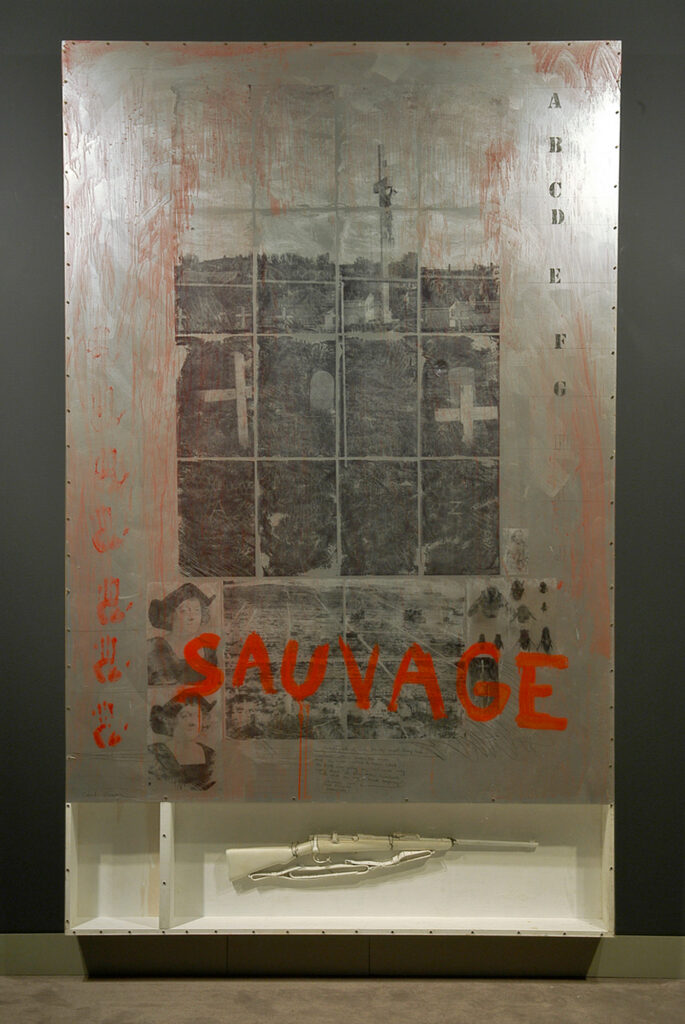
Carl Beam, Sauvage, 1988
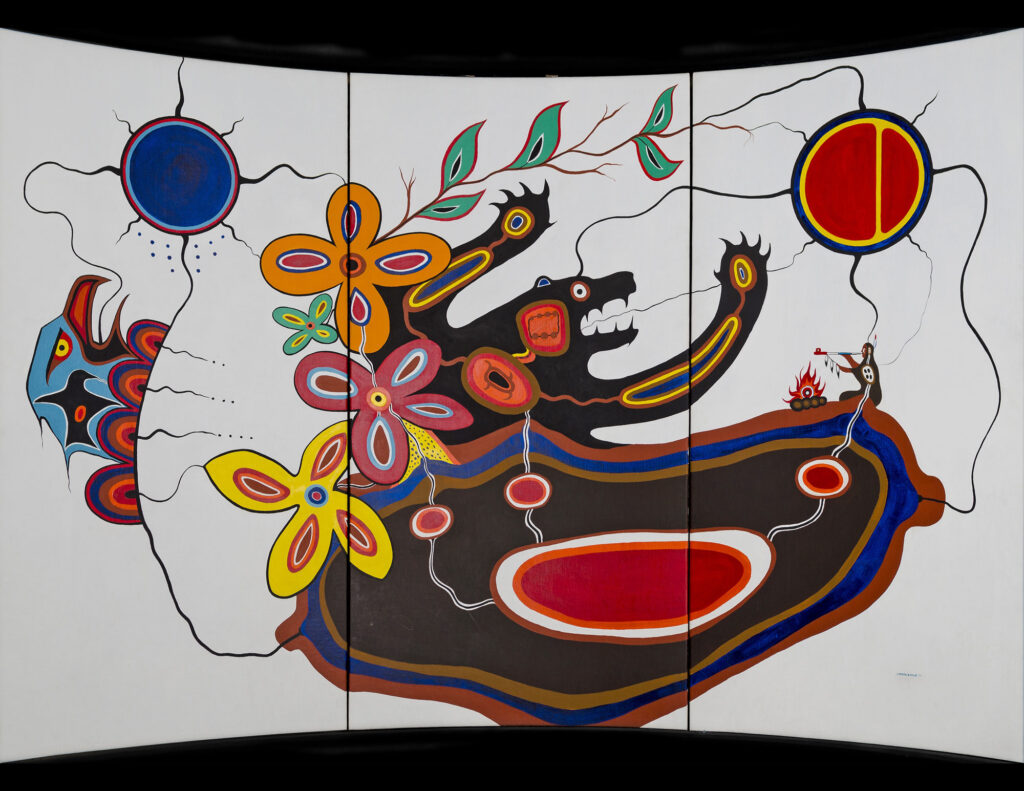
Jackson Beardy, Native World View, 1978

Henry Beaudry, Treaty No. 6, Battleford Area, n.d.

Mary Ceasar, Hair Being Cut by Nuns, 2017

Freda Diesing, Old Woman with Labret, 1973

Faye HeavyShield, Sisters, 1993

Robert Houle, Parfleches for the Last Supper, 1983

Alex Janvier, Blood Tears, 2001

Norval Morrisseau, The Gift, 1975

Ellen Neel, Kakaso'las, 1955–56

David Ruben Piqtoukun, Airplane, 1995

Jamasee Padluq Pitseolak, The Day After, 2010

Abraham Anghik Ruben, The Last Goodbye, 2001

Pitaloosie Saila, Strange Ladies, 2006

Allen Sapp, Recess at Onion Lake School, 1988

Henry Speck, Father Forgive Them, 1958

Adrian Stimson, Sick and Tired, 2005
Gerald Tailfeathers, Blood Camp, 1956

Lawrence Paul Yuxweluptun, Indian Residential School, Leaving the Shallow Graves and Going Home, 2022