Adrian Stimson, Sick and Tired, 2006

Adrian Stimson, Sick and Tired, 2006, windows and infirmary bed from Old Sun Residential School, feathers, fluorescent lights, bison robe, dimensions variable, MacKenzie Art Gallery, Regina.
For his installation Sick and Tired, Adrian Stimson (b.1964) of Siksika Nation, Alberta, a Survivor of Old Sun Residential School, salvaged three original school windows, packed them with feathers, and dramatically backlit them to form the work’s luminous core. Read as barred openings, the windows recall children peering out toward home; read through the feathers, they flicker with suppressed flight—as spirit held in suspension. Stimson describes the work as a way to “exorcise and transcend the colonial project,” an act oriented toward forgiveness, healing, and a state of grace. In this sense, the installation insists that silence enables harm and that speaking (and showing) becomes ceremony. By immobilizing feathers, icons of Niitsitapi (Blackfoot) spirituality and motion, inside institutional frames, he visualizes the psychic claustrophobia of forced containment and language loss imposed by the schools.

Adrian Stimson, Buffalo Boy at Burning Man, 2005, black and white photograph, various dimensions.
Opposite the windows stands an Old Sun infirmary bed, its rusted springs exposed and spotlighted so the cast shadow reads like a stretched hide. Across the frame lies a bison
robe folded as though covering a body—cadaver, ancestor, bundle. For Stimson, the bison compresses the colonial experience: the animal’s near-extermination parallels the colonial power’s deliberate assault on Niitsitapi lifeways, but its survival also indexes cultural regeneration at the core of Niitsitapi being. The bed concentrates what residential schools produced systemically—illness, exhaustion, death, spirits broken
by confinement—and the many children who longed for home and suffered on such institutional cots. Joined in this charged tableau, bed and robe operate as a material reliquary of genocide and survivance, forcing viewers to confront the bodily cost of the residential regime even as Niitsitapi presence endures.
In reassembling these remnants, Sick and Tired operates as counter-memory: it reclaims institutional debris as an Indigenous archive, collapsing past and present into a process oriented toward forgiveness, healing, and a state of grace. Viewers do not receive a moralistic text; rather, they enter a sensorial field of light, shadow, fur, and iron in which
they must shoulder the role of witness, echoing Niitsitapi ceremonial Protocols that assign a responsibility to remember and retell.
Stimson’s multidisciplinary practice moves between biting performance, as in Buffalo Boy at Burning Man, 2005, and elegiac installations that confront colonial violence, such as Iini Bison Heart, 2020. Sick and Tired marks a pivotal turn in contemporary Indigenous truth telling, redirecting national attention from abstract policy to the material architectures that contained and attempted to erase Indigenous children. Situated within broader exhibitions on residential schools, the work extended Stimson’s long project of mourning, satire, and survivance, showing how material culture can expose a national crime while offering a site for communal catharsis. Sick and Tired thus transforms colonial fragments into Indigenous visual sovereignty—memory made tactile, grief made shareable, and healing set in motion.
Collection of Survivors’ Art
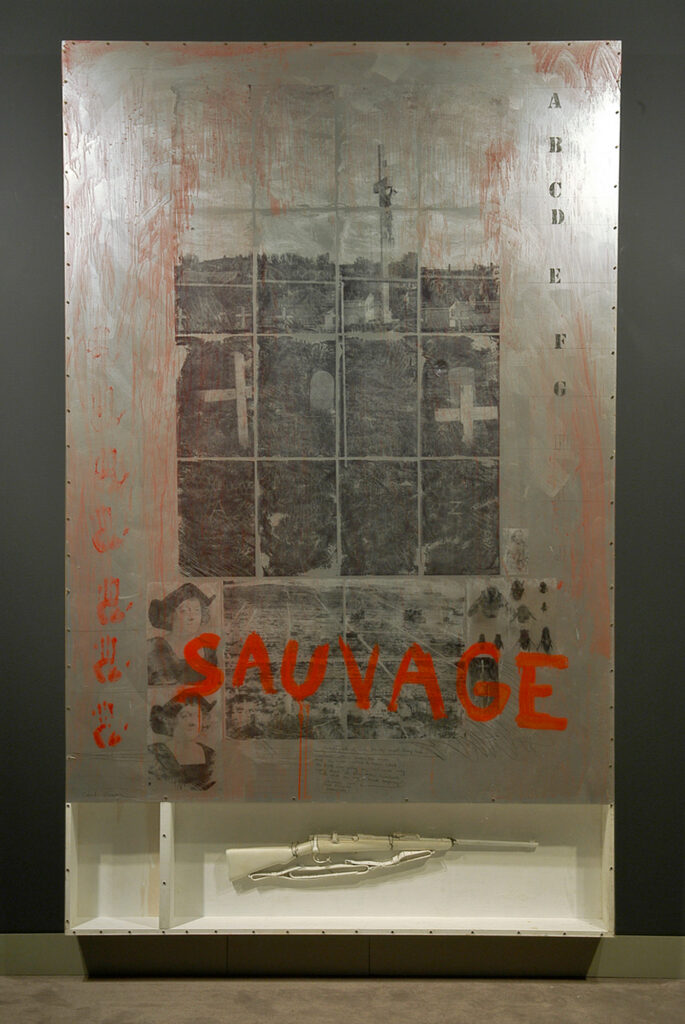
Carl Beam, Sauvage, 1988
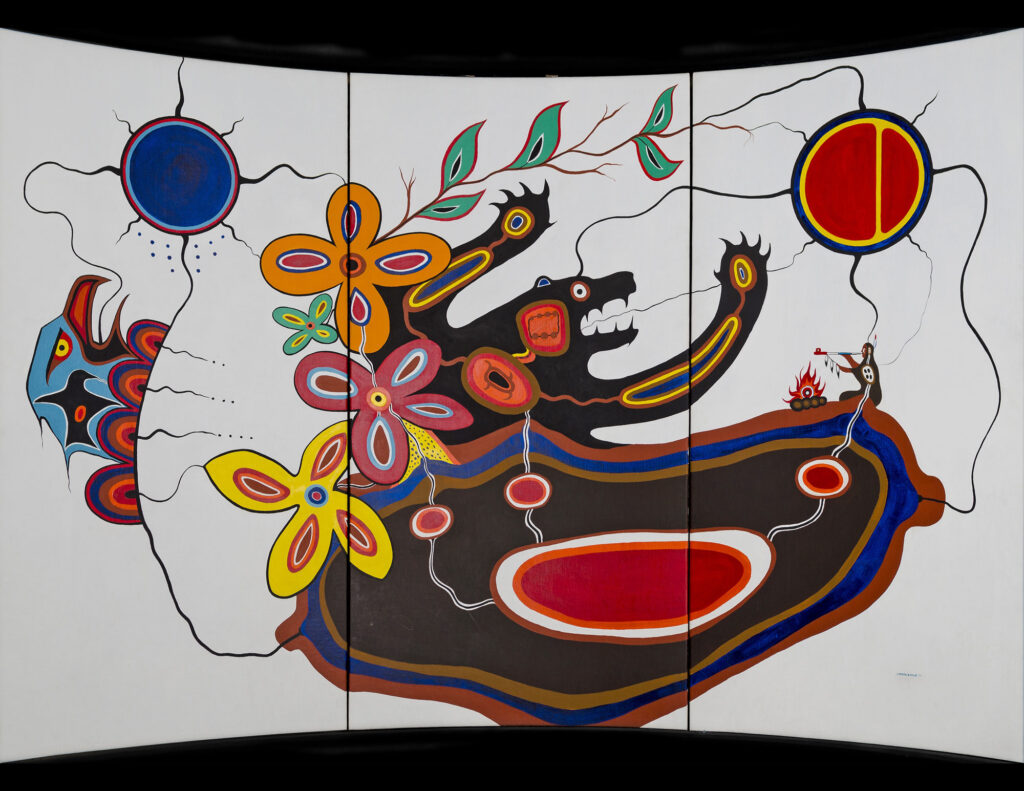
Jackson Beardy, Native World View, 1978

Henry Beaudry, Treaty No. 6, Battleford Area, n.d.

Mary Ceasar, Hair Being Cut by Nuns, 2017

Freda Diesing, Old Woman with Labret, 1973

Faye HeavyShield, Sisters, 1993

Robert Houle, Parfleches for the Last Supper, 1983

Alex Janvier, Blood Tears, 2001

Norval Morrisseau, The Gift, 1975

Ellen Neel, Kakaso'las, 1955–56

David Ruben Piqtoukun, Airplane, 1995

Jamasee Padluq Pitseolak, The Day After, 2010

Abraham Anghik Ruben, The Last Goodbye, 2001

Pitaloosie Saila, Strange Ladies, 2006

Allen Sapp, Recess at Onion Lake School, 1988

Henry Speck, Father Forgive Them, 1958
Adrian Stimson, Sick and Tired, 2005

Gerald Tailfeathers, Blood Camp, 1956

Lawrence Paul Yuxweluptun, Indian Residential School, Leaving the Shallow Graves and Going Home, 2022