Henry Beaudry, Treaty No. 6, Battleford Area, n.d.

Henry Beaudry, Treaty No. 6, Battleford Area, n.d., acrylic and felt pen on canvas, 61 x 76.4 cm, SK Arts Permanent Collection, Regina.
Treaty No. 6, Battleford Area by Plains Cree artist Henry Beaudry (1921–2016) from Poundmaker Cree Nation, Saskatchewan, depicts a staged signing scene: two Cree men—a chief and a councillor—stand opposite a government agent, flanked by a priest and two North-West Mounted Police officers. The composition is simple yet charged. The Cree chief bends to sign his name with an “X,” a mark that speaks to forced participation and linguistic exclusion. The tension between ceremony and coercion in this moment transforms the act of treaty making into a visual meditation on power, endurance, and historical accountability; one that views history not as settled fact but as an ongoing negotiation of sovereignty.
In this painting, Beaudry compresses an entire colonial system into a single tableau. Each figure stands as an archetype: the Cree signatories as witnesses of nationhood, the priest as mediator between belief systems, the police as enforcers of the new order, and the government agent as the bureaucracy of empire. The chief’s “X” embodies the asymmetry of the treaty relationship—a signature that secures a promise but erases a voice. Using flattened perspective, solid colour fields, and sharp outlining, Beaudry sets his scene in an indeterminate time and space, suggesting that the treaty moment remains unfinished, still echoing through the present.

Treaty 6, signed on August 23, 1867.
Treaty 6, signed in 1876 in the Battleford region, covered the lands of the Plains and Woods Cree, Assiniboine, and allied Nations. It promised medicine, rations, and aid in times of famine; yet, it became a site of deep betrayal and contestation. Beaudry’s painting does not illustrate these facts—it remembers them. His brushwork performs a counter-archive, asserting an Indigenous witness to a history often narrated by colonial institutions.
Beaudry’s life story gives this image a deeper resonance. As a Survivor of Thunderchild Residential School, he carried the memory of state assimilation. Later, as a soldier and prisoner of war during the Second World War, he experienced yet another institution of discipline and survival. Returning home to Saskatchewan, he began painting in the late 1950s as a form of renewal—an act of reclaiming story, land, and identity from systems designed to erase them. Unlike many artists whose work directly confronts residential school trauma, Beaudry’s paintings turn toward restoration, affirming the continuity of Cree life and values in the face of cultural suppression. His depictions of camps, ceremonies, and historic encounters embody survivance—a will to persist, narrate, and teach through image. His narrative approach resonates with contemporaries such as Allen Sapp (1928–2015), as well as with later artists, including Sanford Fisher (1927–1995) and Michael Lonechild (b.1955), whose practices extend this emphasis on memory, community, and lived experience across Saskatchewan.
Throughout his career, Beaudry signed his works with an eagle feather, a spiritual declaration of truth and continuity. His art, often gifted to community members and leaders, functions as testimony and teaching rather than commodity. In Treaty No. 6, Battleford Area, he paints not grievance but endurance: a reminder that even within coercive spaces—schools, camps, treaties—Indigenous agency endures. His visual language refuses despair, insisting instead on historical clarity, interconnections, and the persistence of Cree sovereignty across time.
Gallery of Survivors’ Art
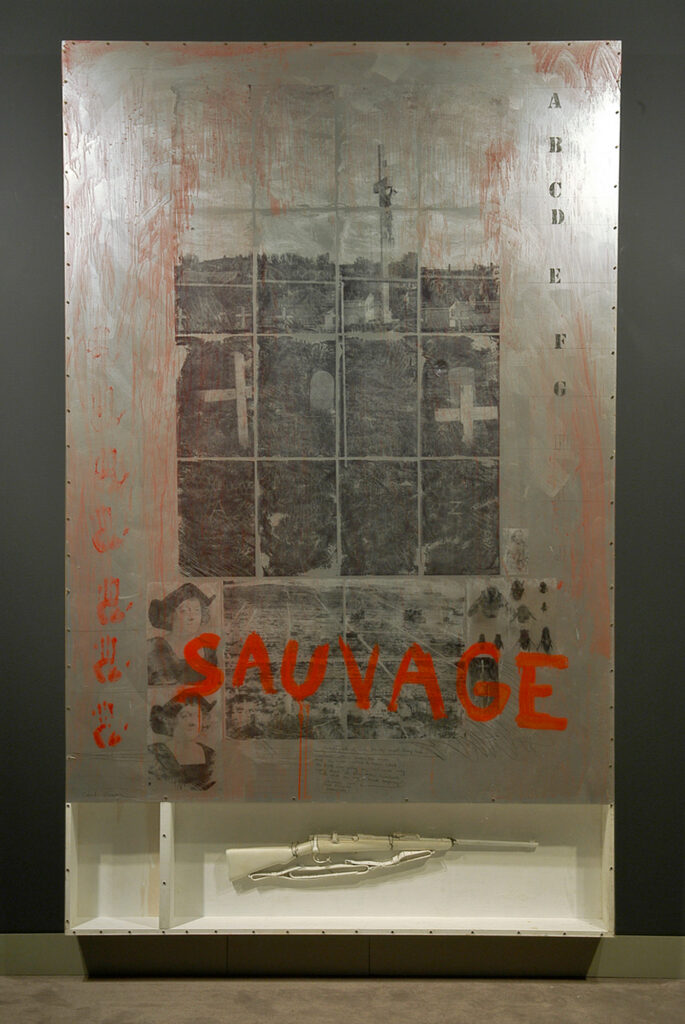
Carl Beam, Sauvage, 1988
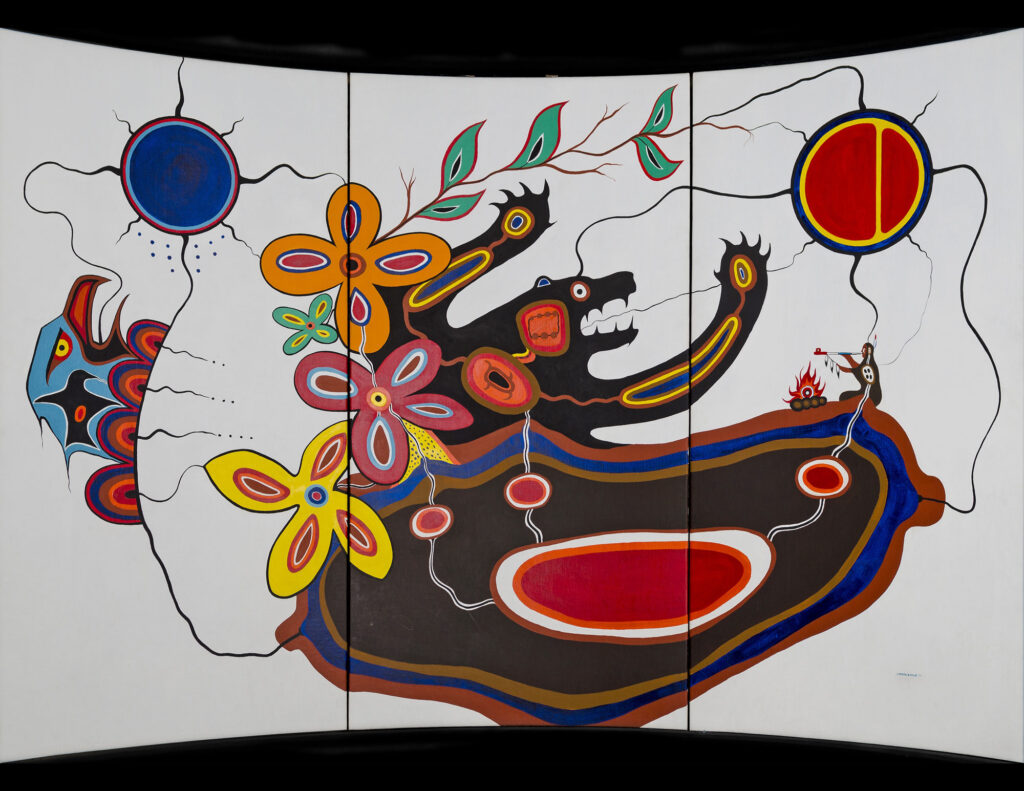
Jackson Beardy, Native World View, 1978
Henry Beaudry, Treaty No. 6, Battleford Area, n.d.

Mary Ceasar, Hair Being Cut by Nuns, 2017

Freda Diesing, Old Woman with Labret, 1973

Faye HeavyShield, Sisters, 1993

Robert Houle, Parfleches for the Last Supper, 1983

Alex Janvier, Blood Tears, 2001

Norval Morrisseau, The Gift, 1975

Ellen Neel, Kakaso'las, 1955–56

David Ruben Piqtoukun, Airplane, 1995

Jamasee Padluq Pitseolak, The Day After, 2010

Abraham Anghik Ruben, The Last Goodbye, 2001

Pitaloosie Saila, Strange Ladies, 2006

Allen Sapp, Recess at Onion Lake School, 1988

Henry Speck, Father Forgive Them, 1958

Adrian Stimson, Sick and Tired, 2005

Gerald Tailfeathers, Blood Camp, 1956

Lawrence Paul Yuxweluptun, Indian Residential School, Leaving the Shallow Graves and Going Home, 2022