Lisa Jackson, Savage, 2009

Lisa Jackson, Savage (still), 2009, 6 min.
In Savage, Anishinaabe filmmaker and multimedia artist Lisa Jackson (b.1974) of Aamjiwnaang First Nation in Ontario compresses colonial dislocation, cultural loss, and Indigenous resistance into six minutes of genre-bending film. It begins with pastoral, gently beautiful imagery: a young Cree girl riding in the back seat of a car through the countryside juxtaposed with the image of a woman in a kitchen singing a lullaby in Cree. These early moments are suffused with longing and nostalgia not merely for a singular moment in time but for what is about to be lost. The lullaby, quiet rituals, and domestic space evoke a world of relationship, language, and care—things residential schooling threatened to sever.

Lisa Jackson, Savage (still), 2009, 6 min.

Lisa Jackson, Savage (still), 2009, 6 min.
Then comes the transformation: the girl is led into the school, her hair is washed and cut, and she is dressed in a uniform. The film’s visual style shifts; instead of open landscapes and lyrical sound, there is harshness and uniform order. In scenes of rote writing, heads bowed, behaviour controlled, Savage evokes the pedagogical violence of assimilation: the suppression of language, the elimination of identity, the systematized removal of innocence.
Jackson does not leave her characters as passive victims. In a subtle yet important intervention, when the teacher leaves the classroom, the children—who until then have obeyed quietly—rise, break the imposed discipline, and perform a synchronized dance. At first, the movement is almost zombie-like: unthinking, uniform. Yet, within that performance there are moments of individuality, solos and improvisation, showing that even under an oppressive regime, identity, creativity, and resistance survive. The apposition of gentle lullaby and then this burst of rhythm and improvisation stages a tension between what is lost and what endures.
Genre, too, is bent and shaped. In Savage, Jackson weaves elements of musical, horror, historical drama, and lyrical imagery. The “residential school musical” label captures this hybrid form—part historical allegory, part performative critique. The musicality implicates viewers into the power of song, dance, and voice as survival tools, while the horror elements such as the zombie-like uniformity viscerally signal the dehumanization inherent in residential schools.
Savage works through ambiguity and restraint rather than graphic depiction. Instead of illustrating obvious violence or explicit
cruelty (which residential schools undoubtedly included), Jackson focuses on an emotional
and symbolic register: loss of self, silencing, transformation. She allows the lullaby to linger and for the transition to feel sudden and wrenching, but she also gives space for resistance—to show that even in forced silence, voices find an outlet. In not quite six minutes, she moves through historical memory, familial grief, corporeal transformation, and a subversive reclaiming of identity within the schooling system that sought to erase it.
Savage reminds viewers that historical colonial practices, far from being confined to the past,
are rippling into the present. The contemporary resonance of forced schooling, the loss of language, and generational trauma remains.
The film insists that remembering is not enough. Resisting dehumanization and reclaiming language, movement, and song are necessary acts of survival and identity.
Gallery of A New Generation of Witness

Sonny Assu, Leila’s Desk, 2013

Michael Barber, A Silent Sky, 2022

Christi Belcourt, Giniigaaniimenaaning (Looking Ahead), 2012

Rebecca Belmore, Apparition, 2013

Rain Cabana-Boucher, Laying Flowers, 2021–24

Quill Christie-Peters, Portrait of Ste. Margaret’s Residential School and All It Could Not Contain, 2018

Dana Claxton, Headdress – Shadae and her Girlz, 2023

Beau Dick, The Ghost Confined to the Chair, 2012
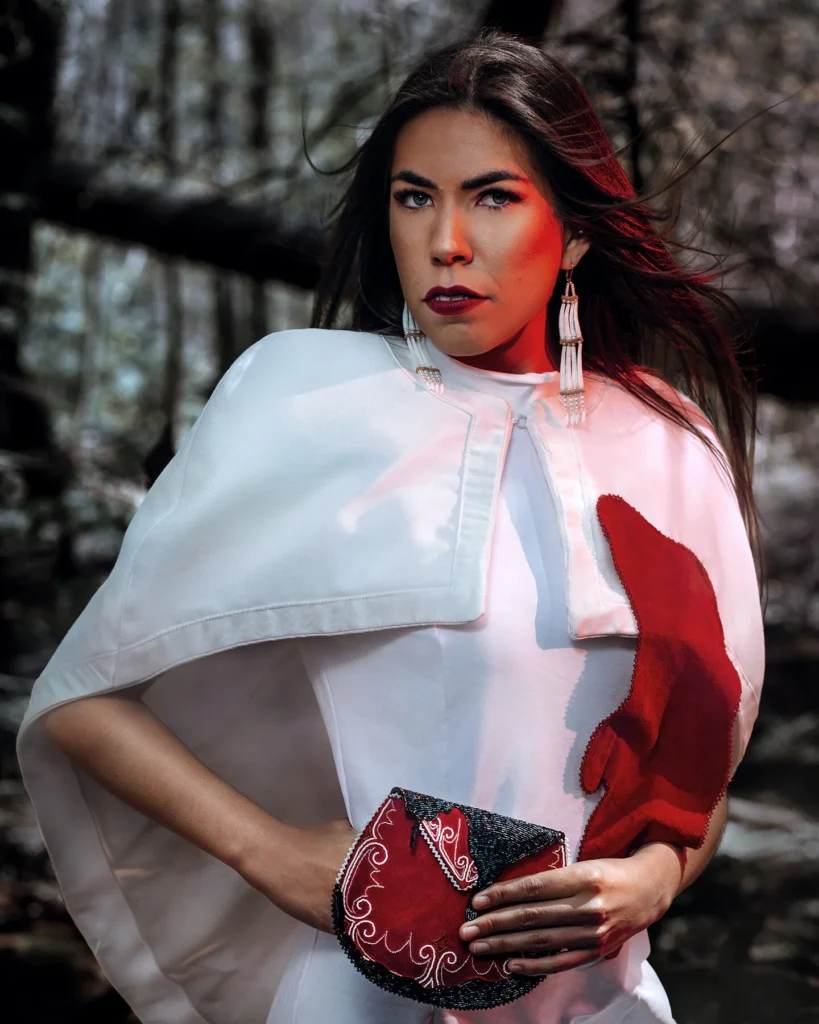
Oakley Rain Wysote Gray, Bleeding Heart Cape – M’st No’gmaq (All My Relations), 2021

7IDANsuu James Hart, Reconciliation Pole: Honouring a Time Before, During and After Canada’s Indian Residential Schools, 2015–17

Emma Hassencahl-Perley, White Flag, 2015

Brent Henry, English Only!, 2021

Shawn Hunt, Flipping the Bird, 2014
Lisa Jackson, Savage, 2009
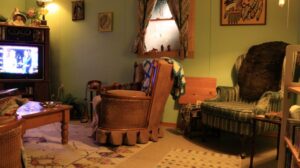
Ursula Johnson, ITHA: The Livingroom, 2021

Siassie Kenneally, All the Things That I Have Seen, 2016

Jake Kimble, It’s All So Incredibly Loud, 2025

Duane Linklater, i want to forget the english language, ulterior, 2020/23

Jim Logan, National Pastimes, 1991

Luke Marston, Bentwood Box, 2009

Kevin McKenzie, Being Indigenous, 2024

Meryl McMaster, Truth to Power, 2017

Kent Monkman, The Scream, 2017

Caroline Monnet, The Black Case, 2014

Tim Moore, Erasure Is Futile, 2021

Peter Morin, This is what happens when you perform the memory of the land (parts 1 and 2), 2013
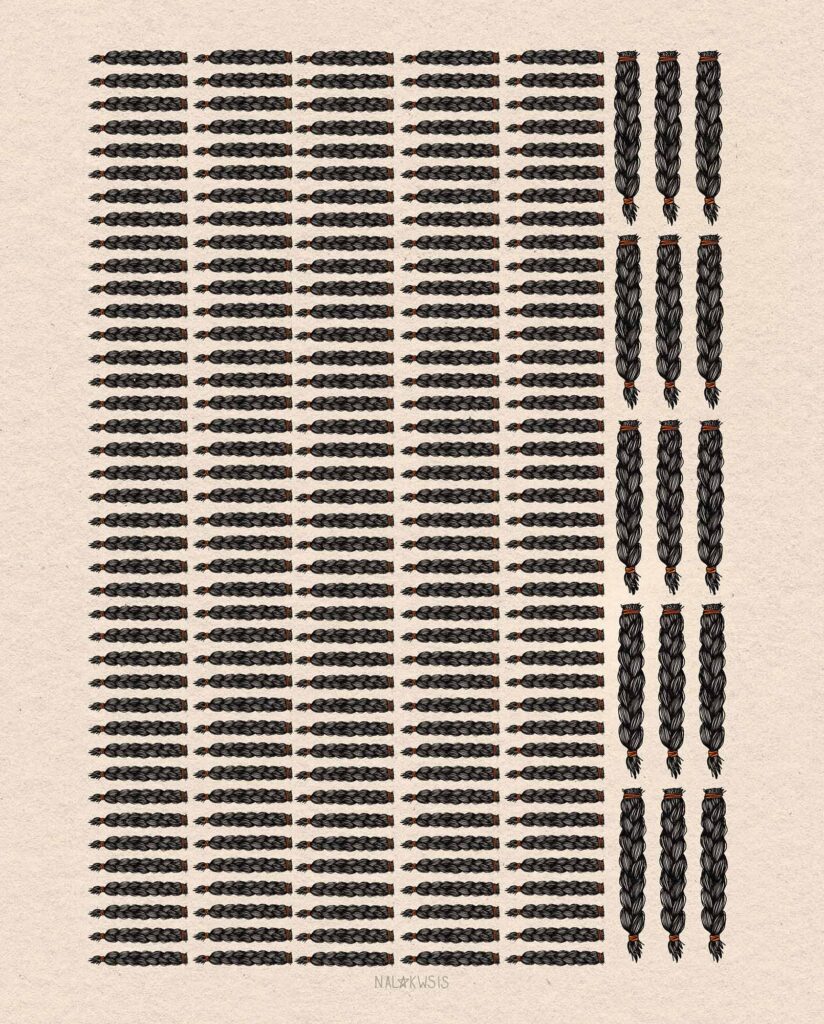
Saige “Nalakwsis” Mukash, 215 Braids, 2021

Nadia Myre, Indian Act, 2000–2002

Carey Newman, Witness Blanket, 2013–14

Davidee Ningeok, Sr., Residential School Nightmare, 2015

Shelley Niro, The Shirt, 2003

Luke Parnell, Neon Reconciliation Explosion, 2020

Dionne Paul, Her First Day of School, 2013
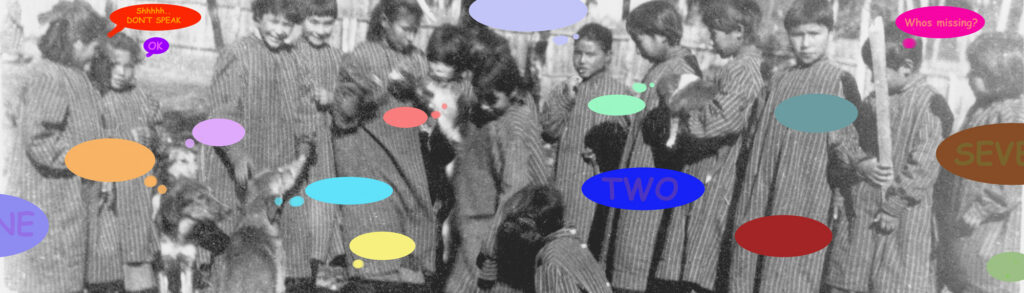
Edward Poitras, Don’t Speak, 2015

Barry Pottle, Yale Dormitory (Residential School), North West River, Labrador, 2015

Teharihulen Michel Savard, Reciprocity (Réciprocité), 2009

Jason Sikoak, Sacrilege, 2015

Greg Staats, Do’-gah – I don’t know [shrugging shoulders], 2020, archival pigment print on canvas on pine stretcher, oil, earth, Indian tobacco ash (edition 2 of 3), 142 x 175.3 x 2.5 cm, Agnes Etherington Art Centre, Kingston.

Alan Syliboy, Grandmother 1, 1997

Jeff Thomas, Broken Treaties, 1613–, 2020
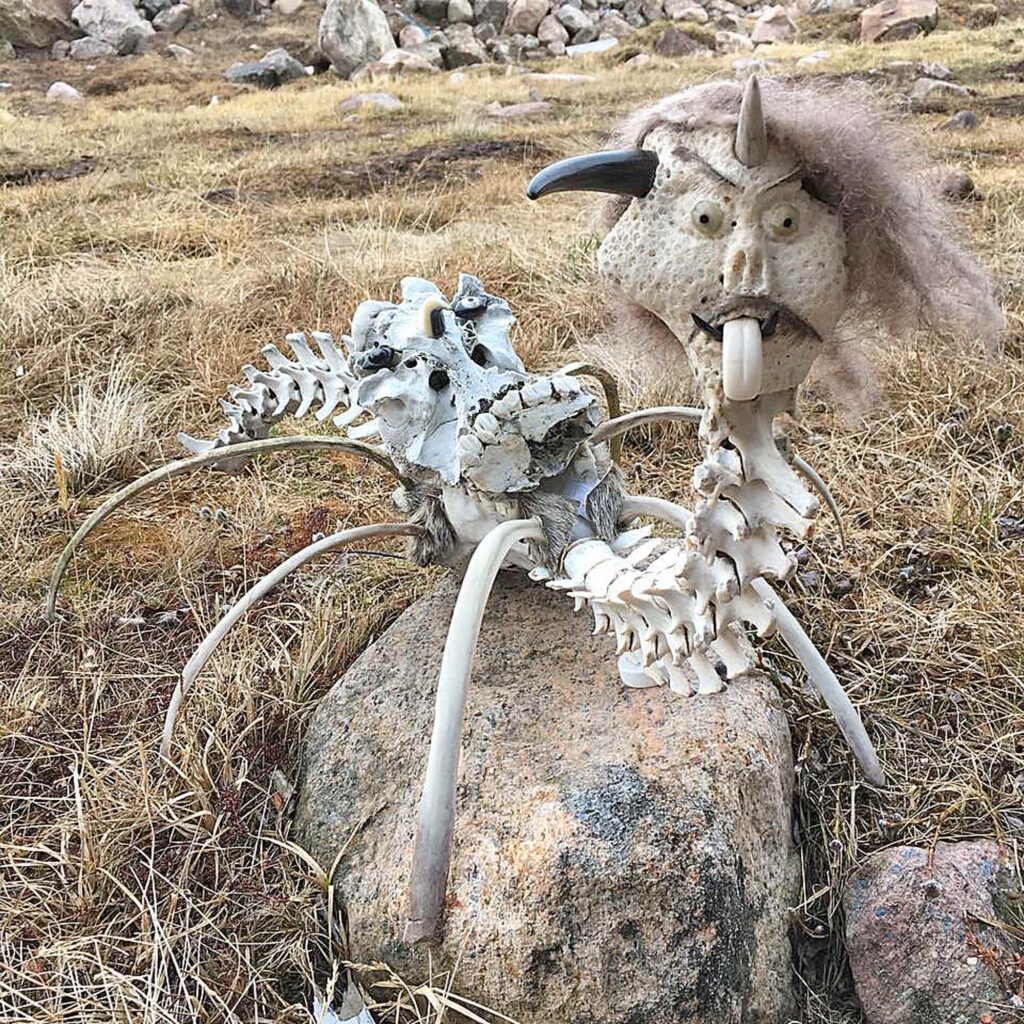
Jesse Tungilik, The Spirit of Intergenerational Trauma, 2019

Tania Willard, Be a Good Girl, 2017