Carey Newman, Witness Blanket, 2013–14

Carey Newman, Witness Blanket, 2013–14, mixed media installation, 3.2 x 12.2 m, Canadian Museum for Human Rights, Winnipeg.
Witness Blanket, created by Hayalthkin’geme, Kwakwaka’wakw, and Coast Salish artist Carey Newman (b.1975), is composed of 887 items—bricks, braids, school desks, photographs—gathered from seventy-seven Indigenous communities. The work is framed in cedar, evoking the protective and ceremonial qualities of a woven blanket. Each object is a witness, carrying the weight of memory and the strength of survival through the era of residential schools. Among them is a drawing by Art Thompson (1948–2003), made during his youth at Alberni Indian Residential School in the late 1950s and discovered by Newman after Thompson’s death. Positioned near the top centre of the installation, it anchors the work in the lived creative acts of those who endured the system.
Newman’s personal connection to the project, rooted in the experience of his father, Victor, at St. Mary’s Residential School in Mission, British Columbia, deepens the work’s relational power. Victor’s journey from silence to healing through testimony mirrors the broader movement within Indigenous communities to reclaim narrative sovereignty. The eighteen-month gathering process for Witness Blanket, which brought together items including a child’s boot from Carcross, Yukon, and a pebble from Inuvik, Northwest Territories, reflects a ceremonial act of remembrance. These objects are not mere artifacts; they are carriers of spirit, story, and resistance, countering the colonial erasure that residential schools sought to impose.
Rather than offering closure, Witness Blanket disrupts the settler desire for a linear reconciliation. Its fragmented composition—pieces from schools, churches, and cultural
sites—embodies the ruptures caused by cultural genocide, as documented by the Truth and Reconciliation Commission of Canada. The cedar frame, referencing Coast Salish and Kwakwaka’wakw traditions, asserts Indigenous presence and sovereignty. Far more than a passive memorial, the work is an active site of ethical witnessing, calling settlers and Indigenous Peoples into relationship and responsibility.
Witness Blanket transforms trauma into testimony, aligning with the ethos of truth telling and reconciliation. Here, art becomes a sovereign act of witness. The collective assembly of objects reflects the strength of kinship and community. Its incompleteness reminds us that reconciliation is an ongoing process.
Importantly, the work critiques institutional frameworks of ownership. Newman’s “living document” agreement with the Canadian Museum for Human Rights (CMHR) in Winnipeg resists the conventional transfer of title, instead embracing a relational model grounded in Indigenous treaty principles of ongoing responsibility and reciprocity. This approach, detailed in Picking Up the Pieces (2019), ensures that the blanket remains a living entity, responsive to community voices and evolving understandings. At twelve metres long and two-and-a-half metres tall, it is both a physical and spiritual presence, a sovereign archive that demands engagement, reflection, and action. Witness Blanket is not only a cornerstone of contemporary Indigenous art but a call to uphold Indigenous truths, to honour Survivors, and to walk together toward justice. It reminds us that memory, instead of being static, is ceremonial and alive.
Collection of A New Generation of Witness

Sonny Assu, Leila’s Desk, 2013

Michael Barber, A Silent Sky, 2022

Christi Belcourt, Giniigaaniimenaaning (Looking Ahead), 2012

Rebecca Belmore, Apparition, 2013

Rain Cabana-Boucher, Laying Flowers, 2021–24

Quill Christie-Peters, Portrait of Ste. Margaret’s Residential School and All It Could Not Contain, 2018

Dana Claxton, Headdress – Shadae and her Girlz, 2023

Beau Dick, The Ghost Confined to the Chair, 2012
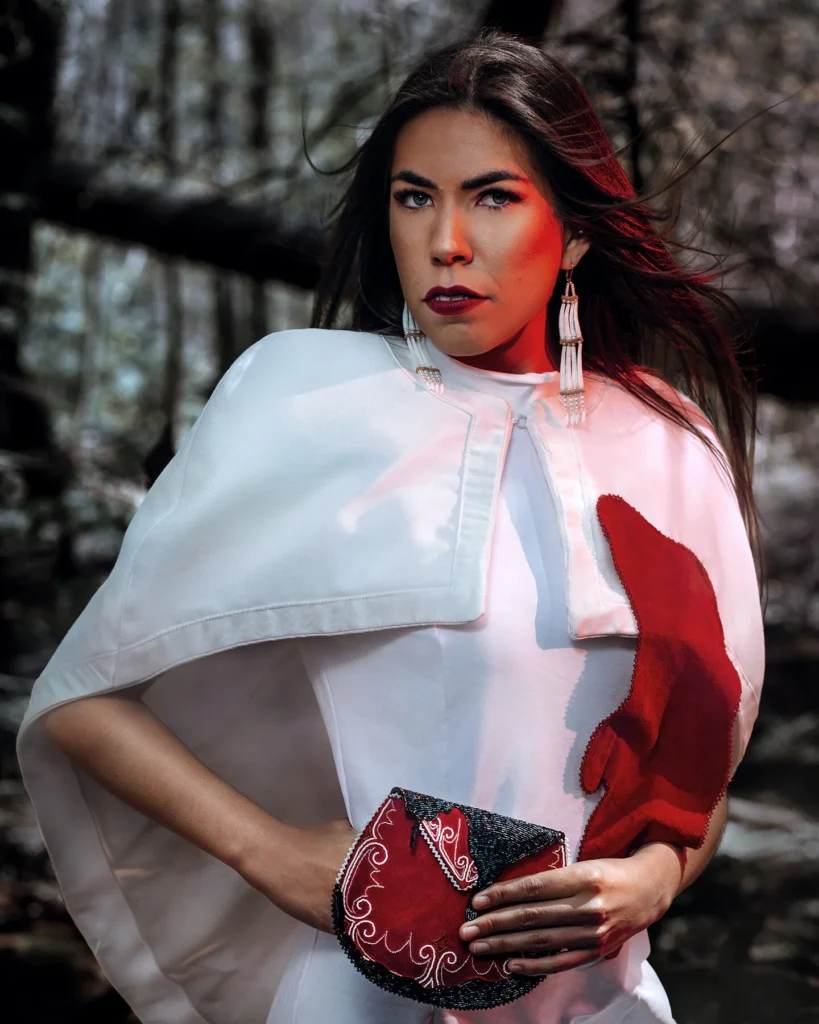
Oakley Rain Wysote Gray, Bleeding Heart Cape – M’st No’gmaq (All My Relations), 2021

7IDANsuu James Hart, Reconciliation Pole: Honouring a Time Before, During and After Canada’s Indian Residential Schools, 2015–17

Emma Hassencahl-Perley, White Flag, 2015

Brent Henry, English Only!, 2021

Shawn Hunt, Flipping the Bird, 2014

Lisa Jackson, Savage, 2009
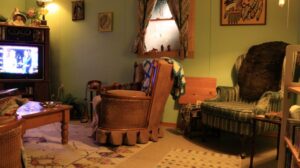
Ursula Johnson, ITHA: The Livingroom, 2021

Siassie Kenneally, All the Things That I Have Seen, 2016

Jake Kimble, It’s All So Incredibly Loud, 2025

Duane Linklater, i want to forget the english language, ulterior, 2020/23

Jim Logan, National Pastimes, 1991

Luke Marston, Bentwood Box, 2009

Kevin McKenzie, Being Indigenous, 2024

Meryl McMaster, Truth to Power, 2017

Kent Monkman, The Scream, 2017

Caroline Monnet, The Black Case, 2014

Tim Moore, Erasure Is Futile, 2021

Peter Morin, This is what happens when you perform the memory of the land (parts 1 and 2), 2013
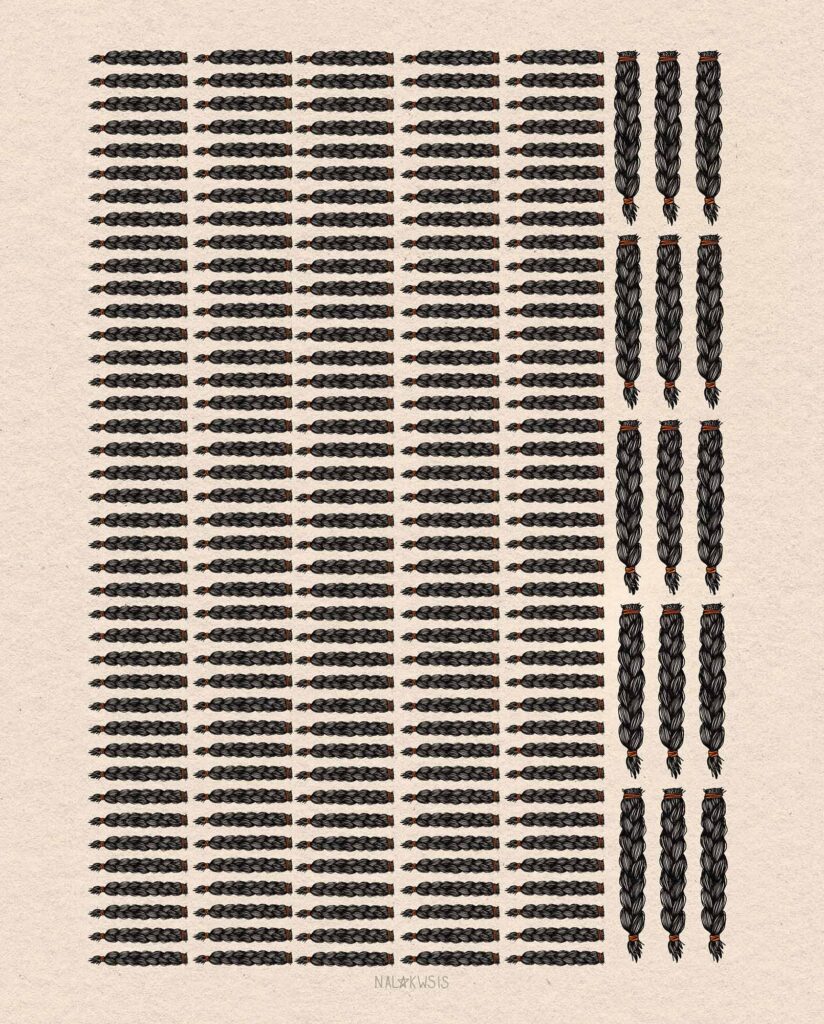
Saige “Nalakwsis” Mukash, 215 Braids, 2021

Nadia Myre, Indian Act, 2000–2002
Carey Newman, Witness Blanket, 2013–14

Davidee Ningeok, Sr., Residential School Nightmare, 2015

Shelley Niro, The Shirt, 2003

Luke Parnell, Neon Reconciliation Explosion, 2020

Dionne Paul, Her First Day of School, 2013
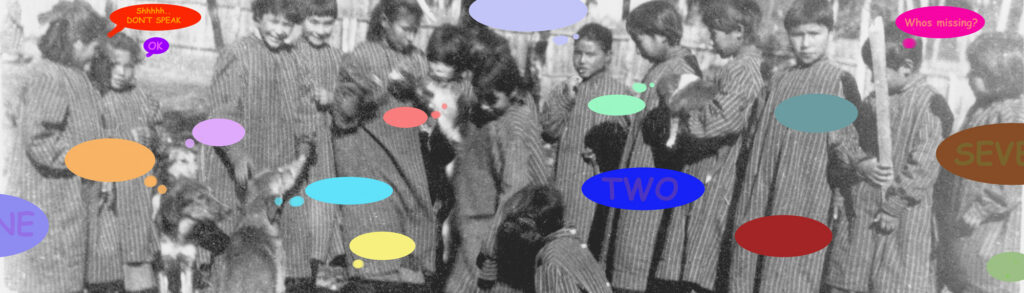
Edward Poitras, Don’t Speak, 2015

Barry Pottle, Yale Dormitory (Residential School), North West River, Labrador, 2015

Teharihulen Michel Savard, Reciprocity (Réciprocité), 2009

Jason Sikoak, Sacrilege, 2015

Greg Staats, Do’-gah – I don’t know [shrugging shoulders], 2020, archival pigment print on canvas on pine stretcher, oil, earth, Indian tobacco ash (edition 2 of 3), 142 x 175.3 x 2.5 cm, Agnes Etherington Art Centre, Kingston.

Alan Syliboy, Grandmother 1, 1997

Jeff Thomas, Broken Treaties, 1613–, 2020
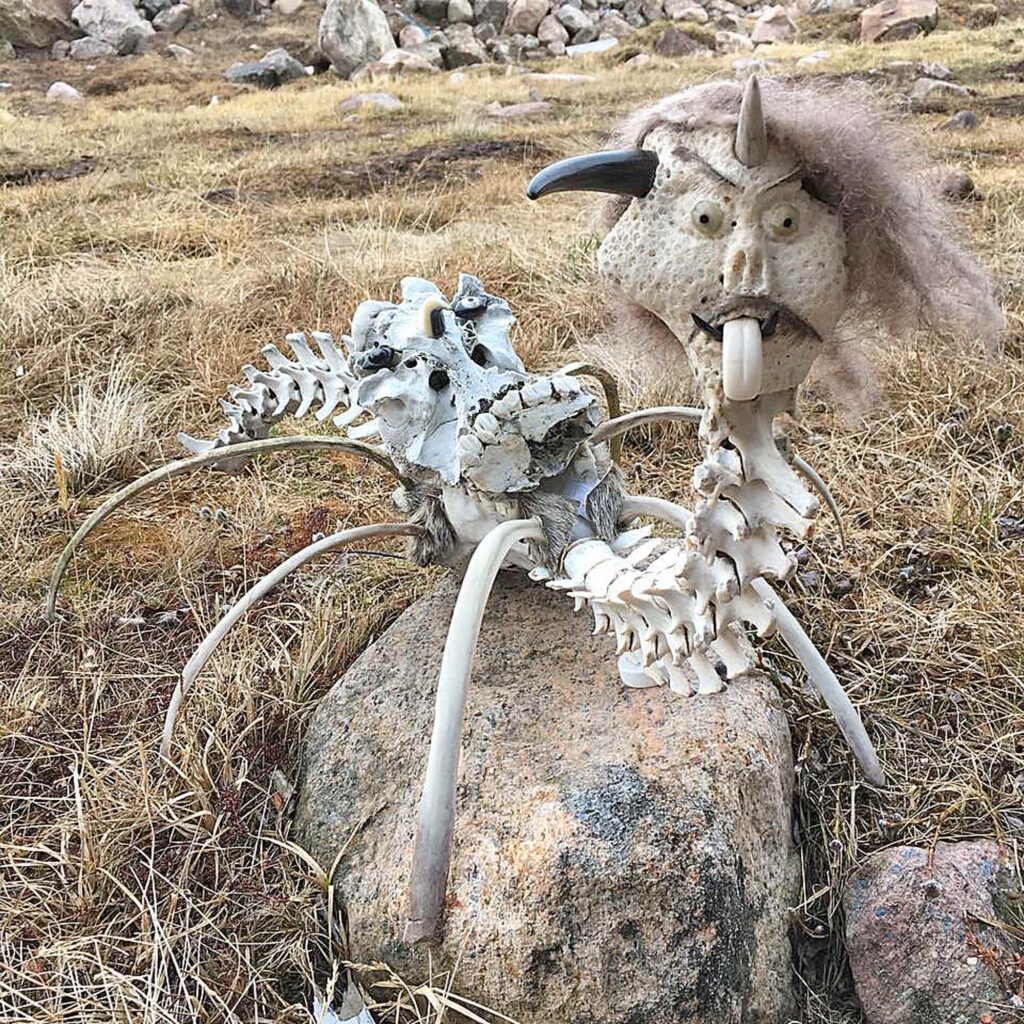
Jesse Tungilik, The Spirit of Intergenerational Trauma, 2019

Tania Willard, Be a Good Girl, 2017