Pegi Nicol MacLeod’s career reveals a painter whose distinctive expressionism set her apart in Canadian modern art. From early depictions of landscapes to kinetic urban and wartime scenes, she developed a personal visual language that fused keen observation with emotional force. Her gestural line work, saturated colour, and fascination with human movement reveal an artist attuned to the rhythms of modern life. MacLeod’s art was shaped by travel, politics, and self-examination. Her work advanced the expressive possibilities of Canadian modernism and redefined how the artist’s self and the world around her could be represented.
Artist of the Wayward Brush
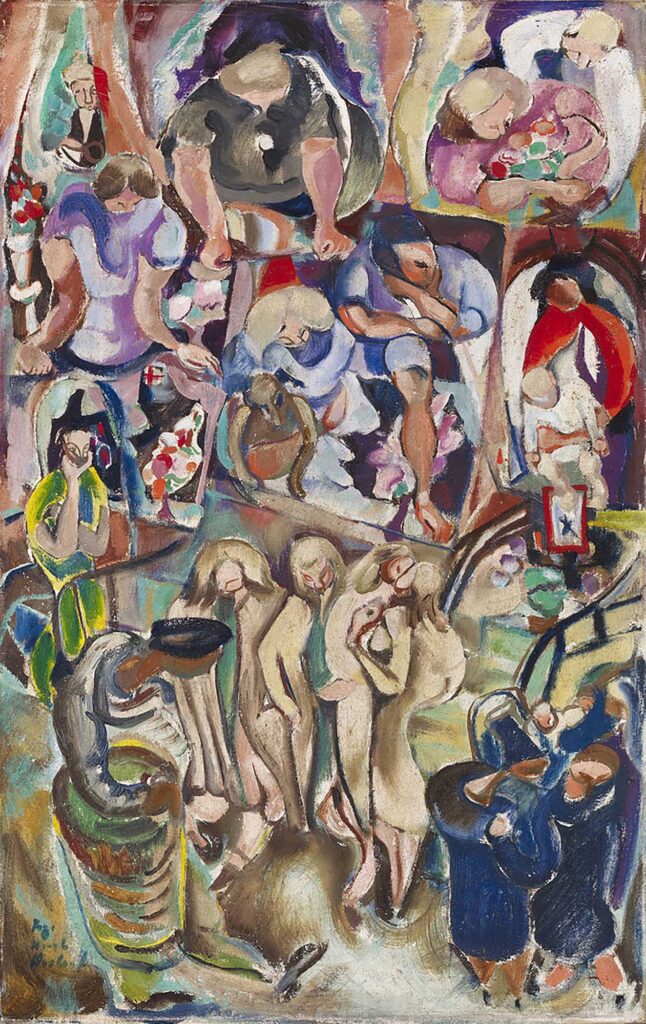
Pegi Nicol MacLeod, New York Apartment View—Manhattan, c.1940, oil on canvas, 66 x 50.8 cm, Art Gallery of Ontario, Toronto.
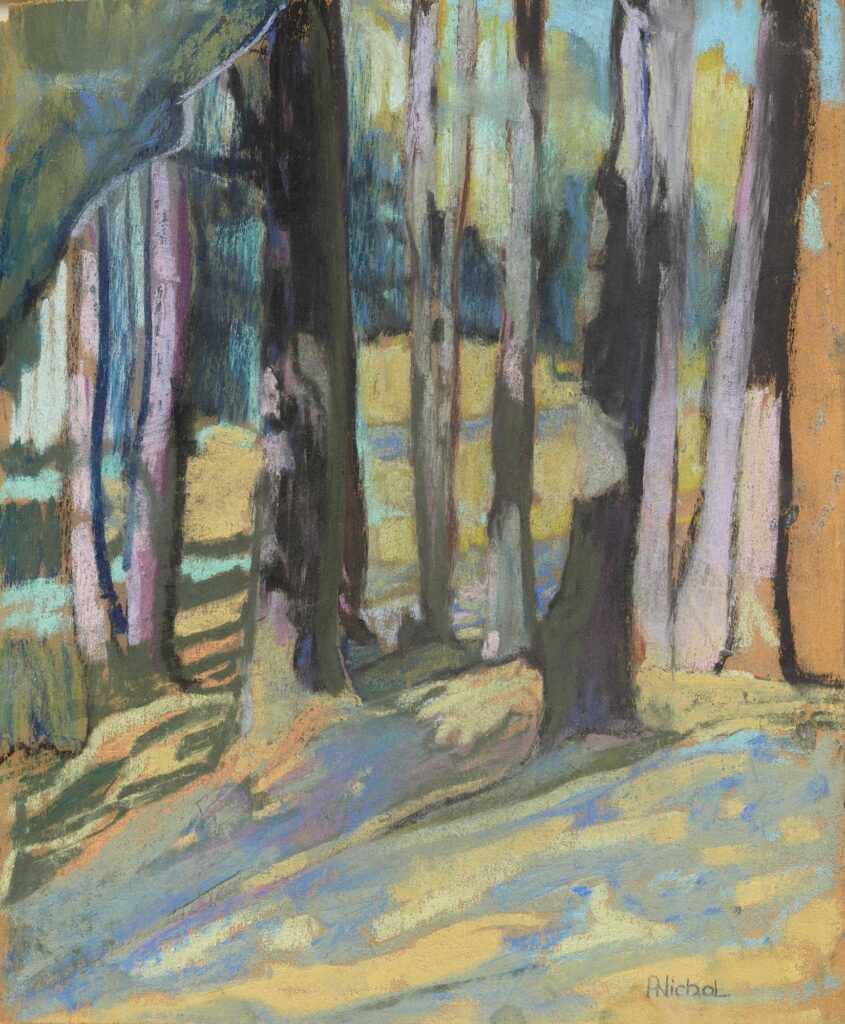
Pegi Nicol MacLeod, Ashbury Hill, c.1925, pastel on wood panel, 27.6 x 22.8 cm, Art Gallery of Ontario, Toronto.
MacLeod’s style and technique, which were rooted in autonomy, shaped by modernist developments, and marked by a refusal to conform, set her apart in Canadian art history. Critic Graham McInnes described her paintings as possessing a “turbulent waywardness” and “violent frenzy of movement”—qualities that distinguish her work from the dominant artistic currents in Canada at the time and give it a unique expressionist energy.
It is MacLeod’s brushwork that anchors her singular style. In paintings like A Descent of Lilies, 1935, and New York Apartment View—Manhattan, 1940, lines surge and twist across the surface, transforming daily scenes into rhythmic compositions of colour and motion. Throughout her fiercely creative and rather bohemian life, painting remained MacLeod’s focus. Her early work, marked by a somewhat more muted palette and more disciplined brushwork—seen, for example, in Ashbury Hill, c.1925—laid the foundation for the expressive energy and vivid colour of her mature style.
Even in her early twenties, she was a technically capable artist, but over time, she developed a style that defied convention and emphasized spontaneity and movement. As she wrote to fellow painter Jack Humphrey (1901–1967) in 1947, “Art should be freedom; its essence is freedom.... Rules, laws, controls, standards—these works smell of the academy.” This conviction is visible in her paintings: with sinuous, gestural brushwork that often verges on abstraction, her works radiate kinetic energy. Few artists working in Canada at the time could match the vivacity, dynamism, and modern sensibility she brought to her subjects.
MacLeod absorbed and reinterpreted the currents of European modernism: the structural rhythm of Paul Cézanne (1839–1906), the chromatic light of Raoul Dufy (1877–1953), and the Fauvist and Expressionist work of Georges Rouault (1871–1958). She never studied abroad, yet her art conversed fluently with Expressionism’s emphasis on emotional immediacy. Like the German Expressionists, she used distortion and gesture to convey emotion, but her tone was more exuberant than anguished. Her paintings radiate motion rather than introspection; they are a celebration of life observed in flux.
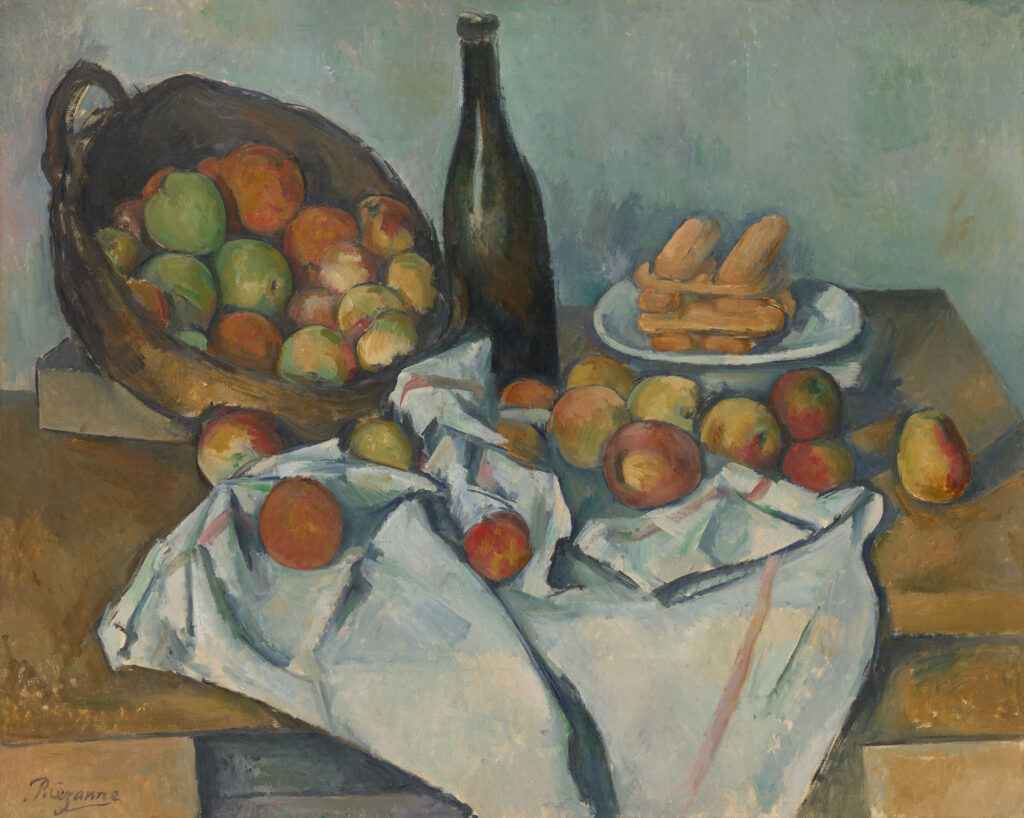
Paul Cézanne, The Basket of Apples, c.1893, oil on canvas, 65 x 80 cm, Art Institute of Chicago.
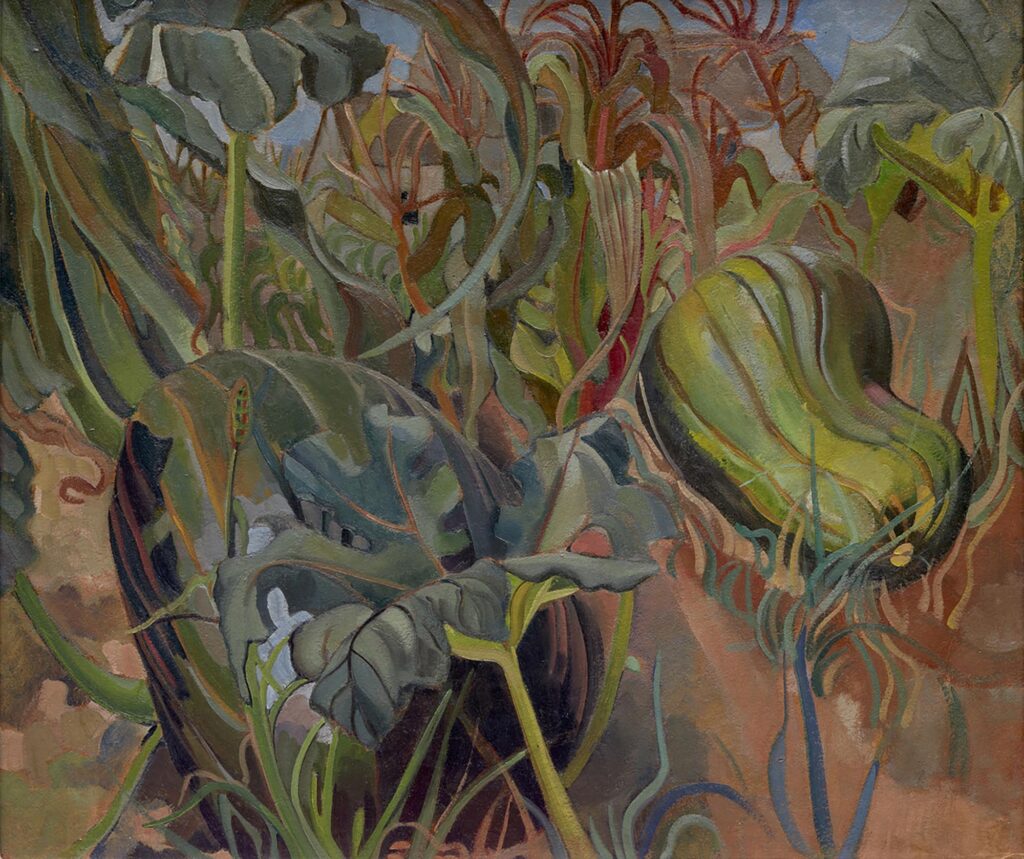
Pegi Nicol MacLeod, The Tangled Garden, 1935, oil on multi-ply wood-pulp board, 60.4 x 71 cm, Art Gallery of Ontario, Toronto.
MacLeod’s technique blended elements of Expressionism and Surrealism: sweeping, supple lines; dark, moody palettes; and occasional dreamlike or fantastical scenes, as seen in paintings like The Peace Bird, c.1946. Other less dreamlike paintings, such as Salmon in the Galley, 1944, were inflected by Expressionism and realism. By the early 1930s, a mature Expressionist style had emerged in her paintings of schoolchildren gardening, women at work, and everyday city life. Whether set in Ottawa or later in New York, MacLeod’s canvases pulsated with movement and life.
Like the work of Edvard Munch (1863–1944) and Wassily Kandinsky (1866–1944), MacLeod’s paintings have a feeling of subjective immediacy, with loose, sketch-like brushwork, flowing contours, and often vibrant colours that animate their surfaces. An example of this approach can be seen in Costume for a Cold Studio (Self-Portrait), c.1930, in which MacLeod depicts herself in her attic atelier. The painting’s flowing lines and bold colours convey not a fixed likeness of the artist but a perceptual moment in time. Her pieces often unfold as fragments of sensation and movement marked by the urgency of the line: repeated serpentine limbs in motion, a crowded street glimpsed from a window, or a self-portrait evoking shifting perception rather than fixed identity.
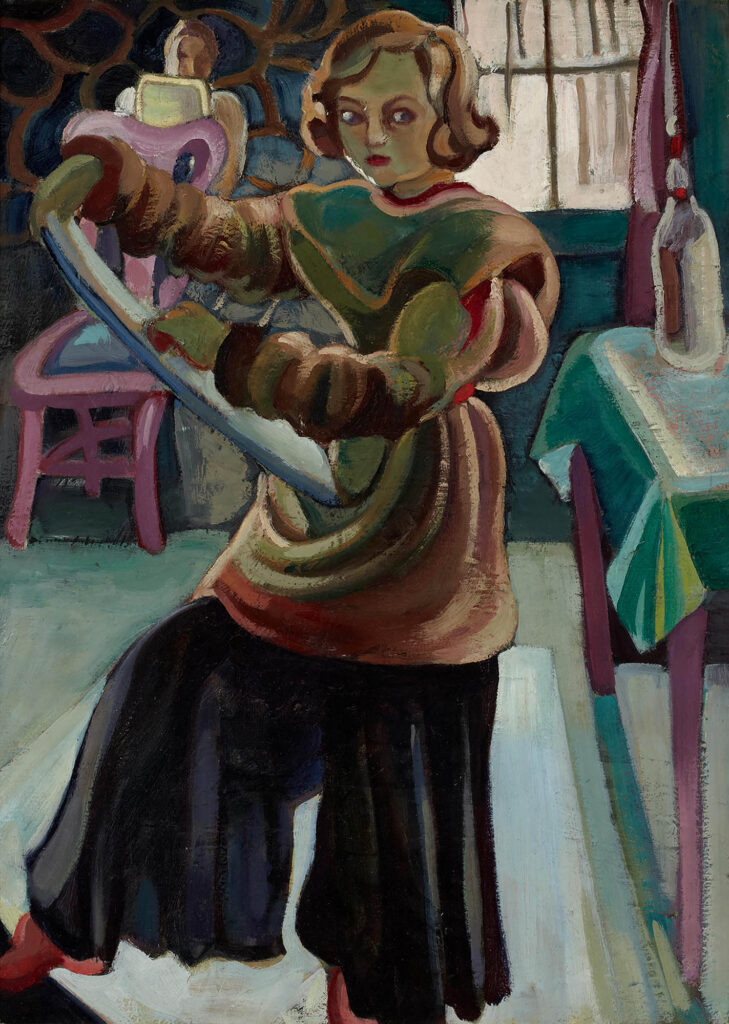
Pegi Nicol MacLeod, Costume for a Cold Studio (Self-Portrait), c.1930, oil on canvas, 53.5 x 38.3 cm, Robert McLaughlin Gallery, Oshawa.
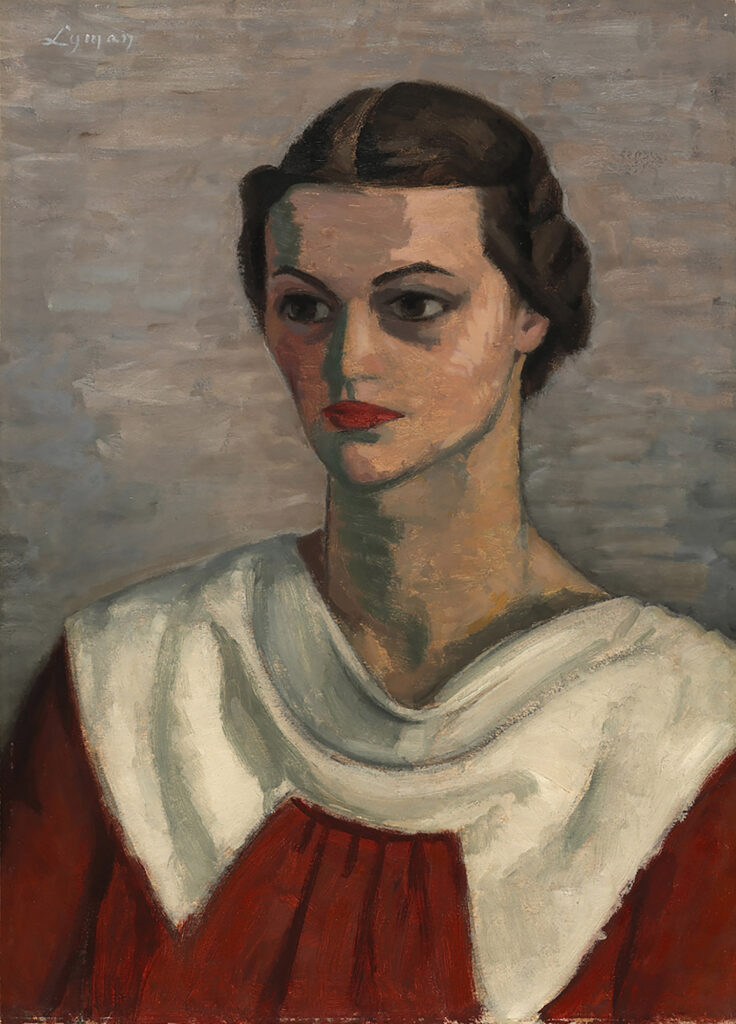
John Lyman, Woman with a White Collar, 1936, oil on cardboard, 61.5 x 44.1 cm, National Gallery of Canada, Ottawa.
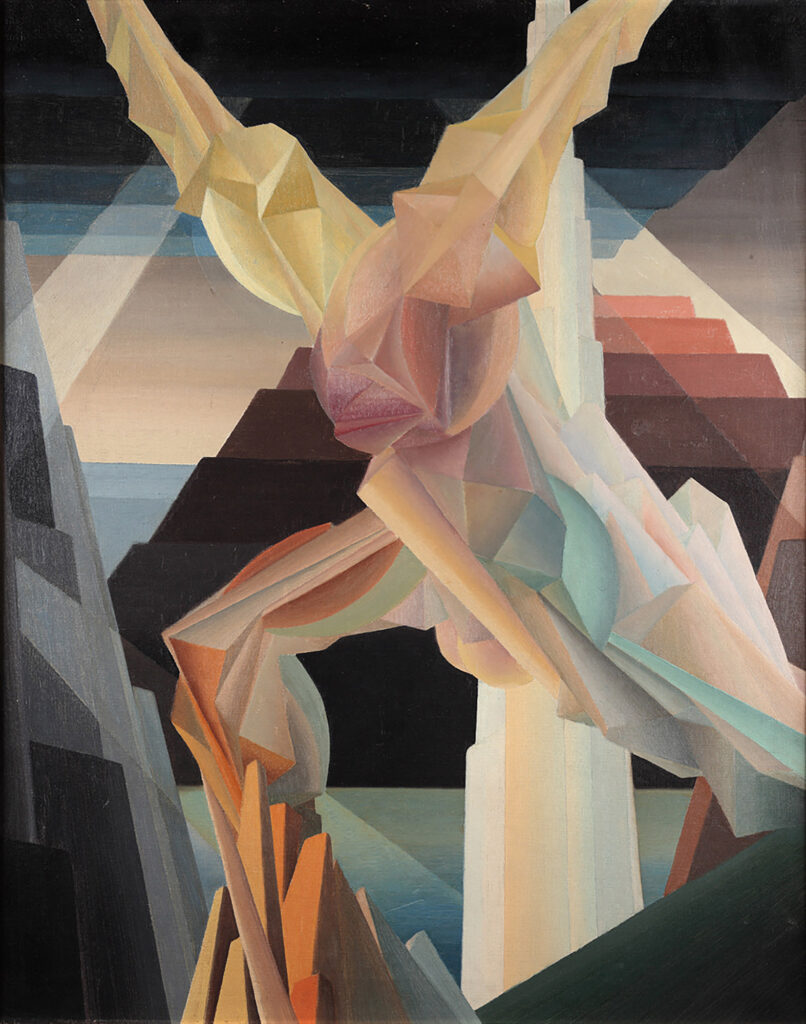
Bertram Brooker, Striving, c.1930, oil on canvas, 76.2 x 60.9 cm, private collection.
Despite the strength and originality of her technique, MacLeod’s artistic path was not straightforward. Her work was often not well received, although that was also true of many modern artists in this period. Early exhibitions of work by Maurice Cullen (1866–1934), John Lyman (1886–1967), Bertram Brooker (1888–1955), and the Group of Seven all received mixed or negative reviews. Many of these male artists are now considered canonical figures in Canadian art, however, and their reputations have been firmly cemented over time in successive art historical texts. The criticism MacLeod faced was shaped by gender bias that persisted after her death and contributed to her marginalization in Canadian art history.
The internationalism of her art practice set MacLeod apart from her contemporaries. She never fully explored abstract art, preferring her own brand of Expressionist-inspired modernism. She shared theorist Walter Abell’s view, articulated in his 1936 book Representation and Form, that abstraction risked losing the human and social dimensions of art—a position also held by National Gallery directors Eric Brown and H.O. McCurry, who were wary of its place in Canadian art. Her own paintings never fully abandoned representational forms. While the dynamism of MacLeod’s lines and compositions hint at abstraction, she always maintained a connection to the scene she was portraying.
Painters Paraskeva Clark (1898–1986) and Charles Comfort (1900–1994) shared MacLeod’s interest in the figure and human subjects, but their realist approach emphasized form and colour. While both artists engaged with European modernism, MacLeod pushed things further towards an Expressionist mode aligned with its more avant-garde currents. As art historian Laura Brandon writes, “Pegi responded to developments in contemporary painting and evolved a unique technique and approach that has no Canadian equivalent in the period.” Few artists of her generation matched her capacity to translate feeling into form.
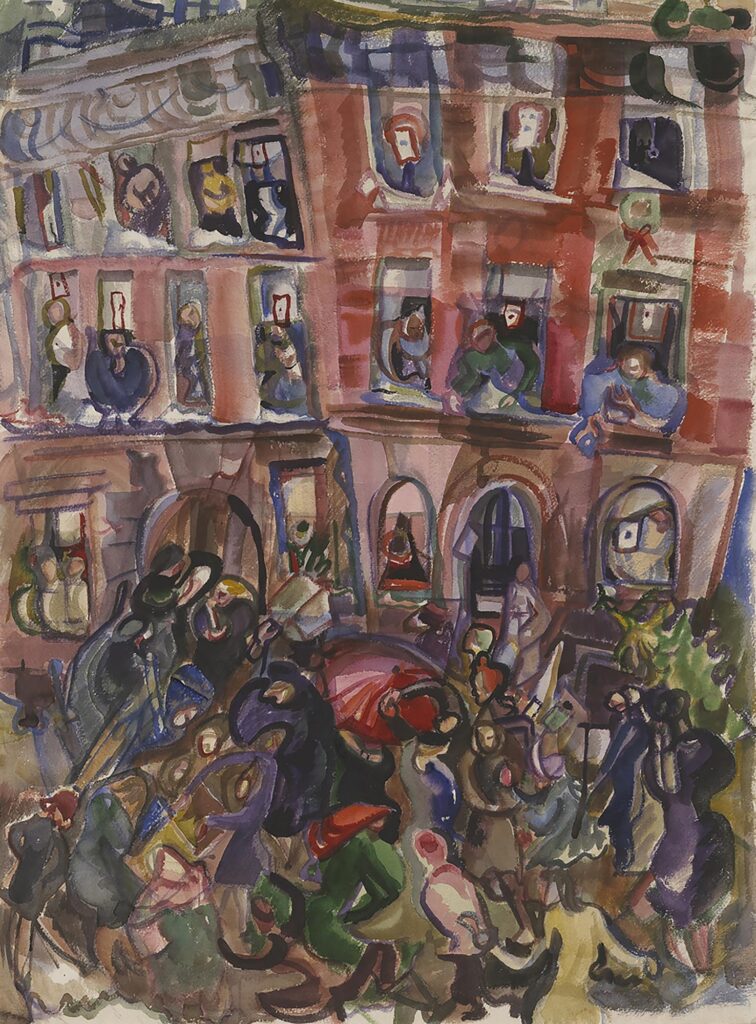
Pegi Nicol MacLeod, Tenements, 1945, watercolour on wove paper, 74.5 x 57.3 cm, National Gallery of Canada, Ottawa.
Critics who once dismissed the fluidity of MacLeod’s work as “formless” overlooked how her brushwork captured the tempo of modern life: the speed, confusion, and intimacy of twentieth-century experience, as seen in Tenements, 1945. MacLeod left a legacy of distinctive work unlike that of her peers. Her art—a body of work propelled by curiosity, defiance, and an unyielding belief in painting as a vital act of freedom—resists containment. In embracing “unfinish” as a defining stylistic choice, MacLeod expanded the possibilities of Canadian modernism and challenged its gendered critical boundaries.
The Great Unfinisher
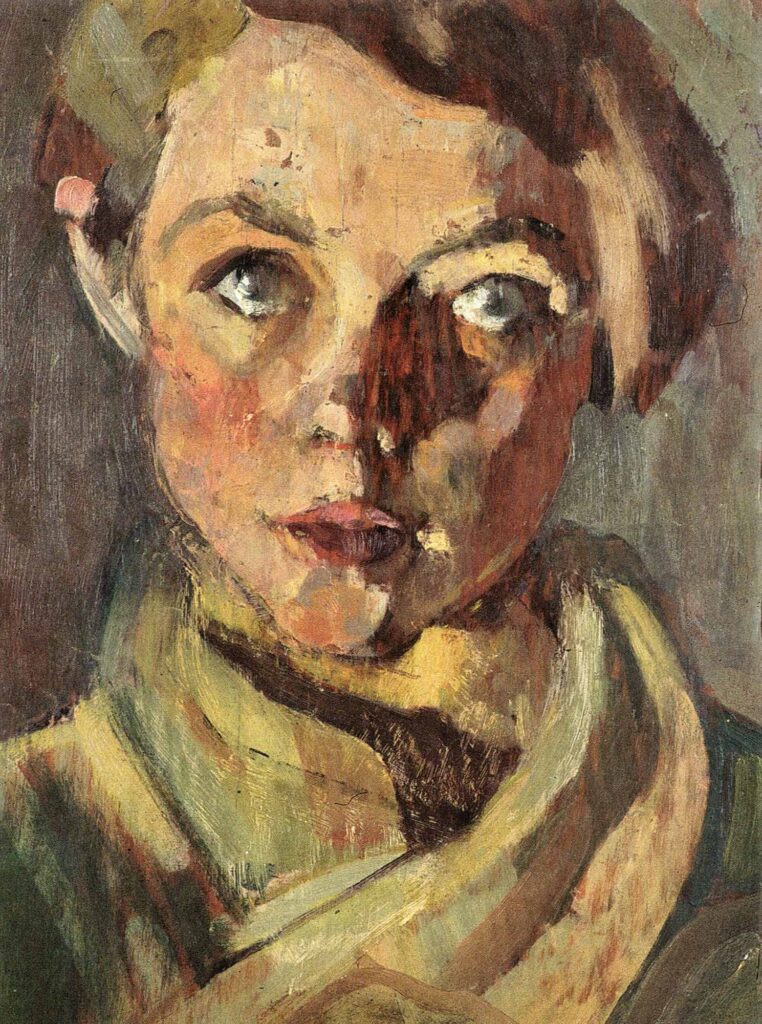
Pegi Nicol MacLeod, Self-Portrait, c.1928, oil on plywood, 30 x 23 cm, Agnes Etherington Art Centre, Kingston.
Critics often described Pegi Nicol MacLeod’s paintings as “unfinished,” “too animated to see all at once,” and “dashed off” or “lacking organization.” Friends and contemporaries called her the “great unfinisher.” Yet this so-called incompleteness was fundamental to her artistic style. In works such as Self-Portrait, c.1928, Self-Portrait with Jane, c.1939, and The Slough, 1928, MacLeod used quick brushwork, visible under-drawing, and unpainted surfaces to convey an immediacy that became her hallmark. Her paintings invite the viewer to linger over their complexity. Her self-portraits, for example, are never static likenesses but alive with ambiguity, fragmentation, and becoming. In Self-Portrait, viewers can see the artist at work in the loose brush strokes and the visible patches of wooden board, as if the act of painting were still unfolding before their eyes.
However unrestrained these paintings might appear, MacLeod regarded them as finished artworks. Self-Portrait with Jane was sent as a Christmas card to friends, The Slough was given as a wedding gift to the Scotts, and A Descent of Lilies, 1935, was sent for exhibition. MacLeod’s paintings were complete on her own terms. What appeared to some as a lack of polish was instead a deliberate embrace of openness and process—qualities at the heart of her modernism. In this sense, her so-called unfinishing can be understood as resistance to the academic ideal of the masterpiece—a standard long associated with masculine notions of control and mastery. Her paintings redefined what “finished” could mean.
Critics, however, often struggled to read MacLeod’s stylistic choices as intentional. Reviews frequently focused on her loose brushwork and “uncontained” compositions, framing them as evidence of haste or lack of discipline. Although modernist aesthetics celebrated spontaneity, MacLeod’s expressive approach was frequently diminished through gendered language. Her friend Margaret MacKenzie later recalled that one male critic told her that if MacLeod “had a little control and kept her paintings on the canvas, she’d do better.”
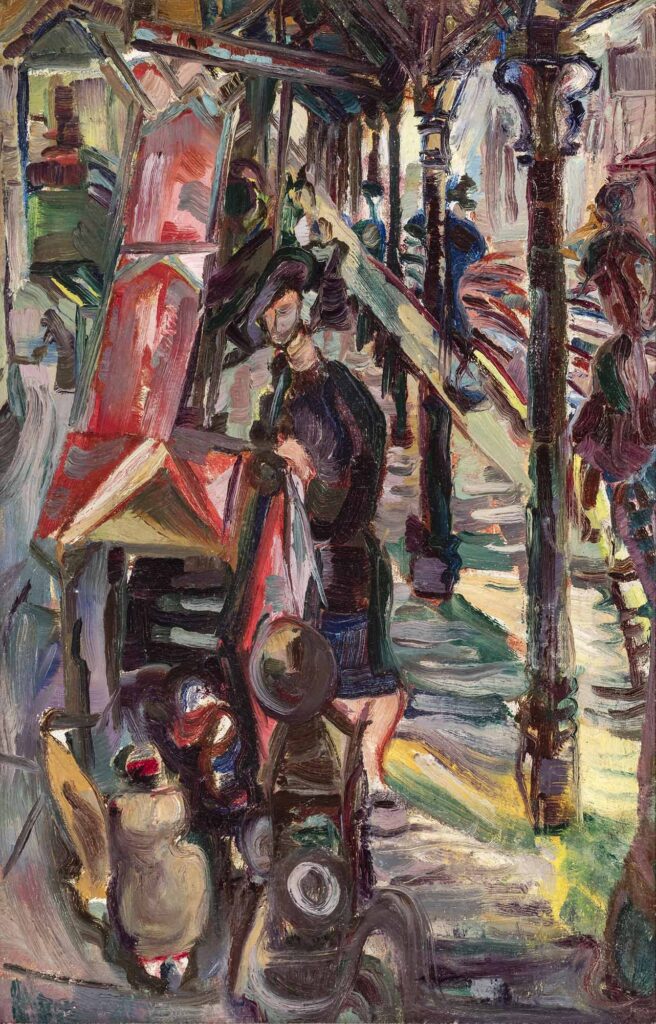
Pegi Nicol MacLeod, Under the El, 1945, oil on canvas, 42.2 x 27.5 cm, Art Museum at the University of Toronto.
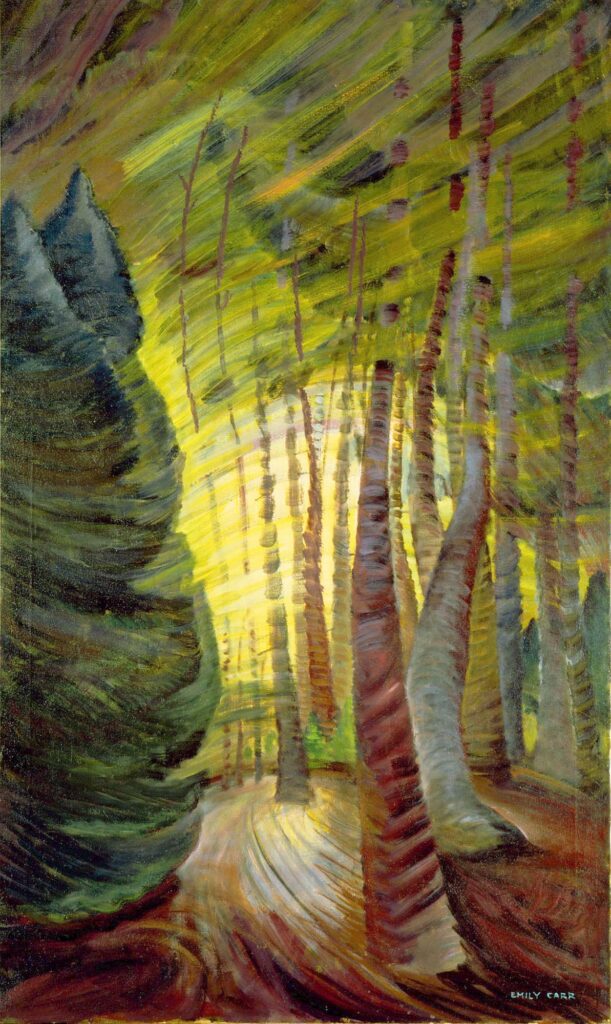
Emily Carr, Sombreness Sunlit, c.1938–40, oil on canvas, 110.7 x 67.2 cm, Royal B.C. Museum, Victoria.
The contrast between the reception to MacLeod’s work and to that of her male contemporaries underscores the gendered limits of modernist criticism. While Paul Cézanne and Bertram Brooker earned admiration for their experimentation, MacLeod’s art was recast as being in need of control or discipline, qualities historically coded as masculine. She faced lingering skepticism, often couched in backhanded praise, from critics who treated her expressive style as evidence of her femininity or immaturity. Such biases were not always overt: women artists were routinely compared to one another. MacLeod, for example, was often likened to Emily Carr (1871–1945) for no reason beyond their shared gender.
At times, critics were more explicit. In a review of a 1950 exhibition with Ernst Neumann, critic Richard Hersey wrote that “very few women painters have anything to offer but MacLeod in her demand for agitation and ability to render these fast rhythms... proved herself in these times.” Such praise, hedged with qualification, reveals the double standard that governed women’s artistic evaluation. Through her embrace of “unfinish,” MacLeod transformed incompletion into a modernist strength, challenging both artistic convention and the limits placed on women’s creativity.
Kaleidoscopic Vision: Painting in Motion
From the mid-1930s on, MacLeod’s art adopted what might be called a visual vocabulary of motion. Her New York street scenes, painted from her apartment window, translate the flux of city life into visual rhythm and colour. In works like War Parade, New York, 1944, and Christmas Tree and Skaters, Rockefeller Plaza, 1946, MacLeod uses elevated vantage points to capture the bustle of city life—tiny figures are seen from above, compressed into animated and abstract constellations of colour and form. These paintings seem to pulse, as though each was a still pulled from a moving sequence. MacLeod’s visual language was movement—both as a compositional strategy and as an artistic value. Rather than freezing time, she stretched and blurred it, offering a vision of life unfolding.
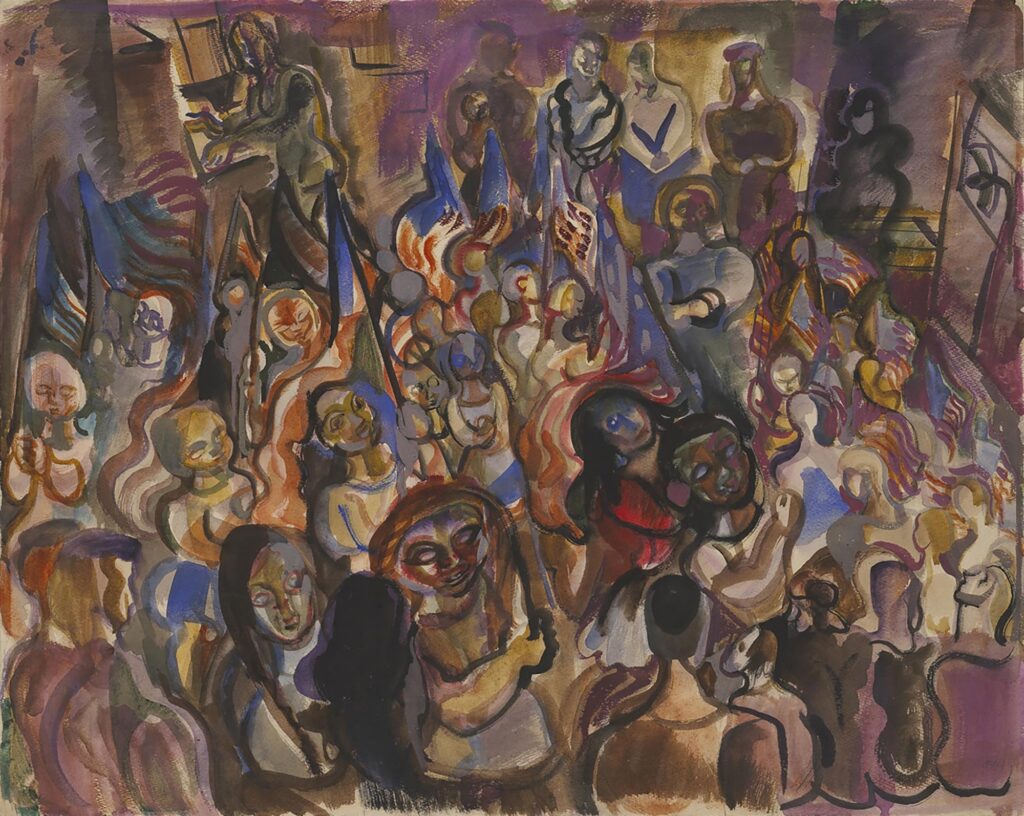
Pegi Nicol MacLeod, War Parade, New York, 1944, watercolour on wove paper, 58.8 x 73.8 cm, National Gallery of Canada, Ottawa.
New York Tenement, n.d., pushes this principle further: it is all colour and movement, crowding, swelling in luxuriant curves. As one critic wrote: “[MacLeod] couldn’t always take time to compose, she was careless about her drawing; all around her, cells were bursting and multiplying, in parks and gardens, in thronged city streets, in flowers and children; the urgent and joyous tumult of life had to be expressed and to organize it too much would be to lose it.” This description captures MacLeod’s insistence on immediacy over refinement. What some read as haste was in fact fidelity to experience—her refusal to still the city.
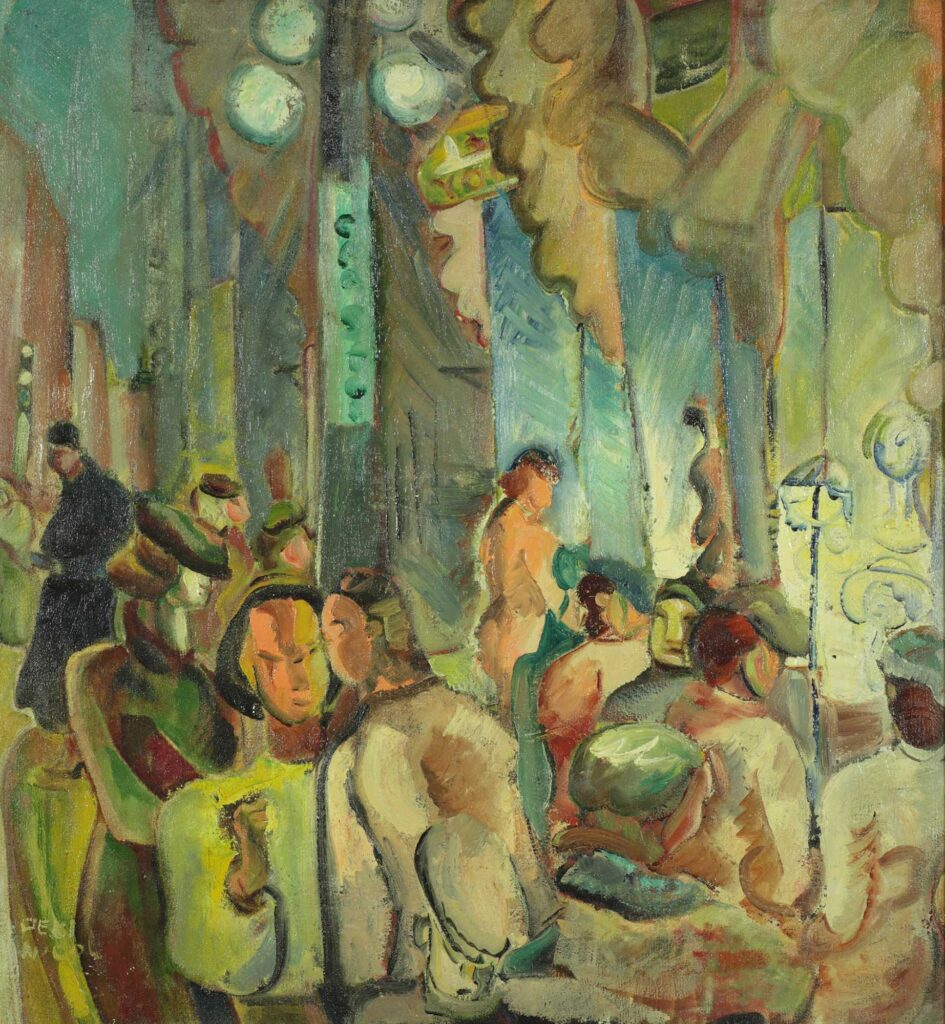
Pegi Nicol MacLeod, Chinatown, Toronto, c.1936, oil on canvas, 64 x 69 cm, Art Windsor-Essex.
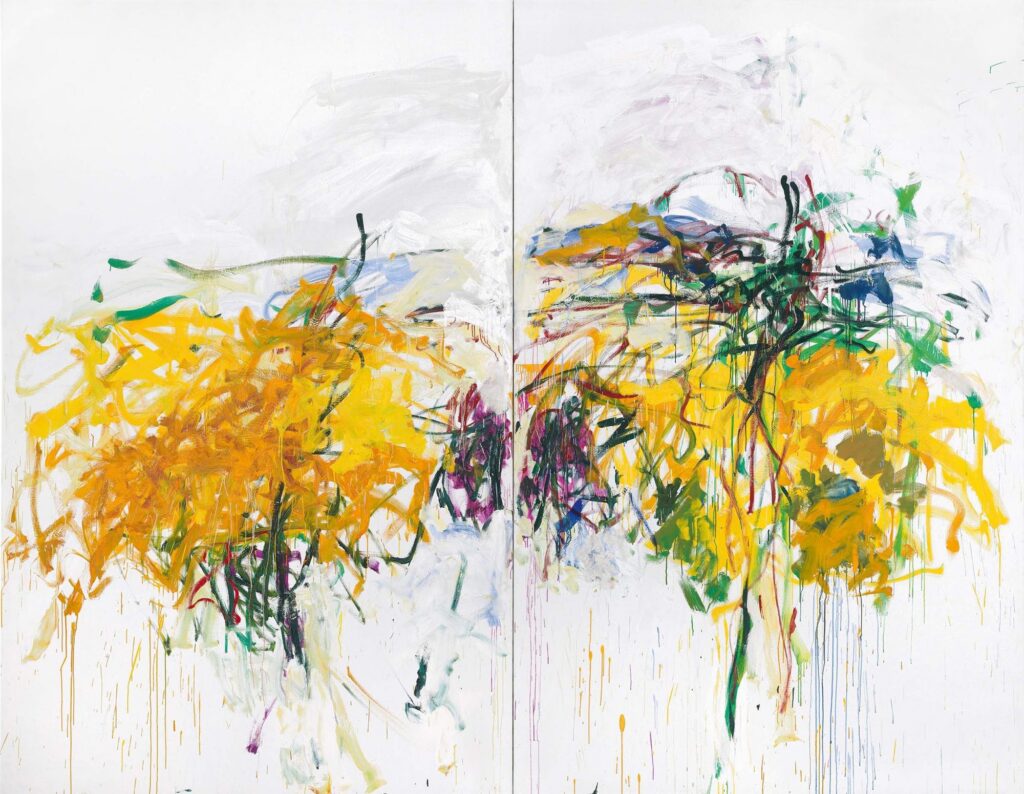
Joan Mitchell, Untitled, 1992, oil on canvas, 280 x 360.7 cm, Joan Mitchell Foundation, New York.
In contrast to the static imagery of the Group of Seven, MacLeod’s technique was “descriptive enough to define objects, yet fluid enough to convey movement, and... capture the spontaneous ambience of a special moment.” She depicted the energy of figures in flux and movement—as seen in Chinatown, Toronto, c.1936—and in this sense, her work preceded the innovations of animator Norman McLaren at the National Film Board, particularly his experiments with drawing on film. MacLeod’s brushwork created that illusion decades earlier through painterly rhythm.
Her fluid technique also points forward to the Abstract Expressionism and action painting of artists such as Jackson Pollock (1912–1956), Elaine de Kooning (1918–1989), and Joan Mitchell (1925–1992). Though MacLeod never abandoned figuration, her energetic surfaces and intuitive marks align her with what would later be celebrated as gestural abstraction. In MacLeod’s paintings, the viewer’s eye is rarely able to settle; instead, it traverses across densely worked surfaces. While she never pursued abstraction as an end in itself, her later watercolours of musicians, orchestras, and New York street life approach it intuitively, translating representation into a sensory impression. Her loose and lively watercolours disrupted the “primness” of the English tradition in Canada. She infused them with what one critic called a “magical sense of rhythm and design,” privileging feeling and gesture over mimesis.
Unlike many of her contemporaries, MacLeod did not turn inward or focus exclusively on solitary, posed figures. She painted crowds, cities, and communities: moving, mingling, growing. Where her (often male) counterparts emphasized narrative or symbolism, MacLeod captured what it feels like to be amid the swarm of modern life. Her kaleidoscopic vision also reflected her deep affection for the world around her.
Watercolour
Among the many media in which Pegi Nicol MacLeod worked, watercolour was the one that best suited her restless experimentation. A medium that rewards immediacy, it complemented her rapid approach to painting urban life, portraits, and still lifes, allowing her to capture gesture and emotion with spontaneity and precision. Her handling of watercolour in paintings like Toronto Victory Garden, c.1937, and Christmas Tree and Skaters, Rockefeller Plaza, 1946, was anything but delicate; she used it with intensity, developing a visual style that was entirely her own.
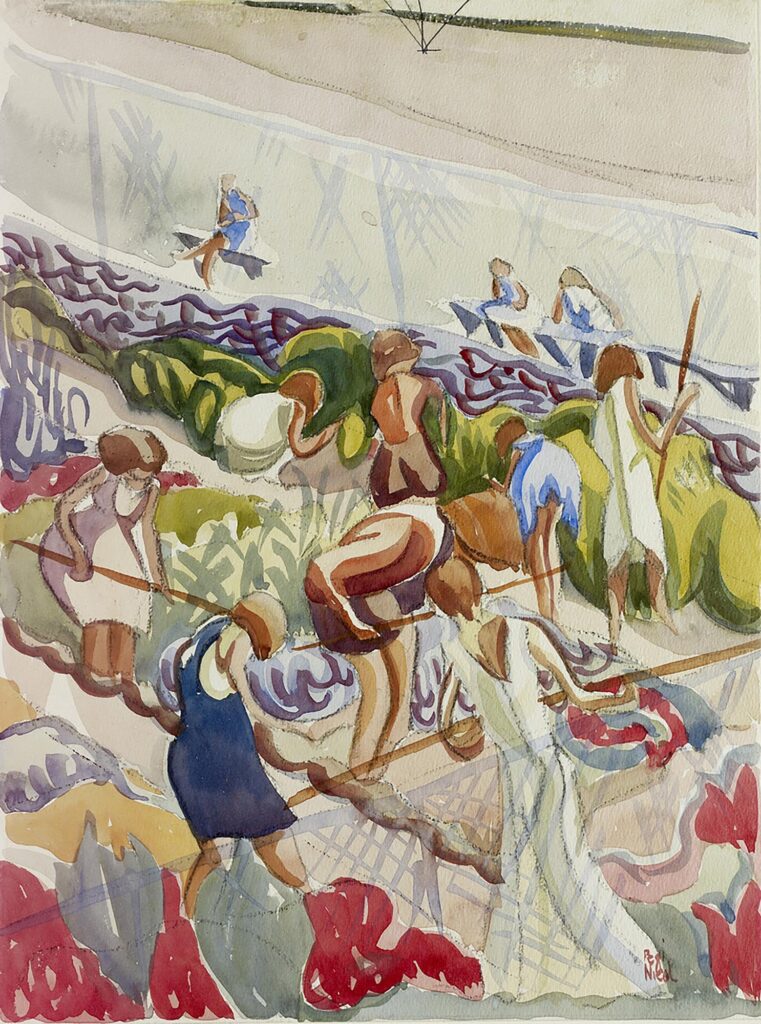
Pegi Nicol MacLeod, Toronto Victory Garden, c.1937, watercolour over charcoal on paper, 37 × 27.6 cm, Art Gallery of Ontario, Toronto.
MacLeod’s sustained engagement with watercolour began in 1932, after she returned to her parents’ Ottawa home. Watercolour was relatively inexpensive and accessible—well suited to the financial constraints she often faced—and its fluidity matched her quick working method. As artist Carl Schaefer observed, she had a “light but strong touch,” and she produced paintings that conveyed “immediate release” and were “not laboured.” Her growing proficiency was evident: she sold and exhibited regularly, and a 1933 solo exhibition at the Ottawa Art Association received strong reviews. In 1934, she exhibited Amateur Hockey, n.d., with the Ontario Society of Artists and painted scenes of the school garden across from her parents’ house.
From 1936 until her death in 1949, MacLeod painted in watercolour almost daily. Works like Orchestra Sketch I, c.1948, and CWAC Beauty Parlour #1, 1944, are characterized by vigorous, swirling lines and layered washes that seem to vibrate with energy. Her modernist experimentations let her brush roam freely, eschewing academic formality. She used watercolour as a fully realized medium that allowed her to work quickly and responsively to capture her subjects in the moment.
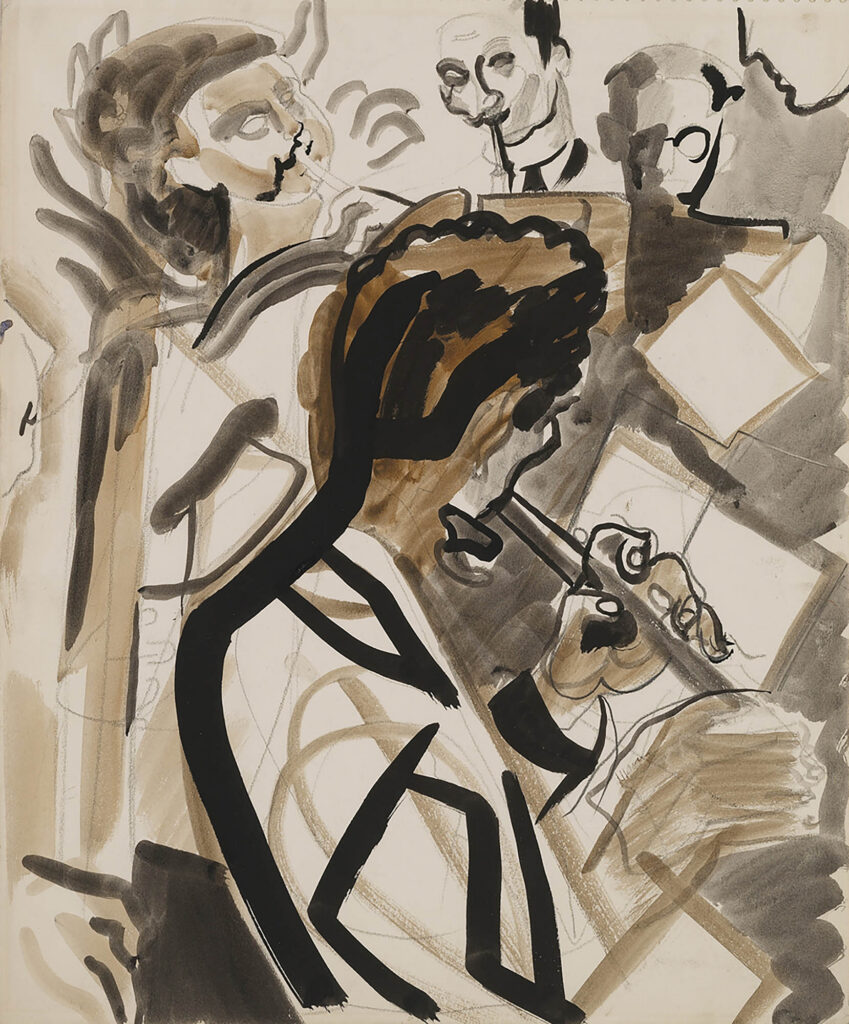
Pegi Nicol MacLeod, Orchestra Sketch I, c.1948, watercolour and black ink over graphite on wove paper, 42.6 x 34.9 cm, National Gallery of Canada, Ottawa.
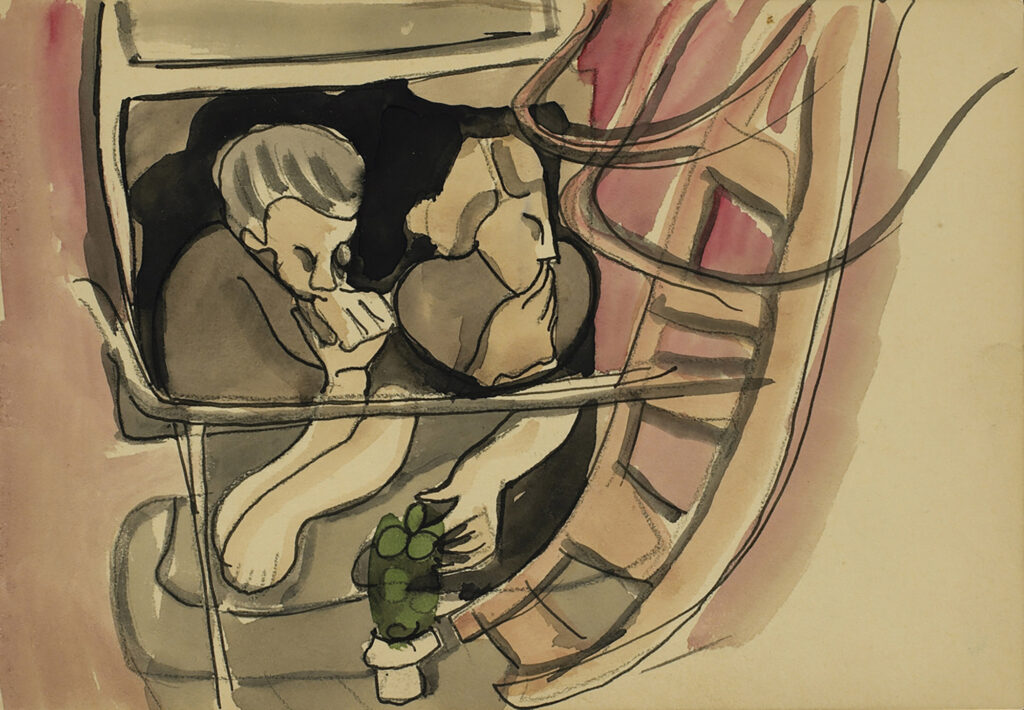
Pegi Nicol MacLeod, Two Figures on a Fire Escape, 1942, watercolour, pen and black ink, and graphite on wove paper, 12.4 x 19.7 cm, National Gallery of Canada, Ottawa.
While MacLeod was influenced by modernist movements like Expressionism and Symbolism, watercolour allowed her to explore movement and rhythm in ways that oil and tempera often couldn’t. She treated the medium not as preliminary but as central to her practice. In doing so, she helped raise the status of watercolour within Canadian modernism, asserting its potential for serious, innovative work.
Material Ingenuity
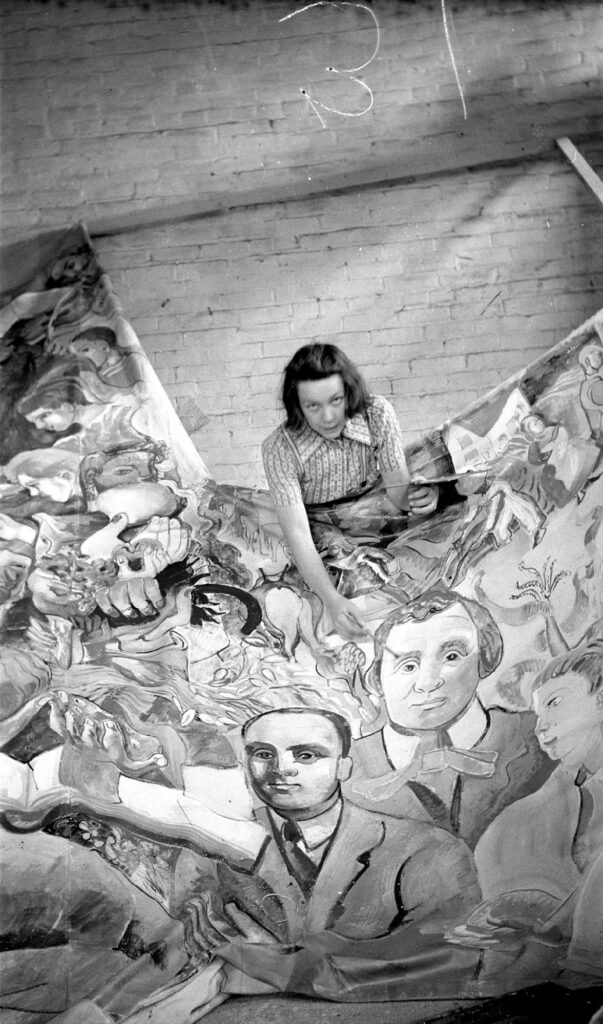
Pegi and her Woodstock mural, 1941, photographer unknown, Provincial Archives of New Brunswick, Fredericton.
If watercolour offered MacLeod freedom of expression, her experiments in other media reveal her ingenuity and adaptability. Throughout her career, she worked with whatever materials were at hand, transforming necessity into invention. Because she had to live within limited means, particularly during her New York years, she often repurposed materials—painting on both sides of the canvas, overpainting earlier works—and used unconventional surfaces such as linoleum and her husband’s discarded engineering blueprints.
MacLeod’s New York studio was a site of constant improvisation. She scavenged thrifted bedsheets for canvases and used industrial pigment powders from her husband’s colleague Harold Kirkpatrick at Reichhold Chemicals. These she likely mixed with linseed oil and turpentine, as well as drying agents like lead oxide. Some have speculated that her makeshift materials may have played a role in her later illness, but there is no conclusive evidence for this and she left no precise notes on her methods.
This spirit of improvisation also shaped her work in illustration and design. Her role as art director for the Canadian Forum influenced her sense of graphic line and composition. The illustration “Five O’Clock,” 1936, features caricatured figures and decorative motifs that contrast with her more emotionally charged paintings, but it retains her signature linework and sense of movement. Even her murals, department store window displays, and stage sets reveal her ability to move seamlessly between fine art and applied art.
One of her most notable mural commissions was for the Carleton County Vocational School in Woodstock, New Brunswick, in 1941. Working on lead-primed canvas cut and glued directly to the wall, MacLeod filled the mural with figures engaged in the trades and crafts taught at the school—digging, spinning, weaving, and experimenting in white lab coats. The result was an earth-coloured composition that aligned vocational education with everyday rural life. The mural was eventually removed, but pieces of it were rescued and framed in 1976.
MacLeod’s interest in craft also extended to hooked rug design—a medium where her distinctive modernist aesthetic intersected with rural craft traditions. When she was moving between Fredericton and New York in the 1930s and 1940s, she produced a series of original rug designs that featured bold, simplified floral motifs, animals, and abstract patterns, all rendered with the gestural rhythm that characterized her painting. Many of these designs, which were initially done in watercolour, are in the University of New Brunswick Art Collection. Her rug Corn Poni—a playful pink pony on a floral background—won third prize in the Museum of Modern Art’s “Arts in Therapy” competition in 1943.
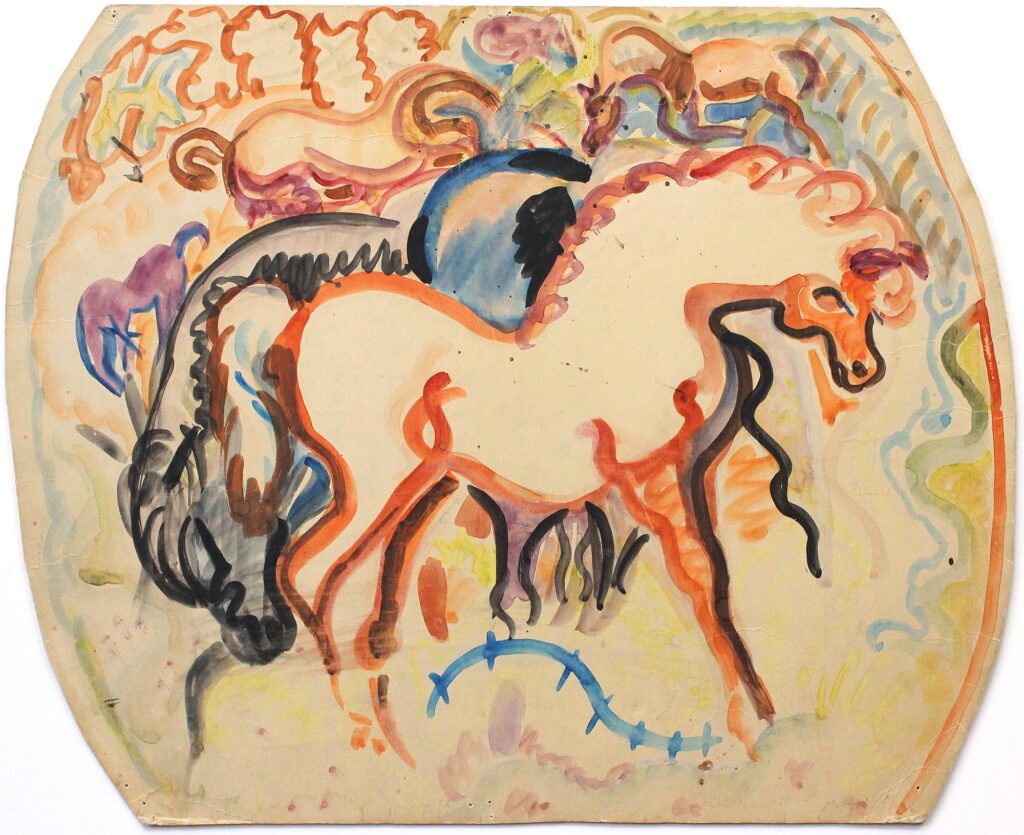
Pegi Nicol MacLeod, Ponies, n.d., gouache rug design, 40.5 cm (tondo), University of New Brunswick Art Centre, Fredericton.
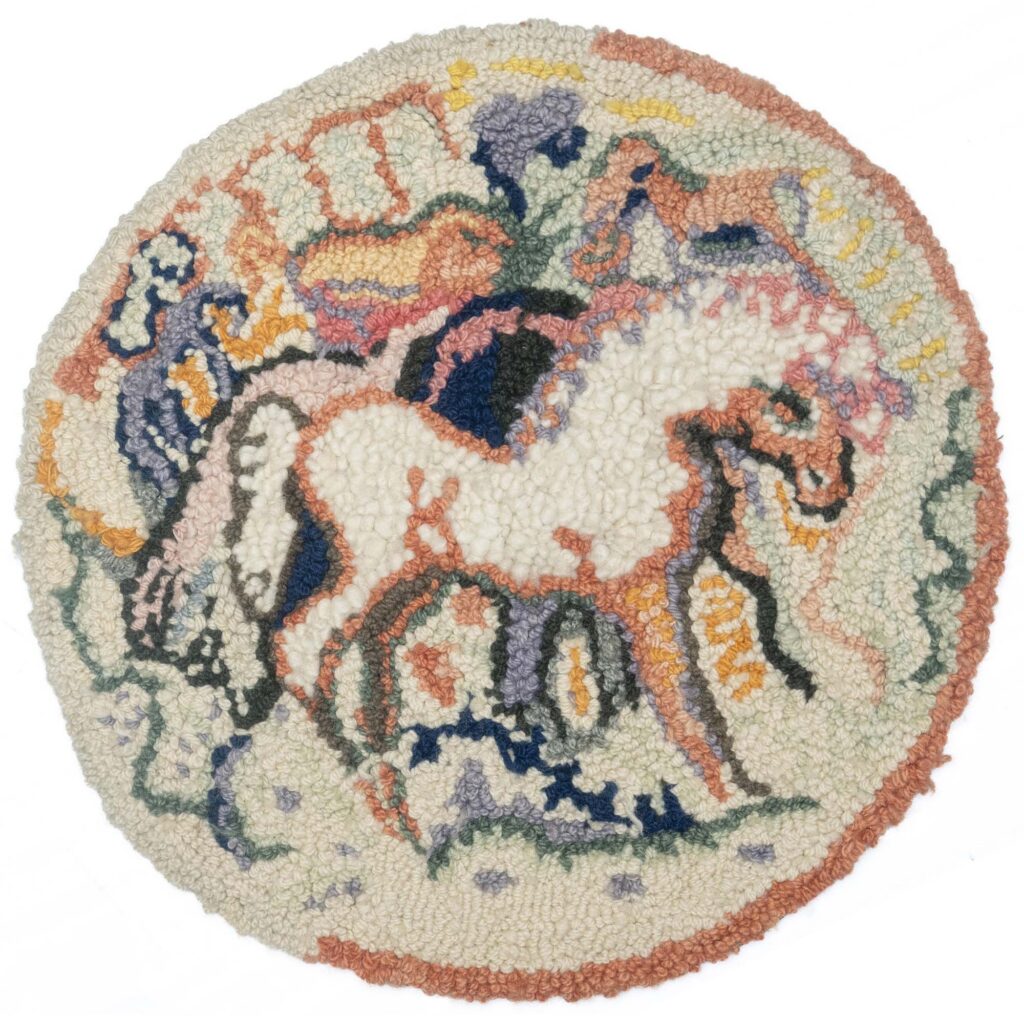
Pegi Nicol MacLeod, Horses, n.d., hand hooked chair cover, Fredericton Region Museum.
Though modest in scale, MacLeod’s rug designs supplemented her income and expanded the reach of her art. They were produced by local rug hookers, including Mrs. Ernest White of Burtt’s Corner, and acquired by important figures in the Canadian art world, such as Saint John painter Ted Campbell, Walter Abell of the Maritime Art Association, and Alice Webster, a founder of the New Brunswick Museum and a key figure in their fine and decorative arts collections.
Like Walter Abell, who thought artists should engage with industrial design, MacLeod believed in extending her artistic experimentation beyond the studio, bridging fine art and domestic craft. Her work asserts her expressive power of line, colour, and rhythm—whether on paper, canvas, or textile.
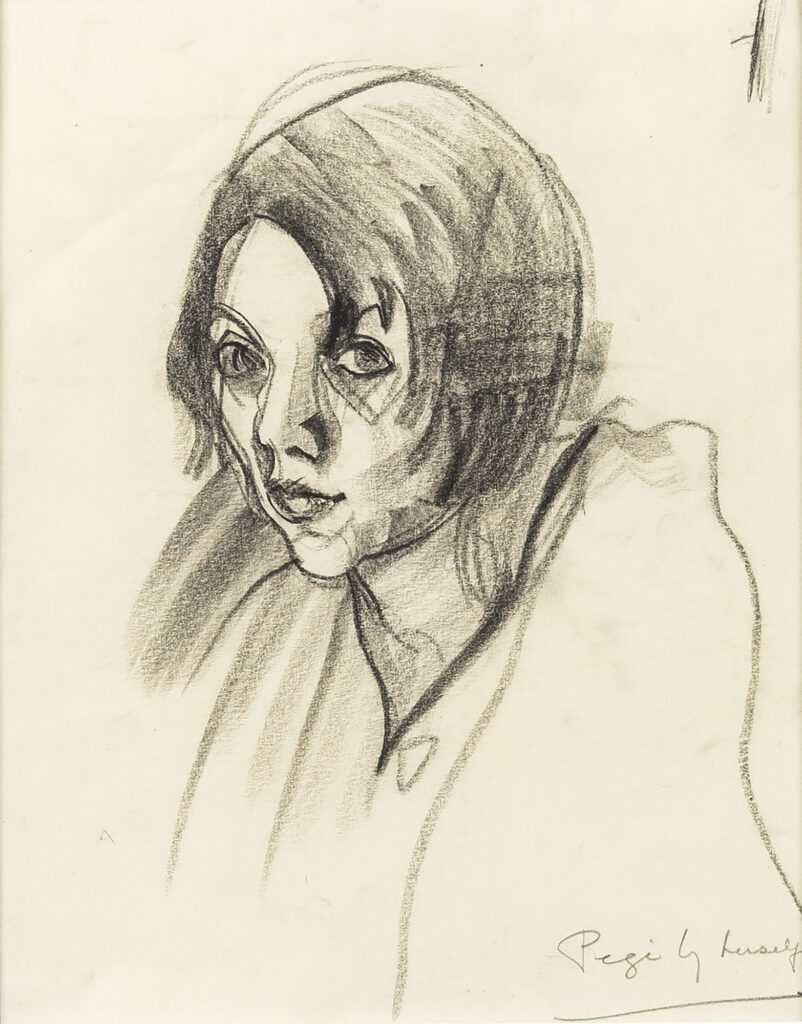
Pegi Nicol MacLeod, Pegi by Herself, c.1926, charcoal on paper, 19 x 23.5 cm, Ottawa Art Gallery.