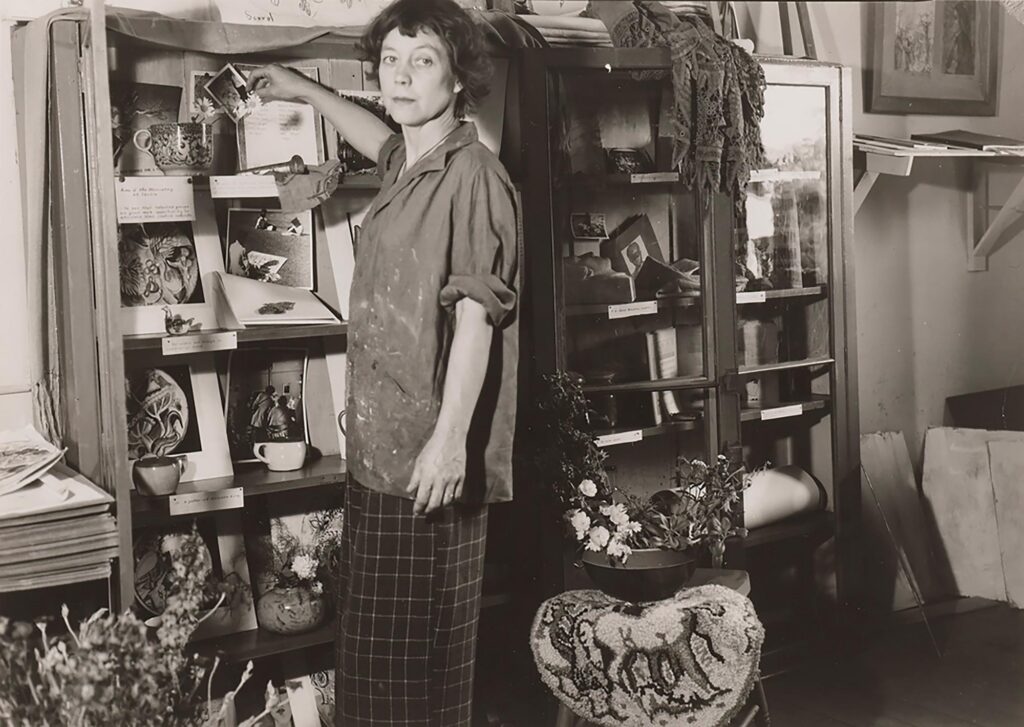
Pegi Nicol MacLeod (1904–1949) was a distinctive voice in Canadian modernism. Known for her expressive brushwork and bright palette, she painted urban scenes, portraits, landscapes, still lifes, and striking self-portraits. Born in Ontario, she studied in Ottawa and Montreal before exhibiting with the Group of Seven and winning the prestigious Willingdon Prize in 1931. In 1937, she moved to New York, where she created the celebrated Manhattan Cycle. During the Second World War, she was commissioned to depict the Canadian Women’s Army Corps and produced over one hundred works. Her career was cut short by her death at forty-five, yet she remains an essential, if often overlooked, contributor to Canadian modernism.
Childhood and Early Artistic Training
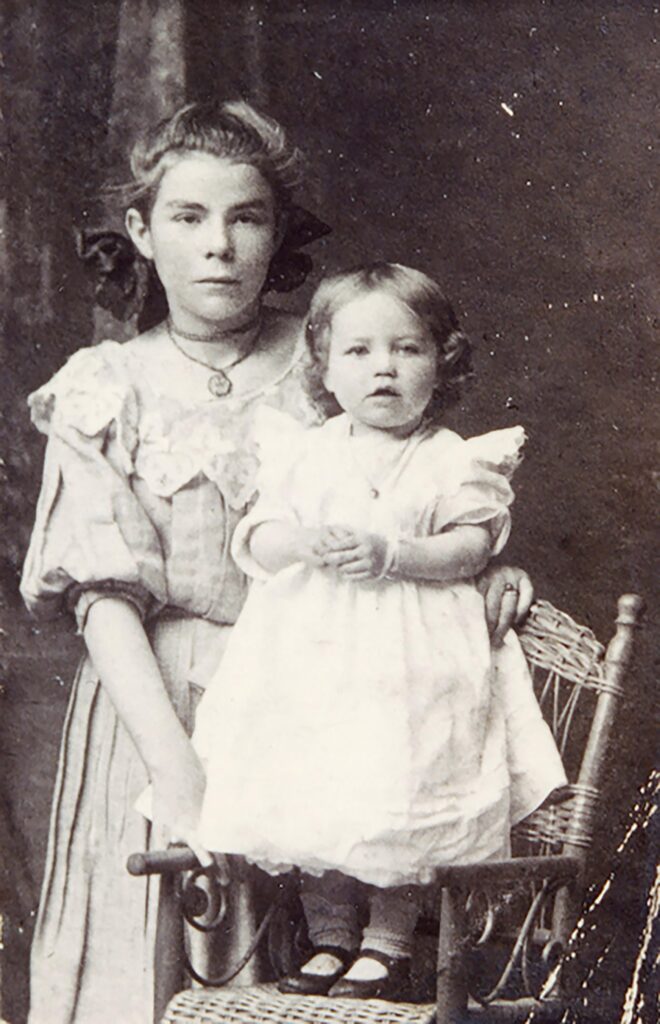
Pegi, aged about two, with Isa Austin, n.d., photographer unknown, National Gallery of Canada Library and Archives, Ottawa.
Born Margaret Kathleen Nichol in 1904 in Listowel, Ontario, Pegi Nicol—later Pegi Nicol MacLeod—grew up in a home marked by tension and creativity. Her mother, Myrtle, was raised with more traditional values, and she struggled to understand Nicol’s artistic ambitions. By contrast, her father, William Wallace Nichol, was a supportive figure who encouraged her interests.
After the family moved to Ottawa for William’s teaching career in 1908, Pegi attended local schools and developed interests in athletics, acting, and especially art. Although little documentation about her early life survives, it is known that during the First World War, her father took a leave from work, and the family moved to Toronto for three years before returning to Ottawa after the war. Nicol’s school report card from 1921 indicates that she was considering teaching—and she did occasionally teach art during her lifetime—but it was the pursuit of a professional art career that ultimately shaped her path.
Nicol’s formal artistic training began in 1921 at the Ottawa Art School under painter Franklin Brownell (1857–1946). Two years later, she enrolled at the new École des beaux-arts de Montréal, where instruction stressed both foundational drawing skills, such as working from plaster casts and live models, and painting en plein air. An early focus on portraiture and still life proved formative for Nicol. As art historian Laura Brandon has noted, “Pegi’s later subject matter of portraiture, the figure, and flowers undoubtedly developed in part as a result of her training.”
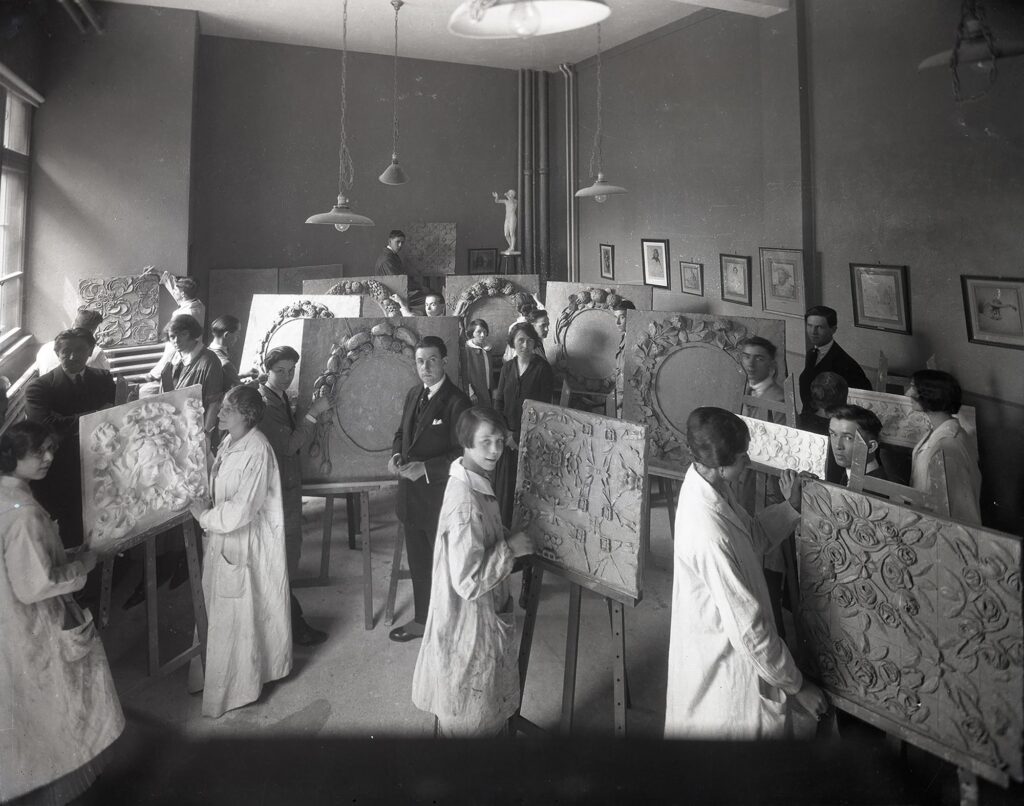
Atelier de modelage decorative ornamental (Ornamental Decorative Modelling Workshop), École des beaux-arts de Montréal, 1924, photographer unknown, Archives UQAM. Pegi Nicol is pictured in the centre.
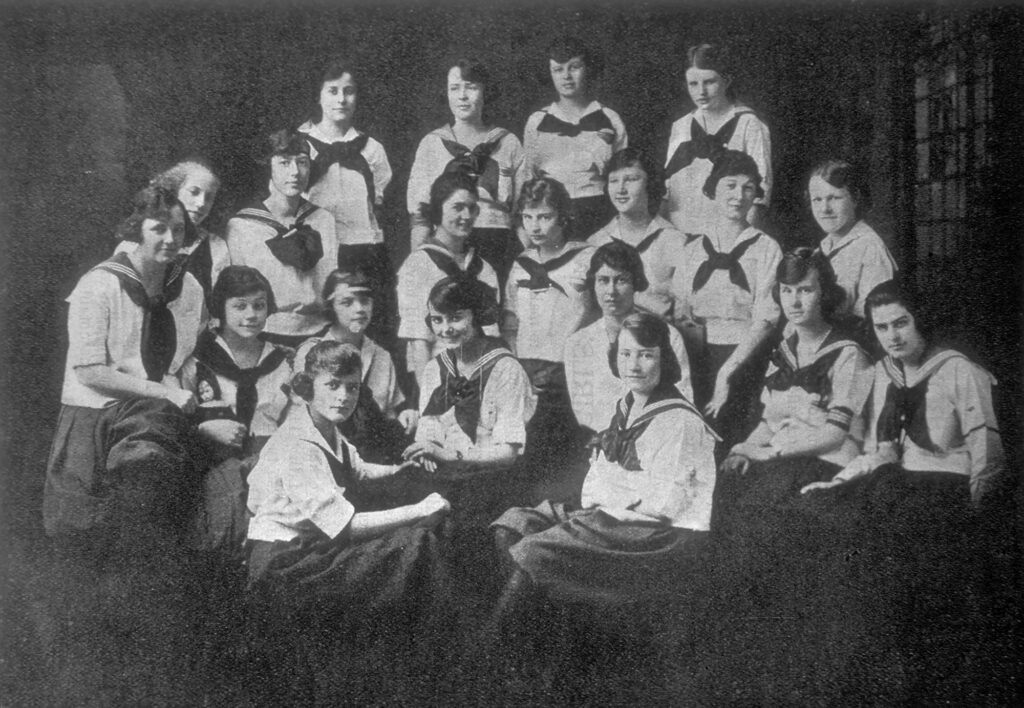
Gym team at Lisgar School, Ottawa, 1920, photographer unknown, Library and Archives Canada, Ottawa.
While in Montreal, Nicol entered an exciting artistic environment and trained alongside people who would later shape Canadian modernism, including Paul-Émile Borduas (1905–1960), Lillian Freiman (1908–1986), Goodridge Roberts (1904–1974), Anne Savage (1896–1971), and Marian Dale Scott (1906–1993). Her friendship with Scott would endure for the rest of her life. Nicol thrived in Montreal, earning five medals for her achievements and exhibiting many early works, including portraits, urban street scenes, and still lifes that reflected the city’s cosmopolitan character. In 1924, she moved back home to Ottawa.
Nicol’s eccentricity and unconventional lifestyle troubled her parents, particularly her conservative mother. One of Nicol’s former students from her time teaching at a private girls’ school recalled both her art lessons and her striking presence, noting that she often wore trousers and arrived on a motorcycle. She was remembered as an inspiring teacher who “broke through the academic rules, and got us all thinking in terms of creation rather than copying.” In her own practice, Nicol painted prolifically, often working outdoors along the Gatineau River. She believed an artist didn’t need to travel far to find inspiration and “could turn out a lifetime of masterpieces and never move away from his house and his backyard.”
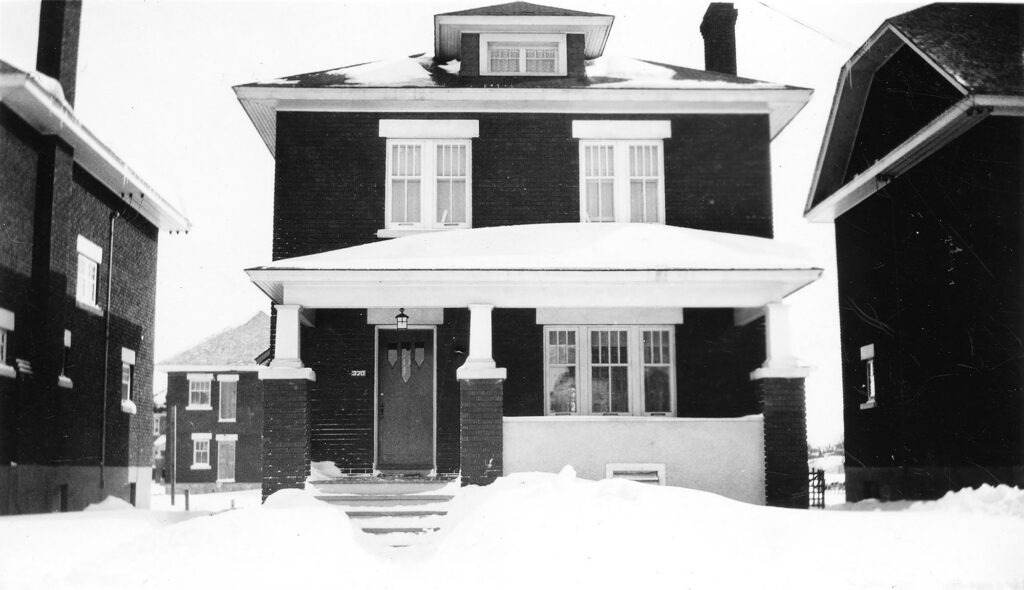
370 Second Avenue, Ottawa, c.1928, photographer unknown, City of Ottawa Archives.
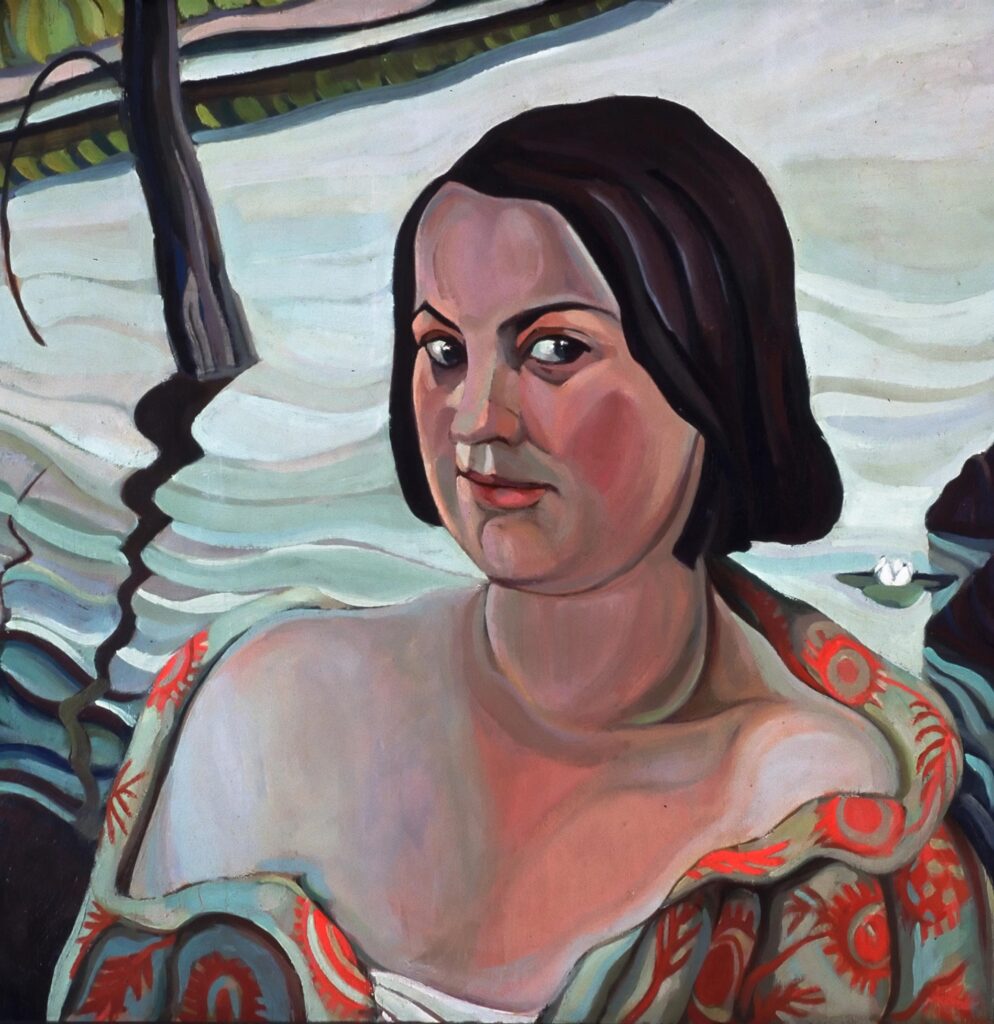
Pegi Nicol MacLeod, My Western Cousin, c.1927–29, oil on board, private collection.
In the mid-1920s, Nicol converted the attic of her family’s home in Ottawa’s Glebe neighbourhood into a makeshift studio where she began experimenting with self-portraiture, a genre that would become one of the most compelling and sustained threads of her artistic career. She also used it as a place to entertain her friends, play music, and read. Her rebellious spirit extended into her choice of reading materials, which ranged from Karl Marx and Katherine Mansfield to Ezra Pound and D.H. Lawrence. Though her father came to a measured acceptance of his only child, her mother, Myrtle, remained deeply critical. She took issue with Nicol’s decision to change her name from Margaret Nichol to Pegi Nicol and viewed her daughter’s unorthodox behaviour and approach to art as distasteful. Eventually, she even destroyed some of Nicol’s work.
Western Travels
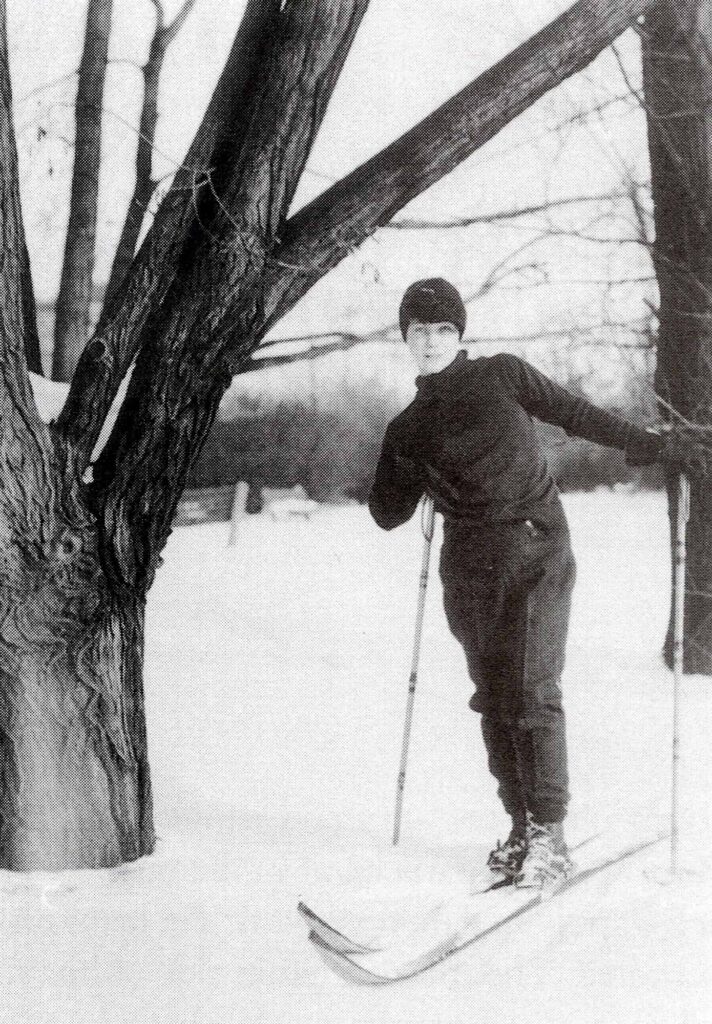
Pegi on skis, n.d., photograph by Eric Brown, private collection.
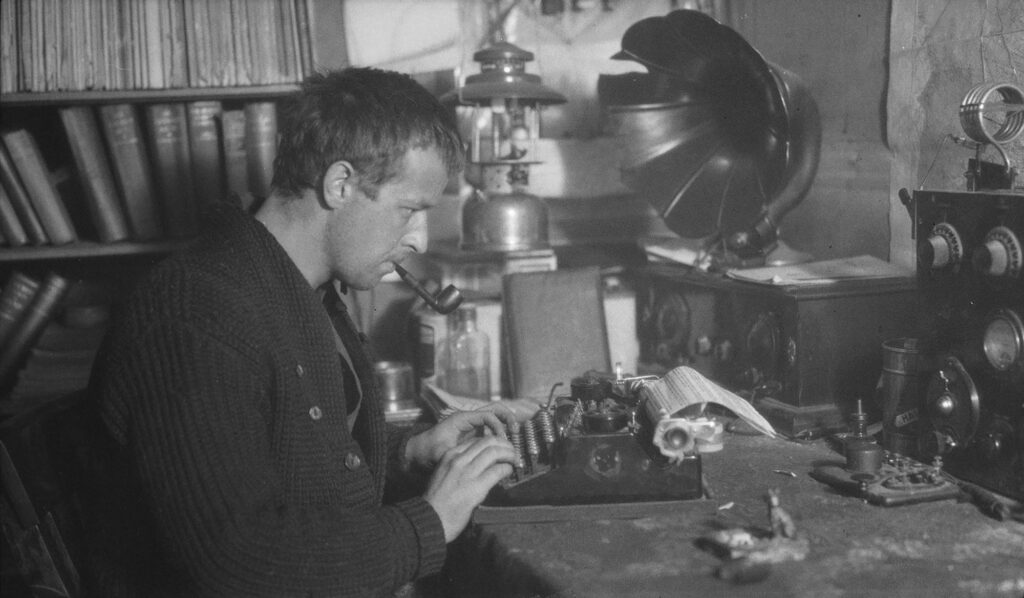
Richard Finnie typing notes at his “Kogluktuk” base, January 1931, photographer unknown, Library and Archives Canada, Ottawa.
In the early 1920s, a chance encounter on a train with Eric Brown (1877–1939), director of the National Gallery of Canada, was the catalyst that opened doors for Nicol in Ottawa’s cultural circles. Brown and his wife, Maud, mentored and supported Nicol, welcoming her into a group of prominent artists, collectors, and intellectuals. Maud later remembered her as “an astonishing person.” She wrote: “Bursting with vitality and ideas she was always ready for a discussion. She could act, dance and ski, and was fearless in the water.” For her part, Nicol was grateful to the Browns, noting, “I never could have painted in Ottawa at all if it hadn’t been for Eric, because my parents hate it and all art classes I have attended and all artists I know.” Around this time, Nicol also met photographer Richard Finnie (1906–1987), who moved in the same cultural circles; the two began a five-year relationship that would have a lasting impact on them both.
In 1927, with the help and encouragement of Eric Brown, ethnologist Marius Barbeau, and writer Duncan Campbell Scott, Nicol travelled west to Morley, Alberta, to paint portraits of the Stoney Nakoda peoples and landscapes of the surrounding scenery. The resulting works, including Smena-Two-Young-Men and Mrs. Hector Crawler, demonstrate her early commitment to portraiture as an individualized encounter, a nuance often missing from contemporaneous settler representations. Her journey was part of the broader settler-colonial effort to document Indigenous Peoples, who were seen as a “vanishing race”—an ideology that stretched back to European-born settler-colonial painters like Canadians Paul Kane (1810–1871) and Cornelius Krieghoff (1815–1872) and American George Catlin (1796–1872), as well as photographer Edward S. Curtis (1868–1952) and others.
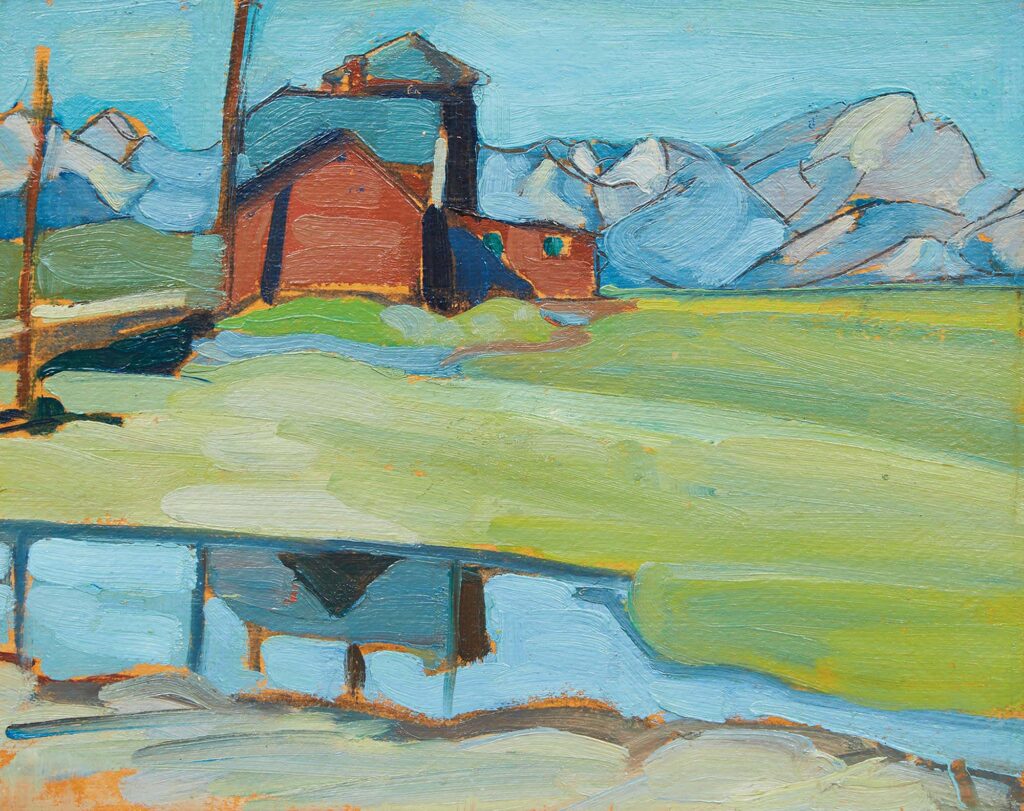
Pegi Nicol MacLeod, Morley Station, 1927, oil on board, 23.5 x 29.2 cm, private collection.
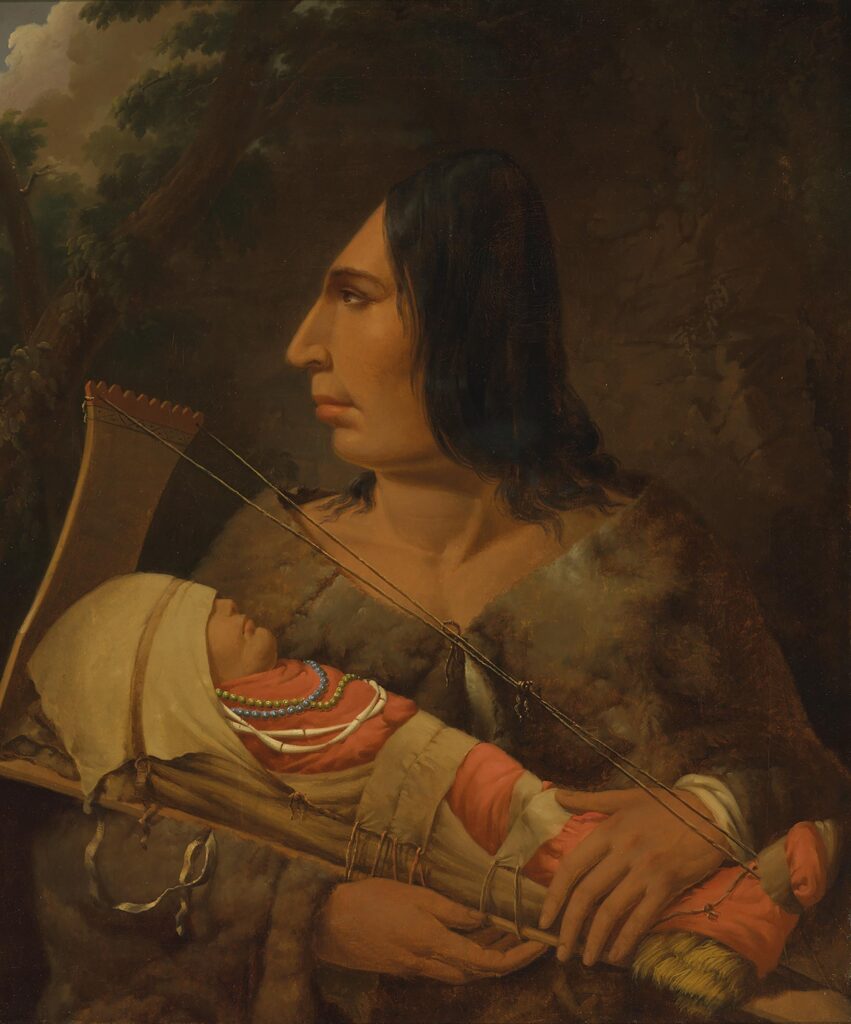
Paul Kane, Flat Head Woman and Child, Caw-wacham, Cowlitz, c.1849–52, oil on canvas, 75.9 x 63.4 cm, Royal Ontario Museum, Toronto.
At this point in her career, Nicol was going back and forth between Ottawa and Montreal, and the journey west marked a further expansion of her artistic range. Four of her paintings from this trip—Widow John Poucett, Charley Davis, and the aforementioned portraits—were included in the landmark 1927 Exhibition of Canadian West Coast Art: Native and Modern at the National Gallery of Canada, alongside works by Emily Carr (1871–1945), A.Y. Jackson (1882–1974), and others.
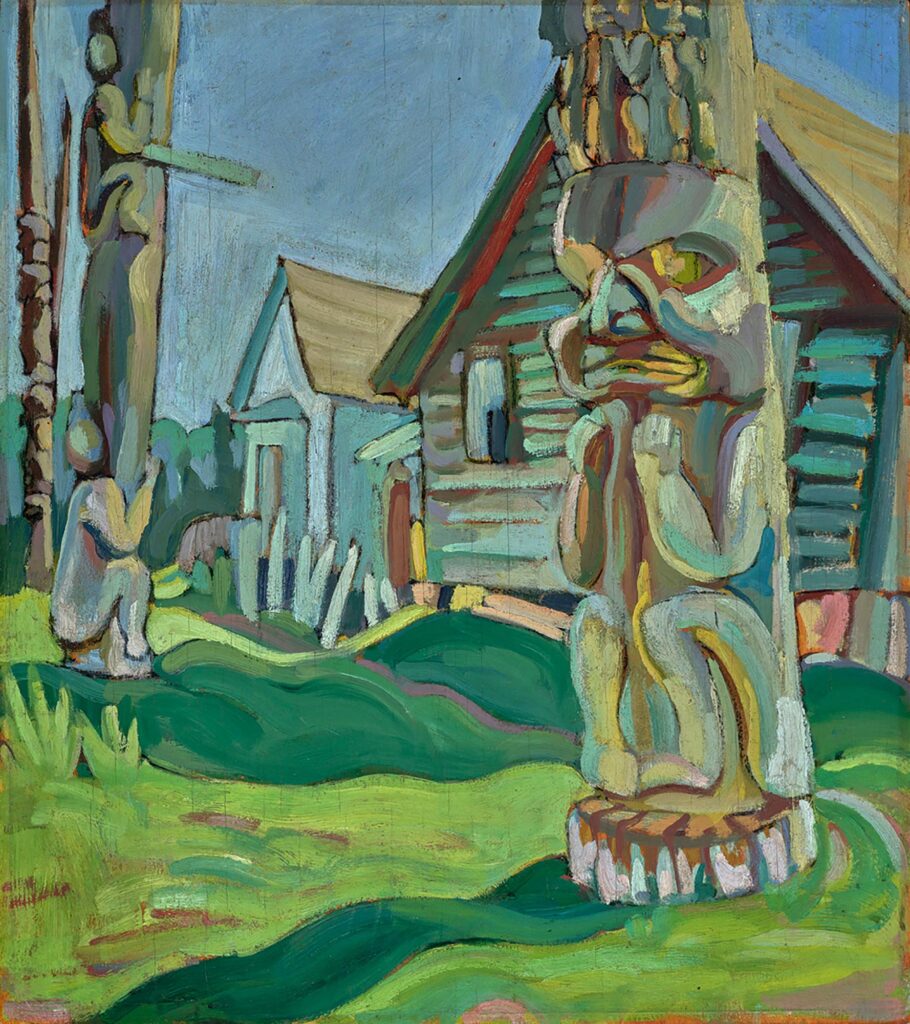
Pegi Nicol MacLeod, Hazelton, 1928, oil on plywood, 46.1 x 40.7 cm, National Gallery of Canada, Ottawa.
In 1928, Nicol travelled to Gitxsan territory in northwestern British Columbia, along the upper Skeena River near the settlement of Hazelton. She was particularly struck by the totem poles she encountered and later recorded her impressions in an article for the Canadian National Railway’s magazine. Hazelton, 1928, one of Nicol's most recognizable works from this period, monumentalizes the totem poles at its centre as aesthetic subjects, reflecting her participation in the colonial project to document Indigenous communities.
Where artists like Emily Carr and Anne Savage often painted distant, depopulated scenes, Nicol offers a close-up frontal view of the totem poles, drawing the viewer into the village. Around this time, she also painted Women Cleaning Fish, which captures a scene of communal labour rather than the remote “village views” favoured by many of her contemporaries. Although Women Cleaning Fish is dated c.1927, surviving documentation does not confirm the exact year; the painting may well have been produced during her 1928 Skeena visit, but the evidence is inconclusive. Regardless, Nicol’s travel experiences not only expanded her geographic and artistic range but also affirmed the figurative concerns that would define her practice.
Nicol marked several important milestones in 1928. In February, she held her first solo exhibition, Portraits, Landscapes and Studies by Pegi Nicol, at Montreal’s newly formed Leonardo Society, an organization that sold reproductions of contemporary European paintings and had begun to support modern Canadian art as well. The show confirmed her growing reputation and soon led to further opportunities: the National Gallery purchased her 1926 portrait of Eric Brown, and the Group of Seven invited her to exhibit with them in Toronto later that year, positioning her among the country’s leading modern painters.
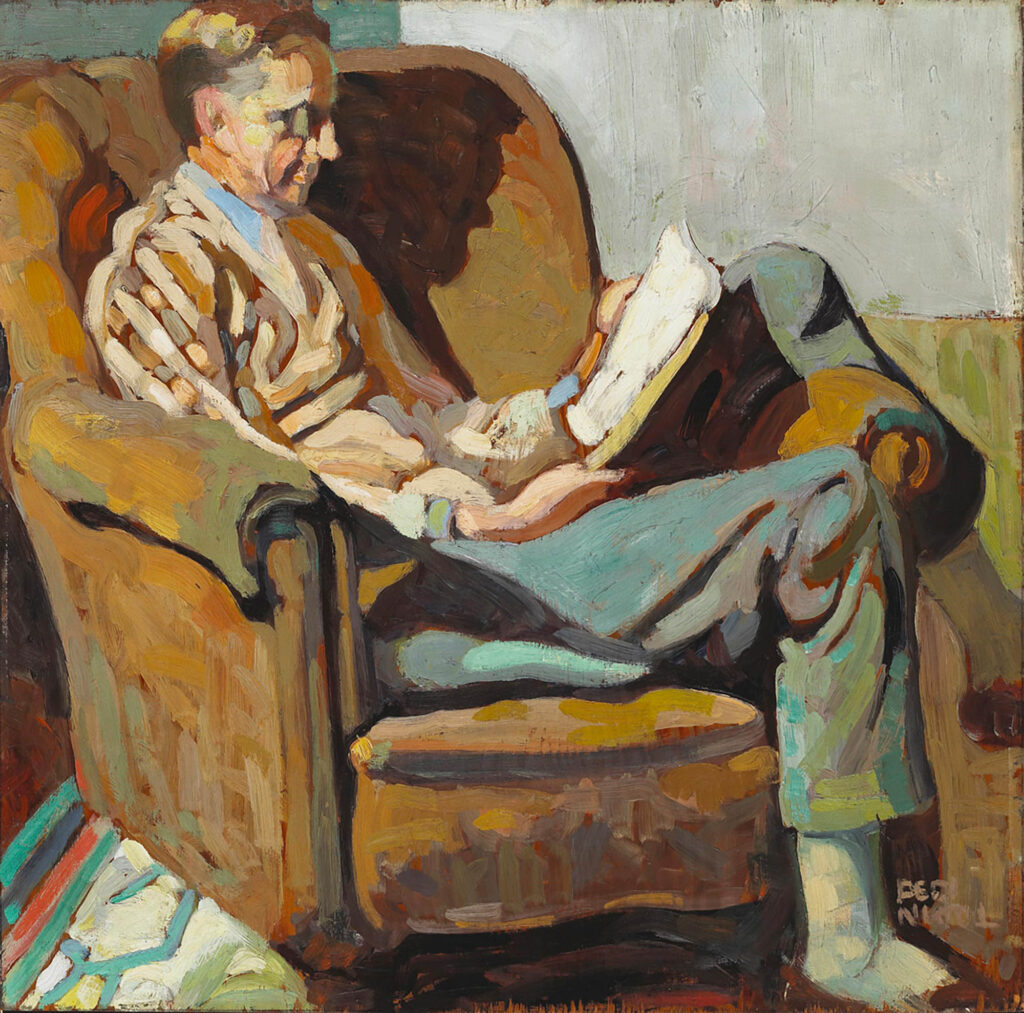
Pegi Nicol MacLeod, Portrait in the Evening, 1926, oil on plywood, 46 x 46.5 cm, National Gallery of Canada, Ottawa.
Artistic Development in the 1930s
By 1930, Nicol’s tumultuous relationship with Richard Finnie had ended. Talented and adventurous, Finnie travelled widely in northern Canada, working first as a radio operator and later as a photographer and filmmaker. When he was home, he and Nicol often performed together with the Ottawa Drama League. Their relationship was passionate, but as Finnie later recalled, “Our natures sometimes clashed.” He never forgot her, though, and confessed that she had left him with “an indelible impression vividly enduring to this day.” Nicol marked the end of their relationship by giving Finnie an early self-portrait—a genre that would become a lifelong fascination for her.
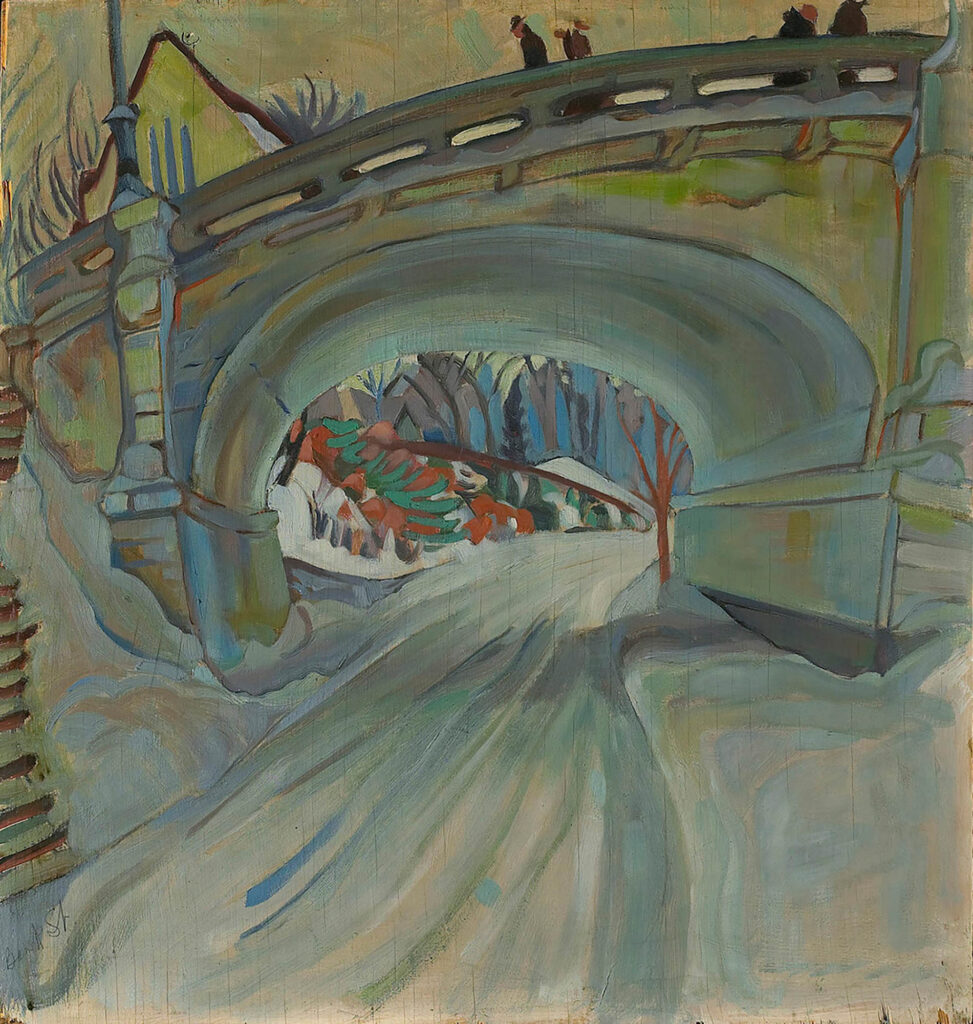
Pegi Nicol MacLeod, Bank Street Bridge, 1930, oil on plywood, 50.7 x 50.7 cm, Art Gallery of Ontario, Toronto.
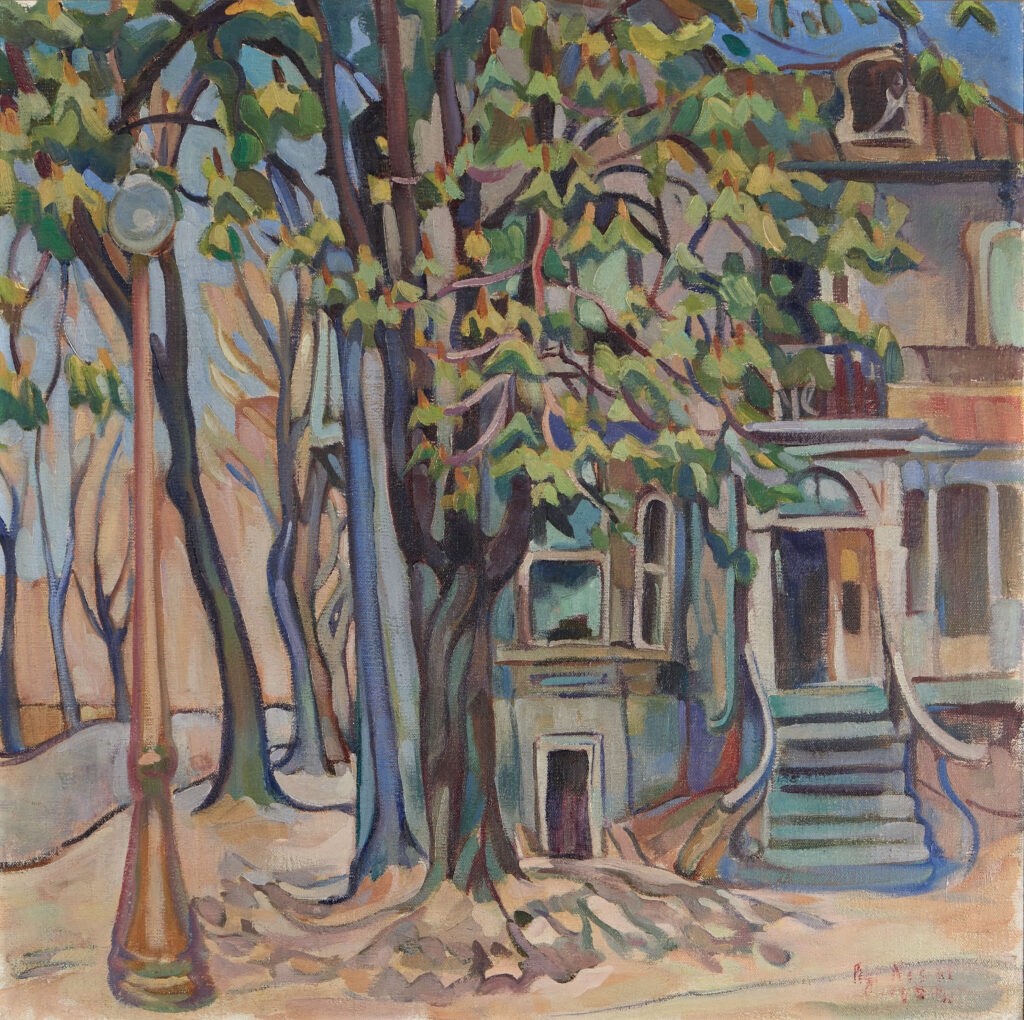
Pegi Nicol MacLeod, Montreal Street Corner, 1928, oil on canvas, 51 x 51 cm, private collection, Ottawa.
Seeking a fresh start, Nicol moved to Montreal in the autumn of 1931, enticed by an art scene more exciting and cosmopolitan than Ottawa’s. Though she arrived amid the devastation of the Great Depression, Montreal offered a supportive artistic environment and more opportunities to show her work. But the Depression had also hit Canadian artists hard: sales were scarce, and institutional support was limited. Many people survived by turning to teaching, illustration, design, or commercial display work—including Nicol, who designed window displays for Eaton’s department store in Toronto in 1934.
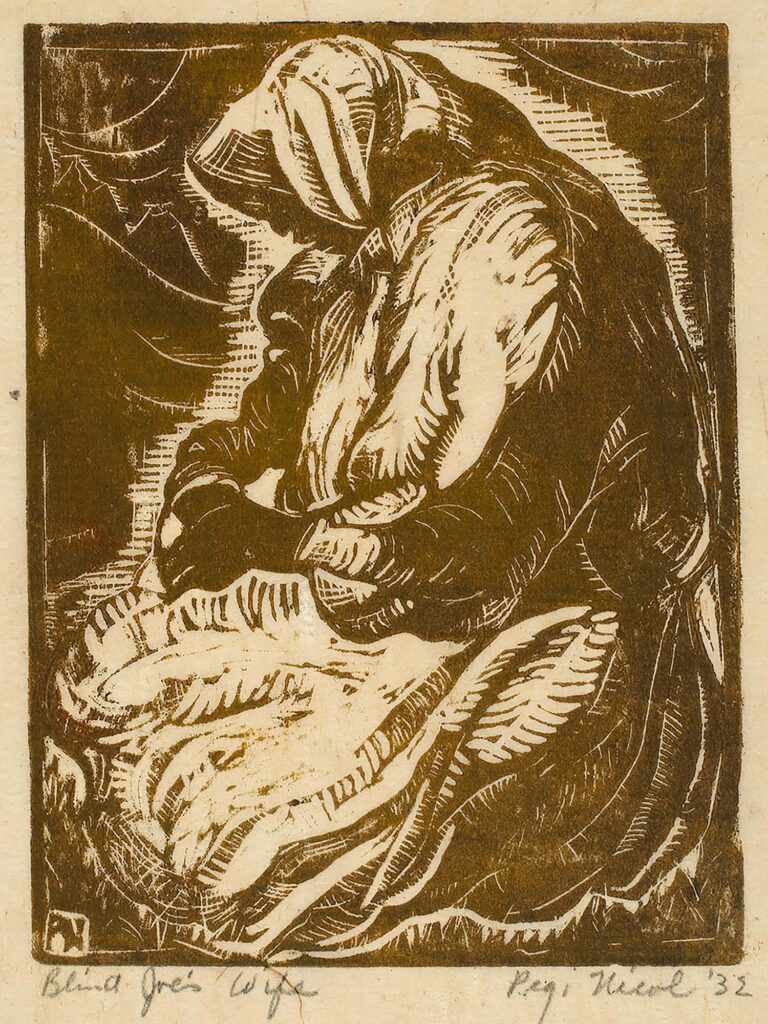
Pegi Nicol MacLeod, Blind Joe’s Wife, 1932, wood engraving in brown ochre on chine, 28.9 x 18.7 cm, National Gallery of Canada, Ottawa.
Despite the hardships, the Depression era fostered experimentation and collaboration among artists. They banded together in groups, such as the Canadian Group of Painters (founded in 1933), which Nicol eventually joined, and they sought new ways to reach the public, from inexpensive prints to exhibitions in department stores. Nicol’s paintings from this period reveal a shift from Group of Seven–inspired landscapes to an increasingly dynamic and fluid Expressionism. She received training in watercolour and engraving from painter and printmaker Edwin Holgate (1892–1977), creating woodblock prints and illustrations for the French Canadian folk tales that were published by Marius Barbeau in La Presse and other outlets.
Throughout the Depression, Montreal’s cultural and artistic life remained rich. Painters like John Lyman (1886–1967) helped articulate a modernist visual ethos in the city, promoting approaches that extended beyond academic traditions and drew on international developments. Within this context, Nicol gravitated to artists like Marian Dale Scott and Anne Savage. Nicol had met Scott at the École des beaux-arts, and the two maintained a close friendship. Scott’s later focus on urban and architectural subjects executed with precision and structure stood in contrast to Nicol’s more fluid and gestural style.
Although few critics in the early twentieth century openly stated that men were superior painters, women artists faced barriers to participation in the art world, and critiques of Nicol’s work were tinged with gender bias. Critics often described her art as unfinished, rushed, or lacking organization, a clear indication that her expressive and experimental style posed a challenge to some. But Nicol’s originality was also rewarded. In 1931, her painting The Log Run, c.1930, won the National Gallery’s highly prestigious Willingdon Prize, signalling that she was becoming an established artist.
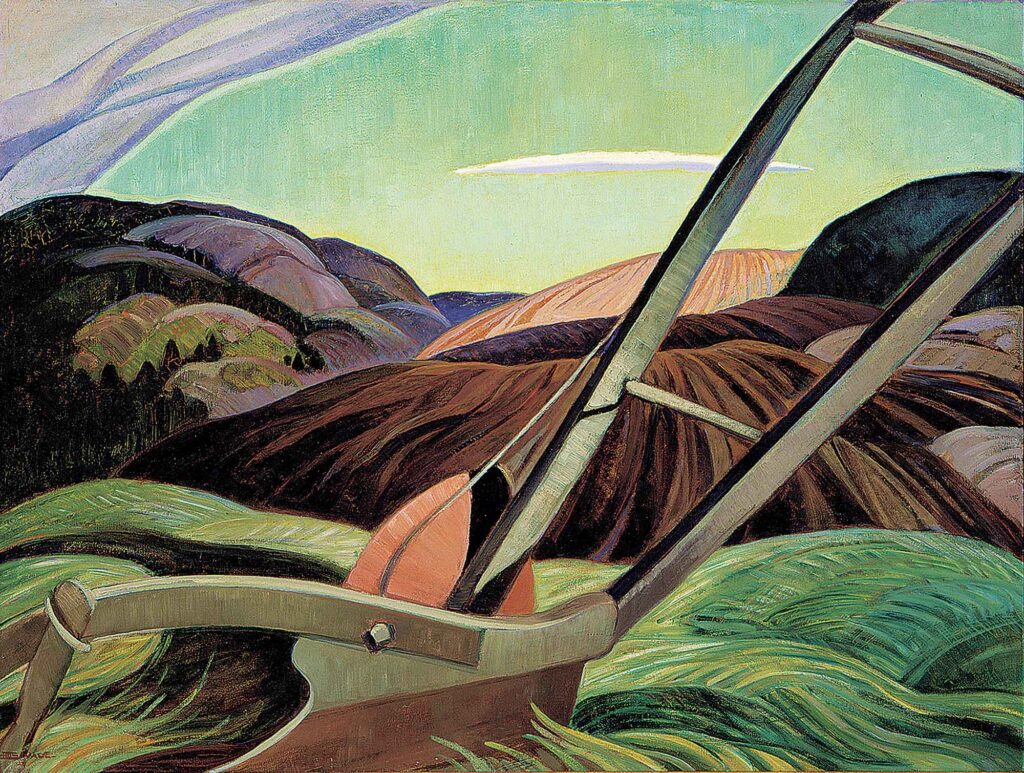
Anne Savage, The Plough, 1931–33, oil on canvas, 76.4 x 102.3 cm, Montreal Museum of Fine Arts.
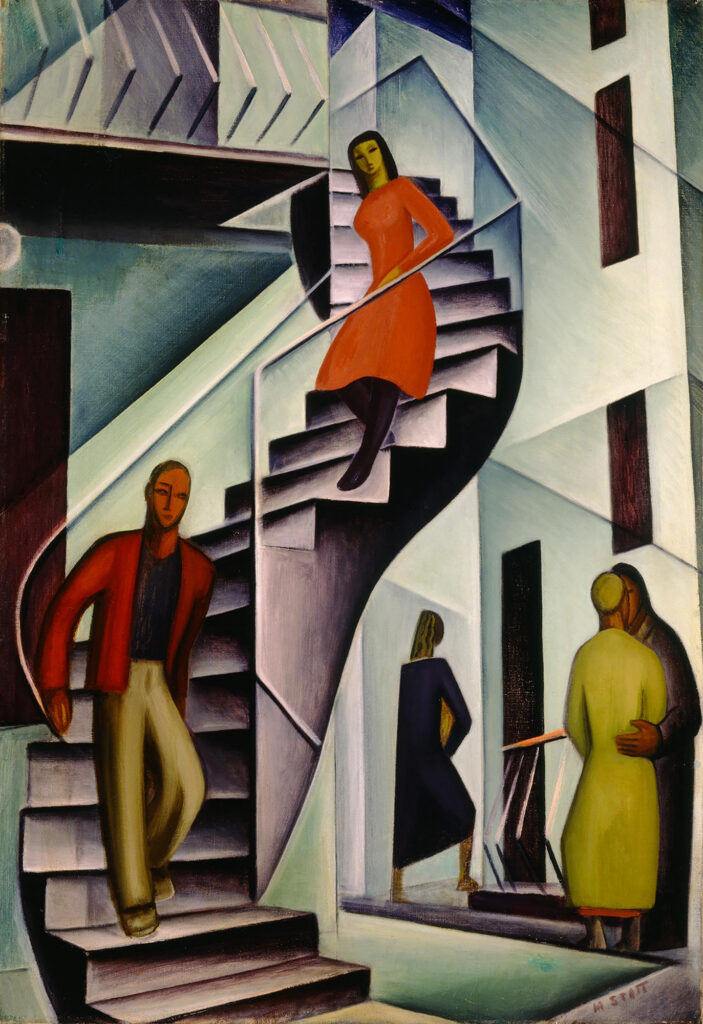
Marian Dale Scott, Stairway, c.1940, oil on canvas, 74.3 x 50.7 cm, Montreal Museum of Fine Arts.
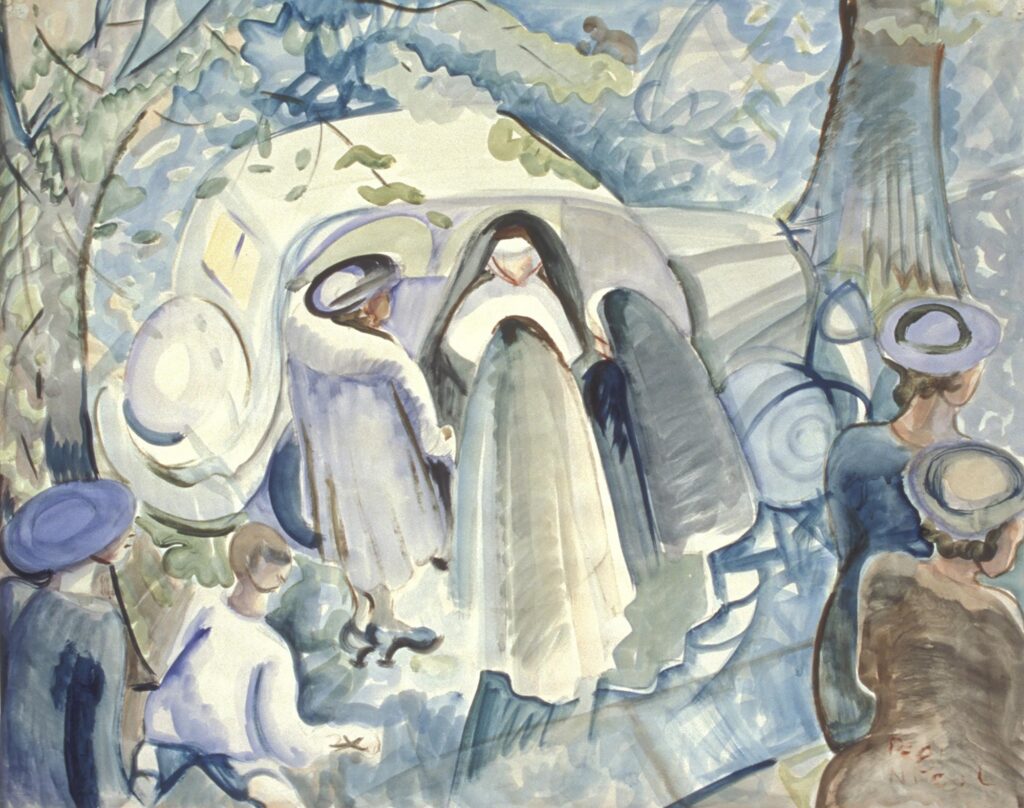
Pegi Nicol MacLeod, Nuns on Jarvis Street, c.1935, watercolour on paper, 72.7 x 57.8 cm, Ottawa Art Gallery.
Tragically, Nicol’s first Montreal studio, a converted stable near the École des beaux-arts, burned down in 1931. It’s unclear what works she lost in that fire, but she still had enough paintings to mount exhibitions in 1932 at the National Gallery of Canada, the Ontario Society of Artists in Toronto, the Art Gallery of Vancouver, the Royal Canadian Academy of Arts, and Eaton’s department store in Montreal, where her exhibition was met with cautious praise. One reviewer observed that Nicol’s paintings could appear “broadly, sometimes roughly painted” and even “shapeless and dull in color” at first glance, but that with time and distance, they revealed “a very good color sense,” their forms gradually cohering and taking on life.
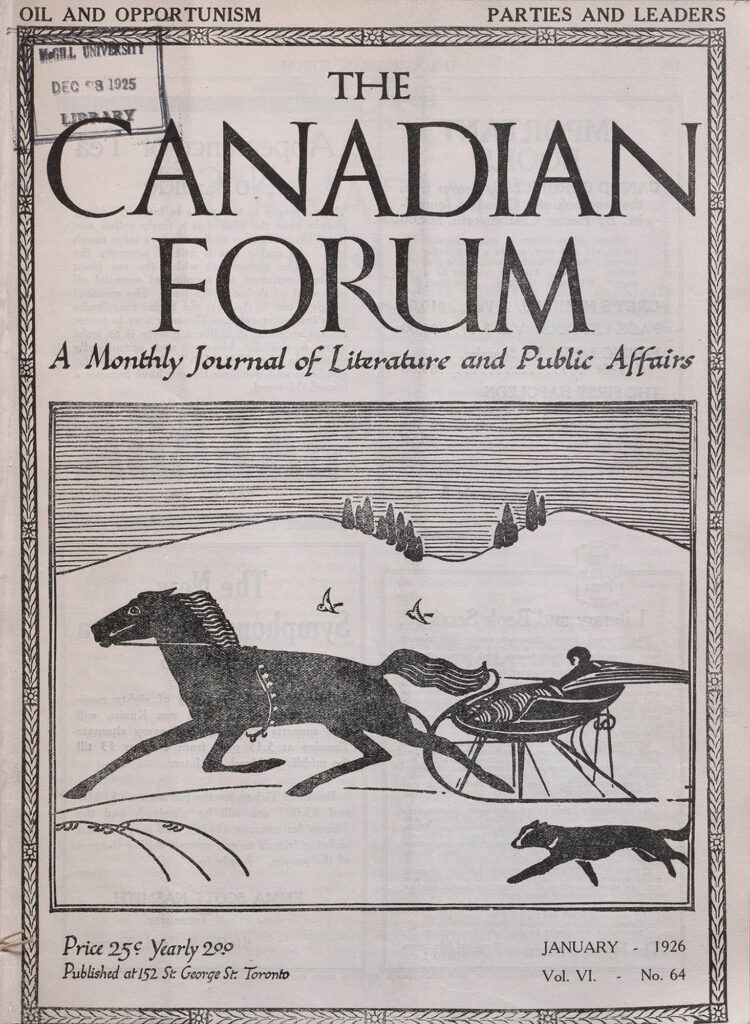
Cover of the January 1925 issue of the Canadian Forum, Rare Books and Special Collections, McGill University Libraries, Montreal.
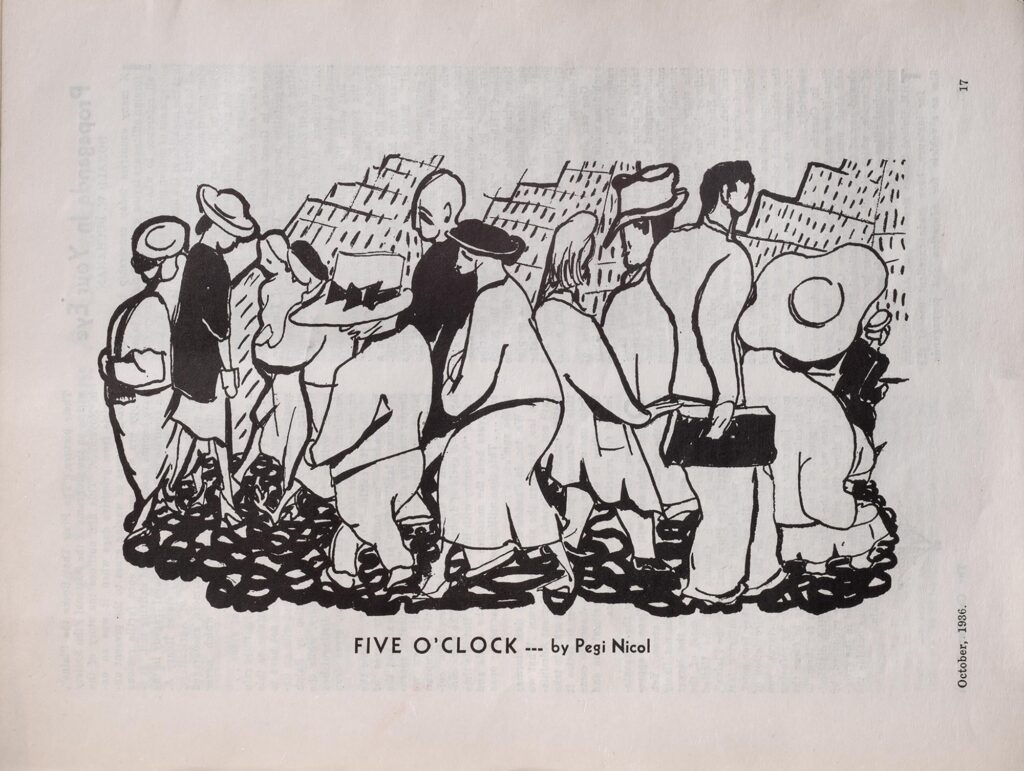
Pegi Nicol McLeod, “Five O’Clock,” featured in Canadian Forum 16 (October 1936), page 17, Rare Books and Special Collections, McGill University Libraries, Montreal.
As socialist and communist ideas gained momentum in Canada during the Great Depression, Nicol became politically engaged—a passion that would shape her life and work. She had read Karl Marx in the 1920s, and her growing interest in socialist theory drew her to the left-leaning publication Canadian Forum, where she served as the art editor in 1935–36. In the same period, she began contributing illustrations and articles to the publication—most notably, her 1936 anti-fascist cartoon “Merry Christmas.”
Through this work, she formed friendships with politically active artists, writers, and intellectuals and became closely associated with the League for Social Reconstruction, a left-leaning intellectual group promoting economic and social reform. Her political awakening was deeply influenced by social advocate King Gordon, who was close friends with Marian’s husband, Frank (F.R.) Scott, co-founder of the Co-operative Commonwealth Federation, the precursor to the New Democratic Party. Gordon’s sister Mary believed that her brother was in love with Nicol, and that she likely felt the same. Though the match ultimately eluded them, the two remained close friends.
In 1932, financial hardship forced Nicol to return to Ottawa. But her friendship with the Scotts, especially Marian, remained strong, and she visited them often. Nicol painted Montreal Harbour from St. Helen’s Island, 1933, on one visit, working on it for a week alongside Marian.
Turn to the Figure and Critical Recognition
In the early 1930s, Nicol’s artistic focus began to shift more towards the figure. A 1933 exhibition of about thirty works at the Ottawa Art Association drew positive reviews. One critic wrote: “In her general concepts she continues to reveal marked individuality, and there are few artists betraying less derivative influences. She is succeeding in summarizing natural phenomena in skillful fashion, and brings to her work a rhythmic quality which is as apparent in her portraits as in her outdoor subjects.”
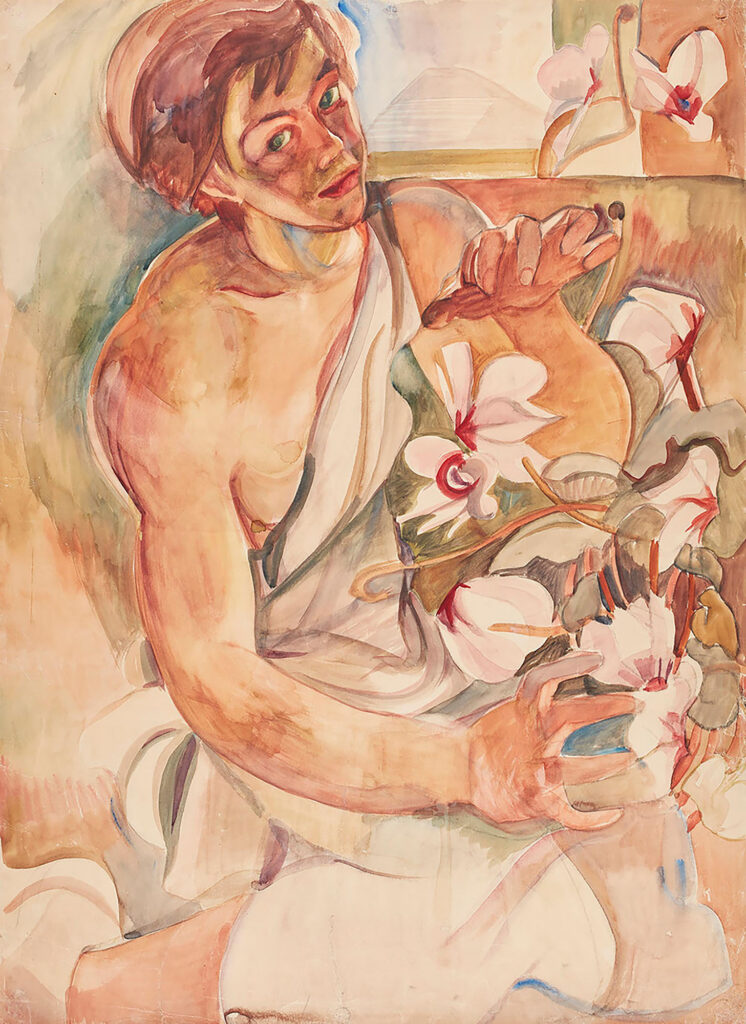
Pegi Nicol MacLeod, Pegi with Cyclamens, 1936, watercolour, traces of charcoal, and graphite on paper, 76.2 x 55.9 cm, Art Gallery of Ontario, Toronto.
As critics began to recognize her distinctive style, Nicol was becoming more engaged with Canada’s growing artistic networks. She joined the newly formed Canadian Group of Painters, attracted to its mandate “to encourage and foster the growth of art in Canada which has a national character,” and to its members’ interest in international artistic trends. Though her knowledge of modernism placed her in dialogue with contemporary movements, her bohemian lifestyle and theatrical flair set her apart in Ottawa’s more conservative art circles. Fellow artist Henri Masson (1907–1996) remembered her as “the enfant terrible of the rather dull and small group of Ottawa artists—strange dresses, active in the theatre group.” Masson noted that “she was so much more alive and interesting than the majority of Canadian painters who painted dull Canadian landscapes.”
Nicol acknowledged narrowing her focus, however, writing to Marian Scott that she had given up “plays, radio, everything” to concentrate more fully on painting and developing her technique. She began to paint nudes in the 1930s—a genre she would return to throughout the decade, often using her own body in self-portraits. In a letter to Frank and Marian Scott, she wrote, “I am recruiting the figures of all my friends. I lure them up the Gatineau in the Ford, then strip them and paint them.” Nicol was described by many of her friends and contemporaries as a free spirit, and this aspect of her personality certainly comes across in bathing scenes and nude studies like Untitled (Nude Study), c.1934, Torso and Plants, c.1935, and A Descent of Lilies, 1935. Throughout this period, she continued to work extensively in watercolour, drawn to a medium that was both economical and well suited to her rapid painting style.
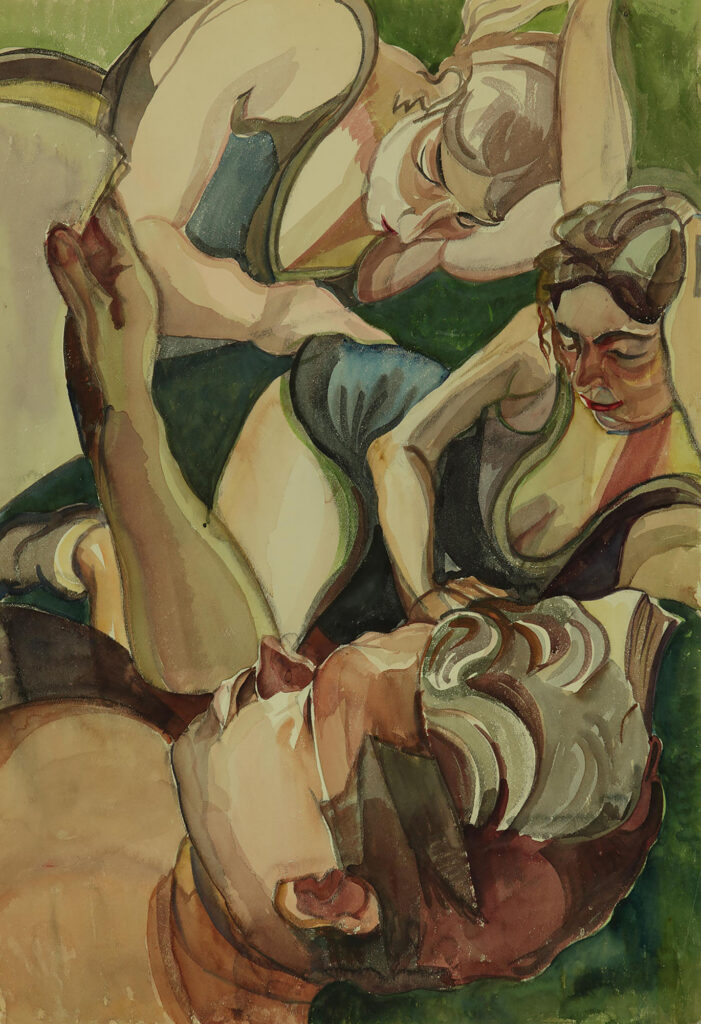
Pegi Nicol MacLeod, Figures Sunning, c.1934, watercolour and charcoal on paper, 73 x 51 cm, Art Windsor-Essex.
In 1934, Nicol moved to Toronto, initially staying with Vincent Massey, the future governor general, and his wife, Alice, whom she had met in Ottawa through the Browns and her Montreal friend Raleigh Parkin, Alice’s brother. That summer, Nicol spent extended periods at Durham House, the Masseys’ nineteenth-century farmhouse on their estate near Port Hope and a gathering place for musicians and painters.
The Masseys were leading patrons of Canadian modern art and acquired a number of works from Nicol during this period, notably her oil painting Tapisserie des vaches, 1934. Thirteen of her works from their collection were included in an exhibition at the Art Gallery of Toronto in December 1934. Throughout this decade, Nicol found herself rubbing shoulders with many prominent cultural figures, including artists David Milne (1882–1953), Lilias Torrance Newton (1896–1980), and Will Ogilvie (1901–1989) and musicians Harry Adaskin (1901–1994) and Frances Adaskin (1900–2001).
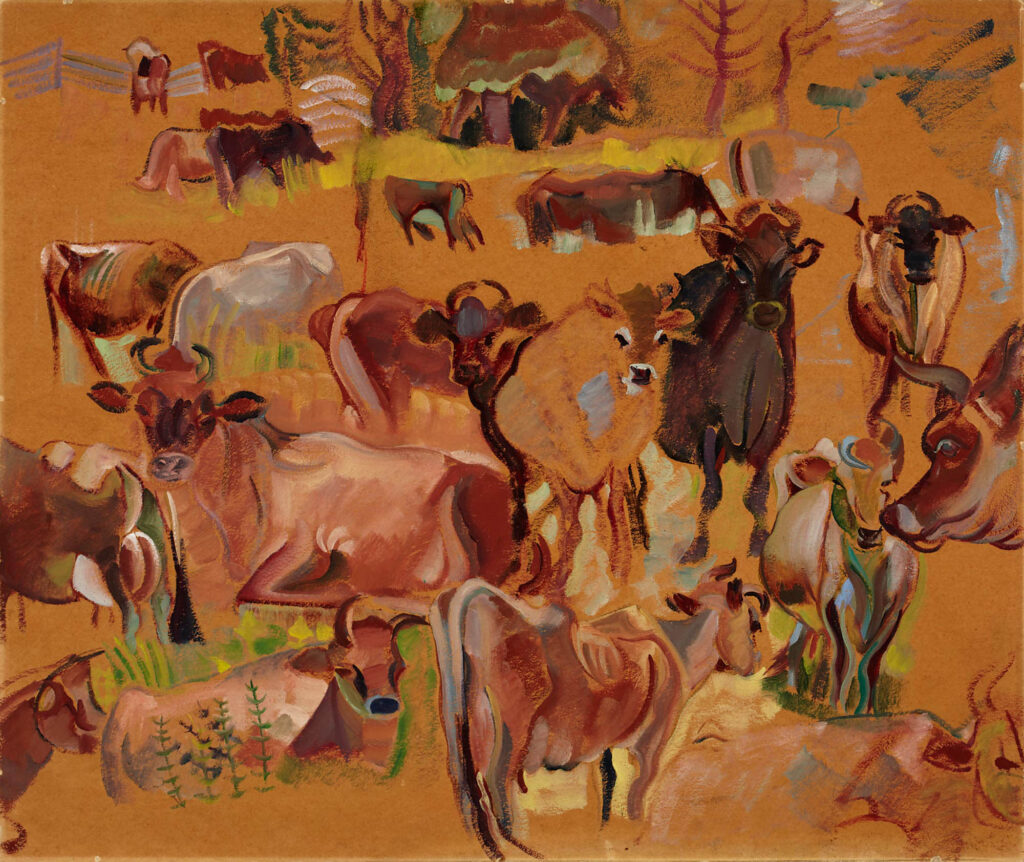
Pegi Nicol MacLeod, Tapisserie des vaches, 1934, oil on canvas, 60 x 71.4 cm, Robert McLaughlin Gallery, Oshawa.
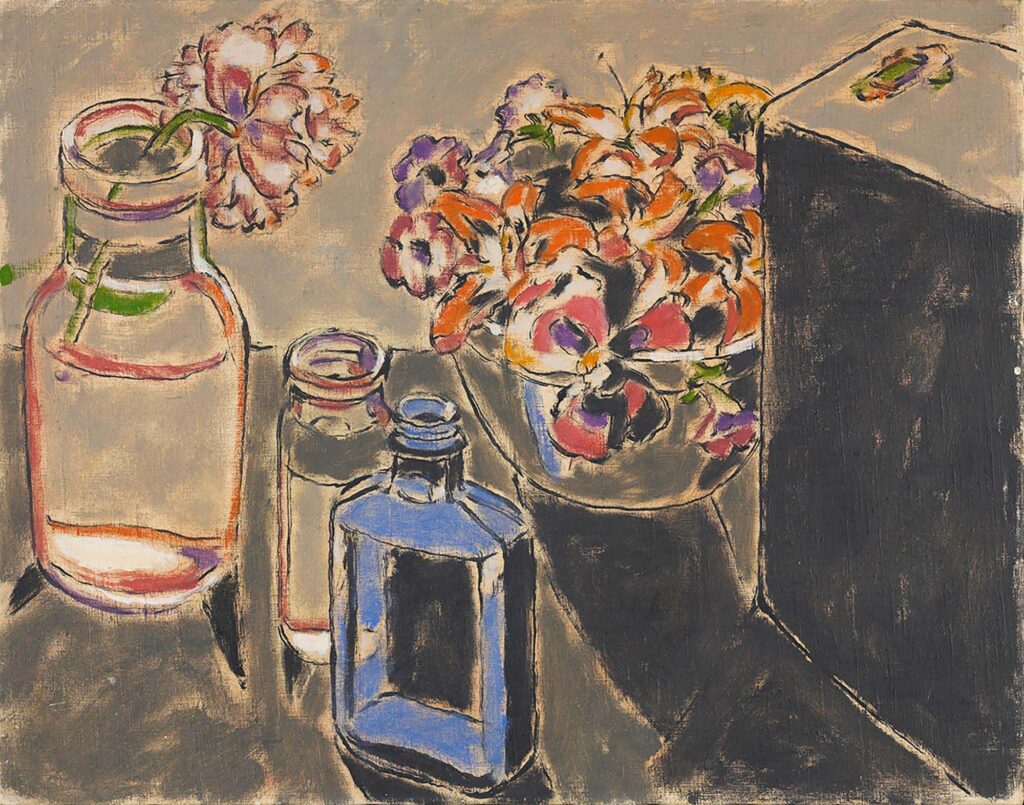
David Milne, Blue Bottle, 1931, oil over graphite on canvas, 56 x 71.5 cm, National Gallery of Canada, Ottawa.
Though she never took to Toronto as she did Montreal, Nicol secured work painting window displays for Eaton’s and designing sets for Hart House Theatre at the University of Toronto. She also participated in exhibitions with the Ontario Society of Artists and helped found the Picture Loan Society, which sought to make contemporary art more accessible to the public. The Depression began to let up somewhat in 1936, but the financial strain of the previous years had limited Nicol’s ability to devote herself entirely to painting, and purchases of her work were few. Her style continued to evolve, but her overall output and momentum slowed. Still, her work garnered increasing recognition.
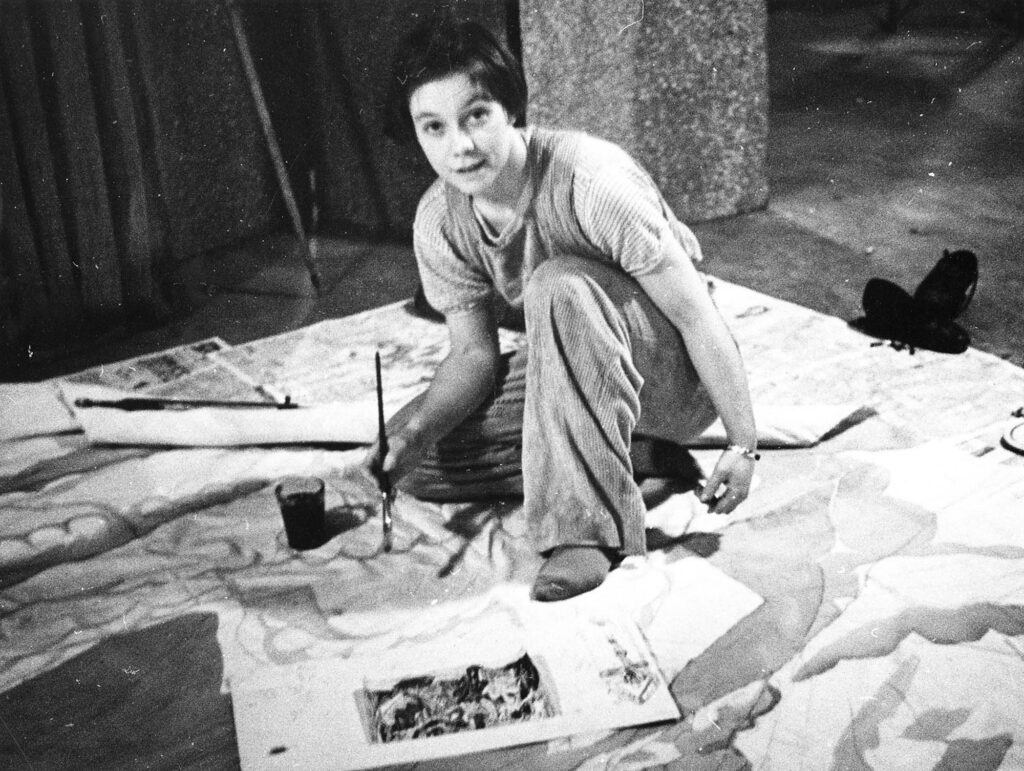
Pegi working on the set for The Piper at Hart House, University of Toronto, 1934, photograph by Allan Sangster, University of Toronto Archives.
In 1936, Nicol exhibited several pieces at the Canadian Society of Painters in Water Colour and the Art Gallery of Toronto, including Gardening Children, n.d., and possibly School in a Garden, c.1934. Writing in Saturday Night, friend and critic Graham McInnes praised her approach: “The chief feature of Miss Nicol’s painting apart from its colour is its immediacy and when her medium does not allow her to think or to feel twice, or to chop logic with herself and dissipate her strength, she produces excellent work.”
New York and Fredericton
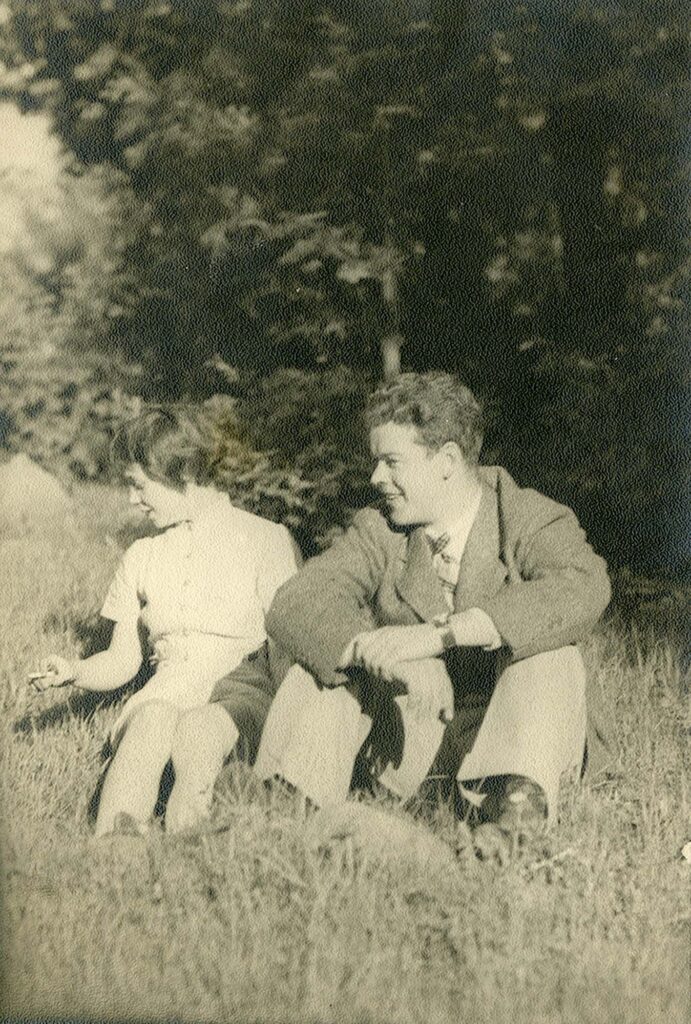
Pegi and Norman MacLeod, c.1936, photographer unknown, National Gallery of Canada Library and Archives, Ottawa.
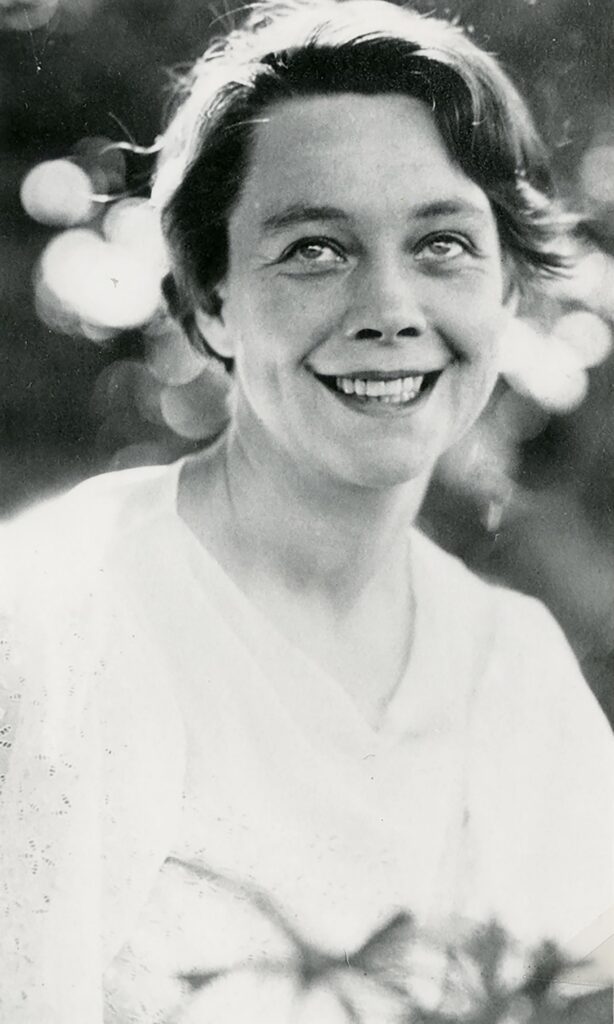
Pegi on her wedding day, 1936, photograph by Allan Sangster, National Gallery of Canada Library and Archives, Ottawa.
In the early 1930s, Nicol’s personal life was rocky. After ending her relationship with Richard Finnie, she had begun dating W.H. (Bill) Graham, whom she met at Eaton’s. During their time together, Nicol became pregnant and had an illegal abortion—an experience hinted at obliquely in letters she sent to Marian Scott and later confirmed by Scott.
In 1935, Nicol met Norman MacLeod, a young engineer from Fredericton, while sitting on a bench in Toronto’s Allan Gardens. Graham McInnes read their relationship as yin and yang: “This wayward teasing elfin creature married a great big wrestler of a man.... He calmed her by force.... This was widely regarded as the Taming of the Shrew. But no one could ever subdue her painting.” Some of their friends judged the two for living together without being married, but they tied the knot in December 1936, and Nicol’s parents even came from Ottawa for the wedding.
In 1937, the couple moved to New York City, where Norman hoped for better job prospects; he ultimately became vice president of an engineering firm. At the time of the move, Pegi Nicol (now MacLeod) was pregnant. She gave birth to their daughter, Jane, in December 1937. For the next decade, MacLeod struggled to juggle motherhood and her need to make art. Domestic responsibilities, financial instability, and Norman’s long work hours often left her feeling isolated. In 1938, she returned to Ottawa with Jane to stay with her parents—perhaps the first sign that things were not rock solid in the marriage. She remained there until late autumn, with short trips to Toronto, before moving with Norman to New Jersey.
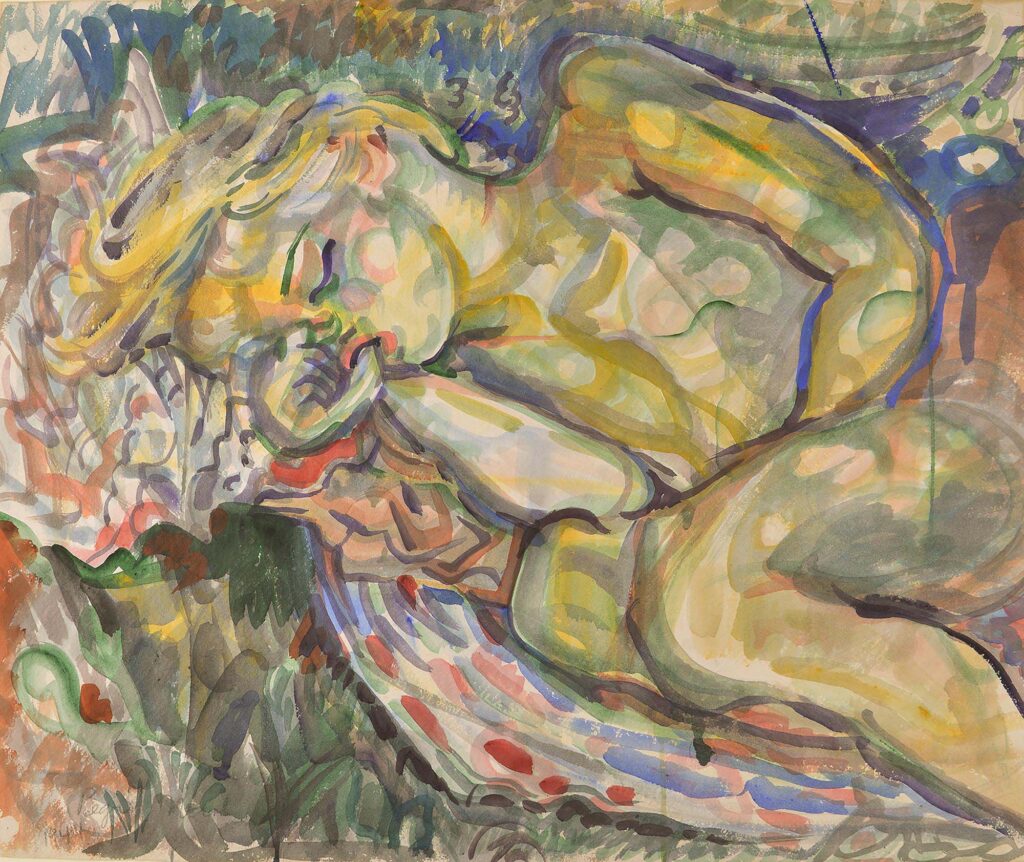
Pegi Nicol MacLeod, Jane Asleep, 1944, watercolour on paper, 48 x 57.6 cm, Art Gallery of Greater Victoria.
By September 1939, the family had settled into a new apartment in Greenwich Village, where MacLeod found inspiration and energy in Manhattan’s bustling street life. She began sketching what she saw from her apartment window—scenes that have been described as “dense chaotic patterns and rhythmic movement: children, her neighbours, soldiers returning from war. Her pictures bloomed with acidic primary colours and psychedelic vitality.”
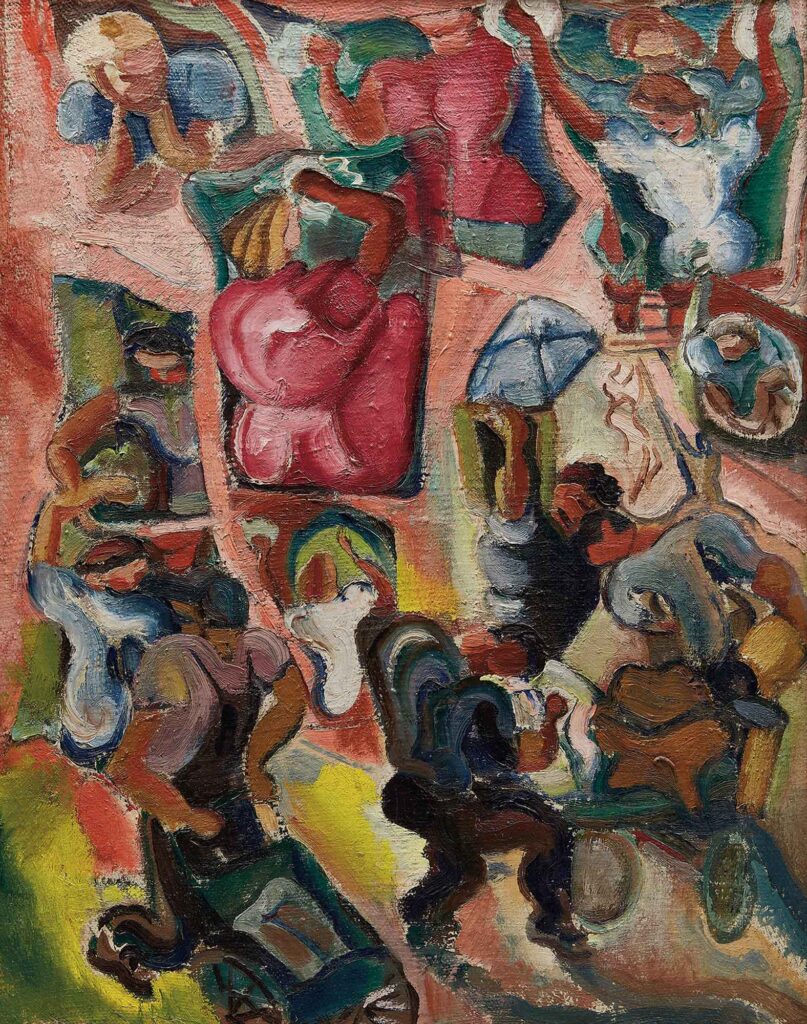
Pegi Nicol MacLeod, Building, Street Scene, New York, c.1940, oil on canvas, 61 x 48.3 cm, private collection.

Georgia O’Keeffe, New York Street with Moon, 1925, oil on canvas. 122 x 77 cm, Thyssen-Bornemisza Museo Nacional, Madrid.
In New York, MacLeod managed a demanding domestic routine while continuing to produce portraits, still lifes, and many striking paintings of her daughter, Jane—works that Laura Brandon describes as a remarkable series of diverse and intriguing interpretations, unique in Canadian art. Her artistic world in New York was also shaped by the city’s rich cultural life. She admired the realism of the Ashcan School and the precision of Georgia O’Keeffe (1887–1986), and she was excited by the photography of Man Ray (1890–1976), Charles Sheeler (1883–1965), Alfred Stieglitz (1864–1946), and Paul Strand (1890–1976). A regular visitor to film screenings at the Museum of Modern Art, MacLeod was inspired by the experimental edge of modern American art. Her neighbour, sculptor Winifred Lansing (b.1911–?), widened MacLeod’s circle further, introducing her to the work of émigré modernists like Marc Chagall (1887–1985), Max Ernst (1891–1976), Fernand Léger (1881–1955), Piet Mondrian (1872–1944), and Yves Tanguy (1900–1955).
MacLeod had several successes in this period. In 1938, she exhibited two works in an important exhibition at the Tate Gallery in London, including School in a Garden, which Vincent Massey bought for $175. In 1939, her painting Children in Pliofilm, 1939, inspired by Jane playing in a plastic rain cape, was selected for the Canadian Pavilion at the New York World’s Fair, and in the same year, she sold the watercolour Jarvis Street Sidewalk, c.1935–36, to the Art Gallery of Toronto. The National Gallery continued to help her in important ways: storing her work, circulating it to exhibitions, handling sales, and depositing the proceeds in her bank account.
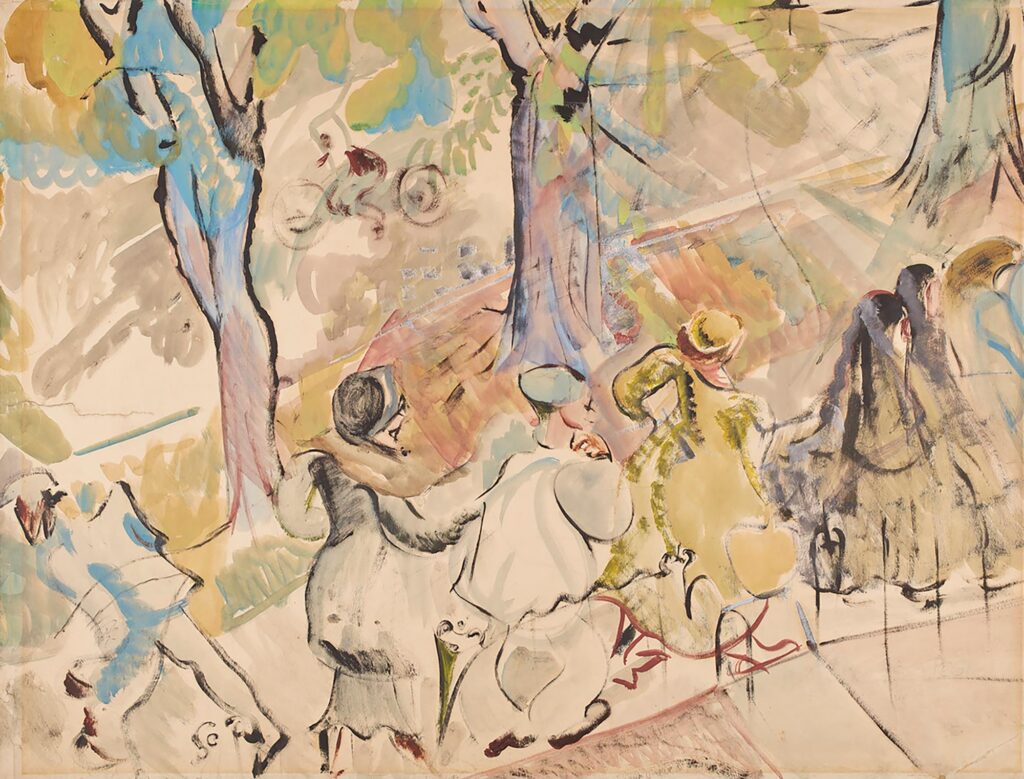
Pegi Nicol MacLeod, Jarvis Street Sidewalk, c.1935-36, watercolour, opaque watercolour, and coloured wax on paper, 59.1 × 77.8 cm, Art Gallery of Ontario, Toronto.
Although she returned briefly to Ottawa with Jane in the summer of 1940, New York was now MacLeod’s base. That year, the family settled into a small railroad apartment on the Upper East Side, where she set up her painting studio in the back room beside the kitchen. Though the space was cramped—friends joked about the proximity of paint pots to dinner pots—MacLeod made it work. The move brought new energy to her artmaking, and she continued painting actively in the city, inspired again by life outside her window. In a letter to her friend Madge Smith (1898–1974), a photographer, art dealer, and champion of regional artists who exhibited MacLeod’s work in New Brunswick, she wrote: “I am on the street every morning at eight attacking the flower carts with huge canvasses.”
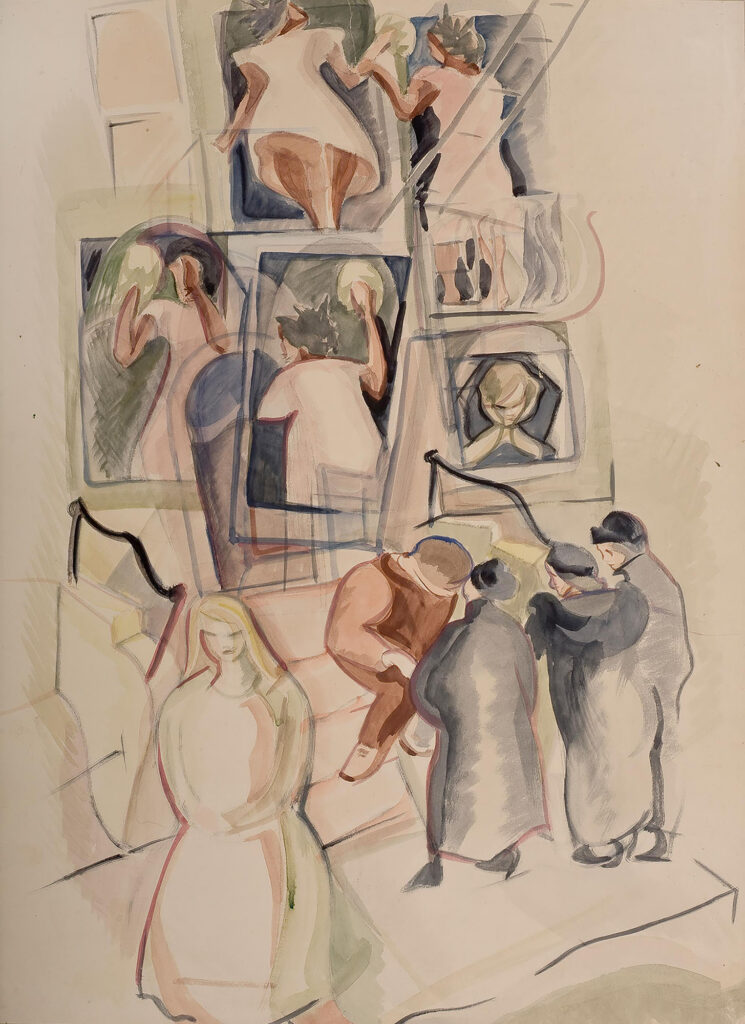
Pegi Nicol MacLeod, New York Street Scene—Tenement Folks Washing Up, n.d., watercolour and graphite, 76.4 x 55.8 cm, Art Museum at the University of Toronto.
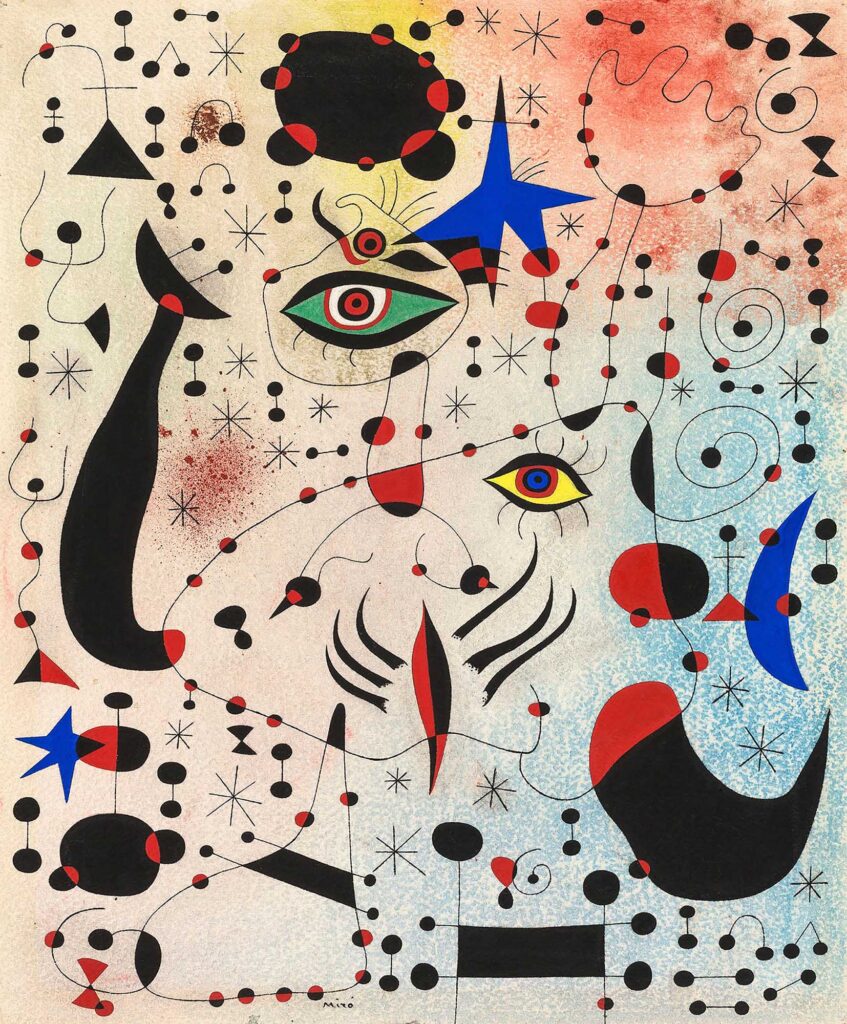
Joan Miró, Ciphers and Constellations, in Love with a Woman, 1941, opaque watercolour with watercolour washes on ivory, rough-textured wove paper, 45.9 x 38 cm, Art Institute of Chicago.
In late 1941, New York’s streets were animated by the excitement of the Christmas season, but the attack on Pearl Harbor and the United States’ entry into the Second World War quickly transformed the mood of the city. MacLeod painted scenes of street vendors, holiday markets, children playing, and soldiers parading—capturing the resilience and pulse of wartime in the city. Her paintings from this period are tightly framed and full of kinetic lines and swirling colour, reflecting the immediate energy and claustrophobia of city life. As art historian Donald Buchanan observed after her death, “It was, as she stated, that once a line was put down it possessed an expressive reality in itself, and should never be changed.... This was part and parcel of the quality of spontaneity which was most typical of her, both as a human being and as a painter.”
Throughout this period, MacLeod remained active on multiple fronts: she exhibited in a group show at the Art Gallery of Toronto, contributed to the Brooklyn Museum’s Eleventh Biennial of Watercolor Painting in 1941, and started an application for a Guggenheim Fellowship, a prestigious award providing both financial assistance and formal recognition of talent to mid-career artists. Although she was disconnected from the New York avant-garde, she remained committed to her figurative vision. After visiting an exhibition of works by Joan Miró (1893–1983), she confessed: “My approach is old fashioned.... The Miro’s [sic] aren’t all perfect, but there is something about their daring that makes me feel staid and dull.”
In 1940, MacLeod took Jane to stay with Norman’s mother in Fredericton, New Brunswick, a place she would return to often. She immediately fell in love with the city’s historic charm and burgeoning arts scene. After she connected with local artist and teacher Lucy Jarvis and Margaret MacKenzie, the wife of University of New Brunswick (UNB) President Norman MacKenzie, the three worked to transform the UNB Observatory into an art centre, affectionately nicknamed the Fiddlehead Observatory. With support from H.O. McCurry, who had succeeded Eric Brown as the director of the National Gallery, MacLeod obtained slides and prints for teaching summer classes at the newly established UNB Art Centre. Between 1940 and 1948, MacLeod conducted lively art classes that emphasized speed, vivid colour, and direct observation, while encouraging students to develop their own modes of expression rather than adhere to rigid technique.
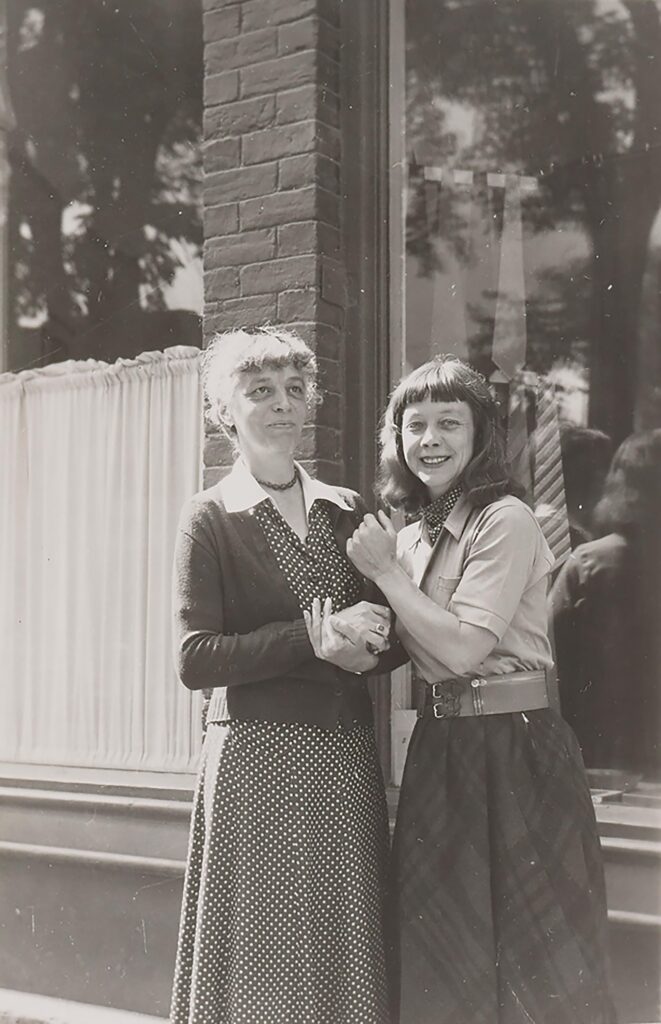
Madge Smith and Pegi Nicol MacLeod in front of Madge’s shop, Fredericton, n.d., photographer unknown, National Gallery of Canada Library and Archives, Ottawa.
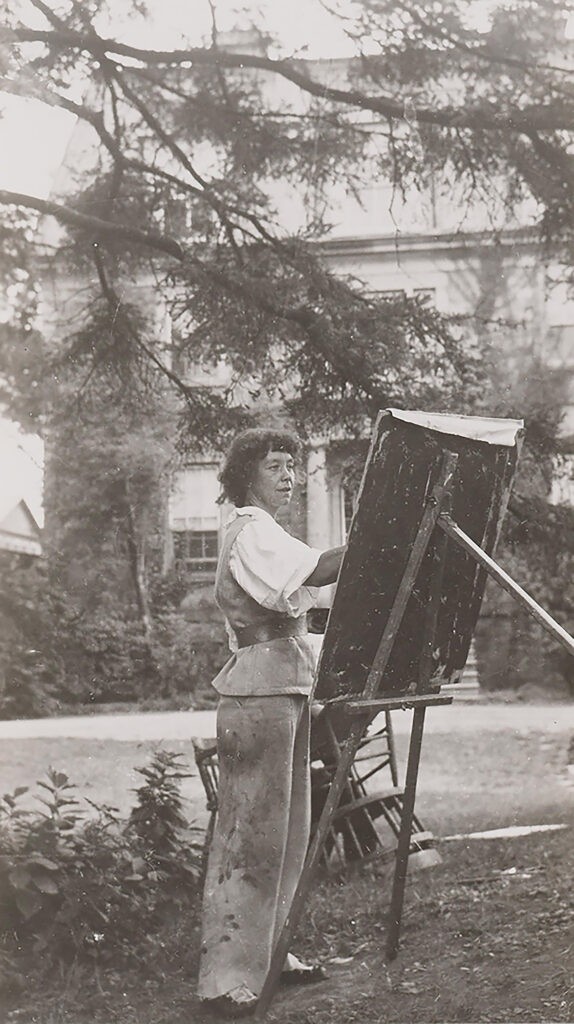
Pegi Nicol MacLeod at the Observatory, University of New Brunswick, Fredericton, n.d., photograph by Madge Smith, National Gallery of Canada Library and Archives, Ottawa.
Being in Fredericton in the summers was supposed to be a break from the hubbub of New York for MacLeod, but teaching at the art centre gradually wore on her. In a letter to Madge Smith from 1945, she admitted, “Secret between you and me! Judging by the fearful result on my health... I don’t think I shall teach next year.” By the mid 1940s, the early signs of fatigue and underlying illness—later diagnosed as cancer—were already appearing.
Painting War
As the Second World War raged in the background, MacLeod was firmly settled in New York, even as she maintained strong connections to the Canadian art world for the remainder of her life. In 1941, she travelled to Kingston to attend the landmark Conference of Canadian Artists at Queen’s University. Organized by her friend and colleague André Biéler (1896–1989)—with support from Queen’s, the National Gallery of Canada, and the Carnegie Corporation of New York—this conference marked the first time Canadian artists, critics, curators, and collectors had met to focus on two central issues: recent technical developments in artistic production and the role of the artist in society.
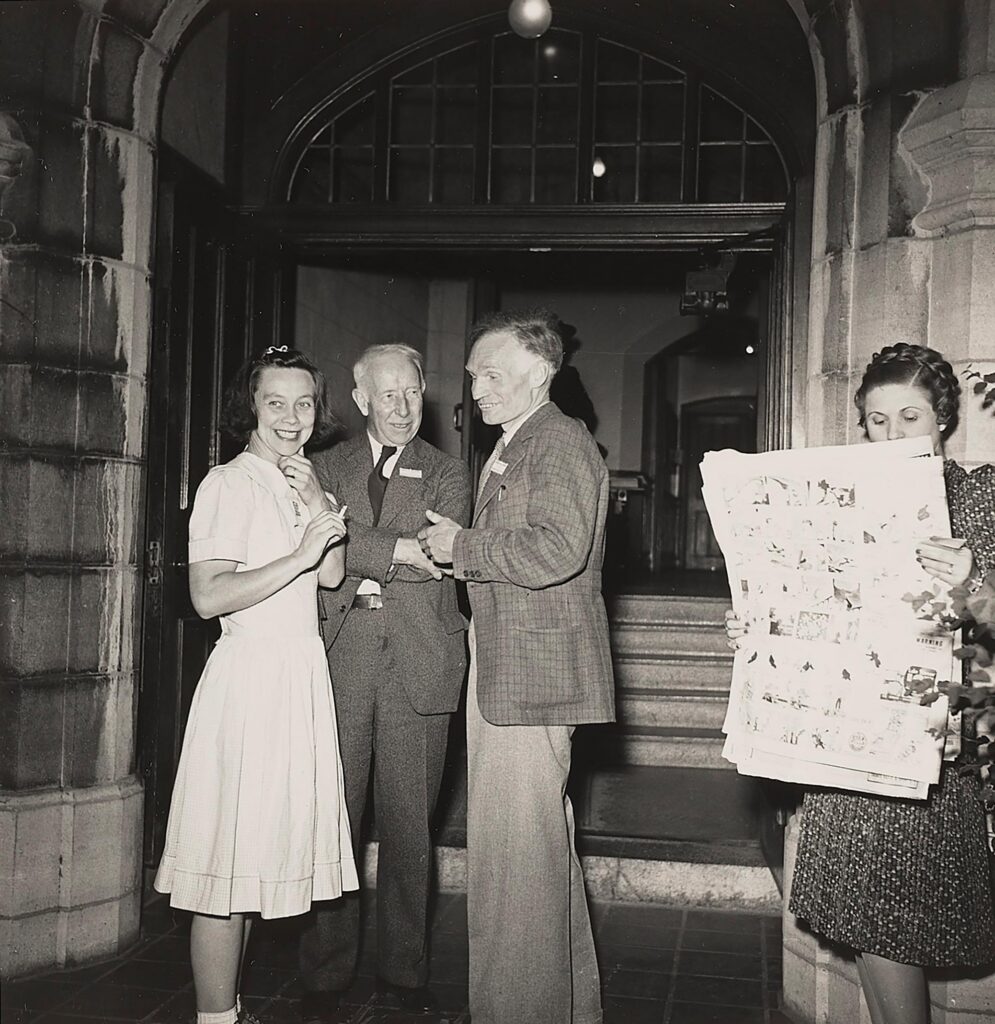
At the Kingston Conference (left to right: Pegi Nicol MacLeod, A.Y. Jackson, André Biéler), 1941, photograph by Hazen Sise, Library and Archives Canada, Ottawa.
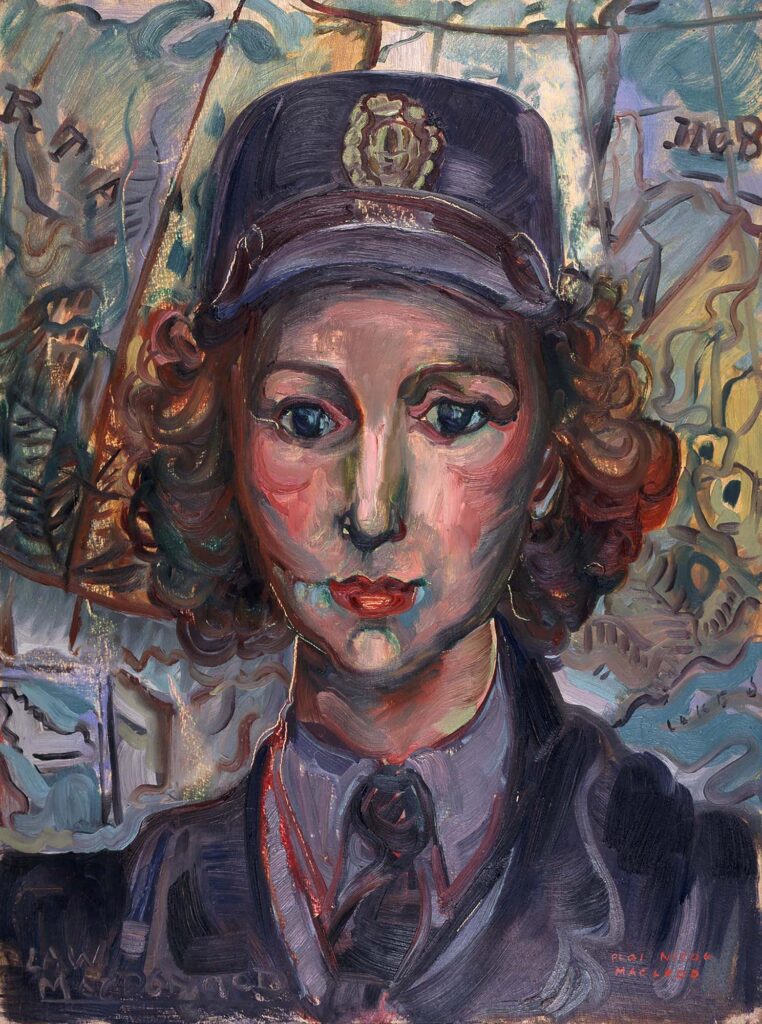
Pegi Nicol MacLeod, L.A.W. MacDonald, 1944, oil on plywood, 60.4 x 45.4 cm, Canadian War Museum, Ottawa.
The Kingston Conference, as it is commonly known, had lasting institutional consequences, contributing to the formation of the Federation of Canadian Artists (the country’s first national arts organization) and, later, the Royal Commission on National Development in the Arts, Letters and Sciences (known as the Massey Commission). As painter Lawren S. Harris (1885–1970) later reflected, “It is significant that the Federation was born in the early years of World War II, when people were beginning to realize that war not only meant a struggle for existence but also an urgent search for a new pattern of living.” More immediately for MacLeod, the conference’s debates about the artist’s civic responsibility in a time of war resonated deeply. As the conflict intensified, she confronted these questions directly, turning to painting to register the lived realities of wartime.
When the Second World War broke out, however, MacLeod initially grappled with how to respond artistically. She struggled with official calls to create patriotic imagery, writing to Marian Scott in 1943: “I’m sure it is a struggle for every painter to paint ‘Canada at War’. I have turned myself inside out.... I’m just not equipped.... What we want to say about Canada now is that we don’t want war at all.... When I sent all those [paintings of Jane]... to Toronto three years ago... nobody got it and I felt I was a terrible propagandist.”

Alex Colville, Landing Craft Assault Off Southern France, 1944, oil on canvas, 101.4 x 76 cm, Canadian War Museum, Ottawa.
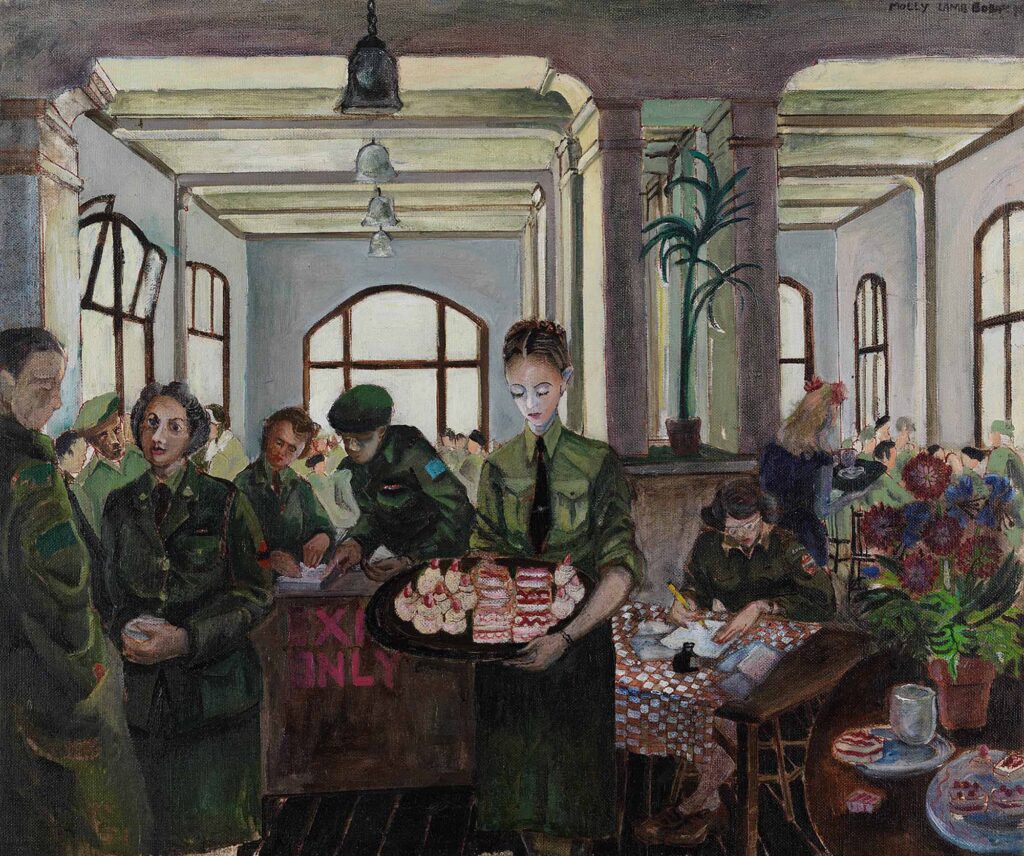
Molly Lamb Bobak, Canteen, Nijmegen, Holland, 1945, oil and ink on canvas, 51.2 x 61.1 cm, Canadian War Museum, Ottawa.
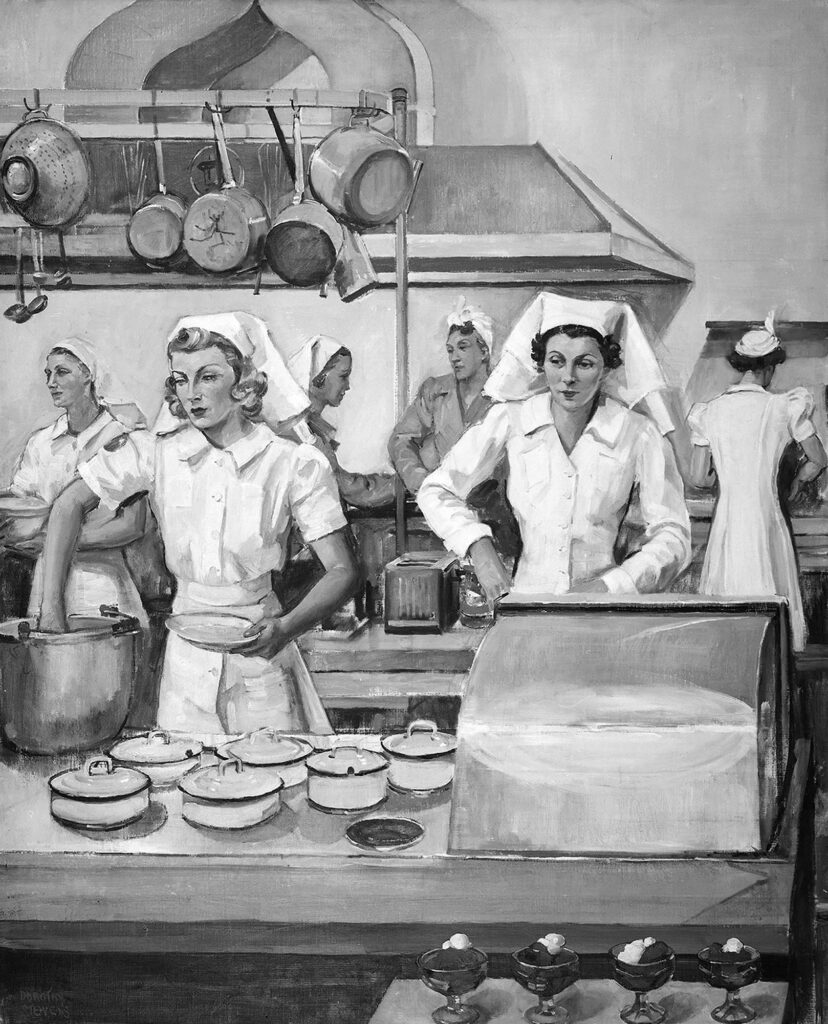
Dorothy Stevens, My Day at the Canteen, c.1942, oil on canvas, 96.8 x 78.9 cm, Library and Archives Canada, Ottawa.
Canada’s second official war art program, overseen by the Department of National Defence, began in 1942 and employed artists serving in the armed forces, including Will Ogilvie, Charles Comfort (1900–1994), Alex Colville (1920–2013), and Molly Lamb Bobak (1920–2014). For these artists, capturing the complexity of a global conflict that was unfolding across multiple fronts, often involving modern mechanized warfare, was a real challenge. MacLeod, by contrast, was not in uniform; she received a civilian commission from the National Gallery of Canada to depict the daily experiences of women serving in the Canadian Women’s Army Corps (CWAC). These paintings remain some of her most important contributions to Canadian art history.
Established in 1941, the CWAC marked the first time women were called to serve in the Canadian Armed Forces. Of the fifty thousand women who enlisted, over half served in the army, while the others served in non-combat roles as clerks, drivers, mechanics, and signal operators. At the time, official war art programs primarily focused on combat and military operations overseas, leaving the experiences of Canadian servicewomen largely overlooked.
Recognizing this gap, National Gallery director H.O. McCurry sought to ensure that the contributions of the CWAC were visually represented. In 1944, he wrote to MacLeod: “Now here is what I would like to suggest about the CWACs, Women’s Division, RCAF and possibly the Wrens [Women’s Royal Canadian Naval Service (WRCNS)]; no one has done anything about them yet and the service people in authority do not seem to be greatly interested but the fact is that war records would be most incomplete without some vital stuff on the women’s part in the three services.”
McCurry commissioned MacLeod to document the work of the CWAC and paid her a $300 monthly honorarium plus supplies. Delighted by the offer, she went on to produce over a hundred oil and watercolour paintings of wartime subjects. Rather than glorifying military life in her war paintings, MacLeod revealed its everyday humanity—moments of fatigue, camaraderie, and small pleasures—through scenes of women in beauty parlours or resting after long shifts.
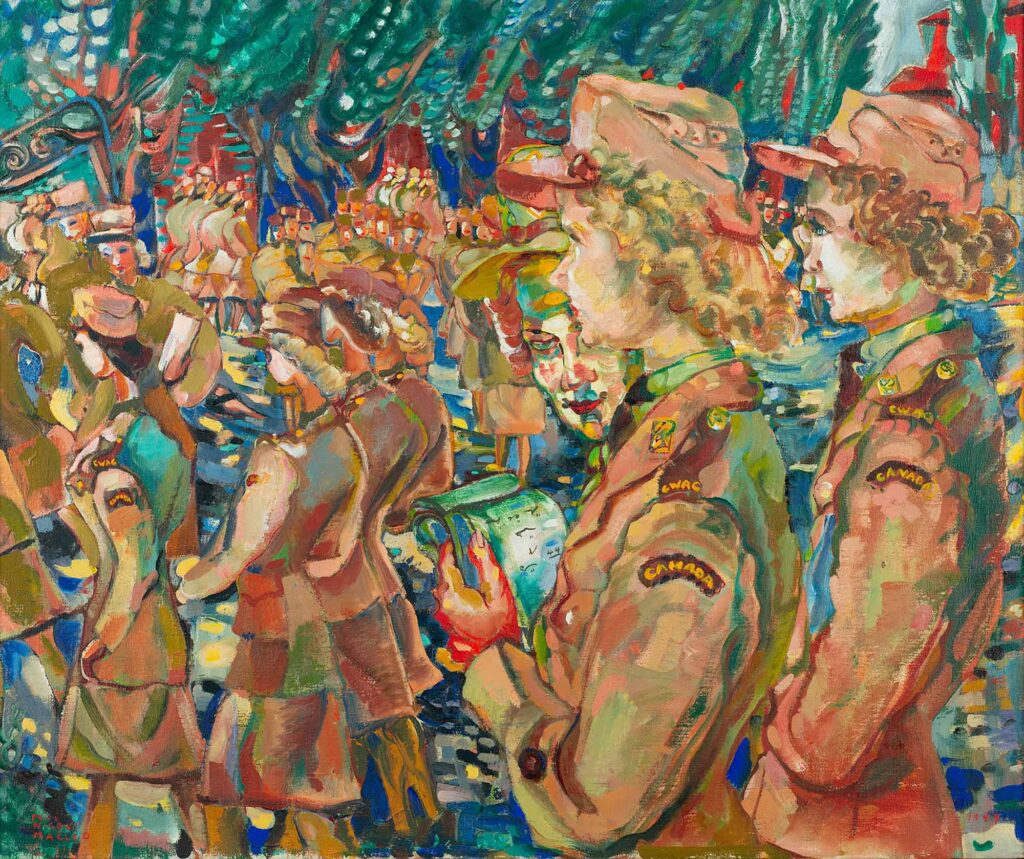
Pegi Nicol MacLeod, Morning Parade, 1944, oil on canvas, 76.5 x 91.8 cm, Canadian War Museum, Ottawa.

Pegi Nicol MacLeod, Bunks, 1944, watercolour, 44.5 x 29.2 cm, private collection.
Her CWAC paintings are rare visual testaments to the gendered dimensions of war work, offering a counter-narrative to the masculine heroic imagery that dominated wartime art. Between 1944 and 1945, MacLeod documented women working in various capacities, recognizing their service as an essential part of the war effort. She enjoyed this work, writing to Madge Smith, “My work, more than fun. Operating on Wrens now, dear little things!!”
One of the most compelling pieces in MacLeod’s commission is Morning Parade, 1944, a vivid depiction of uniformed women drilling in formation. With staccato brushwork in the background, Cubist-inspired elements in the women’s clothing, and the expressive use of colour and line, the painting conveys the rhythmic motion of the women marching in unison, their bodies dissolving into near abstraction. Amid the figures in their matching skirts, one woman turns her head to meet the viewer directly—a moment that captures both individual wartime participation and the collective spirit of military life. Among MacLeod’s other war works are L.A.W. Macdonald, Salmon in the Galley, CWAC Beauty Parlour #1, and Bunks—all 1944. These four pieces portray women serving on the home front. In Bunks, MacLeod captures the intimacy of women’s shared quarters using fluid lines and washes of red, pink, and green to convey the bustle and camaraderie of everyday military life.
While in New York, MacLeod also continued to explore self-portraiture. One of her last major works in this vein was Self-Portrait with Jane, c.1939, an intimate painting that introduces her daughter to the world, and a work that was reused in 1944 as a Christmas card. Both Jane and the mother-and-child motif reappear in The Peace Bird, c.1946, which is reminiscent of the work of Marc Chagall and, like Self-Portrait with Jane, frames MacLeod’s wartime experience through themes of motherhood and peace.
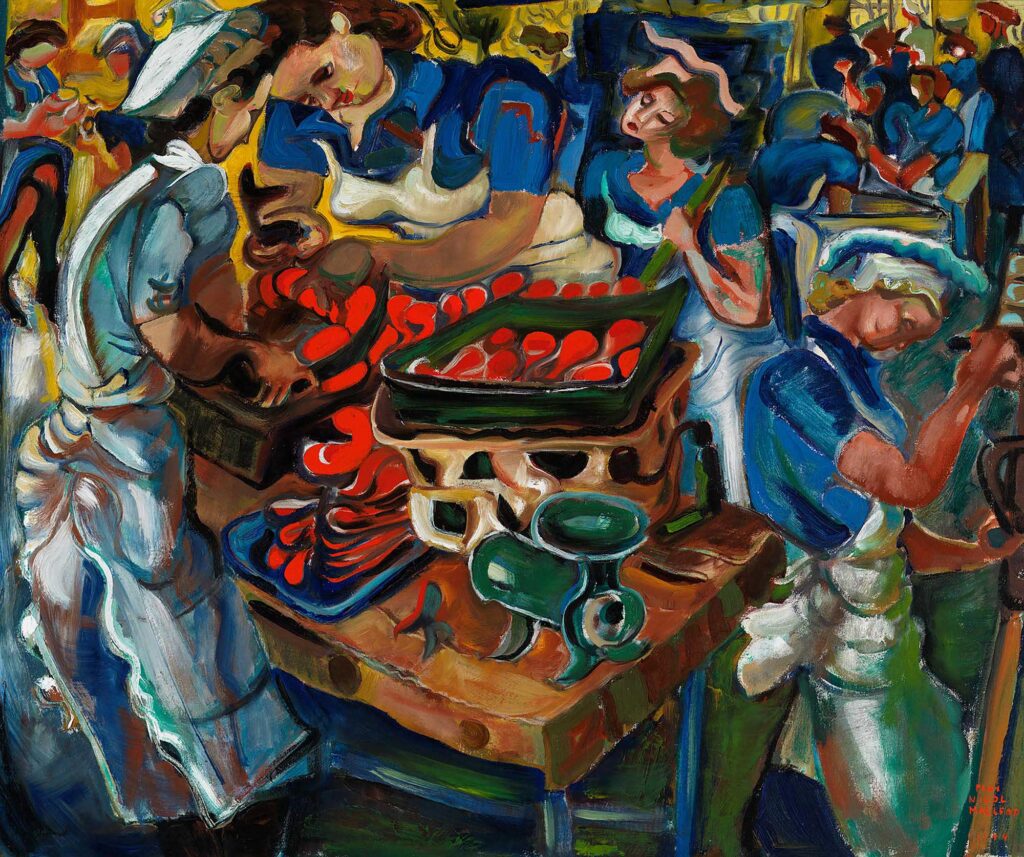
Pegi Nicol MacLeod, Salmon in the Galley, 1944, oil on canvas, 76.2 x 91.7 cm, Canadian War Museum, Ottawa.
The Manhattan Cycle
Throughout the 1940s, MacLeod painted almost daily, producing more than a hundred watercolours and oils. From her Manhattan apartment, she captured the bustling energy of the metropolis, including parades, children playing, and signs of war efforts on the home front. Unlike her commissioned CWAC paintings, which focused on uniformed women in Canada, her New York work often depicted the war’s impact on civilians, particularly women and children.
MacLeod dreamed of shaping her impressions into a major series she called the Manhattan Cycle. In her 1942 Guggenheim Fellowship application, she proposed “an unencumbered year of day in day out painting of New York City subjects... the push-carts, the ice-man, the flower wagon, the open markets, and the hand-ball games.” Though she didn’t win the fellowship, she pursued the project anyway, and by late 1945, she had produced over 110 works focusing on Manhattan’s everyday life: crowded streets, parades, stoop-sitters, and market scenes. In a letter to Marian Scott, MacLeod described working feverishly: “My project is mostly 88th Street, Manhattan. I’ve been involved with this block now six years and still find it fascinating.”
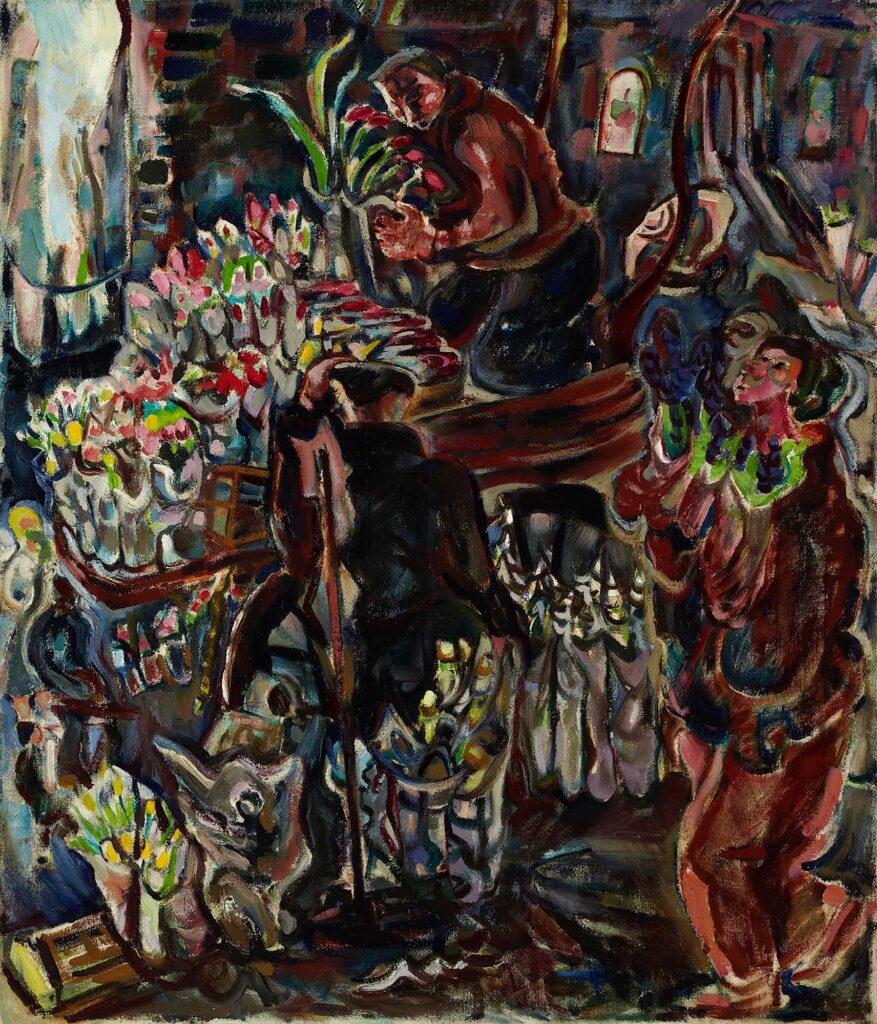
Pegi Nicol MacLeod, Flower Cart, c.1945, oil on canvas, 84.1 x 71.4 cm, Robert McLaughlin Gallery, Oshawa.
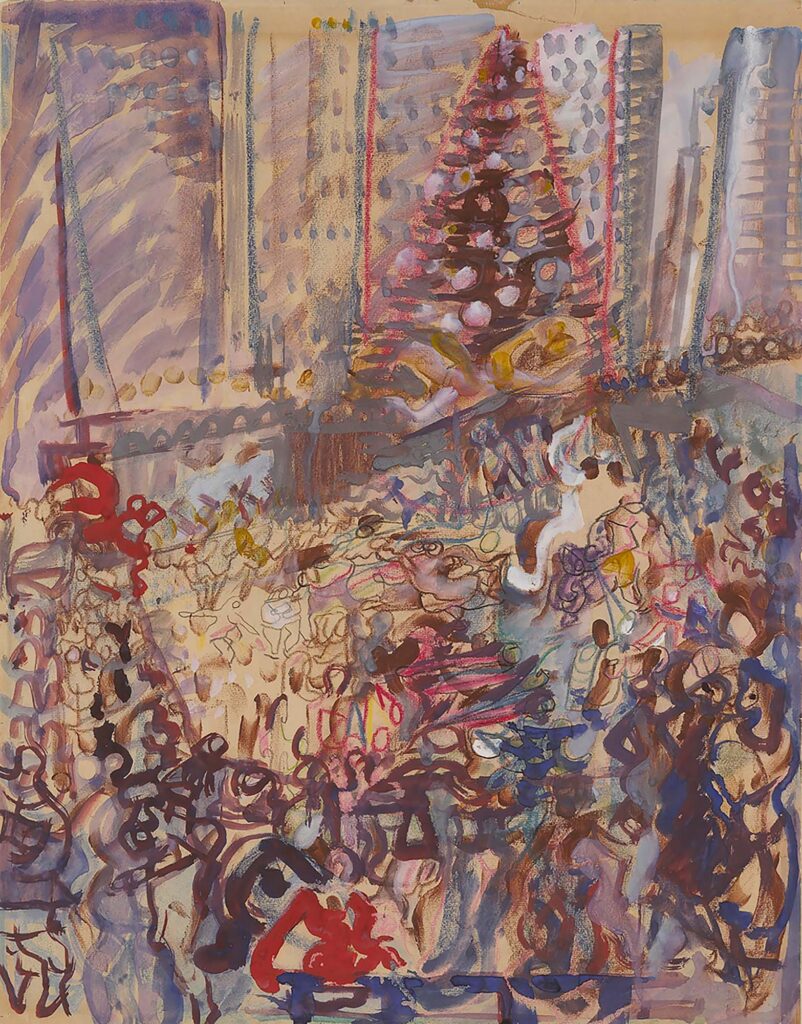
Pegi Nicol MacLeod, Christmas Tree and Skaters, Rockefeller Plaza, 1946, watercolour over graphite on laid paper, 61 x 47.8 cm, National Gallery of Canada, Ottawa.
The works in the Manhattan Cycle—like The Slum Book, n.d., and Christmas Tree and Skaters, Rockefeller Plaza, 1946—evoke the density and rhythm of city life with swirling lines and bright colours. These paintings reveal both MacLeod’s love for New York’s chaotic energy and her growing sense of constraint as she struggled to carve out a place for herself in the city’s competitive art world.
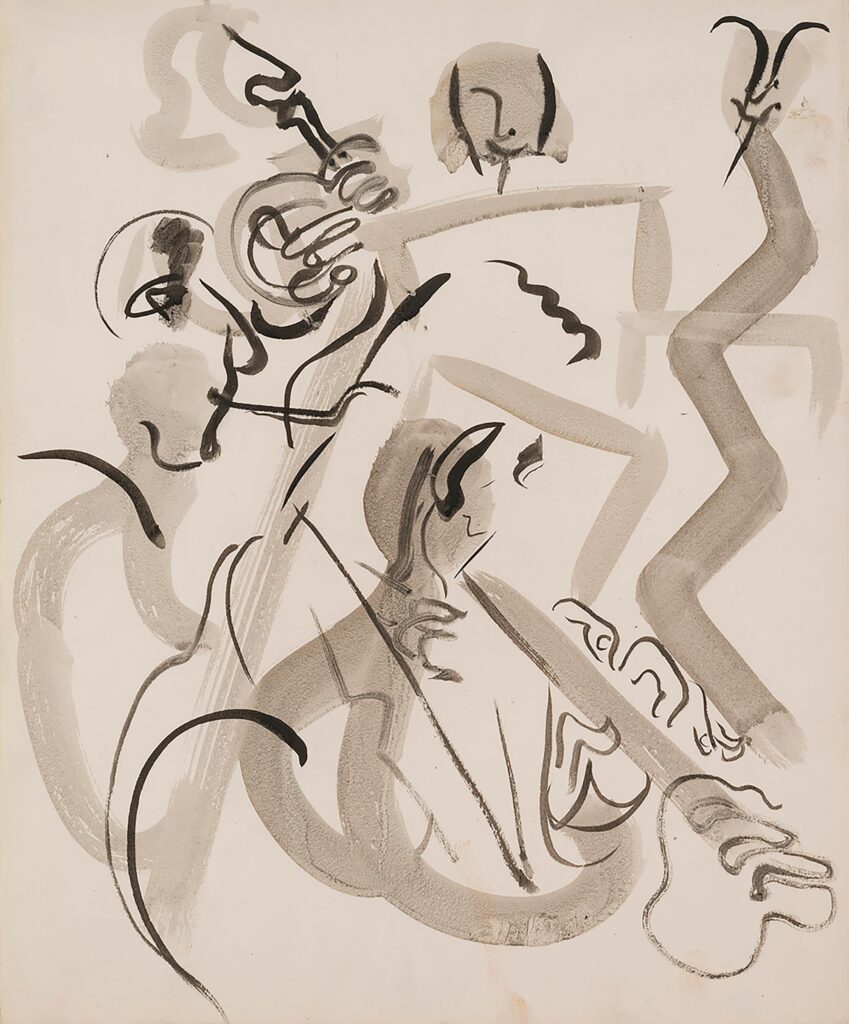
Pegi Nicol MacLeod, Orchestra Sketch II, c.1948, watercolour on wove paper, 42.6 x 34.9 cm, National Gallery of Canada, Ottawa.
By the end of the war, MacLeod had established a professional reputation in Canada, with exhibitions in Montreal, Toronto, and Wolfville, Nova Scotia, and her work was frequently praised for its rich use of colour and strong design. Despite doubts about her own abilities, MacLeod remained committed to her practice and continued to find acclaim, mostly in Canada. Friends such as Madge Smith, H.O. McCurry, and Helen Beals—a student of MacLeod’s and assistant editor of Maritime Art—helped keep her work visible, though MacLeod struggled to translate that success into wider acceptance in New York.
She channelled her frustration by pouring her energy into the Manhattan Cycle, which culminated in a celebrated 1947 exhibition that premiered at Eaton’s in Toronto, moved on to Ottawa and Fredericton, and then toured Western Canada the following year. The show included major works such as Orchestra Sketch II, c.1948; a selection from her 88th Street series; and acclaimed canvases like When Johnnie Comes Marching Home, c.1946, and The Peace Bird. Critics praised her fluid brushwork and her ability to capture the human drama of urban life. For many, the exhibition confirmed her as one of Canada’s most vital painters of modern subjects.
Although the Manhattan Cycle marked the peak of MacLeod’s career—she relished the praise and the positive reviews—it also marked its end. The demands of touring and selling her work increasingly pulled her away from painting, making the cycle her final sustained body of large-scale, fully realized work.
A Life Cut Short
After the success of the Manhattan Cycle, MacLeod’s health began to decline rapidly, and she died in New York City in 1949 after an eight-month illness. She was just forty-five. In the beginning, doctors didn’t tell her that she had cancer (only her husband, Norman, knew), and she tried to remain optimistic, writing letters full of cheer and even painting from her sickbed. In early 1949, she described herself in a letter to her friend Mary Greey propped up on pillows with brushes in hand, determined to keep working and insisting she would soon be well. Friends who visited her in those last weeks were struck by the vitality she continued to project despite her pain.
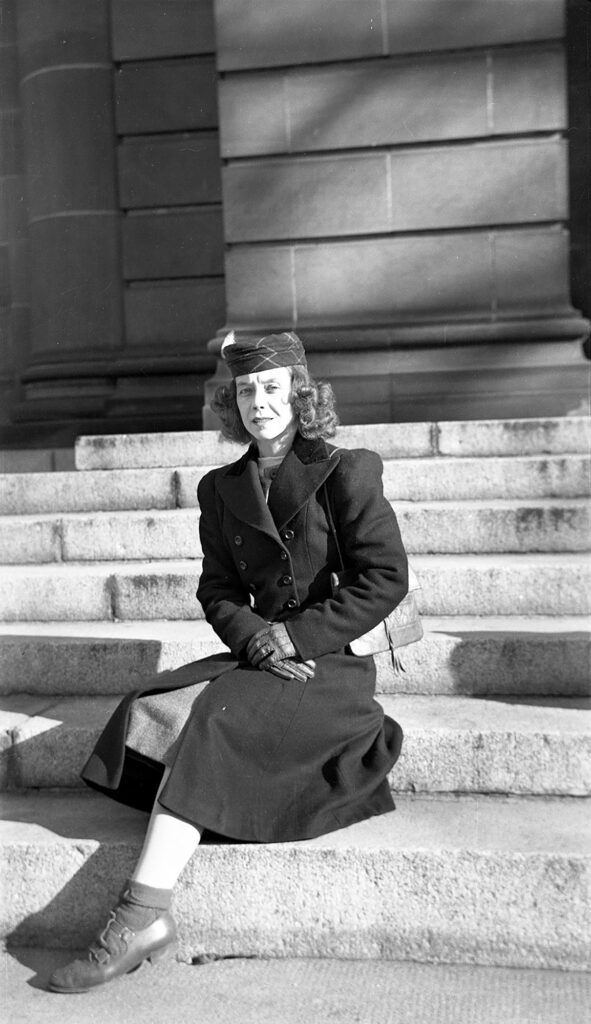
Pegi Nicol MacLeod, c.1940, photographer unknown, Provincial Archives of New Brunswick, Fredericton.
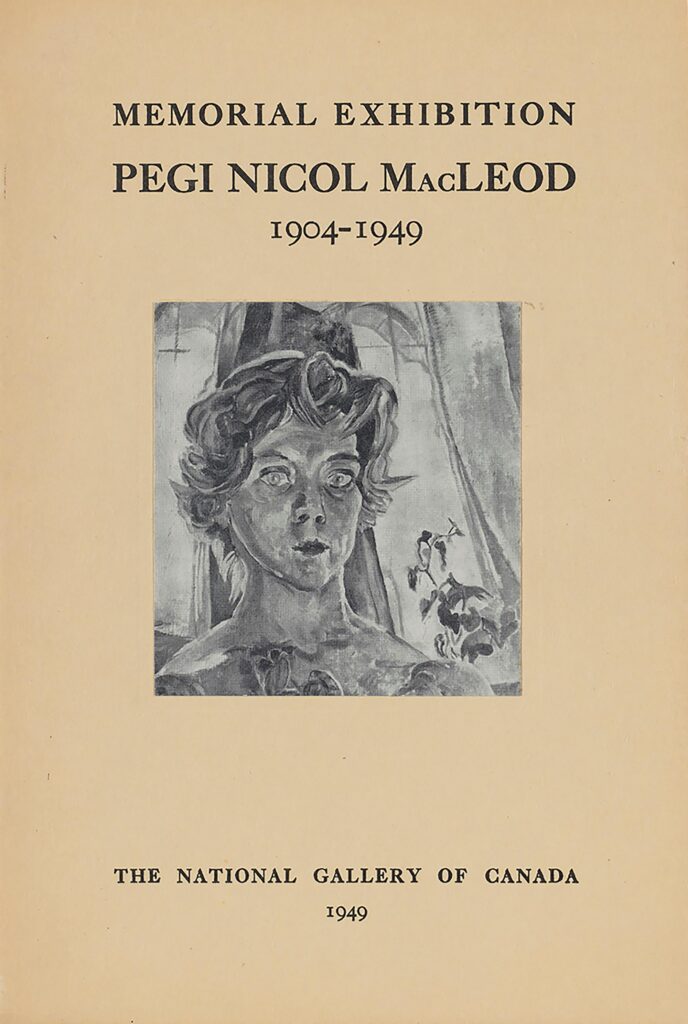
Cover of Pegi Nicol MacLeod 1904–1949: Memorial Exhibition, National Gallery of Canada Library and Archives, Ottawa.
On the evening of February 11, 1949, Norman remained at Pegi’s side until she drifted off to sleep. She didn’t wake up again. The next morning, he sent a brief telegram to Madge Smith: “Pegi died at seven this morning. Please inform friends and press.” Writing of her death in The Ottawa Citizen, Graham McInnes paid her the following tribute:
Her painting was simple, gay and direct. It caught life on the wing, arresting for a moment in vivid pattern its shifting kaleidoscope. Those figures that she set down so freely remain as light as the touch of a snowflake, and as deft as a weaver’s shuttle. She found people—plain people—fascinating, and in painting them in a thousand gay and accidental groupings, she poured out her almost inexhaustible vitality. It is a cruel irony that she who, for so many of those who knew her, personified the ageless spirit of enthusiasm and enquiry, should herself have been cut down in her prime. All one can say is that her paintings—of Ottawa, Toronto, the Gatineau, the North Shore, Manhattan—with their extraordinary brightness, their unforced gaiety and their often-undisciplined exuberance, remain behind her to lighten a world shadowed by her passing, and to add to the achievement of Canadian painting.
The memorial exhibition held in her honour at the National Gallery of Canada in late 1949 was a testament to her influence; its list of lenders includes Senator Norman Lambert, industrialist F.G. Garbutt, Vincent Massey, Donald Buchanan, Eric Brown, Duncan Campbell Scott, and painter Paraskeva Clark—a veritable who’s who of Canada’s cultural elite. In her lifetime, MacLeod was championed by Eric Brown and numerous other curators, art collectors, and patrons, but as time wore on, her reputation faded.
Still, despite her short life, Pegi Nicol MacLeod has left an enduring legacy in Canadian art. As her friend and former colleague René Cera reflected, years after her death, “If I remember her with warmth; it is because of her intense personality as a private Artist who had a perpetual love affair with her own work just for the sake of it.”
Pegi Nicol MacLeod in Madge Smith’s shop on Queen Street, Fredericton, 1945, photograph by Madge Smith, National Gallery of Canada Library and Archives, Ottawa.