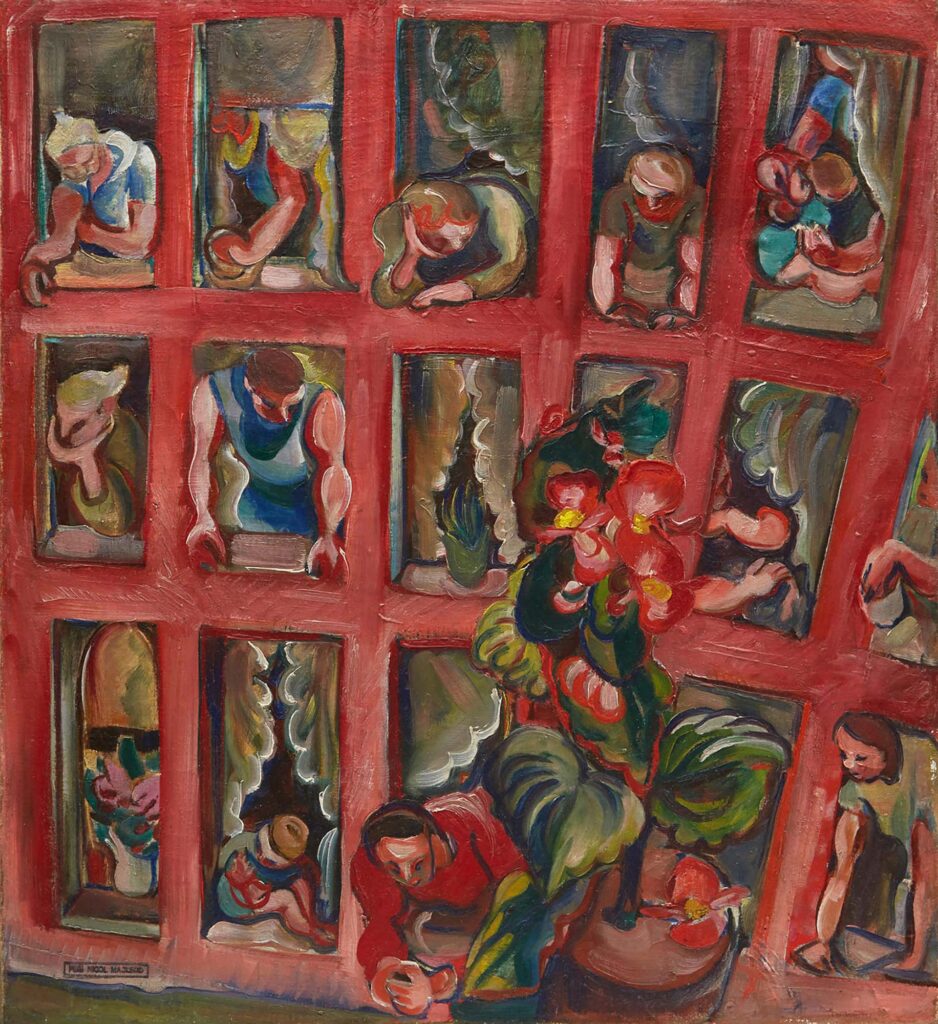
Pegi Nicol MacLeod shaped a vision rooted in everyday life, social conscience, and self-reflection. Restless in spirit and endlessly experimental, she moved fluidly between portraiture, social realism, and modernist expression. From her 1920s portraits of Indigenous sitters in Alberta and British Columbia to her 1940s depictions of urban life and wartime women, she explored how art might respond to the social world around her. And her self-portraits and nudes confronted the tensions between artistic authorship, gender, and domestic life. Her work remains a vital record of twentieth-century modern artistic and social transformation in Canada.
Venturing Out West
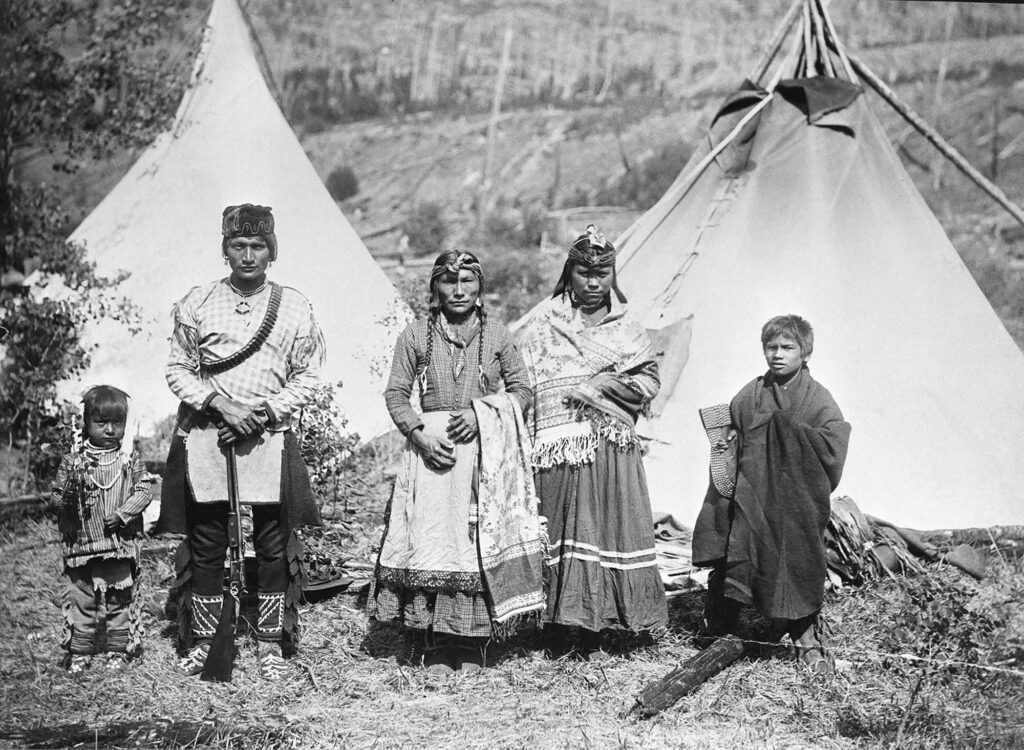
Amos Big Stoney and family from Stoney reserve, Alberta, 1889, Glenbow Archives, Calgary.
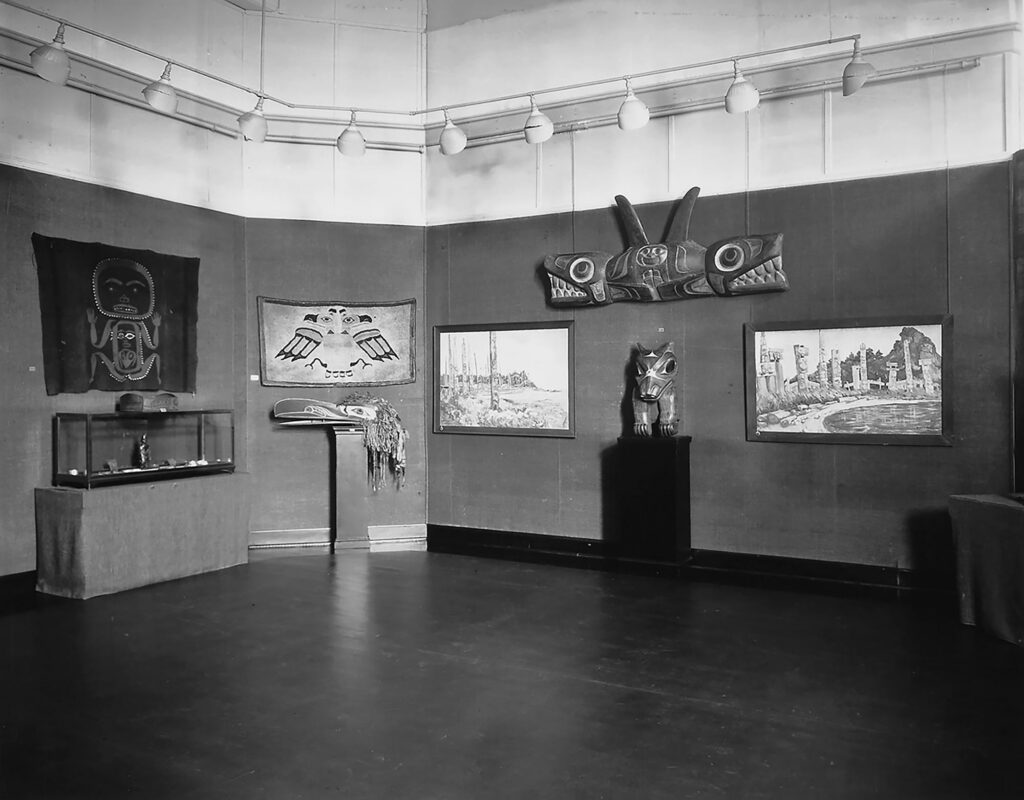
Installation view of Exhibition of Canadian West Coast Art: Native and Modern, National Gallery of Canada, 1927, National Gallery of Canada Library and Archives, Ottawa.
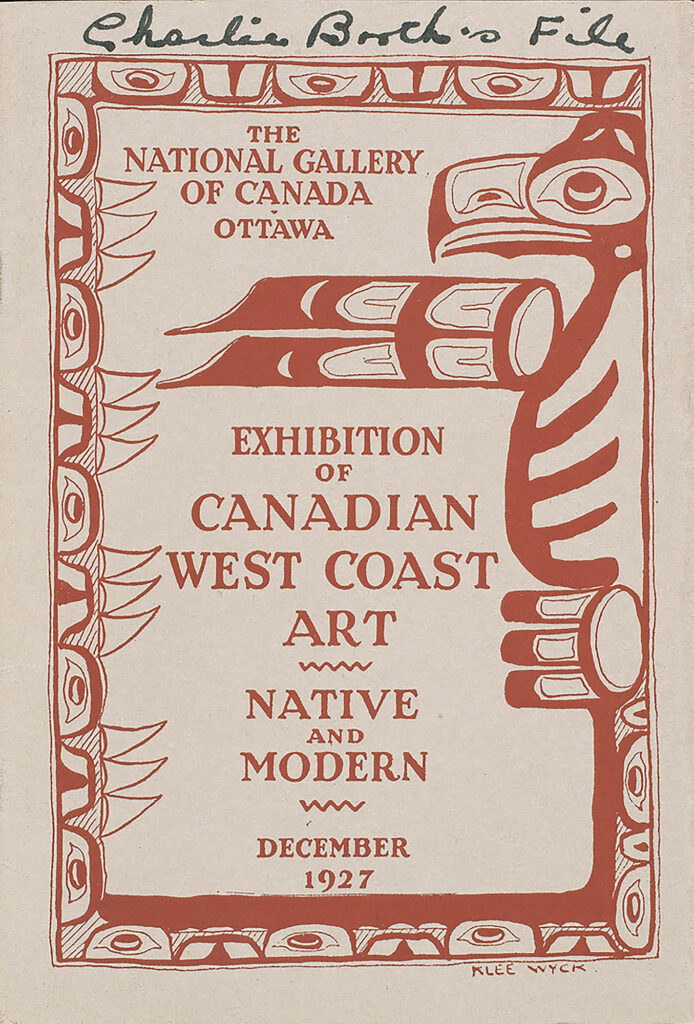
Cover of Exhibition of Canadian West Coast Art: Native and Modern (National Gallery of Canada, 1927), National Gallery of Canada Library and Archives.
Although lesser known today, Pegi Nicol MacLeod’s western works are crucial to understanding her development as a figurative and portrait painter. Her 1927 portraits of the Stoney Nakoda community—Smena-Two-Young-Men, Mrs. Hector Crawler, Widow John Poucett, and Charley Davis—were included in the Exhibition of Canadian West Coast Art: Native and Modern at the National Gallery of Canada. Although the exhibition brought Indigenous material culture into the Gallery, it also reinforced colonial ideologies by not offering proper context or consent. And it perpetuated harmful stereotypes that exoticized and objectified Indigenous Peoples, while excluding their voices from the curatorial process.
With assistance from ethnologist Marius Barbeau and the Canadian Pacific Railway, MacLeod travelled west twice in the late 1920s: to the Stoney Nakoda reserve near Morley, Alberta, in 1927, and to Gitxsan territory along the Skeena River in northern British Columbia in 1928. The trips linked her to a broader network of settler artists and anthropologists, and inevitably, to the period’s salvage ethnography, which sought to record Indigenous cultures thought to be on the verge of disappearance. Even as these works emerged from a colonial framework, MacLeod’s approach often resisted its logic.
For example, in Women Cleaning Fish, c.1927, three Indigenous women crouch at the edge of a river, absorbed in skilled, communal work in a scene of daily life rather than ethnographic spectacle. MacLeod’s work reveals the ways in which settler artists were involved in larger nation-building narratives that sought to preserve and aestheticize Indigenous Peoples and cultures. At the same time, these systems of power undermined Indigenous sovereignty, and Canadian government policies actively sought to eradicate their culture.
MacLeod’s most compelling western works, including Bianinetnan, Aged Indian Woman of Hagwelget Canyon, c.1928, demonstrate her attention to lived experience and her nuanced understanding of the interplay between figure and environment. In these paintings, she begins to move towards the expressive, human-centred modernism that anchored her later career.
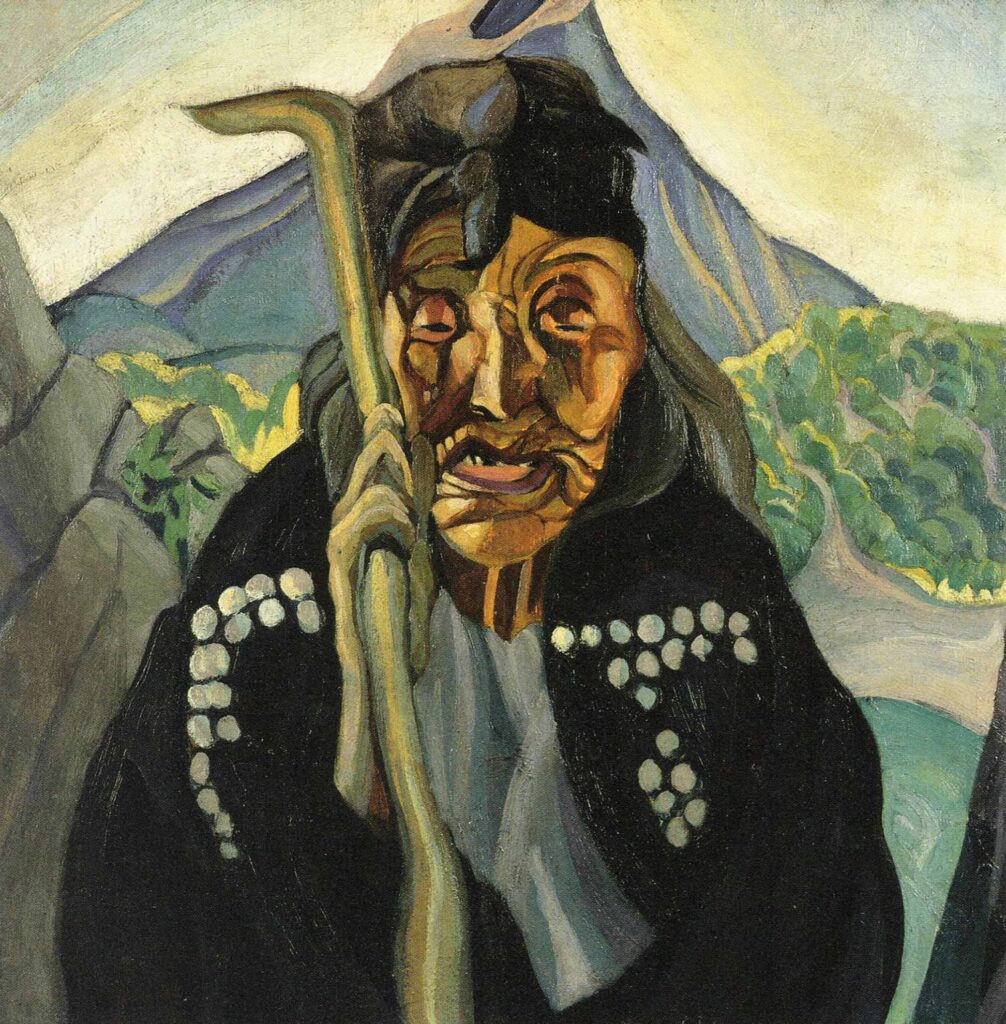
Pegi Nicol MacLeod, Bianinetnan, Aged Indian Woman of Hagwelget Canyon, c.1928, oil on board, 61 x 61 cm, private collection, Calgary.
Stylistically, the Skeena paintings mark a shift in MacLeod’s development. In Bianinetnan, she sets the face of an older Gitxsan woman against a mountain backdrop, the deep furrows of her features mirroring the rugged topography behind her, fusing portrait and place. This compositional analogy recalls conventions that equated Indigenous Peoples with nature, yet it also reveals MacLeod’s growing engagement with modernist tendencies. Her focus on women, use of foreshortening, and increasingly gestural brushwork signal her turn towards the expressive, subjective modernism that would characterize her later work.
The Role of the Artist in the 1930s and 1940s
For MacLeod and many of her peers, the artist in the 1930s and 1940s was not merely an observer but a participant—documenting, responding to, and helping to shape a society in flux. MacLeod’s writing, like her painting, embraced the idea that art could engage with the realities of social change and war without abandoning aesthetic concerns. Her attention to movement, gesture, and collectivity—all visible in her New York street scenes and wartime depictions of women—revealed her belief that the artist’s role was to make visible the textures and rhythms of shared experiences, and to respond to the political pressures shaping those experiences.
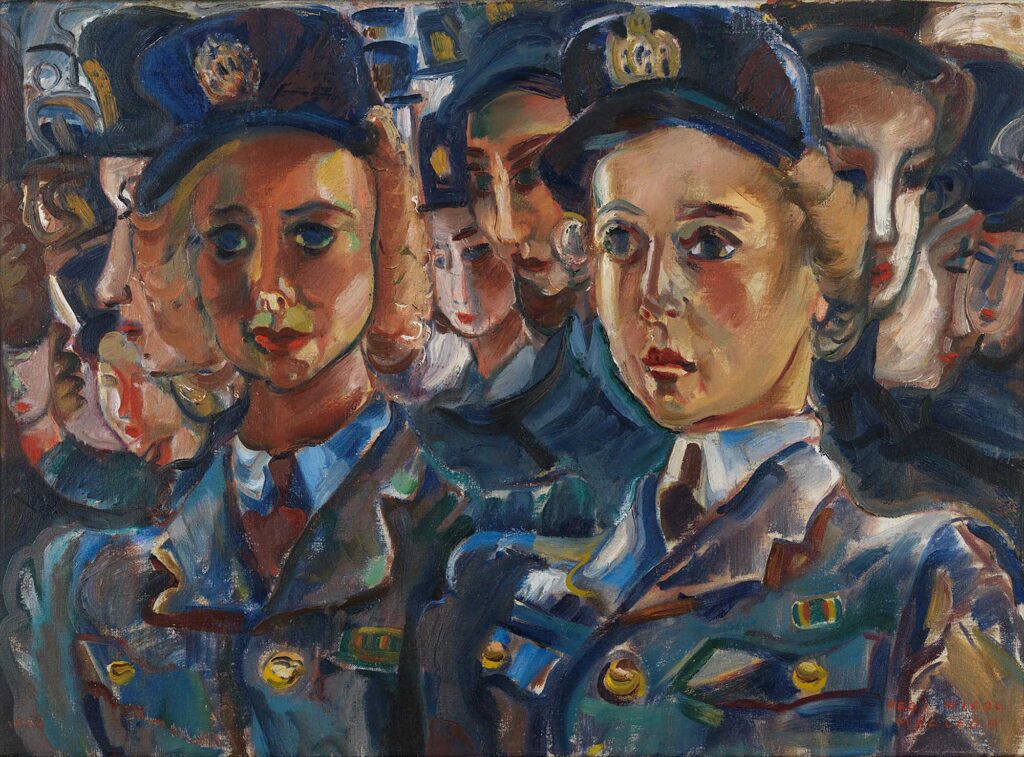
Pegi Nicol MacLeod, Untitled, 1944, oil on canvas, 57.4 x 78.2 cm, Canadian War Museum, Ottawa.
In the 1930s, a period of economic uncertainty and political change, MacLeod’s exposure to new ideas about social reform and artistic responsibility marked the beginning of her political awakening. She had encountered Marxist texts during her early years in Ottawa, and in Montreal, she found intellectual kinship among artists and writers affiliated with the League for Social Reconstruction, a group of progressive thinkers advocating for democratic socialism and cultural renewal. Their ideas fed into the 1932 formation of the Co-operative Commonwealth Federation, which would later evolve into the New Democratic Party. Through close friendships with Marian and F.R. Scott and her relationship with journalist King Gordon, MacLeod became part of a circle that viewed art as a catalyst for social change.
As art director of the Canadian Forum in 1935–36, MacLeod translated these ideals into visual form. Her illustrations and essays, especially the drawings “Five O’Clock” and “Merry Christmas,” both 1936, capture the everyday politics of Depression-era life. “Five O’Clock” shows urban workers at day’s end, while “Merry Christmas” disguises its anti-fascist message beneath imagery of seasonal cheer. Together, these works bring to light the social tensions of the 1930s, tracing the subtle negotiations between private experience and public ideology.
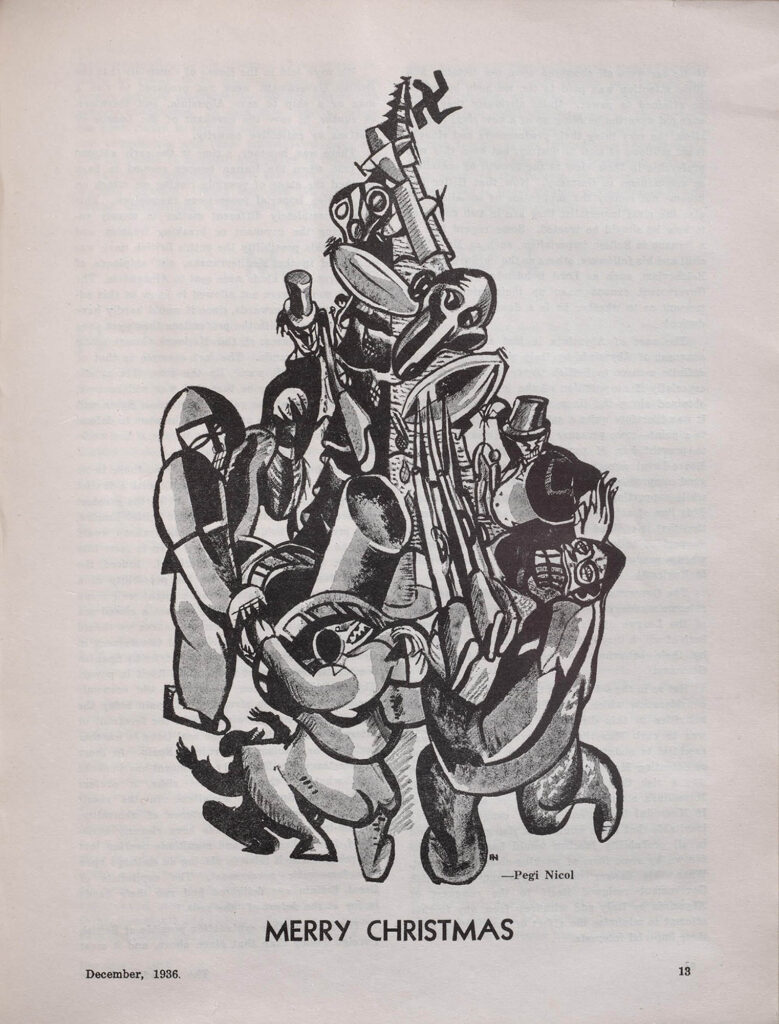
Pegi Nicol MacLeod, “Merry Christmas,” featured in Canadian Forum 16 (December 1936), page 13, Rare Books and Special Collections, McGill University Libraries, Montreal.
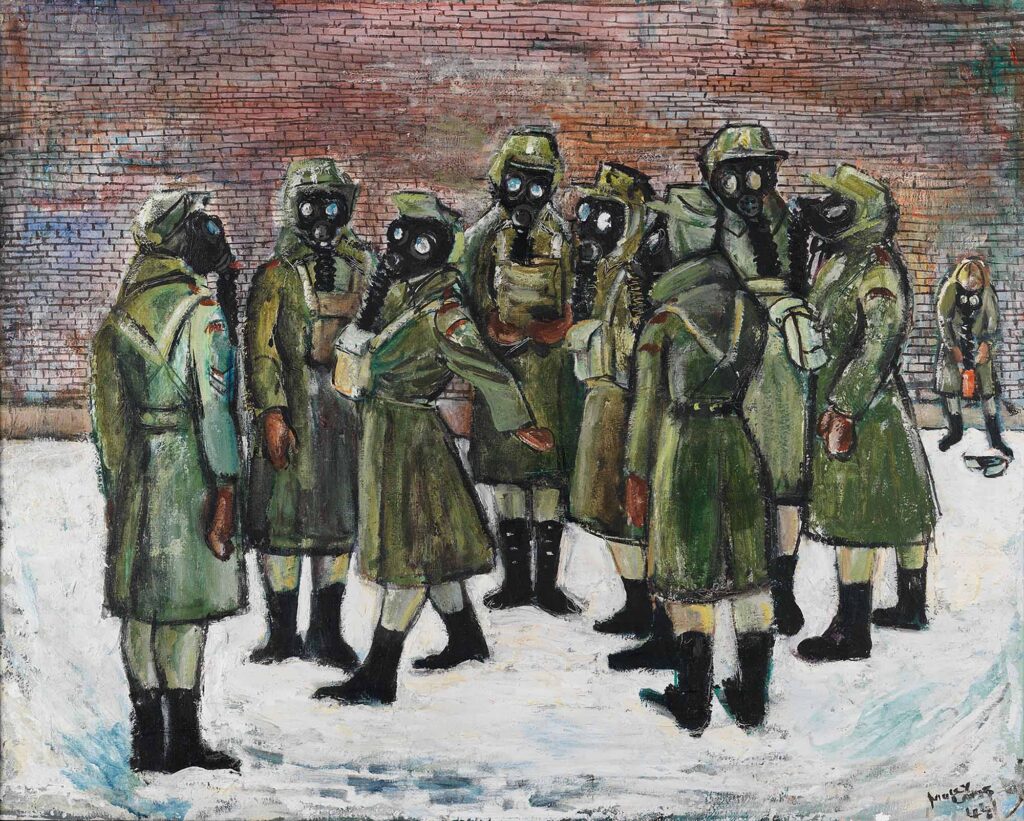
Molly Lamb Bobak, Gas Drill, 1944, oil on canvas, 68.8 x 86.8 cm, Canadian War Museum, Ottawa.
Notably, MacLeod’s “Merry Christmas” employs a visual language that anticipates later Canadian artists’ approaches to representing war. The image depicts groups of human figures in a distorted, Christmas tree–like formation—wearing gas masks or bearing Picasso-influenced faces, others fused with machine guns—transforming fascist collectivity into something monstrous and alienating. Instead of depicting disciplined unity, MacLeod presents mass formation as unstable, dehumanizing, and grotesque. Read alongside Molly Lamb Bobak’s Gas Drill, 1944, where gas masks similarly erase individuality, MacLeod’s illustration anticipates a shared visual strategy in which anonymity and distortion convey conformity and the psychological costs of wartime mobilization.
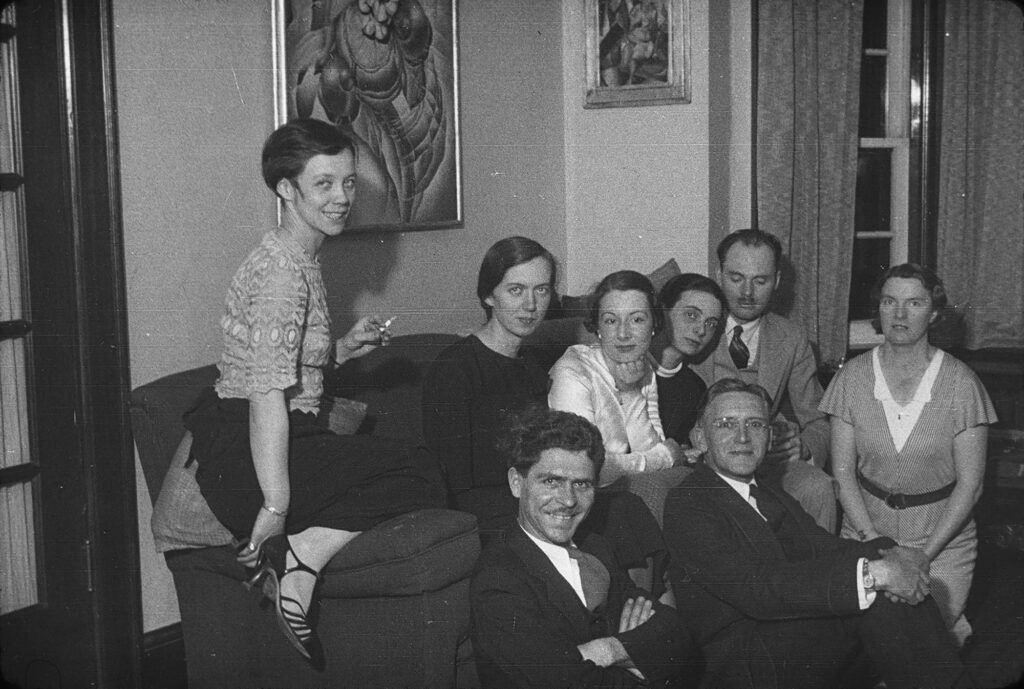
Party for Pegi Nicol MacLeod and Marian Dale Scott at Bertram Brooker’s house, Toronto, 1933, photograph by Charles Comfort, Library and Archives Canada, Ottawa.
MacLeod’s socially engaged perspective aligned with that of artists like Paraskeva Clark (1898–1986), Louis Muhlstock (1904–2001), and Bertram Brooker (1888–1955), who also sought to move beyond landscape and towards the representation of human experience. As Brooker observed in 1930, Canadian art was finally beginning to “bear a closer relationship to the modern movement in other countries.”
This shift also reshaped institutions: MacLeod exhibited with artist-led cooperatives like the Picture Loan Society in Toronto and the Atelier in Montreal, which fostered experimentation and offered access to art outside of official venues. These spaces emerged in response to a conservative-minded National Gallery of Canada, which had acquired only one work by a younger artist between 1932 and 1936. They reflected a growing insistence that cultural production was a civic responsibility—a conviction that culminated in the groundbreaking 1941 Conference of Canadian Artists in Kingston, where MacLeod joined others in calling for stronger cultural infrastructure and direct government support for artists. The conference also affirmed the artist’s civic responsibility during times of crisis and war.
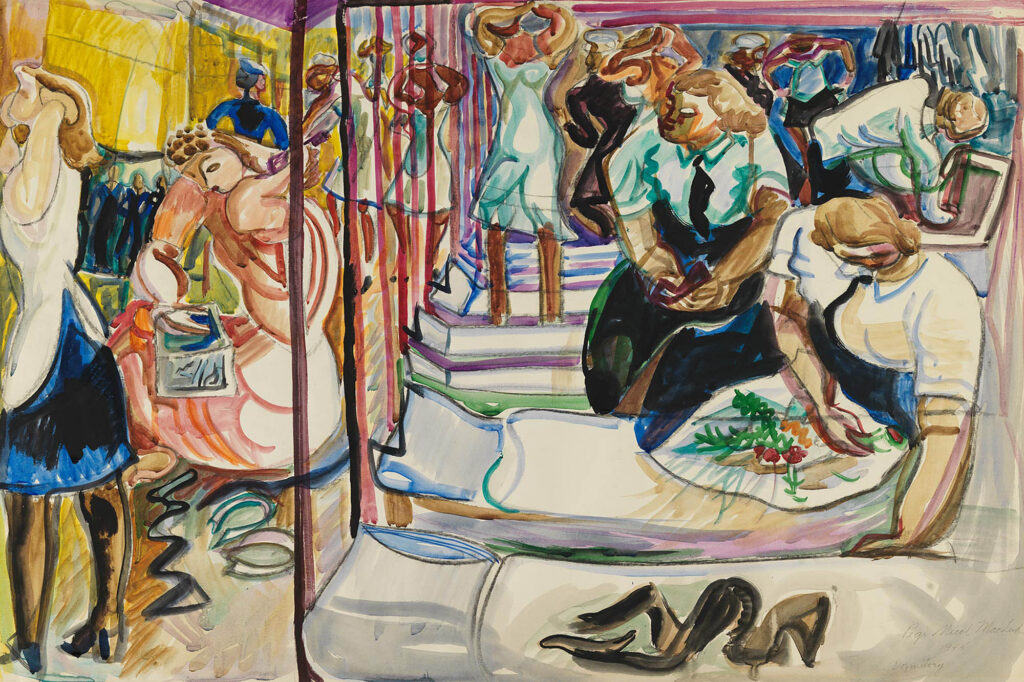
Pegi Nicol MacLeod, Dormitory, 1945, watercolour on paper, 60.8 x 91.3 cm, Canadian War Museum, Ottawa.
MacLeod’s later wartime work extended these commitments. In an essay for Canadian Art on painting the Canadian Women’s Army Corps, she described her subjects in vivid terms as ordinary women whose organized labour and daily routines captured the spirit of national resilience. Through paintings like CWAC Beauty Parlour #1, 1944, and Dormitory, 1945, MacLeod confirmed her belief that the artist’s role was not to broadcast ideology but to make visible the lived realities of the time.
Self-Portraiture and the Nude
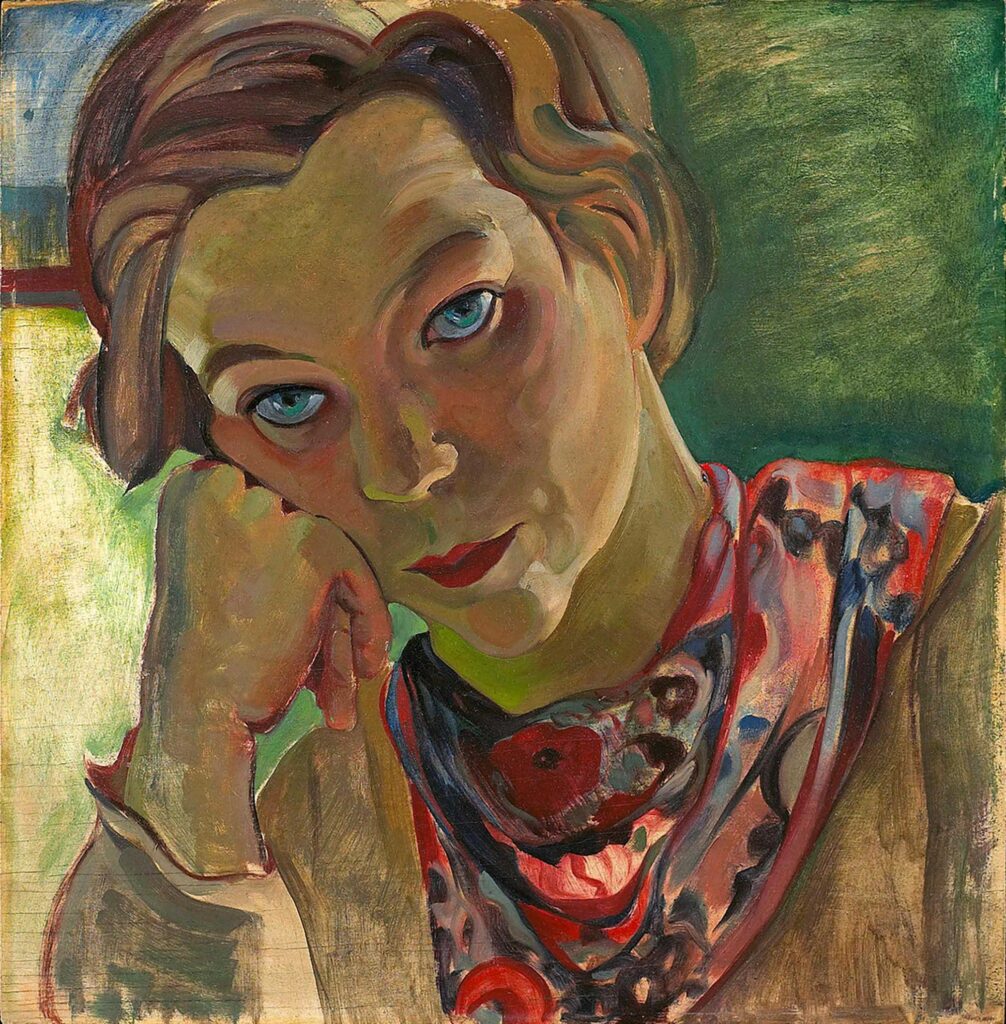
Pegi Nicol MacLeod, Self-Portrait, c.1935, oil on plywood, 40.3 x 40.2 cm, Art Gallery of Ontario, Toronto.
Through self-portraiture and the nude, Pegi Nicol MacLeod explored questions of artistic identity via modernist experimentation. Using her own body as both subject and instrument, she merged these two genres to challenge the visual conventions that had historically reduced women into objects. Her gestural brushwork, compressed spaces, and expressive distortions transform her body into a site of inquiry—at once vulnerable and defiant, unstable and capable of agency.
MacLeod began to experiment with self-portraiture while living in Ottawa in the mid-1920s. Early works such as Self-Portrait, c.1928, reveal her awareness of the self as something both constructed and contingent. In this painting, which she later gave to Richard Finnie (1906–1987), MacLeod uses uneven, gestural brush strokes to depict herself with an intense, almost confrontational gaze. The surface is loosely worked, with sections of the wooden board still visible through the paint, creating the impression that the figure is partially dissolving into the background. This visual instability suggests a fragmented self and draws attention to the very process of representation.
Throughout the 1920s and 1930s, MacLeod used self-portraiture to engage with broader questions of gender, artistic identity, and the viewer’s gaze. By presenting herself in various roles and contexts—mother, artist, observer—she resists reductive categories, positioning her work within a lineage of feminist artistic inquiry that challenges the politics of representation. Works like Costume for a Cold Studio, c.1930, and Self-Portrait with Jane, c.1939, exemplify this reflexive quality.
In Costume for a Cold Studio, a work MacLeod painted in her parents’ Ottawa attic, she portrays herself before a mirror, sketchbook resting on her torso, her expression direct and unflinching. The distorted perspective and thick, tactile brushwork anticipate the near abstraction of her later work. Nearly a decade later, in Self-Portrait with Jane, she depicts herself with her young daughter, both nude, their closeness rendered through overlapping contours rather than idealized form.
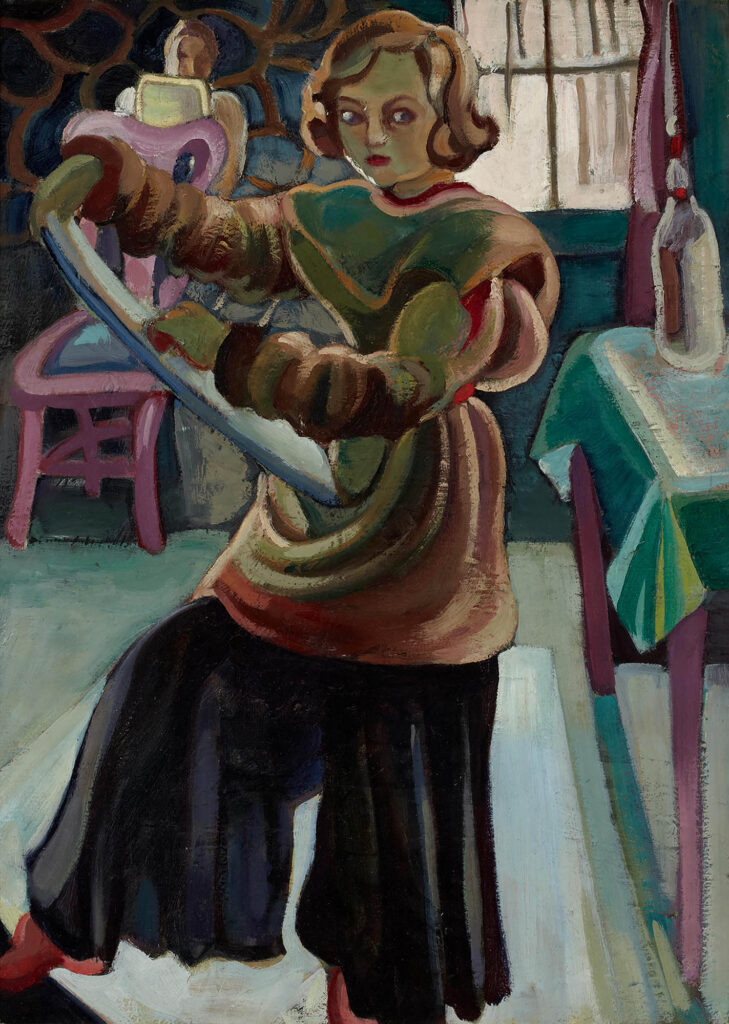
Pegi Nicol MacLeod, Costume for a Cold Studio (Self-Portrait), c.1930, oil on canvas, 53.5 x 38.3 cm, Robert McLaughlin Gallery, Oshawa.
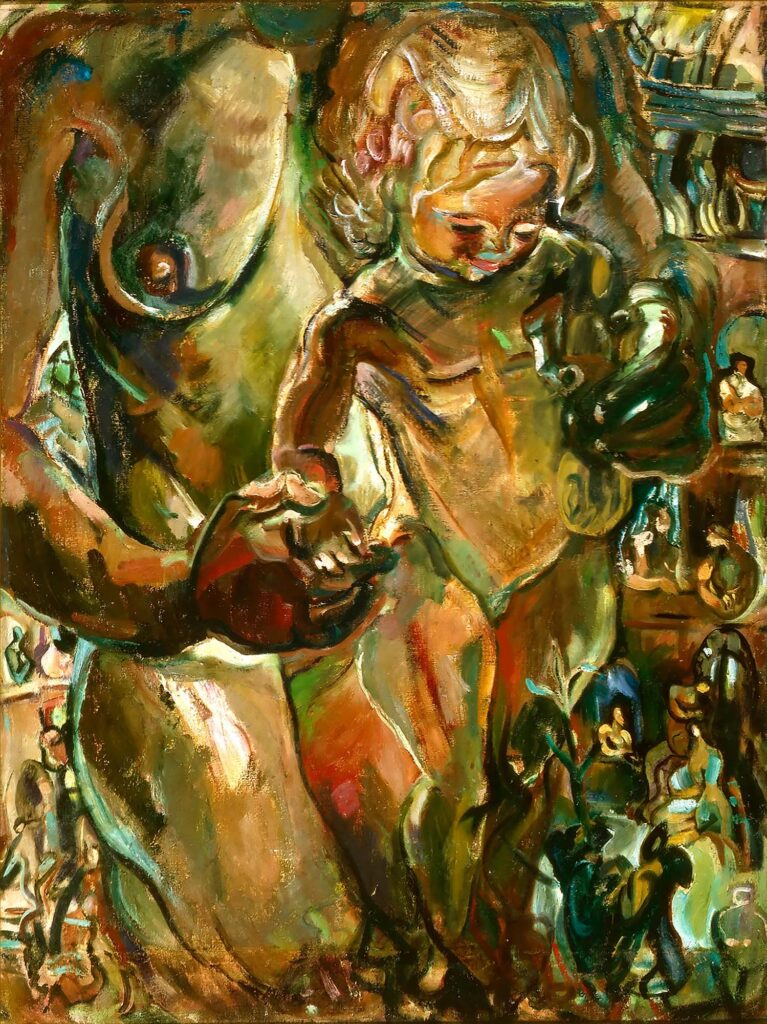
Pegi Nicol MacLeod, Self-Portrait with Jane, c.1939, oil on canvas, 84.8 × 69.5 cm, Winnipeg Art Gallery.
Self-portraiture has long been an important way for artists to explore identity, authorship, and the act of creation itself. MacLeod’s fascination with the female nude extended naturally from her portraiture practice, and her approach to the genre reflects a deep engagement with Surrealist aesthetics and ideas about the self. Graham McInnes described her paintings as marked by a “turbulent waywardness” and a “violent frenzy [of] movement,” qualities that enliven works like A Descent of Lilies, 1935, and Torso and Plants, c.1935. These paintings reject the polished idealism of the academic tradition in favour of rough surfaces, ambiguous space, and a raw corporeality.
This engagement with embodiment connects MacLeod to broader modernist and feminist currents. Her approach is similar to that of early twentieth-century French painter Suzanne Valadon (1865–1938), whose nudes—also characterized by dark outlines, compressed spaces, and frank self-observation—transformed a genre long dominated by male artists. Yet MacLeod’s position within Canadian art makes her innovation distinct.
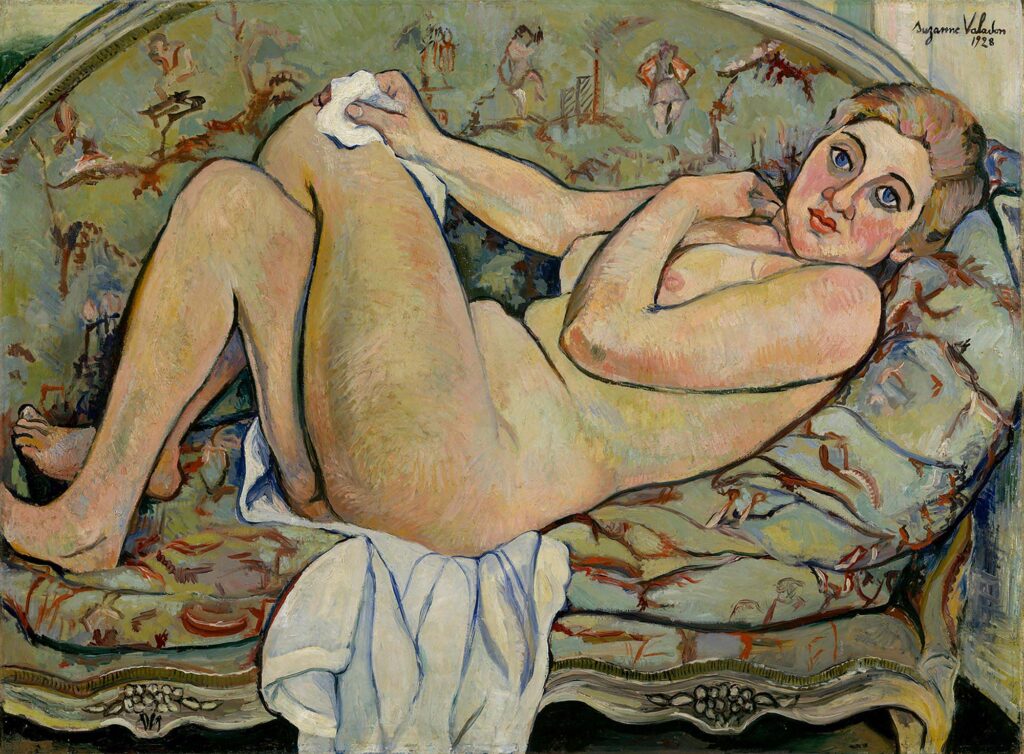
Suzanne Valadon, Reclining Nude, 1928, oil on canvas (lined), 60 x 80.5 cm, Metropolitan Museum of Art, New York.
While contemporaries such as Prudence Heward (1896–1947), Lilias Torrance Newton (1896–1980), and Edwin Holgate (1892–1977) also reimagined the nude figure, MacLeod’s treatment of her own body stands apart for its experimental and self-reflexive approach. There are clear resonances with Heward in particular. Writing about The Bather, 1930, curator Sarah Milroy observes that Heward’s portraits of defiant female sitters are about “discomfort, not ease,” and stage a negotiation of power between sitter and artist—a dynamic echoed in MacLeod’s own self-representations.
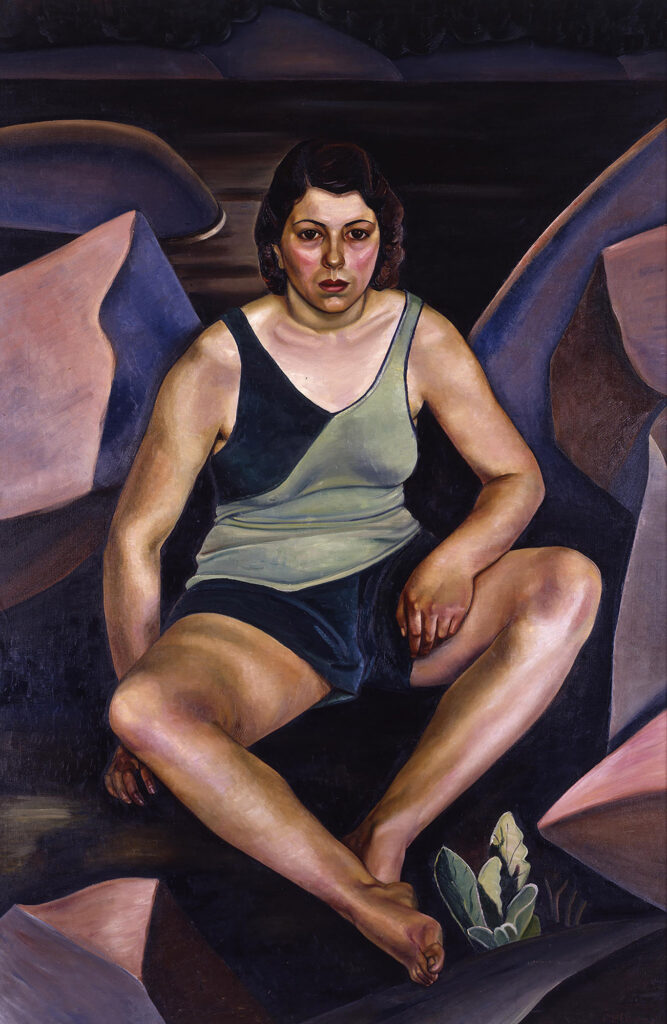
Prudence Heward, The Bather, 1930, oil on canvas, 162.1 x 106.3 cm, Art Windsor-Essex.
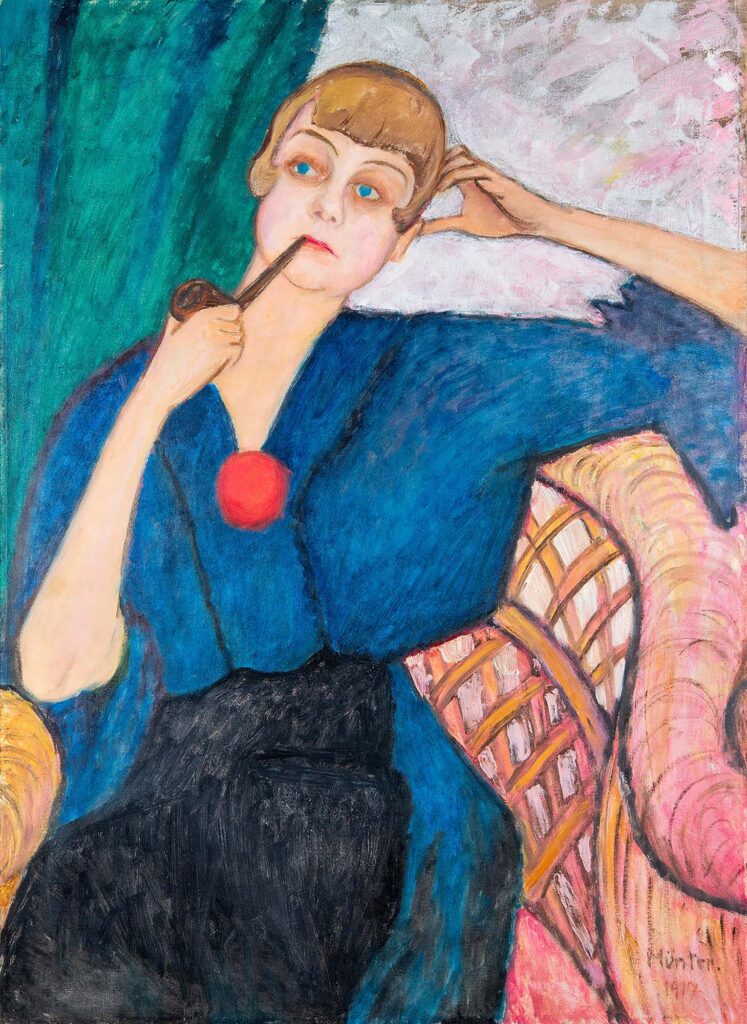
Gabriele Münter, Portrait of Anna Roslund, 1917, oil on canvas, 94.5 × 68.5 cm, Leicester Museums and Galleries.
Like Heward’s, MacLeod’s paintings often defied easy categorization and resisted the pressures to conform to prevailing market expectations. But through the interplay of subject and object, she went further, subverting the conventions that rendered women visible only through the eyes of others. Her nude self-portraits deny the viewer a stable or eroticized point of entry. Instead, they invite us to witness the artist’s encounter with her own image, a process both analytic and embodied. This radical self-regard anticipated 1970s feminist critiques of the male gaze.
Expressionist precedents also informed MacLeod’s approach. Like artists such as Oskar Kokoschka (1886–1980), Ernst Ludwig Kirchner (1880–1938), and Gabriele Münter (1877–1962), she employed distortion and intensity to convey psychological depth. Yet where Expressionist self-portraits often perform identity through theatrical guises, MacLeod’s are quieter, more introspective. Her fragmented bodies and unstable compositions suggest less a performance than a meditation on the difficulty of knowing oneself at all. As her friend F.R. Scott observed, she seemed to “enter a room like a self-portrait.”
MacLeod’s sustained attention to the figure situates her within a socially conscious, humanist strain of Canadian modernism. Though she painted landscapes and urban scenes, her enduring focus remained the human form: children playing, women working during wartime, figures in motion, and crucially, herself. In using her own body as a space of experimentation, MacLeod forged a visual language that was both deeply personal and profoundly modern.
Motherhood and Modernism
Like many of her peers, MacLeod struggled to balance the dual burden of artistic ambition and domestic obligation. In a letter to fellow artist Madge Smith (1898–1974), she confessed, “I am trying hard in between house cleaning to finish up a lot of my paintings.” Her correspondence reveals the practical and emotional challenges women artists faced in reconciling domestic responsibilities with their desire to pursue serious creative work. As art critic Sarah Milroy has noted, these “pressures and distractions left the output of many women artists patchy and inconsistent, with no steady through-line of artistic development.”
In a letter to painter Jack Humphrey (1901–1967) in 1941, MacLeod wrote with weary candour: “I’m ‘hors concours’ from the point of having a husband to support me. I make the best of it by painting all I can just as if I were earning my way. In fact, I have assisted my husband in his support of me and child. Now if I hadn’t a husband I would take a job. If it weren’t an art job, it would be one of some kind. So you can gather, all my art life is a side issue from housework, dishes, laundry, shopping, and nursery.... I’ve worked slavishly all my life and if I have the pleasure of being an artist, I am satisfied.”
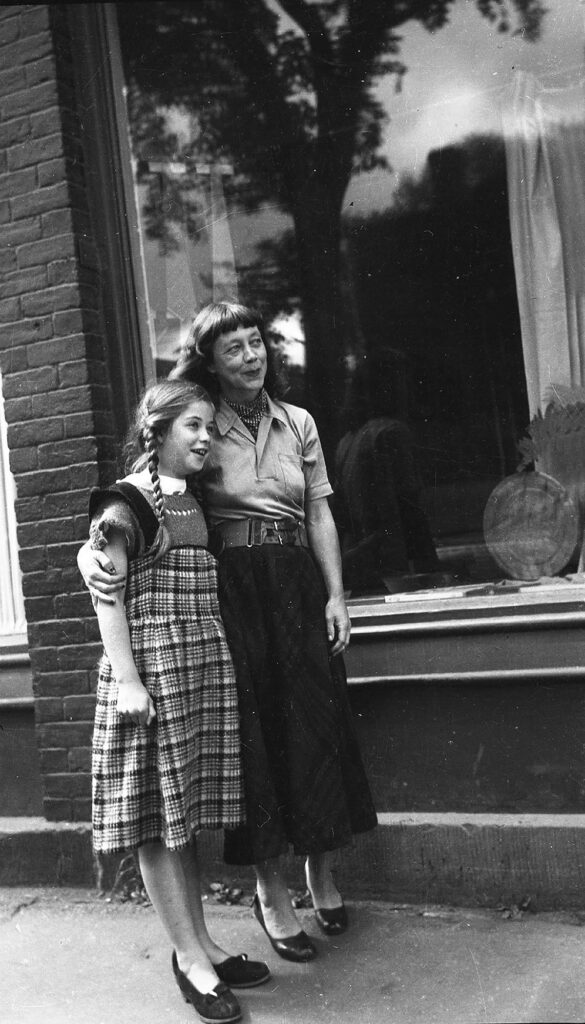
Pegi and Jane MacLeod outside Madge Smith’s shop posing on downtown street with daughter, Jane, n.d., photograph by Madge Smith, Provincial Archives of New Brunswick, Fredericton.
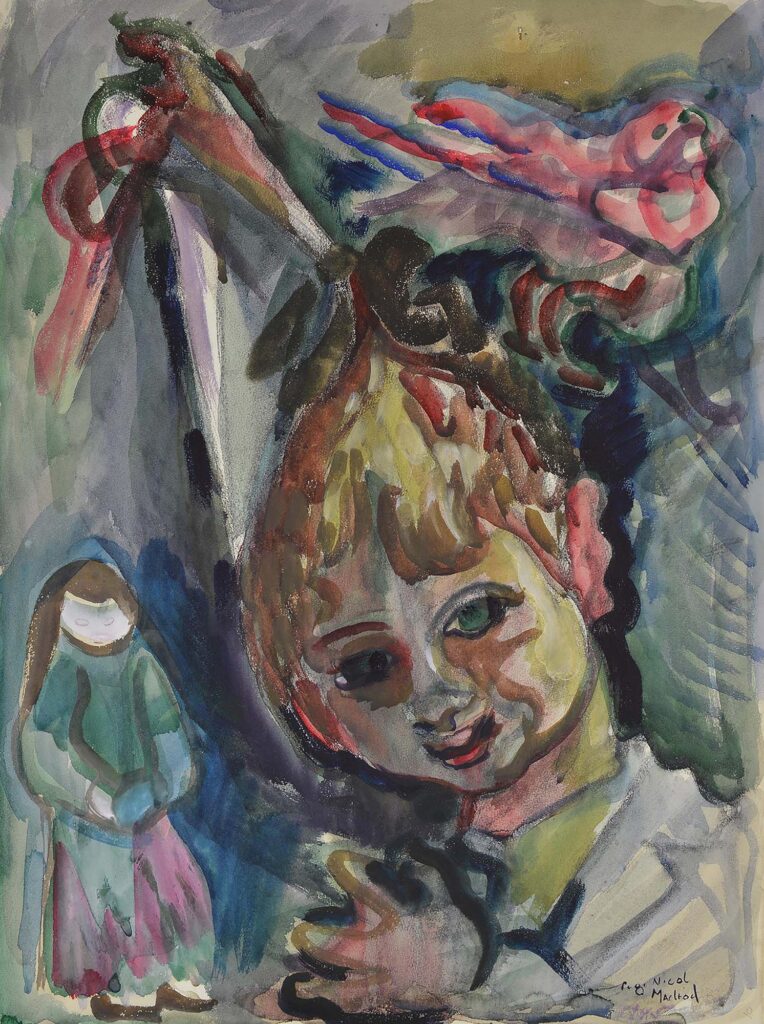
Pegi Nicol MacLeod, Jane at a Party, 1945, watercolour and gouache, 57.2 x 42.5 cm, Art Gallery of Greater Victoria.
For MacLeod, the demands of motherhood were not only a constraint but also a creative catalyst. Domestic life shaped both her working methods and her subject matter. Creativity depends on confidence and sustained focus, both of which were often disrupted for women artists, but MacLeod’s interrupted practice gave rise to an aesthetic of immediacy. The trials of balancing home life and a professional career were also felt acutely by her contemporary Paraskeva Clark, who lamented: “There is just cooking, cooking, cooking. Loblaws, Dominion; Dominion, Loblaws.”
While her Canadian Women’s Army Corps commission brought purpose and renewed visibility in Canada, life in New York remained isolating. With little support from and limited access to the city’s artistic networks, MacLeod juggled the competing demands of childcare, housework, and her studio practice. The daily realities of cooking, cleaning, and caring for Jane left her few opportunities to meet curators or circulate her work. The tensions of this period register in the Manhattan Cycle. These paintings convey her deep affection for the city’s crowded vitality, but they also hint at a growing claustrophobia—a sense of being hemmed in as much by domestic obligation as by the tight architecture of East 88th Street.
Pegi Nicol Macleod, New York Tenement, n.d., oil on canvas, 53.3 x 48.3 cm, private collection.
MacLeod often felt torn between her responsibilities and her ambitions, and she expressed frustration at her inability to sustain focus. As she wrote to her friend Marian Dale Scott (1906–1993) in 1937: “How did you ever do it? Be a bride, mother and paint? You can see by the question that I have found out the truth. There isn’t time to live.” Though Norman was generally supportive and Jane was bright and independent, the pressures of poverty and the strain of their living conditions shaped her working rhythm and the subjects she chose.
While many women artists confronted gender as a lived structure that conditioned their artistic output, careers, and public reception, each responded differently in subject matter and style. MacLeod did not identify as a feminist in the political sense—she was situated between the suffragist movement and second-wave feminism—yet she was a prescient figure whose work anticipated many of the concerns that would later underpin feminist art history. While she navigated the constraints of the Canadian art world in the early twentieth century, MacLeod carved out a space for herself as a professional painter, and her life and work reveal the subtle pressures and gendered dynamics that shaped women’s artistic practices.
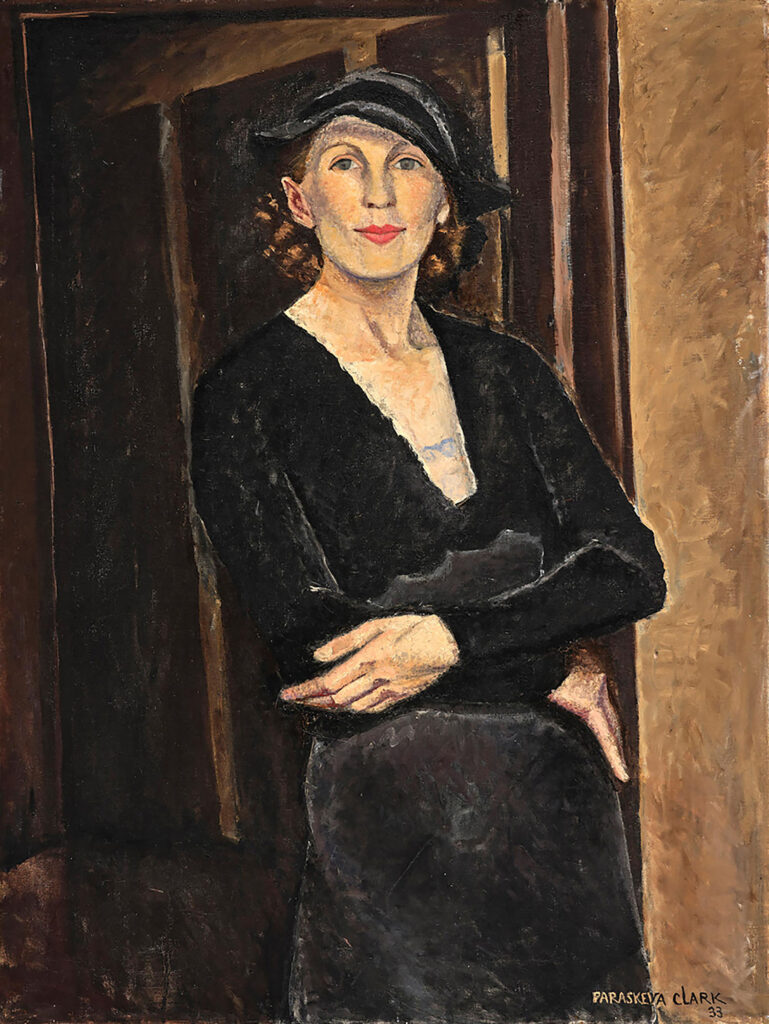
Paraskeva Clark, Myself, 1933, oil on canvas, 101.6 x 76.7 cm, National Gallery of Canada, Ottawa.
Her career must be understood alongside those of contemporaries like Prudence Heward and Paraskeva Clark—women who similarly resisted the limits imposed by their gender and developed strikingly modern approaches to representation. While art institutions had become more welcoming to women by the 1930s, the professionalized art field in Canada was only partially inclusive in the first half of the twentieth century. Institutions may have adopted a discourse of gender neutrality around aesthetic judgment, but the realities of exclusion, market access, and domestic expectation told a different story.
The experiences of MacLeod, Heward, and Clark (among many others) demonstrate how women artists were often compelled to adopt modes of working that did not follow a straight developmental arc. Interruptions, gaps, and changes in style were often symptomatic of broader structural forces. As Sarah Milroy has observed, to understand these women’s careers, scholars must attend to both the “silent spaces” within the artistic record and the “underground rivers of connection, solidarity, and critique” that allowed them to persist despite these constraints.
In MacLeod’s case, these structural challenges were compounded by the gendered reception of her work. Critics often described her paintings as “rushed,” “incomplete,” or “unfinished”—terms that subtly overlooked the deliberateness of her technique. While modernist aesthetics frequently embraced spontaneity, gesture, and unresolved form, MacLeod’s rapid brushwork was interpreted as a lack of control. These critiques revealed broader assumptions that associated female creativity with amateurism or emotional excess, even when similar qualities in male artists were celebrated as evidence of expressive freedom. Thus MacLeod’s aesthetic—rooted in immediacy, flux, and experimentation—was simultaneously modern and marginalized.
Her scenes of children, interiors, and everyday labour made the domestic visible as a terrain of artistic inquiry. In this sense, her work intersects with feminist concerns about the value of women’s labour and the legitimacy of the personal as political. After her death, MacLeod—while not immediately forgotten—was, like many women, gradually written out of Canadian art history as modernist narratives were consolidated.
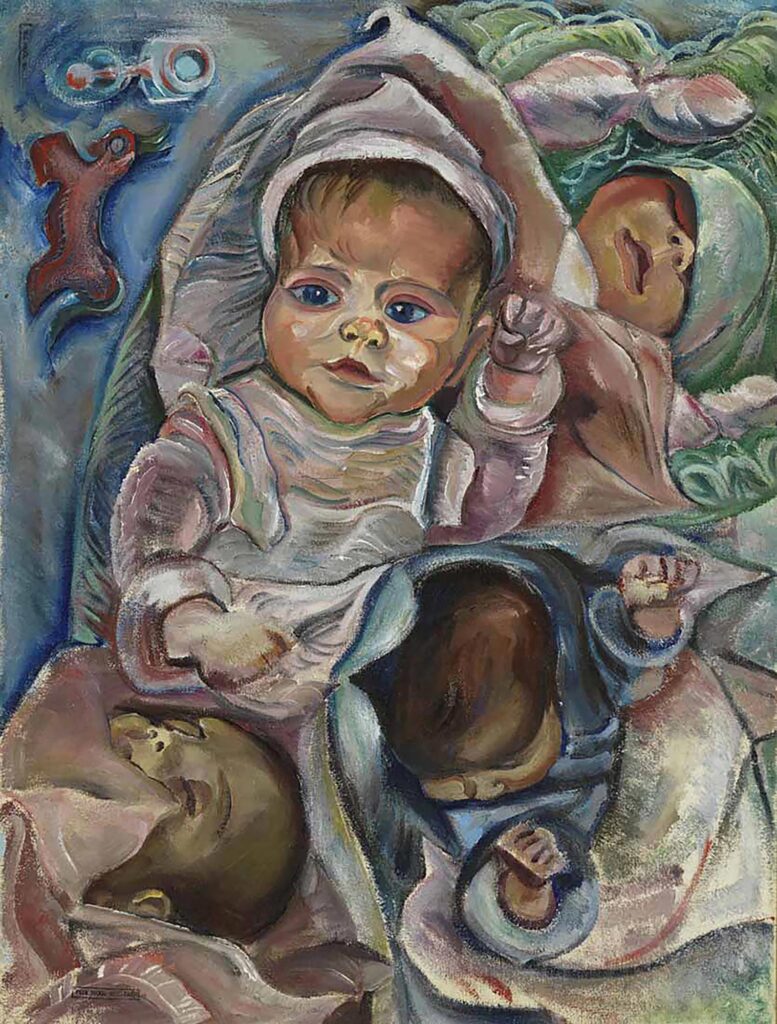
Pegi Nicol MacLeod, Babies, 1938, oil on canvas, 67.7 x 51.4 cm, private collection.
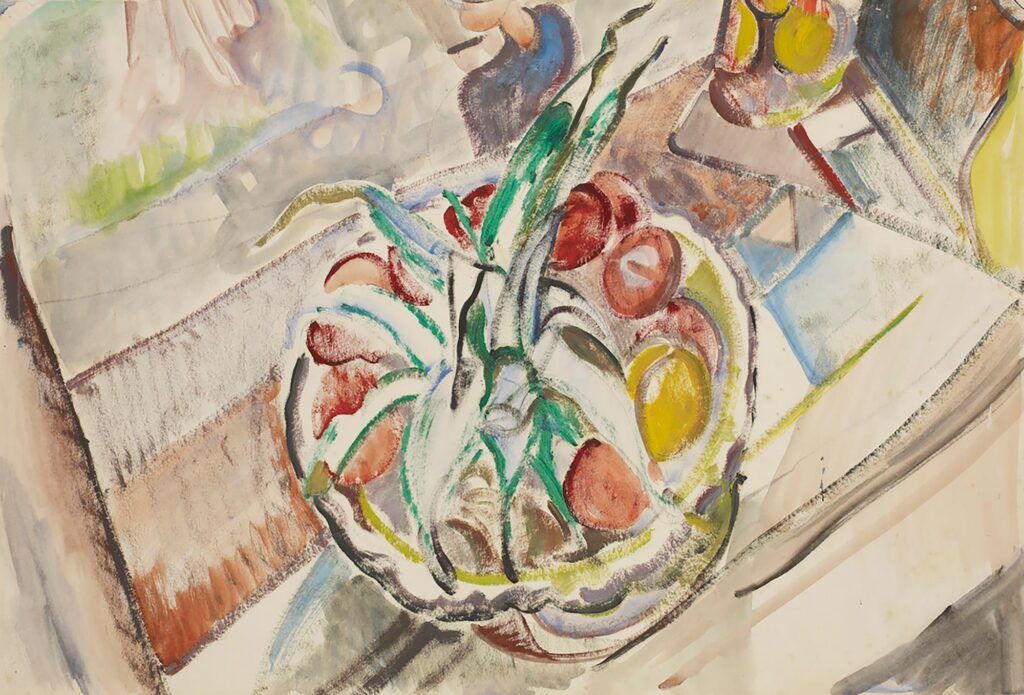
Pegi Nicol MacLeod, Basket Still Life, 1934–37, watercolour, coloured wax, and charcoal on paper, 37.9 × 55.7 cm, Art Gallery of Ontario, Toronto.
Her oeuvre, however, anticipated key feminist insights about subjectivity, embodiment, and authorship. In placing herself within her work as both subject and artist, MacLeod refused the disembodied neutrality often associated with modernist authorship. Instead, she presented female subjectivity as dynamic, fractured, and in process. Her art and her life speak to the negotiations women artists continually made between creative vision and gender norms, ambition and constraint, and to the radical potential of insisting on their own point of view.
Reappraisal and Legacy
Pegi Nicol MacLeod’s legacy lies in her innovative engagement with modern life and the human figure, and in the ways her work continues to reshape how women artists are remembered in Canada. Known for her restless energy, bold use of colour, and unconventional depictions of the self and the everyday, she held a distinct place within the country’s modernist developments. Her paintings of children, wartime workers, and urban crowds brought a dynamic immediacy to Canadian modernism, while her self-portraits and nudes expanded the possibilities for women artists.
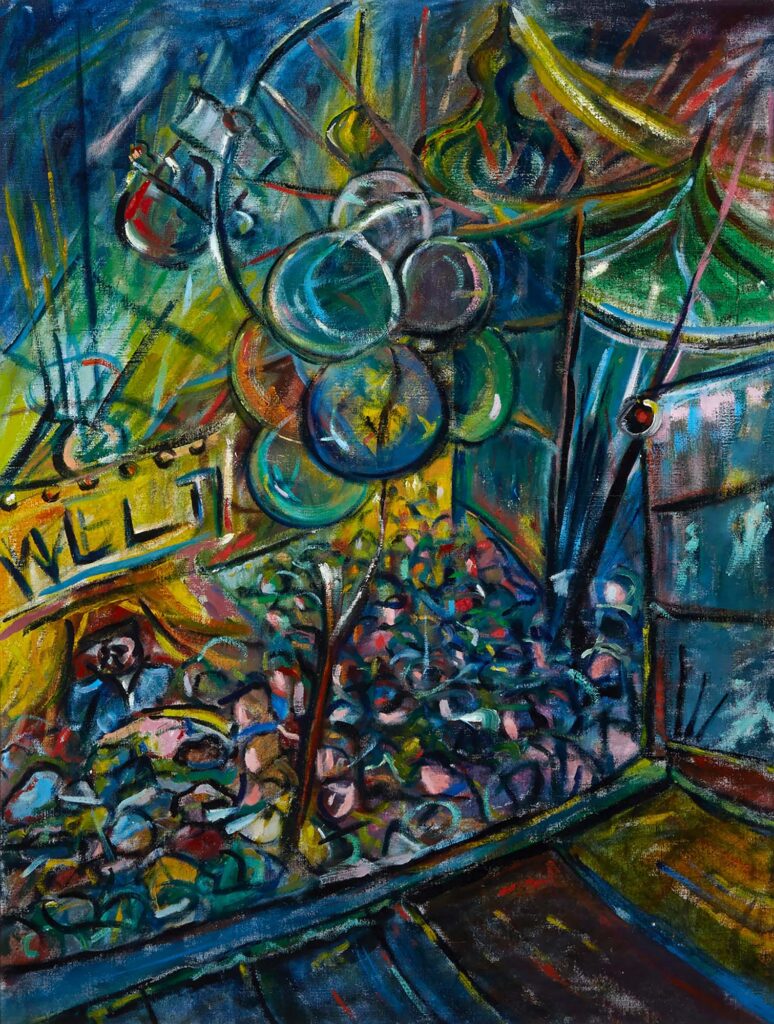
Pegi Nicol MacLeod, New York World’s Fair, c.1940, oil on canvas, 78.7 x 61 cm, private collection.
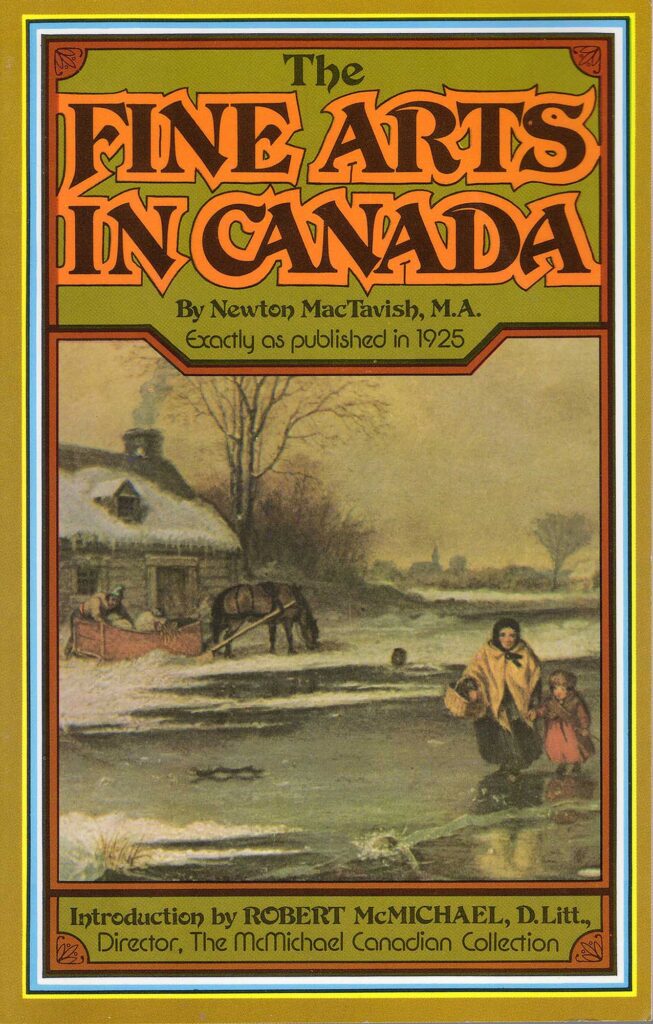
Cover of The Fine Arts in Canada, by Newton MacTavish (Coles Publishing Co., 1973).
In the mid-twentieth century, as influential figures like William Colgate, Russell J. Harper, and Dennis Reid published books and surveys on Canadian art history, women artists were largely written out of the national story. They were not, however, ignored in their own time. Art critic Newton MacTavish devoted a chapter to women artists in his 1925 book The Fine Arts in Canada, and MacLeod herself was widely exhibited and reviewed in prominent newspapers, including the Toronto Star and the Montreal Gazette. As Vincent Massey observed, “We Canadians would do well to recognize and appreciate genius more quickly when it appears among our own people. It is inevitable that final appraisal must always await the process of time, but failure to encourage in some measure an artist during his lifetime means a loss to us all.... To this splendid company belongs Pegi Nicol MacLeod. She was an artist of unique and vivid individuality who has left an indelible record in the history of Canadian art.” It was only after her death in 1949 that her presence in the historical record began to fade.
The feminist interventions of the 1970s and 1980s reshaped this narrative. Inspired by American art historian Linda Nochlin’s landmark essay “Why Have There Been No Great Women Artists?” scholars and curators began to re-examine the structural barriers that had excluded women from full participation in the art world’s institutions and histories. Exhibitions such as From Women’s Eyes, 1975, and Joan Murray’s Daffodils in Winter, 1984, as well as Laura Brandon’s research on MacLeod (including her 1992 master’s thesis and a 2005 biography), were instrumental in reintroducing the artist’s work to scholars and the public.
More recently, exhibitions like The Artist Herself: Self-Portraits by Canadian Historical Women Artists, 2015–16, and Uninvited: Canadian Women Artists in the Modern Moment, 2021, have positioned MacLeod alongside her peers as a vital artistic voice within twentieth-century modernism.
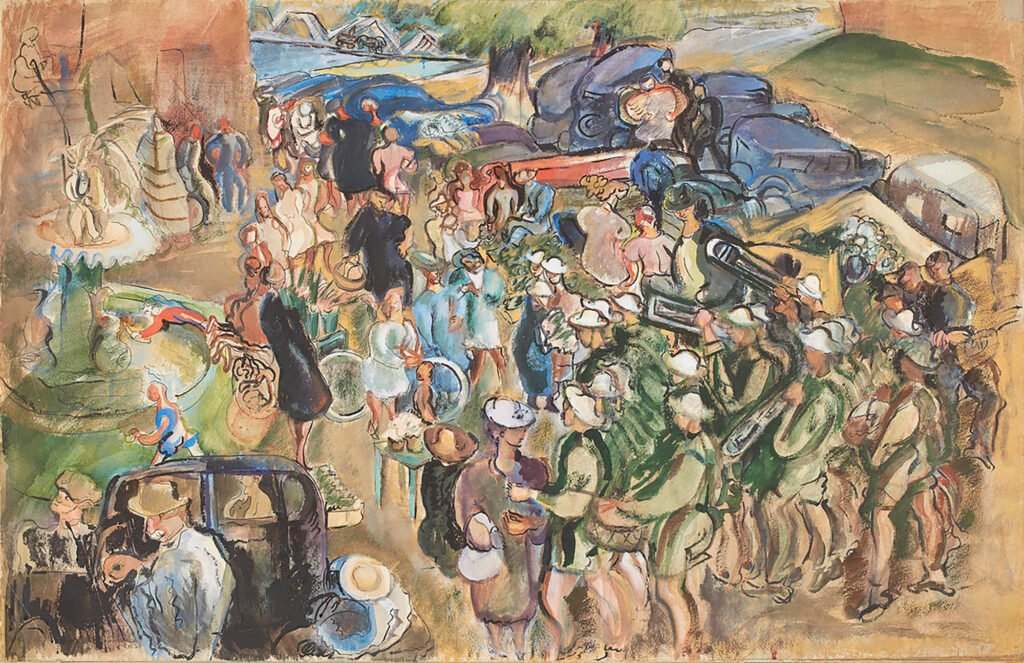
Pegi Nicol MacLeod, Square, Fredericton, c.1943, watercolour, opaque watercolour, black ink, and graphite on paper mounted on paper board, 64.6 x 99.6 cm, Art Gallery of Ontario, Toronto.